IIT(BHU)–IIITH at CoNLL–SIGMORPHON 2018 Shared Task on
Universal Morphological Reinflection
Abhishek Sharma∗
IIT (BHU), Varanasi Language Technologies Research CenterGanesh Katrapati IIIT Hyderabad
Dipti Misra Sharma
Language Technologies Research Center IIIT Hyderabad
Abstract
This paper describes the systems submit-ted by IIT (BHU), Varanasi/IIIT Hyderabad (IITBHU–IIITH) for Task 1 of CoNLL– SIGMORPHON 2018 Shared Task on Uni-versal Morphological Reinflection (Cotterell et al., 2018). The task is to generate the in-flected form given a lemma and set of morpho-logical features. The systems are evaluated on over 100 distinct languages and three different resource settings (low, medium and high). We formulate the task as a sequence to sequence learning problem. As most of the characters in inflected form are copied from the lemma, we use Pointer-Generator Network (See et al., 2017) which makes it easier for the system to copy characters from the lemma. Pointer-Generator Network also helps in dealing with out-of-vocabulary characters during inference. Our best performing system stood 4th among 28 systems, 3rd among 23 systems and 4th among 23 systems for the low, medium and high resource setting respectively.
1 Introduction
Morphological Inflection is the process of inflect-ing a lemma accordinflect-ing to a set of morphologi-cal features so that the lemma becomes in accor-dance with other words in the sentence. It is useful for alleviating data sparsity, especially in morpho-logically rich languages during Natural Language Generation. For example, Minkov et al. (2007) translate words from the source language to lem-mas in the target language and then use Morpho-logical Inflection as a post-processing step to make the words of the output sentence in agreement with each other. Not only their approach reduces the data sparsity by decreasing the number of candi-date words while translating, it also gives better results.
∗
This research was conducted during the authors intern-ship at IIIT Hyderabad.
CoNLL–SIGMORPHON 2018 Shared Task on Universal Morphological Reinflection consisted of two tasks. Participants could compete in either or both of the tasks. We participated in Task 1 only. The task was to build a system which could inflect a lemma given a set of morphological tags. The systems were evaluated on over 100 distinct lan-guages, out of which 10 were surprise languages. An example showing input and the expected out-put of the system is given below.
(touch,V;V.PTCP;PRS)→touching
To assess the system’s ability to generalize in dif-ferent resource settings, three varying amounts of labeled training data (low, medium, high) were given. The systems were evaluated separately for each language and the three data quantity con-ditions. Accuracy (the fraction of correctly pre-dicted forms) and the average Levenshtein dis-tance between the prediction and the truth across all predictions were used as metrics. An aggre-gated performance measure separate for each of the resource setting was obtained by averaging the results for individual languages.
Morphological Inflection is accomplished by different morphological processes such as prefixa-tion, infixaprefixa-tion, suffixation (attaching bound mor-pheme in front, within and at the end of stem re-spectively) and ablaut depending on the language. As the systems were evaluated on over 100 dis-tinct languages, we were motivated to use neural network based approaches because they do not re-quire any manual feature engineering. But neu-ral networks require a lot of training data to work. We try to address this challenge by designing neu-ral network architectures which work well even on the low resource setting of the task.
Our system is based on attention based encoder-decoder models (Bahdanau et al., 2014). The
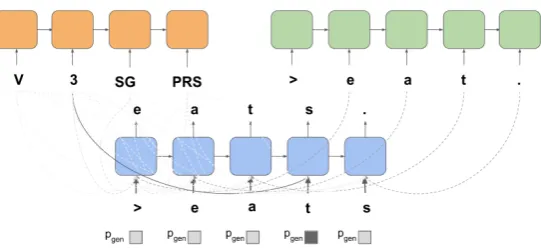
Figure 1: Neural network architecture for our system. The two encoders are shown at the top, while the decoder is shown at the bottom. At each time step, the decoder computes attention distribution over both the lemma and the tags separately. Attention mechanism is shown by the dotted lines (darker colour corresponds to more weight). A scalar - generation probabilitypgen ∈[0,1](shown as the square, the lighter the colour the less the value) is also
calculated at each time step, which corresponds to how likely a character will be generated from the vocabulary instead of a character being copied from the lemma.
lemma and the tags are encoded using two sepa-rate encoders. While decoding, the decoder reads relevant parts of the lemma and the tags using at-tention mechanism. As most of the characters in the inflected form are copied from the lemma, it is necessary to design a system with strong tendency to copy. We use Pointer-Generator Network (See et al., 2017) which facilitates copying of charac-ters of lemma and tackles the problem of out-of-vocabulary tokens during prediction. Compared to other similar performing systems, our system is trained end-to-end, doesn’t require data augmen-tation techniques and uses soft attention over hard monotonic attention which makes it more flexible. Our best performing system outperforms the baseline by 14.21%, 22.41% and 19.13% for the low, medium and high resource settings respec-tively. It stood 4th among 28 systems, 3rd among 23 systems and 4th among 23 systems for the low, medium and high data conditions respectively.
The remainder of this paper is organized as fol-lows. We present prior work on Morphological In-flection in Section 2. We describe our system in Section3. The results of the shared task are pre-sented in Section4. In Section5, we present ab-lation studies and discuss the contribution of the specific design decisions we made to the perfor-mance of our systems. We conclude the paper with Section6.
2 Background
Traditional approaches for morphological inflec-tion involve crafting hand-engineered rules. Al-though these rules offer high accuracy, they are
very expensive to create.
Machine learning based approaches treat mor-phological inflection as a string transduction task (Durrett and DeNero, 2013; Hulden et al., 2014; Ahlberg et al.,2015;Nicolai et al.,2015). These approaches extract rules automatically from the data, but they still require language specific fea-ture engineering.
Neural network based approaches successfully solve this problem. These approaches require no feature engineering and the same architecture works for different languages. Faruqui et al. (2016) were the first to formulate morphological inflection as neural sequence to sequence learn-ing problem (Cho et al., 2014; Sutskever et al., 2014;Bahdanau et al.,2014). Kann and Sch¨utze (2016) improved on their approach by using a sin-gle model instead of separate models for each mor-phological feature. They fed mormor-phological tags into the encoder along with the sequence of char-acters of lemma. They also used attention mecha-nism (Bahdanau et al.,2014). Aharoni and Gold-berg (2017) present an alternative to the soft at-tention in form of hard monotonic atat-tention which models the almost monotonic alignment between characters in lemma and the inflected form.
2017;Silfverberg et al., 2017;Zhou and Neubig, 2017;Nicolai et al.,2017).
3 System Description
In this section, we describe our system in de-tail. We report the neural network architecture, the training process, the hyperparameters and our sub-missions.
3.1 Neural network architecture
Our neural network architecture is based on Pointer-Generator Network (See et al.,2017) with some subtle differences.
Characters of the lemma ci along with the
ad-ditional start and stop characters are fed one by one into a bidirectional LSTM encoder producing a sequence of hidden stateshli. Similarly, using a
separate bidirectional LSTM encoder, the tagstgi are encoded and another sequence of hidden states htgi is obtained.
We use a unidirectional LSTM as the decoder. The decoder’s hidden statesi is initialised by
ap-plying an affine transformation on the concatena-tion of the last hidden states of the lemma and the tag encoders. As the input and output sequences have different semantics, this affine transforma-tion gives the model the ability to learn transfor-mation of semantics from input to output (Faruqui et al.,2016).
s0=Winitial[hlN;htgN] +b (1)
While decoding, at each time stept, the decoder computes an attention distribution over the lemma and the tag separately denoted asatl andattg (Bah-danau et al.,2014).
etli =vTtanh(Whlhli+Wslst−1+bl) (2)
ettgi =vT tanh(Whtghtgi +Wstgst−1+btg)
(3) atl =softmax(etl) (4) attg=softmax(ettg) (5)
The context vectorsh∗l andh∗tgare computed as the weighted sum over the encoder hidden states hli andhtgiwith the attention distribution massa
t l
andattgas weights.
h∗lt =X
i
atlihli (6)
h∗tgt =X
i
attgihtgi (7)
The combined context vector is obtained by sim-ply concatenating the lemma and the tag context vector.
h∗t = [h∗lt;h∗tg
t] (8)
The combined context vectorh∗t and the embed-ding of character predicted at the previous time step,yt−1(while training to speed up convergence
we use the ground truth labely∗t−1instead) is given as input to the decoder. At the first time step, start character is given as input in place ofyt−1.
st=f(st−1, h∗t, yt−1) (9)
wheref is a nonlinear function.
A probability distribution over the characters in the vocabulary is calculated which corresponds to how likely will a particular character be generated (if a character is generated at all).
Pvocab=softmax(V[st;h∗] +b) (10)
At each time step, a generation probability pgen ∈ [0,1]is calculated. The generation
prob-ability determines if the decoder will generate a character from the vocabulary or copy a character from the lemma.
pgen=σ(whh∗t +wsst+wyyt−1+b) (11)
Note that here pgen is calculated using yt−1
(the embedding of output produced at the previ-ous time step) instead of the decoder inputxtas in
See et al.(2017).
The probability of predicting a character c is computed as the sum of probability of generating cweighted by the generation probabilitypgenand
the total attention distribution overcweighted by the probability of copying it (1−pgen) .
P(c) =pgenPvocab(c)+(1−pgen) X
i:ci=c
atli (12)
The decoder keeps predicting characters until the stop character is predicted or a fixed number of time steps are reached.
3.2 Training
We use negative log likelihood to compute the loss. The loss for time stept, wherec∗tis the target character is given by,
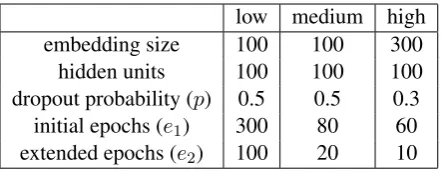
low medium high embedding size 100 100 300 hidden units 100 100 100 dropout probability (p) 0.5 0.5 0.3
initial epochs (e1) 300 80 60
extended epochs (e2) 100 20 10
Table 1: Hyperparameters for low, medium and high resource settings.
The loss for the overall sequence is,
loss= 1
T T X
t=0
losst (14)
We use Adam Optimiser (Kingma and Ba, 2014) with initial learning rate 0.001 and batch
size 32to train the neural network. To deal with
exploding gradient problem, we clip the norm computed over all the gradients together to3. We
apply dropout (Srivastava et al.,2014) with prob-abilitypover embeddings and the encoder hidden states.
We use early stopping to prevent overfitting. A portion of the development set is used as the val-idation set. After each epoch, performance on validation set is calculated. Initially the model is trained on e1 epochs. If the highest
perfor-mance on validation set is obtained withine2
re-cent epochs, the model is further trained for e2
epochs. This goes on until performance on vali-dation set stops improving.
Single layer LSTMs were used as encoders and decoders to reduce number of parameters. Opti-mal size of embeddings and the number of hidden units in LSTMs were determined based on the per-formance of the model on a subset of languages in development set.
The values for hyperparameters p, e1, e2,
em-bedding size and hidden units of LSTM are given in Table1.
We used PyTorch for implementing the net-work. The code for the system is available at
https://github.com/abhishek0318/ conll-sigmorphon-2018.
3.3 Submissions
We made a total of two submissions. For the first submission, we trained only one system for each language and data resource setting pair. We used ensembling technique for the second submission. We trained5,3and1system(s) for each language
System 1 System 2 Baseline low 49.79% 52.60% 38.20% medium 82.90% 84.19% 61.78% high 94.43% 94.43% 75.30%
Table 2: Average accuracy of the system on the test set over all the languages for low, medium and high resource settings respectively.
in low, medium and high data resource settings re-spectively. Their predictions were combined using hard voting.
4 Results
Average accuracy of the system over all the lan-guages in a data resource setting is presented in Table2.
Our best performing system outperforms the baseline by very large margins - 14.21%, 22.41% and 19.13% for the low, medium and high resource settings respectively.
We observe that using ensembling technique (in the second submission) gives a boost of few per-centage points in the accuracy over the first sub-mission, where ensembling is not used.
5 Ablation Studies
In this section, we investigate how difference sys-tem design choices influenced the performance of the system. As reasonable performances were ob-tained for medium and high resource settings in previous editions of the shared task, we focus our attention to the low resource setting and compare models on this setting.
5.1 Pointer Generator Network
We examine the performance gain obtained by using Pointer-Generator Network, the essence of our system. We compare the performance of a simple attention based neural encoder-decoder model with and without using ideas from Pointer-Generator Network.
Consider the architecture proposed byKann and Sch¨utze(2016) for the task of morphological in-flection. The architecture is based on simple atten-tion based encoder-decoder model. The source se-quencesi consists of the characters of the lemma
followed by the tags.
[image:4.595.72.294.62.148.2] [image:4.595.311.519.62.118.2]et al.,2017). The network uses the computed at-tention distribution to determine which character from the lemma it should copy. Because there is only a single encoder, the attention distribution is over both the lemma and the tags. The tags there-fore have some attention over them. To use Equa-tion 12, we must normalise the attention weights of the characters, so that we have a new attention distribution over the set of characters.
P(c) =pgenPvocab(c) + (1−pgen) P
i:si=ca
t i P
i:si∈Ca
t i
(15) We use modified form of Equation 12 as shown above to calculateP(c). HereCis the set of char-acters.
For the same hyperparameters, the architecture used in Kann and Sch¨utze (2016) gives 21.99%
average accuracy as compared to the architecture including ideas from Pointer-Generator Network, which gives 44.02% average accuracy tested on
development set over all the languages for low resource setting. Thus using Pointer Generator Network increases the performance of the system tremendously for low resource setting.
5.2 Separate Encoder for Tags
We investigate the benefit of using a separate en-coder for the tags, instead of encoding them using a same encoder as inKann and Sch¨utze(2016).
Consider the neural network architecture with two separate encoders for the lemma and the tags. At each timestep while decoding, attention distri-bution is computed over the lemma. The last hid-den state of the tag encoder is used as the represen-tation of the set of tags. It along with the context vector of the lemma is fed to the decoder at each time step. We compare the performance of this architecture, to the architecture described in Sec-tion5.1(which uses single encoder for the lemma and tags and Pointer-Generator Network). The ar-chitecture with a single encoder obtains 44.02%
average accuracy, while the one with two separate encoders achieves48.18%average accuracy tested
on the development set for low resource setting. A possible explanation for the difference in the performance is that the lemma and the tags are completely separate entities and a single encoder can’t encode them correctly. We were motivated to represent the tags using embeddings as embed-dings have more representational power compared to zeros and ones in case of one hot encoding. As
the number of tags vary for each example, using LSTM to encode them seemed apt. Note that the representation obtained using this approach is not order invariant. Using order invariant representa-tions (Vinyals et al.,2016;Zaheer et al.,2017) is left as future work.
5.3 Attention over Tags
We inspect whether using attention over the se-quence of tags as compared to using a fixed vec-tor representation gives better results. We consider the architecture introduced in Section5.2. Instead of using last hidden state of the encoder to rep-resent the tags, we use attention over tags too and compare the performance. Note this is same archi-tecture we described in3.1. Using attention over tags leads to average accuracy of49.08%as
com-pared to48.18% on the development set for low
resource setting.
This can explained as by using attention mech-anism, the model doesn’t need to compress the in-formation of all the tags into a single vector. It can attend to a specific tag based on the decoder state.
5.4 Hierarchical Attention
We investigate if using Hierarchical Attention (Li-bovick´y and Helcl,2017) instead of just concate-nating the two context vectors for lemma and the tags as done in Equation 8 proves advantageous. Libovick´y and Helcl (2017) proposed Hierarchi-cal Attention technique for combining the context vectors in case of multiple source sequences.
ah=σ(vtanh(whl∗h∗l +wh∗tgh
∗
tg+wsst+b))
(16) h∗t =ahh∗lt+ (1−ah)h
∗
tgt (17)
After computing the individual context vectors, a scalar ah ∈ [0,1]is calculated. This scalar
cor-responds to how the attention should be divided between the lemma and the tag. The combined context vector is obtained by taking the weighted average, as shown above.
Compared to the concatenating the context vec-tors (as done in our submission), using hierarchi-cal attention gives worse results (46.60%average
accuracy as compared to49.08%average accuracy
on development set for low resource setting). This is possibly because of the increase in number of parameters to learn and the additional non lineari-ties such as sigmoid andtanhwhich lead to
6 Conclusion
In this paper, we described IITBHU–IIITH sys-tem for Task 1 of CoNLL–SIGMORPHON 2018 Shared Task. Our system is one of the top per-forming systems in this edition of the shared task and beats the baseline by large margins. Even though our approach was completely based on neural networks, our system works very well for low resource setting.
We conclude that neural network architectures with explicit copying mechanism (like Pointer-Generator Network) perform well in Morpholog-ical Inflection task even on low resource setting.
References
Roee Aharoni and Yoav Goldberg. 2017. Morphologi-cal inflection generation with hard monotonic atten-tion. InProceedings of the 55th Annual Meeting of the Association for Computational Linguistics, ACL 2017, Vancouver, Canada, July 30 - August 4, Vol-ume 1: Long Papers, pages 2004–2015.
Malin Ahlberg, Markus Forsberg, and Mans Hulden. 2015. Paradigm classification in supervised learn-ing of morphology. InNAACL HLT 2015, The 2015 Conference of the North American Chapter of the Association for Computational Linguistics: Human Language Technologies, Denver, Colorado, USA, May 31 - June 5, 2015, pages 1024–1029.
Dzmitry Bahdanau, Kyunghyun Cho, and Yoshua Bengio. 2014. Neural machine translation by jointly learning to align and translate. CoRR, abs/1409.0473.
Toms Bergmanis, Katharina Kann, Hinrich Sch¨utze, and Sharon Goldwater. 2017. Training data aug-mentation for low-resource morphological inflec-tion. InProceedings of the CoNLL SIGMORPHON 2017 Shared Task: Universal Morphological Rein-flection, pages 31–39, Vancouver. Association for Computational Linguistics.
Kyunghyun Cho, Bart van Merrienboer, C¸aglar G¨ulc¸ehre, Dzmitry Bahdanau, Fethi Bougares, Hol-ger Schwenk, and Yoshua Bengio. 2014. Learning phrase representations using RNN encoder-decoder for statistical machine translation. InProceedings of the 2014 Conference on Empirical Methods in Nat-ural Language Processing, EMNLP 2014, October 25-29, 2014, Doha, Qatar, A meeting of SIGDAT, a Special Interest Group of the ACL, pages 1724– 1734.
Ryan Cotterell, Christo Kirov, John Sylak-Glassman, G´eraldine Walther, Ekaterina Vylomova, Arya D. McCarthy, Katharina Kann, Sebastian Mielke, Gar-rett Nicolai, Miikka Silfverberg, David Yarowsky,
Jason Eisner, and Mans Hulden. 2018. The CoNLL– SIGMORPHON 2018 shared task: Universal mor-phological reinflection. In Proceedings of the CoNLL–SIGMORPHON 2018 Shared Task: Univer-sal Morphological Reinflection, Brussels, Belgium. Association for Computational Linguistics.
Greg Durrett and John DeNero. 2013. Supervised learning of complete morphological paradigms. In
Human Language Technologies: Conference of the North American Chapter of the Association of Computational Linguistics, Proceedings, June 9-14, 2013, Westin Peachtree Plaza Hotel, Atlanta, Geor-gia, USA, pages 1185–1195.
Manaal Faruqui, Yulia Tsvetkov, Graham Neubig, and Chris Dyer. 2016. Morphological inflection gener-ation using character sequence to sequence learn-ing. InNAACL HLT 2016, The 2016 Conference of the North American Chapter of the Association for Computational Linguistics: Human Language Tech-nologies, San Diego California, USA, June 12-17, 2016, pages 634–643.
Mans Hulden, Markus Forsberg, and Malin Ahlberg. 2014. Semi-supervised learning of morphological paradigms and lexicons. InProceedings of the 14th Conference of the European Chapter of the Asso-ciation for Computational Linguistics, EACL 2014, April 26-30, 2014, Gothenburg, Sweden, pages 569– 578.
Katharina Kann and Hinrich Sch¨utze. 2016. MED: the LMU system for the SIGMORPHON 2016 shared task on morphological reinflection. InProceedings of the 14th SIGMORPHON Workshop on Computa-tional Research in Phonetics, Phonology, and Mor-phology, Berlin, Germany, August 11, 2016, pages 62–70.
Katharina Kann and Hinrich Sch¨utze. 2017. The lmu system for the conll-sigmorphon 2017 shared task on universal morphological reinflection. In
Proceedings of the CoNLL SIGMORPHON 2017 Shared Task: Universal Morphological Reinflection, pages 40–48, Vancouver. Association for Computa-tional Linguistics.
Diederik P. Kingma and Jimmy Ba. 2014. Adam: A method for stochastic optimization. CoRR, abs/1412.6980.
Jindrich Libovick´y and Jindrich Helcl. 2017. Attention strategies for multi-source sequence-to-sequence learning. InProceedings of the 55th Annual Meet-ing of the Association for Computational LMeet-inguis- Linguis-tics, ACL 2017, Vancouver, Canada, July 30 - August 4, Volume 2: Short Papers, pages 196–202.
Peter Makarov, Tatiana Ruzsics, and Simon Clematide. 2017. Align and copy: UZH at SIGMORPHON 2017 shared task for morphological reinflection. In
Einat Minkov, Kristina Toutanova, and Hisami Suzuki. 2007. Generating complex morphology for machine translation. InACL 2007, Proceedings of the 45th Annual Meeting of the Association for Computa-tional Linguistics, June 23-30, 2007, Prague, Czech Republic.
Garrett Nicolai, Colin Cherry, and Grzegorz Kondrak. 2015. Inflection generation as discriminative string transduction. InNAACL HLT 2015, The 2015 Con-ference of the North American Chapter of the Asso-ciation for Computational Linguistics: Human Lan-guage Technologies, Denver, Colorado, USA, May 31 - June 5, 2015, pages 922–931.
Garrett Nicolai, Bradley Hauer, Mohammad Motallebi, Saeed Najafi, and Grzegorz Kondrak. 2017. If you can’t beat them, join them: the university of alberta system description. In Proceedings of the CoNLL SIGMORPHON 2017 Shared Task: Universal Mor-phological Reinflection, pages 79–84, Vancouver. Association for Computational Linguistics.
Abigail See, Peter J. Liu, and Christopher D. Manning. 2017. Get to the point: Summarization with pointer-generator networks. InProceedings of the 55th An-nual Meeting of the Association for Computational Linguistics, ACL 2017, Vancouver, Canada, July 30 - August 4, Volume 1: Long Papers, pages 1073– 1083.
Miikka Silfverberg, Adam Wiemerslage, Ling Liu, and Lingshuang Jack Mao. 2017. Data augmentation for morphological reinflection. In Proceedings of the CoNLL SIGMORPHON 2017 Shared Task: Univer-sal Morphological Reinflection, pages 90–99, Van-couver. Association for Computational Linguistics.
Nitish Srivastava, Geoffrey E. Hinton, Alex Krizhevsky, Ilya Sutskever, and Ruslan Salakhutdi-nov. 2014. Dropout: a simple way to prevent neural networks from overfitting. Journal of Machine Learning Research, 15(1):1929–1958.
Ilya Sutskever, Oriol Vinyals, and Quoc V. Le. 2014. Sequence to sequence learning with neural net-works. InAdvances in Neural Information Process-ing Systems 27: Annual Conference on Neural In-formation Processing Systems 2014, December 8-13 2014, Montreal, Quebec, Canada, pages 3104– 3112.
Oriol Vinyals, Samy Bengio, and Manjunath Kudlur. 2016. Order matters: Sequence to sequence for sets. InInternational Conference on Learning Represen-tations (ICLR).
Manzil Zaheer, Satwik Kottur, Siamak Ravanbakhsh, Barnab´as P´oczos, Ruslan R. Salakhutdinov, and Alexander J. Smola. 2017. Deep sets. InAdvances in Neural Information Processing Systems 30: An-nual Conference on Neural Information Processing Systems 2017, 4-9 December 2017, Long Beach, CA, USA, pages 3394–3404.