On Hierarchical Re-ordering and Permutation Parsing
for Phrase-based Decoding
Colin Cherry National Research Council [email protected]
Robert C. Moore Google
Chris Quirk Microsoft Research [email protected]
Abstract
The addition of a deterministic permutation parser can provide valuable hierarchical in-formation to a phrase-based statistical ma-chine translation (PBSMT) system. Permuta-tion parsers have been used to implement hier-archical re-ordering models (Galley and Man-ning, 2008) and to enforce inversion trans-duction grammar (ITG) constraints (Feng et al., 2010). We present a number of theoret-ical results regarding the use of permutation parsers in PBSMT. In particular, we show that an existing ITG constraint (Zens et al., 2004) does not prevent all non-ITG permutations, and we demonstrate that the hierarchical re-ordering model can produce analyses during decoding that are inconsistent with analyses made during training. Experimentally, we ver-ify the utility of hierarchical re-ordering, and compare several theoretically-motivated vari-ants in terms of both translation quality and the syntactic complexity of their output.
1 Introduction
Despite the emergence of a number of syntax-based techniques, phrase-based statistical machine transla-tion remains a competitive and very efficient trans-lation paradigm (Galley and Manning, 2010). How-ever, it lacks the syntactically-informed movement models and constraints that are provided implicitly
by working with synchronous grammars.
There-fore, re-ordering must be modeled and constrained explicitly. Movement can be modeled with a dis-tortion penalty or lexicalized re-ordering probabili-ties (Koehn et al., 2003; Koehn et al., 2007), while
decoding can be constrained by distortion limits or by mimicking the restrictions of inversion transduc-tion grammars (Wu, 1997; Zens et al., 2004).
Recently, we have begun to see deterministic per-mutation parsers incorporated into phrase-based de-coders. These efficient parsers analyze the sequence of phrases used to produce the target, and assem-ble them into a hierarchical translation history that can be used to inform re-ordering decisions. Thus far, they have been used to enable a hierarchical re-ordering model, or HRM (Galley and Manning, 2008), as well as an ITG constraint (Feng et al., 2010). We discuss each of these techniques in turn, and then explore the implications of ITG violations on hierarchical re-ordering.
We present one experimental and four theoreti-cal contributions. Examining the HRM alone, we present an improved algorithm for extracting HRM statistics, reducing the complexity of Galley and
Manning’s solution fromO(n4)toO(n2).
Examin-ing ITG constraints alone, we demonstrate that the three-stack constraint of Feng et al. can be reduced to one augmented stack, and we show that another phrase-based ITG constraint (Zens et al., 2004) ac-tually allows some ITG violations to pass. Finally, we show that in the presence of ITG violations, the original HRM can fail to produce orientations that are consistent with the orientations collected during training. We propose three HRM variants to address this situation, including an approximate HRM that requires no permutation parser, and compare them experimentally. The variants perform similarly to the original in terms of BLEU score, but differently in terms of how they permute the source sentence.
We begin by establishing some notation. We view the phrase-based translation process as producing a sequence of source/target blocks in their target or-der. For the purposes of this paper, we disregard the lexical content of these blocks, treating blocks spanning the same source segment as equivalent. The block [si, ti]indicates that the source segment
wsi+1, . . . , wti was translated as a unit to produce
the ith target phrase. We index between words;
therefore, a block’s length in tokens is t−s, and
for a sentence of lengthn,0 ≤ s≤ t ≤n. Empty
blocks haves=t, and are used only in special cases.
Two blocks [si−1, ti−1]and [si, ti] are adjacent iff
ti−1 = si orti = si−1. Note that we concern
our-selves only with adjacency in the source. Adjacency in the target is assumed, as the blocks are in target order. Figure 1 shows an example block sequence, where adjacency corresponds to cases where block corners touch. In the shift-reduce permutation parser we describe below, the parsing state is encoded as a stack of these same blocks.
2 Hierarchical Re-ordering
Hierarchical re-ordering models (HRMs) for phrase-based SMT are an extension of lexicalized re-ordering models (LRMs), so we begin by briefly reviewing the LRM (Tillmann, 2004; Koehn et al., 2007). The goal of an LRM is to characterize how a phrase-pair tends to be placed with respect to the block that immediately precedes it. Both the LRM and the HRM track orientations traveling through the target from left-to-right as well as right-to-left. For the sake of brevity and clarity, we discuss only the left-to-right direction except when stated
oth-erwise. Re-ordering is typically categorized into
three orientations, which are determined by exam-ining two sequential blocks[si−1, ti−1]and[si, ti]:
• Monotone Adjacent (M):ti−1 =si
• Swap Adjacent (S):ti=si−1
• Disjoint (D): otherwise
Figure 1 shows a simple example, where the first two blocks are placed in monotone orientation, fol-lowed by a disjoint “red”, a swapped “dog” and a disjoint period. The probability of an orientation
Oi ∈ {M, S, D} is determined by a conditional
distribution: Pr(Oi|source phrasei,target phrasei).
Em
ily
ai
m
e son
gro
s
ch
ien
r
ouge
.
[0, 2] Emily loves
[2, 4] her big
[5,6] red
[4,5] dog
[6,7]
[image:2.612.333.519.54.221.2].
Figure 1: A French-to-English translation with 5 blocks.
To build this model, orientation counts can be ex-tracted from aligned parallel text using a simple heuristic (Koehn et al., 2007).
The HRM (Galley and Manning, 2008) maintains similar re-ordering statistics, but determines orienta-tion differently. It is designed to address the LRM’s dependence on the previous block[si−1, ti−1]. Con-sider the period [6,7] in Figure 1. If a different seg-mentation of the source had preceded it, such as one that translates “chien rouge” as a single [4,6] block, the period would have been in monotone orienta-tion. Galley and Manning (2008) introduce a de-terministic shift-reduce parser into decoding, so that the decoder always has access to the largest possible previous block, given the current translation history.
The parser has two operations: shiftplaces a newly
translated block on the top of the stack. If the top
two blocks are adjacent, then a reduce is
immedi-ately performed, replacing them with a single block spanning both. Table 1 shows the parser states cor-responding to our running example. Whether “chien rouge” is translated using [5,6],[4,5] or [4,6] alone, the shift-reduce parser provides a consolidated pre-vious block of [0,6] at the top of the stack (shown
with dotted lines). Therefore, [6,7] is placed in
monotone orientation in both cases.
Op Stack
S [0,2]
S [0,2],[2,4]
R [0,4]
S [0,4],[5,6]
S [0,4],[5,6],[4,5]
R [0,4],[4,6]
R [0,6]
S [0,6],[6,7]
[image:3.612.135.238.54.194.2]R [0,7]
Table 1: Shift-reduce states corresponding to Figure 1.
word will be present in one of the stack’s blocks. However, it can be useful to maintain both.
The top item of a parser’s stack can be approxi-mated using only the coverage vector. The approx-imate top is the largest block of covered words that contains the last translated block. This approxima-tion will always be as large or larger than the true top of the stack, and it will often match the true top ex-actly. For example, in Figure 1, after we have trans-lated [2,4], we can see that the coverage vector con-tains all of [0,4], making the approximate top [0,4], which is also the true top. In fact, this approxima-tion is correct at every time step shown in Figure 1. Keep this approximation in mind, as we return to it in Sections 3.2 and 4.3.
We do not use a shift-reduce parser that consumes
source words from right-to-left;1 therefore, we
ap-ply the above approximation to handle the right-to-left HRM. Before doing so, we re-interpret the de-coder state to simulate a right-to-left dede-coder. The
last block becomes [si, ti] and the next block
be-comes [si−1, ti−1], and the coverage vector is in-verted so that covered words become uncovered and vice versa. Taken all together, the approximate test for right-to-left adjacency checks that any gap be-tween [si−1, ti−1] and [si, ti] is uncovered in the
original coverage vector.2 Figure 2 illustrates how a
monotone right-to-left orientation can be (correctly) determined for[2,4]after placing[5,6]in Figure 1.
Statistics for the HRM can be extracted from
word-aligned training data. Galley and Manning
(2008) propose an algorithm that begins by
run-1This would require a second, right-to-left decoding pass. 2Galley and Manning (2008) present an under-specified
ap-proximation that is consistent with what we present here.
Prev
2 4 5 6 7
0
Next Coverage / Approx Top
Next
2 4 5 6 7
0
Prev Cov / Approx Top Le8-‐to-‐Right (Disjoint [5,6])
Implied Right-‐to-‐Le8 (Monotone [2,4])
Figure 2: Illustration of the coverage-vector stack ap-proximation, as applied to right-to-left HRM orientation.
Phrase
Sour
ce
Target
èM
èS çM
[image:3.612.331.522.58.179.2]çS
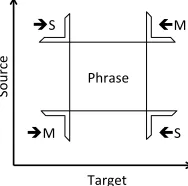
Figure 3: Relevant corners in HRM extraction. → indi-cates left-to-right orientation, and←right-to-left.
ning standard phrase extraction (Och and Ney, 2004) without a phrase-length limit, noting the corners of each phrase found. Next, the left-to-right and right-to-left orientation for each phrase of interest (those within the phrase-length limit) can be determined by checking to see if any corners noted in the previous step are adjacent, as shown in Figure 3.
2.1 Efficient Extraction of HRM statistics
The time complexity of phrase extraction is bounded by the number of phrases to be extracted, which is determined by the sparsity of the input word align-ment. Without a limit on phrase length, a sentence
pair withnwords in each language can have as many
asO(n4) phrase-pairs.3 Because it relies on
unre-stricted phrase extraction, the corner collection step
for determining HRM orientation is alsoO(n4).
By leveraging the fact that the first step col-lects corners, not phrase-pairs, we can show that
HRM extraction can actually be done inO(n2)time,
through a process we call corner propagation.
In-stead of running unrestricted phrase-extraction, cor-ner propagation begins by extracting all minimal
3Consider a word-alignment with only one link in the center
[image:3.612.379.473.221.314.2]Sour
ce
Target
èM
èS çM
çS èS çM
[image:4.612.119.259.54.193.2]èM çS
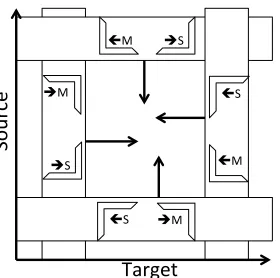
Figure 4: Corner Propagation: Each of the four passes propagates two types of corners along a single dimension.
phrase-pairs; that is, those that do not include un-aligned words at their boundaries. The
complex-ity of this step is O(n2), as the number of
mini-mal phrases is bounded by the minimum of the num-ber of monolingual phrases in either language. We note corners for each minimal pair, as in the orig-inal HRM extractor. We then carry out four non-nested propagation steps to handle unaligned words, traversing the source (target) in forward and reverse order, with each unaligned row (column) copying corners from the previous row (column). Each pass takes O(n2)time, for a total complexity of O(n2). This process is analogous to the growing step in phrase extraction, but computational complexity is minimized because each corner is considered inde-pendently. Pseudo-code is provided in Algorithm 1, and the propagation step is diagrammed in Fig-ure 4. In our implementation, corner propagation is roughly two-times faster than running unrestricted phrase-extraction to collect corners.
Note that the trickiest corners to catch are those that are diagonally separated from their minimal block (they result from unaligned growth in both the source and target). These cases are handled cor-rectly because each corner type is touched by two propagators, one for the source and one for the tar-get (see Figure 4). For example, the top-right-corner
arrayAq is populated by both propagate-right and
propagate-up. Thus, one propagator can copy a cor-ner along one dimension, while the next propagator copies the copies along the other dimension, moving the original corner diagonally.
Algorithm 1Corner Propagation
Initialize target-source indexed binary arrays
Aq[m][n], Ay[m][n], Ap[m][n]andAx[m][n]to record corners found in minimal phrase-pairs.
{Propagate Right}
forifrom2toms.t.target[i]is unaligneddo
forjfrom1tondo
Aq[i][j] =True ifAq[i−1][j]is True
Ay[i][j] =True ifAy[i−1][j]is True
{Propagate Up}
forjfrom2tons.t. source[j]is unaligneddo
forifrom1tomdo
Ap[i][j] =True ifAp[i][j−1]is True
Aq[i][j] =True ifAq[i][j−1]is True
{Propagate Left and Down are similar}
returnAq,Ay,ApandAx
3 ITG-Constrained Decoding
Phrase-based decoding places no implicit limits on
re-ordering; all n! permutations are theoretically
possible. This is undesirable, as it leads to
in-tractability (Knight, 1999). Therefore, re-ordering is limited explicitly, typically using a distortion limit. One particularly well-studied re-ordering constraint is the ITG constraint, which limits source permu-tations to those achievable by a binary bracketing synchronous context-free grammar (Wu, 1997). ITG constraints are known to stop permutations that
gen-eralize 3142 and 2413,4and can drastically limit the
re-ordering space for long strings (Zens and Ney, 2003). There are two methods to incorporate ITG constraints into a phrase-based decoder, one using the coverage vector (Zens et al., 2004), and the other using a shift-reduce parser (Feng et al., 2010). We begin with the latter, returning to the coverage-vector constraint later in this section.
Feng et al. (2010) describe an ITG constraint that is implemented using the same permutation parser used in the HRM. To understand their method, it is important to note that the set of ITG-compliant per-mutations is exactly the same as those that can be reduced to a single-item stack using the shift-reduce permutation parser (Zhang and Gildea, 2007). In fact, this manner of parsing was introduced to SMT
42413 is shorthand notation that denotes the block sequence
Sour
ce
Target
0[1,2]4
[2,3]
[0,1]
2[3,4]4
0[1,2]5
2[2,3]4
[0,1] [3,4]
Sour
ce
2[4,5]5
Target
[image:5.612.76.297.54.186.2](a) (b)
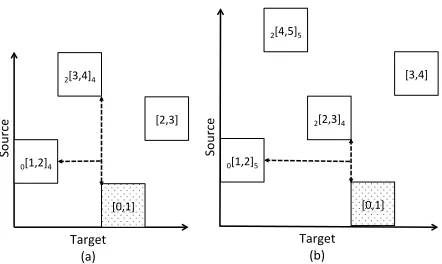
Figure 5: Two non-ITG permutations. Violations of po-tential adjacency are indicated with dotted spans. Bounds for the one-stack constraint are shown as subscripts.
in order to binarize synchronous grammar
produc-tions (Zhang et al., 2006). Therefore, enforcing
an ITG constraint in the presence of a shift-reduce parser amounts to ensuring that every shifted item
can eventually be reduced. To discuss this
con-straint, we introduce a notion ofpotential adjacency,
where two blocks are potentially adjacent if any words separating them have not yet been covered. Formally, blocks[s, t]and[s0, t0]are potentially ad-jacent iff one of the following conditions holds:
· they are adjacent (t0 =sort=s0)
· t0< sand[t0, s]is uncovered
· t < s0and[t, s0]is uncovered
Recall that a reduction occurs when the top two items of the stack are adjacent. To ensure that re-ductions remain possible, we only shift items onto the stack that are potentially adjacent to the cur-rent top. Figure 5 diagrams two non-ITG permu-tations and highlights where potential adjacency is violated. Note that no reductions occur in either of these examples; therefore, each block [si, ti] is
also the top of the stack at time i. Potential
ad-jacency can be confirmed with some overhead us-ing the stack and coverage vector together, but Feng et al. (2010) present an elegant three-stack solution that provides potentially adjacent regions in constant time, without a coverage vector. We improve upon their method later this section. From this point on, we abbreviate potential adjacency as PA.
We briefly sketch a proof that maintaining po-tential adjacency maintains reducibility, by showing that non-PA shifts produce irreducible stacks, and
that PA shifts are reducible. It is easy to see that ev-ery non-PA shift leads to an irreducible stack. Let [s0, t0]be an item to be shifted onto the stack, and [s, t]be the current top. Assume thatt0 < sand the
two items are not PA (the case wheret < s0is
simi-lar). Because they are not PA, there is some indexk
in[t0, s]that has been previously covered. Since it is
covered,kexists somewhere in the stack, buried
be-neath[s, t]. Becausekcannot be re-used, no series
of additional shift and reduce operations can extend [s0, t0]so that it becomes adjacent to[s, t]. Therefore, [s, t]will never participate in a reduction, and pars-ing will close with at least two items on the stack. Similarly, one can easily show that every PA shift is reducible, because the uncovered space[t0, s]can be filled by extending the new top toward the previous top using strictly adjacent shifts.
3.1 A One-stack ITG Constraint
As mentioned earlier, Feng et al. (2010) provide a method to track potential adjacency that does not re-quire a coverage vector. Instead, they maintain three stacks, the original stack and two others to track po-tentially adjacent regions to the left and right respec-tively. These regions become available to the de-coder only when the top of the original stack is ad-jacent to one of the adjacency stacks.
We show that the same goal can be achieved with even less book-keeping by augmenting the items on the original stack to track the regions of potential adjacency around them. The intuition behind this technique is that on a shift, the new top inherits all of the constraints on the old top, and the old top be-comes a constraint itself. Each stack item now has four fields, the original block [s, t], plus a left and right adjacency bound, denoted together as`[s, t]r,
where`andrare indices for the maximal span
con-taining[s, t]that is uncovered except for[s, t]. If the top of the stack is`[s, t]r, then shifted items must fall
inside one of the two PA regions,[`, s]or[t, r]. The region shifted into determines new item’s bounds.
The stack is initialized with a special0[0,0]nitem,
and we then shift unannotated blocks onto the stack. As we shift[s0, t0]onto the stack, rules derive bounds
`0andr0for the new top based on the old top`[s, t]r:
• Shift-left (t0 ≤s):`0=`,r0 =s
[2,4]
[5,7]
0 9
Shi. [5,7]
4 9
[2,4] 9
0
[2,7]
[4,7]
0 9
Reduce
4 9
[2,4] 9
0
[image:6.612.133.482.54.137.2](a) (b)
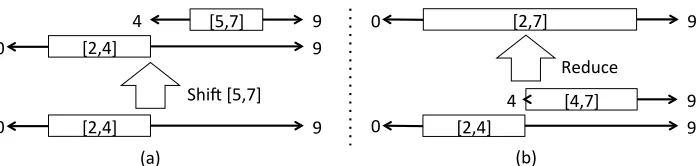
Figure 6: Two examples of boundaries for the one-stack solution for potential adjacency. Stacks are built from bottom to top, blocks indicate [s,t] blocks, while tails are left and right adjacency boundaries.
Meanwhile, when reducing a stack with `0[s0, t0]r0
at the top and `[s, t]r below it, the new top simply
copies`andr. The merged item is larger than[s, t], but it is PA to the same regions. Figure 6 diagrams a shift-right and a reduce, while Figure 5 annotates bounds for blocks during its ITG violations.
3.2 The Coverage-Vector ITG Constraint is
Incomplete
The stack-based solution for ITG constraints is el-egant, but there is also a proposed constraint that uses only the coverage vector (Zens et al., 2004). This constraint can be stated with one simple rule: if the previously translated block is[si−1, ti−1]and the next block to be translated is [si, ti], one must
be able to travel along the coverage vector from [si−1, ti−1]to [si, ti] without transitioning from an
uncovered word to a covered word. Feng et al.
(2010) compare the two ITG constraints, and show that they perform similarly, but not identically. They
attribute the discrepancy to differences in whenthe
constraints are applied, which is strange, as the two constraints need not be timed differently.
Let us examine the coverage-vector constraint
more carefully, assuming that ti < si−1 (the case
whereti−1 < siis similar). The constraint consists
of two phases: first, starting fromsi−1, we travel to
the left towardti, consuming covered words until we
reach the first uncovered word. We then enter into the second phase, and the path must remain
uncov-ered until we reachti. The first step over covered
positions corresponds to finding the left boundary of the largest covered block containing[si−1, ti−1], which is an approximation to the top of the stack (Section 2). The second step over uncovered posi-tions corresponds to determining whether [si, ti]is
PA to the approximate top. That is, the coverage-vector ITG constraint checks for potential adjacency
using the same top-of-stack approximation as the right-to-left HRM.
This implicit approximation implies that there may well be cases where the coverage-vector con-straint makes the wrong decision. Indeed this is the case, which we prove by example. Consider the irreducible sequence 25314, illustrated in Fig-ure 5b. This non-ITG permutation is allowed by the coverage-vector approximation, but not by the stack-based constraint. Both constraints allow the placement of the first three blocks[1,2], [4,5]and [2,3]. After adding[0,1], the stack-based solution detects a PA-violation. Meanwhile, the vector-based
solution checks the path from2to1for a transition
from uncovered to covered. This short path touches
only covered words. Similarly, as we add[3,4], the
path from 1 to 3 is also completely covered. The
entire permutation is accepted without complaint. The proof provided by Zens et al. (2004) misses this case, as it accounts for phrasal generalizations of the 2413 ITG-forbidden substructure, but it does not account for generalizations where the substruc-ture is interrupted by a discontiguous item, such as
in 25{3}14, where 2413 is revealed not by merging
items but by deleting 3.
4 Inconsistencies in HRM parsing
We have shown that the HRM and the ITG con-straints for phrase-based decoding use the same de-terministic shift-reduce parser. The entirety of the ITG discussion was devoted to preventing the parser
from reaching an irreducible state. However, up
until now, work on the HRM has not addressed the question of irreducibility (Galley and Manning, 2008; Nguyen et al., 2009).
word-你
的
旅游
经济
又
如何
取得
效益
?
[4,6] How can
[0,1] you
[6,7] achieve
[1,2] the
[3,4] economic and
[2,3] tourism
[image:7.612.75.298.53.212.2][7,9] benefits ?
Figure 7: An example irreducible derivation, drawn from our Chinese-to-English decoder’sk-best output.
Last translated block 2-red *-red approx
How can [4,6] [4,6] [4,6] [4,6]
you [0,1] [0,1] [0,1] [0,1]
achieve [6,7] [6,7] [6,7] [4,7]
the [1,2] [1,2] [1,2] [0,2]
economic and [3,4] [3,4] [3,4] [3,7]
tourism [2,3] [1,4] [0,7] [0,7]
benefits? [7,9] [7,9] [0,9] [0,9]
Table 2: Top of stack at each time step in Figure 7, under 2-reduction (as in the original HRM), *-reduction, and the coverage-vector approximation.
aligned training data. In Figure 7, we show an ir-reducible block sequence, extracted from a Chinese-English decoder. The parser can perform a few small reductions, creating a [1,4] block indicated with a dashed box, but translation closes with 5 items on the stack. One can see that [7,9] is assigned a dis-joint orientation by the HRM. However, if the same translation and alignment were seen during train-ing, the unrestricted phrase extractor would find a phrase at [0,7], indicated with a dotted box, and [7,9] would be assigned monotone orientation. This in-consistency penalizes this derivation, as “benefits ?” is forced into an unlikely disjoint orientation. One potential implication is that the decoder will tend to avoid irreducible states, as those states will tend to force unlikely orientations, resulting in a hidden, soft ITG-constraint. Indeed, our decoder does not select this hypothesis, but instead a (worse) transla-tion that is fully reducible. The impact of these in-consistencies on translation quality can only be
de-termined empirically. However, to do so, we require alternatives that address these inconsistencies. We describe three such variants below.
4.1 ITG-constrained decoding
Perhaps the most obvious way to address irreducible states is to activate ITG constraints whenever decod-ing with an HRM. Irreducible derivations will disap-pear from the decoder, along with the corresponding inconsistencies in orientation. Since both techniques require the same parser, there is very little overhead. However, we will have also limited our decoder’s re-ordering capabilities.
4.2 Unrestricted shift-reduce parsing
The deterministic shift-reduce parser used through-out this paper is actually a special case of a general class of permutation parsers, much in the same way that a binary ITG is a special case of synchronous context-free grammar. Zhang and Gildea (2007)
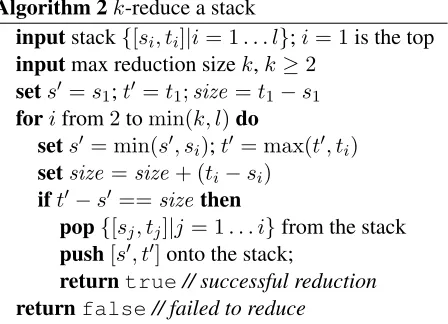
de-scribe a family of k-reducing permutation parsers,
which can reduce the top k items of the stack
in-stead of the top 2. Fork≥ 2we can generalize the
adjacency requirement for reduction to a
permuta-tionrequirement. Let{[si, ti]|i=1. . . k}be the topk
items of a stack; they are a permutation iff:
max
i (ti)−mini (si) =
X
i
[ti−si]
That is, every number between the max and min is present somewhere in the set. Since two adjacent items always fulfill this property, we know the
orig-inal parser is 2-reducing.k-reducing parsers reduce
by moving progressively deeper in the stack, looking
for the smallest2≤ i≤ kthat satisfies the
permu-tation property (see Algorithm 2). As in the original
parser, ak-reduction is performed every time the top
of the stack changes; that is, after each shift and each successful reduction.
If we setk = ∞, the parser will find the
small-est possible reduction without rsmall-estriction; we refer to this as a *-reducing parser. This parser will never reach an irreducible state. In the worst case, it
re-duces the entire permutation as a singlen-reduction
[image:7.612.78.294.258.367.2]Algorithm 2k-reduce a stack
inputstack{[si, ti]|i= 1. . . l};i= 1is the top
inputmax reduction sizek,k≥2
sets0 =s1;t0=t1;size =t1−s1
forifrom2tomin(k, l)do
sets0= min(s0, si);t0 = max(t0, ti)
setsize =size+ (ti−si)
ift0−s0==size then
pop{[sj, tj]|j = 1. . . i}from the stack
push[s0, t0]onto the stack;
returntrue// successful reduction
returnfalse// failed to reduce
that reduction is no longer a constant-time operation,
but is insteadO(n)in the worst case (consider
Algo-rithm 2 withk=∞andl=nitems on the stack).5
As a result, we will carefully track the impact of this parser on decoding speed.
4.3 Coverage vector approximation
One final option is to adopt the top-of-stack approxi-mation for left-to-right orientations, in addition to its current use for right-to-left orientations, eliminating the need for any permutation parser. The next block [si, ti]is adjacent to the approximate top of the stack
only if any space between [si, ti] and the previous
block[si−1, ti−1]is covered. But before committing fully to this approximation, we should better under-stand it. Thus far, we have implied that this approx-imation can fail to predict correct orientations, but we have not specified when these failures occur. We now show that incorrect orientations can only occur while producing a non-ITG permutation.
Let [si−1, ti−1] be the last translated block, and [si, ti]be the next block. Recall that the
approxima-tion determines the top of the stack using the largest block of covered words that contains [si−1, ti−1]. The approximate top always contains the true top, because they both contain [si−1, ti−1] and the ap-proximate top is the largest block that does so. Therefore, the approximation errs on the side of ad-jacency, meaning it can only make mistakes when
5
Zhang and Gildea (2007) provide an efficient algorithm for *-reduction that uses additional book-keeping so that the num-ber of permutation checks as one traverses the entire sequence is linear in aggregate; however, we implement the simpler, less efficient version here to simplify decoder integration.
Prev Next
si-‐1 ti-‐1 t’ si ti True top
Approximate top
[image:8.612.75.299.61.223.2]Breaks PA
Figure 8: Indices for when the coverage approximation predicts a false M.
assigning an M or S orientation; if it assigns a D, it is always correct. Let us consider the false M case (the false S case is similar). If we assign a false M, thenti−1 < si andsiis adjacent to the approximate
top; therefore, all positions betweenti−1 andsi are
covered. However, since the M is false, the true top of the stack must end at somet0 : ti−1 ≤ t0 < si.
Since we know that every position betweent0andsi
is covered,[si, ti]cannot be PA to the true top of the
stack, and we must be in the midst of making a non-ITG permutation. See Figure 8 for an illustration of the various indices involved. As it turns out, both the approximation and the 2-reducing parser assign in-correct orientations only in the presence of ITG vio-lations. However, the approximation may be prefer-able, as it requires only a coverage vector.
4.4 Qualitative comparison
Each solution manages its stack differently, and we illustrate the differences in terms of the top of the
stack at timeiin Table 2. The *-reducing parser is
the gold standard, so we highlight deviations from its decisions in bold. As one can see, the original 2-reducing parser does fine before and during an ITG violation, but can create false disjoint orientations after the violation is complete, as the top of its stack becomes too small due to missing reductions. Con-versely, the coverage-vector approximation makes errors inside the violation: the approximate top be-comes too large, potentially creating false monotone or swap orientations. Once the violation is complete, it recovers nicely.
5 Experiments
BLEU NIST 08 Complexity Counts Speed
Method nist04 nist06 nist08 >2 4 5 6 7 ≥8 sec/sent
LRM 38.00 33.79 27.12 241 146 40 32 12 11 3.187
HRM 2-red 38.53 34.20 27.57 176 113 31 20 8 4 3.353
HRM apprx 38.58 34.09 27.60 280 198 41 26 13 2 3.231
HRM *-red 38.39 34.22 27.41 328 189 71 34 20 14 3.585
[image:9.612.117.495.56.153.2]HRM itg 38.70 34.26 27.33 0 0 0 0 0 0 3.274
Table 3: Chinese-to-English translation results, comparing the LRM and 4 HRM variants: the original 2-reducing parser, the coverage vector approximation, the *-reducing parser, and an ITG-constrained decoder.
complexity, as measured by the largestkrequired to
k-reduce the translations.
5.1 Data
The system was trained on data from the NIST 2009 Chinese MT evaluation, consisting of more than 10M sentence pairs. The training corpora were split into two phrase tables, one for Hong Kong and UN data, and one for all other data. The dev set was taken from the NIST 05 evaluation set, augmented with some material reserved from other NIST cor-pora; it consists of 1.5K sentence pairs. The NIST 04, 06, and 08 evaluation sets were used for testing.
5.2 System
We use a phrase-based translation system similar to Moses (Koehn et al., 2007). In addition to our 8 translation model features (4 for each phrase table), we have a distortion penalty incorporating the min-imum possible completion cost described by Moore and Quirk (2007), a length penalty, a 5-gram lan-guage model trained on the NIST09 Gigaword cor-pus, and a 4-gram language model trained on the tar-get half of the parallel corpus. The LRM and HRM are represented with six features, with separate weights for M, S and D in both directions (Koehn et al., 2007). We employ a gap constraint as our only distortion limit (Chang and Collins, 2011). This re-stricts the maximum distance between the start of a phrase and the earliest uncovered word, and is set to 7 words. Parameters are tuned using a batch-lattice version of hope-fear MIRA (Chiang et al., 2008; Cherry and Foster, 2012). We re-tune parameters for each variant.
5.3 Results
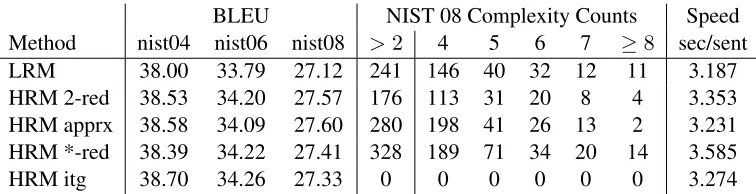
Our results are summarized in Table 3. Speed and complexity are measured on the NIST08 test set, which has 1357 sentences. We measure permutation complexity by parsing the one-best derivations from each system with an external *-reducing parser, and
noting the largest k-reduction for each derivation.
Therefore, the>2column counts the number of
non-ITG derivations produced by each system.
Regarding quality, we have verified the effective-ness of the HRM: each HRM variant outperforms the LRM, with the 2-reducing HRM doing so by 0.4 BLEU points on average. Unlike Feng et al. (2010), we see no consistent benefit from adding hard ITG constraints, perhaps because we are building on an HRM-enabled system. In fact, all HRM variants perform more or less the same, with no clear win-ner emerging. Interestingly, the approximate HRM is included in this pack, which implies that groups wishing to augment their phrase-based decoder with an HRM need not incorporate a shift-reduce parser.
Regarding complexity, the 2-reducing HRM pro-duces about half as many non-ITG derivations as the *-reducing system, confirming our hypothesis that a 2-reducing HRM acts as a sort of soft ITG con-straint. Both the approximate and *-reducing de-coders produce more violating derivations than the LRM. This is likely due to their encouragement of more movement overall. The largest reduction we
observed wask= 11.
6 Discussion
We have presented a number of theoretical contribu-tions on the topic of phrase-based decoding with an on-board permutation parser. In particular, we have shown that the coverage-vector ITG constraint is ac-tually incomplete, and that the original HRM can produce inconsistent orientations in the presence of ITG violations. We have presented three HRM vari-ants that address these inconsistencies, and we have compared them in terms of both translation quality and permutation complexity. Though our results in-dicate that a permutation parser is actually unneces-sary to reap the benefits of hierarchical re-ordering, we are excited about the prospects of further ex-ploring the information provided by these on-board parsers. In particular, we are interested in using fea-tures borrowed from transition-based parsing while decoding.
References
Yin-Wen Chang and Michael Collins. 2011. Exact de-coding of phrase-based translation models through la-grangian relaxation. InEMNLP, pages 26–37, Edin-burgh, Scotland, UK., July.
Colin Cherry and George Foster. 2012. Batch tuning strategies for statistical machine translation. In HLT-NAACL, Montreal, Canada, June.
David Chiang, Yuval Marton, and Philip Resnik. 2008. Online large-margin training of syntactic and struc-tural translation features. InEMNLP, pages 224–233. Yang Feng, Haitao Mi, Yang Liu, and Qun Liu. 2010. An
efficient shift-reduce decoding algorithm for phrase-based machine translation. In COLING, pages 285– 293, Beijing, China, August.
Michel Galley and Christopher D. Manning. 2008. A simple and effective hierarchical phrase reordering model. InEMNLP, pages 848–856, Honolulu, Hawaii, October.
Michel Galley and Christopher D. Manning. 2010. Ac-curate non-hierarchical phrase-based translation. In HLT-NAACL, pages 966–974, Los Angeles, Califor-nia, June.
Kevin Knight. 1999. Squibs and discussions: Decod-ing complexity in word-replacement translation mod-els. Computational Linguistics, 25(4):607–615, De-cember.
Philipp Koehn, Franz J. Och, and Daniel Marcu. 2003. Statistical phrase-based translation. In HLT-NAACL, pages 127–133.
Philipp Koehn, Hieu Hoang, Alexandra Birch, Chris Callison-Burch, Marcello Federico, Nicola Bertoldi, Brooke Cowan, Wade Shen, Christine Moran, Richard Zens, Chris Dyer, Ondrej Bojar, Alexandra Con-stantin, and Evan Herbst. 2007. Moses: Open source toolkit for statistical machine translation. In ACL, pages 177–180, Prague, Czech Republic, June. Robert C. Moore and Chris Quirk. 2007. Faster
beam-search decoding for phrasal statistical machine trans-lation. InMT Summit XI, September.
Vinh Van Nguyen, Akira Shimazu, Minh Le Nguyen, and Thai Phuong Nguyen. 2009. Improving a lexi-calized hierarchical reordering model using maximum entropy. InMT Summit XII, Ottawa, Canada, August. Franz Josef Och and Hermann Ney. 2004. The
align-ment template approach to statistical machine transla-tion. Computational Linguistics, 30(4), December. Kishore Papineni, Salim Roukos, Todd Ward, and
Wei-Jing Zhu. 2002. BLEU: a method for automatic eval-uation of machine translation. InACL, pages 311–318. Christoph Tillmann. 2004. A unigram orientation model for statistical machine translation. In HLT-NAACL, pages 101–104, Boston, USA, May.
Dekai Wu. 1997. Stochastic inversion transduction grammars and bilingual parsing of parallel corpora. Computational Linguistics, 23(3):377–403.
Richard Zens and Hermann Ney. 2003. A comparative study on reordering constraints in statistical machine translation. InACL, pages 144–151.
Richard Zens, Hermann Ney, Taro Watanabe, and Ei-ichiro Sumita. 2004. Reordering constraints for phrase-based statistical machine translation. In COL-ING, pages 205–211, Geneva, Switzerland, August. Hao Zhang and Daniel Gildea. 2007. Factorization
of synchronous context-free grammars in linear time. In Proceedings of SSST, NAACL-HLT 2007 / AMTA Workshop on Syntax and Structure in Statistical Trans-lation, pages 25–32, Rochester, New York, April. Hao Zhang, Liang Huang, Daniel Gildea, and Kevin