Multi-source named entity typing for social media
Reuth Vexler
Information Systems Dep. University of Haifa Haifa, Israel, 31905
Einat Minkov
Information Systems Dep. University of Haifa Haifa, Israel, 31905
Abstract
Typed lexicons that encode knowledge about the semantic types of an entity name, e.g., that ‘Paris’ denotes a
geoloca-tion, product, or person, have proven
use-ful for many text processing tasks. While lexicons may be derived from large-scale knowledge bases (KBs), KBs are inher-ently imperfect, in particular they lack coverage with respect to long tail entity names. We infer the types of a given entity name using multi-source learn-ing, considering information obtained by alignment to the Freebase knowledge base, Web-scale distributional patterns, and global semi-structured contexts re-trieved by means of Web search. Eval-uation in the challenging domain of so-cial media shows that multi-source learn-ing improves performance compared with rule-based KB lookups, boosting typing results for some semantic categories.
1 Introduction
Typed lexicons associate lexical entity names with a set of semantic types, e.g., the name ‘Paris’ may be mapped into the semantic categories of
geolo-cation, product, or person. Such world
knowl-edge has proven valuable for various text process-ing tasks, includprocess-ing the classification of search queries (Pasca, 2004), question answering (Bordes et al., 2014; Yao and Durme, 2014), named entity recognition (Ling and Weld, 2012; Yamada et al., 2015), entity linking (Fang and Chang, 2014; Hof-fart et al., 2014), and relation extraction (Ling and Weld, 2012; Chang et al., 2014).
Over the last years, large scale knowledge bases
(KBs) have become available, like Freebase (Bol-lacker et al., 2008), DBPedia (Auer et al., 2007) and YAGO (Suchanek et al., 2007), which or-ganize entities and their lexical aliases into se-mantic categories (or, types). KBs are inherently incomplete however in their coverage of world knowledge (West et al., 2014). This is partly be-cause updates to the database with emerging en-tities and facts exhibit some delay (Wang et al., 2012; Hoffart et al., 2014). In addition, the ‘long tail’ of unpopular, local or domain-specific con-cepts is under-represented in general knowledge bases (Lin et al., 2012; Ling and Weld, 2012).
In this work, we seek to associate semantic types of interest with a given entity name. We re-fer to this problem as named entity typing. Our main focus is on names mentioned on social me-dia. In this domain, local contextual information is often very limited, so that background world knowledge is especially useful for semantic pro-cessing purposes. For example, the commercial system described by Gattani et al. (2013) performs named entity recognition in tweets by matching the tweet text against known entity names in a reference knowledge base (KB). But, emerging and long tail entity names, which are frequently mentioned on social media, e.g., the names of lo-cal businesses, as well as informal names, abbre-viations, and acronyms, are often missing from KBs (Ritter et al., 2011).
Previously, researchers have proposed to infer the semantic types of entity names based on lo-cal distributional evidence harvested from Web documents (Lin et al., 2012; Yaghoobzadeh and Sch¨utze, 2015), however such distributional evi-dence is sparse and costly to obtain for long tail names. We claim that in order to infer the seman-tic types of infrequent entity names, it is
sary to model global, semi-structured, contextual evidence of the respective name mentions. Specif-ically, we consider in this work paragraph-level contexts, Webpage titles and URLs, obtained by means of Web search. As suggested by R¨ud et
al. (2011), Web search has several advantages as a
source of background knowledge in cross-domain settings. We believe this work to be the first to ex-amine Web search as an information source for the task of entity name typing, and the first to evaluate this task in the social media domain.
We apply a discriminative learning framework using an ensemble of information sources, naming this approach as Multi-Source Named Entity Typ-ing (MS-NET). Relevant evidence about a given entity name is extracted from the various sources and represented as features in a joint feature space. Specifically, we model as features in this work re-lated Freebase category tags, distributional infor-mation in the form of ReVerb lexico-syntactic pat-terns (Fader et al., 2011), and semi-structured Web search results.
In our experiments, we consider a set of nine target semantic entity types found to be highly popular on social media (Ritter et al., 2011). While training examples are obtained by means of distant supervision, our evaluation of MS-NET is conducted using a gold-labeled dataset of en-tity names extracted from tweets, in which each name string has been annotated with its full set of semantic types. We make this evaluation dataset available to the research community.
To the best of our knowledge, this is the first work to combine diverse information sources, in-cluding Web search results, for the purpose of en-tity name typing. Our results clearly show that the information sources modeled are complimentary– learning using all sources yields the best overall typing performance with respect to both recall and precision. MS-NET improves overall performance compared with a plausible baseline of rule-based alignment to a KB. In particular, a boost in perfor-mance is obtained for some of the semantic types evaluated, such as facility and product, which ap-ply to a long tail of infrequent entity names.
2 Related Work
2.1 Named entity typing
Several recent works have considered a similar problem setting to ours. These works mainly rely on Web-scale lexico-syntactic distributional
pro-files of the target name mentions to induce its types.
Lin et al. (2012) represent KB-indexed as well as out-of-KB entity names in terms of subject–
relation–object triplets with which they cooccur
in Web documents, extracted using the ReVerb algorithm (Fader et al., 2011). Freebase seman-tic types are then propagated from indexed to un-known names over common ReVerb triplets. We represent ReVerb distributional patterns as fea-tures in our framework. Similarly to previous re-searchers (Yaghoobzadeh and Sch¨utze, 2015), we find ReVerb triplets to perform poorly when used as a standalone information source. We discuss the reasons for this in detail below.
Yaghoobzadeh and Sch¨utze (2015) presented an embedding based approach for the typing of named entities. They compute embedding vec-tors for words, entities and semantic types using an annotated version of the ClueWeb Web corpus, in which entity mentions have been tagged with their Freebase IDs. They report poor typing per-formance for infrequent entity names, possibly be-cause the embedding approach is sensitive to con-text sparsity (Cui et al., 2015).
In this work, we model distributional lexico-syntactic information within a multi-source learn-ing framework. This distributional information is integrated with knowledge extracted from struc-tured datasets and with global semi-strucstruc-tured contextual signals, obtained via web search. We believe this work to be the first to evaluate named entity typing on twitter messages, which con-tain relatively many unknown and irregular entity name forms. Our contribution is orthogonal to the works mentioned above, as various types of dis-tributional features can be easily integrated using multi-source learning.
2.2 Semantic type prediction using Web
Search
to Web queries in that they are short, ambiguous and noisy.
R¨ud et al. (2011) claim to be first to consider the idea of using search engines as an informa-tion source for an NLP problem. They outline a variety of features extracted from search engine results, designed to achieve cross-domain named entity recognition robustness. While their work is evaluated on the classification of Web queries, they conjecture that their approach is similarly ap-plicable to related domains like Twitter and SMS. This work continues these previous efforts, ap-plying Web search features to the task of named entity typing, and evaluating this task in the so-cial media domain. We find that modeling of global semi-structured contexts obtained via Web search is necessary in order to maintain high cross-domain performance. Unlike previous works, we put emphasis on investigating the synergy between Web search results and other sources of world knowledge, including structured KBs. A detailed evaluation reveals that the best configuration of in-formation sources depends on the characteristics of the target semantic class.
3 Multi-source named entity typing
Let us first formally define the named entity typ-ing task. Given a named entity strtyp-ingeand a set of target semantic types of interest L, our goal is to output a membership functionm:e×L7→ {0,1}, such that m(e, ℓ)=1 if e denotes some entity of typeℓ∈L.1 The membership relation is not func-tional, and it is possible thatebe associated with any subset of the target typesS⊆L, including the empty set.
We address this multi-class multi-label classifi-cation task by learning binary classifiers per label, C1, ..., C|L|, having each classifierCjpredict a bi-nary membership, m(e, ℓj) ∈ (0,1). A main ad-vantage of the binary prediction setting is that it is intuitive, simple, and scalable (Read et al., 2009).
3.1 Knowledge sources
Each nameeis represented as a multinomial vec-tor of features, extracted from multiple sources as described below. We illustrate the pro-posed feature scheme using the running example e=‘eagles’, which maps to the types sportsteam and music artist according to our annotation.
1Named entity detection is out of scope of this work.
En-tity names of interest may be identified automatically (Lin et al., 2012; Hoffart et al., 2014) or manually.
Data: Entity namee, knowledge basek
Result:S(e), a set of semantic types associated witheaccording tok initialization;
1. ExtractA(e): the set of entities ink, for whicheis a possible alias; 2. InitializeS(e);
3. fora∈A(e)do
Retrieve S(a): the semantic types of entityaaccording tok; S(e) =S(e)∪S(a);
end
Algorithm 1: Extraction of semantic types
asso-ciated withefrom a KB
KB tags. Knowledge bases model distinct
en-tities and the relations between them. Typically, entities are associated with a hierarchical struc-ture of semantic types, as well as with lexical aliases (Dalvi et al., 2015). In this work, we ex-tract and represent as features semantic categories associated with the name entity string ein Free-base (FB).
We apply the procedure outlined in Alg. 1 to extractSF(e), the set of Freebase semantic types associated with the name stringe. As described, step (1) of the algorithm involves alignment of the target entity name with possibly matching entities in the KB. In order to increase recall, one can ap-ply proximate string matching in performing this alignment. In this work, we use Freebase API for this purpose, enabling inexact search against known entity aliases.2 Once relevant entities are identified, their known types are unified to create the set of associated FB types.
47 semantic tags in total were extracted in this fashion for the string ‘eagles’. The extracted tags are of high-quality in part, e.g., sports/professional
sports team, but include also noisy tags, e.g., base/websites/website. Noisy tags can be ex-plained by annotation inconsistencies that exist in Freebase, and also result from the proximate alignment of ‘eagles’ to FB–while increasing re-call, proximate matching involves some decrease in precision. In general, databases may include noise also as the result of applying imperfect auto-matic knowledge population methods.
The set of the KB extracted types has to be mapped to the target type schema L. It is com-mon practice to make use of manually constructed mapping rules to align KB categories against a tar-get semantic schema (Ling and Weld, 2012). We rather apply learning to perform this alignment, having the tagsSF(e) represented as binary
fea-2We use the filter: ”(all name:entity alias:entity)”,
Freebase cateogry tags
fb.base/popstra/topic, fb.base/popstra/sww base
fb.base/losangelesbands/topic, base/ontologies/ontology instance sports/professional sports team, base/usnris/nris listing base/ovguide/country musical groups, base/schemastaging/topic ...
ReVerb patterns
reverbRel.be also a master of reverbRel.win in
...
Web search features
url.philadelphiaeagles
title.philadelphia.-1, title.official, title.site, title.philadelphia snippet.philadelphia.-1, snippet.official.1, snippet.team.2 snippet.site.3, snippet.official, snippet.team, snippet.site snippet.philadelphia, snippet.roster, snippet.new, snippet.history snippet.youth, snippet.program, snippet.ticket and snippet.inform
Table 1: An illustration of the feature types de-rived from the various sources fore=‘eagles’.
tures, as illustrated in Table 1. Ideally, learning should discard or downweight the features that correspond to irrelevant KB categories.
As discussed above, a main weakness of gen-eral knowledge bases as information source is that even large-scale KBs such as Freebase are inher-ently incomplete. Long tail and emerging entities, as well as informal name forms that are creatively and dynamically used in social media, are likely to be missing or from the KB. In such cases, relevant evidence must be obtained from other sources.
Lexico-syntactic distributional patterns.
Named entities and their types may be extracted based on distinctive lexical patterns that surround the target entity mentions (Banko et al., 2007; Carlson et al., 2010).
Distributional semantics may be represented in terms of key phrases (Hoffart et al., 2014), distributional clusters (Roth, 2009), topics (Rit-ter et al., 2011) or word embeddings (Rong et al., 2016). Similarly to previous works (Lin et al., 2012; Yaghoobzadeh and Sch¨utze, 2015), we consider here lexico-syntactic contexts in the form of<subject,relation,object>triplets ex-tracted from Web documents using the ReVerb al-gorithm (Fader et al., 2011).
We utilize a collection of 15 million ReVerb as-sertions extracted with high confidence from the ClueWeb09 corpus3. Following Lin et al. (2012), for each entity namee, we consider the set of as-sertions in whicheappears as subject. The string ‘eagles’, for example, appears as the subject argu-ment in 140 different patterns in this corpus, in-cluding the (lemmatized) triplets<eagles, be also
a master of, craftsmanship>, and<eagles, win in
a war of, attrition>. As shown in Table 1, we
3
http://reverb.cs.washington.edu/
Figure 1: Top two search results for the query ‘ea-gles’
represent the relation argument cooccuring withe as a full string. In preliminary experiments, we also considered a bag-of-word representation of the subject and object arguments, but found those representations to give inferior results.
A manual inspection of the extracted Reverb patterns reveals them to be quite noisy. One rea-son is ambiguity of the subject argument, which may denote a general noun phrase as well as an entity name. For example, triplets that include
ea-gles may refer to mentions of the bird species that
the sportsteam is inspired from. As name men-tions in social media are often short and ambigu-ous, they tend to match general noun phrases. An-other downside of using distributional statistics as information source is that limited data exists for long tail entity names. Given only a few Web mentions, it is often the case that a long tail name be matched with no Reverb pattern. Finally, as indicated elsewhere (Yaghoobzadeh and Sch¨utze, 2015), these well-formed patterns may not main-tain their effectiveness across genres.
Web search results. We wish to further model global Web contexts of the target namee, includ-ing the full paragraphs in which it appears, and semi-structured evidence in the form of the Web-page title and source. We obtain this information by means of Web search.
There are several advantages of modeling Web search results that make it appropriate for the pro-cessing of social media. Mainly, search engines provide access to nearly real-time raw Web data. They therefore provide good coverage of emerg-ing entities, as well as long tail and noisy name forms that appear frequently on social media.
Given the paragraphs in which eis mentioned (‘snippets’), we encode local context information using positional features, denoting the distance and direction of neighboring words within a win-dow of 3 tokens to the right and left of the name mention. These local features are highly specific, and are therefore expected to be sparse. Use-ful context information can be further derived at paragraph-level (Pritsker et al., 2015)–we there-fore additionally represent the whole snippet using count-weighted unigram word features.
We further model the respective Webpage ti-tle and source URL, both providing useful semi-structured evidence. Webpage titles are often the-matic, and are sometimes generated using wrap-pers indicative of a source table or list. Likewise, the source URL may map to a domain-specific re-source, e.g., imdb.com is a Web database that in-dexes entities in the entertainment domain. We represent titles using positional and bag-of-word features similarly to the snippet. The URL string is split by period and backslash symbols, having each token map to a feature. The full list of gener-ated features per the top search result for ‘eagles’ are detailed in Table 1.
3.2 Distant learning
As described above, we learn|L|binary classifiers C1, ..., C|L|, having each classifierCjpredict a bi-nary membershipm(x, ℓj)∈(0,1).
Given labeled examples, a variety of learning methods can be applied to learn Cj. As it is costly to annotate a large set of examples with re-spect to each category, we adopt a distantly su-pervised approach. For each target semantic type ℓ∈L, we obtain relevant entity names from Free-base. Following previous researchers (Ritter et al., 2011; Ling and Weld, 2012), we manually iden-tified Freebase tags that correspond to each cate-goryℓj. Entity names were then sampled from the selected Freebase lists, forming a set of positively labeled examples for classifier cj. In our experi-ments, we consider a random sample of examples positively associated with the remaining classes, ℓi 6=ℓjas negative examples forcj.
There are several limitations of distant supervi-sion. We expect the distribution of entity names indexed in FB to be different from entity names that are mentioned on social media. In particu-lar, long tail entities are under-represented in Free-base. In addition, the labels obtained using distant
supervision may be noisy. (Mainly, negative labels may be false due to FB incompleteness.) Never-theless, this approach enables one to collect a large number of auto-labeled examples with minimal ef-fort, and is therefore highly adaptive.
4 Experimental setup
For each target typeℓ∈L, we sampled 900 entity names from relevant Freebase categories. In order to assess and correct possible representation bias, we further sampled 100 additional entity names per category from manually identified Web lists. We found that 18% of the latter names were miss-ing from Freebase. Overall, the constructed train-ing dataset includes about 1,000 unique names per target category. In learning a binary classifiercj, we uniformly sample an equal number of entity names (1,000) associated with the other classes as negative examples.
We used Google API to perform Web-scale search.4 Following tuning experiments, in which we examined cross-validation results using the training data, we set the number of top search re-sults modeled per entity name to k = 15. We found performance to be relatively insensitive to value ofk, as long as at least 5 search results were modeled.
Arguably, search engines inflect bias over the produced rankings. We experimented with shuf-fling of the top 50 search results (prior to selecting the top 15 results) and found performance to be robust with respect to ranking variance. Further-more, in our experiments, we ignore exact ranking information, assigning equal importance to each of the selected search results.
We report the results of a strict yet realistic learning setting, in which the classifiers trained us-ing the examples obtained from Freebase and spe-cialized Web lists were applied across domains to a test dataset, which includes entity names found on twitter. We experimented with several classifi-cation algorithms using Weka (Hall et al., 2009), and report our results using SVM, which was found to perform best. In the following section we first describe the test dataset, and then turn to discuss the experimental results.
5 Gold labeled evaluation dataset
For evaluation purposes, we manually constructed a gold-labeled dataset of entity names mentioned
4
N Agreement Out-of-FB: ratio / examples
Music artist (MA) 193 0.69 6.2% suenalo, shakemode, testing tomorrow Company (CO) 155 0.81 6.5% indigenous, evergreen Subaru, nex-tech
Facility (F) 123 0.73 23.6% the tall ship silva, belles mansion, knighttime billiards
Geo location (GL) 245 0.83 2.9% robinhoods bay, long island mac Arthur airport, Cromwell field
Movie (M) 121 0.82 0%
Product (PR) 141 0.75 11.3% Avast AntiVirus 4 8, Air Music Jump, vanilla vodka, Bugatti V Sports team (ST) 38 1.00 13.2% Marlboro Ducati, Ryerson Quidditch Team, AIS U21, WB Wildcats
TV show (TV) 70 0.90 2.9%
[image:6.595.76.518.66.168.2]Person (P) 356 0.86 8.4% denise calaman, Eduardo surita
Table 2: Statistics of the gold-labeled twitter dataset detailed by semantic type: no. of labels, inter-annotator agreement, and ratio and examples of entity names for which no match in FB was found.
in tweets. We considered a corpus of 2,400 tweets collected by Ritter et al. (2011). They have identified the name mentions in this corpus, and annotated these mentions with their contextual-ized meaning with respect to the following set of types: music artist, company, facility,
geoloca-tion, movie, product, sportsteam, tv-show and per-son. These types were found to be most popular
in the given tweets. A similar set of categories has been used in other works on social media (Gattani et al., 2013; Derczynski et al., 2015).
In order to use this resource for the evaluation of multi-label named entity typing, we have anno-tated the entity names in the corpus with their full set of types, using the same target category set. La-beling was performed by a graduate student, who was allowed to use any resource available, includ-ing Web searches, to determine whether an entity belonged to each of the target classes.
A random subset of 100 entities has been co-annotated by the first author in order to assess inter-agreement rates. Cohen’s kappa agreement scores with respect to each of the target classes are detailed in Table 2. As shown, agreement ranges between 0.69–1, denoting substantial to perfect agreement (Landis and Koch, 1977). In-terestingly, the lowest agreement was observed for the music artist category. We found that dis-agreements mainly occurred for short, and there-fore highly ambiguous, entity names; e.g., ’Justin’ may or may not refer to the music artist “justin bieber”, and ‘MAC’ is possibly an alias for “The Mac Band”. Somewhat more expectedly, moder-ate agreement was observed for the product and
facility categories. It is not clear, for example, if
‘Twitter’ and ‘Facebook’ are services or products. The resulting dataset includes 965 distinct en-tity names and 1,442 label assignments overall. About 27% of the entity names were assigned two classes, and 11% of the entity names were labeled
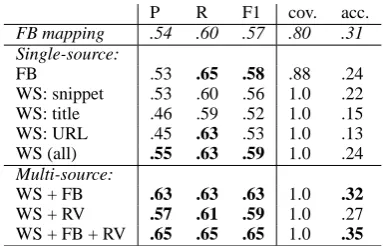
P R F1 cov. acc.
FB mapping .54 .60 .57 .80 .31 Single-source:
FB .53 .65 .58 .88 .24
WS: snippet .53 .60 .56 1.0 .22 WS: title .46 .59 .52 1.0 .15 WS: URL .45 .63 .53 1.0 .13 WS (all) .55 .63 .59 1.0 .24 Multi-source:
WS + FB .63 .63 .63 1.0 .32 WS + RV .57 .61 .59 1.0 .27 WS + FB + RV .65 .65 .65 1.0 .35
Table 3: Instance-level performance using various information sources and features. Results that im-prove over the baseline are bold faced.
with three types or more. The corpus includes mis-spelled, abbreviated, and ‘long tail’ entity names, such as local restaurants and hotels. Table 2 details the total number, as well as concrete examples, of names per category for which no matching entry was found in Freebase (‘Out-of-FB’), despite us-ing a proximate alignment procedure.
This dataset may be first to include gold map-pings of entity names into a set of types of inter-est in the social media domain. We will make the dataset freely available to the research community.
6 Results
[image:6.595.320.512.225.348.2]fea-FB Mapping MS-NET
Target type N P R F1 P R F1 ∆F1
[image:7.595.169.431.67.189.2]Music-artist 193 .48 .63 .54 .43 .69 .53 -1.9% Company 155 .54 .43 .48 .61 .46 .52 8.3% Facility 123 .46 .33 .38 .61 .55 .58 52.6% Geo-location 245 .69 .72 .70 .83 .67 .74 5.7% Movie 121 .64 .42 .51 .60 .41 .49 -3.9% Product 141 .49 .40 .44 .53 .50 .51 15.9% Sportsteam 38 .28 .63 .39 .38 .79 .51 30.8% Tv-show 70 .59 .50 .54 .43 .53 .47 -13.0% Person 356 .87 .78 .82 .82 .67 .74 -9.8% Macro average .56 .54 .55 .58 .59 .58 5.5%
Table 4: Classifier performance by type. Results that improve over the baseline are bold faced.
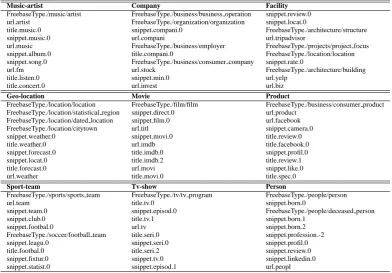
Music-artist Company Facility
FreebaseType./music/artist FreebaseType./business/business operation snippet.review.0 url.artist FreebaseType./organization/organization snippet.locat.0
title.music.0 snippet.compani.0 FreebaseType./architecture/structure
snippet.music.0 url.compani url.tripadvisor
url.music FreebaseType./business/employer FreebaseType./projects/project focus snippet.album.0 title.compani.0 FreebaseType./location/location snippet.song.0 FreebaseType./business/consumer company snippet.rate.0
url.fm url.stock FreebaseType./architecture/building
title.listen.0 snippet.min.0 url.yelp
title.concert.0 url.invest url.biz
Geo-location Movie Product
FreebaseType./location/location FreebaseType./film/film FreebaseType./business/consumer product FreebaseType./location/statistical region snippet.direct.0 url.product
FreebaseType./location/dated location snippet.film.0 url.facebook FreebaseType./location/citytown url.titl snippet.camera.0
snippet.weather.0 snippet.movi.0 title.review.0
title.weather.0 url.imdb title.facebook.0
snippet.forecast.0 title.imdb.0 snippet.profil.0
snippet.locat.0 title.imdb.2 title.review.1
title.forecast.0 url.movi snippet.like.0
url.weather title.movi.0 title.spec.0
Sport-team Tv-show Person
FreebaseType./sports/sports team FreebaseType./tv/tv program FreebaseType./people/person
url.team title.tv.0 snippet.born.0
snippet.team.0 snippet.episod.0 FreebaseType./people/deceased person
snippet.club.0 title.tv.1 snippet.born.1
snippet.footbal.0 url.tv snippet.born.2
FreebaseType./soccer/football team title.seri.0 snippet.profession.-2
snippet.leagu.0 snippet.seri.0 snippet.profil.0
title.footbal.0 title.seri.2 snippet.review.0
snippet.fixtur.0 snippet.tv.0 snippet.linkedin.0
snippet.statist.0 snippet.episod.1 url.peopl
Table 5: Top weighted features per category
ture types modeled.
Mapping baseline. As baseline, we consider the plausible strategy of rule-based mapping, align-ing SF(e), the set of Freebase tags extracted for name e (Alg. 1), with the target labels L. We manually determined a set of alignment rules for the purposes of this study, utilizing and expand-ing rules made previously available by other re-searchers (Ling and Weld, 2012). As shown, man-ual mapping applies to 80% of the entity names in the twitter dataset, for which at least one possibly matching entry in Freebase was found. The result-ing instance-level precision and recall are .54 and .60. While manual rules tend to be precise, a main source of noise lies in the proximate matching of stringeagainst FB entities. And, hand-picking FB categories for alignment hurts recall.
Single-source learning results. We first discuss our experimental results using each information source separately. Encoding the set of Freebase categories associated with e as features in the learning framework (‘FB’) substantially improves over the manual alignment rules in terms of cov-erage (.88 vs. .80) and recall (.65 vs. .60). While both methods use the same resource, the mapping rules rely on fewer high-quality FB categories.
Learning using the features derived from Web search results (‘WS’) gives perfect coverage. Per-formance using either snippet, title or URL in-formation is lower compared with the KB-lookup baseline, however when all of the Web search fea-tures are modeled, learning outperforms the map-ping baseline across all macro-level measures.
[image:7.595.103.496.216.489.2]infor-mation sources gives comparable performance– instance-level macro-F1 is .58 vs. .59, respec-tively.
Finally, classification results using ReVerb fea-tures (‘RV’) were poor, and were therefore omit-ted from the table. The coverage of these features was low, i.e., many of the example entity names were found no matching ReVerb assertions. In ad-dition, as mentioned before, ReVerb patterns are noisy in that they do not distinguish between gen-eral noun phrases and named entities. Neverthe-less, we found these features to be useful in hybrid configurations, as discussed next.
Multi-source learning. We now review named
entity typing results using multi-source learning. The modeling of both Web search and FB fea-tures improves on either one of the individual sources, reaching macro-F1 performance of .63. As shown, this gain is due to a large improvement in macro-precision, reflected also in higher entity-level accuracy (.32). We thus observe that Web search results and Freebase tags are complimen-tary in that integrating the two perspectives serves to eliminate noise, while maintaining high recall.
The best-performing system models all of the three information sources (‘WS+FB+RV’): macro-precision, recall and F1 all measure .65, improving 20.4%, 8.3% and 14% over the map-ping baseline, respectively. Similarly, accuracy improves 13% over the baseline. In what follows, we set MS-NET to this best-performing configu-ration.
Performance by type. Table 4 details the per-formance of each of the binary classifiers that comprise MS-NET, comparing it against the rule-based mapping baseline. The best results per cate-gory are shown in boldface. Table 5 further shows the features with the highest information gain per category.
As shown in Table 4, a boost in performance was achieved using MS-NET for the categories
facility (∆F1=52.6%), sportsteam (30.8%) and
product (15.9%). These types apply to a variety of
long tail entities, like local restaurants, or amateur sports teams, which are not indexed in Freebase but can be found on the Web (see dataset statis-tics in Table 2). Moderate performance gains were obtained for the categories company (8.3%) and
geolocation (5.6%).
MS-NET failed to improve on the manual
align-ment rules for highly-granular categories like
TV-show and movie. As indicated in Table 2, almost
all of the name mentions of these categories in our twitter evaluation dataset are included in Freebase. Automatic imports from external data sources like Wikipedia ensure that FB information in these ar-eas is complete and up-to-date.
Finally, learning failed to improve on person name typing. We found one reason for this to be high ambiguity of person names, resulting some-times in bias of the search results towards more popular entities with the same name. Consider, for example, the celebrity names Paris or MAC–in these cases, mentions of the city and product, re-spectively, dominate the search results. Sampling of the search results may correct possible bias to-wards highly popular entities (Anagnostopoulos et al., 2006). Lastly, some of the annotated person names in our dataset refer to non-public figures that have neither KB-, nor Web presence (Gattani et al., 2013).
7 Conclusion
We have presented and evaluated a distantly super-vised multi-source learning approach for semantic named entity typing. We believe this work to be the first to model KB information, Web-scale dis-tributional evidence and Web search results as in-formation sources in a joint framework, and the first to evaluate the task of named entity typing in the social media domain.
Our results indicate these various sources to be complimentary–their combination yields best overall performance with respect to both preci-sion and recall. In particular, multi-source learn-ing boosts typlearn-ing performance for semantic types that apply to out-of-KB entity names, which are prevalent in social media.
References
Aris Anagnostopoulos, Andrei Z. Broder, and David Carmel. 2006. Sampling search-engine results. World Wide Web, 9(4).
S˝oren Auer, Christian Bizer, Georgi Kobilarov, Jens Lehmann, and Zachary Ives. 2007. Open infor-mation extraction from the web. In Proceedings of International Joint Conference on Artificial Intelli-gence (IJCAI).
Michele Banko, Michael J. Cafarella, Stephen Soder-land, Matt Broadhead, and Oren Etzioni. 2007. Db-pedia: A nucleus for a web of open data. In Pro-ceedings of International Joint Conference on Arti-ficial Intelligence (IJCAI).
Kurt Bollacker, Colin Evans, Praveen Paritosh, Tim Sturge, and Jamie Taylor. 2008. Sfreebase: a col-laboratively created graph database for structuring human knowledge. In Proceedings of the ACM SIG-MOD international conference on Management of data (SIGMOD).
Antoine Bordes, Jason Weston, and Nicolas Usunier. 2014. Open question answering with weakly super-vised embedding models. In Proceedings of ECML-PKDD. Springer.
Andrew Carlson, Justin Betteridge, Bryan Kisiel, Burr Settles, Estevam R. Hruschka Jr., and Tom M. Mitchell. 2010. Toward an architecture for never-ending language learning. In Proceedings of AAAI Conference on Artificial Intelligence (AAAI).
David Carmel, Ming-Wei Chang, Evgeniy Gabrilovich, Bo-June (Paul) Hsu, and Kuansan Wang. 2014. Erd’14: Entity recognition and disambiguation chal-lenge. ACM SIGIR Forum, 48(2).
Kai-Wei Chang, Wen tau Yih, Bishan Yang, and Christopher Meek. 2014. Typed tensor decompo-sition of knowledge bases for relation extraction. In Proceedings of the Conference on Empirical Meth-ods in Natural Language Processing (EMNLP).
Marco Cornolti, Paolo Ferragina, Massimiliano Cia-ramita, Stefan Rued, and Hinrich Schuetze. 2014. The smaph system for query entity recognition and disambiguation. In ERD 2014: Entity Recognition and Disambiguation Challenge. SIGIR Forum.
Qing Cui, Bin Gao, Jiang Bian, Siyu Qiu, Hanjun Dai, and Tie-Yan Liu. 2015. Knet: A general framework for learning word embedding using morphological knowledge. ACM Transactions on Information Sys-tems (TOIS), 34(1).
Bhavana Bharat Dalvi, Einat Minkov, Partha Pratim Talukdar, and William W. Cohen. 2015. Automatic gloss finding for a knowledge base using ontologi-cal constraints. In Proceedings of the ACM Interna-tional Conference on Web Search and Data Mining (WSDM).
Leon Derczynski, Diana Maynard, Giuseppe Rizzo, Marieke van Erp, Genevieve Gorrell, Raphal Troncy, Johann Petrak, and Kalina Bontcheva. 2015. Anal-ysis of named entity recognition and linking for tweets. Information Processing and Management, 51:32–49.
Anthony Fader, Stephen Soderland, and Oren Etzioni. 2011. Identifying relations for open information ex-traction. In Proceedings of the Conference on Em-pirical Methods in Natural Language Processing, EMNLP ’11, pages 1535–1545, Stroudsburg, PA, USA. Association for Computational Linguistics.
Yuan Fang and Ming-Wei Chang. 2014. Entity link-ing on microblogs with spatial and temporal signals. Transactions of the Association for Computational Linguistics, 2.
Abhishek Gattani, Digvijay S. Lamba, Nikesh Garera, Mitul Tiwari, Xiaoyong Chai, Sanjib Das, Sri Sub-ramaniam, Arnand Rajaraman, Venky Harinarayan, and AnHai Doan. 2013. Entity extraction, link-ing, classification, and tagging for social media: a wikipedia-based approach. Proceedings of the VLDB Endowment, 6(11):1126–1137.
Mark Hall, Eibe Frank, Geoffrey Holmes, Bernhard Pfahringer, Peter Reutemann, and Ian H. Witten. 2009. The weka data mining software: An update. SIGKDD Explorations, 11(1).
Johannes Hoffart, Yasemin Altun, and Gerhard Weikum. 2014. Discovering emerging entities with ambiguous names. In 23rd International World Wide Web Conference, WWW ’14, Seoul, Republic of Korea, April 7-11, 2014, pages 385–396.
J. Richard Landis and Gary G. Koch. 1977. The mea-surement of observer agreement for categorical data. Biometrics, 33(1):159–174.
Thomas Lin, Mausam, and Oren Etzioni. 2012. No noun phrase left behind: Detecting and typing un-linkable entities. In Proceedings of the Confer-ence on Empirical Methods in Natural Language Processing and Computational Natural Language Learning (EMNLP-CONLL).
Xiao Ling and Daniel S. Weld. 2012. Fine-grained entity recognition. In Proceedings of the 26th Con-ference on Artificial Intelligence (AAAI).
Gjorgji Madjarova, Dragi Kocevb, Dejan Gjorgjevikja, and Sa˘so D˘zeroskib. 2012. An extensive experi-mental comparison of methods for multi-label learn-ing. Pattern Recognition, 45(9).
Marius Pasca. 2004. Acquisition of categorized named entities for web search. In Proceedings of the ACM International Conference on Information and Knowledge Management (CIKM).
of the Conference on Empirical Methods in Natural Language Processing (EMNLP).
Jesse Read, Bernhard Pfahringer, Geoff Holmes, and Eibe Frank. 2009. Classifier chains for multi-label classification. In W. Buntine, M. Grobelnik, D. Mladenic, and J. Shawe-Taylor, editors, Lecture Notes in Artificial Intelligence. Springer.
Alan Ritter, Sam Clark, Mausam, and Oren Etzioni. 2011. Named entity recognition in tweets: an ex-perimental study. In EMNLP.
Xin Rong, Zhe Chen, Qiaozhu Mei, and Eytan Adar. 2016. Egoset: Exploiting word ego-networks and user-generated ontology for multifaceted set expan-sion. In ACM International Conference on Web Search and Data Mining (WSDM).
Lev Ratinov Dan Roth. 2009. Design challenges and misconceptions in named entity recognition. In Pro-ceedings of the Conference on Computational Natu-ral Language Learning (CoNLL).
Stefan R¨ud, Massimiliano Ciaramita, Jens M¨uller, and Hinrich Sch¨utze. 2011. Piggyback: using search engines for robust cross-domain named entity recog-nition. In Proceedings of the 49th Annual Meet-ing of the Association for Computational LMeet-inguistics (ACL).
Dou Shen, Jian-Tao Sun, Qiang Yang, and Zheng Chen. 2006. Building bridges for web query classification. In Proceedings of the annual international ACM SI-GIR conference on Research and development in in-formation retrieval (SIGIR).
Fabian M. Suchanek, Gjergji Kasneci, and Gerhard Weikum. 2007. Yago: A core of semantic knowl-edge unifying wordnet and wikipedia. In Proceed-ings of the International World Wide Web Confer-ence (WWW).
Prashant Ullegaddi and Vasudeva Varma. 2011. Learn-ing to rank categories for web queries. In Proceed-ings of the ACM International Conference on Infor-mation and Knowledge Management (CIKM).
Chi Wang, Kaushik Chakrabarti, Tao Cheng, and Sura-jit Chaudhuri. 2012. Targeted disambiguation of ad-hoc, homogeneous sets of named entities. In Pro-ceedings of the International World Wide Web Con-ference (WWW).
Robert West, Evgeniy Gabrilovich Kevin Murphy, Shaohua Sun, Rahul Gupta, and Dekang Lin. 2014. Knowledge base completion via search-based ques-tion answering. In Proceedings of the internaques-tional conference on World wide web (WWW).
Yadollah Yaghoobzadeh and Hinrich Sch¨utze. 2015. Corpus-level fine-grained entity typing using con-textual information. In Proceedings of the Confer-ence on Empirical Methods in Natural Language Processing (EMNLP).
Ikuya Yamada, Hideaki Takeda, and Yoshiyasu Take-fuji. 2015. Enhancing named entity recognition in messages using entity linking. In Proceedings of the ACL 2015 Workshop on Noisy User-generated Text.