ORIGINAL ARTICLE
IJPHY
ABSTRACT
Background: Breast cancer is a prevalent disease that requires intense and prolonged treatments. Because of improved detection and treatment options, the mortality rate from breast cancer has decreased, greatly increasing the number of survivors who are living with the disease and its side effects. Fatigue is one of the most common debilitating symptoms experienced by patients with cancer. It is a persistent feeling of exhaustion and decreased physical and mental capacity unrelieved by rest or sleep. The purpose of current study was to evaluate the effect of high intensity physical training exercise program in improving breast cancer related fatigue.
Methods: Forty six patients suffering from breast cancer related fatigue, were randomly divided into two groups of equal number. Exercise group (E); received high intensity physical training program while Control group (C) received usual medical care and kept their habitual activity. The intensity of fatigue and quality of life score were measured at the beginning and after eight weeks of treatment.
Results: Results of the study showed that there was significant reduction of fatigue after eight weeks in exercise (E) group more than control group with the percentage of improvement was 53%, 2% respectively. As regard to QOL mea-surements, there was significant increase of QOL score after treatment in exercise (E) group more than control group with the percentage of improvement was 43%, 3% respectively.
Conclusion: High intensity physical exercise program may have beneficial effects in reduction of fatigue intensity and thereby improving quality of life in breast cancer patient.
Keywords: Breast cancer related fatigue, Exercise, Revised Piper Fatigue Scale, Functional Assessment of Cancer Ther-apy-Breast
Received 10th December 2015, revised 27th December 2015, accepted 21st January 2016
www.ijphy.org
10.15621/ijphy/2016/v3i1/88905
CORRESPONDING AUTHOR
Int J Physiother. Vol 3(1), 29-34, February (2016) ISSN: 2348 - 8336
HIGH INTENSITY PHYSICAL TRAINING EXERCISE
PROGRAM IN IMPROVING BREAST CANCER
RELAT-ED FATIGUE
*1
Intsar S. Waked
2
Asmaa F. Attalla
3
Abdel Hamid N. Deghidi
*1Intsar S. Waked
Assistant Professor,
Department of physical Therapy for surgery, Faculty of Physical Therapy,
Cairo University, Egypt. ²Lecturer of Physical Therapy,
Department of physical Therapy for surgery, Faculty of Physical Therapy,
Cairo University, Egypt. ³Lecture of physical therapy,
College of Applied Medical Sciences, Majmaah University,
INTRODUCTION
Breast cancer is the second-leading cause of cancer-relat-ed deaths among women agcancer-relat-ed less than 50 years. Breast cancer is an economic burden, with its cost of illness be-ing comprised of direct cost, morbidity cost, and mortality cost. Over extended periods, cancer expenditures are in-creasing at a similar rate to overall health costs [1].
Cancer and its treatment result in behavioral symptom distress, and one of the most pervasive and distressing symptoms is fatigue [2]. Cancer-related fatigue (CRF) can be defined as a “persistent, subjective sense of tiredness re-lated to cancer and cancer treatment that interferes with usual functioning” [3]. CRF is more intense than typical fatigue and may be due to the disease itself and/or cancer treatment [4].
Fatigue is one of the most common and debilitating symp-toms experienced by patients with cancer. CRF is char-acterized by feelings of tiredness, weakness, and lack of energy, and is distinct from the “normal” drowsiness expe-rienced by healthy individuals in that it is not relieved by rest or sleep. It occurs both as a consequence of the cancer itself and as a side effect of cancer treatment such as che-motherapy, radiotherapy, although the precise underlying pathophysiology is largely unknown [5] [6].
CRF may be an early symptom of malignant disease and is reported by as many as 40% of patients at diagnosis. Vir-tually all patients expect fatigue from cancer therapy. It is known that fatigue is the commonest side-effect of chemo-therapy and radiochemo-therapy: it has been shown that 65–100% of patients undergoing radiotherapy [7-9] and up to 82– 96% of those receiving chemotherapy [10-11] suffer from fatigue during their treatment. Deconditioning due to fur-ther reduction of physical activity in cancer patients might even further affect feelings of fatigue [12].
Frequently, the fatigue causes patients to avoid strenuous activities. This reduced level of activity results in a para-doxical relationship, however. Inactivity leads to fatigue in and of its self, while the fatigue leads to inactivity [13]. The fatigue may also lead to cognitive dysfunction and post-ex-ertional malaise that further exacerbate the decreased quality of life feelings[14].CRF is associated with consid-erable psychological distress and can impose a significant financial burden by limiting a patient’s ability to work[15]. An important goal for cancer patients is to improve the quality of life (QOL) by maximizing functions affected by the disease and its therapy. Research has provided prelim-inary evidence for the safety, feasibility, and efficacy of ex-ercise training in breast cancer survivors[16]. Researchers say that a combination of supervised strength and aerobic training not only reduces fatigue, but helps patients ac-tually increase muscle fitness during the first 18 weeks of treatment however there were no guidelines about which exercises more suitable to cancer patient regarding exercis-es intensity and duration.
SUBJECTS AND METHODS
Subjects
This study was conducted at National Cancer Institute, Egypt between July 2013 and June 2015. Fifty two female patients suffering from fatigue resulting from cancer and its treat-ment such as chemotherapy or radiotherapy were enrolled in the study. Inclusion criteria were age of the patients ranged from 35-65, patients scheduled for chemotherapy, patients are also scheduled for radiotherapy, only subjects in good physical condition without anemia or cardiovascular, pul-monary, thromboembolic complications, or other important comorbidities, were included. The exclusion criteria were non consenting patients, Bed ridden patients, patient with bone malignancies, patients with central nervous system malignancies, patients with co-morbidities where exercise is contraindicated such as acute or chronic bone, joint, or mus-cular abnormalities. Forty six patients were met inclusion criteria and randomized into two groups of equal number Exercise group (E), and a control group (C). Concealed domization was achieved using a computer-generated ran-dom list.
Measurement procedures
Validated questionnaires were used; Primary outcome: fa-tigue (Revised Piper Fafa-tigue Scale). Secondary outcome: quality of life (The Functional Assessment of Cancer Thera-py-Breast (FACT-B). Measurements were done at the begin-ning and the end of study period.
Primary outcomes: Revised Piper Fatigue Scale [17-19] Revised Piper Fatigue Scale (PFS-R) is a valid and reliable multidimensional scale that routinely used by medical re-searchers to scientifically measure fatigue levels in patients during clinical studies. 22-question scale is divided into four different subscales, involves ranking each item on a scale of 0-10, where higher scores indicate greater fatigue. The four subscales arebehavioral/severity, sensory, cognitive/mood, and affective meaning. These 22 items are used to calculate the four sub-scale/dimensional scores and the total fatigue scores. Five additional items (# 1 and # 24-27) are not used to calculate subscale or total fatigue scores but are recom-mended to be kept on the scale as these items furnish rich, qualitative data. To score the PFS, the items contained on each specific subscale were added together and divided by the number of items on that subscale. This gave a subscale score that remains on the same “0” to “10” numeric scale. To calculate the total fatigue score, add the 22- item scores together and divide by 22 in order to keep the score on the same numeric “0” to “10” scale. Severity codes: 0 None, 1-3 Mild, 4-6 Moderate, 7-10 Severe.
Secondary outcomes:
The Functional Assessment of Cancer Therapy-Breast (FACT-B) [20-22]
in assessing treatment outcomes. The FACT-B is widely used in international clinical trials and health services research. a 43-item self-report instrument designed to measure multi-dimensional quality of life (QL) in patients with breast can-cer. FACT-B Total scores can range from 0-144 with the higher the score indicating thegreater the overall quality of life. The FACT-B consists of the FACT-General (FACT-G) plus the Breast Cancer Subscale (BCS), which complements the general scale with items specific to QL in breast cancer. The general FACT (FACT-G) is multidimensionalconsisting of subscales assessing physical, emotional, social, functional well-being, and relationship with doctor. The FACT-B is ap-propriate for use in oncology clinical trials, as well as in clin-ical practice. It demonstrates ease of administration, brevity, reliability, validity, and sensitivity to change.
Treatment procedures [23-25]
Patients in Exercise group (E) received high-intensity physical training session lasting 90 minutes, three times per week for 8 weeks. The high-intensity exercise program session involved resistance training on machines, such as leg and chest presses, and cardiovascular training on a sta-tionary exercise bike. The session consisted of 30 minutes of warm-up exercises, 45 minutes of resistance training, and 15 minutes of cardiovascular training. The warm-up consisted of dynamic exercises with the large muscle groups, along with balance and coordination training and had an estimated average intensity of 9 METs (4.5 MET hours per training session)., six machines were used for resistance training: a leg press, a chest press, a pull down, an abdominal crunch, a lower back, and a knee extension. The one repetition maximum test was used to measure the weight a patient could lift once on any specific machine. The aim of the resistance training component was to ac-complish three continuous series of five to eight repetitions at 70-100% of the one repetition maximum test. Resistance training was estimated to have an intensity of 5.5 METs (4 MET hours per training session). Cardiovascular training involved interval training on stationary bicycles with a workload of 70-250 W, equivalent to 85-95% of each par-ticipant’s maximum heart rate. This training was estimat-ed to have an intensity of 15 METs (3.75 MET hours per training session). Practical and safety guidelines include; patients were advised to wear proper clothing, to work within recommended exercise level, and did not work to exhaustion, to stop training if they feel any pain or abnor-mal sensation, to keep diaries in order to register their ac-tivities daily and any notes. Patients assigned to the control group (C) received conventional medical care. They were asked to maintain their habitual physical activity pattern. STATISTICAL ANALYSIS
Continuous variables were presented as mean and stan-dard deviation while categorical variables were described by frequency and percentage. Paired T-test was used to test the differences in outcome measures within group while independent t –test was used to compare the effect between both groups for parametric statistics while Manwhitnety
used to compare the effect between both groups for non-parametric statistics. Differences were assumed significant at p value <0.05. Statistical analysis were performed using statistical package for the Social Sciences (SPSS) version 20.0.
RESULTS
Out of 52 patients, 46 patients were met the inclusion cri-teria and were classified randomly into 2 groups of equal number. Exercise Group (E) received high intensity phys-ical training program and Control Group received only usual medical care. All 46 patients complete treatment procedures and analysis. Table (1) showed demographic and clinical characteristics at baseline of treatment. The two groups were comparable in respect to age (p = 0.587), Education level (p = 0.512), cancer stage (p = 0.743), type of cancer treatment (p = 0.936), employment (p = 0.365), marital status (p = 0.205), baseline fatigue level (p = 0.092), baseline quality of life (p = 0.502), there were no significant differences as p value > 0.05.
Table 1: Demographic and clinical characteristics of pa-tients at baseline of treatment
Variable Exercise group (N. 23)
Control group
(N.23) P value
Age (years) 49.82±9.9 48.3±8.9 0.587*
Education level
• Illiterate
• Primary
• Secondary
• College/uni
-versity
8 (34.8%) 8 (34.8%) 3 (13.0%) 4 (17.4%)
6 (26.1%) 9 (39.1%) 2 (8.7%)
6 (26.1%) 0.512*
cancer stage
• Local
• Loco-regional
• Metastasis
5 (21.7%) 9 (39.1%) 9 (39.1%)
7 (30.4%) 7 (30.4%)
9 (39.1%) 0.743*
Type of cancer treatment
• Mastectomy
• Chemother -apy
• Radiotherapy
• Conservative
surgery
6 (26.1%) 9 (39.1%) 3 (13.0%) 5(21.7%)
7(30.4%) 8 (34.8%) 2 (8.7%)
6 (26.1%) 0.936*
Employment
• Employ
• Not employ 16 (69.6 %)7 (30.4%) 13 (56.5%)10 (43.5%) 0.365*
Marital status
• Married
• Not married 18 (78.3%)5 (21.7%) 14 (60.9%)9 (39.1%) 0.205*
Baseline fatigue
level 8.39±1.26 8.95±0.93 0.092* Baseline quality
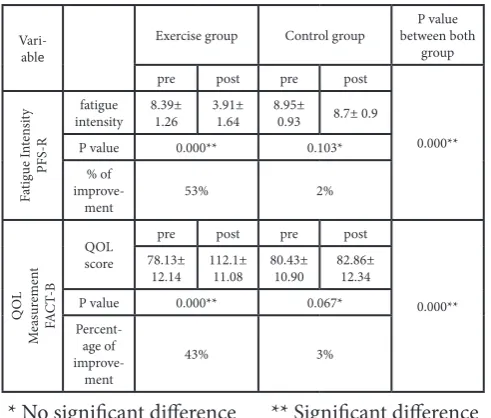
Table (2) represent statistical analysis of fatigue intensity & quality of life measurements. There was significant reduc-tion of fatigue after treatment in Exercise (E) group with the percentage of improvement was 53% while for Control group there was no significant difference pre & post treat-ment as p value=0.103. When comparing exercise & con-trol groups there were highly significant differences post treatment as p =0.000. As regard to QOL measurements, there was significant increase of QOL score after treatment in Exercise (E) group with the percentage of improvement was 43% while for Control group there was no significant difference pre & post treatment as p value=0.067. When comparing exercise & control groups regarding QOL score there were highly significant differences post treatment as p =0.000.
Table 2: Statistical analysis of fatigue intensity & quality of life measurements
Vari-able
Exercise group Control group between both P value group
pre post pre post
0.000**
Fa
tigue I
nt
en
sit
y
PFS-R
fatigue
intensity 8.39± 1.26 3.91± 1.64 8.95± 0.93 8.7± 0.9
P value 0.000** 0.103*
% of
improve-ment 53% 2%
Q
OL
M
ea
sur
em
en
t
FA
CT
-B
QOL score
pre post pre post
0.000** 78.13±
12.14 112.1± 11.08 80.43± 10.90 82.86± 12.34
P value 0.000** 0.067*
Percent-age of
improve-ment
43% 3%
* No significant difference ** Significant difference Figure 1: Percentage of improvement in QOL and Fatigue
DISCUSSION
Previously physicians recommended rest in order to re-lieve from cancer related fatigue (CRF), However this approach often acts counterproductive as lack of activity leads to “atrophy of muscles and loss of cardio-respiratory fitness.”[26-27]The rationale for recommending physical activity interventions following cancer diagnosis relates to improving psychosocial factors during and after cancer treatments, minimizing biological processes associated with cancer promotion and enhancing behavioral changes
of cancer [28-30].
This randomized controlled study was designed to evalu-ate the effect of application of high intensity physical ex-ercise program in improving breast cancer related fatigue (BCRF). Forty six patients suffering from BCRF was ran-domized into 2 groups of equal number, exercise group who received high intensity physical training program and control group who received usual medical care and kept their habitual activity. Fatigue intensity and QOL scoring were measured at the beginning of the study and after 8 weeks by PEF-R scale and FACT-B scale respectively. Results of the study showed that there was significant re-duction of fatigue after 8 weeks in exercise (E) group more than control group with the percentage of improvement was 53%, 2% respectively. As regard to QOL measure-ments, there was significant increase of QOL score after treatment in exercise (E) group more than control group with the percentage of improvement was 43%, 3% respec-tively, This confirm the effectiveness of exercises in im-proving fatigue and quality of life in patients with breast cancer. The mechanism believed for improving fatigue is that engaging in exercise early in the breast cancer treat-ment process helps to change physical and emotional dy-namics at a critical time, both by breaking the “vicious cy-cle” of “a self-perpetuating detraining state” that induces fatigue, and by increasing feelings of “general self-efficacy and mastery” among patients in treatment.
In this study, high intensity physical exercise program was applied for 90 minutes and this results in improving fatigue and quality of life. These findings were supported by the findings Dimeo et al 's study [31], who stated that even brief periods of exercise may be sufficient to reduce fatigue and also it appears that exercising for longer duration reduces fatigue more, but providing an exercise recommendation that is realistic and achievable for women is paramount. Another study of Admasen et al [25], reported that super-vised exercise programs that include high and low intense cardiovascular and resistance training can help reduce fatigue in patients with cancer who are undergoing adju-vant chemotherapy or treatment for advanced disease. The exercise training also improves patients' vitality, muscular strength, aerobic capacity and emotional well-being, ac-cording to research.
Other recent controlled studies [32-33]have shown that aerobic exercises prevent worsening fatigue and psycholog-ical stress in patients receiving high-dose therapy. Further-more, in women with breast cancer receiving chemothera-py, exercise can significantly reduce the level of fatigue, and as the duration of exercise increases, the intensity of fatigue declines. Regarding side effects, our study reported that no one report any discomfort or side effect during application of high intensity physical exercise program.
CONCLUSION
phys-ical exercise program may have beneficial effects in reduc-tion of fatigue intensity and thereby improving quality of life in breast cancer patient.
CONFLICT OF INTEREST
We certify that there is no conflict of interest with any fi-nancial organization regarding the material discussed in the manuscript.
SOURCE OF FUNDING
This research received no specific grant from any funding agency in the public, commercial, or not / for profit sectors.
REFERENCES
[1] Brown ML, Lipscomb J, Snyder C: The burden of ill-ness of cancer: economic cost and quality of life. Annu Rev Public Health. 2001; 22:91-113.
[2] Berger AM, Visovsky C, Hertzog M, Holtz S, Loberiza FR Jr. Usual and Worst Symptom Severity and Inter-ference With Function in Breast Cancer Survivors. J Support Oncol. 2012; 10(3):112–118.
[3] Mock V, Atkinson A, Barsevick A, et al. NCCN Practice Guidelines for Cancer-Related Fatigue. Oncology (Williston Park). 2000;14:151-161.
[4] Hofman M, Ryan JL, Figueroa-Moseley CD, Jean-Pierre P,Morrow GR: Cancer-related fatigue: the scale of the problem. Oncologist. 2007;12(Suppl 1):4–10
[5] Cella D, Davis K, Breitbart W, et al. Cancer-related fatigue: Prevalence of proposed diagnostic criteria in a United States sample of cancer survivors. J ClinOn-col. 2001; 19(14):3385-3391.
[6] Irvine D, Vincent L, Graydon JE, et al. The prevalence and correlates of fatigue in patients receiving treatment with chemotherapy and radiotherapy. A comparison with the fatigue experienced by healthy individuals. Cancer Nurs. 1994; 17(5):367-378.
[7] Ream L, Richardson A. Fatigue: a concept analysis. Int J Nurs Stud 1996; 33(5):519–529.
[8] [8] Virginia Carrieri-Kohlman, et al. Pathophysiolog-ical Phenomena in Nursing: Human Response to Ill-ness.3rd edi; 2003.
[9] Blesch K, Paice J, Wickam R et al. Correlates of fatigue in people with breast or lung cancer. Oncol Nurs Fo-rum 1991; 18(1): 81–87.
[10] Tierney A, Leonard R, Taylor J et al. Side effects ex-pected and experienced by women receiving chemo-therapy for breast cancer. BMJ 1991; 302: 272.
[11] Nerenz DR, Leventhal H, Love RR. Factors contribut-ing to emotional distress durcontribut-ing chemotherapy. Can-cer. 1982; 50(5): 1020–1027.
[12] Ballard-Barbash R. Physical activity levels among
breast cancer survivors. Med Sci Sports Exerc. 2004. 36(9):1484-1491.
[13] Dimeo F. C and Thomas F. Effects of exercise on can-cer-related fatigue. Cancer. 2001. 92(6), 1689-1693.
[14] Dimeo F.C., Thomas F., Raabe-Menssen C., Propper F. and Mathias M. Effect of aerobic exercise and relax-ation training of fatigue and physical performance on cancer patients after surgery. A randomised controlled
trial. Support Care Cancer.2004; 12(11); 774-779.
[15] Hofman M1, Ryan JL, Figueroa-Moseley CD,
Jean-Pierre P, Morrow GR. Cancer-related fatigue: the scale of the problem. Oncologist. 2007;12Suppl 1:4-10.
[16] Courneya KS, Mackey JR, McKenzie DC. Exercise
after breast cancer: Research evidence and clinical guidelines. Physician Sportsmed. 2002,30:33-42
[17] Travier N, Velthuis MJ, Steins Bisschop CN, van den Buijs B, et al, Effects of an 18-week exercise pro-gramme started early during breast cancer treatment: a randomized controlled trial. BMC Med. 2015; 13: 121.
[18] Piper B.F., Dibble S.L., Dodd M.J., Weiss M.C., Slaugh-ter R.E. and Paul S.M. The revised piper fatigue scale: Psychometric evaluation in women with breast cancer. Oncology Nursing Forum.1998; 25(4):677-684.
[19] Reeve BB, Stover AM, Alfano CM, Smith AW,
Bal-lard-Barbash R, Bernstein L McTiernan A, Baumgart-ner KB, Piper BF. The Piper Fatigue Scale-12 (PFS-12): psychometric findings and item reduction in a cohort of breast cancer survivors. Breast Cancer Res Treat. 2012;136(1):9-20.
[20] Cantarero-Villanueva I, Fernández-Lao C,
Díaz-Ro-dríguez L, Cuesta-Vargas AI,Fernández-de-las-Peñas C, Piper BF, Arroyo-Morales M. The Piper Fatigue Scale-Revised: translation and psychometric evalua-tion in Spanish-speaking breast cancer survivors. Qual Life Res. 2014;23(1):271-6.
[21] Brady MJ1, Cella DF, Mo F, Bonomi AE, Tulsky
DS, Lloyd SR, Deasy S, Cobleigh M, Shiomoto G. Re-liability and validity of the Functional Assessment of Cancer Therapy-Breast quality-of-life instrument. Cli-nOncol. 1997; 15(3):974-86.
[22] Thompson P., (2007). The relationship of fatigue and meaning of life in breast cancer survivors. Oncology Nursing Forum, 34(3), 653-660.
[23] Dimeo F.C., Thomas F. Raabe-Menssen C., Propper F. and Mathias M. Effect of aerobic exercise and relax-ation training of fatigue and physical performance on cancer patients after surgery. A randomised controlled trial. Support Care Cancer.2004; 12(11):774-779.
[24] Saltin B, Gollnick PD. Skeletal muscle adaptabili-ty: significance for metabolism and performance. In: Peachey LD, Adrian PH, Geiger SR, eds. Handbook of physiology, sektion 10: skeletal muscle. American Physiological Society, 1983:555-631.
[25] Adamsen L, Quist M, Andersen C, Møller T Herrstedt, J, Kronborg D et al. Supervised exercise program sig-nificantly improved fatigue in cancer patients under-going chemotherapy; BMJ 2009.
[26] Cramp F, Daniel J. Exercise for the management of cancer-related fatigue in adults. Cochrane Database Syst Rev. 2008, 16;(2):CD006145.
[27] Jose S, Diwan SK. Effect of standardized exercise pro-gram on reported fatigue in patients of cancer receiving chemotherapy. Clin Cancer Investig J 2014;3(5):373-6
Moderate exercise training and natural killer cell cy-totoxic activity in breast cancer patients. Int J Sports Med. 1995; 16(5):334-7.
[29] Stoll BA. Diet and exercise regimens to improve breast carcinoma prognosis. Cancer. 1996;78(12):2465-70.
[30] Courneya KS. Exercise interventions during cancer treatment: biopsychosocial outcomes. Exerc Sport Sci Rev. 2001;29(2):60-4
[31] Dimeo, f. c., m. h. m. Tilmann, h. Bertz, l. kanz, r. Mer-telsmann, and j. keul. Aerobic exercise in the rehabili-tation of cancer patients after high dose chemotherapy
Citation
Intsar S. Waked, Asmaa F. Attalla, & Abdel Hamid N. Deghidi. (2016). HIGH INTENSITY PHYSICAL TRAINING EXERCISE PROGRAM IN IMPROVING BREAST CANCER RELATED FATIGUE. International Journal of Physio-therapy, 3(1), 29-34.
and autologous stem cell transplantation. Cancer.1997; 79(9):1717-1722.
[32] Dimeo FC, Stieglitz RD, Novelli-Fischer U et al. Effects of physical activity on the fatigue and psychologic sta-tus of cancer patients during chemotherapy. Cancer. 1999; 85(10): 2273–2277.