Original Research Article
Assessment of knowledge and practice of menstrual hygiene among
school going adolescent girls in an urban area of Odisha:
a cross sectional study
Sasmita Pradhan
1*, Krishna Kar
2, Barada Prasanna Samal
3, Jagannath Pradhan
4INTRODUCTION
Females have always been in a position to take a lead role in the health of a family. They play several roles like as a daughter, a sister, a wife, a mother and a grandmother in their lives. As a mother, being a pivot in the family, she is considered to be the first teacher of the offspring. Such an
important person in the society always needs to be stress free and to haves a right to enjoy a good status of health.1
In the life of a female, the transition from childhood to adulthood occurs during period of adolescence which according to WHO extends from 10-19 years of age.2 It starts with the onset of menarche, a milestone in a woman’s life and denotes the beginning of her
ABSTRACT
Background: In the life of a female, menarche denotes the beginning of her reproductive capacity. Menstrual hygiene
is an issue that every girl has to deal with in her life, but there is lack of awareness on the process of menstruation, the physical and psychological changes associated with puberty and proper requirement for managing menstruation.
Methods: A cross-sectional study was conducted from October 2016 to December 2016 in the urban field practice area of SCB Medical College. One government high school and one private high school were selected purposively. A purposeful convenience sampling was done to select the girls who were studying in 8th, 9th and 10th standard. Data collected from 165 adolescent school girls using a predesigned, pretested and structured questionnaire. The objective of the present study is to assess the knowledge and practices regarding menstrual hygiene among school going adolescent girls and to know about the restrictions imposed upon them during menstruation.
Results: Most of the adolescent girls (61.82%) had attained menarche between 13-15 years of age. 59.39% girls were
aware about menstruation before menarche. The source of information about menstruation was the mother or elder sister in most of the girls (81.21 %), followed by teachers/friends in case of 18.79 % girls. 84.85% of the girls used only sanitary pad, 4.24% used only cloth and the rest 10.91% used both sanitary pad and cloth during menstruation.
Conclusions: Maintenance of menstrual hygiene was better in private school girls as compared to government school
girls. Health education sessions about menstrual hygiene should be conducted in the schools for spreading awareness regarding menstruation and menstrual hygiene.
Keywords: Adolescent girls, Knowledge, Practice, Menstrual hygiene
1
Department of Community Medicine, 3Department of Orthopedics,Veer Surendra Sai Institute of Medical Science and Research, Burla, Odisha, India
2Department of Community Medicine, PRM Medical College, Baripada, Odisha, India
4Department of Community Medicine, Veer Surendra Sai Institute of Medical Science and Research, Burla, Odisha,
India
Received: 21 June 2019
Accepted: 02 August 2019
*Correspondence:
Dr. Sasmita Pradhan,
E-mail: [email protected]
Copyright: © the author(s), publisher and licensee Medip Academy. This is an open-access article distributed under
the terms of the Creative Commons Attribution Non-Commercial License, which permits unrestricted non-commercial use, distribution, and reproduction in any medium, provided the original work is properly cited.
reproductive capacity of woman.3,4 For most girls, menarche is a negative, frightening experience, or, at the best, a nuisance, or is something to fear or to be ashamed of. Restrictions in daily activities such as not being allowed to take bath, change clothes, comb hair, entering holy places and even dietary restrictions are also imposed during the menstrual period.5
Menstrual hygiene is an issue that every girl has to deal with in her life, but there is lack of awareness on the process of menstruation, the physical and psychological changes associated with puberty and proper requirement for managing menstruation. The taboos surrounding this issue in the Indian society prevent girls and women from articulating their menstrual needs. The problems of poor menstrual hygiene management have been ignored or misunderstood by the society as well the policy makers till now.6
The present study was done to assess knowledge, status of hygiene and practices regarding menstruation among adolescent girls and study various factors affecting it.
Objectives
The objective of the present study is to assess and compare the knowledge and practices of menstrual hygiene among adolescent girls studying in government and private schools and to assess the restrictions imposed upon them during menstruation.
METHODS
Study design
A cross-sectional study.
Study period
The study was conducted from October 2016 to December 2016.
Study population
Adolescent girls reading in the schools, situated in the urban field practice area of the department of Community Medicine of SCB Medical College, Cuttack.
Written permission for conducting the research work was taken from the District Education Officer, Cuttack and a list of schools, located in the urban field practice area was prepared. There were 3 government high schools and 2 private high schools. The study was conducted in 1 government high school and 1 private high school that were selected purposively. A purposeful convenience sampling was done to select the girls who were studying in 8th, 9th and 10th standard. A total of 165 girls studying in the selected schools constitute the study sample.
After taking permission from the school authorities, the aim of study was explained to the students. They were assured that all the data obtained would be kept confidential and used for only statistical purposes. A pre-designed, pre-tested and structured questionnaire was used to collect data regarding awareness about menstruation, the sources of information regarding menstruation, the hygienic practices during menstruation, queries about the type of absorbent used, the frequencies of changing and cleaning them and how it is affecting their day-to-day activity. Then a session on educating the girls about the normal physiology of menstruation, the importance of maintaining hygiene and safe hygienic practices during menstruation was conducted.
Exclusion criteria
Students with chronic illnesses and/or on long term medications. Those students who were unwilling to participate in the study and who had not attained menarche were excluded from the study.
Data analysis
Data thus collected were entered and analyzed by using the software SPSS 21 version in the Department of Community Medicine, S.C.B Medical College and appropriate statistical measures i.e., percentages and Chi-square test were applied in this study.
RESULTS
Table 1 shows that the age of study subjects ranged between 13-15 years, mean age was 14.06 years. Majority of students (57.57%) belonged to nuclear families.
Table 1: Demographic profile of adolescent girls in government vs. private schools.
Demographic characteristics
Private school (n=80)
Government school (n=85)
Total (n=165)
χ2 value P value
Age in years
13 24 (30) 29 (34.12) 53 (32.12)
1.634 0.44
14 27 (33.75) 21 (24.71) 48 (29.1)
15 29 (36.25) 35 (41.17) 64 (38.78)
Type of family
Nuclear 53 (66.25) 42 (49.41) 95 (57.57)
8.76 0.01
Joint 21 (26.25) 23 (27.06) 44 (26.67)
Demographic characteristics
Private school (n=80)
Government school (n=85)
Total (n=165)
χ2 value P value
3 generation 6 (7.5) 20 (23.53) 26 (15.76)
Occupation of mother
Housewife 71 (88.75) 81 (95.29) 152 (92.12)
2.43 0.11
Working 9 (11.25) 4 (4.71) 13 (7.88)
Education of mother
Illiterate 1 (1.25) 6 (7.05) 7 (4.25)
9.98 0.04
Primary school certificate 4 (5.0) 7 (8.24) 11 (6.66)
Middle school certificate 20 (25) 28 (32.95) 48 (29.1)
High school certificate 29 (36.25) 31 (36.47) 60 (36.36)
Graduate and above 26 (32.5) 13 (15.29) 39 (23.63)
*Numbers in parenthesis indicate percentage.
23.53% students from government school belonged to 3 generation families in comparison with only 7.5% in private school. This difference in both the schools was statistically significant (p=0.01). Mother’s educational status of students studying in private school was better than government school. More number of (32.5%) mothers of students of private school was graduate as compared to 15.29% in government school. Statistically significant difference (P=0.04) was there in the educational status of mothers in both type of schools.
Table 2 shows that most of the study subjects (61.82) had attained menarche between 13-15 years of age. While 98 (59.39%) girls were aware about menstruation before menarche, the remaining 67 (40.61%) were not. The source of information about menstruation was the mother or elder sister in most of the girls (81.21%) while teachers/friends were the source of information in case of 18.79% girls.
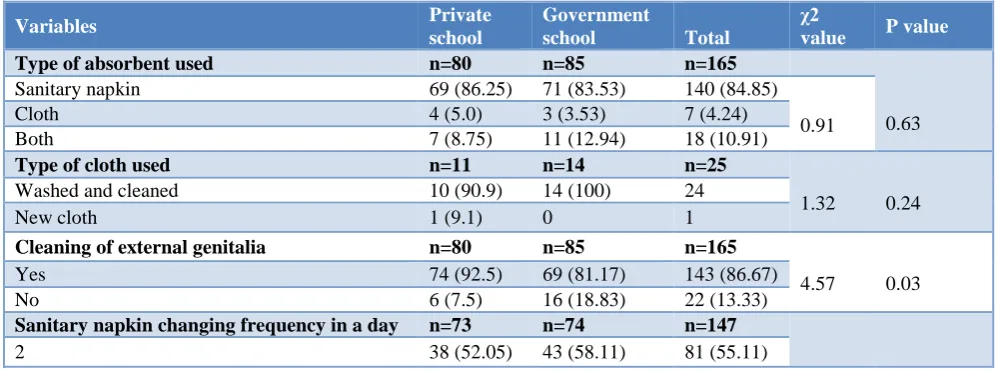
Personal hygiene plays a very important role during menstruation. Table 3 shows 84.85% of the girls used only sanitary pad, 4.24% used only cloth and the rest 10.91% used both sanitary pad and cloth during menstruation. Most of the female students of private
school used sanitary pad in comparison to 83.53% of government school. Statistically significant difference is there that more number of girls in private school clean their external genitalia during menstruation than government school girls. 44.89% of the girls used to change the pad 3 times or more in a day during menstruation. Pad disposal by wrapping with paper was practiced by 57.14% of girl students. Proper disposal of used sanitary pad found in more proportion female students of private school (58.91%).
Table 2: Age of menarche, knowledge of adolescent school girls about menstruation (n=165).
Variables N %
Age of menarche (in years)
10-12 63 38.18
13-15 102 61.82
Awareness about menstruation before menarche
Yes 98 59.39
No 67 40.61
Source of information before menarche
Mother/elder sister 134 81.21
School teacher 4 2.42
Friends 27 16.37
Table 3: Maintenance of menstrual hygiene by the adolescent girls of government vs. private school (n=165).
Variables Private
school
Government
school Total
χ2
value P value
Type of absorbent used n=80 n=85 n=165
0.63
Sanitary napkin 69 (86.25) 71 (83.53) 140 (84.85)
0.91
Cloth 4 (5.0) 3 (3.53) 7 (4.24)
Both 7 (8.75) 11 (12.94) 18 (10.91)
Type of cloth used n=11 n=14 n=25
1.32 0.24
Washed and cleaned 10 (90.9) 14 (100) 24
New cloth 1 (9.1) 0 1
Cleaning of external genitalia n=80 n=85 n=165
4.57 0.03
Yes 74 (92.5) 69 (81.17) 143 (86.67)
No 6 (7.5) 16 (18.83) 22 (13.33)
Sanitary napkin changing frequency in a day n=73 n=74 n=147
2 38 (52.05) 43 (58.11) 81 (55.11)
Variables Private school
Government
school Total
χ2
value P value
≥3 35 (47.95) 31 (41.89) 66 (44.89) 0.54 0.46
Method of disposal
1.32 0.24
a. Cloth n=11 n=14 n=25
Washing and reusing 10 (90.9) 14 (100) 24 (96)
Wrapping and dumping 1 (9.1) 0 1 (4)
b. Sanitary napkin n=73 n=74 n=147
1.14 0.56
Wrapping and dumping 43 (58.91) 41(55.4) 84 (57.14)
Dumping without wrapping 26 (35.62) 31 (41.89) 57 (38.77)
Flusing out 4 (5.47) 2 (2.71) 6 (4.09)
*Numbers in parenthesis indicate percentage.
Table 4: Type of restriction followed during menses.
Restriction imposed during menstruation
Private school
Government school
Total χ2 value
P value
Restriction imposed n=80 n=85 n=165
5.12 0.02
Yes 47 (58.75) 64 (75.29) 111 (67.27)
No 33 (41.25) 21 (24.71) 54 (32.73)
Type of restriction (multiple responses) n=47 n=64 n=111
0.91 0.82
Don’t attend religious function 34 (72.34) 47 (73.43) 81 (72.97)
Don’t do household work 16 (34.04) 18 (28.12) 34 (30.63)
Don’t play 17 (36.17) 19 (29.68) 36 (32.43)
Sleep separately 08 (17.02) 14 (21.87) 22 (19.81)
*Numbers in parenthesis indicate percentage.
Table 5: Distribution of adolescent girls according to school absenteeism during menses.
Private school (n=80)
Government school (n=85)
Total
(n=165) χ2 value P value
Absent from school during menses
Yes 12 (15) 27 (31.76) 39 (23.64)
6.41 0.01
No 68 (85) 58 (68.24) 126 (76.36)
*Numbers in parenthesis indicate percentage.
Table 6: Distribution of adolescent girls according to the reason for not attending school during menses (n=39).
Reason Private school
(n=80)
Government school (n=85)
Total (n=165)
χ2
value p-value
Lack of provision for disposal of
soiled pads/cloth 02 (16.67) 08 (29.63) 10 (25.64)
1.03 0.59
Pain or discomfort 03 (25) 04 (14.81) 07 (17.95)
Fear of getting stain on clothes 07 (58.33) 15 (55.56) 22 (56.41)
*Numbers in parenthesis indicate percentage.
Table 4 shows that 75.29% of girls in government school and 58.75% of girls in private school have certain restriction during menstruation, the difference is statistically significant. Among all restriction imposed most common was that they didn’t attend religious function.
More number of girls of government school (31.76%) were absent in school during their menstruation than that of private school. The difference was statistically significant. Most common reason for absenteeism in school was fear of getting stain on clothes (56.41%)
followed by lack of provision for disposal of soiled pads/clothes.
DISCUSSION
government school and the difference is significant statistically. In the present study it was found that 59.39% girls were aware about menstruation before puberty. Nearly similar results were found in the study by Ray et al.3
The main source of information of menstruation before menarche in present study was mothers or elder sisters of the girls (81.21%).This is similar to the study done by Thakre et al in which mothers were the main informant followed by sisters in 71.33% and 23.78% girls respectively.4 It was found that during menstruation 84.85% of the study subjects used only sanitary pad in the present study than that of 44.1% in the study by
Shanbhag D et aland 11.25% in the study conducted by
Dasgupta et al.7,8
In the present study, majority of the girls (67.27%) had certain type of restriction imposed during menstruation. Most of them were restricted not to attend the religious functions during menstruation. Similar results were reported by the studies conducted by Ray et al and Dasgupta et alwhere 75% and 70 % respectively were restricted to attend religious places.3,8 30.63% adolescent school girls in the present study were not allowed to perform house hold works but the study by Dasgupta et al and Lalwhere 16 % &15% girls were not allowed to perform house hold works respectively.1,8
In the present study 39 (23.64%) of the adolescent girls were found to be absent from school during their menses in comparison to a study done by Kumar et al where 42.8% adolescent girls were absent from school during menses.9
CONCLUSION
Maintenance of menstrual hygiene was better in private school girls as compared to government school girls, this may be due to better education status of the mothers of the private school girls. Health education sessions about menstrual hygiene should be conducted in the schools for
spreading awareness regarding menstruation and
menstrual hygiene.
Funding: No funding sources Conflict of interest: None declared
Ethical approval: The study was approved by the Institutional Ethics Committeeof S.C.B Medical College
REFERENCES
1. Sharma ML. To study the knowledge, attitude and
practices regarding menstrual hygiene and
restrictions imposed upon them during menstruation in the adolescent girls studying in a government and a private school in Sahibzada Ajit Singh Nagar (Mohali City) in Punjab-a comparison pilot study. IOSR J Dent Med Sci. 2017;16(8): 30-7.
2. World Health Organization. Programming for
adolescent health and development, WHO Tech Rep Ser No. 1996: 2.
3. Ray S, Dasgupta A. Determinants of Menstrual
HygieneAmong Adolescent Girls: A Multivariate Analysis. Nat J Community Med. 2012;3(2):294-301.
4. Thakre SB, Thakre SS, Reddy M, Rathi N, Pathak
K, Ughade S. Mestrual hygiene: knowledge and practice among adolescent school girls of Saoner,
Nagpur District. J Clin Diagnos Res.
2011;5(5):1027-33.
5. Dube S, Sharma K. 2012. Knowledge, attitude and
practice regarding reproductive health among urban and rural girls: a comparative study. Ethno Med. 2017;6(2):85-94.
6. Juyal R, Kandpal SD, Semual J, Negi NS. Practices
of menstrual hygiene among adolescent girls. Indian J Commun Health. 2012;24(2):124-8.
7. Shanbhag D, Ravi S, D’Souza N, Josephine P,
Singh J, Goud BR. Perceptions regarding
menstruation and Practices during menstrual cycles among high school going adolescent girls in resource limited settings around Bangalore city, Karnataka, India. Int J Collaborat Res Intern Med Public Health. 2012;4(7):1353-62.
8. Dasgupta A, Sarkar M. Menstrual hygiene: how
hygienic is the adolescent girl? Indian J Community Med. 2008;33(2):77-80.
9. Kumar P, Gupta SB, Danish I, Nipun A. A
comparative study of menstrual practices among urban and rural adolescent school girls in Bareilly district, India. Int J Curr Microbiol App Sci. 2016;5(3):42-6.
Cite this article as: Pradhan S, Kar K, Samal BP,
Pradhan J.Assessment of knowledge and practice of