Open Access Dissertations
Theses and Dissertations
Spring 2015
Learning compact hashing codes with complex
objectives from multiple sources for large scale
similarity search
Qifan Wang
Purdue University
Follow this and additional works at:
https://docs.lib.purdue.edu/open_access_dissertations
Part of the
Computer Sciences Commons
This document has been made available through Purdue e-Pubs, a service of the Purdue University Libraries. Please contact [email protected] for additional information.
Recommended Citation
Wang, Qifan, "Learning compact hashing codes with complex objectives from multiple sources for large scale similarity search" (2015).Open Access Dissertations. 584.
PURDUE UNIVERSITY GRADUATE SCHOOL Thesis/Dissertation Acceptance
This is to certify that the thesis/dissertation prepared By
Entitled
For the degree of
Is approved by the final examining committee:
To the best of my knowledge and as understood by the student in the Thesis/Dissertation Agreement, Publication Delay, and Certification Disclaimer (Graduate School Form 32), this thesis/dissertation adheres to the provisions of Purdue University’s “Policy of Integrity in Research” and the use of copyright material.
Approved by Major Professor(s):
Approved by:
Head of the Departmental Graduate Program Date
Qifan Wang
LEARNING COMPACT HASHING CODES WITH COMPLEX OBJECTIVES FROM MULTIPLE SOURCES FOR LARGE SCALE SIMILARITY SEARCH
Doctor of Philosophy Luo Si Chair Yi Wu David Gleich Dongyan Xu Luo Si William J. Gorman 4/14/2015
FROM MULTIPLE SOURCES FOR LARGE SCALE SIMILARITY SEARCH
A Dissertation Submitted to the Faculty
of
Purdue University by
Qifan Wang
In Partial Fulfillment of the Requirements for the Degree
of
Doctor of Philosophy
May 2015 Purdue University West Lafayette, Indiana
ACKNOWLEDGMENTS
My greatest gratitude goes to my advisor, Prof. Luo Si, for guiding me towards one of the major achievements in my life. His enthusiasm in research and his patience in teaching have made me become an independent researcher. I still remember the day when he first introduce the research area of information retrieval to me. He always provides useful guidance and help when I most needed in research. His work ethics, his insights, and his accomplishments have been and will be an inspiration to me for years to come. I am very proud and lucky to have him as my Ph.D. advisor. I truly miss the time working with him.
I would like to show my special thanks to my Ph.D. committee members, Prof. David Gleich, Yi Wu, Jennifer Neville and Dongyan Xu, for their excellent suggestion and advice during my exams and on my dissertation. My appreciation also goes to many other faculty members in the computer science department, for the courses they offered that helped me build a solid foundation. I would like to extend my thanks to Dr. William J. Gorman for his dedication to students and to the department, and Sandra Freeman who helps me a lot.
The information retrieval lab is my academic home. I would like to thank all of my lab mates, Dan Zhang, Yi Fang, Suleyman Cetintas, Dzung Hong, Ahmet Bugdayci, Bin Shen, Mariheida Cordova, Lei Cen, Lingyun Ruan, Praveen Kumar, Zhiwei Zhang, Ning Zhang, Chuanfei Ouyang, Tao Wu, Kexin Pei and Chang Li, for their valuable collaborations and assistance on my research, as well as for the great friendship. My life at Purdue would have been much less fun without my friends. I have always enjoyed the great time with Mu Wang, Liang Li, Wei Feng, Yingkai Hu, Zhui Deng, Lian Duan, Wenchang Zhou, Chao Wu, Xiahong Lin, Jingjing Mao, Yangyang Hou, Jiahong Zhu, Yuelin Wang, Di Jin, Dicong Chen, for all the joy they have brought to me in these years.
Finally, I would like to thank my family, especially my fiancee Shumiao, for their love, encouragement, understanding, and continuous support during my Ph.D. studies.
TABLE OF CONTENTS
Page
LIST OF TABLES . . . . vii
LIST OF FIGURES . . . . ix
ABSTRACT . . . . xi
1 Introduction . . . . 1
1.1 Hashing Methods for Large Scale Similarity Search . . . . 3
1.1.1 Learning to Hash with Semantic Tags . . . . 3
1.1.2 Learning to Hash on Partial Multi-Modal Data . . . . 5
1.1.3 Learning to Hash on Structured Data . . . . 6
1.1.4 Learning Ranking Preserving Hashing Codes . . . . 7
1.1.5 Active Learning with Insufficient Supervision. . . . 8
1.2 Main Contributions . . . . 8
1.3 Origins of the Material . . . . 11
2 Learning to Hash with Semantic Tags . . . . 15
2.1 Motivation. . . . 15
2.2 Background and Related Work. . . . 15
2.2.1 Introduction . . . . 15
2.2.2 Related Work . . . . 17
2.3 Algorithm . . . . 28
2.3.1 Problem Definition and Notation . . . . 28
2.3.2 Tag Consistency. . . . 29
2.3.3 Similarity Preservation . . . . 31
2.3.4 Overall Objective and Optimization . . . . 32
2.3.5 Discussion . . . . 35
2.3.6 Extension using Topic Modeling . . . . 37
2.4 Experiments . . . . 39
2.4.1 Datasets and Setup . . . . 39
2.4.2 Evaluation Method . . . . 42
2.4.3 Results and Discussion . . . . 44
3 Learning to Hash on Partial Multi-Modal Data. . . . 54
3.1 Motivation. . . . 54
3.2 Background and Related Work. . . . 54
3.2.1 Introduction . . . . 54
Page
3.3 Algorithm . . . . 57
3.3.1 Problem Setting and Overview. . . . 57
3.3.2 Data Consistency between Modalities . . . . 58
3.3.3 Similarity Preservation within Modality. . . . 60
3.3.4 Overall Objective and Optimization . . . . 61
3.3.5 Orthogonal Rotation . . . . 62
3.3.6 Analysis . . . . 65
3.4 Experiments . . . . 65
3.4.1 Datasets . . . . 65
3.4.2 Evaluation Method . . . . 67
3.4.3 Baselines and Setting . . . . 67
3.4.4 Results and Discussion . . . . 68
4 Learning to Hash on Structured Data . . . . 72
4.1 Motivation. . . . 72
4.2 Background and Related Work. . . . 72
4.2.1 Introduction . . . . 72 4.2.2 Related Work . . . . 74 4.3 Algorithm . . . . 75 4.3.1 Problem Setting. . . . 75 4.3.2 Structure Consistency . . . . 76 4.3.3 Similarity Preservation . . . . 77 4.3.4 Overall Objective . . . . 78 4.3.5 Relaxation. . . . 78 4.3.6 Orthogonal Transformation . . . . 79 4.3.7 Complexity Analysis . . . . 80 4.4 Experiments . . . . 81
4.4.1 Datasets and Setting . . . . 81
4.4.2 Comparison Methods . . . . 82
4.4.3 Evaluation Metrics . . . . 82
4.4.4 Results and Discussion . . . . 83
5 Ranking Preserving Hashing with Relevance Judgement . . . . 88
5.1 Motivation. . . . 88
5.2 Background and Related Work. . . . 88
5.3 Algorithm . . . . 91 5.3.1 Approach Overview . . . . 91 5.3.2 Problem Statement . . . . 92 5.3.3 Problem Formulation . . . . 93 5.3.4 Optimization . . . . 96 5.3.5 Discussion . . . . 98 5.4 Experiments . . . . 98
Page
5.4.2 Comparison Methods . . . . 99
5.4.3 Evaluation Metrics . . . . 100
5.4.4 Results and Discussion . . . . 101
6 Active Learning via Joint Data Example and Label Selection . . . . 107
6.1 Motivation. . . . 107
6.2 Background and Related Work. . . . 108
6.2.1 Introduction . . . . 108
6.2.2 Related Work . . . . 110
6.3 Algorithm . . . . 113
6.3.1 Approach Overview . . . . 113
6.3.2 Supervised Hashing . . . . 114
6.3.3 Joint Data Example and Tag Selection . . . . 116
6.3.4 Overall Objective and Optimization . . . . 120
6.3.5 Computational Complexity Analysis . . . . 121
6.4 Experiments . . . . 123
6.4.1 Datasets and Implementation . . . . 123
6.4.2 Evaluation Metrics . . . . 124
6.4.3 Results and Discussions . . . . 125
7 Conclusions . . . . 135
7.1 Main Contributions . . . . 135
7.2 Future Directions . . . . 138
LIST OF REFERENCES . . . . 141
LIST OF TABLES
Table Page
2.1 Semi-Supervised Tag Hashing (SSTH) . . . . 36
2.2 Precision of the top 200 returned examples using Hamming Ranking on
NUS-WIDE with different hashing bits. . . . . 42
2.3 Precision of the top 200 returned examples using Hamming Ranking on
F lickr-1M with different hashing bits. . . . . 43
2.4 Precision of the top 200 returned examples using Hamming Ranking on
ImageN et with different hashing bits. . . . . 44
2.5 Precision of the top 200 returned examples under different training tag
ratios on NUS-WIDE with 32 hashing bits. . . . . 44
2.6 Precision of the top 200 returned examples under different training tag
ratios on F lickr-1M with 32 hashing bits. . . . . 45
2.7 Precision of the top 200 returned examples under different training tag
ratios on ImageN et with 32 hashing bits. . . . . 46
2.8 Training and testing time (in second) on three datasets with 32 hashing bits. . . . . 48
3.1 Partial Multi-Modal Hashing (PM2H). . . . 64
3.2 Precision of top 100 retrieved examples with PDR=0.4. . . . . 66
3.3 Precision of top 100 examples before and after orthogonal rotation with
PDR=0.4 on modality 1. . . . . 71
4.1 Hashing on Structured Data (HSD) . . . . 81
4.2 Precision of the top 100 retrieved examples using Hamming Ranking on
both datasets with different hashing bits. . . . . 83
4.3 Precision of the top 100 examples under different training ratios on both
datasets with 32 hashing bits. . . . . 85
4.4 Training and testing time (in second) on both datasets with 32 hashing bits. . . . . 86
Table Page
5.2 Results of NDCG@K using Hamming Ranking on both datasets, with
64 hashing bits. . . . . 100 5.3 Precision of the top 100 retrieved data examples on both datasets with
different hashing bits.. . . . 101
6.1 Active Hashing with Joint Data Example and Tag Selection . . . . 122
6.2 Precision and recall of the top 200 retrieved examples of different selection
methods on four datasets with 32 hashing bits. . . . . 125
6.3 Precision and recall of the retrieved examples within Hamming radius 2
of different selection methods on four datasets with 32 hashing bits. . . 126
6.4 Comparison with two state-of-the-art hashing methods. Results of
precision and labeling cost of the top 200 retrieved examples with 32 hashing bits.. . . . 129
LIST OF FIGURES
Figure Page
1.1 Several image examples with tags fromMIRFLICKR-1M dataset.. . . . 3
1.2 Several document examples with tags. . . . . 4
1.3 Data examples with structure information. (a) Webpages link to each
other. (b) Images share semantic labels. . . . . 6
2.1 LSH example: one bit. . . . . 20
2.2 LSH example: two bits. . . . . 21
2.3 Precision results of SSTH on three image datasets. (a)-(c): Precision of the top 200 returned examples using Hamming Ranking. (d)-(f): Precision
within Hamming radius 2 using Hash Lookup. . . . . 38
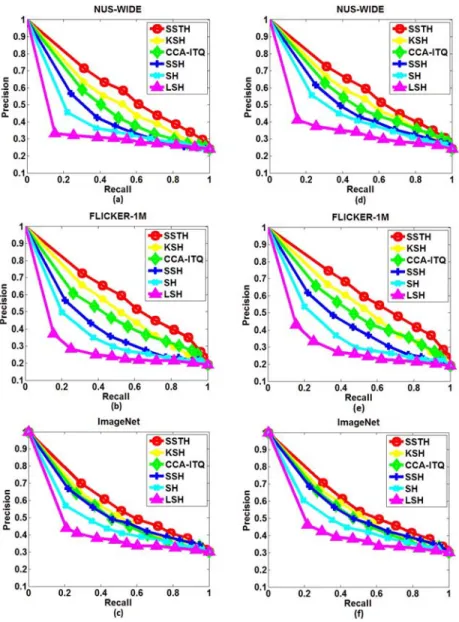
2.4 Precision-Recall behavior of SSTH on three image datasets. (a)-(c):
Precision-Recall curve with 16 hashing bits. (d)-(f): Precision-Recall curve
with 32 hashing bits. . . . . 39
2.5 Tag prediction results on F lickr-1M. . . . . 47
2.6 Parameter sensitivity results of precision of the top 200 retrieved examples
with 32 hashing bits. . . . . 49
2.7 Precision of the top 100 retrieved examples on four text datasets. . . . 50
2.8 Precision of the retrieved examples within Hamming radius 2 on four text datasets. . . . . 51 2.9 Results of Precision-Recall curve with 32 hashing bits on four text
datasets. . . . . 52 3.1 Precision within Hamming radius 2 using different hashing bits with
PDR=0.4. . . . . 68
3.2 Precision of top 100 retrieved examples under different PDRs with 32 bits. 70
3.3 Parameter sensitivity results with 32 bits under PDR=0.4. . . . . 71
4.1 Precision on both datasets with different bits. (a)-(b): Precision of the top 100 returned examples using Hamming Ranking. (c)-(d): Precision
Figure Page 4.2 Parameter sensitivity results of precision of the top 100 retrieved examples
with 32 hashing bits. . . . . 87
5.1 An overview of the proposed RPH approach. . . . . 91
5.2 Performance evaluation on both datasets with different number of hashing
bits. (a)-(b): NDCG@10 using Hamming Ranking. (c)-(d): ACG with
Hamming radius 2 usingHash Lookup.. . . . 102
5.3 (a)-(b): NDCG@10 with different number of training queries using 64 hashing bits on both datasets. (c)-(d): NDCG@10 with different number of data examples associated with each query using 64 hashing bits on both datasets. . . . . 104 5.4 Parameter sensitivity results of NDCG@10 on both datasets with 64
hashing bits.. . . . 105
6.1 An overview of the proposed AH-JDETS approach. . . . . 113
6.2 Results of Precision-Recall curve with 32 hashing bits on F lickr1m and
ReutersV1 datasets. . . . . 127 6.3 Results of precision of top 200 examples on four datasets with different
hashing bits.. . . . 128 6.4 Precision results of varying batch sizes while fixing the labeling cost.
Hashing bits are set to be 32 for all datasets.. . . . 131
6.5 Precision results of increasing number of iterations on four datasets with 32 hashing bits. . . . . 132
6.6 Parameter Sensitivity for β and λ. Results of precision of the top 200
ABSTRACT
Wang, Qifan Ph.D., Purdue University, May 2015. Learning Compact Hashing Codes with Complex Objectives from Multiple Sources for Large Scale Similarity Search . Major Professor: Luo Si.
Similarity search is a key problem in many real world applications including image and text retrieval, content reuse detection and collaborative filtering. The purpose of similarity search is to identify similar data examples given a query example. Due to the explosive growth of the Internet, a huge amount of data such as texts, images and videos has been generated, which indicates that efficient large scale similarity search becomes more important.
Hashing methods have become popular for large scale similarity search due to their computational and memory efficiency. These hashing methods design compact binary codes to represent data examples so that similar examples are mapped into similar codes. This dissertation addresses five major problems for utilizing supervised information from multiple sources in hashing with respect to different objectives. Firstly, we address the problem of incorporating semantic tags by modeling the latent correlations between tags and data examples. More precisely, the hashing codes are learned in a unified semi-supervised framework by simultaneously preserving the similarities between data examples and ensuring the tag consistency via a latent factor model. Secondly, we solve the missing data problem by latent subspace learning from multiple sources. The hashing codes are learned by enforcing the data consistency among different sources. Thirdly, we address the problem of hashing on structured data by graph learning. A weighted graph is constructed based on the structured knowledge from the data. The hashing codes are then learned by preserving the graph similarities. Fourthly, we address the problem of learning high ranking quality hashing
codes by utilizing the relevance judgments from users. The hashing code/function is learned via optimizing a commonly used non-smooth non-convex ranking measure, NDCG. Finally, we deal with the problem of insufficient supervision by active learning. We propose to actively select the most informative data examples and tags in a joint manner based on the selection criteria that both the data examples and tags should be most uncertain and dissimilar with each other.
Extensive experiments on several large scale datasets demonstrate the superior performance of the proposed approaches over several state-of-the-art hashing methods from different perspectives.
1 INTRODUCTION
Similarity search identifies similar data examples given a query example, which has many different applications in various research areas including information retrieval, machine learning, data mining and computer vision. Due to the explosive growth of the Internet, a huge amount of data such as texts, images and videos has been generated, which indicates that efficient large scale similarity search becomes more important. When there is only a low-dimensional feature space, similarity search can be carried out by some space partitioning index structures, such as TF-IDF methods [1, 2], KD-tree, or data partitioning index structures, like R-tree [3]. Several types of structures and operations of inverted indexing are also proposed [4–6] for traditional ad-hoc text search with relatively short user queries. However, traditional similarity search may fail to work efficiently within a high-dimensional vector space [7], which is often the case for many real world information retrieval applications. Therefore, it is important to design effective and efficient methods for similarity search with large scale data. Two major challenges have to be addressed for using similarity search in large scale datasets such as storing the data efficiently and retrieving the large scale data in an effective and efficient manner.
Traditional similarity search methods are difficult to be directly used for large scale datasets since the computational cost of similarity calculation using the original data features (i.e. often in high dimensional space) is impractical for large scale
applications. Recently, hashing [8–24] has become a popular approach in large
scale problems such as similar document detection [25–27], content-based image retrieval [28–31] and collaborative filtering [32, 33], etc. Hashing methods design compact binary codes to represent data examples so that similar data examples are mapped into similar codes. In the retrieving process, these hashing methods first transform query examples into the corresponding hashing codes and then similarity
search can be simply conducted by calculating the Hamming distances between the query code and the codes in the database, and selecting data examples within small Hamming distances. Therefore, hashing method addresses the two major challenges of large scale similarity search in the following ways: (1) The encoded data is highly compressed within a low-dimensional binary space, and thus can often be dealt with in main memory and stored efficiently; (2) The retrieval process is very efficient, since the distance between two codes is simply the number of bits that they differ, which can be computed using bit XOR operations.
Recent hashing methods have shown that the code performance could be boosted by incorporating supervised information from multiple sources into hashing codes learning, such as semantic tags/labels [34–37], structure data [38] and relevance values/judgments [31]. These supervised multi-source information provides useful knowledge and guidance for achieving more effective hashing codes. Although existing hashing methods generate promising results in large scale similarity search, the supervised knowledge is not fully exploited in previous methods. Most of the existing hashing methods only utilize a small portion of the knowledge extracted from different sources such as pairwise similarity and listwise ranking information, which might not be accurate or reliable. There are several main problems for leveraging the supervised knowledge from multiple sources into learning effective hashing codes for different objectives: 1. How to leverage these supervised knowledge from multiple sources to achieve more effective hashing codes; 2. How to handle the missing data issue from multiple sources; 3. How to incorporate the structure information into hashing code learning; 4. How to utilize multiple sources to learn high quality code for ranking-oriented measure; 5. How to obtain the most informative knowledge in an active manner with low human labeling cost for generating supervised information, when the supervision is insufficient. In this dissertation, we discuss these problems in the following sections respectively.
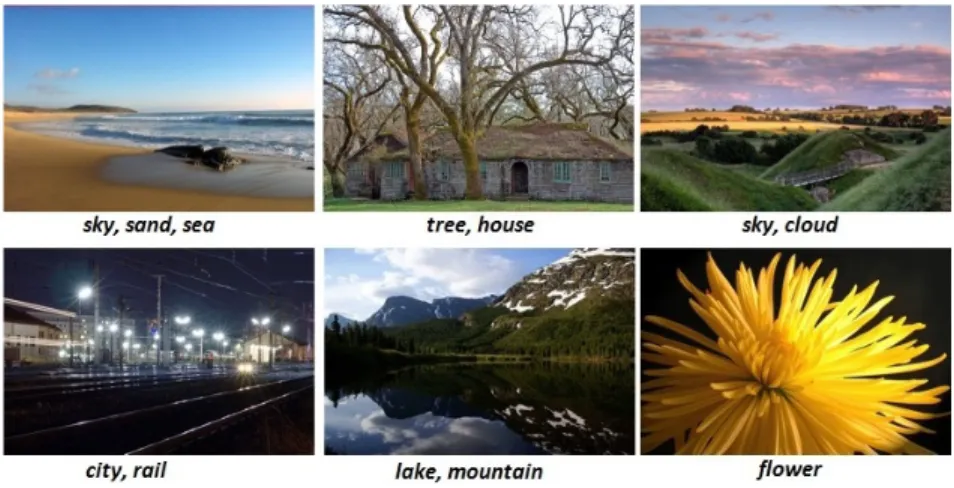
Figure 1.1. Several image examples with tags fromMIRFLICKR-1M dataset.
1.1 Hashing Methods for Large Scale Similarity Search 1.1.1 Learning to Hash with Semantic Tags
Tags or labels have been popularly utilized in many applications with image and text data for better managing, organizing and searching for useful information. For example, Flickr has more than 2 billion images with millions of newly uploaded photos per day and YouTube contains hundreds of millions of videos [23]. These data examples are usually associated with multiple tags assigned by users. Figure 1.1 and 1.2 show some examples of images and webpages associated with multiple tags. This tag information source provides useful supervised knowledge for users to better categorize or search desired data. Therefore, it is an important and practical research problem to design efficient and effective hashing methods that can incorporate these supervised information for large scale similarity search.
Several supervised/semi-supervised hashing methods have been proposed to utilize the tag information into their hashing function learning, such as semi-supervised hashing (SSH) [28, 29], kernel supervised hashing (KSH) [30], Canonical Correlation Analysis with Iterative Quantization (CCA-ITQ) [35, 36], etc. For example, in SSH
Figure 1.2. Several document examples with tags.
and KSH, pairwise constrains between data examples besides their original features
are imposed for learning more effective hashing function. More precisely, these
pairwise similarity constraints are also called Must-Link and Cannot-Link, which are generated from tags. A Must-Link is created when two data examples share a common tag and a Cannot-Link is created when two examples share no tag. Their basic motivation is that the hashing codes of data example pairs with Must-Link should be as close as possible, while the hashing codes of example pairs with Cannot-Link should be as different as possible. For the CCA-ITQ method, it treats the data features and tags as two different views. The hashing function is then learned by extracting a common space from these two views.
One major assumption of most existing supervised hashing methods is that
the tags associated with data examples are complete and clean. But in many
applications, tags tend to be incomplete and noisy. Moreover, tags may have different representations for a similar semantic meaning (e.g.,‘car’ versus ‘automobile’). In this situation, the pairwise constraints extracted from the semantic tags only represent a small portion of tag information rather than the complete supervised knowledge and thus are not reliable. Similarly, CCA-ITQ may generate low quality codes when only
incomplete tags is available. We need to design a scheme that could fully leverage the supervision knowledge in hashing function learning while at the same time preserves the data similarity.
1.1.2 Learning to Hash on Partial Multi-Modal Data
In many applications, data examples are usually represented by multiple modalities captured from different sources. For example, in web page search, the web page content and its linkage information can be regarded as two modalities. In web image retrieval, the image visual feature, text description and textual tags can be viewed as multiple modalities. Recently, several multi-modal hashing methods (also known as multi-view or cross-view hashing) have been proposed to handle multi-modal data. Roughly speaking, these multi-modal hashing approaches can be divided into two categories: modality-specific hashing methods and modality-integrated ones. The modality-specific methods learn independent hashing codes for each modality of an example, and then concatenate multiple modality-specific binary codes into the final hashing codes [39–42], whereas the modality-integrated ones directly learn unified hashing codes for data examples [10, 43–45].
Although existing multi-modal hashing methods generate promising results in dealing with multi-modal data, most of them assume that all data examples have full information in all modalities, or there exists at least one modality which contains all the examples. However, in real world tasks, it is often the case that every modality suffers from some missing information, which results in many partial examples. Consider again the aforementioned two examples, for web page search, many web pages may not contain any linkage information. For web image retrieval, not all images are associated with tags or text descriptions. Moreover, the image itself may be inaccessible due to deletion or invalid url. Therefore, it is a practical and important research problem to design effective hashing methods for partial multi-modal data.
Figure 1.3. Data examples with structure information. (a) Webpages link to each other. (b) Images share semantic labels.
1.1.3 Learning to Hash on Structured Data
Hashing methods generate promising results by successfully addressing the storage and search efficiency challenges. However, most existing hashing methods assume that data examples are independently and identically distributed. But in many applications, the dependencies between data examples naturally exist and if incorporated in models, they can potentially improve the hashing code performance significantly.
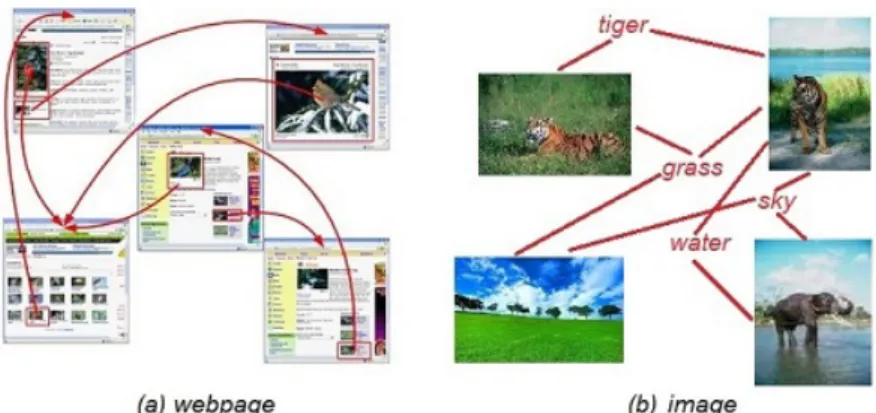
For example, many webpages have hyperlinks pointing to other related webpages (see Fig.1.3(a)). The contents of these linked webpages are usually relevant, which present similar topics. The hyperlinks among webpages provide important structure knowledge. Another example is that similar images often share semantic labels (see Fig.1.3(b)). The more labels two images have in common, the more similar the images are. The shared semantic labels among images offer valuable information in binary codes learning. These structure information have been utilized in clustering [46] and classification [38] problems, and proven to be helpful knowledge. Therefore, it is important to design hashing method that preserve the structure information among data examples in the learned Hamming space.
1.1.4 Learning Ranking Preserving Hashing Codes
In many information retrieval applications, such as similarity search, learning to rank, recommendation, etc., it is more realistic and desirable that the most relevant examples to a query can be presented in front of less relevant ones. In other words, users prefer the retrieval results with better ranking performance. Although existing hashing methods have achieved promising results, very limited work explores the search/ranking accuracy, which is important for evaluating the quality of hashing codes in real world applications. Consider the following scenario: given a query
example xq and three relevant/similar data examples x1, x2, x3 but with different
relevance values as r1 > r2 > r3 to the query. Most existing hashing methods
only model the relevance of a data example to a query in a binary way, i.e., each
example is either relevant to the query or irrelevant. These methods treat x1, x2
and x3 as relevant examples to xq with no difference. But in practice it will be
more desirable ifx1 could be presented before x2 and x3 since it is more relevant to
xq than the other two. Some ranking based hashing methods [31, 47–49] have been
recently proposed to improve the hashing performance by modeling the ranking order with respect to relevance values. However, these methods do not fully preserve the specific relevance values in learning hashing function, while the relevance values are important in evaluating the search accuracy. In other words, they do not differentiate the situations where (r1, r2, r3) = (3,2,1) and (10,2,1) due to their identical ranking orders, i.e., r1 > r2 > r3. But ideally, the Hamming distance between the learned
hashing codes ofx1 andxq should be smaller in the later situation than in the former
one since the relevance value of x1 to the query example is much larger in the later
situation (10 versus 3). Therefore, it is important to design effective hashing method to incorporate relevance value/judgement information from users in learning more effective hashing codes that could achieve high ranking performance.
1.1.5 Active Learning with Insufficient Supervision
One of the basic assumptions in most existing supervised hashing methods is that the labeled data are provided beforehand. These hashing methods are regarded as passive methods. But in many real world applications, such supervised information may not be sufficient or available and it is often expensive to acquire for a large dataset. Therefore, it is important to design effective methods to actively identify only a small set of the most informative data examples for users to label. The only prior work we found using active learning in hashing is [50], which directly chooses the most uncertain data examples based on the hashing function. A batch mode algorithm is also proposed in this work to speed up their active selection.
The labeling cost not only depends on the number of data examples that are selected but also depends on the total number of tags that the users label to the selected data examples. In many large scale applications, there are often hundreds or thousands of tags for users to label. Moreover, similar tags usually carry similar semantic meanings. For instance, ‘car’ and ‘automobile’ have similar meanings and choosing both of them may not gain substantial new information over just selecting one. However, the method in [50] only considers identifying the most informative data examples and tries to label all possible tags to these selected examples, which requires a great amount of labeling efforts for those datasets associated with a huge number of tags. Therefore, it is important to design effective method that jointly selects the most informative data examples and tags such that the hashing function can be learned efficiently with only a small number of labeled data, which can greatly reduces the labeling cost.
1.2 Main Contributions
Hashing methods generate promising results in large scale similarity search. As can be seen from the above discussion, the problem of leveraging supervised information from multiple sources has not been fully explored. The major contribution of this
dissertation is that we propose a unified framework to incorporate different types of supervised knowledge from multi-sources into learning effective hashing codes. We summarize our contributions in more details as follows.
• As shown in Section 1.1.1, semantic tags or labels are usually associated with
data examples and have been popularly utilized in many applications. This tag information source provides useful supervised knowledge for users to better categorize or search desired data. In this dissertation, a research problem, Learning to Hash with Semantic Tags, is proposed to incorporate the semantic tags into hashing codes learning. To solve this problem, a novel semi-supervised tag hashing (SSTH) approach is proposed to fully exploit tag information by modeling the semantic correlation between tags and hashing bits. The hashing function is learned in a unified learning framework by simultaneously ensuring the tag consistency and preserving the similarities between data examples. An iterative coordinate descent algorithm is designed as the optimization procedure. We also improve the effectiveness of hashing function through orthogonal transformation by minimizing the quantization error. Furthermore, we extend this framework by preserving the topic level similarity between data examples to obtain more effective codes when original feature distances do not reflect the similarity between data examples.
• In many applications, data examples are usually represented by multiple
modalities captured from different sources. However, in real world tasks, it is often the case that every modality suffers from some missing information,
which results in many partial examples. For example, not all images are
associated with tags or text descriptions. Moreover, the image itself may be inaccessible due to deletion or invalid url. In this dissertation, we propose a
novel Partial Multi-Modal Hashing (PM2H) approach to deal with such partial
data. More specifically, a unified learning framework is developed to learn the binary codes, which simultaneously ensures the data consistency among different
modalities via latent subspace learning, and preserves data similarity within the same modality through graph Laplacian. A block gradient descent algorithm is applied as the optimization procedure.
• As discussed in Section 1.1.3, in many applications, the dependencies between
data examples naturally exist and if incorporated in models, they can potentially improve the hashing code performance significantly. In this dissertation, a novel approach of learning to Hash on Structured Data (HSD) is proposed,
which incorporates the structure information associated with data. The
hashing function is learned in a unified learning framework by simultaneously ensuring the structural consistency and preserving the similarities between data examples. In particular, the objective function of the proposed HSD approach is composed of two parts: (1) Structure consistency term, which ensures the hashing codes to be consistent with the structure information. (2) Similarity preservation term, which aims at preserving the similarity between data examples in the learned hashing codes.
• In many learning to rank and recommendation systems, it is more realistic and
desirable that the most relevant examples to a query can be presented in front of less relevant ones. In other words, users prefer the retrieval results with better ranking performance. This dissertation proposes a novel Ranking Preserving Hashing (RPH) approach that directly optimizes the popular ranking accuracy measure, Normalized Discounted Cumulative Gain (NDCG), to learn effective ranking preserving hashing codes that not only preserves the ranking order but also models the relevance values of data examples to the queries in the training data. The main difficulty in direct optimization of NDCG is that it depends on the rankings of data examples rather than their hashing codes, which forms a non-convex non-smooth objective. We then address this challenge by optimizing the expectation of NDCG measure calculated based on a linear hashing function
to convert the problem into a smooth and differentiable optimization problem. A gradient descent method is applied to solve this relaxed problem.
• When the supervised information is insufficient or even not available, it is
important to design effective methods to actively identify only a small set of the most informative data examples for users to label. In this dissertation, we proposes a novel active hashing approach to actively select the most informative data examples and tags in a joint manner for hashing function learning. We first identify a set of informative data examples and tags for users to label based on the selection criteria that both the data examples and tags should be most uncertain and dissimilar with each other. Then this labeled information is combined with the unlabeled data to generate an effective hashing function. An iterative procedure is proposed for learning the optimal hashing function and selecting the most informative data examples and tags.
The rest of the dissertation is organized as follows: Chapter 2 proposes a novel hashing approach to leverage the semantic tag knowledge by modeling semantic correlations between hashing codes and tags. Chapter 3 discusses the solution of dealing with partial multi-modal data. A novel hashing on structured data approach is given in Chapter 4 to incorporate the structure knowledge among data examples. Chapter 5 presents a hashing method to learn ranking based hashing codes with relevance supervision via optimizing the NDCG measure. Chapter 6 designs an active hashing method with joint data example and tag selection to handle the insufficient supervision problem. Finally, Chapter 7 gives the conclusions and future work.
1.3 Origins of the Material
The material in this dissertation is based on a number of papers listed below, some of which have already been published, while others are currently in submission. 1. Qifan Wang, Luo Si and Bin Shen. Learning to Hash on Partial Multi-Modal
2. Qifan Wang, Zhiwei Zhang and Luo Si. Ranking Preserving Hashing for Large Scale Similarity Search. In submission, 2015.
3. Dennis Strelow, Qifan Wang, Anders Eriksson and Luo Si. General, Nested,
and Constrained Wiberg Minimization. IEEE Transactions on Pattern Analysis and Machine Intelligence (TPAMI), 2015. In submission.
4. Qifan Wang, Luo Si and Bin Shen. Learning to Hash on Structured Data. The Twenty-Ninth AAAI Conference on Artificial Intelligence (AAAI), 2015.
5. Bin Shen, Baodi Liu, Qifan Wang, Yi Fang and Jan Allebach. SP-SVM:
Large Margin Classifier for Data on Multiple Manifolds. The Twenty-Ninth AAAI Conference on Artificial Intelligence (AAAI), 2015.
6. Xiaojun Quan, Qifan Wang, Ying Zhang, Luo Si and Wenyin Liu. Latent
Discriminative Models for Social Emotion Detection with Emotion Dependency. ACM Transactions on Information Systems (TOIS), 2015.
7. Zhongshu Gu, Kexin Pei, Qifan Wang, Luo Si, Xiangyu Zhang and Dongyan
Xu. LEAPS: Detecting Camouflaged Attacks with Statistical Learning Guided by Program Analysis. The 45th Annual IEEE/IFIP International Conference on Dependable Systems and Networks (DSN), 2015.
8. Bin Shen, Qifan Wang and Jan Allebach. Piecewise Linear Dimension
Reduction for Nonnegative Data. Imaging and Multimedia Analytics in a Web and Mobile World SPIE Electronic Imaging, 2015.
9. Qifan Wang, Luo Si, Zhiwei Zhang and Ning Zhang. Active Hashing with Joint Data Example and Tag Selection. The 37th Annual ACM SIGIR Conference (SIGIR), 2014.
10. Zhiwei Zhang,Qifan Wang, Lingyun Ruan and Luo Si. Preference Preserving
Hashing for Efficient Recommendation. The 37th Annual ACM SIGIR
11. Ning Zhang, Ying Zhang, Luo Si, Yanshan Lu,Qifan Wangand Xiaojie Yuan. Cross-Domain and Cross-Category Emotion Tagging for Comments of Online News. The 37th Annual ACM SIGIR Conference (SIGIR), 2014.
12. Qifan Wang, Lingyun Ruan and Luo Si. Adaptive Knowledge Transfer for Multiple Instance Learning in Image Classification. The Twenty-Eighth AAAI Conference on Artificial Intelligence (AAAI), 2014.
13. Qifan Wang, Luo Si and Dan Zhang. Learning to Hash with Partial Tags: Exploring Correlation Between Tags and Hashing Bits for Large Scale Image Retrieval. The 13th European Conference on Computer Vision (ECCV), 2014. 14. Qifan Wang, Bin Shen, Shumiao Wang, Liang Li and Luo Si. Binary Codes Embedding for Fast Image Tagging with Incomplete Labels. The 13th European Conference on Computer Vision (ECCV), 2014.
15. Qifan Wang, Bin Shen, Zhiwei Zhang and Luo Si. Sparse Semantic Hashing for Efficient Large Scale Similarity Search. The 23rd ACM International Conference on Information and Knowledge Management (CIKM), 2014.
16. Bin Shen, Baodi Liu, Qifan Wang and Rongrong Ji. Robust Nonnegative
Matrix Factorization via L1 Norm Regularization. The 21st IEEE International Conference on Image Processing (ICIP), 2014.
17. Bin Shen, Baodi Liu and Qifan Wang. Elastic Net Regularized Dictionary
Learning for Image Classification. Multimedia Tools and Applications, 2014. 18. Qifan Wang, Dan Zhang and Luo Si. Semantic Hashing using Tags and Topic
Modeling. The 36th Annual ACM SIGIR Conference (SIGIR), 2013.
19. Qifan Wang, Lingyun Ruan, Zhiwei Zhang and Luo Si. Learning Compact Hashing Codes for Efficient Tag Completion and Prediction. The 22nd ACM International Conference on Information and Knowledge Management (CIKM), 2013.
20. Qifan Wang, Dan Zhang and Luo Si. Weighted Hashing for Fast Large Scale Similarity Search. The 22nd ACM International Conference on Information and Knowledge Management (CIKM), 2013.
21. Qifan Wang, Luo Si and Dan Zhang. A Discriminative Data-dependent Mixture-Model Approach for Multiple Instance Learning in Image Classifica-tion. The 12th European Conference on Computer Vision (ECCV), 2012.
22. Dzung Hong, Qifan Wang, Dan Zhang and Luo Si. Query Expansion and
Message-passing Algorithms for TREC Microblog Track Embeddings. Text Retrieval Conference (TREC), 2011.
23. Qifan Wang and Luo Si. A Robust One-Class Bayesian Approach for
Masquerade Detection. Conference on Computer and Communications
2 LEARNING TO HASH WITH SEMANTIC TAGS 2.1 Motivation
Most of existing supervised and semi-supervised hashing methods assume the tags are complete and clean. But in many real world applications such as web image retrieval, tags tend to be noisy and are usually partially assigned to images by users. Moreover, semantic similar tags may have different representations (e.g.,‘car’ versus ‘automobile’). Therefore, the assumption made by the existing hashing methods may limit the performance of learned hashing codes. In this dissertation, we propose a novel semi-supervised tag hashing approach to fully exploit tag information in learning effective hashing function by modeling the semantic correlation between tags and hashing bits. The hashing function is learned in a unified learning framework by simultaneously ensuring the tag consistency and preserving the similarities between
data examples. An iterative coordinate descent algorithm is designed as the
optimization procedure. We also improve the effectiveness of hashing function through orthogonal transformation by minimizing the quantization error. Furthermore, we extend this framework by preserving the topic level similarity between data examples to obtain more effective codes when original feature distances do not reflect the similarity between data examples.
2.2 Background and Related Work 2.2.1 Introduction
Due to the explosive growth of the Internet, a huge amount of data such as texts, images and videos has been generated, which indicates that efficient similarity search becomes more important. Traditional similarity search methods are difficult
to be directly used for large scale datasets since the computational cost of similarity calculation using the original data features (i.e. often in high dimensional space) is impractical for large scale applications. Recently, hashing has become a popular approach in large scale problems, which designs compact binary codes to represent data examples so that similar examples are mapped into similar codes. In the retrieving process, these hashing methods first transform query examples into the corresponding hashing codes and then similarity search can be simply conducted by calculating the Hamming distances between the query code and the codes in the database, and selecting data examples within small Hamming distances.
Recently, hashing methods have shown that the code performance could be boosted by leveraging supervised information into hashing function learning, i.e., semantic tags/labels [34–37]. Although existing supervised hashing methods generate promising results in large scale similarity search, tag information is not fully exploited in previous methods, especially when tags are incomplete and noisy. Most of the existing hashing methods only utilize a small portion of the knowledge contained in tags such as pairwise similarity and listwise ranking information, which might not be accurate or reliable under the situation where only partial tags are available. There are three main challenges to incorporate tag information into hashing function learning: (1) we have no knowledge about how tags are related to the hashing bits; (2) we need to deal with noisy and incomplete tags when only partial tags are available; (3) we need to deal with the ambiguity of semantically similar tags.
This dissertation proposes a novel semi-supervised tag hashing (SSTH) approach to fully exploit tag information in learning effective hashing function by modeling the semantic correlation between tags and hashing bits. The hashing function is learned in a unified framework by simultaneously ensuring the tag consistency and preserving the similarities between data examples. In particular, the objective function of the proposed SSTH approach is composed of two components. (1) Tag consistency term (supervised), which ensures the hashing codes to be consistent with the observed tags. The key observation is that: the more common tags two data examples share, the
more similar their hashing codes should be. This observation is then transformed into a latent factor model. (2) Similarity preservation term (unsupervised), which aims at preserving the original feature similarity between data examples in the learned hashing codes. This term is important especially when the data examples are associated with very few tags. An iterative algorithm is then derived based on the relaxed objective function using a coordinate descent optimization procedure. Moreover, we prove the orthogonal invariant property of the optimal relaxed solution and learn an orthogonal matrix by minimizing the quantization error to further improve the code effectiveness. We also extend this framework by preserving the topic level similarity between data examples to obtain more effective codes when original feature distances do not reflect the similarity between data examples. Extensive experiments on several large scale datasets demonstrate the superior performance of the proposed approach over several state-of-the-art hashing methods.
2.2.2 Related Work
Efficiency is a crucial issue for large scale information retrieval applications with a huge amount of data examples. When there is only a low-dimensional feature space, similarity search can be carried out by some space partitioning index structures, such as TF-IDF methods [1, 2], KD-tree, or data partitioning index structures, like R-tree [3]. Several types of structures and operations of inverted indexing are also proposed [4–6] for traditional ad-hoc text search with relatively short user queries. However, traditional similarity search may fail to work efficiently within a high-dimensional vector space [7], which is often the case for many real world information retrieval applications.
Hashing method [14, 48, 49, 51–63] is proposed to address the similarity search problem within a high-dimensional feature space. In particular, hashing methods try to represent each data example by using a small fixed number of binary bits so that the queries can be answered in a short time [64]. The hashing based fast
similarity search can be viewed as a strategy to transform data examples from a high-dimensional space into a low-dimensional binary space, and at the same time preserve the semantic similarity between data examples as much as possible. Hashing methods generate binary codes for efficient search, which is different from traditional dimensionality reduction methods such as Principal Component Analysis (PCA) and Latent Semantic Indexing (LSI) [65, 66].
Locality-Sensitive Hashing (LSH) [15, 67] is one of the most popularly used hashing methods. It simply utilizes random linear projections to map data examples from a high-dimensional Euclidean space to a low-dimensional one. It has already been shown that the Hamming distance between different data examples will asymptotically approach their Euclidean distance in the original feature space with the increase of the hashing bits. LSH has been extended to Kernelized Locality-Sensitive Hashing (KLSH) [21, 23] by exploiting kernel similarity for better retrieval efficacy. Recently, the work in [68] further extends the KLSH to the scheme of Boosting Multi-Kernel Locality-Sensitive Hashing (BMKLSH) that improves the retrieval performance of KLSH by making use of multiple kernels.
Several machine learning approaches have been proposed to solve the hashing problem. For example, the PCA Hashing [17] method projects each example to the top principal components of the training set, and then binarizes the coefficients by setting a bit to 1 when its value is larger than the median value seen for the training set, and -1 otherwise. The work in [8] uses stacked Restricted Boltzman Machine (RBM) [69, 70] to generate compact binary hashing codes, which can be viewed as binarized LSI. Recently, Spectral Hashing (SH) [19] is proposed to learn compact binary codes that preserve the similarity between data examples by forcing the balanced and uncorrelated constraints into the learned codes, which be viewed
as an extension of spectral clustering [71]. A graph-based hashing method has
been proposed in work [12] to automatically discover the neighborhood structure inherent in the data to learn appropriate compact codes. A Self-taught Hashing method [22] combines an unsupervised step with a supervised step to learn more
accurate hashing codes. More recently, the work [10] proposes a Composite Hashing with Multiple Information Sources (CHMIS) method to integrate information from
different sources. In another recent work [56], an isotropic hashing (IsoHash)
method is proposed to learn projection functions of individual hashing codes with equal variances. A bit selection method [72] has been proposed to select the most informative hashing bits from a pool of candidate bits generated from different hashing methods. A Topology Preserving Hashing (TPH) [73] method is proposed to preserve the neighborhood rankings of data points in Hamming space. Most recently, several supervised/semi-supervised hashing methods have been proposed. For example, a Canonical Correlation Analysis with Iterative Quantization (CCA-ITQ) method has been proposed in [35, 36] which treats the data features and tags as two different views. The hashing function is then learned by extracting a common space from these two views. The semi-supervised hashing (SSH) method in [28, 29] utilizes pairwise knowledge between data examples besides their original features for learning more effective hashing function. A kernelized supervised hashing (KSH) framework proposed in [30] imposes the pairwise relationship between data examples to obtain good hashing codes. Complementary Hashing (CH) [9] uses pairwise information to learn multiple complementary hash tables in a boosting manner. A ranking-based supervised hashing (RSH) [31] method is proposed to leverage the listwise ranking information to improve the search accuracy.
In the following sections, we mainly discuss several state-of-the art hashing methods including three unsupervised methods, i.e., Locality-Sensitive Hashing (LSH) [15], Spectral Hashing (SH) [19] and Self-taught Hashing (STH) [22], and three supervised/semi-supervised hashing methods, i.e., Semi-Supervised Hashing (SSH) [28, 29], Kernelized Supervised Hashing (KSH) [30] and Canonical Correlation Analysis with Iterative Quantization (CCA-ITQ) [35, 36].
Locality-Sensitive Hashing (LSH)
Locality-Sensitive Hashing [15] is one of the most popularly used hashing methods.
It simply utilizes k random linear projections to map data examples from a
high-dimensional Euclidean space to a low-high-dimensional binary space as follows:
yp =sgn(wTpx+bp) (2.1)
where yp is the p-th bit for data example x and wp is the linear projection which
is randomly samples from Gaussian distribution. bp is the bias. We also illustrate
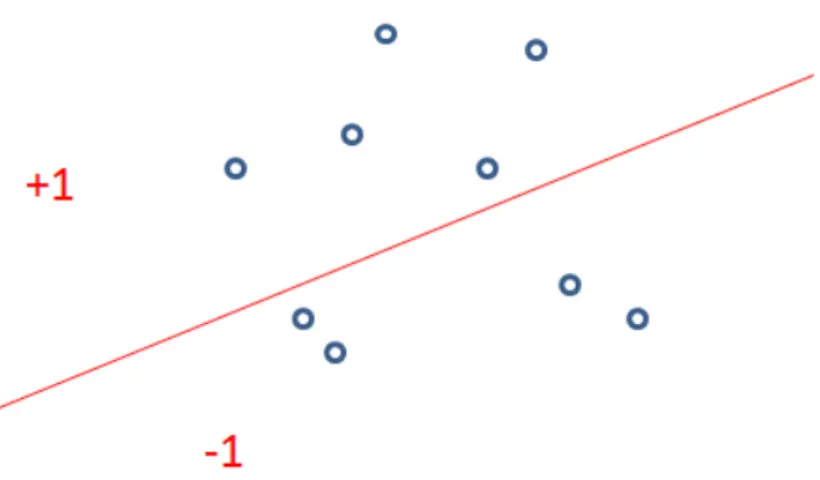
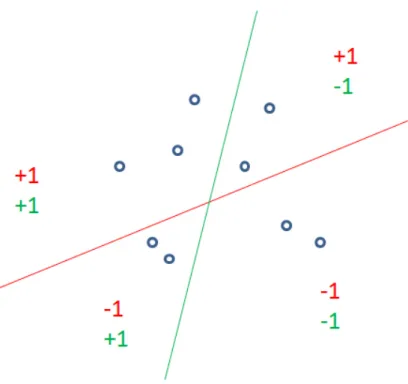
LSH in figure 2.1 and 2.2. Although LSH is a data-independent hashing method, it has already been shown that the Hamming distance between different data examples will asymptotically approach their Euclidean distance in the original feature space with the increase of the hashing bits. LSH method has been extended to Kernelized Locality-Sensitive Hashing (KLSH) [21, 23] by exploiting kernel similarity for better retrieval efficacy. Recently, the work in [68] further extends the KLSH to the scheme
Figure 2.2. LSH example: two bits.
of Boosting Multi-Kernel Locality-Sensitive Hashing (BMKLSH) that improves the retrieval performance of KLSH by making use of multiple kernels.
Spectral Hashing (SH)
Spectral Hashing (SH) [19] method tries to seek hashing codes that satisfy (1) easily computed for a novel input query (2) requires a small number of bits to code the full dataset and (3) maps similar data examples to similar binary codes. For a code to be efficient, it also require that each bit has a 50% chance of being +1 or
−1, and that different bits are independent of each other. Among all codes that have
this property, it seek the ones where the average Hamming distance between similar examples is minimal.
Let yi be the hashing code with k bits for data example xi. SSSi,j be the affinity
matrix. Since it is assuming the inputs are embedded inRdso that Euclidean distance
correlates with similarity, it use SSSi,j = exp(−xi−xj2/σ2), where σ is the scaling
parameter that defines the distance inRd. Using this notation, the average Hamming
distance between similar neighbors can be written as i,jSSSi,jyi−yj2. Then the optimal hashing codes can be obtain by solving the following problem:
min y i,j SSSi,jyi−yj2 s.t. yi∈ {−1,+1}k i yi= 0 1 n i yiyiT =III (2.2)
where the constraint iyi = 0 is the bit balance constraint which requires each bit
to appear 50% of the time, and the constraint n1iyiyiT = III requires the bits to be uncorrelated or orthogonal. The objective function incurs a heavy penalty if two similar data examples are mapped far away, which preserves the similarity between data examples. Obtaining exact solution of the above problem turns out to be NP-hard by the following theorem.
Theorem 2.2.1 For k=1, solving problem 2.2 is equivalent to balanced graph partitioning and is NP hard.
Proof Consider an undirected graph whose vertices are the data points and where the weight between data iand j is given bySSSi,j. Consider a code with a single bit. The bit partitions the graph into two equal parts (A, B), vertices where the bit is on and vertices where the bit is off. For a single bit, i,jSSSi,jyi −yj2 is simply the weight of the edges cut by the partition: cut(A, B) =i∈A,j∈BSSSi,j. Thus problem 2.2
is equivalent to minimizing cut(A, B) with the requirement thatA=B which is
The problem in Eqn.2.2 is then approximated using spectral relaxation. By introducing a n× k matrix YYY whose i-th row is yT
i and a diagonal n×n matrix
DDDi,i = jSSSi,j and relaxing the binary and bit balance constraint, the problem can be rewritten as: min y tr(YYY T(((DDD−−−SSS)))YYY) s.t. YYYTYYY =III (2.3)
Then the problem becomes an easy problem whose solutions are simply the k
eigenvectors ofDDD−−−SSSwith minimal eigenvalue (after excluding the trivial eigenvector 1 which has eigenvalue 0).
Self-Taught Hashing (STH)
Self Taught Hashing (STH) [22] usually generally provides more effective hashing solutions than LSH and SH. STH combines an unsupervised learning step with a supervised learning step to learn hashing codes.
In the unsupervised learning step, STH constructs a similarity graph using a fix number of nearest neighbors for the given dataset, and then embeds all the data
examples into a k dimensional space through spectral analysis similar to SH, and
finally uses simple thresholding to obtain the binary hashing code for each data example. This step is exactly the same as in Eqn.2.3 of SH method.
In the supervised learning step, a set of k SVM classifiers are trained based
on existing documents and their binary hashing codes learned from the previous
step. Then, thek classifiers can be used to generate the hashing codes for the query
documents as a classification problem. STH does not assume that data are uniformly distributed in a hyper-rectangle as requested by SH, which is often too restrictive for real world applications. STH often generates more effective hashing codes than SH.
Semi-Supervised Hashing (SSH)
The work in [28, 29] proposes a Semi-Supervised Hashing (SSH) approach for incorporating the pairwise relationships between data examples into learning hashing function. More precisely, these pairwise similarity constraints are also called Must-Link and Cannot-Must-Link, which could be partially generated from tags. For example, a Must-Link is created when two data examples share a common tag, i.e., (xi, xj)∈M, and a Cannot-Link is created when two examples share no tag , i.e., (xi, xj) ∈ C. Their basic motivation is that the hashing codes of data example pairs with Must-Link should be as close as possible, while the hashing codes of example pairs with Cannot-Link should be as different as possible. This motivation is then incorporated into the objective function for learning the hashing codes.
In SSH method, it first define a pairwise constraint matrix SSS incorporating the
pairwise link information as:
S SSij = ⎧ ⎪ ⎪ ⎪ ⎪ ⎨ ⎪ ⎪ ⎪ ⎪ ⎩ 1, if (xi, xj)∈M −1, if (xi, xj)∈C 0, otherwise (2.4)
Then the supervised part of the objective function can be represented as:
J(WWW) =trsgn(WWWTXXX)SSSsgn(WWWTXXX)T (2.5) The unsupervised part of the objective is constructed based on the maximum entropy
principle that a binary bit that gives balanced partitioning ofXXX provides maximum
information. Then it shows that maximum entropy partitioning is equivalent to maximizing the variance of a bit and thus the unsupervised term is defined as:
R(WWW) = k
var[sgn(wkTx)] (2.6)
Maximizing the above function with respect to WWW is still hard due to its
non-differentiability. To overcome this problem, it shows that the maximum variance of a hash function is lower-bounded by the scaled variance of the projected data.
Theorem 2.2.2 The maximum variance of a hash function is lower-bounded by the scaled variance of the projected data, i.e.,max var[sgn(wT
kx)]≥α var[wTkx]
Proof Suppose xi2 ≤ β. Since we assume wk2 = 1, from Cauchy-Schwarz inequality, wT kx2≤ wk2x2≤β =βsgn(wkTx)2 ⇒E[sgn(wT kx)2]≥ 1βE[wTkx2] ⇒max var[sgn(wT kx)]≥α var[wTkx] since the data is zero centered, i.e., E[wT
kx] = 0, and for maximum bit variance
E[sgn(wx k)] = 0.
Given the above theorem, it uses the lower bound on the maximum variance of a hash function as a regularizer, which is easy to optimize:
R(WWW) = 1 β k E[wT kx2] = 1 nβtr W WWTXXXXXXTWWW (2.7) Combining equations 2.5 and 2.7 and relaxing the sign function, the overall semi-supervised objective function is given as:
J(WWW) =trWWWTXXXSSSXXXTWWW +γtrWWWTXXXXXXTWWW =trWWWT(XXXSSSXXXT +XXXXXXT)WWW =trWWWTMMMWWW
(2.8)
The learning of optimal projectionsWWW becomes a typical eigen-problem, which can be easily solved by doing an eigenvalue decomposition on matrixMMM. Mathematically, it is very similar to finding maximum variance direction using PCA except that the original covariance matrix gets ‘adjusted’ by another matrix arising from the labeled data. A sequential projection method is also porposed to solve the resulting optimization problem.
The SSH has shown promising results for improving hashing effectiveness by leveraging the pairwise information, but there are several limitations for SSH. Firstly, the SSH method only utilizes the pairwise similarity constraints as the summary of tag information, which is suboptimal with respect to the complete information in the tags.
Secondly, the pairwise link information may not be accurately generated when tags are missing, incomplete or mismatched, which is often the case for many real world applications. Furthermore, SSH also directly works in the original keyword feature space for modeling content similarity of documents. These problems may potentially limit the performance of the hashing methods based on pairwise constraints.
Kernelized Supervised Hashing (KSH)
Kernelized Supervised Hashing (KSH) [30] method employs kernel trick similar to that in Kernelized Locality-Sensitive Hashing (KLSH) [75] algorithm. The hashing function is defined as follows:
y=sgn( m
j=1
κ(x(j), x)aj−b) (2.9)
where x(1), . . . , x(m) are m samples uniformly selected at random from X,aj ∈ Ris
the coefficient, andb∈Ris the bias. Note thatmis fixed to a constant much smaller
than the data set size n in order to maintain fast hashing. Based on the balancing
criterion, the bias b is set to be the median as b= ni=1mj=1κ(x(j), xi)aj/n. Then the hashing function can be rewritten as:
y=sgn(aTκˆ(x)) (2.10)
where a= [a1, . . . , am]T. The objective function of KSH is given as:
min A 1 ksgn(KAKAKA)sgn(KAKAKA) T −SSS2 F (2.11)
Here SSS is the pairwise constraint matrix defined in Eqn.2.4. A greedy optimization
method is utilized to solve the above problem. In KSH method, it also proposes to
use a sigmoid smoothing function to approximate thesgn(x).
The time complexities for training KSH are both bounded by O(nmk+l2mk+
Canonical Correlation Analysis with Iterative Quantization (CCA-ITQ)
The Canonical Correlation Analysis with Iterative Quantization (CCA-ITQ) method [35, 36] consists of two main components. The first part is the Canonical Correlation Analysis which treats the tags and features of data examples as two views and extracts a common latent space from these two views. Denote the tag matrix asTTT ∈ {0,1}n×l. The goal of CCA is to find projection directions w
k anduk for feature and tag vectors to maximize the correlation between the projected data
XXXwk andTTT uk as: max w,u w T kXXXTTTT uk s.t. wT kXXXTXXXwk = 1, uTkTTTTTTT uk = 1. (2.12)
Maximizing the above objective function involves solving the following generalized eigenvalue problem to get wk:
XXXTTTT(TTTTTTT +ρI)−1TTTTXXXw
k =λ2k(XXXTXXX+ρI)wk (2.13)
in which ρ is a small regularization constant used to prevent a trivial solution. The
leading generalized eigenvectors of the above equation then give us a sequence of
orthogonal wk directions that span the solution space, just as for PCA. Note that
once we have wk, we can also solve for the corresponding uk, but in our case, we
only care about the projection directions in the data space, since we assume that tag information will be unavailable at test time.
The second component is iterative quantization. Assume we obtain the projection
direction from the first part of CCA-ITQ denoted as WWW. Then the relaxed solution
before binarization isVVV =XWXWXW. By the observation that ifWWW is the optimal solution of Eqn.2.12, then so is ˆWWWˆˆ =W RW RW R for any orthogonal k×k matrixRRR. Therefore, we are free to orthogonally transform the projected dataVVV in such a way as to minimize the quantization loss:
Intuitively, we seek binary codes that are close to some orthogonal transformation of the relaxed solution. The orthogonal transformation not only preserves the optimality of the relaxed solution but also provides us more flexibility to achieve better hashing
codes with low quantization error. Then the optimal orthogonal matrix RRR and
binarization codesYYY can be obtained by iteratively optimizing the above equation.
2.3 Algorithm
2.3.1 Problem Definition and Notation
Assume there are total n training examples. Let us denote their features as:
XXX = {x1, x2, . . . , xn} ∈ Rd×n, where d is the dimensionality of the feature. Denote the observed/partial tags as: TTT = {t1, t2, . . . , tl} ∈ {0,1}n×l, where l is the total
number of possible tags for each data example. A label TTTij = 1 means the i-th
data example is associated with thej-th tag, while a label 0 means a missing tag or
the tag is not associated with that example. The goal is to obtain a linear hashing function f : Rd → {−1,1}b, which maps data examplesXXX to their binary hashing codes YYY = {y1, y2, . . . , yn} ∈ {−1,1}b×n (b is the binary code length). The linear hashing function is defined as:
yi =f(xi) =sgn(WWWTxi) (2.15)
whereWWW ∈Rd×b is the coefficient matrix representing the hashing function andsgn is the sign function. yi∈ {−1,1}b is the binary hashing code1 of xi. Without loss of generality, we assume the data are zero-centered, thus there is no bias in Eqn.2.15.
The objective function of Semi-Supervised Tag Hashing (SSTH) is composed of two components: (1) Tag consistency term, the supervised part which ensures that the hashing codes are consistent with the observed tags. (2) Similarity preservation term, the unsupervised part which aims at preserving the data similarity in the learned hashing codes. In the rest of this section, we will present the formulation of these two
components respectively. Then in the next section, we will describe the optimization algorithm together with a scheme that can further improve the quality of the hashing function by minimizing the quantization error.
2.3.2 Tag Consistency
In many real-world applications, data examples are often associated with various tags. These tag information provides useful supervised knowledge in learning effective hashing function. Therefore, it is necessary to design a scheme for leveraging tag information. There are three main challenges to incorporate tags. (1) We have no knowledge about how tags are related to the hashing bits. Therefore, we need to explore the correlation between them in order to bridge tags with hashing codes. (2) Tags tend to be noisy and missing, and we need to deal with the situation of incomplete tags. (3) We need to deal with the ambiguity of semantically similar tags (e.g., ‘human’ versus ‘people’, ‘car’ versus ‘automobile’).
In this dissertation, we propose to model the consistency between observed tags and hashing codes via matrix factorization using the latent factor model [76, 77]. Semantically similar tags are represented by different tags (e.g., ‘human’ and ‘people’ are two distinct tags) in our model and we will discuss how this issue can be
addressed later. In the latent factor model, a set of latent variables cj for each
tag tj is first introduced to model the correlation between tags and hashing bits,
wherej ∈ {1,2, . . . , l}andcj is ab×1 vector indicating the correlation between the
j-th tag and the b hashing bits. Then a tag consistency component can be naturally
formulated as: n i=1 l j=1 TTTij−yiTcj2+α l j=1 cj2 (2.16)
here TTTij is the label of j-th tag on the i-th data example. Intuitively, yiTcj can be
essentially viewed as a weighted sum that indicates how the j-th tag is related to
thei-th data example, and this weighted sum should be consistent with the observed