ISSN(Online): 2320-9801
ISSN (Print): 2320-9798
I
nternational
J
ournal of
I
nnovative
R
esearch in
C
omputer
and
C
ommunication
E
ngineering
(An ISO 3297: 2007 Certified Organization)
Vol. 3, Issue 7, July 2015
Multiple Human Tracking Based on Auxiliary
Particle Filter
Kartheek G C R
1, Dr. Jharna Majumdar
2, Kiran S
3M Tech, Dept of CSE, Nitte Meenakshi Institute of Technology, Bangalore, India1
Dean R&D, Professor and Head, Dept of CSE [PG], Nitte Meenakshi Institute of Technology, Bangalore, India2
Asst. Professor, Dept of CSE, Nitte Meenakshi Institute of Technology, Bangalore, India3
ABSTRACT:The problem oftracking is a method of positioning and approximating the path of a moving object or multiple objects in a scene over a period of time.Human tracking plays a vital role in several military and security applications. However, tracking multiple humans in a scene is a challenging problem to solve. This paper proposes an advanced method of particle filter called auxiliary particle filter to address this problem of multiple human tracking.
KEYWORDS:Particle filter, Auxiliary Particle filter, Human tracking, Multiple Human Tracking.
I. INTRODUCTION
Human tracking has very wide applications in real world scenario like defence surveillance and tracking applications, navigation systems, security systems, human-computer interaction etc. Tracking multiple humans in a scene is a challenging and difficult task, especially when the objects in motion are moving faster with respect to frame rate. This has increased the demand of advanced techniques for effective tracking of multiple human beings in the real world scenario. In the proposed work, auxiliary particle filter is used for multiple (two) people tracking in motion in a video sequence.
To solve the problem of multiple human tracking several methods have been proposed in the past and it is still an active research area.In [1] Particle filter is used for tracking of single moving object or multiple moving objects in a video scene, by making use of various features like color, edge, speed, shape and motion are proposed. It also proposes a Monte Carlo method for tracking of objects in a video sequence which uses multiple features for tracking. In [2], an approach which incorporates multiple cues in a probabilistic manner for particle filter based tracking is presented. The approach proposed here uses a feedback loop to perform the integration of features in a way closer to that used by democratic integration. [3] proposes a tracking scheme using auxiliary particle filters specifically tailor made for tracking the human body in cluttered environment. Auxiliary particle filter is utilized here for feature tracking in gesture recognition system. To deal with the occlusion problem the direction of the observed motion of the object is taken into consideration and is incorporated in prorogation model of the tracking system. In [4] three main variants of particle filter called Generic particle filter, Condensation algorithm and Auxiliary particle filter are explored and these algorithms are evaluated for tracking in 3D applications specifically for tracking in non-linear applications that are not suitable for tracking using linear estimators like Kalman filter.
ISSN(Online): 2320-9801
ISSN (Print): 2320-9798
I
nternational
J
ournal of
I
nnovative
R
esearch in
C
omputer
and
C
ommunication
E
ngineering
(An ISO 3297: 2007 Certified Organization)
Vol. 3, Issue 7, July 2015
II. AUXILIARY PARTICLE FILTER
The Auxiliary Particle filter first proposed by [5] is an advanced algorithm for the Monte Carlo approximation based on state space models.It drives the sampling process to explore the current solution space taking current measurement into account by the means of an auxiliary variable. The auxiliary particle filter algorithm works in two steps. First, particles are spread over the time and their likelihood is calculated. Later, the particles are propagated again based on the likelihood of the particles in the previous time instance whose state equation and observation equations are given as below.
=
(
,
)
=
ℎ
(
,
)
Where k ϵN is a desecrate time index, ϵ is observation vector with dimension and ϵ is state vector with
dimension ; ϵ is the noise vector in the system process and ϵ is observation noise vector.
APF uses the current observation data to populate the new particle set, which has high probability to be close to true state. It enhances the observation model used in generic particle filter through intermediate auxiliary weights computed prior to the generation of a new particle set. The weights here are further considered to resample the prior distribution which produces comparatively precise results. The final weights are estimated using the likelihood function of a new measurement and observation. The essence of auxiliary particle filter is that the sampling step could be altered to estimate an intermediate auxiliary variable that corresponds to a particle index, depending on a distribution which weights every particle with respect to its compatibility with the coming observation.
The weights of the particles are calculated using the observation likelihood function. Each particle is weighted according to the observation likelihood function. Hence it directly affects the quality of the tracking process. Since the resampling is done on the low weighted particles, the process to determine the weights of the particles is crucial.
The observation likelihood is denoted as (z , x( ) ). It is calculated using,
ℒ
,
( )/
Where, = 0.15 is the parameter which governs the steepness of the function. That is, how the function decreases
rapidly in case of large distance due to bad particles. dis the Bhattacharya distance for the particle to the reference
model. The distance parameter is used by the likelihood function to weight the particles. The particle with a smaller Bhattacharyya distance gets a larger weight and a particle with a larger distance gets a smaller weight assigned to it.
III. PROPOSED METHODOLOGY
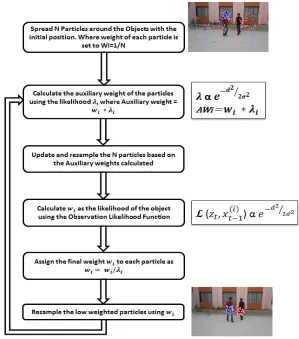
In the propose method, ‘M’ independent trackers are used which utilize auxiliary particle filter for tracking of ‘M’ number of humans in a scene. As a color feature for tracking the color histogram in RGB color space is used, which represent the color distribution using ‘m’ bins.The histograms are used to represent reference and observation model as they are robust against partial object scaling and occlusion. Bhattacharyya distance measure is used to measure the similarity between the reference and the target histograms. The trackers are initialized with ‘N’ particles each. The working principle of APF is depicted in figure 1 (flowchart) below.The algorithm for auxiliary particle filter for multiple human tracking is as follows.
Auxiliary Particle Filter algorithm for multiple human tracking
1) Spread N Particles around the Objects with the initial position so that the number of good particles will be
more say almost equal to number of particles, where weight of each particle is set to = 1/ .
2) Call the Observation model for the frame.
3) In the Observation model calculate the color histogram of the particles and then call the distance formula to
calculate the similarity of the particles.
4) With this similarity calculate the auxiliary weight of the particles using the likelihood , where Auxiliary
weight = ∗ .
5) Update and resample the N particles based on the Auxiliary weights calculated in step. Thus, The Auxiliary
particle filter favours particles with high .
6) Calculate the color histogram of the particles and then call the distance formula to calculate the similarity of
ISSN(Online): 2320-9801
ISSN (Print): 2320-9798
I
nternational
J
ournal of
I
nnovative
R
esearch in
C
omputer
and
C
ommunication
E
ngineering
(An ISO 3297: 2007 Certified Organization)
Vol. 3, Issue 7, July 2015
7) With this similarity calculate the weight and the likelihood of the object using the Observation Likelihood
Function.
8) Assign a weight to each particle as = / .
9) Resample the low weighted particles using and repeat the steps.
Fig 1: Flowchart for Auxiliary Particle Filter working principle
IV. EXPERIMENTAL RESULTS
ISSN(Online): 2320-9801
ISSN (Print): 2320-9798
I
nternational
J
ournal of
I
nnovative
R
esearch in
C
omputer
and
C
ommunication
E
ngineering
(An ISO 3297: 2007 Certified Organization)
Vol. 3, Issue 7, July 2015
ISSN(Online): 2320-9801
ISSN (Print): 2320-9798
I
nternational
J
ournal of
I
nnovative
R
esearch in
C
omputer
and
C
ommunication
E
ngineering
(An ISO 3297: 2007 Certified Organization)
Vol. 3, Issue 7, July 2015
V. CONCLUSION
In this paper, we presented an advanced variant of particle filter called auxiliary particle filter to address the problem of multiple human tracking. We have proposed the use of new likelihood model for both auxiliary weight and particle weight calculations. The results shows that the use of auxiliary particle filter address the multiple human tracking problem effectively.
REFERENCES
1.Lyudmila Mihaylova, Paul Brasnett, NishanCanagarajahand David Bull, “Object Tracking by Particle Filtering Techniques in Video Sequences”, Journal Image and Vision Computing, Volume 25 Issue 8, Pages 1217, August 2007.
2.ChunhuaShen, Anton van den Hengel and Anthony Dick, “Probabilistic Multiple Cue Integration for Particle Filter Based Tracking”, Proceedings of 7th Digital Image Computing: Techniques and Applications, 10-12 Dec. 2003, Sydney.
3.A.Oikonomopoulos, M.Pantic, “Human Body Gesture Recognition using Adapted Auxiliary Particle Filtering”, IEEE Conference on Advanced Video and Signal Based Surveillance, IEEE, 2007.
ISSN(Online): 2320-9801
ISSN (Print): 2320-9798
I
nternational
J
ournal of
I
nnovative
R
esearch in
C
omputer
and
C
ommunication
E
ngineering
(An ISO 3297: 2007 Certified Organization)
Vol. 3, Issue 7, July 2015
4.YasirSalih and Aamir S. Malik, “3D Tracking Using Particle Filters”, Instrumentation and Measurement Technology Conference , IEEE, May. 2011.
5.M. K. Pitt and N. Shephard,“Filtering via simulation: Auxiliary particle filters”, Journal of the AmericanStatistical Association, Volume 94(446):pp590–599, 1999.