DOI: 10.1007/978-3-319-06320-1 15, ISPEC 2014: 187-201. The final publication is available at link.springer.com.
Efficient Hardware Implementation of MQ
Asymmetric Cipher PMI+ on FPGAs
Shaohua Tang?, Bo Lv ??, Guomin Chen?? , and Zhiniang Peng
School of Computer Science & Engineering, South China University of Technology, Guangzhou, China
[email protected], [email protected]
Abstract. PMI+ is a Multivariate Quadratic (MQ) public key algo-rithm used for encryption and decryption operations, and belongs to post quantum cryptography. We designs a hardware on FPGAs to effi-ciently implement PMI+ in this paper. Our main contributions are that, firstly, a hardware architecture of encryption and decryption of PMI+ is developed, and description of corresponding hardware algorithm is proposed; secondly, basic arithmetic units are implemented with higher efficiency that multiplication, squaring, vector dot product and power op-eration are implemented in full parallel; and thirdly, an optimized imple-mentation for core module, including optimized large power operation, is achieved. The encryption and decryption hardware of PMI+ is effi-ciently realized on FPGA by the above optimization and improvement. It is verified by experiments that the designed hardware can complete an encryption operation within 497 clock cycles, and the clock frequency can be up to 145.6MHz, and the designed hardware can complete a de-cryption operation within 438 clock cycles wherein the clock frequency can be up to 37.04MHz.
Keywords: Multivariate Quadratic (MQ) Public Key Algorithm, PMI+ Encryption and Decryption, Hardware Implementation, FPGA, Opti-mized Large Power Operation
1
Introduction
Public key cryptography has played an important role in modern communication and computer networks. The public key cryptography, which is used widely, mainly includes RSA based on integer factorization problem, ElGamal based on discrete logarithm problem and elliptic curve cryptography, etc. In order to adapt various occasions, many efficiently hardware implementations are proposed by researchers [22,18,25,19,23,14,8].
The quantum algorithm of P.Shor is able to solve the integer factorization and discrete logarithm problem in polynomial time, including a calculation prob-lem in elliptic curve field, which directly threatens classical cryptosystems based
? Corresponding Author: Shaohua Tang. ??
on hard problems of number theory, and which helps to drive the development of post quantum cryptography. The post quantum cryptography can be divided into four categories: signature schemes based on hash function[17], lattice-based public key cryptosystem[13], public key cryptosystem based on error correct-ing code[16] and multivariate public key cryptosystem[7]. The research for post quantum cryptography is growing rapidly and many hardware and embedded system implementations of the post quantum cryptography appear in order to adapt various occasions[24,21,11,20,1,2,3,6].
PMI+ [5] is one kind of multivariate public key cryptosystem, and is a variant of MI[15]. Ding enhanced the security of MI by adding internal perturbation to the central map of MI in 2004, to produce a new variant of the MI cryptosystem which is called PMI cryptosystem[4]. However, the PMI cryptosystem has been broken by differential cryptanalysis by Fouque et al.[10] in 2005. Ding introduced new external perturbation to the central mapping of MI [5] in 2006, to produce PMI+ cryptosystem whose security has been greatly improved. Up to present, the PMI+ cryptosystem is still secure, and its hardware implementation is rel-atively less, so a hardware used to implement PMI+ is designed in this paper, which can be efficiently implemented in FPGA.
Our Contributions. The paper designs a hardware used to implement PMI+, which can be efficiently implemented on FPGA.
Firstly, a hardware architecture of encryption and decryption of PMI+ is developed, and description of corresponding hardware algorithm is proposed.
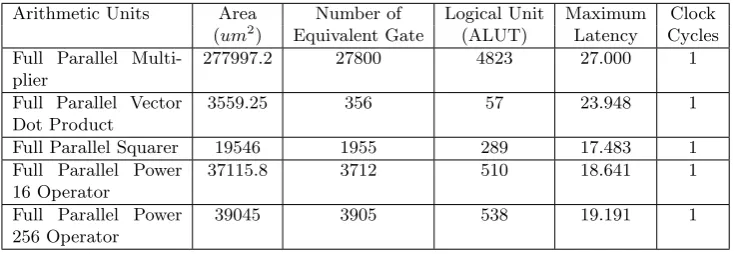
Secondly, basic arithmetic units are implemented with higher efficiency that multiplication, squaring, vector dot product and power operation are imple-mented in full parallel, wherein compared with a full parallel multiplier, a full parallel squarer takes up about one-twentieth of the logical unit and has shorter latency.
Thirdly, we implement an optimized large power operation, and compared with general power operation, it can reduce 4288 cycles at most in one process of decryption, with an obvious optimization. The encryption and decryption hardware of PMI+ is efficiently realized on FPGA by the above optimization and improvement.
Our experiments verify that if parameters are selected as (n, q, θ, r, a) = (84,2,4,6,14), the length of a plaintext block is 84 bits and the length of a ciphertext block is 98 bits, our designed hardware can complete an encryption operation within 497 clock cycles or 3.42us, wherein the clock frequency can be up to 145.6MHz, and our designed hardware can complete an decryption operation within 438 clock cycles or 11.83us, wherein the clock frequency can be up to 37.04MHz.
mod-ule; Section 4 lists detailed experimental data, and makes performance contrast with other public key encryption schemes; and Section 5 is the conclusion of this paper, which summarizes the findings of this paper and proposes further research directions.
2
Preliminaries
We describes the basic theory of the encryption and decryption of PMI+ [5] in this section. The basic idea of PMI+ is adding internal perturbation and external perturbation to the central map of MI scheme to resist linearization equation attack and differential attack.
2.1 Notations for PMI+
Letkbe a finite field of characteristic two and cardinalityq,Kbe an extension of degreen overk. Let ϕ:K→kn defined byϕ(a
0+a1x+...+an−1xn−1) = (a0, a1, ..., an−1).
Fixθso that gcd(qθ+1, qn−1) = 1 and define ˜F:K→Kby ˜F(X) =X1+qθ. ThenF is invertible and ˜F−1(X) =Xt, wheret(1 +qθ)≡1 mod (qn−1).
Define the mapF0 :kn →kn byF0(x
1, ..., xn) =ϕ◦F˜◦ϕ−1(x1, ..., xn) . Fix a small integerrand randomly chooserinvertible affine linear functions
z1, ..., zr, written aszj(x1, ..., xn) = n
P
i=1
αijxi+βj, forj= 1, ..., r. This defines a mapZ :kn →krbyZ(x
1, ..., xn) = (z1, ..., zr).The mapZ is source of internal perturbation.
Randomly choosen quadratic polynomials ˆf1, ...,fˆn ∈ k[z1, ..., zr] . The ˆfi define a map ˆF : kr → kn by ˆF(z1, ..., zr) = ( ˆf1, ...,fˆn). Let P be the set consisting of the pairs (λ, µ), whereλis a point that belongs to the image of ˆF
andµis the set of pre-images ofλunder ˆF.
Define an internal perturbation map byF∗(x1, ..., xn) = ˆF◦Z(x1, ..., xn) = (f∗
1, ..., fn∗).Define a map byF(x1, ..., xn) = (F0+F∗)(x1, ..., xn).
Randomly chooseanon-linear equations onx1, ..., xn for the central mapF as external perturbation. Randomly choose an invertible affine mapL1in n+a dimensional vector space kn+a, randomly choose an invertible affine mapL
2in
n dimensional vector space kn, and ¯F(x
1, ..., xn) = L1◦F◦L2(x1, ..., xn) is a public key of PMI+, and the private key includes the central mapF0, the map
ˆ
F,Z,L−11 andL−21.
2.2 PMI+ Encryption
For a given plaintext block (x1, ..., xn), when encrypting the plaintext, it only needs to apply the plaintext into the public key polynomial
y1= ¯f1(x1, x2, ..., xn),
...
yn+a= ¯fn+a(x1, x2, ..., xn),
to calculate the evaluation of n+a quadratic polynomials that a ciphertext (y1, ..., yn+a) can be acquired.
2.3 PMI+ Decryption
We can decrypt the ciphertext (y1, ..., yn+a) by computing
X = (x1, ..., xn) =L2−1◦F−1◦L1−1(y1, ..., yn+a). (2) The process is:
(1) calculatingY0 =L1−1(Y) = (y01, ..., y0n+a);
(2) removing a external perturbation polynomials from Y0 to obtain ¯Y = (¯y1, ...,y¯n);
(3) calculating (yλ1, ..., yλn) =F−1((¯y1, ...,y¯n) +λ) for each (λ, µ)∈P, and checking ifµ =Z(yλ1, ..., yλn) , if not, continuing this step, otherwise, moving on to the next step;
(4) applying (yλ1, ..., yλn) into a external perturbation polynomials, if the verification is successful, moving on to the next step, otherwise, returning to the previous step; and
(5) calculating X =L2−1(yλ1, ..., yλn) = (x1, ..., xn), and X is a decrypted plaintext.
2.4 Security and Parameter Selection of PMI+
The obtained PMI+ instance can reach a corresponding security level after asso-ciated parameters are set. For example, Ding [5] has shown two sets of relatively practical PMI+ parameters in his paper that the security level can be up to over 280, and the following table shows the two sets of parameters.
Table 1. Parameters for PMI+
n q r a θ
84 2 4 6 14
136 2 8 6 18
The parameters for PMI+ encryption and decryption hardware implemented in this paper is as the first set of parameters shown in Table 1, and the security level can be up to over 280.
3
Design and Implementation of PMI+ Hardware
3.1 Hardware Structure Design and Algorithm Process
Plaintext Polynomial Evaluation
Ciphertext
Fig. 1.The Hardware Structure of PMI+ Encryption
It can be shown from (1) in Section 2.2, the operation process of PMI+ en-cryption is equivalent to applying the plaintext into the polynomial to calculate, and its hardware structure is illustrated in Fig. 1.
If parameters are selected as (n, q, θ, r, a) = (84,2,4,6,14), the length of the plaintext block is 84 bits and the length of the ciphertext block is 98 bits, it needs to add 14 external perturbations, the public key is 358,190 (3,655*98) bits, i.e. 44,774 bytes.
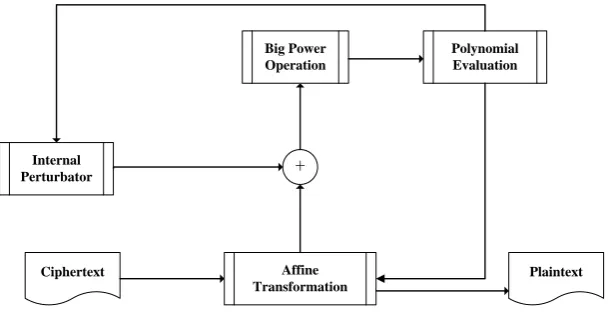
Design of PMI+ Decryption. The hardware structure of PMI+ Decryption is shown in Fig. 2.
Big Power Operation
Ciphertext
Polynomial Evaluation
Affine Transformation
Plaintext Internal
Perturbator +
Fig. 2.The hardware structure of PMI+ Decryption
be calculated in the affine transformation module again to obtain the plaintext block, otherwise, to select another element from the internal perturbator for large power operation after addition.
Based on Eq. (2), the process of PMI+ decryption can be abstracted into two parts: affine transformation and decryption mapping. In the parameters we selected, the process is that: firstly the ciphertext is operated by L1−1 affine transformation, wherein the parameter is 98 bits; then the result of the L1−1 affine transformation is mapped by decryption mapping algorithm to the plain-text space, and the result is 84 bits; finally the result of the PMI+ decryption mapping is operated byL2−1affine transformation, and a 84-bit plaintext block is obtained.
3.2 Basic Arithmetic Unit
Firstly, the basic arithmetic unit throughout the process of PMI+ encryption and decryption is described here.
Full Parallel Multiplier. Elements in the finite field K can be expressed by a polynomial as a=
83
P
i=0
aixi, whereai ∈ {0,1}. And a multiplication over the
finite field can be expressed byc=a⊗bmodR(x) =M modR(x).
One large field multiplication can be completed in one clock cycle by an or-dinary multiplication algorithm based on standard basis which contains merging similar items and conducting modulus reduction, and the main computation in the algorithm is on modulus reduction. It can be pre-processed with external program. The full parallel multiplier is structured as follows.
m0=a0⊗b0,
m1= (a0⊗b1)⊕(a1⊗b0),
...
m165= (a82⊗b83)⊕(a83⊗b82),
m166=a83⊗b83;
c0=m0⊕m84⊕...⊕m166,
c1=m1⊕m85⊕...⊕m166,
...
c83=m83⊕m110⊕...⊕m165.
Full Parallel Vector Dot Product. In the process of PMI+ decryption, the affine transformation is used twice, where in the first time, nis 98, and in the second time, nis 84. It needs to implement two vector dot products: a 98 dimensional vector dot product and a 84 dimensional vector dot product. The scalar value in the vector is 0 or 1, so for scalar value in the vector, the addition uses a XOR gate circuit, and the multiplication uses a AND gate circuit.
Seta= (a0, ..., an−1),b= (b0, ..., bn−1), where ai, bi∈ {0,1}, i= 0, ..., n−1, and the dot product of vectors isc∈ {0,1}:c= (a0⊗b0)⊕...⊕(an−1⊗bn−1). The vector dot product operation can be completed in one clock cycle, which usesnAND gate circuits andn−1 XOR gate circuits.
Full Parallel Squarer. There is a very useful property in Frobenius mapping that for a map Ti(X) = Xqi over the finite field K, X is represented as a polynomial basisa0+a1x+...+a83x83, and then the following equation holds:
Ti(X) =Xqi =a
0+a1xq i
+...+a83x83∗q i
.
While in the finite field K, q = 2, set a = 83
P
i=0
aixi as any element in K,
then:a2 = a
0 +a1x2 +...+a83x83∗2. It can be pre-processed with external program. The full parallel squarer has the following hardware structure.
c0=a0⊕a42⊕...⊕a83,
c1=a56⊕a61⊕...⊕a83,
...
c83=a55⊕a60⊕...⊕a82.
The full parallel squarer can complete one squaring operation over the finite fieldKin one clock cycle, which uses 1,525 XOR gate circuits. Compared with a full parallel multiplier, the full parallel squarer uses about one in twenty logical units, and has a shorter latency, so it seems worthwhile to implement the full parallel squarer.
Full Parallel Power Operator. In order to implement the large power oper-ation efficiently and reuse public arithmetic unit at the most extent, two power operators are implemented, where one is a full parallel power 16 operator and the other is a full parallel power 256 operator. Based on the nature of Frobenius mapping, setaas any element inK, and then:
a16=a
0+a1x16+...+a83x83∗16,
a256=a
0+a1x256+...+a83x83∗256.
It can be pre-processed with external program. The full parallel power 16 operator has the following hardware structure:
c0=a0⊕a9⊕...⊕a81,
c1=a1⊕a7⊕...⊕a83,
...
The full parallel power 256 operator has the following hardware structure:
d0=a0⊕a4⊕...⊕a83,
d1=a1⊕a2⊕...⊕a83,
. . .
d83=a2⊕a3⊕...⊕a83.
The full parallel power operator that we implemented can complete one ex-ponentiation over the finite field K in one clock cycle. Compared with a full parallel multiplier, the full parallel squarer uses about one in tenth logical units, and has a shorter latency.
3.3 Implementation of Hardware Core Modules
Implementation of Polynomial Calculation. The calculation of polynomial can be an addition or multiplication over finite field GF(2), which can be im-plemented by XOR operation and AND operation respectively. The polynomial calculation module is used in both PMI+ encryption and decryption. Wherein, in PMI+ encryption, the input of the polynomial calculation module is a plain-text block of PMI+ and a public key polynomial, the outputY of the polynomial calculation module is a ciphertext block, and the role of the polynomial calcula-tion module is to implement PMI+ encrypcalcula-tion; in PMI+ decrypcalcula-tion, the input of the polynomial calculation module is a result of the large power operation andaexternal perturbation polynomials of PMI+, the output of the polynomial calculation module is a result of PMI+ decryption mapping, and the role of the polynomial calculation module is to verifyaexternal perturbation polynomials.
Implementation of Affine Transformation. The affine transformation in-cludes a vector addition and a vector dot product. The vector addition can be implemented by XOR operation directly. The vector dot product can be im-plemented by the full parallel vector dot product defined by us. In the PMI+ decryption, two affine transformations are used, respectively before and after decryption mapping, the first uses a 98 dimensional vector dot product, and the second uses a 84 dimensional vector dot product.
Implementation of Internal Perturbator. When we implement the PMI+ decryption, it needs to abstract a component to complete a transformation for mapping fromr= 6 dimensional vector to 84 dimensional vector, which is called as internal perturbator. The expression of the map is calculated by a external program off-line, and the arithmetic unit is implemented by 1,078 XOR gates and 627 AND gates.
Conventional Large Power Operation. The large power operation is implemented by a “square-multiplication” method. The binary equivalent for t is 10000111 10000111 10000111 10000111 10000111 10000111 10000111 10000111 10000111 10000111 1000,Xtcan be expressed asBt=B23⊗B24⊗...⊗B283, so one large power operation can be completed by 83 squaring operations and 40 multiplica-tions.
Optimal Implementation of Large Power Operation. The basic idea to implement large power operation is reusing public arithmetic unit at the most extent, so as to reduce clock cycles of the large power operation. The software implementation of PMI+ has been completed in a 8051 microcontroller by Chen [26] in his master dissertation, where the large power operation uses a similar idea. The differences between the above paper and this paper are that the size oftused in this paper is different (methods for optimization are different), and the implementation of PMI+ in this paper is based on FPGA hardware platform.
We find that fragmentS= 10000111 appears 10 times in the binary string, so
Xtcan be expressed asXt=X23⊗(XS)16⊗((XS)16)256⊗...⊗((XS)16)...)256. In the optimized large power operation,XS =X10000111is firstly calculated, and we implement it for optimization that XS can be calculated in 5 cycles. Then, the operation ofXtcan be quickly completed by adding new arithmetic unit, and the rest of the operation can be completed in 11 clock cycles.
Algorithm 1: Optimal Implementation of Large Power Operation
Input:X; Output:Y; Procedure:
1 begin
2 B2 : = square(X);
3 B4 : = square(B2);Y :=multiply(X, B2);
4 B8 : = square(B4);Y :=multiply(Y, B4);
5 B128 : = power16(B8);B16 : = square(B8);
6 B135 : = multiply(B128, Y);
7 tmp:= power16(B135);
8 Y := multiply(B16,tmp);tmp = power256(tmp);
9 i= 8;
10 whilei >= 0do
11 Y : = multiply(Y,tmp); tmp = power256(tmp);
12 i− −;
13 end
14 Y := multiply(Y,tmp);
15 returnY;
16 end
vector, the arithmetic units of squareand multiplyare a full parallel squarer and a full parallel multiplier respectively, and the arithmetic units of power16 and power256 are a full parallel power 16 operator and a full parallel power 256 operator respectively.
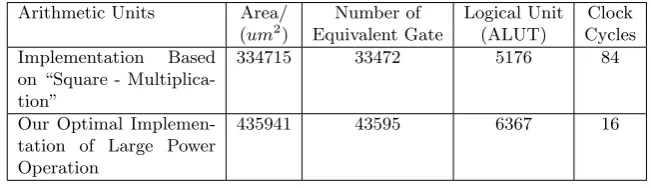
Our new proposed large power operation can complete a large power op-eration in 16 clock cycles which are less than one-sixth of those for “square-multiplication” method, and only the logical units taken up by the arithmetic units of power16andpower256increases for its area, so the operational per-formance is greatly enhanced.
4
Experiment Results and Analyses
The algorithm of PMI+ encryption and decryption is implemented inQuartas II 8.0 environment by VHDL with the idea of high speed and parallelization, its hardware simulation is implemented in EP2S130F102014 of the family of
StratixII, and the area of PMI+ encryption and decryption hardware is eval-uated bySynopsysDC, where the process library is 0.18nm process library of TSMC and the working voltage is 1.62 volt. The following results come from the real experimental data and compared with current implemented hardware in performance.
4.1 PMI+ Basic Arithmetic Unit
Some basic arithmetic units of PMI+ are implemented in Section 3.2, including a full parallel multiplier, a full parallel vector dot product, a full parallel squarer and a full parallel power operator, and the performance data of these basic arithmetic units is shown in Table 2.
Table 2. The Performance of PMI+’s Basic Arithmetic Units
Arithmetic Units Area Number of Logical Unit Maximum Clock
(um2) Equivalent Gate (ALUT) Latency Cycles Full Parallel
Multi-plier
277997.2 27800 4823 27.000 1
Full Parallel Vector Dot Product
3559.25 356 57 23.948 1
Full Parallel Squarer 19546 1955 289 17.483 1
Full Parallel Power 16 Operator
37115.8 3712 510 18.641 1
Full Parallel Power 256 Operator
39045 3905 538 19.191 1
the full parallel multiplier takes up the maximum area, and compared with the multiplier, the squarer and power operator complete an operation with lower latency while take up less area.
4.2 Large Power Operation in PMI+
A comparison of the number of logical units and the number of clock cycles between two different large power operations is listed in Table 3.
Table 3. Performance Comparison between two Large Power Operation Methods
Arithmetic Units Area/ Number of Logical Unit Clock
(um2) Equivalent Gate (ALUT) Cycles Implementation Based
on “Square - Multiplica-tion”
334715 33472 5176 84
Our Optimal Implemen-tation of Large Power Operation
435941 43595 6367 16
These results show that the performance of the optimized large power opera-tion has a significant improvement that clock cycles of the optimized large power operation reduce by 80.9% and the area adds about 30.2% for one large power operation. In PMI+ decryption, it needs 64 large power operations at most, so it can save up to 4,416 clock cycle at most for a period of decryption.
4.3 PMI+ Encryption and Decryption
We implement the first PMI+ encryption and decryption hardware on FPGA. Compared with other public key encryption and decryption hardware, our hard-ware implementation of PMI+ possesses of advantages such as small space, fast speed of encryption and decryption, and practical security level.
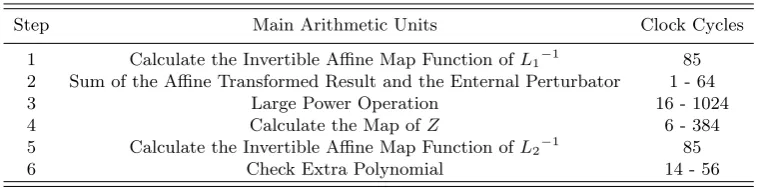
The whole PMI+ decryption needs at least 207 clock cycles (excepting cycles of reading ROM) to complete a signature operation, and it takes up a total of 11,005 logical units with a area of 680,302um2 .
Table 4. Cycles Required by Arithmetic Units in PMI+ Encryption
Step Main Arithmetic Units Clock Cycles
1 Calculate the Invertible Affine Map Function ofL1−1 85 2 Sum of the Affine Transformed Result and the Enternal Perturbator 1 - 64
3 Large Power Operation 16 - 1024
4 Calculate the Map ofZ 6 - 384
5 Calculate the Invertible Affine Map Function ofL2−1 85
6 Check Extra Polynomial 14 - 56
Table 5. Performance of our PMI+ Encryption and Decryption
Hardware Imple- menta-tion
Area (um2)
Number of Equivalent Gate
Logical Unit (ALUT)
Clock Frequency (MHz)
Period (ns)
Clock Cy-cles
Total Time (us)
PMI+ Encryp-tion
160385 16039 3468 145.60 6.868 497 3.42
PMI+ Decryp-tion
680302 68031 11005 37.04 27.000 438
-2915
11.83 -78.71
4.4 Performance Comparison
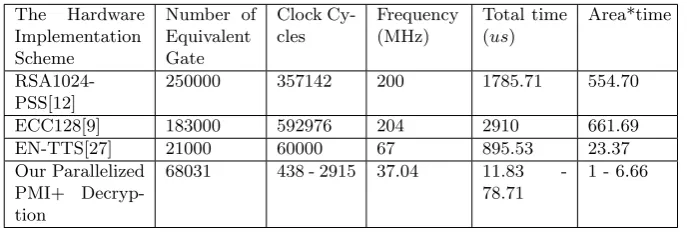
The performances of the PMI+ decryption hardware is compared with other public key cryptosystem hardware in this section. Table 6 lists the results after comparing the implementation of the PMI+ decryption hardware with other public key cryptosystems.
The data in the table shows that compared with RSA and ECC, paralleliza-tion PMI+ decrypparalleliza-tion hardware that we implemented has a higher performance advantage, such as small product of area and time, and high operating efficiency.
5
Conclusion
Table 6. Performance Comparison among some Public Key Crypto Hard-wares
The Hardware Implementation Scheme
Number of Equivalent Gate
Clock Cy-cles
Frequency (MHz)
Total time (us)
Area*time
RSA1024-PSS[12]
250000 357142 200 1785.71 554.70
ECC128[9] 183000 592976 204 2910 661.69
EN-TTS[27] 21000 60000 67 895.53 23.37
Our Parallelized PMI+ Decryp-tion
68031 438 - 2915 37.04 11.83
-78.71
1 - 6.66
is implemented which needs only 16 cycles to complete one exponentiation, and compared with general power operation, it can reduce 4288 cycles at most in one process of decryption, with an obvious optimization.
Future studies will include: 1) using registers in hardware more accurately to reduce the area and power consumption of hardware; and 2) reducing the number of logical units of multiplier and latency on the premise that the clock cycles do not increase.
Acknowledgment
This work is supported by the National Natural Science Foundation of China under Grant No. U1135004 and 61170080, Guangdong Province Universities and Colleges Pearl River Scholar Funded Scheme (2011), and High-level Tal-ents Project of Guangdong Institutions of Higher Education (2012).
References
1. Balasubramanian, S., Carter, H., Bogdanov, A., Rupp, A., Ding, J.: Fast Multi-variate Signature Generation in Hardware: The Case of Rainbow. In: Application-Specific Systems, Architectures and Processors, 2008. pp. 25–30 (July 2008) 2. Bogdanov, A., Eisenbarth, T., Rupp, A., Wolf, C.: Time-Area Optimized
Public-Key Engines:MQ-Cryptosystems as Replacement for Elliptic Curves? In: Oswald, E., Rohatgi, P. (eds.) Cryptographic Hardware and Embedded Systems - CHES 2008, Lecture Notes in Computer Science, vol. 5154, pp. 45–61 (2008)
3. Czypek, P., Heyse, S., Thomae, E.: Efficient Implementations of MQPKS on Con-strained Devices. In: Prouff, E., Schaumont, P. (eds.) Cryptographic Hardware and Embedded Systems - CHES 2012, Lecture Notes in Computer Science, vol. 7428, pp. 374–389. Springer Berlin Heidelberg (2012)
5. Ding, J., Gower, J.: Inoculating Multivariate Schemes Against Differential Attacks. In: Yung, M., Dodis, Y., Kiayias, A., Malkin, T. (eds.) Public Key Cryptography - PKC 2006, Lecture Notes in Computer Science, vol. 3958, pp. 290–301. Springer Berlin Heidelberg (2006)
6. Ding, J., Schmidt, D., Yin, Z.: Cryptanalysis of the New TTS Scheme in CHES 2004. International Journal of Information Security 5(4), 231–240 (2006)
7. Ding, J., Yang, B.Y.: Multivariate Public Key Cryptography. In: Bernstein, D., Buchmann, J., Dahmen, E. (eds.) Post-Quantum Cryptography, pp. 193–241. Springer Berlin Heidelberg (2009)
8. Fan, J., Vercauteren, F., Verbauwhede, I.: Efficient Hardware Implementation of Fp-Arithmetic for Pairing-Friendly Curves. IEEE Transactions on Computers 61(5), 676–685 (2012)
9. Fan, J., Vercauteren, F., Verbauwhede, I.: Faster Fp-arithmetic for Cryptographic Pairings on Barreto-Naehrig Curves. In: Clavier, C., Gaj, K. (eds.) Cryptographic Hardware and Embedded Systems - CHES 2009, Lecture Notes in Computer Sci-ence, vol. 5747, pp. 240–253. Springer Berlin Heidelberg (2009)
10. Fouque, P.A., Granboulan, L., Stern, J.: Differential Cryptanalysis for Multivariate Schemes. In: Eurocrypt 2005. Lecture Notes in Computer Science, vol. 3494, p. 341353. Springer (2005)
11. Ghosh, S., Verbauwhede, I.: BLAKE-512 Based 128-bit CCA2 Secure Timing Attack Resistant McEliece Cryptoprocessor. IEEE Transactions on Computers PP(99), 1–1 (2012)
12. Groschdl, J.: High-Speed RSA Hardware Based on Barrets Modular Reduction Method. In: Ko, e., Paar, C. (eds.) Cryptographic Hardware and Embedded Sys-tems - CHES 2000. Lecture Notes in Computer Science, vol. 1965, pp. 191–203. Springer Berlin Heidelberg (2000)
13. Hoffstein, J., Pipher, J., Silverman, J.: NTRU: A Ring-Based Public Key Cryp-tosystem. In: Buhler, J. (ed.) Algorithmic Number Theory, Lecture Notes in Com-puter Science, vol. 1423, pp. 267–288. Springer Berlin Heidelberg (1998)
14. Mahdizadeh, H., Masoumi, M.: Novel Architecture for Efficient FPGA Implementa-tion of Elliptic Curve Cryptographic Processor OverGF(2163). IEEE Transactions on Very Large Scale Integration (VLSI) Systems 21(12), 2330–2333 (2013) 15. Matsumoto, T., Imai, H.: Public Quadratic Polynomial-Tuples for Efficient
Signature-Verification and Message-Encryption. In: Barstow, D., Brauer, W., Brinch Hansen, P., Gries, D., Luckham, D., Moler, C., Pnueli, A., Seegmller, G., Stoer, J., Wirth, N., Gnther, C. (eds.) Advances in Cryptology - EUROCRYPT88. Lecture Notes in Computer Science, vol. 330, pp. 419–453. Springer Berlin Heidel-berg (1988)
16. McEliece, R.J.: A Public-Key Cryptosystem Based on Algebraic Coding Theory. DSN progress report 42(44), 114–116 (1978)
17. Merkle, R.C.: Secrecy, Authentication, and Public Key Systems. Ph.D. thesis, Stan-ford University (1979)
18. Miyamoto, A., Homma, N., Aoki, T., Satoh, A.: Systematic Design of RSA Pro-cessors Based on High-Radix Montgomery Multipliers. IEEE Transactions on Very Large Scale Integration (VLSI) Systems 19(7), 1136–1146 (2011)
20. Shih, J.R., Hu, Y., Hsiao, M.C., Chen, M.S., Shen, W.C., Yang, B.Y., Wu, A.Y., Cheng, C.M.: Securing M2M With Post-Quantum Public-Key Cryptography. IEEE Journal on Emerging and Selected Topics in Circuits and Systems 3(1), 106–116 (2013)
21. Shoufan, A., Wink, T., Molter, H., Huss, S., Kohnert, E.: A Novel Cryptoprocessor Architecture for the McEliece Public-Key Cryptosystem. IEEE Transactions on Computers 59(11), 1533–1546 (2010)
22. Sutter, G., Deschamps, J., Imana, J.: Modular Multiplication and Exponentiation Architectures for Fast RSA Cryptosystem Based on Digit Serial Computation. IEEE Transactions on Industrial Electronics 58(7), 3101–3109 (2011)
23. Sutter, G., Deschamps, J., Imana, J.: Efficient Elliptic Curve Point Multiplica-tion Using Digit-Serial Binary Field OperaMultiplica-tions. IEEE TransacMultiplica-tions on Industrial Electronics 60(1), 217–225 (2013)
24. Tang, S., Yi, H., Ding, J., Chen, H., Chen, G.: High-Speed Hardware Implementa-tion of Rainbow Signature on FPGAs. In: Yang, B.Y. (ed.) Post-Quantum Cryp-tography, Lecture Notes in Computer Science, vol. 7071, pp. 228–243. Springer Berlin Heidelberg (2011)
25. Wang, D., Ding, Y., Zhang, J., Hu, J., Tan, H.: Area-Efficient and Ultra-Low-Power Architecture of RSA Processor for RFID. Electronics Letters 48(19), 1185–1187 (2012)
26. Y, C.: An Implementation of PMI+ on Low-Cost SmartCard. Master’s thesis, National Taiwan University (2006)