DEVELOPMENT AND IN VITRO EVALUATION OF SOLID DISPERSIONS OF CANDESARTAN
CILEXETIL
UPPULURU ASHOK KUMAR
1*, GANDE SURESH
21Department of Pharmaceutics, Research Scholar, Mewar University, Chittorgarh, Rajasthan, India. 2Department of Pharmaceutics, Research Supervisor, Mewar University, Chittorgarh, Rajasthan, India. Email: [email protected]
Received: 16 April 2018, Revised and Accepted: 23 October 2018
ABSTRACT
Objective: The main objective of the present study is the systematic development of solid dispersions of Candesartan cilexetil by solvent evaporation method to enhance the solubility and bioavailability.
Methods: In the present study, 18 formulations of SD were prepared with 1:1 and 1:3 ratios of drug: Carrier and with and without surfactant. There was a significant improvement in the rate of drug release from all 20 SD and the formulation (SD16) comprising Candesartan: Containing Soluplus (1:3 ratio of drug: Soluplus with 2% sodium lauryl sulfate as a surfactant) by a solvent evaporation process.
Results: Final optimized design SD16 contained maximum drug content of 99.08%. In in vitro dissolution studies, it shows greater dissolution rate, that is, 99.7±4.2% associated through additional designs and pure drug. The drug was compatible with all the excipients as per the Fourier transform infrared spectroscopy. From powder X-ray diffraction and by (scanning electron microscope) studies, it was evident that crystalline form of Candesartan has been converted into amorphous form within SD design.
Conclusion: From these studies, we can accomplish SD are one of the greatest favorable formulation for Candesartan cilexetil for enhancing the solubility and bioavailability of poorly water-soluble drugs in the effective group of hypertension and other cardiac problems.
Keywords: Candesartan cilexetil, Hypertension, Solid dispersions, Soluplus, Poloxamer, Kolliwax.
INTRODUCTION
Candesartan is a common drug used for the treatment of hypertension and heart failure. Delivery of candesartan is difficult due to its low aqueous solubility, efflux through intestinal p-glycoprotein and vulnerability to enzymatic degradation in the small intestine [1]. Hence, various formulations are continuously researched and developed of which lipid-based systems are most widely accepted [2]. Low oral solubility and bioavailability are the major hurdles for designing delivery systems with improved pharmacokinetic profiles and therapeutic responses [3]. Drugs belonging to BCS Class II and IV have inspired formulators for the expansion of drug delivery technologies to overcome the effort in their solubilization by biochemical or mechanical alteration of the environment surrounding drug substance/physically altering macromolecular characteristics of aggregated drug particles [4].
To control hypertension Thiazide diuretics, angiotensin-converting enzyme inhibitors, β-blockers, calcium antagonists, and AT1 antagonists are employed mostly to prevent organ damage and reduce the mortality rate. However, most of these undertake extensive first-pass metabolism, frequent administration and have varied bioavailability [5]. The most possible method for increasing dissolution with the help of a water-soluble carrier is to reduce the particle size and thereby increase the surface area of absorption. Several approaches can be utilized to obtain solid dispersions (SD) that enhance solubility and bioavailability such as fusion, fusion dissolution, solvent removal, and spray drying [6]. The term SD refers to two different components, hydrophilic matrix, and hydrophobic drug. Hydrophilic carriers include povidone (polyvinylpyrrolidone [PVP]), polyethylene glycols (6000, 8000, etc.), and many more [7]. Nature of the solvent and the rate and temperature of evaporation are critical factors that can affect the final formulation [8]. This method is unique that thermal decay of drugs can be prevented as low temperature is required for the removal of the organic solvents [9].
The aim of this study is to design and evaluate various formulations of Candesartan SD prepared using different polymer ratios so as to increase the overall solubility and bioavailability of the final formulation.
MATERIALS AND METHODS Materials
Candesartan cilexetil pure drug was gifted from Aurobindo Pharma Ltd, Hyderabad, India. Poloxamer 407 and PEG 8000 obtained from BASF, Mumbai. Kolliwax GMS was obtained from Signet Chemical Corp. Pvt. Ltd, Mumbai. Soluplus was gifted from BASF, Germany. PVP K-30 was gifted from Dow Chemicals, USA. All other chemicals used are of analytical grade.
Preliminary solubility studies of Candesartan cilexetil
Solubility measurements of Candesartan cilexetil performed according to a published method reported by Higuchi and Connors in 1965 [10]. Excess amount of Candesartan cilexetil existed added to 25 ml aqueous solution of water-soluble carriers such as PEG8000, Soluplus, Kolliwax GMS II, Poloxamer 407, and PVPK-30 screw-capped bottles. Samples are shaken for 24 h at room temperature. Subsequently, suspensions are filtered through Whatman filter paper no 1. Filtered solutions are diluted up to the mark with methanol. Diluted solutions of Candesartan cilexetil analyzed at UV 257 nm.
Preparation of Candesartan cilexetil SD by solvent evaporation method
The calculated amount of Candesartan cilexetil and the employed polymers (Soluplus, Kolliwax GMS, Poloxamer 407, PEG 8000, and PVPK-30) in different drug-polymer ratios (1:1 and 1:3) besides sodium lauryl sulfate (SLS) as surfactant (0 or 2%) (as shown in Table 1) are weighed and mixed together in a porcelain dish. 20 different formulations prepared by a solvent evaporation method. Drug and
Research Article
polymer mixtures were dissolved in the least amount of methanol as a common solvent. The solvent was evaporated in an oven at temperature 50°C till complete evaporation. SD thus prepared were pulverized in a mortar and sieved. The fraction of powder that passed through 45 μm sieve was stored in a desiccator and used for further investigations.
Evaluation of Candesartan cilexetil SD
SD obtained from the above method were tested for their percentage practical yield, drug content, and in vitro drug release studies.
Percentage practical yield
Percentage of practical yield was calculated to know about percent yield or efficiency of the method so as to help in the selection of a suitable method of production [11].
Drug content
SD equivalent to 16 mg Candesartan cilexetil is weighed accurately and dissolved in 100 ml of methanol. Solution is filtered, diluted with a suitable solvent and drug content is analyzed at λmax 257 nm against
blank by UV spectrometer [12].
In vitro dissolution study of SD
USP dissolution test type II apparatus (Electrolab TDT- 06 N, India) is used. Amount of samples equivalent to 16 mg drug was dispersed into a dissolution vessel containing 900 mL phosphate buffer pH 6.5 containing 0.75% Tween 20 at 37°C and stirred at 50 rpm. Samples are withdrawn periodically, filtered and replaced with fresh dissolution medium. After filtration through 0.45 μm microfilter, the concentration of Candesartan cilexetil is determined spectrophotometrically at λ max 257 nm [13].
Characterization
Fourier transform infrared (FTIR) studies
Using Shimadzu FTIR-8700 spectrophotometer, potassium bromide disc method is employed. Pure drug, physical mixtures, and SD are studied. Powdered samples are intimately mixed with dry powdered potassium bromide. This mixture was then compressed into a transparent disc under high pressure using special dies. Disc is placed in IR spectrophotometer using a sample holder, and then the spectrum is recorded [14].
Powder X-ray diffraction (p-XRD)
X-ray powder diffraction patterns were recorded on an X-ray powder diffraction system (Shimadzu, Japan) using copper target, a voltage of 40 Kv and a current of 30 mA. The scanning was done over 2_ range of 5–60° [15].
Scanning electron microscope (SEM) studies
Surface morphology of layered sample was inspected using SEM (Hitachi, Japan). Small amount of powder was manually dispersed onto a carbon tab (double adhesive carbon coated tape) adhered to an aluminum stub. These sample stubs were coated with a thin layer (30Å) of gold by employing POLARON-E 3000 sputter coater. Samples are examined by SEM and photographed under various magnifications with direct data capture images onto a computer [16].
Stability studies
Systematized SD were placed inside sealed 40cc HDPE container with child-resistant cap under controlled temperature environment inside stability chamber (Thermo Lab, India) with a relative humidity of 75%±5% RH and temperature 40°C±2°C for stability studies. Samples were removed after 1, 2, and 3 months and evaluated for percentage drug content and in vitro dissolution studies and compared with those SDs tested immediately after preparation [17].
RESULTS AND DISCUSSION
Preliminary solubility studies Candesartan cilexetil
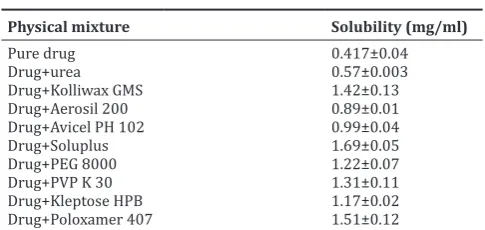
Preliminary solubility studies were carried out to select suitable water-soluble carriers for the preparation of SD. Pure drug solubility was found to be 0.417 mg/ml. From this study, drug and Soluplus in ratio of 1:1 shown highest drug solubility of about 1.69±0.05 mg/ml, almost 4-fold increase paralleled to that of pure drug. For all the water-soluble carriers used in preliminary solubility studies, Avicel PH 102, Colloidal Silicone dioxide (Aerosil 200), and urea have shown low solubility when compared with other carriers and are not included in the preparation of
SD 15 0.16 - - - 0.48 - 0 Qs
SD: Solid dispersions, PVP: Polyvinylpyrrolidone, SLS: Sodium lauryl sulfate
Candesartan cilexetil SD. The graphical representation solubility studies of Candesartan cilexetil physical mixtures are shown in Fig. 1 and Table 2.
Preparation of Candesartan cilexetil SD
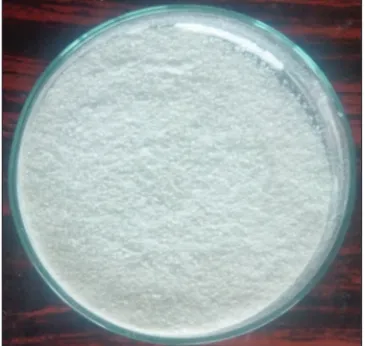
Candesartan cilexetil SD were prepared and shown in Fig. 2.
Evaluation parameters
Solubility studies of Candesartan cilexetil SD
Different formulations of Candesartan cilexetil SD were prepared using solvent evaporation method with their respective carriers. After preparation, SD solubility analysis was carried out. Formulation (SD16) with Soluplus in the ratio of 1:3 and SLS showed the highest solubility, that is, 4.599±0.07 mg/ml, almost 11-fold compared to that pure drug (pure drug solubility is 0.417±0.04 mg/ml). Results were tabulated in Table 3and the graphical representation is shown in Fig. 3.
Percent practical yield and drug content
Results of percent practical yield for all formulations of SD were found to be in the range of 83.88–99.28%; results are shown in Table 4. Maximum yield found to be 99.28% in formulation SD16. The drug content in prepared SD found to be in the range of 86.33–99.08%. Maximum percent drug content, that is, 99.08% found in formulation SD16.
In vitro dissolution studies
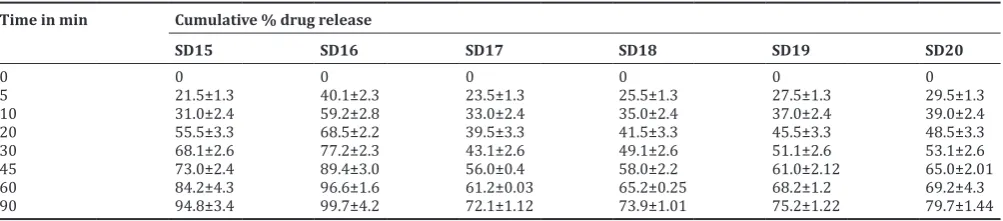
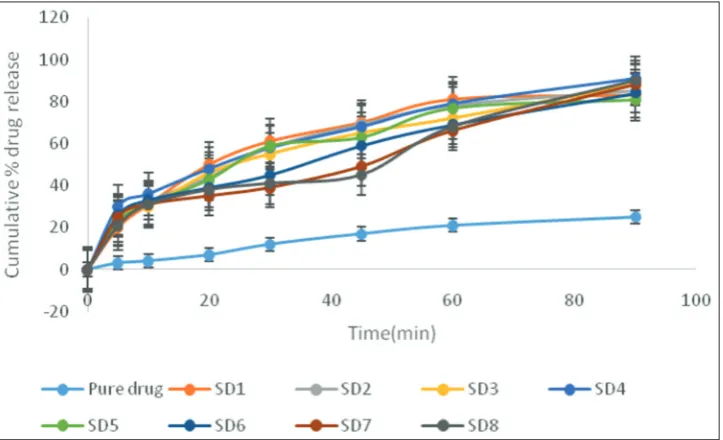
Drug release data obtained for formulations SD1-SD20 are tabulated in Tables 5-7, respectively. They show a cumulative percent drug released as a function of time for all formulations. In vitro studies reveal that there
Fig. 1: Solubility studies of Candesartan cilexetil physical mixture
Fig. 2: Candesartan cilexetil solid dispersions
Table 3: Solubility studies of Candesartan cilexetil solid dispersions (SD) prepared by a solvent evaporation method
Formulation code Solubility (mg/ml)*
Table 4: Percent practical yield and drug content for Candesartan cilexetil SD
Formulation % Practical yield % Drug content
Table 5: In vitro dissolution profile of pure drug and different formulations of Candesartan cilexetil SD1-SD8 Time (minutes) Cumulative % drug release
Pure drug SD1 SD2 SD3 SD4 SD5 SD6 SD7 SD8
0 0 0 0 0 0 0 0 0 0
5 3.11±0.43 20.6±2.9 22.6±2.9 26.8±2.0 30.3±2.5 23.3±3.4 26.4±2.9 25.5±1.3 21.5±1.3
10 4.38±0.12 31.7±3.9 32.7±3.9 30.3±2.9 36.9±1.5 31.2±1.4 33.8±2.3 31.0±2.4 31.0±2.4
20 7.01±0.36 50.8±2.0 44.8±2.0 46.5±3.3 48.5±2.7 43.3±2.3 39.5±1.6 35.5±3.3 32.5±3.3
30 12.12±0.73 61.4±1.4 58.4±1.4 55.5±3.8 58.2±2.6 59.1±2.9 45.8±1.8 39.1±2.6 41.1±2.6
45 17.09±0.40 70.7±3.8 69.7±3.8 65.5±1.9 68.5±2.2 63.2±1.4 59.5±1.7 46.0±2.4 45.0±2.4
60 21.22±0.80 81.4±2.2 78.4±2.2 72.9±3.3 79.3±2.9 77.5±3.6 69.9±1.8 66.2±4.3 68.2±1.5
90 25.55±0.64 83.6±1.7 85.6±2.7 88.4±3.1 91.5±2.8 81.8±3.3 84.2±1.2 88.8±3.1 90.9±3.4
SD: Solid dispersions
Table 6: In vitro dissolution profile of different formulations of Candesartan cilexetil SD9-SD14 Time in min Cumulative % drug release
SD9 SD10 SD11 SD12 SD13 SD14
0 0 0 0 0 0 0
5 26.6±2.9 25.2±3.7 26.6±2.9 23.6±2.9 26.6±2.9 23.4±2.9
10 36.7±3.9 32.6±1.9 41.7±3.9 33.7±3.9 36.7±3.9 39.8±2.3
20 58.8±2.0 44.6±2.5 53.8±2.0 48.8±2.0 49.8±2.0 51.5±1.6
30 63.4±1.4 56.8±0.55 65.4±1.4 63.4±1.35 58.4±1.4 61.8±1.8
45 77.7±0.8 68.5±0.13 73.7±3.7 72.7±3.6 67.7±3.8 69.5±1.7
60 81.5±2.2 79.9±2.5 83.5±2.9 84.4±2.2 77.4±2.2 79.9±1.8
90 83.22±1.7 84.1±3.8 86.6±1.7 88.8±1.7 89.6±2.7 91.3±1.2
SD: Solid dispersions
Table 7: In vitro dissolution profile of different formulations of Candesartan cilexetil SD15-SD20 Time in min Cumulative % drug release
SD15 SD16 SD17 SD18 SD19 SD20
0 0 0 0 0 0 0
5 21.5±1.3 40.1±2.3 23.5±1.3 25.5±1.3 27.5±1.3 29.5±1.3
10 31.0±2.4 59.2±2.8 33.0±2.4 35.0±2.4 37.0±2.4 39.0±2.4
20 55.5±3.3 68.5±2.2 39.5±3.3 41.5±3.3 45.5±3.3 48.5±3.3
30 68.1±2.6 77.2±2.3 43.1±2.6 49.1±2.6 51.1±2.6 53.1±2.6
45 73.0±2.4 89.4±3.0 56.0±0.4 58.0±2.2 61.0±2.12 65.0±2.01
60 84.2±4.3 96.6±1.6 61.2±0.03 65.2±0.25 68.2±1.2 69.2±4.3
90 94.8±3.4 99.7±4.2 72.1±1.12 73.9±1.01 75.2±1.22 79.7±1.44
SD: Solid dispersions
is marked an increase in the dissolution rate of Candesartan cilexetil from all the SD when compared to pure Candesartan cilexetil itself. From the in vitro drug release profile, it can be seen that formulation SD16 containing Soluplus (1:3 ratio of drug: Soluplus with surfactant) shows higher dissolution rate, that is, 99.7±4.2% compared with other
Fig. 4: In vitro dissolution profile of the pure drug and different formulations of Candesartan cilexetil solid dispersions (SD1-SD8)
Fig. 5: In vitro dissolution profile of different formulations of Candesartan cilexetil solid dispersions (SD9-SD14)
Fig. 7: Fourier transform infrared spectrum of Candesartan cilexetil pure drug
Fig. 8: Fourier transform infrared spectrum of Soluplus
Fig. 10: Fourier transform infrared spectrum of Candesartan cilexetil physical mixture
Fig. 11: Fourier transform infrared spectrum of Candesartan cilexetil optimized formulation SD16
Fig. 12: X-ray diffractograms of Candesartan cilexetil pure drug like a matrix particle. Results could be attributed to dispersion of the
drug in molten mass of polymer.
Stability studies
Optimized formulation (SD16) was selected for stability studies on the basis of high cumulative percent drug release. Stability studies are conducted for drug content and invitro drug release studies for 3 months at accelerated stability conditions according to the ICH guidelines. The optimized formulation is stable during 3 months period. From these results, it is concluded that optimized formulation (SD16) is stable and retained its original properties with minor differences. The results are summarized in Table 8.
CONCLUSION
Fig. 13: X-ray diffractograms of Candesartan cilexetil optimized formulation SD16
Fig. 14: Pure drug of Candesartan
Fig. 15: Candesartan optimized formulation SD16S
Table 8: Evaluation parameters of optimized formulation (SD16) stored at 40±2°C/75±5%rh Retest time for optimized
formulation (days) % Drug content In vitrorelease (%) drug
0 day 99.08 99.70
1. Fotouh KA, Allam AA, El-Badry M, El-Sayed AM. Development and in vitro/in vivo performance of self-nanoemulsifying drug delivery systems loaded with candesartan cilexetil. Eur J Pharm Sci 2017;109:503-13. 2. Shafiq S, Shakeel F, Talegaonkar S, Ahmad FJ, Khar RK, Ali M, et al.
Development and bioavailability assessment of ramipril nanoemulsion formulation. Eur J Pharm Biopharm 2007;66:227-43.
3. Pathak K, Raghuvanshi S. Oral bioavailability: Issues and solutions via nanoformulations. Clin Pharmacokinet 2015;54:325-57.
4. Kasturi M, Agarwal S, Yadav JK. Self-nano-emulsifying drug delivery system of ramipril: Formulation and in-vitro evaluation. Int J Pharm Pharm Sci 2016;8:975-1491.
5. Ali HH, Hussein AA. Oral solid self-nanoemulsifying drug delivery systems of candesartan citexetil: Formulation, characterization and in vitro drug release studies. Apps Open 2017;3:6.
6. Patel TB, Patel LD, Patel TB, Makwana SH, Patel TR. Formulation and characterization of solid dispersions containing glibenclamide. Int J Pharm Pharm Sci 2010;2:975-1491.
7. Anna B, Harisha KM, Uday KG. Development, characterization and evaluation of solid dispersions of artemether and lumefantrine by solvent evaporation method using hydrophilic polymer. Int J Pharm Pharm Sci 2014;6:975-1491.
8. Yamashita K, Nakate T, Okimoto K, Ohike A, Tokunaga Y, Ibuki R, et al. Establishment of new preparation method for solid dispersion formulation of tacrolimus. Int J Pharm 2003;267:79-91.
9. Dasi S, Roy S. Solid dispersions: An approach to enhance the bioavailability of poorly water-soluble drugs. Int J Pharm Pharm Tech 2008;3:227-4.
10. Chen S, Zhu J, Ma F, Fang Q, Li Y. Preparation and characterization of solid dispersions of dipyridamole with a carrier “copolyvidonum plasdone S-630”. Drug Dev Ind Pharm 2007;33:888-99.
11. Lakshmi K, Reddy MPK, Kaza R. Dissolution enhancement of telmisartan by surface solid dispersion technology. Int J Innov Pharm Res 2012;3:247-51.
12. Shingala K, Chetan S, Deepak D. Formulation development and evaluation of immediate release tablet of poorly soluble candesartan cilexetil. J Pharm Sci Biosci Res 2013;3:77-90.
13. Valizadeh H, Nokhodchi A, Qarakhani N, Zakeri-Milani P, Azarmi S, Hassanzadeh D, et al. Physicochemical characterization of solid
can conclude that SD are one of the most favorable formulations for Candesartan cilexetil for the effective management of hypertension and other cardiac problems.
dispersions of indomethacin with PEG 6000, myrj 52, lactose, sorbitol, dextrin, and eudragit E100. Drug Dev Ind Pharm 2004;30:303-17. 14. Yang M, Wang P, Huang CY, Ku MS, Liu H, Gogos C, et al. Solid
dispersion of acetaminophen and poly(ethylene oxide) prepared by hot-melt mixing. Int J Pharm 2010;395:53-61.
15. Shamma RN, Basha M. Soluplus®: A novel polymeric solubilizer for
optimization of Carvedilol solid dispersions: Formulation design and effect of method of preparation. Powder Technol 2013;237:406-14. 16. Breitenbach J. Melt extrusion: From process to drug delivery
technology. Eur J Pharm Biopharm 2002;54:107-17.