Text Classification into Abstract Classes Based on Discourse Structure
Boris Galitsky
Knowledge Trail Inc.
San-Francisco, USA
[email protected]
Dmitry Ilvovsky
National Research
Universi-ty Higher School of
Eco-nomics, Moscow, Russia
[email protected]
Sergey O. Kuznetsov
National Research
Universi-ty Higher School of
Eco-nomics, Moscow, Russia
[email protected]
Abstract
The problem of classifying text with respect to belonging to a document or a meta-document is formulated and its application areas are pro-posed. An algorithm is proposed for document classification tasks where counts of words is insufficient do differentiate between such ab-stract classes of text as metalanguage and ob-ject-level. We extend the parse tree kernel method from the level of individual sentences towards the level of paragraphs, based on anaphora, rhetoric structure relations and communicative actions linking phrases in dif-ferent sentences. Tree kernel learning tech-nique is applied to these extended trees to lev-erage of additional discourse-related infor-mation. We evaluate our approach in the do-main of action-plan documents.
1
Introduction
Solving text classification problems, keywords and their topicality usually suffice. These fea-tures provide abundant information to determine a topic of a text or document, such as apple vs banana, or adventures vs relaxing travel. At the same time, there is a number of document classi-fication domains where distinct classes have sim-ilar words. In this case, style, phrasings and other kinds of text structure information need to be leveraged. To perform text classification in such domains, one needs to employ discourse infor-mation such as anaphora, rhetoric structure, enti-ty synonymy and ontology, if available (Wu et al., 2011).
In this study, an issue of classifying a text with respect to being metalanguage or language object is addressed. We are concerned with differentiat-ing between object-level documents, which in-form us on how to do things, or how something has been done, and meta-documents, specifying how to write a document which explains how to do things, or how things have been done. Meta-language is a symbolic system intended to
ex-press information, or analyze another language or symbolic system. In a natural language docu-ment, metalanguage is used as a special expres-sive means to ascend to the desired level of ab-straction. To automatically recognize metalan-guage patterns in text, one needs some implicit signals at the syntactic level. Naturally, just us-ing keyword statistics is insufficient to differen-tiate between texts in metalanguage and lan-guage-object.
A presence of verbs for speech acts and men-tal states (such as knowing) may help to identify metalanguage patterns, but is an unreliable crite-rion: I know the location of the highest mountain
vs I know what he thinks about the highest moun-tain in the world. The latter sentence contains a meta-predicate think (who, about-what) with the second variable ranging over a set of (object-level) expressions for thoughts about the highest mountain. Relying on syntactic parse trees would provide us with specific expressions and phrasings connected with a metalanguage. How-ever, it will still be insufficient for a thorough description of linguistic features inherent to a metalanguage. It is hard to identify such features without employing a discourse structure of a document. This discourse structure needs to in-clude anaphora, rhetoric relations, and interac-tion scenarios by means of communicative lan-guage (Galitsky and Kuznetsov, 2008). Further-more, to systematically learn these discourse fea-tures associated with metalanguage, and differen-tiate them from the ones for language-object, one needs a unified approach to classify graph struc-tures at the level of paragraphs (Galitsky et al., 2013).
The design of such features for automated learning of syntactic and discourse structures for classification is still done manually today. To overcome this problem, tree kernel approach has been proposed (Cumby and Roth, 2003). Tree kernels constructed over syntactic parse trees, as well as discourse trees (Galitsky et al., 2015) is one of the solutions to conduct feature
ing. Convolution tree kernel (Collins and Duffy, 2002; Haussler, 1999) defines a feature space consisting of all subtree types of parse trees and counts the number of common subtrees to ex-press the respective distance in the feature space. They have found a broad range of applications in NLP tasks such as syntactic parsing re-ranking, relation extraction (Zhang et al., 2008), named entity recognition (Cumby and Roth, 2003), pro-noun resolution (Kong and Zhou, 2011), question classification, and machine translation.
The kernel ability to generate large feature sets is useful to assure we have enough linguistic fea-tures to differentiate between the classes, to quickly model new and not well understood lin-guistic phenomena in learning machines. How-ever, it is often possible to manually design fea-tures for linear kernels that produce high accura-cy and fast computation time whereas the com-plexity of tree kernels may prevent their applica-tion in real scenarios. SVM (Vapnik, 1995) can work directly with kernels by replacing the dot product with a particular kernel function. This useful property of kernel methods, that implicitly calculates the dot product in a high-dimensional space over the original representations of objects such as sentences, has made kernel methods an effective solution to modeling structured linguis-tic objects (Moschitti, 2006).
An approach to build a kernel based on more than a single parse tree for search has been pro-posed (Galitsky et al., 2015). To perform classi-fication based on additional discourse features, we form a single tree from a tree forest for a se-quence of sentences in a paragraph of text.
A number of NLP tasks such as classification require computing of semantic features over par-agraphs of text containing multiple sentences. Doing it at the level of individual sentences and then summing up the score for sentences will not always work. In the complex classification tasks where classes are defined in an abstract way, the difference between them may lay at the para-graph level and not at the level of individual sen-tences. In the case where classes are defined not via topics but instead via writing style, discourse structure signals become essential. Moreover, some information about entities can be distribut-ed across sentences, and classification approach needs to be independent of this distribution. We will demonstrate the contribution of paragraph-level approach vs the sentence paragraph-level in our evalu-ation.
2
Text Classification Based on
Dis-course Text Structure
2.1 The domain of documents and meta-documents
Our first example of the use of meta-language is the following text shared by an upset customer, doing his best to have a bank to correct an error:
The customer representative acknowledged that the only thing he is authorized to do is to inform me that he is not authorized to do anything.
This is a good example for how people describe
thinking about thinking. In this example, bank operations can be described in language-object, and bank employee’s authorizations to perform these operations are actually described in meta-language. Here a document on banking opera-tions is an object-level document, and authoriza-tion rules document is a meta-document relative to the operations document. The claim of this work is that this classification can be performed based on text analysis only without any knowledge of banking industry.
We define an action-plan (object-level) doc-ument as a docdoc-ument which contains a thorough and well-structured description of how to build a particular system or work of art, from engineer-ing to natural sciences to creative art. Accordengineer-ing to our definition, action-plan document follows the reproducibility criteria of a patent or research publication; however format might deviate sig-nificantly. One can read such document and be-ing proficient in the knowledge domain, can build such a system or work of art.
Conversely, a meta-document is a document explaining how to write object-level, action-plan documents. They include manuals, standard ac-tion-plan documents should adhere to, tutorials on how to improve them, and others.
We need to differentiate action-plan docu-ments from the classes of docudocu-ments which can be viewed as ones containing meta-language, whereas the genuine action-plan documents con-sists of the language-object patterns and should not include metalanguage ones. As to the exam-ples of meta-documents, they include design re-quirements, project requirement document, oper-ational requirements, design guidelines, design guides, tutorials, design templates (template for technical design document, research papers on system design, educational materials on system design, resume of a design professional, and oth-ers.
topic in terms of style and phrasing. To extract these features, rhetoric relations are essential. Notice that meta-documents can contain object-level text, such as design examples. Object object-level documents (genuine action-plan docs) can con-tain some author reflections on the system design process (which are written in metalanguage). Hence the boundary between classes does not strictly separates metalanguage and language object. We use statistical language learning to optimize such boundary, having supplied it with a rich set of linguistic features up to the dis-course structures. In the design document do-main, we will differentiate between texts ex-pressed mostly via meta-language and the ones mostly in language-object.
2.2 Discourse Structure of a Document
It turns out that sentence-level tree kernels are insufficient for classification in our domains. Since important phrases can be distributed through different sentences, one needs a sentence boundary – independent way of extracting both syntactic and discourse features. Therefore we intend to combine/merge parse trees to make sure we cover all the phrase of interest. Let us analyze the following text with respect of be-longing to a document or meta-document.
This document describes the design of back end processor. Its requirements are enumerated below.
From the first sentence, it looks like an action-plan document. To process the second sentence, we need to disambiguate the preposition ‘its’. As a result, we conclude from the second sentence that it is a requirements document, not an object-level action-plan one.
The structure of a document which can be po-tentially valuable for classification can be char-acterized by rhetoric relations that hold between the parts of a text. These relations, such as ex-planations or contrast, are important for text un-derstanding in general since they contain infor-mation on how these parts of text are related to each other to form a coherent discourse. Natural-ly, we expect the structure of discourse for meta-language text patterns to be different to that of language-object text patterns.
Rhetorical Structure Theory, or RST (Mann, and Thompson, 1988; Mann et al., 1992; Marcu, 1997) is one of the most popular approaches to model extra-sentence as well as intra-sentence discourse. RST represents texts by labeled hier-archical structures, called Discourse Trees (DTs). The leaves of a DT correspond to contiguous
Elementary Discourse Units (EDUs). Adjacent EDUs are connected by rhetorical relations (e.g., Elaboration, Contrast), forming larger discourse units (represented by internal nodes), which in turn are also subject to this relation linking. Dis-course units linked by a rhetorical relation are further distinguished based on their relative im-portance in the text: nucleus being the central part, whereas satellite being the peripheral one. Discourse analysis in RST involves two sub-tasks: discourse segmentation is the task of iden-tifying the EDUs, and discourse parsing is the task of linking the discourse units into a labeled tree. Discourse analysis explores how meanings can be built up in a communicative process, which varies between a text metalanguage and a text language-object. Each part of a text has a specific role in conveying the overall message of a given text.
For our classification tasks, just an analysis of a text structure can suffice for proper classifica-tion. Given a positive sequence
A hardware system contains classes such as GUI for user interface, IO for importing and ex-porting data between the emulator and environ-ment, and Emulator for the actual process con-trol. Furthermore, a class Modules is required which contains all instances of modules in use by emulation process.
and a negative sequence
A socio-technical system is a social system sit-ting upon a technical base. Email is a simple example of such system. The term socio-technical was introduced in the 1950s by the Tavistok In-stitute.
We want to classify the paragraph
They are the Database for storing transactions, Web Forms for user data input, and Business rule processor for handling the web forms. Addi-tionally, the backend email processing includes the components for nightly transaction execution.
One can see that it follows the rhetoric struc-ture of the top (positive) training set element, although it shares more common keywords with the bottom (negative) element. Hence we classify it as an action-plan document, being an object-level text, since it describes the system rather than introduces a terms (as the negative element does).
2.3 Anaphora and Rhetoric Relations for Classification Task
We introduce a classification problem where keyword and even phrase-based features are in-sufficient. This is due to the variability of ways information can be communicated in multiple sentences, and variations in possible discourse structures of text which needs to be taken into account.
We consider an example of text classification problem, where short portions of text belong to two classes:
Tax liability of a landlord renting office to a business.
Tax liability of a business owner renting an office from landlord.
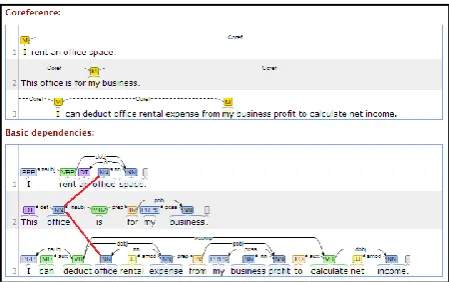
I rent an office space. This office is for my business. I can deduct office rental expense from my business profit to calculate net income.
To run my business, I have to rent an office. The net business profit is calculated as follows. Rental expense needs to be subtracted from rev-enue.
To store goods for my retail business I rent some space. When I calculate the net income, I take revenue and subtract business expenses such as office rent.
I rent out a first floor unit of my house to a travel business. I need to add the rental income to my profit. However, when I repair my house, I
can deduct the repair expense from my rental income.
I receive rental income from my office. I have to claim it as a profit in my tax forms. I need to add my rental income to my profits, but sub-tract rental expenses such as repair from it.
I advertised my property as a business rental. Advertisement and repair expenses can be sub-tracted from the rental income. Remaining rental income needs to be added to my profit and be reported as taxable profit.
Note that keyword-based analysis does not help to separate the first three paragraph and the second three paragraphs. They all share the same
keywords
rent-al/office/income/profit/add/subtract. Phrase-based analysis does not help, since both sets of paragraphs share similar phrases.
Secondly, pair-wise sentence comparison does not solve the problem either. Anaphora resolu-tion is helpful but insufficient. All these sentenc-es include ‘I’ and its mention, but other links
between words or phrases in different sentences need to be used.
Rhetoric structures need to come into play to provide additional links between sentences. The structure to distinguish between
renting for yourself and deducting from total income and
renting to someone and adding to income em-braces multiple sentences. The second clause about adding/subtracting incomes is linked by means of the rhetoric relation of elaboration with the first clause for landlord/tenant. This rhetoric relation may link discourse units within a sen-tence, between consecutive sentences and even between first and third sentence in a paragraph. Other rhetoric relations can play similar role for forming essential links for text classification.
There are multiple ways the nodes from parse trees of different sentences can be connected: we choose the rhetoric relation of elaboration which links the same entity office and helps us to form the structure rent-office-space – for-my-business – deduct-rental-expense which is the base for our classification.
We show the resultant extended tree with the root ‘I’from the first sentence.
It includes the whole first sentence, a verb phrase from the second sentence and a verb phrase from the third sentence according to rhet-oric relation of elaboration. Notice that this ex-tended tree can be intuitively viewed as repre-senting the ‘main idea’ of this text compared to other texts in our set. All extended trees need to be formed for a text and then compared with that of the other texts, since we don’t know in ad-vance which extended tree is essential. From the standpoint of tree kernel learning, extended trees are learned the same way as regular parse trees.
2.4 Learning on Extended Trees
For every inter-sentence arc which connects two parse trees, we derive the extension of these trees, extending branches according to the arc (Fig. 1).
In this approach, for a given parse tree, we will obtain a set of its extension, so the elements of kernel will be computed for many extensions, instead of just a single tree. The problem here is that we need to find common sub-trees for a much higher number of trees than the number of
sentences in text, however by subsumption (sub-tree relation) the number of common sub-(sub-trees will be substantially reduced.
If we have two parse trees P1 and P2 for two sentences in a paragraph, and a relation R12: P1i
→P2j between the nodes P1i and P2j, we form the pair of extended trees P1*P2:
…,P1i-2, P1i-1, P1i, P2j, P2j+1, P2j+2,…
…,P2j-2, P2j-1, P2j, P1i, P1i+1, P2i+2,…,
which would form the feature set for tree ker-nel learning in addition to the original trees P1 and P2.
Fig. 1: An arc which connects two parse trees for two sentences in a text (on the top) and the de-rived set of extended trees (on the bottom).
The algorithm for building an extended tree for a set of parse trees T is presented below:
Input:
1) Set of parse trees T.
2) Set of relations R, which includes relations Rijk between the nodes of Ti and Tj: Ti T, Tj T, Rijk R. We use index k to range over multiple rela-tions between the nodes of a parse tree for a pair of sentences.
Output: the exhaustive set of extended trees E.
Set E = ;
For each tree i=1:|T|
For each relation Rijk, k= 1: |R| Obtain Tj
Form the pair of extended trees Ti * Tj; Verify that each of the extended trees do not have a super-tree in E
If verified, add to E; Return E.
Notice that the resultant trees are not the prop-er parse trees for a sentence, but nevprop-ertheless
P11
P1i P2j
P2
1
P2j+
evaluation setting, using discourse improved the classification F-measure by 5.5 – 8.6% depend-ing on a classification sub-domain.
There is a strong disattachment between mod-ern text learning approaches and text discourse theories. Usually, learning of linguistic structures in NLP tasks is limited to keyword forms and frequencies. On the other hand, most theories of semantic discourse are not computational in na-ture. In this work we attempted to achieve the best of both worlds: learn complete parse tree information augmented with an adjustment of discourse theory allowing computational treat-ment.
In this paper, we used extended parse trees in-stead of regular ones, leveraging available dis-course information, for text classification. This work describes one of the first applications of tree kernel to industrial scale NLP tasks. The advantage of this approach is that the manual thorough analysis of text can be avoided for complex text classification tasks where the clas-ses are as high-level as documents vs meta-documents. The reason of the satisfactory per-formance of the proposed classification method is a robustness of statistical learning algorithms to noisy and inconsistent features extracted from documents.
The experimental environment, extended tree learning functionality and the evaluation
frame-work are available at
http://code.google.com/p/relevance-based-on-parse-trees.
Acknowledgements
This work was carried out by the authors with-in the project “Data mwith-inwith-ing based on applied on-tologies and lattices of closed descriptions” sup-ported by the Basic Research Program of the Na-tional Research University Higher School of Economics. This work has been also supported by the RFBR grant №13-07-00504/15.
References
Cumby, C. and Roth D. (2003) On Kernel Methods for Relational Learning. ICML, pp. 107-14. Russell, S., Wefald, E, .Karnaugh, M., Karp, R.,
McAllester, D., Subramanian, D., Wellman, M. (1991) Principles of Metareasoning, Artificial In-telligence, pp 400--411, Morgan Kaufmann. Collins, M., and Duffy, N. (2002) Convolution
ker-nels for natural language. In Proceedings of NIPS, 625–32.
Mann, W. and Thompson, S. 1988. Rhetorical Struc-ture Theory: Toward a functional theory of text or-ganization, Text 8 (3), 243-281.
Galitsky, B. 2003. Natural Language Question An-swering System: Technique of Semantic Headers. Advanced Knowledge International, Adelaide, Australia.
Galitsky, B., Usikov, D., and Kuznetsov S.O. 2013. Parse Thicket Representations for Answering Mul-ti-sentence questions. 20th International Confer-ence on Conceptual Structures.
Galitsky B., Ilvovsky, D., Kuznetsov, S.O. (2015) Text Integrity Assessment: Sentiment Profile vs Rhetoric Structure. CICLing-2015, Cairo, Egypt. Wu, J., Xuan Z. and Pan, D. 2011. Enhancing text
representation for classification tasks with semantic graph structures, International Journal of Innova-tive Computing, Information and Control (ICIC), Volume 7, Number 5(B).
Haussler, D. 1999. Convolution kernels on discrete structures. UCSB Technical report.
Kong, F. and Zhou G. 2011. Improve Tree Kernel-Based Event Pronoun Resolution with Competitive Information. Proceedings of the Twenty-Second International Joint Conference on Artificial Intelli-gence, 3 1814-19.
Moschitti, A. 2006. Efficient Convolution Kernels for Dependency and Constituent Syntactic Trees. 2006. In Proceedings of the 17th European Confer-ence on Machine Learning, Berlin, Germany. A. Severyn, A. Moschitti. 2012. Structural
relation-ships for large-scale learning of answer re-ranking. SIGIR 2012: 741-750.
A. Severyn, A. Moschitti. 2012. Fast Support Vector Machines for Convolution Tree Kernels. Data Min-ing Knowledge Discovery 25: 325-357.
Mann, W., Matthiessen C. and Thompson S. 1992. Rhetorical Structure Theory and Text Analysis. Discourse Description: Diverse linguistic analyses of a fund-raising text. ed. by Mann W and Thomp-son S.; Amsterdam, John Benjamins. pp. 39-78. Zhang, M.; Che, W.; Zhou, G.; Aw, A.; Tan, C.; Liu,
T.; and Li, S. 2008. Semantic role labeling using a grammar-driven convolution tree kernel. IEEE transactions on audio, speech, and language pro-cessing. 16(7): 1315–29.
Lee, H., Chang, A., Peirsman, Y., Chambers, N., Surdeanu, M. and Jurafsky, D. 2013. Deterministic coreference resolution based on entity-centric, pre-cision-ranked rules. Computational Linguistics 39(4), 885-916.
Pro-ceedings of ACL Workshop on Intelligent Scalable Text Summarization, pp. 82–8, Madrid, Spain. Kohavi, R. 1995. A Study of Cross-Validation and
Bootstrap for Accuracy Estimation and Model Se-lection. International Joint Conference on Artificial Intelligence. 1137-43.
Recasens, M., de Marneffe M-C, and Potts, C. 2013. The Life and Death of Discourse Entities: Identify-ing SIdentify-ingleton Mentions. In ProceedIdentify-ings of NAACL.
Croft, B., Metzler, D., Strohman, T. 2009. Search Engines - Information Retrieval in Practice. Pear-son Education. North America.
Salton, G. and Buckley, C. 1988. Term-weighting approaches in automatic text retrieval. Information Processing & Management 24(5): 513—23. Moore, JS and Boyer RS. 1991. MJRTY - A Fast
Ma-jority Vote Algorithm, In R.S. Boyer (ed.), Auto-mated Reasoning: Essays in Honor of Woody Bledsoe, Automated Reasoning Series, Kluwer Ac-ademic Publishers, Dordrecht, The Netherlands, pp. 105-17.
John G.H. and Langley, P. 1995. Estimating Continu-ous Distributions in Bayesian Classifiers. In Elev-enth Conference on Uncertainty in Artificial Intel-ligence, San Mateo, 338-45.
Vapnik, V. (1995) The Nature of Statistical Learning Theory, Springer-Verlag.
Michael T. Cox and Anita Raja. (2007) Metareason-ing: A manifesto.
S. Joty, G. Carenini, and R. T. Ng. 2012. A Novel Discriminative Framework for Sentence-Level Discourse Analysis. In Proceedings of the 2012 Joint Conference on Empirical Methods in Natural Language Processing and Computational Natural Language Learning, EMNLP-CoNLL’12, pages 904–915, Jeju Island, Korea. Association for Com-putational Linguistics.
S. Joty, G. Carenini, R. Ng, Y. Mehdad. 2013. Com-bining Intra- and Multi-sentential Rhetorical Pars-ing for Document-level Discourse Analysis. In Proceedings of the 51st Annual Meeting of the As-sociation for Computational Linguistics, Sofia, Bulgaria.
Joty S. and Moschitti A. 2014. Discriminative Re-ranking of Discourse Parses Using Tree Kernels. In proceedings of EMNLP 2014.
Galitsky, B., Kuznetsov S. 2008. Learning communi-cative actions of conflicting human agents. J. Exp. Theor. Artif. Intell. 20(4): 277-317 .