R E S E A R C H
Open Access
Bit-depth scalable video coding with new
inter-layer prediction
Jui-Chiu Chiang
*, Wan-Ting Kuo and Po-Han Kao
Abstract
The rapid advances in the capture and display of high-dynamic range (HDR) image/video content make it imperative to develop efficient compression techniques to deal with the huge amounts of HDR data. Since HDR device is not yet popular for the moment, the compatibility problems should be considered when rendering HDR content on conventional display devices. To this end, in this study, we propose three H.264/AVC-based bit-depth scalable video-coding schemes, called the LH scheme (low depth to high depth), the HL scheme (high bit-depth to low bit-bit-depth), and the combined LH-HL scheme, respectively. The schemes efficiently exploit the high correlation between the high and the low bit-depth layers on the macroblock (MB) level. Experimental results demonstrate that the HL scheme outperforms the other two schemes in some scenarios. Moreover, it achieves up to 7 dB improvement over the simulcast approach when the high and low bit-depth representations are 12 bits and 8 bits, respectively.
Keywords:scalable video coding, bit-depth, high-dynamic range, inter-layer prediction
1. Introduction
The need to transmit digital video/audio content over wired/wireless channels has increased with the continu-ing development of multimedia processcontinu-ing techniques and the wide deployment of Internet services. In a het-erogeneous network, users try to access the same multi-media resource through different communication links; consequently, in a compressed bitstream, scalability has to be ensured to provide adaptability to various channel characteristics.
To make transmission over heterogeneous networks more flexible, the concept of scalable video coding (SVC) was proposed in [1-3]. Currently, SVC has become an extension of the H.264/AVC [4] video-cod-ing standard so that full spatial, temporal, and quality scalability can be realized. Thus, any reasonable extrac-tion from a scalable bitstream will yield a sequence with degraded characteristics, such as smaller spatial resolu-tion, lower frame rate, or reduced visual quality.
Figure 1 shows the coding architecture of the SVC standard with two-layer spatial and quality scalabilities. A low-resolution input video can be generated from a
high-resolution video by spatial downsampling and encoded by the H.264/AVC standard to form the base layer. Then, a quality-refined version of the low-resolu-tion video can be obtained by combining the base layer with the enhancement layer. The enhancement layer can be realized by coarse grain scalability (CGS) or medium grain scalability (MGS). Similar to the H.264/AVC encoding procedure, for every MB of the current frame, only the residual related to its prediction will be encoded in SVC.
The H.264/AVC standard supports two kinds of pre-diction: (1) intra-prediction, which removes spatial redundancy within a frame; and (2) inter-prediction, which eliminates temporal redundancy among frames. With regard to spatial scalability in SVC, in addition to intra/inter-predictions, the redundancy between the lower and the higher spatial layers can be exploited and removed by different types of inter-layer prediction, e.g., inter-layer intra-prediction, inter-layer motion predic-tion, and inter-layer residual prediction. Hence, the cod-ing efficiency of SVC will be better than that under simulcast conditions, where each layer is encoded inde-pendently, since inter-layer prediction between the base and the enhancement layers may yield a better rate-dis-tortion (R-D) performance for some MBs.
* Correspondence: [email protected]
Department of Electrical Engineering, National Chung Cheng University, Chia-Yi, 621, Taiwan
Acquiring high-dynamic range (HDR) images has become easier with the development of new capture techniques. As a result, HDR images receive consider-able attention in many practical applications [5,6]. For example, in High-Definition Multimedia Interface 1.3, the supported bit-depth has been extended from 8 to 16 bits per channel, so that viewers perceive the displayed content as more realistic. In 2003, the joint video team (JVT) called for proposals to enhance the bit-depth scope of H.264/AVC video coding [7]. The supported bit-depth in H.264/AVC is now up to 14 bits per color channel. However, the bandwidth required to transmit the encoded high bit-depth image/video content is much larger. In addition, conventional display devices cannot present the HDR video format, and so it is necessary to design algorithms that can resolve such problems. In addition to the three supported scalabil-ities, it is possible to extend the technical feasibility of the SVC standard to provide the bit-depth scalability. The embedded scalable bitstream can be truncated according to the bit-depth requirements of the specific application. In contrast, a high-quality, high bit-depth and high-resolution output is achievable by decoding the complete bitstream for high-definition television (HDTV) applications.
To cope with the increased size of high bit-depth image/video data compared to those of conventional LDR applications, it is necessary to develop appropriate compression techniques. Some approaches for HDR image compression that concentrate on backward com-patibility with conventional image standards can be found in [8,9]. Moreover, to address the scalability issue, a number of bit-depth scalable video-coding algorithms
efficiency, Wu et al. [17] recommended that inverse tone mapping should be realized before spatial upsampling. Moreover, the residual of the low bit-depth layer should be upsampled and utilized to predict the residual of the high bit-depth layer [18]. This approach removes more redundancy than the methods in [15,16]. In [19], an MPEG-based HDR video-coding scheme was proposed. First, the low dynamic range (LDR) frames, which are tone-mapped versions of the HDR frames, are encoded by MPEG and serve as references for the HDR frames by appropriate processing. The residuals associated with the original HDR frames are filtered to eliminate invisible noise before quantization and entropy encoding. Finally, the encoded residual is stored in the auxiliary portion of the MPEG bitstream.
Most depth scalable coding schemes use low bit-depth information to predict high bit-bit-depth information. In addition to the inter-layer prediction from the low bit-depth layer, we consider also to perform the inter-layer prediction in the reverse direction in this article, i. e., from the high bit-depth layer to the low bit-depth layer [20]. The rationale for our approach is that the information contained in the high bit-depth layer should be more accurate than that in the low bit-depth layer. Thus, better coding efficiency can be expected when reverse prediction is adopted. Our previous study [20] can be seen as a preliminary and partial result of this study. A more detailed description of the proposed schemes, as well as a more complete and rigorous per-formance analysis of the proposed schemes will be addressed in this article.
The remainder of this article is organized as follows. Section 2 reviews the construction of HDR images and their properties, as well as several tone- and inverse tone-mapping methods. In Section 3, we introduce the proposed LH scheme, which is similar to most current methods. We also describe the proposed HL scheme and the combined LH-HL scheme in detail. Section 4 details the experimental results. Then, in Section 5, we summarize our conclusions.
2. HDR images and tone-mapping technology HDR technologies for the capture and display of images/ video content have grown rapidly in recent years. As a result, HDR imaging has become increasingly important in many applications, especially in the entertainment field, e.g., HDTV, digital cinema, mixed reality render-ing, image/video editrender-ing, and remote sensing. In this section, we introduce the concept of HDR image tech-nology and some tone/inverse tone-mapping techniques.
2.1. HDR images
In the real world, the dynamic range of light perceived by humans can be 14 orders of magnitude [21]. Even
with in the same scene, the ratio of the brightest inten-sity over the darkest inteninten-sity perceived by humans is about five orders of magnitude. However, the dynamic range supported by contemporary cameras and display devices is much lower, which explains the visual quality of images containing natural scenes being not always satisfactory.
There are two kinds of HDR images: images rendered by computer graphics and images of real scenes. In this article, we focus on the latter type, which can be cap-tured directly. Such latter type sensors for capturing the HDR image have been developed in recent years, and associated products are now available on the market. HDR images can also be constructed by conventional cameras using several LDR images with varied exposure times [22], as shown in Figure 2. A number of formats can be used to store HDR images, e.g., Radiance RGBE [23], LogLuv TIFF [24], and OpenEXR [25]. Currently, the conventional display and printing devices do not support HDR format, and it is difficult to render such images on these devices. Tone-mapping techniques have been developed to address the problem. We discuss sev-eral of those techniques in this article.
2.2. Tone mapping
Bit truncation is the most intuitive way to transform HDR images into LDR images, but it often results in serious quality degradation. Thus, the key issue addressed by tone-mapping techniques is how to gener-ate LDR images with smooth color transitions in conse-cutive areas while maintaining the details of the original HDR images as much as possible. Tone-mapping techni-ques can be categorized into four different types, namely,global operations, local operations, frequency domain operations, and gradient domain operations [21]. Global methods produce LDR images according to some predefined tables or functions based on the HDR images’features, but the methods also generate artifacts. The most significant artifacts result from distortion of the detail of the brightest or the darkest area. Although such artifacts can be resolved by using a local operator, local methods are less popular than global methods due to their high complexity. In contrast, frequency domain operations emphasize compression of the low-frequency content in an image, while gradient domain techniques try to attenuate the pixel intensity of areas with a high spatial gradient. Next, we introduce the tone-mapping algorithm used in our proposed bit-depth scalable cod-ing schemes.
2.2.1. Review of the tone-mapping algorithm presented in [26]
employed in the proposed bit-depth scalable coding schemes. Usually, photographers use the zone system to map a real scene with a HDR into print zones. In the first step, it is necessary to determine the key of the scene, which indicates whether the scene is bright, nor-mal, or dark. For example, a room that is painted white would have a high key, while a dim room would have a low key. The key can be estimated by calculating the log-average luminance [28] as follows:
¯
LHDR= exp ⎛ ⎝1
M
x,y
log
δ+LHDR(x,y) ⎞
⎠, (1)
whereLHDR(x, y) is the HDR luminance at position (x,
y);δis a small value to avoid singularity in the log com-putation; and M is the total number of pixels in the image. Then, a scaled luminance valueLs(x, y) can be computed as follows:
Ls(x,y) =
c ¯ LHDR
LHDR(x,y), (2)
wherecis a constant value determined by the user. For scenes with a normal key,cis usually set at 0.18 because
¯
LHDRis mapped to the middle-gray area of the print
zone, and it corresponds to 18% reflectance of the print. After that, a normalized LDR image can be obtained by
LLDR(x,y) =
Ls(x,y)
1 +Ls(x,y)
1 + Ls(x,y) L2
white
, (3)
where LWhite represents the smallest luminance mapped to pure white, and the value of LLDR(x, y) is
between 0 and 1. The first component on the right-hand side of (3) tries to compress areas of high lumi-nance. Thus, areas with low luminance are scaled line-arly, while areas of high luminance are compressed to a larger scale. The second component on the right-hand side of the equation is for linear scaling after consider-ing the normalized maximum-intensity of the HDR image. For further details, readers may refer to [26]. Then, the final LDR image can be generated by mapping
LLDR(x, y) into the corresponding value within the LDR. For example, the final LDR image LFLDR(x,y)can be
easily obtained by
LFLDR(x,y) = roundLLDR(x,y)×2NL−1, (4)
whereNLdenotes the bit-depth of the LDR image.
2.3. Inverse tone mapping
In general, HDR images cannot be recovered completely after inverse tone mapping of tone-mapped LDR images. This is because inverse tone mapping is not an exact inverse of tone mapping in the mathematical sense. Consequently, the goal of inverse tone mapping is to minimize the distortion of the reconstructed HDR images after the inverse-mapping process. In [11,16], those authors propose three simple and intuitive meth-ods for inverse tone mapping, namely, linear scaling, lin-ear interpolation, and up table mapping. The look-up table is compiled by minimizing the difference between the original HDR images and the images after tone mapping followed by inverse tone mapping. In addition, some inverse tone-mapping techniques based on scaling and offset are described in [10,15]. Specifi-cally, HDR images are predicted by the addition of
Synthesize
Tone mapping
HDR Image
LDR image
scaled LDR images with a suitable offset. In [29], an invertible tone/inverse tone-mapping pair is proposed. The associated tone-mapping algorithm is based on the
μ-Law encoding algorithm [30], and its mathematical inverse form can be derived. However, because of the quantization error generated in the encoding process, it is impossible to reconstruct HDR images perfectly. In this study, we adopt the look-up table-mapping process proposed in [11,16] for inverse tone mapping.
3. Proposed methods 3.1. The LH scheme
To ensure that the generated bitstream is embedded and be compliant with the H.264/AVC standard, most bit-depth scalable coding schemes employ inter-layer pre-diction, which uses the low bit-depth layer to predict the high bit-depth layer [15-18]. The proposed LH (low bit-depth to high bit-depth) scheme adopts this idea with several modifications. We explain how it differs from other methods later in the article.
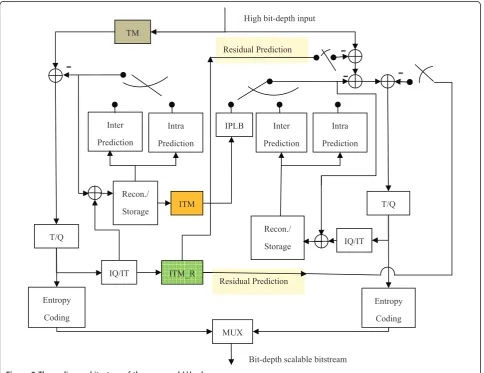
The coding structure of the proposed LH scheme is shown in Figure 3. The low bit-depth input is obtained after tone mapping of the original high bit-depth input and then encoded by H.264/AVC, as shown in the left-hand side of Figure 3. In this way, the generated bit-depth scalable bitstream allows for backward compatibil-ity with H.264/AVC.
The right-hand side of Figure 3 shows the coding pro-cedures for the high depth layer. Like the low bit-depth layer, the encoding process is implemented on the MB level, but there are two differences. First, in addition to intra/inter-predictions, the high bit-depth MB level gets another prediction from the corresponding low bit-depth MB by inverse tone mapping of the reconstructed low bit-depth MB. This prediction, which we call intra-prediction from low bit-depth (IPLB), can be regarded as a type of inter-layer prediction and treated as an additional intra-prediction mode with a block size of 16 × 16, which is similar to inter-layer intra-prediction per-formed in the spatial scalability of the SVC standard.
Residual Prediction TM
Inter
Prediction
Intra Prediction
T/Q
Entropy Coding
MUX
Inter Prediction
Intra Prediction IPLB
ITM
IQ/IT High bit-depth input
-
-
-
-Bit-depth scalable bitstream ITM_R
T/Q Recon./
Storage
IQ/IT
Residual Prediction Recon./
Storage
Entropy Coding
Thus, two kinds of intra-prediction are available in the proposed LH scheme: one explores the spatial redun-dancy within a frame, while the other tries to remove the redundancy between different bit-depth layers.
Furthermore, to improve the coding efficiency of inter-coding, the residual of the low bit-depth MB is inversely tone mapped and utilized to predict the resi-dual of the high bit-depth MB. The process, called resi-dual prediction can be regarded as another kind of inter-layer prediction and can be realized in two ways. The high bit-depth MB can perform motion estimation and motion compensation before subtracting the pre-dicted residual derived from the low bit-depth layer, or it can subtract the predicted residual before motion esti-mation and motion compensation, which is similar to inter-layer residual prediction realized in the spatial scalability of the SVC standard. The residual prediction operation can be mathematically repressed as below:
Residual prediction 1→MEMCFHBD
−ITM RRˆLBD
Residual prediction 2→MEMCFHBD−ITM R
ˆ
RLBD
, (5)
whereFHBD andRˆLBDdenote the high bit-depth layer
MB and the reconstructed residual of the low bit-depth layer MB, respectively. MEMC stands for the operation of motion estimation, followed by motion compensation, while ITM_R for inverse tone mapping of residual. Both
residual predictionmethods try to reduce the amount of redundancy in residuals of the low and the high bit-depth layers. Besides, contrary to IPLB mode where the inverse tone mapping used is based on look-up table, the inverse tone-mapping method used for the residual is based on linear scaling and expressed as follows,
ITM R = LBD residual×HBD input/LBD input, (6)
where LBD_residual denotes the residual of the low bit-depth MB; HBD_input and LBD_input stand for the intensities of high bit-depth pixel and of low bit-depth pixel, respectively.
Basically, we utilize both IPLB prediction and residual prediction based on the results of R-Doptimization. Note that there are four kinds of prediction in the pro-posed LH scheme: intra-prediction, inter-prediction, IPLB prediction, andresidual prediction, which can be used in two ways. Moreover, residual prediction coop-erates with inter-prediction if doing so yields better cod-ing efficiency, while IPLB competes with other types of prediction. If inter-layer prediction (i.e., IPLB orresidual prediction) is not used, then the high bit-depth layer is encoded by H.264/AVC. In this case, the coding perfor-mance in such scalable coding scheme is the same as that achieved by simulcast. Next, we summarize the
features of the proposed LH scheme, which distinguish it from several current approaches.
1. IPLB: Similar to most bit-depth SVC schemes [15-18], the high bit-depth MB can be predicted from the corresponding low bit-depth MB by inverse tone mapping. However, in [16], intra/inter-predic-tion is not realized in the high bit-depth layer in conjunction with inter-layer prediction.
2.Residual Prediction: Residual Predictioncan be applied in two ways, as indicated in Figure 3. The high bit-depth MB can perform motion estimation after subtracting the predicted residual derived from the low bit-depth layer, or it can subtract the pre-dicted residual after motion compensation.Residual predictionis not used in the schemes proposed in [15,16]. The residual prediction operation described in [17,18] is performed only after motion compensa-tion in the high bit-depth layer.
3.Motion information: In the proposed LH scheme, both the low and the high bit-depth layers have their own motion information including the MB mode and motion vector (MV). This is contrary to the approach in [15], where the high bit-depth MB uses directly the motion information obtained in the cor-responding low bit-depth MB.
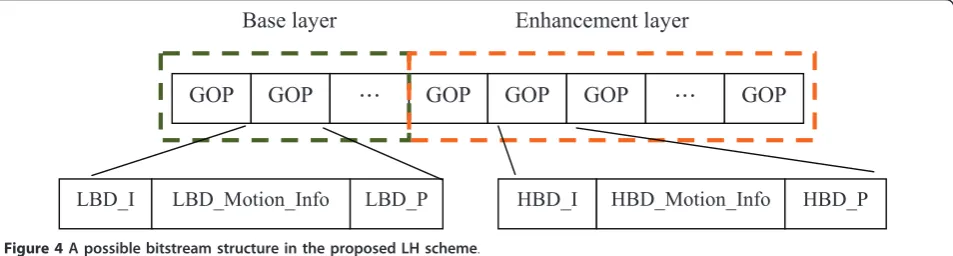
3.1.1. Bitstream structure in the LH scheme
3.2. The HL scheme
In this section, we propose a new scheme called the HL scheme which processes the high bit-depth layer first, and then provides the low bit-depth layer with useful information after suitable processing. The scheme achieves a better R-Dperformance in some scenarios, for example, if a display device supports the high bit-depth format and the user wants to view only the high depth video content or the user requests both bit-depth versions simultaneously. The HL scheme tries to achieve a good coding performance in such applications. However, if the user only has a display device with low
bit-depth, then a truncated bitstream would still guaran-tee successful reconstruction of a low bit-depth video.
First, we consider I-frame encoding in the proposed HL scheme. The high bit-depth I-frame is H.264/AVC encoded directly. It is not necessary to encode and transmit the corresponding low bit-depth layer, which can be created by tone mapping of the reconstructed high depth I-frame at the decoder. Thus, the stream does not reserve a specific space for the low bit-depth I-frame.
For the P-frame, the low bit-depth layer input is obtained by tone mapping of the original high bit-depth
GOP
GOP
Ξ
GOP
GOP
GOP
Ξ
GOP
LBD_I LBD_Motion_Info LBD_P HBD_I
Base layer
Enhancement layer
HBD_Motion_Info HBD_P
Figure 4A possible bitstream structure in the proposed LH scheme.
Residual Prediction
TM ME
MC MC
Recon./
Storage Recon./
Storage
IQ/IT
T/Q TM_R
IQ/IT ITM_R
Entropy Coding
Entropy Coding MUX
Bit-depth scalable bitstream
-High bit-depth input
T/Q
input. Note that, in the HL scheme, the high bit-depth layer is processed before the corresponding low bit-depth layer. Every MB in the high bit-bit-depth layer is intra-coded or inter-coded, depending on the optimiza-tion of theR-Dcost. If the high bit-depth MB is desig-nated as intra-mode, then the remaining coding procedure is exactly the same as that in H.264/AVC. The associated low bit-depth MB can be obtained at the decoder after tone mapping of the reconstructed high bit-depth MB using the procedures adopted for I-frames. On the other hand, if the high bit-depth MB is designated as inter-mode, then the subsequent coding procedures are different from those in H.264/AVC inter-coding. Figure 5 illustrates the encoding architec-ture for the inter-MB in the HL scheme. The encoding process can be summarized by three steps:
Step 1: After performing motion estimation (ME) and deciding the mode for the high bit-depth MB, the derived motion information, which contains the MV and MB modes of the high bit-depth MB, is transferred to the low bit-depth layer and utilized by the corre-sponding low bit-depth MB.
Step 2: After performing motion compensation (MC), the residual of the high bit-depth MB is tone mapped, followed by discrete cosine transform (DCT), quantiza-tion, and entropy encoding. Then, it becomes part of the embedded bitstream of the corresponding low bit-depth MB. As a result, the decoder can reconstruct the
low bit-depth MB directly using the motion information of the high bit-depth MB to perform motion compensa-tion, followed by a summation with the decoded residual.
The tone mapping for the residual is different from those used in textures. The tone-mapping method adopted for residual data is based on linear scaling and expressed as follows:
LBD residual = TM R(HBD residual) = HBD residual×(LBD MC/HBD MC)(7)
HDR MC = ITM(LBD MC) (8)
where TM_R and ITM denote the tone mapping for residual data and inverse tone mapping for tex-tures, respectively. LBD_MC stands for the low bit-depth pixel intensity after performing motion com-pensation using the MV derived in the high bit-depth layer MB.
Step 3: The reconstructed residual of the low bit-depth MB is converted back to the high bit-depth layer by inverse tone mapping, similar to that performed in the LH scheme. Then, only the difference between the residual of the high bit-depth MB and the residual predicted from the low bit-depth MB is encoded, under which situation, a betterR-Dperformance is achieved in this way.
From the description above, the features of the HL scheme can be summarized as follows:
GOP
GOP
Ξ
GOP
GOP
GOP
Ξ
GOP
LBD_I HBD_Motion_Info LBD_P HBD_I
Base layer
Enhancement layer
HBD_P
Figure 7A possible bitstream structure in the proposed LH-HL scheme.
GOP
GOP
Ξ
GOP
GOP
GOP
Ξ
GOP
HBD_I HBD_Motion_Info LBD_P HBD_P
Base layer
Enhancement layer
1. The low bit-depth I-frame is not transmitted and can be generated at the decoder by tone mapping of the reconstructed high bit-depth layer I-frame. 2. Two kinds of inter-layer prediction are employed for inter-coding in the HL scheme.
a. The first kind of inter-layer prediction is from the high bit-depth layer to the low bit-depth layer, where the motion information derived in the high depth layer is shared by the low bit-depth layer. Moreover, the residual of the high bit-depth layer is tone mapped to be the residual of the low bit-depth layer.
b. The second kind of inter-layer prediction is from the low depth layer to the high bit-depth layer, where the quantized residual of the low bit-depth layer can be used for predicting the residual of the high bit-depth layer. It is calledresidual predictionin the HL scheme. 3.2.1. Bitstream structure in the HL scheme
The bitstream in the HL scheme is different from that in the LH scheme, as shown in Figure 6, where the GOP size is 2. The base layer consists of three components. It starts by filling up information about the high bit-depth I-frame, denoted as HBD_I, followed by information about the P-frame for both the high bit-depth and low bit-depth layers. The low bit-depth MB and the corre-sponding high bit-depth MB are reconstructed using the same MV and MB modes, denoted as HBD_Motion_Info. The residual of the high bit-depth layer is tone mapped to the low bit-depth layer. After transformation, quanti-zation- and entropy-encoding operations, it will form LBD_P. HBD_P denotes the residual data used for recon-structing the high bit-depth layer. Obviously, the entire encoded HL bitstream is smaller than the bitstream in the LH scheme because of the absence of low bit-depth intra-coded MBs and because both bit-depth layers share motion information for inter-coded MBs.
Note that, although motion estimation is only per-formed in the high bit-depth layer, the low bit-depth layer in the HL schemes uses this motion information, as well as the residual of the high bit-depth layer for reconstruction. The motion information is put into the base layer bitstream, instead of into the enhancement layer bitstream. Moreover, the residual data in the base layer comes from the tone mapping of the residual of the high bit-depth layer. After transformation, quantiza-tion and entropy coding, this residual is also put into the base layer bitstream. Thus, there is no drift issue in the HL schemes due to the embedded bitstream structures.
3.3. Combined LH-HL scheme
As mentioned earlier, for I-frames, the bitstream of the HL scheme only contains high bit-depth information.
Intuitively, this will result in bandwidth inefficiency if the receiver uses a low bit-depth display device, espe-cially in the case where a small GOP size is adopted and the data in the I-frames dominate the bitstream. To improve the coding efficiency in such situations, we combine the HL scheme with the LH scheme to form a hybrid LH-HL scheme in which the intra-MBs and inter-MBs are encoded by the LH scheme and the HL scheme, respectively. It means that intra-mode-encoding path in the LH scheme and inter-mode-encoding path in the HL scheme are combined in the LH-HL scheme. For every high bit-depth MB in the LH-HL scheme, either intra-mode or inter-mode is chosen by comparing theR-Dcost. It means that theR-Dcost of intra-coding by the LH scheme and theR-Dcost of inter-coding by the HL scheme will be compared. If the R-D cost of intra-coding by the LH scheme is smaller, then this MB is encoded as intra-mode; otherwise, it is inter-mode and encoded by the HL scheme. The combined LH-HL scheme tries to improve the coding performance of the HL scheme in the above situation.
3.3.1. Bitstream structural in the LH-HL scheme
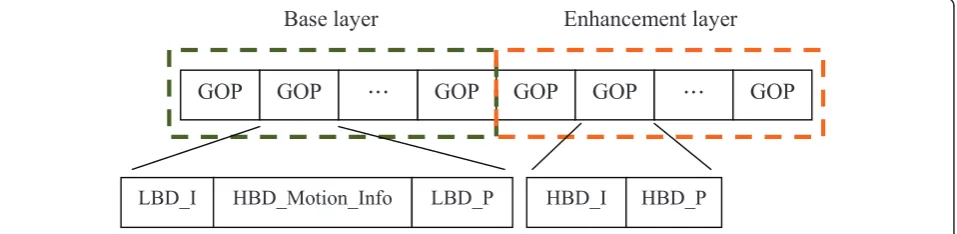
Figure 7 shows a possible bitstream structure of the combined LH-HL scheme, where the GOP size is 2. For each GOP in the base layer, three components provide the information used for reconstructing the low bit-depth layer, i.e., LBD_I for low bit-bit-depth I-frames, HBD_Motion_Info and LBD_P for the low bit-depth P-frame. Besides, HBD_I and HBD_P are used to ensure the reconstruction of the high bit-depth I- and P-frames, respectively.
Note that, the LH-HL scheme is H.264/AVC compati-ble. First, intra-MB coding in LH-HL scheme is exactly the same as that in LH scheme. For inter-MB in P frame, the MV obtained in the high bit-depth layer MB is used by the low bit-depth layer directly and put into the base layer bitstream. Moreover, the residual data in the base layer comes from the tone mapping of the resi-dual of the high bit-depth layer. After transformation, quantization, and entropy coding, this residual is also put into the base layer bitstream. In this way, the gener-ated bit-depth scalable bitstream of the LH-HL scheme allows backward compatibility with H.264/AVC, and there is no drift issue involved.
3.4. Comparison of three proposed schemes
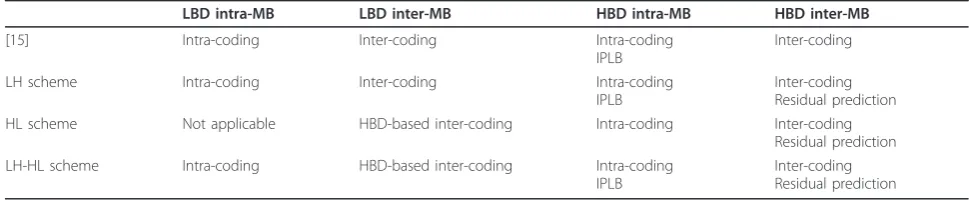
high bit-depth layer, residual prediction in the LH scheme can be used either before or after motion esti-mation. On the other hand, in the HL scheme,residual predictioncan only be used after motion estimation and motion compensation. Moreover, HBD-based inter-cod-ing requires that the residual of the high bit-depth MB is tone mapped, followed by DCT, quantization, and entropy coding before it can become part of the embedded bitstream of the low bit-depth MB; and no motion estimation is executed in the low bit-depth layer. Then, the reconstruction of the low bit-depth layer is realized by using the MV of the high bit-depth layer to find the referenced block in the previously reconstructed low bit-depth frame, in conjunction with the decoded residual.
Table 2 summarizes the inter-coding complexity of the proposed three schemes. Compared to [15], the high bit-depth MB in the LH scheme needs higher computa-tion complexity due to multi-loop MC, once IPLB mode is chosen. In the HL and the LH-HL schemes, the low bit-depth layer needs no motion estimation because a shared MV is provided by the high bit-depth layer. Moreover, there is no multi-loop MC issue in the high bit-depth layer.
4. Experimental results
We extend H.264/AVC baseline profile to complete the proposed bit-depth scalable video-coding scheme. The used reference software is JM 9.3, which supports 12-bit video input. To evaluate the performance of the pro-posed algorithms, two 12-bit (high bit-depth) test sequences, “Sunrise” (960 × 540) and“Library” (900 × 540), provided in [31] are used in the simulation. Both sequences have low camera motion, and the color
format is 4:2:0. In our systems, the low bit-depth input is 8 bits for each color channel, and the high bit-depth input is 12 bits. The frame rate of both sequences is 30 Hz, and the 8-bit representations are acquired by tone mapping of the original 12-bit sequences. We employ the tone-mapping method in [26], and use look-up table mapping [11,16] to realize the inverse tone mapping. Note that the tone and inverse-tone mapping techniques used in this article are the same for all the schemes. Thus, we can avoid the influence of different techniques on the coding efficiency. Both the high and low bit-depth layers use the same quantization parameter (QP) settings, so no extra QP scaling is needed to encode the high bit-depth layer. Moreover, GOPs containing 1, 4, 8, and 16 pictures are used for differentiating the coding efficiency of I-frames and P-frames in proposed coding schemes.
4.1. Intra-coding performance (GOP = 1)
The R-D performance of the proposed algorithm is shown in Figures 8 and 9 when the GOP size is 1. The PSNR is calculated as follows:
PSNR = 10log10
2N−12
MSE , (9)
where Nis the bit-depth, and MSE denotes the mean squared error between the reconstructed and the origi-nal images. The performances of 12-bit single-layer and simulcast codings are also compared. In this case, the HL scheme is equivalent to single-layer coding; and the combined LH-HL scheme is the same as the LH scheme as well as the approach in [15].
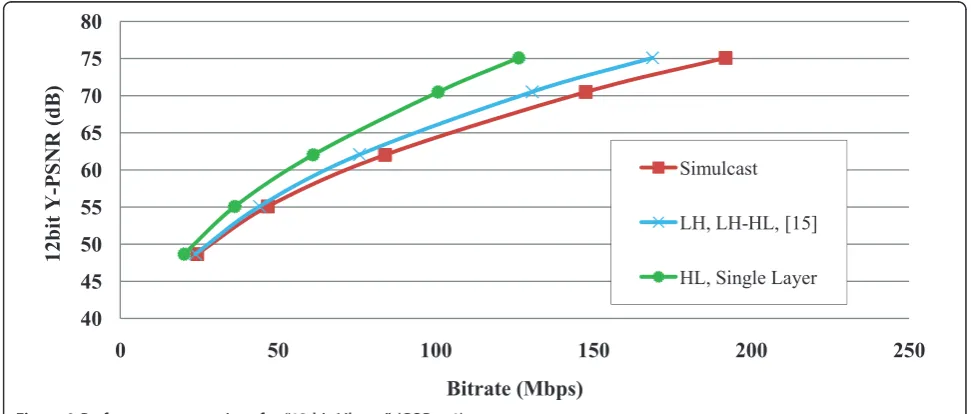
Figures 8 and 9 show that the HL and the LH schemes achieve better coding efficiency than the simul-cast scheme. Specifically, the HL scheme achieves up to 7 dB improvement over the simulcast scheme in the high bit-rate scenario. Table 3 summarizes the percen-tages of IPLB mode employed in I-frames for the LH scheme. The table shows that the percentages of IPLB mode increase, as the QP value decreases. This indicates that high bit-depth intra-MBs are likely to be predicted from their low bit-depth versions, instead of by conven-tional intra-prediction, if the corresponding low
bit-Table 1 Comparison of the coding strategies of the proposed schemes
LBD intra-MB LBD inter-MB HBD intra-MB HBD inter-MB
[15] Intra-coding Inter-coding Intra-coding
IPLB
Inter-coding
LH scheme Intra-coding Inter-coding Intra-coding
IPLB
Inter-coding Residual prediction HL scheme Not applicable HBD-based inter-coding Intra-coding Inter-coding
Residual prediction LH-HL scheme Intra-coding HBD-based inter-coding Intra-coding
IPLB
Inter-coding Residual prediction
Table 2 Comparison of the inter-coding complexity of the proposed schemes
[15] LH scheme HL scheme LH-HL scheme
LBD ME ME No ME No ME
MC MC MC MC
HBD ME ME ME ME
depth MB is reconstructed well. As a result, the gener-ated bitrate can be reduced.
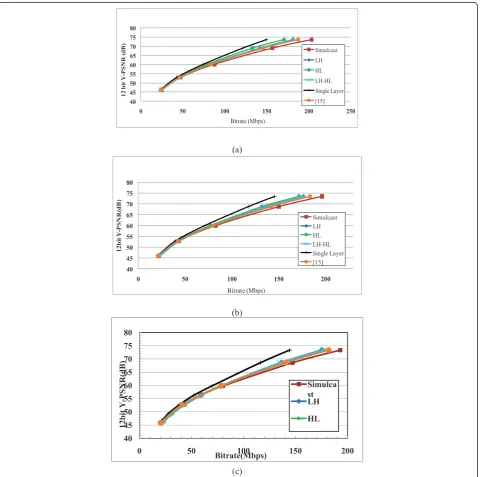
4.2. Coding performance when GOP = 4, 8, and 16 Next, we consider the coding performance of the pro-posed schemes when GOP is 4, 8, and 16. Figures 10 and 11 compare the performances of the schemes for sequences “Sunrise” and “Library,” respectively. The results demonstrate that the three proposed schemes outperform the simulcast scheme. It is also clear that the HL scheme outperforms the LH scheme, the com-bined LH-HL scheme, as well as the approach proposed in [15] by approximately 2 dB. Tables 4 and 5 detail the statistical distributions of the inter-layer mode chosen
for MBs in the high bit-depth layer in the LH scheme and the HL scheme, respectively. Note that, for the HL scheme, only the inter-frame is considered for the statis-tics in Table 5 because of no coding of low bit-depth I-frame. For the LH scheme, the statistics in Table 4 includes both I-frames and P-frames. For the LH scheme, the high bit-depth MB can be predicted from the associated low bit-depth MB in two ways: (1) by IPLB prediction, where the high bit-depth MB texture is predicted by inverse tone mapping of the reconstructed low bit-depth MB or (2) by residual prediction, where the residual of the high bit-depth MB is predicted from the residual of the low bit-depth MB. Obviously, the probability of adoptingresidual prediction is higher in
40
45
50
55
60
65
70
75
80
0
50
100
150
200
250
12
b
it
Y-PS
NR
(d
B
)
Bitrate (Mbps)
Simulcast
LH, LH-HL, [15]
HL, Single Layer
Figure 8Performance comparison for“12-bit Sunrise”(GOP = 1).
40
45
50
55
60
65
70
75
80
0
50
100
150
200
250
12b
it Y-P
S
NR
(dB)
Bitrate (Mbps)
Simulcast
LH, LH-HL, [15]
HL, Single Layer
the HL scheme than in the LH scheme. After analyzing the coding architecture of the three schemes, as well as the statistics in Tables 4 and 5, we observe that two fac-tors are responsible for the superior performance of the
HL scheme. First, the HL scheme does not need to transmit the low bit-depth intra-MB, and the motion information set is shared by both layers. Second, resi-dual predictionfrom the high bit-depth layer to the low bit-depth layer is efficient and reliable.
As mentioned in Section 3, the proposed residual pre-diction operation in the LH scheme can be applied in two ways. Table 6 summarizes the statistical distribution of the predictions derived by the two methods. In the table, residual prediction_1means that the residual from the low bit-depth layer is used to predict the residual of
Table 3 Percentages of IPLB mode employed in I-frames in the LH scheme
QP = 10 QP = 15 QP = 24 QP = 32 QP = 40
Sunrise (%) 79.19 70.48 65.43 42.35 19.23 Library (%) 73.41 67.63 52.65 34.64 15.85
40 45 50 55 60 65 70 75 80
0 50 100 150 200 250
12
b
it
Y
-P
S
N
R
(d
B
)
Bitrate (Mbps)
Simulcast LH HL LH-HL Single Layer [15]
(a)
40 45 50 55 60 65 70 75 80
0 50 100 150 200
12
b
it Y
-P
S
N
R
(d
B
)
Bitrate (Mbps)
Simulcast LH HL LH-HL Single Layer [15]
(b)
(c) 40
45 50 55 60 65 70 75 80
0 50 100 150 200
12bit Y-PSNR(dB)
Bitrate(Mbps)
Simulca st LH
HL
the high bit-depth layer after motion estimation and compensation. Residual prediction_2 means that the high bit-depth layer MB performs motion estimation and compensation after subtracting the residual
predicted by the low bit-depth layer from the original texture. As indicated in Table 6,residual prediction_1is more likely to be used in the high bit-depth layer. Furthermore, it seems thatresidual prediction_2 can be
40 45 50 55 60 65 70 75 80
0 50 100 150 200
12
b
it Y
-P
S
NR
(d
B)
Bitrate (Mbps)
Simulcast LH HL LH-HL Single Layer [15]
(a)
40 45 50 55 60 65 70 75 80
0 50 100 150 200
˄˅
˵˼
̇ʳˬ
ˀˣ
˦
ˡ
˥
ʳʻ
˷˕
ʼ
Bitrate(Mbps)
Simulcast LH HL LH-HL Single Layer [15]
(b)
(c)
40 45 50 55 60 65 70 75 80
0 50 100 150 200
12bit Y-PSNR(dB)
Bitrate(Mbps)
Simulca st LH
HL
removed to reduce the coding complexity in the high bit-depth layer without significant performance loss.
4.3 Coding performance of modified LH schemes 4.3.1. Modified LH scheme with shared MV
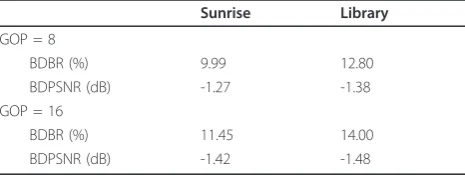
Contrary to the approach in [15] where motion informa-tion in the low bit-depth layer is shared by MBs of both depth layers, the low depth and the high bit-depth layers in the LH scheme have their own motion information. We know that if high bit-depth layer uses directly the motion information provided by the low bit-depth layer, the data of header can be reduced because no motion information is embedded. However, the data of residual may be increased due to inaccurate MV. To verify the gain brought by separate motion information, Table 7 lists the rate distortion performance in terms of Bjontegaard delta bitrate (BDBR) and Bjontegaard delta PSNR (BDPSNR) [32] for the modified LH scheme where motion information of the low bit-depth layer is shared by the high bit-depth layer, with respect to the original LH scheme. Moreover, the comparison between the method in [15] and the LH is also expressed in terms of Bjontegaard metric, as shown in Table 8.
On the other hand, we also conduct a modified LH scheme where the motion information of the high bit-depth layer is shared with the low bit-bit-depth layer, and the performance is presented in Table 9. This reveals that the modified LH scheme with shared MV from HBD performs worse than the original LH scheme. In fact, the residual data for the low bit-depth layer have been much increased in this modified scheme because of inaccurate MV. From Tables 7, 8, 9 and 10, we can conclude that the LH scheme outperforms the approach in [15] because of two factors: 1) in addition to IPLB mode, Residual Predictionis employed in the high
bit-depth layer, and 2) individual motion estimation speci-fied for each bit-depth layer is used.
4.3.2. Modified LH scheme with PMV from LBD
To exploit the correlation of the MV in the high bit-depth and the low bit-bit-depth layers, we conduct another experiment where the MV of the low bit-depth MB is served as the predicted motion vector (PMV) of the cor-responding high bit-depth MB. Table 10 lists the rate distortion performance in terms of Bjontegaard delta bitrate (BDBR) and Bjontegaard delta PSNR (BDPSNR) [32] for this modified LH scheme, with respect to the original LH scheme. It seems that this new scheme has similar R-D performance as that in the original LH scheme.
4.3.3. Modified LH scheme with single-loop MC
To avoid multi-loop motion compensation, we modify the LH scheme to make IPLB mode applicable only for those high depth MBs with intra-coded low bit-depth MBs, such that the single-loop motion compensa-tion is achievable. The performances of the modified scheme are shown in Table 11. As indicated in this table, the PSNR loss under single-loop MC constraint is in the range of 0.54-0.76 dB.
4.4. Coding performance when the QPs used in both layers are different
In H.264/AVC standard, an additional QP scalar is adopted to modify the QP for inputs with bit-depth lar-ger than 8 bit. The purpose is to constrain the bitstream size. The adjusted QP is expressed as
QPadjusted = input QP + QS,
with QS = 6 × (bit - depth − 8) (10) Table 4 Percentages of inter-layer prediction employed
by high bit-depth layer MBs in the LH scheme
GOP QP = 10 QP = 15 QP = 24 QP = 32 QP = 40
IPLB (%) 4 26.78 24.15 18.09 10.70 3.28 8 26.70 20.80 17.61 10.51 3.34 Residual prediction
(%)
4 66.21 71.55 65.79 63.67 59.43
8 66.01 71.38 65.94 63.51 59.13
Table 5 Percentages of inter-layer prediction employed by high bit-depth layer MBs in the HL scheme
GOP QP = 10 QP = 15 QP = 24 QP = 32 QP = 40 Residual prediction (%)
4 91.76 91.79 82.76 69.48 48.66
8 91.01 90.92 76.38 60.53 44.50
Table 6 Percentages of residual prediction used for high bit-depth inter-MBs in the LH scheme
QP = 10 QP = 15 QP = 24 QP = 32 QP = 40 Residual prediction_1 (%)
65.17 69.99 63.59 61.01 56.08
Residual prediction_2 (%)
1.70 1.70 2.27 2.63 2.42
Table 7 Performance for the modified LH scheme (shared MV of LBD) with respect to the LH scheme
Sunrise Library
GOP = 8
BDBR (%) 9.99 12.80
BDPSNR (dB) -1.27 -1.38
GOP = 16
BDBR (%) 11.45 14.00
where input QP stands for the initial QP given by user. In this case, the QP value for high bit-depth layer is different from that used in the low bit-depth layer.
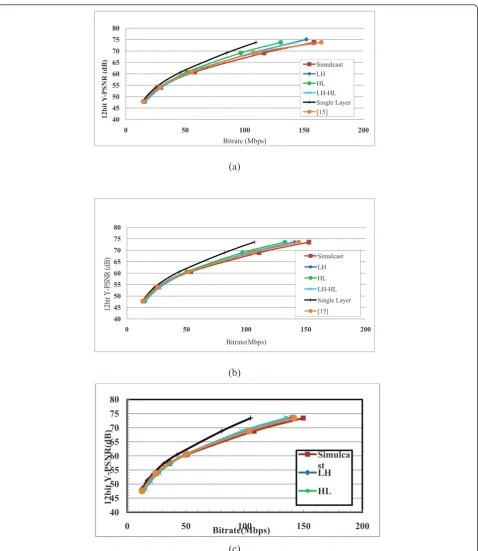
We conduct another experiment to verify the coding efficiency of the scheme where the QP value used in the high bit-depth layer follows the rule expressed in Equa-tion 10. Figures 12 and 13 present the coding perfor-mances when QP scaling is carried out for GOP = 8 and GOP = 16, respectively. These two figures indicate that all the three schemes with QP scaling perform worse than those under the same QP setting. Moreover, the PSNR loss in the HL and the LH-HL schemes with QP scaling are more serious compared to that in the LH scheme.
Intuitively, a larger QP corresponds to a worse image quality. Thus, compared with the same QP setting, the prediction from the high bit-depth layer would become less reliable for the low bit-depth layer, and the coding efficiency will be degraded in the HL scheme. Moreover, in the scheme with QP scaling, although the high bit-depth layer can be predicted from a low bit-bit-depth layer with higher reconstructed quality (due to a smaller QP) and results in a better coding efficiency in the high depth layer, the bitrate consumption in the low bit-depth layer is higher than that for the scheme with the same QP setting. It indicates that the bitrate overhead is larger than the benefit brought by a more precise pre-diction source in the low bit-depth layer.
4.5. Coding performance of low bit-depth video
Figures 14a and 15a show the performance of low bit-depth representation for sequence“Sunrise” when the
GOP sizes are 4 and 16, respectively, where the single-layer coding for an 8-bit sequence is equivalent to the proposed LH scheme. The figures show that the LH-HL scheme outperforms the other two schemes under most bitrates, because the LH-HL and the LH schemes adopt the same intra-coding method; hence, the figures demonstrate that the inter-coding in the LH-HL scheme achieves better R-Dperformance than that in the LH scheme.
We know that coding efficiency depends mainly on the data amount of residual after motion compensation. For the inter-coding of the LH-HL scheme, the motion information derived from the high bit-depth layer is shared by the low bit-depth layer. Figures 14a and 15a indicate that the shared MV from the high bit-depth layer, in conjunction with the tone-mapped residual from the high bit-depth layer results in a better recon-structed inter-MB in the LH-HL scheme, compared to that in the LH scheme. Besides, a primary reason accounts for the superiority of the HL scheme over the LH scheme at moderate-to-high bitrate: better recon-structed low bit-depth intra-frames are offered. Table 12 illustrates the PSNR of the low bit-depth intra-frame for the HL and the LH schemes; it implies that the HL scheme offers better low bit-depth I-frames, which echoes the statement described above. Figure 16 pre-sents the PSNR over a number of frames for both bit-depth layers in the HL scheme, when GOP size is 16 and QP is 32.
We are also interested in the performance of low bit-depth representation when the entire bitstream is received perfectly. Figures 14b and 15b show the
Table 8 Performance for the method in [15] with respect to the LH scheme
Sunrise Library
GOP = 8
BDBR (%) 7.47 11.28
BDPSNR (dB) -1.01 -1.22
GOP = 16
BDBR (%) 8.77 12.80
BDPSNR (dB) -1.18 -1.34
Table 9 Performance for the modified LH scheme (shared MV of HBD) with respect to the LH scheme
Sunrise Library
GOP = 8
BDBR (%) 15.36 20.63
BDPSNR (dB) -1.91 -2.08
GOP = 16
BDBR (%) 16.43 21.73
BDPSNR (dB) -1.95 -2.15
Table 10 Performance for the modified LH scheme (PMV from LBD) with respect to the LH scheme
Sunrise Library
GOP = 8
BDBR (%) 0.17 0.15
BDPSNR (dB) -0.02 -0.03
GOP = 16
BDBR (%) 0.13 0.40
BDPSNR (dB) -0.02 -0.05
Table 11 Performance for the modified LH scheme (single-loop MC) with respect to the LH scheme
Sunrise Library
GOP = 8
BDBR (%) 5.53 5.23
BDPSNR (dB) -0.71 -0.54
GOP = 16
BDBR (%) 6.11 6.26
performances when GOP sizes are 4 and 16, respec-tively. We can see that the PSNRs for the 8-bit video are the same in the two subfigures in Figures 14 and 15, and the bitrate in subfigure (a) is much lower than that in subfigure (b) because only the bitrate of the low bit-depth layer is counted.
The HL scheme outperforms the LH scheme up to 6.2 dB and 4.5 dB in Figures 14b and 15b, respectively. Thus, we conclude that if the whole bitstream can be delivered successfully without any truncation, then the
HL scheme can provide both high bit-depth images and low bit-depth images with better quality.
5. Conclusion
We have proposed three H.264/AVC-based bit-depth scalable video-coding schemes. The LH scheme is simi-lar to most existing approaches because the high bit-depth layer is encoded by considering the inter-layer prediction of the corresponding low bit-depth layer. The scheme provides an embedded encoding architecture
25 30 35 40 45 50 55 60 65
0 10 20 30 40 50 60 70 80 90
12
bit
Y-PSNR(
dB)
Bitrate(Mbps)
LH
HL
LH-HL
LH with QP scaling
HL with QP scaling
Figure 12Performance comparison for the proposed schemes with QP scaling (Sunrise, GOP = 8).
25 30 35 40 45 50 55 60 65
0 10 20 30 40 50 60 70 80 90
12bit Y-PSN
R
(dB)
Bitrate(Mbps)
LH HL LH-HL
LH with QP scaling HL with QP scaling LH-LH with QP scaling
that is fully backward compatible with H.264/AVC. On other hand, the proposed HL scheme yields better cod-ing efficiency in the specified applications where only the high bit-depth layer or both layers are requested in the destination. The inter-layer prediction adopted in the HL scheme can be directed from the high bit-depth layer to the low bit-depth layer, as well as vice versa. To resolve the backward compatibility problem in the HL scheme, we propose a combined LH-HL scheme in which the LH scheme complements the HL scheme. Our experimental results demonstrate the efficacy of the
proposed algorithms. In particular, the HL scheme achieves the best R-D performance if the decoder requests high bit-depth content. We have proved that the proposed HL scheme is effective, when the high bit-depth layer is processed first. Then, the low bit-bit-depth layer can be encoded by considering certain information, such as the MV and the residual, provided by the high bit-depth layer. In addition, the combined LH-HL scheme outperforms the LH scheme in all the simula-tions, and these two schemes differ in the method of inter-MB encoding. From the results, we conclude that
20
25
30
35
40
45
50
55
0
20
40
60
80
8bit Y
-PSNR(dB)
Bitrate(Mbps)
HL
LH, 8-bit Single Layer
LH-HL
(a)
20
25
30
35
40
45
50
55
0
50
100
150
200
8bit Y
-PSNR(dB)
Bitrate(Mbps)
HL
LH
LH-HL
(b)
(a)
(b)
20 25 30 35 40 45 50 55
˃ ˄˃ ˅˃ ˆ˃ ˇ˃ ˈ˃ ˉ˃
8bit Y
-PSNR(dB)
Bitrate(Mbps) HL
LH, 8-bit Single Layer LH-HL
20 25 30 35 40 45 50 55
˃ ˈ˃ ˄˃˃ ˄ˈ˃ ˅˃˃
8bit Y
-PSNR(dB)
Bitrate(Mbps)
HL LH LH-HL
Figure 15Performance comparison for“8-bit Sunrise”(GOP = 16): (a) with bitstream truncation and (b) without bitstream truncation.
Table 12 PSNRs (dB) of intra-frames for the HL scheme and the LH scheme
QP = 10 QP = 15 QP = 24 QP = 32 QP = 40
Sunrise
HL scheme 59.98 57.23 52.61 47.04 39.80 LH scheme 51.25 47.02 39.19 33.00 27.85 Library
HL scheme 57.02 54.25 48.65 42.53 34.12 LH scheme 51.14 46.98 39.59 33.54 28.40
30 35 40 45 50 55 60 65
0 10 20 30 40 50
Y-P
S
N
R
(d
B
)
frame number
HL_LBD
HL_HBD
Figure 16PSNR of each frame in the proposed HL schemes for
the information in the high bit-depth layer can be exploited to remove redundancy in both the low and high bit-depth layers, and better R-Dperformance can be ensured in this way.
Abbreviations
BDBR: Bjontegaard delta bitrate; BDPSNR: Bjontegaard delta PSNR; CGS: coarse grain scalability; DCT: discrete cosine transform; GOP: group of pictures; HBD: high bit-depth; HDR: dynamic range; HDTV: high-definition television; HL scheme: high bit-depth to low bit-depth; IPLB: intra-prediction from low bit-depth; ITM_R: inverse tone mapping of residual; JVT: joint video team; LBD: low bit-depth; LDR: low-dynamic range; LH scheme: low bit-depth to high bit-depth; MB: macroblock; MC: motion compensation; ME: motion estimation; MEMC: operation of motion estimation: followed by motion compensation; MGS: medium grain scalability; MSE: mean squared error; MV: motion vector; PMV: predicted motion vector; PSNR: peak signal-to-noise ratio; QP: quantization parameter;R-D: rate-distortion; SVC: scalable video coding.
Competing interests
The authors declare that they have no competing interests. Received: 1 November 2010 Accepted: 18 July 2011 Published: 18 July 2011
References
1. J Reichel, H Schwarz, M Wien, (Eds.), Scalable video coding-joint draft 9, in Joint Video Team, Doc JVT-V201,Marrakech, Morocco (2007)
2. J Vieron, M Wien, H Schwar, Draft reference software for SVC, inJoint Video Team, Doc JVT-AC203,Busan, Korea (October 2008)
3. H Schwarz, D Marpe, T Wiegand, Overview of the scalable video coding extension of the H.264/AVC standard. IEEE Trans Circ Syst Video Technol. 17(9), 1103–1120 (2007)
4. T Wiegand, G Sullivan, G Bjontegaard, A Luthra, Overview of the H.264/AVC video coding standard. IEEE Trans Circ Syst Video Technol.13(7), 560–576 (2003)
5. A Segall, On the requirement for bit-depth and chroma format scalability, inJoint Video Team, Doc JVT-Z036,Antalya, Turkey (January 2008) 6. Y Gao, Y Wu, Applications and requirement for color bit depth scalability, in
Joint Video Team, Doc JVT-U049,Hangzhou, China (October 2006) 7. G Sullivan, A Luthra, T Wiegand, Call for proposals for extended sample bit
depth and chroma format support in the advanced video coding standard, inJoint Video Team, Doc JVT-G048, Pattaya II,Thailand (March 2003) 8. G Ward, M Simmons, JPEG-HDR: a backward-compatible, high dynamic
range extension to JPEG, inProceedings of the 13th Color Imaging Conference(November 2005)
9. M Okuda, N Adami, Two-layer coding algorithm for high dynamic range images based on luminance compensation. J Vis Commun Image R.17, 377–386 (2007)
10. S Liu, A Vetro, WS Kim, Inter-layer prediction for SVC bit-depth scalability, in Joint Video Team, Doc JVT-X075,Geneva, Switzerland (June 2007) 11. M Winken, H Schwarz, D Marpe, T Wiegand, SVC bit depth scalability, in
Joint Video Team, Doc JVT-V078,Marrakech, Morocco (January 2007) 12. A Segall, Y Su, System for bit-depth scalable coding, inJoint Video Team,
Doc JVT-W113.San Jose, California, USA (April 2007)
13. Y Ye, H Chung, M Karczewicz, IS Chong, Improvement to bit depth scalability coding, inJoint Video Team, Doc JVT-Y048,Shenzhen, China (October 2007)
14. Y Yu, S Gordon, M Yang, Improving compression performance in bit depth SVC with a prediction filter, inJoint Video Team, Doc JVT-Z045,Antalya, Turkey (January 2008)
15. A Segall, Scalable coding of high dynamic range video, inProceedings of IEEE International Conference On Image Processing,San Antonio, USA, pp. 1–4 (2007)
16. M Winken, D Marpe, H Schwarz, T Wiegand, Bit-depth scalable video coding, inProceedings of IEEE International Conference on Image Processing, San Antonio, USA, pp. 5–8 (2007)
17. Y Wu, Y Gao, Y Chen, Bit depth scalable coding, inProceedings of IEEE International Conference on Multimedia and Expo.,Beijing, China, pp. 1139–1142 (July 2007)
18. Y Wu, Y Gao, Y Chen, Bit-depth scalable coding based on macroblock level inter-layer prediction, inProceedings of IEEE Symposium Conference on Circuits and Systems,Seattle, USA, pp. 3442–3445 (May 2008)
19. R Mantiuk, A Efremov, K Myszkowski, HP Seidel, Backward compatible high dynamic range MPEG video compression, inProceedings of ACM SIGGRAPH, Boston, USA, pp. 713–723 (2006)
20. JC Chiang, WT Kuo, Bit-depth scalable video coding using inter-layer prediction from high bit-depth layer, inProceedings of IEEE International Conference on Acoustics, Speech and Signal Processing,Taipei, Taiwan, pp. 649–652 (2009)
21. E Reinhard, S Pattanaik, G Ward, P Debevec,High Dynamic Range Imaging: Acquisition, Display, And Image-Based Lighting(Morgan Kaufmann, San Francisco, CA, 2006)
22. P Debevec, J Malik, Recovering high dynamic range radiance maps from photographs, inProceedings of ACM SIGGRAPH,Los Angeles, USA, pp. 369–378 (1997)
23. G Ward, inReal Pixels, ed. by J. Arvo. Graphic Gems II (Academic Press, San Diego, CA, 1991)
24. G Ward, The LogLuv encoding for full gamut, high dynamic range images. JGT.3(1), 15–31 (1998)
25. F Kainz, R Bogart, D Hess, The OpenEXR image file format, inSIGGRAPH Technical Sketches,http://www.openexr.com (2003)
26. E Reinhard, M Stark, P Shirley, J Ferwerda, Photographic tone reproduction for digital images. ACM T Graphic.23(3), 267–276 (2002)
27. A Adams,The Print: The Ansel Adams Photography Series(Little, Brown and Company, New York, USA, 1983)
28. E Reinhard, Parameter estimation for photographic tone reproduction. JGT. 7(1), 45–51 (2003)
29. N Sugiyama, H Kaida, X Xue, T Jinno, N Adami, M Okuda, HDR image compression using optimized tone mapping model, inProceedings of IEEE International Conference on Acoustic, Speech And Signal Processing,Taipei, Taiwan, pp. 1001–1004 (2009)
30. B Smith, Instantaneous companding of quantized signals. Bell Syst Tech J. 36, 653–709 (1957)
31. A Segall, Donation of tone mapped image sequences, inJoint Video Team, Doc. JVT-Y072,Shenzhen, China (October 2007)
32. G Bjontegaard, Calculation of average PSNR difference between RD-curves, indocument VCEG-M33.doc, ITU-T SG16/Q.6,Austin, TX (April 2001)
doi:10.1186/1687-6180-2011-23
Cite this article as:Chianget al.:Bit-depth scalable video coding with new inter-layer prediction.EURASIP Journal on Advances in Signal Processing20112011:23.
Submit your manuscript to a
journal and benefi t from:
7 Convenient online submission 7 Rigorous peer review
7 Immediate publication on acceptance 7 Open access: articles freely available online 7 High visibility within the fi eld
7 Retaining the copyright to your article
![Figure 1 The SVC coding architecture with two spatial layers [3].](https://thumb-us.123doks.com/thumbv2/123dok_us/1146829.1143926/2.595.58.540.88.301/figure-svc-coding-architecture-spatial-layers.webp)
![Figure 2 The generation of HDR images from multiple LDR images [22].](https://thumb-us.123doks.com/thumbv2/123dok_us/1146829.1143926/4.595.57.540.88.298/figure-generation-hdr-images-multiple-ldr-images.webp)