Volume 2006, Article ID 73685, Pages1–14 DOI 10.1155/WCN/2006/73685
Mutual Image-Based Authentication Framework with
JPEG2000 in Wireless Environment
G. Ginesu, D. D. Giusto, and T. Onali
MCLab, Department of Electronic Engineering, University of Cagliari, Cagliari 09123, Italy
Received 30 September 2005; Revised 24 March 2006; Accepted 13 June 2006
Currently, together with the development of wireless connectivity, the need for a reliable and user-friendly authentication system becomes always more important. New applications, as e-commerce or home banking, require a strong level of protection, allow-ing for verification of legitimate users’ identity and enablallow-ing the user to distallow-inguish trusted servers from shadow ones. A novel framework for image-based authentication (IBA) is then proposed and evaluated. In order to provide mutual authentication, the proposed method integrates an IBA password technique with a challenge-response scheme based on a shared secret key for image scrambling. The wireless environment is mainly addressed by the proposed system, which tries to overcome the severe constraints on security, data transmission capability, and user friendliness imposed by such environment. In order to achieve such results, the system offers a strong solution for authentication, taking into account usability and avoiding the need for hardware upgrades. Data and application scalability is provided through the JPEG2000 standard and JPIP framework.
Copyright © 2006 G. Ginesu et al. This is an open access article distributed under the Creative Commons Attribution License, which permits unrestricted use, distribution, and reproduction in any medium, provided the original work is properly cited.
1. INTRODUCTION
Nowadays, the deployment of a robust authentication system is one of the most interesting aspects for Internet providers and users. The diffusion of new web services, as e-commerce or home banking, has increased the security vulnerabilities, entailing the need for verifying the identity of both con-tracting parties and for personal data protection. Against such necessity, the techniques of security breaking are con-stantly growing together with technology; since attacks be-come increasingly frequent and well performed. Current auto-cracking tools allow the hackers to gain unauthorized access to digital data, generally with the aim of stealing clas-sified information, as passwords or credit card numbers. In the wireless networks, this problem is still greater as the wardriver community succeed very simply to elude the WEP protocol, traditionally used for WLAN protection. A robust control access system, in addition to privacy and data in-tegrity, becomes the essential condition to support the thriv-ing of World Wide Web and mobile Internet, allowthriv-ing the identification of legitimate users and avoiding unauthorized intrusion. Furthermore, applications based on a client-server model require to verify the authenticity of service provider, to avoid the risk of coming up against a shadow server.
The most part of current authentication systems is not able to provide these security requirements, especially in
in fact, that pictures are easier to recall than alphanumeric passwords [1–3]. Furthermore, graphical passwords do not require hardware upgrades and can be combined with tech-niques of steganography, watermarking, or image scrambling to insert secret visual information into messages for server authentication.
Several visual login systems have been proposed in the literature, many implementing a weak authentication only. D´ej`a Vu [4] requires the identification of five random-art images out of a challenge set of twenty-five images. Viskey [5] asks the user to select a series of image spots following a precise order. Picture password [6] and Awase-E [7] re-quire the identification of a correct pass-images sequence, that is, the sequence of images that are chosen by the client during registration, the first employing a single verification stage with a grid of 5×6 images, the second employing mul-tistep stages, each with a number of images depending on the display size. Unfortunately, the process of remembering a combination of abstract images or a precise order of se-lection may become harder than the use of traditional pass-words, thus nullifying the simplification introduced by the visual approach [8]. Furthermore, most of the proposed so-lutions offer a security level comparable to PIN codes, there-fore inadequate to current applications, which require the security of [6–8] character long alphanumeric password. Be-sides, some of such systems are not suitable for small displays and poor handiness of mobile terminals; Viskey, for instance, may be used only with mouse or light pen. Awase-E, al-though purposely studied for wireless applications, involves the transmission of a large amount of visual information, which is inconvenient due to bandwidth limitation of wire-less channels. GPRS network providers, for instance, gener-ally allow for a bandwidth smaller than 56 kbps, while the billing system is often traffic-dependant. Moreover, all of the above-mentioned IBA frameworks fail in providing mutual authentication. Other graphical systems have been proposed for mutual authentication. For example, a technique of visual cryptography [9,10] provides each user with a transparency, that is, a portion of visual information, which reveals a se-cret when combined with another sent by the server during the authentication session. Steganography may be used to-gether with visual cryptography; an overview for such ap-proach is given in [11]. The most widely known technique consists in replacing the last bit of each image pixel with a bit of secret information. These systems rely only on the secret keys exchange; one key is stored into the user terminal, while the other is sent by the server at each login request. So, both the user and the server keys are not very protected against theft or network sniffing attacks, allowing malicious clients or shadow servers to break the security system.
This paper proposes a novel mutual image-based authen-tication framework (MIBA) that exploits platform scalability in order to achieve a good tradeoffbetween security and data transfer for several applications and devices, such as com-puter terminals, PDAs, and mobile phones. While user au-thentication is implemented through an image-based pass-word creation process, server authentication is granted by the scrambling of any visual information to be transmitted to the
client. The proposed framework makes extensive use of the JPEG2000 standard for both image storage and processing, while relying on the properties of wavelet decomposition for the scrambling and transmission of visual information to the client.
The paper is organized as follows: Section 2 describes the wireless connectivity scenario.Section 3provides a brief overview of the JPEG2000 standard. In Section 4the pro-posed IBA method is described in its details. The processes for registration and authentication are illustrated, together with the proposed image scrambling method for mutual au-thentication and some details related to the JPEG2000 inter-face. Comparative results are provided inSection 5. Finally, conclusions are drawn.
2. THE WIRELESS ENVIRONMENT
It is recognized that wireless networks are very vulnerable to security issues [12,13]. Operative systems currently embed-ded in mobile devices have been implemented in order to op-timize the use of available radio resources rather than guar-antee an adequate security level. To interfere into a system based on radio-frequency is often very simple.
Three are the basic security requirements defined by IEEE for the WLAN environment, that is, privacy, integrity, and authentication [14]. Privacy ensures that confidential infor-mation, as passwords, is not transmitted in clear through the network using cryptographic techniques. Integrity pro-vides that messages are not modified during transmission; it is supported by hashing algorithms. Finally, authentication is needed to verify the clients’ identity and to prevent unautho-rized access. Many applications also require to authenticate the server: data traffic is only sent after mutual authentica-tion is provided.
Typically, the IEEE 802.11 [14] standard supports the wired equivalent privacy (WEP) protocol to protect wireless communications between clients and access points. It sat-isfies all security requirements even though with many re-serves. In particular, privacy relies on RC4 encryption al-gorithm and uses a secret key of 64 or 128 bits, which are not sufficient for guaranteeing secure applications. Besides, a simple challenge-response scheme is provided for authen-ticating only the device; no user and mutual authentications occur.
performs user authentication through a numeric or alphanu-meric password that is stored in the access point and, option-ally, also on the user’s terminal. It offers a weak level of pro-tection, similar to WEP. The enterprise mode, instead, guar-antees for high security performance. It is based on IEEE 802.1X standard [16], requires an external authentication server, and provides for algorithms of mutual authentication. These protocols achieve security for the wireless portion of connection, between client and access point only. In or-der to grant end-to-end secure communication and to rein-force wireless security, other types of mechanisms, as end-to-end encryption, password protection, or applications for end-points authentication, must be supplied. For instance, if a user requires Internet access from a wireless network, data protection must be provided on the whole path of communi-cation, together with a mutual authentication system to ver-ify identity of both client and server. The purpose of the pro-posed approach is then to define an authentication system to provide end-to-end mutual security at application level.
3. JPEG2000 STANDARD
JPEG2000 is the state-of-the-art international standard [17–
19] for image data coding based on wavelet-domain deposition and the EBCOT algorithm. The basic system is com-pletely described in its part 1, which gained the status of in-ternational ISO standard in 2001. Actually, there exist other 11 official parts, describing several specific aspects of the compression environment.
The basic characteristics exploited in our work are wavelet decomposition and tiling. Decomposition in the wavelet domain is a fundamental aspect of JPEG2000 and is meant to exploit the correlation of visual signal. The image scrambling technique proposed in Section 4.2 exploits the properties of wavelet-domain representation for the intro-duction of pseudorandom ordering of wavelet coefficients. While JPEG2000 images are generally coded as one block, that is, the whole image is wavelet-transformed and coded as a whole, the standard provides for tiling option. When tiles are used, the coding process is applied separately to each tile, in a similar way to JPEG 8×8 pixel blocks. Although tiling is generally applied to very large images in order to reduce com-putational complexity, the devised framework adopts tiling as a simple technique for decomposing the images used for authentication and for guaranteeing the scalable transmis-sion of local refinement data.
In addition to the baseline algorithm, our interest is mainly on part 9—JPIP (interactive protocols and API) [20]. JPIP defines syntaxes and methods for the remote interro-gation and optional modification of JPEG2000 codestreams and files. It specifies a protocol consisting of a structured se-ries of interactions between a client and a server by means of which image file metadata, structure, and partial or whole image codestreams may be exchanged in a communications efficient manner. For instance, through JPIP the client is al-lowed to formulate a specific request defining the resolution, size, location, components, layers, and other parameters for the image and imagery-related data to be received. The server
Registration
Authentication
Server Client
MIBA JPIP HTTPS
MIBA JPIP HTTPS JPEG2000 DB
Figure1: The MIBA framework [21].
responds by delivering imagery-related data with precinct-based streams, tile-precinct-based streams, or whole images. Oper-atively, the JPIP protocol defines how to generate messages out of portions of single JPEG2000databins. Databins con-tain portions of a JPEG 2000 compressed image representa-tion, such that it is possible to construct a stream that com-pletely represents the information present in a JPEG 2000 file or codestream. For our purpose, JPIP provides for dynamic image data transmission, for example, single regions or cremental refinement information, through client-server in-teraction.
4. PROPOSED METHOD
The proposed IBA method is based on a client-server inter-face [21] to optimize processing, minimize data transmis-sion, and improve security. The authentication framework consists of two classical phases: registration and authentica-tion (Figure 1). While registration has to be carried out from a computer terminal, authentication may be performed from any device.
The core algorithm at the base of image authentication consists in an iterative selection and zooming, supported by the JPEG2000 standard, through the use of tiling and JPIP protocol. Such choice allows for data-stream scalability and for an efficient transmission and refinement of image infor-mation. Further, end-to-end security is granted by the adop-tion of the HTTPS protocol, which provides for SSL encryp-tion and, opencryp-tionally, for authenticaencryp-tion. Besides, JPIP allows for scalable transmission of image components.
While scalability, thus data transfer optimization, is as-sured by the JPEG2000 framework, described in Sections
Client
nth scrambled GOI Choice
nth scrambled detail Choice
nth GOI scrambling
1st detail scrambling
Password generation
nth detail scrambling
Password generation
nth scrambled GOI Choice
nth scrambled detail Choice Pass reject
Server
1st GOI scrambling
Password check
nth GOI scrambling
1st detail scrambling
Password check
nth detail scrambling
Password check
Authentication
Figure2: Message exchange scheme for the registration and authentication phases.
visual information in order to make its content understand-able. Then there are four possible scenarios.
(1) Trusted server.
(a) Trusted client—the transaction may proceed and the scrambling/descrambling process is transpar-ent.
(b) Malicious client—the client is unable to under-stand the visual content. Even if the malicious client gained possession of the scrambling key, authentication would require the visual password identification. Thus, in this scenario the encryp-tion procedure constitutes a double protecencryp-tion against malicious authentication.
(2) Shadow server.
(a) The server ignores the system architecture—in this case it will send uncrypted visual information, even though the user always performs the descram-bling process. Such process will again result in the encryption of transmitted visual information, thus rendering the image incomprehensible.
(b) The server knows the system architecture—the server might try a brute-force attack in order to
recreate the correct scrambling key. However, such operation depends in part on the user interaction and the shadow server would have only a few tries. Then, even thou the server succeeded in recreat-ing the scramblrecreat-ing key, it should own the client’s pass-images in order to include them among the displayed pictures collection.
In order to minimize data transmission in all environ-ments, the major part of data processing is performed on the server side, which is required to store and manipulate the JPEG2000 compressed images, to generate an appropri-ate key for the scrambling process, and to perform the image scrambling during each of image authentication. The server replies to each user’s request by providing the correct (scram-bled) visual information so that refinement data are prefer-ably transmitted. In order to do so, only the correct portion of information, that is, tiles, subbands, and quality layers, is transmitted at each step. On the client’s side, the device would only have to perform the descrambling, the exact re-sizing of the received image, and the transmission of pass-coordinates.
4.1. Registration
The process of authentication requires the user to define three parameters: an access key, a scrambling key, and the vi-sual password. Such keys have different characteristics and must be defined during the registration process (Figure 2, left). The access key is based on the user’s personal data and devices characteristics. It is used to identify the client each time he tries to log in, in order to customize the image-based authentication procedure. Preliminary authentication may be implemented in two different ways through the access key mechanism. While the first consists in defining a shared key to be transmitted each time the user starts an authen-tication session without intervention, the other requires the user to input some piece of information. Although the sec-ond solution is more secure in the case of device theft, the first has been preferred for its simplicity and usability. Then, particular security is not required since the access key has the only purpose of preliminary user identification. Moreover, the case of device theft is generally solved through simple no-tification by blocking the device or disabling the user’s profile
(Section 4.6).
The scrambling key is used to generate the pseudoran-dom sequence that drives the image scrambling process for mutual authentication discussed inSection 4.2. Such key is shared by both server and client, but is transmitted only dur-ing the registration phase. Finally, the visual password is gen-erated from the user’s graphical choices and is used as au-thentication password.
Then, the registration interface phase allows the user to acquire his access key, scrambling key, to choose the desired images for authentication and to define the graphical pass-word. During registration, the server first presents a tradi-tional form for submitting the user information. While the access key is directly derived from personal data, the scram-bling key is generated through a mixture of personal infor-mation and random data, such as the current time or the actual content of a few bytes of RAM. Subsequently, the server shows a large set of images, randomly selected from a database of JPEG2000 images and assembled in GOIs (group of images). These images should be inspired by some diff er-ent themes, excluding random-art and abstract images in or-der not to compromise the usability of the proposed method. The user must choosekpass images from the visual database, with the only constraint that one image out ofkmust be se-lected only once. For each pass image a single pass detail, that is, the image portion to be used as part of the visual pass-word, must be chosen. Upload of personal images is allowed, although it is generally discouraged, since the authentication process may be easily guessed from personal data. As the reg-istration process may be time consuming and requires the exchange of personal data, it is done online from a computer terminal over secure HTTPS connection.
In order to guarantee data transmission security during registration, HTTPS is adopted with both SSL authentica-tion and encrypauthentica-tion. During registraauthentica-tion handshake, an SSL secure session is established, including mutual authentica-tion. Then, server and client cooperate in the creation of
symmetric keys used for encryption and decryption. In this way, all sensible information, that is, access key, scrambling key, and visual password, are well protected against any form of attack. Such procedure is not adopted during authentica-tion, where only SSL encryption is preserved, while authen-tication is implemented by the MIBA method itself.
4.2. Image scrambling for mutual authentication
The mutual authentication feature of the devised system is assigned to image data scrambling for the transmission of vi-sual information from server to client. Server’s authenticity is then verifiable “at a glance,” while the encrypting technique, combined with the visual password, guarantees a higher level of security.
Several image scrambling techniques have been inves-tigated by the recent literature. They are generally based on the randomization of pixels ordering or on the addi-tion of some variaaddi-tions in the coding algorithm. Lossless scrambling/descrambling is defined in [22], using a periodi-cally shift variant (PSV) discrete system in order to permute pixel disposition. Reference [23] performs visual informa-tion scrambling through changing the fracinforma-tional phase in a GF(qn) composite domain. A method based on chaos sys-tem is presented in [24]. It not only permutes the image pix-els, but also circularly iterates gray pixel values, through a 2D nonlinear map. Reference [25] discusses two kinds of trans-formations, based on the Fibonacci and Lucas sequences. They totally decorrelate the visual signal, spreading all pix-els, while maintaining equidistance as in the original im-age, and separating adjacent pixels as much as possible. In [26], the scrambling scheme relies on the 2D extension of the discrete prolate spheroidal sequences (DPSS) is proposed. Other methods define image scrambling in a transform do-main. A JPEG-based image encryption algorithm has been proposed in [27]. It consists in three steps: the permutation of luminance and chrominance planes by pseudorandom SFCs (space filling curves); the confusion of DCT coefficients in each DCT block, based on different frequency bands; the encryption of DCT coefficient signs. For JPEG2000 im-ages, scrambling methods are proposed in [28,29]. Part 8 of JPEG2000 standard, named JPSEC [30], provides for the scrambling to be either performed on the wavelet coefficients or directly on the codestream. Reference [28] presents a sys-tem based on JPSEC that encrypts the packet body using RC4 and AES algorithms. In [29], a method for partial-scalable scrambling of JPEG2000 coding units, that is, layers, DWT-levels, subbands, or code-blocks, is proposed. It relies on public-key encryption, which is robust to attacks but results in much more computational cost than secret-key encryp-tion.
Scrambling key,
Figure3: The scrambling method and resulting permutation patterns.
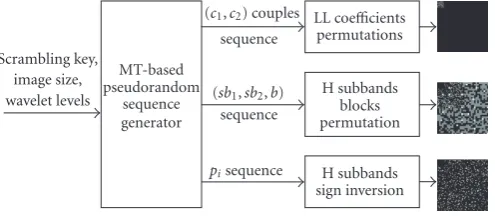
JPEG2000 or SPIHT and adds only an irrelevant computa-tional cost to the codecs. Moreover, the integration of coding and scrambling makes the system more robust to security at-tacks. As a drawback, the scrambling process inevitably duces the wavelet ability to decorrelate the signal energy, re-sulting in weakened coding efficiency. However, such aspect may be restrained so to offer an adequate perceived quality for reasonable compression ratios. In fact, it must be ob-served that the application of visual authentication is not particularly demanding in terms of visual quality. Thus, the proposed system is based on three stages of pseudorandom permutations in the wavelet domain: LL coefficients, high subbands blocks, and high subbands signs (Figure 3).
The first aspect to be considered is the generation of a pseudorandom sequence of coordinates to drive each of the scrambling stages. The mersenne twister (MT) algorithm [31] has been considered in order to accomplish such task. The method for generating uniform pseudorandom num-bers has a large prime period of 219937 −1 and consumes
a working area of only 624 words and the sequence is 623 distributed to 32-bits accuracy. Since each stage is meant to drive a particular class of coefficient permutations in the wavelet domain, the pseudorandom generator must provide three different sequences from the scrambling key defined during the registration phase. This is obtained by normal-izing the MT output to a desired range that covers each per-mutation’s space, depending on image size and decomposi-tion levels. The scrambling key constitutes then the seed for the pseudorandom generator.
While LL coefficients permutation is straightforward, that is, the sequence (c1,c2) defines which two coefficients
to exchange inside the LL subband, high subband blocks per-mutation follows a slightly more complex scheme. In fact, the sequence (sb1,sb2,b) defines which two subbandssb1and
sb2with indices described inFigure 4(left), and which
refer-ence blockb from the largest subband among sb1 andsb2
to consider. Block size is proportional to the largest subband size, for example, 2×2 blocks for 32×32 subbands, 4×4 blocks for 64×64 subbands, and so on, so that any subband is divided into 16×16 blocks in the case of square subbands
(Figure 4right).
After determining the largest subbands amongsb1 and
sb2, the reference block positionband block size, the
algo-rithm searches for the block in the smaller subband, which
0 3 6
Figure4: Indexes definition for subband selection (left), and block selection (right).
satisfies the condition of having the least MSE (mean square error) with the reference block (target block). The two blocks of coefficients are then exchanged. Such simple procedure may be schematized as follows:
For each (sb1,sb2,b)
smax=MAX (sb1,sb2);smin=MIN (sb1,sb2)
sizereference block=sizetarget block=sizesmax/16
positionreference block=b
Find target block insminthat minimizes
MSE (reference block, target block) Permute target block and reference block
Finally, sign inversion is driven by the index sequencepi. Starting from each index, the algorithm searches for the co-efficient with greatest absolute value in a neighborhood of
10 15 20 25 30 35 40
PSNR
(dB)
0.5 0.7 0.9 1.1 1.3 1.5 1.7 1.9 Bitrate (bpp)
Level 1-cd Level 1-wd Level 2-cd
Level 2-wd Level 3-cd Level 3-wd
Figure5: Average coding results for three detail levels with correct (cd) or wrong/no (wd) descrambling.
proposed method is that the descrambling process simply follows the scrambling procedure by reversing the order of each permutation sequence.
In order to evaluate the proposed algorithm in the appli-cation environment, 10 different test images have been con-sidered, with three levels of detail each. InFigure 5, the aver-age rate-distortion curve is shown for each detail level, con-sidering correct scrambling/descrambling (cd) and wrong or no descrambling (wd). As expected, higher detail level corre-sponds to more efficient compression, since the image con-tent decreases accordingly. Moreover, although the scram-bling/descrambling process has still an important effect on coding efficiency, that is, there is an average deterioration of 5 to 8 dB compared to unscrambled coding, at a bitrate of 1.5 bpp the system offers adequate image reproduction. This is also illustrated byFigure 6, where a visual comparison between unscrambled, correctly descrambled, and wrongly descrambled images is provided. It must also be observed that wrong or no descrambling, or equivalently wrong or no scrambling with correct descrambling, results in unin-telligible image data, achieving a constant PSNR of about 15 dB.
To evaluate computational cost, 10 different test im-ages have been processed with complete codecoding and scrambling-descrambling phases. Compression has been car-ried out at 16 different rates, ranging from 0.5 to 2 bpp, in order to evaluate the incidence of the proposed scram-bling technique with several codec settings. Average results are presented inFigure 7as the ratio between scrambling-descrambling time and complete processing time. Three dif-ferent scrambling profiles were used and are reported asL,
H, andS, meaning the number of low, high frequencies, and sign permutations, respectively. It must be observed that re-sults shown in Figures5and6were obtained with the pro-fileL,H,S= 80 400 1000. As expected, computational cost is inversely proportional to the scrambling profile and de-creases for increasing compression rates. With the chosen profile (80 400 1000), the incidence of the scrambling
tech-Level 1 Level 2 Level 3
No scrambling
Correct descrambling
Wrong descrambling
Figure6: Example of visual results for the scrambling technique, coded at 1.5 bpp.
0.08 0.09 0.10 0.11 0.12 0.13 0.14 0.15 0.16
C
o
mputational
cost
(scr
ambling-descr
ambling
time
/
w
hole
pr
oc
ess)
0.5 0.7 0.9 1.1 1.3 1.5 1.7 1.9 Bitrate (bpp)
L=60,H=300,S=800
L=80,H=400,S=1000
L=100,H=500,S=1200
Figure7: Computational cost evaluation.
nique is maintained around 10–13% without any code opti-mization.
4.3. Authentication architecture
Table1: Application profiles.
Profile Device Connection Security (k,h,N) Low Mobile GPRS Limited (1, 9, 9) Medium PDA Wireless High (4, 16, 16)
High PC LAN Very High (4, 25, 75)
Application window
k=4 grids
Image grid
h=44 cells Figure8: Example of partitioning of the application window.
counterfeit clients’ access to the system for stealing private in-formation.
The IBA password consists in the recognition of the pass images and pass details. Device/complexity scalability is achieved through parameterization of this procedure. The application window is divided intokgrids, each made ofh
cells (Figure 8). During the pass image/s selection procedure the user has to correctly identify thekpass image/s among
Nimages, randomly extracted from the JPEG2000 database. Similarly, during the detail selection one secret detail must be recognized for each pass image through the iterative zoom-ing process. By definzoom-ing withdimgandddspthe sizes of
orig-inal image and display and the number of iterations for the pass image selectionP1and for the detail selectionP2result
P1≤ N
h, P2≤
logh
k·dimg
ddsp
−1
. (2)
So that the maximum number of iterations is
Pmax=max
P1+P2 . (3)
By choosing a combination of{k,h,N}, the proposed frame-work may be easily adapted to any user device. Three appli-cation profiles have been defined inTable 1.
4.4. User authentication
During the authentication phase, the server manages the preliminary user and user’s device identification by detect-ing and decryptdetect-ing the access key. If this is a valid key, the challenge-response scheme based on the scrambling key may start. For each authentication session, the server must send a number of scrambled image sequences between 1 +P2and
N/h+P2. Only if the user owns the scrambling key, the
re-ceived images can be correctly decrypted and displayed. The visual password codes are transmitted step by step, mini-mizing the risk of sniffing. Whenever the server detects an
(a) (b)
(c)
Figure9: Example of authentication process for the medium pro-file.
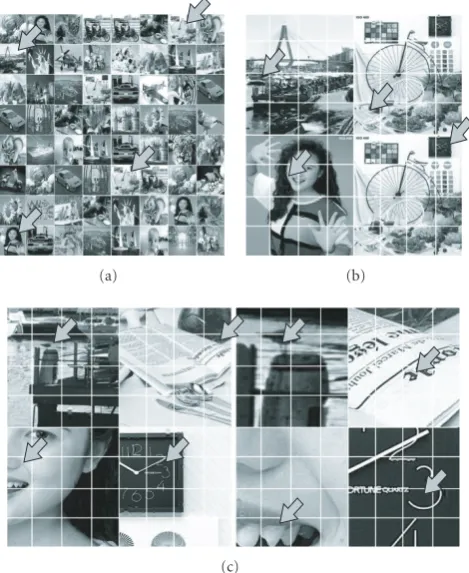
authentication failure, the authentication process is not in-terrupted until the last step. Only then, the user is rejected and a notification policy is adopted. During authentication, the user must recognize the combination ofk pass images with their pass details. During each authentication session, the server showskgrids, each containinghimages randomly positioned in order to minimize the risk of back-shoulder at-tack. Such randomization does not undermine the method’s usability, since the pass image recognition process is not based on image location. After the first stage of verification, thekgrids are used to divide the selected images each intoh
regions. For each image, the user must iteratively select the portion containing its pass detail.
The values ofkandhdepend on the desired degree of se-curity. As described inSection 4.3, a good tradeoffbetween security and usability for the medium profile is to usek=4,
h=16. An example of authentication is provided inFigure 9
for the medium profile. The time sequence of four authenti-cation steps is shown from 1 (upper left) to 4 (lower right). While step 1 consists in the choice of four pass images (one duplicated) out of 16, the other steps are the recursive pass detail selections. Arrows indicate the user’s choice.
offer generous displays and good interactivity, so that de-creasing the value of [h,N] to [16, 16] is sufficient to achieve a good tradeoffbetween usability and security performance. On the other hand, mobile devices with limited connectiv-ity and interactivconnectiv-ity require the extreme downscaling of the proposed method. For such reason, the low profile has been set tok=1,h=9, andN=9. In mobile environment, per-sonal device/card codes as the international mobile equip-ment identity (IMEI) and the subscriber identity module (SIM) may be used to allow for the unique identification of the user every time he logs on the network.
4.5. JPEG2000 parameters
JPEG2000 and JPIP are used in order to transmit only those portions of the scalable image datastream that are required at the client’s side at each step. In the proposed method, tile databins are the basic elements of JPEG2000 images used by JPIP. JPEG2000 images are partitioned into 40×40 pixel tiles, coded with 5 decomposition levels and 6 quality layers (0.15, 0.3, 0.5, 0.75, 1.0, 1.5 bpp). Scalability is obtained through the combination of three parameters: tiles, reduce factor (resolution scalability), and quality layers. The num-ber of tiles to be transmitted at each step is proportional to
Ntiles= d img
hP−P1·d tiles
. (4)
By defining the resizing factor between physical and dis-played image portion as
Z= k
hP−P1−1·
dimg
ddsp
, (5)
the reduce factor may be made proportional to
reduce=√Z, (6)
while the quality layer is assigned the value
Q= −5·
√
Z
√
Zmax+ 6
, (7)
where√Zmaxrepresents the maximum resizing factor with
the givendimg,ddsp, andPmaxvalues.
4.6. Notification policies
The proposed MIBA method is supported by event-management and notification policies to increase the protec-tion level against unauthorized intrusions. These policies al-low legitimate users to control and check all events related to the authentication process, in order to avoid malicious users from registering under an assumed name or accessing through password guessing.
As soon as the registration phase is done, the server sends to the user a confirmation e-mail. The e-mail contains per-sonal data which can be checked to ascertain registration accuracy. Neither authentication keys nor registered images and password are enclosed; in fact, the former should have been already sent through SSL secure connection, while the
latter are never transmitted. The e-mail also indicates a URL corresponding to a web page always updated with all the au-thentication events log. The user may check this page in or-der to detect immediately any attempt of unauthorized ac-cess. Notification is also adopted in case a wrong password is entered. During authentication, errors in password inputting may occur because a legitimate user does not remind its pass-word correctly or a malicious user tries to guess it. In both cases, the server allows up to three attempts. After that, the system is temporarily inhibited and a notification e-mail is sent to the legitimate user, who may modify its password or simply reactivate the system in case of mistake. Such policies constitute a further protection against password-guessing at-tacks. It must be noted that the notification policies may be set differently, depending on the security level required by each application.
Another notification mechanism is the possibility of physically blocking the mobile device when lost or stolen. By gaining possession of a personal device where both the access and scrambling keys are stored, a malicious individual would be able to try an educated guess attack. To prevent such risk, the stolen or lost device can be physically blocked, for exam-ple, mobile phones are identified through the IMEI that is also used to freeze the device permanently. Further, in case of device theft or loss, the legitimate user may inhibit or reset his authentication profile.
5. RESULTS
The proposed method has been evaluated in the medium profile (PDA environment), estimating performance in terms of security, as possible input combinations, data trans-fer, and usability, as the amount of information required for visual password memorization. Section 5.1summarizes all authentication scenarios and analyzes possible attacks.
Section 5.2 provides a consistent performance comparison
between the proposed method and the other visual pass-word techniques. For this purpose, image scrambling is not considered and the analysis is performed in terms of input combinations, data transfer, and user friendliness. Finally,
Section 5.3presents overall results by considering the
com-plete framework.
5.1. Risk assessment
In order to analyze all possible use cases and relative risks, let us first introduce some basic notation. Let us callMthe generic malicious entity and use the pedicesc,s, andtto in-dicate client, server, or third party, respectively. An apex with incremental numbering is used to indicate one particular at-tack occurence, so thatM3
c, for instance, specifies the third case of attack carried out by a malicious client. Similarly we callK the generic key information and use pedicesa,sand
vto indicate the access, scrambling, and visual key, respec-tively. Since the visual key is provided through several steps a further numbering is used, for example,Kv2indicates the
Table2: Classification and characteristics of third party attacks.
Event Phase What is stolen Attack Likelihood Impact
Value Notes
M0
t —
User device
device theft Medium Low In case of theft, the
(KaandKs) device/account can be blocked
M1 t
Registration
Personal user
Eavesdropping man in Very Low
Low Kais derived from personal information
the middle
information and other data
M2
t Kaand/orKs Medium/high
Preliminary identification and scrambling/descrambling
would be possible
M3
t One or moreKvi Low
The value of the visual key is generated dynamically and
changes continuously
M4
t Registration/ authentication
One or more pieces
Eavesdropping man in Low
Medium
The visual information is of scrambled
the middle
visual useless without the
information scrambling key
M5 t
Authentication
Ka Low Preliminary identification
would be possible M6
t One or moreKvi Low SeeMt3
M7 t
The look of one or moreKvi
Backshoulder/social
engineering Medium Low All other keys should be known
C S
Request for registration Registration form Personal information
Ka,Ks Ack 1st scrambled
visual info
Kv1 . . . Registration
M1t
M2 t
M4t
M3t
C S
Request for authentication Authentication form
Ka
1st scrambled visual info
Kv1 . . .
Authentication
M5 t
M4 t
M6 t
M7 t
Figure10: Message exchange and third party attacks.
entity is a third party who tries to acquire sensible credentials during normal client-server interaction (interception), or (ii) attacks are performed by a malicious entity pretending to be the client/server (impersonation or brute force attack).
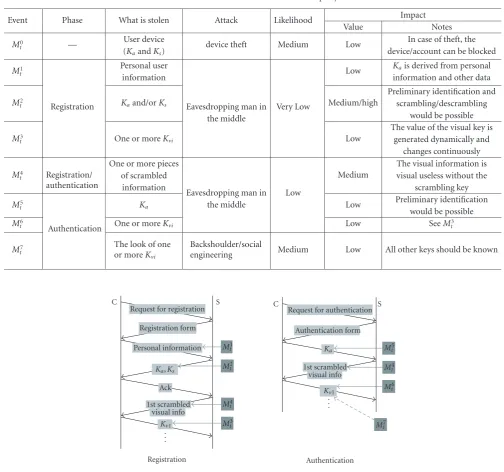
In the case of third party attack, the malicious entity generally tries to acquire some piece of personal informa-tion by managing to break into the client-server transac-tion.Figure 10schematizes the authentication and registra-tion processes and pinpoints all possible attacks. InTable 2, third party attacks are summarized and analyzed in order to evaluate their likelihood and impact on system security. A very lowtohighempirical scale is adopted.
Attacks performed by malicious clients or through shadow servers generally fall in the category of imperson-ation attacks (Table 3). The malicious client will try to per-form authentication through brute force or educated guess attacks. On the other hand, clients may unknowingly connect to a shadow server and divulge sensitive credentials such as authentication credentials. Both cases require the knowledge of some piece of user information. Evidently, attack likeli-hood is inversely proportional to the system knowledge.
Table3: Classification and characteristics of malicious clients or shadow servers attacks.
Event What information is How was acquired Possible attack Impact
known Value Notes
M1
c Nothing — Brute force Very low —
M2
s System architecture System knowledge
Masquerade
Low Extremely improbable; the shadow server should have
M2 s
System architecture M1
s andMt0orM2t Low/ knowledge of the image database
andKs medium and of each user’s profile
1E+0
Figure 11: Security against data transfer performance for the medium profile.
inSection 4.6constitute additional countermeasures against
several attack scenarios.
5.2. Framework evaluation
For the medium profile, the performance of the proposed IBA method (MIBA) has been compared with three-state-of-the art graphical password systems compatible with mobile platforms: Viskey, picture password, and Awase-E. Security is reported against data transfer inFigure 11. For the proposed method, security is given by
SMIBA=
with a limitation on the maximum number of zooming stagesPdepending on the original image and display sizes, described in (3). In the figure,M+Pindicates the length of the password, whereMcorresponds toN/hin the proposed method, that is, the number of image sequences shown by the
server for the pass-image selection. For the other methods,
M +P corresponds to the number of images or spots to be recalled and selected by the user. The first authentica-tion step consists in the transmission of composite images and requires 35 KB on average. At each successive step, the size of the JPEG2000 stream decreases progressively thanks to the possibility of refining image information. As a result, an average saturation of the transmitted stream is recorded. On the other hand, Awase-E requires one image of 35 KB on average to be transmitted at each step. Picture password only requires the transmission of one composite image of about 35 KB, whereas Viskey only requires one single image of about 25 KB. These last two methods are then the opti-mal choice for data transmission. However, their solution is unacceptable because of reduced usability. In fact, the data transfer gain is compromised by the need for choosing an exact combination of images or a precise spot sequence in a specific temporal order. Furthermore, if we consider the se-curity increment given by the scrambling process, the pro-posed method provides a better protection, allowing for an adequate security despite lowerM+Pvalue.
Finally, in order to evaluate the usability, the amount of information that the user is required to recall has been con-sidered.Figure 12shows the 3D distribution of the consid-ered features: security, data transfer, and usability, in terms of mnemonic load. Mnemonic load is measured as the num-ber of pass images or pass details to be recalled for complet-ing authentication. A multiplicative weight of 2 is considered each time the visual method requires a precise ordering of the pass-image/detail sequence. The triangle and circle marks represent the best and worst situations, respectively.
Table4: Overall results.
Key length
Security MIBA
(bits) Visual password Visual password and scrambling
16 65536 (16, 1, 0), (32, 2, 0) —
32 4.295E+09 (16, 2, 0), (32, 3, 0) (16, 1, 16), (32, 2, 12) 64 1.845E+19 (16, 4, 0), (32, 5, 0) (16, 2, 32), (16, 3, 16), (32, 4, 12) 128 3.403E+38 (16, 8, 0) (16, 2, 96), (16, 3, 80), (16, 4, 64), (32, 4, 76) 256 1.158E+77 — (16, 2, 225), (16, 3, 209), (16, 4, 193), (32, 4, 204), (32, 5, 188) 512 1.34E+154 — (16, 3, 464), (16, 4, 448), (16, 5, 432), (32, 4, 460), (32, 5, 444)
350 300 250 200 150 100 50 0
Data transfer (kB) 0
5 10 15 20
M
n
emonic
load
0 5
10 15
20 25
Security (110
x) M+P=8
M+P=5
M+P=3
MIBA Viskey
Picture password Awase-E
Figure12: 3D distribution of security, data transfer and mnemonic load for several IBA methods.
a precise selection order must be followed, considerably compromising the system usability.
5.3. Overall results
The security level of the proposed MIBA method is evalu-ated and compared to a generic system based on a K-bit key. Several MIBA setups are reported inTable 4, achieving the same level of security as the corresponding key length value. Both cases with and without scrambling are considered and represented by the triplet{N,P,L}, combinations of image alphabet size, number of steps to select the visual password, and length of the scrambling key, respectively. While the vi-sual password alone cannot offer a security level greater than a 128- bit key, the scrambling method allows for a security level comparable to that of any key. Results with scrambling represent the overall security of the MIBA system, excluding the access key input.
CONCLUSIONS
A novel mutual image-based authentication framework has been presented. It consists in a challenge-response scheme based on visual password and image scrambling. This ar-chitecture offers strong protection against malicious clients,
who might penetrate the system only by taking over both vi-sual password and scrambling key. The risk of impersonation attack by a shadow server is equally unlikely, since the images needed for authentication are transmitted after scrambling. Then, only if the pass images, visual password and scram-bling key are successfully stolen on the server side, a mali-cious entity may impersonate the trusted server. The pro-posed system may be implemented in any environment by upgrading the user’s device with simple software: complex-ity is minimized in order to be compatible with the limited computational capabilities of some user terminals, as mobile phones. System usability has been taken into account by con-sidering both difficulty of memorization and restrictions of user interfaces, especially in wireless environment. The pro-posed approach offers a modular architecture and exploits the properties of JPEG2000 and JPIP to achieve datastream and application scalability. Results indicate the validity of the devised method, which realizes the better tradeoffbetween security, data transfer, and usability in several application en-vironments.
REFERENCES
[1] A. Paivio, T. B. Rogers, and P. C. Smythe, “Why are pictures easier to recall than words?” Psychonomic Science, vol. 11, no. 4, pp. 137–138, 1968.
[2] R. N. Shepard, “Recognition memory for words, sentences, and pictures,”Journal of Verbal Learning and Verbal Behavior, vol. 6, pp. 156–163, 1967.
[3] D. Weinshall and S. Kirkpatrick, “Passwords you’ll never for-get, but can’t recall,” inProceedings of the ACM Conference on Human Factors in Computing Systems (CHI ’04), pp. 1399– 1402, Vienna, Austria, April 2004.
[4] R. Dhamija and A. Perrig, “D´ej`a Vu: a user study using images for authentication,” inProceedings of the 9th Usenix Security Symposium, pp. 45–58, Denver, Colo, USA, August 2000. [5] Software and Solutions from Cologne,http://www.viskey.com. [6] W. Jansen, S. Gavrila, V. Korolev, R. Ayers, and R. Swanstrom, “Picture password: a visual login technique for mobile de-vices,” Tech. Rep. IR 7030, National Institute of Standards and Technology, Gaithersburg, Md, USA, July 2003.
[8] D. M. Wegner, F. Quillian, and C. E. Houston, “Memories out of order: thought suppression and the disturbance of sequence memory,”Journal of Personality and Social Psychology, vol. 71, no. 4, pp. 680–691, 1996.
[9] M. Naor and B. Pinkas, “Visual authentication and identifica-tion,” inAdvances in Cryptology (Crypto ’97), B. Kaliski, Ed., pp. 322–336, Springer, Berlin, Germany, 1997.
[10] M. Naor and A. Shamir, “Visual cryptography,” inAdvances in Cryptology (EuroCrypt ’94), A. De Santis, Ed., pp. 1–12, Springer, Berlin, Germany, 1995.
[11] M. Kharrazi, H. T. Sencar, and N. Memon,Image Steganogra-phy: Concepts and Practice, Lecture Note Series, Institute for Mathematical Sciences, National University of Singapore, Sin-gapore, Republic of SinSin-gapore, 2004.
[12] F. Majstor, “WLAN security threats & solutions,” in Proceed-ings of the 28th Annual IEEE International Conference on Local Computer Networks, p. 650, Brussels, Belgium, October 2003. [13] W. Shunman, T. Ran, W. Yue, and Z. Ji, “WLAN and it’s
secu-rity problems,” inProceedings of the 4th International Confer-ence on Parallel and Distributed Computing, Applications and Technologies (PDCAT ’03), pp. 241–244, Chengdu, China, Au-gust 2003.
[14] ANSI/IEEE Std 802.11, 1999 Edition (R2003), IEEE Standard for Information Technology-Telecommunications and Infor-mation Exchange between Systems-Local and Metropolitan Area Network-Specific Requirements-Part 11: Wireless LAN Medium Access Control (MAC) and Physical Layer (PHY) Specifications, 1999.
[15] IEEE Std 802.11i-2004, IEEE Standard for Information Technology- Telecommunications and information exchange between systems- Local and metropolitan area networks-Specific requirements Part 11: Wireless LAN Medium Ac-cess Control (MAC) and Physical Layer (PHY) Specifications Amendment 6: Medium Access Control (MAC) Security En-hancements, 2004.
[16] IEEE Std 802.1X-2001, IEEE Standard for Local and metro-politan area networks Port-Based Network Access Control, 2001.
[17] JPEG 2000 image coding system—Part 1: Core Coding System, ISO/IEC JTC 1/SC 29/WG 1 15444-1.
[18] T. Ebrahimi, C. Christopoulos, and D. T. Lee, Eds., “Special issue on JPEG2000,”Signal Processing: Image Communication, vol. 17, no. 1, 2002.
[19] T. Ebrahimi and D. D. Giusto, Eds., “Special section on JPEG2000 digital imaging,”IEEE Transactions on Consumer Electronics, vol. 49, no. 4, pp. 771–888, 2003.
[20] JPEG 2000 image coding system—Part 9: Interactivity tools, APIs and protocols, ITU-T Recommendation T.808, ISO/IEC 15444-9, July 2004.
[21] C. Perra and D. D. Giusto, “A framework for image based au-thentication,” inProceedings of the IEEE International Confer-ence on Acoustics, Speech, and Signal Processing (ICASSP ’05), vol. 2, pp. 521–524, Philadelphia, Pa, USA, March 2005. [22] K. S. Joo and T. Bose, “Two-dimensional periodically shift
variant digital filters,”IEEE Transactions on Circuits and Sys-tems for Video Technology, vol. 6, no. 1, pp. 97–107, 1996. [23] Y. S. Sun and H. C. Shyu, “Image scrambling through a
frac-tional GR(qn) composite domain,”Electronics Letters, vol. 37, no. 11, pp. 685–696, 2001.
[24] Z. Han, W. X. Feng, L. Z. Hui, L. D. Hai, and L. Y. Chou, “A new image encryption algorithm based on chaos system,” in Proceedings of the IEEE International Conference on Robotics, Intelligent Systems and Signal Processing, pp. 778–782, Chang-sha, China, October 2003.
[25] J. Zou, R. K. Ward, and D. Qi, “The generalized fibonacci transformations and application to image scrambling,” in Pro-ceedings of the IEEE International Conference on Acoustics, Speech and Signal Processing (ICASSP ’04), vol. 3, pp. 385–388, Montreal, Quebec, Canada, May 2004.
[26] D. Van De Ville, W. Philips, R. Van De Walle, and I. Lemahieu, “Image scrambling without bandwidth expansion,” IEEE Transactions on Circuits and Systems for Video Technology, vol. 14, no. 6, pp. 892–897, 2004.
[27] S. Lian, J. Sun, and Z. Wang, “A novel image encryption scheme based-on JPEG encoding,” inProceedings of the 8th In-ternational Conference on Information Visualization, vol. 8, pp. 217–220, London, UK, July 2004.
[28] H. Wu and D. Ma, “Efficient and secure encryption schemes for JPEG2000,” inProceedings of the IEEE International Con-ference on Acoustics, Speech and Signal Processing (ICASSP ’04), vol. 5, pp. 869–872, Montreal, Quebec, Canada, May 2004. [29] O. Watanabe, A. Nakazaki, and H. Kiya, “A fast
image-scramble method using public-key encryption allowing back-ward compatibility with JPEG2000,” inProceedings of the Inter-national Conference on Image Processing (ICIP ’04), vol. 2, pp. 3435–3438, Singapore, Republic of Singapore, October 2004. [30] JPEG 2000 image coding system—Part 8: JPSEC Final
Com-mittee Draft—Version 1.0, ISO/IEC JTC1/SC29/WG1 N 3480, November 2004.
[31] M. Matsumoto and T. Nishimura, “Mersenne twister: a 623-dimensionally equidistributed uniform pseudo-random num-ber generator,”ACM Transactions on Modeling and Computer Simulation, vol. 8, no. 1, pp. 3–30, 1998.
G. Ginesureceived MS in electronic engi-neering (2001), discussing a thesis on ther-mal image processing and pattern recogni-tion, and received his PhD degree in elec-tronic engineering (2004) from the Univer-sity of Cagliari, Italy. During 2001, he was at the Institute for Telecommunications of the Technical University of Braunschweig, Germany, to work on thermographic im-age processing. In 2003 he spent a period
of 6 months as a Visiting Scholar at Rensselaer Polytechnic Insti-tute, Troy, NY, to work on volumetric data coding (advisory Pro-fessor W. A. Pearlman). His research interests are related to image processing and transmission, volumetric data processing and cod-ing, error concealment for wavelet-based image trasmission, and JPEG2000/MPEG standards. He is a Member of IEEE and of the CNIT’s Unit of Research in Cagliari.
D. D. Giusto received his MS degree in electronic engineering (1986) and his PhD degree in telecommunications (1990) from the University of Genoa, Italy. Since 1994, he has been a permanent faculty member of the Department of Electrical and Elec-tronic Engineering, University of Cagliari, where he was appointed Full Professor of telecommunications in 2002. He is the re-cipient of the 1993 AEI Ottavio Bonazzi best
European Commission since 1994. His research interests are in the area of communication systems, multimedia, and video/image pro-cessing and transmission. He is a Senior Member of IEEE.
![Figure 1: The MIBA framework [21].](https://thumb-us.123doks.com/thumbv2/123dok_us/915655.1110791/3.600.329.531.70.261/figure-the-miba-framework.webp)