Available online: https://edupediapublications.org/journals/index.php/IJR/ P a g e | 830
A Hybrid Method in Wireless Sensor Networks for Modeling
MAC Protocols
B. Manideep
& Dr.K.S.Yuvaraj
#1PG Student, Dept. of MCA, St. Ann’s College of Engineering & Technology, Chirala.
#2Assistant Professor, Dept. of MCA, St. Ann’s College of Engineering & Technology, Chirala.
Abstract: Model Driven Software Engineering
(MDSE) is an approach for outline and execution of programming applications that can be connected over numerous areas. The focal points incorporate quick prototyping and execution, alongside diminishment in blunders instigated by people all the while, by means of robotization. Wireless Sensor Actuator Networks (WSANs) depend on asset compelled equipment and have stage particular executions. Medium Access Control (MAC) conventions specifically are for the most part in charge of radio correspondence, the greatest buyer of vitality, and are likewise in charge of Quality of Service (QoS). The outline and improvement of conventions for WSAN could profit by the utilization of MDSE. In this article, The Work utilize Colored Petri Nets (CPN) for stage autonomous displaying of conventions, introductory check, and reenactment. The PetriCode apparatus is utilized to create stage particular executions for numerous stages, including MiXiM for reproduction and TinyOS for arrangement. Encourage the created code is dissected by means of system recreations and true sending test. Through the procedure of MDSE-based code age and investigation, the
convention configuration is approved, checked and examined. The Work utilize the GinMAC convention as a running case to represent the outline and improvement life cycle.
Keywords: Model-Based Development,
Code-generation, Medium Access Control Protocols, Colored Petri Nets, Simulation, Implementation, Wireless Sensor Actuator Networks (WSAN)
1 INTRODUCTION
Available online: https://edupediapublications.org/journals/index.php/IJR/ P a g e | 831 bring about a checked and approved plan that
additionally fulfills the constant prerequisites. The established plan philosophy is to: (1) plot the prerequisites to the arrangement; (2) outline an answer in view of the necessities; (3) convey an investigative assessment of the execution of the arrangement; and (4) complete a manual transformation of the plan into reproduction code for facilitate execution examination, and (5) change over the outline into usage code and perform organization test on equipment.
The Dual-Mode Adaptive MAC convention (DMAMAC) [10] is a Medium Access Control (MAC) convention for process control applications. The conventional outline approach was utilized for DMAMAC convention plan [10] in light of utilization prerequisites and further assessed diagnostically. The DMAMAC convention was reenacted and assessed for execution [9]. Further, was assessed with genuine arrangement [11] (these means relate to 1,2,3,4 and 5). Three essential issues that can emerge in the general plan approach are: human instigated blunders in manual transformation, tedious manual transformation, and the prerequisite to roll out manual improvements at each progression when changes are required to the outline or the necessities. With the utilization of rising programming building hones, one can enhance the plan and advancement process. This could help in additionally reinforcing the unwavering quality of the product part of the
arrangement, while also lessening the time from configuration to advancement, hence decreasing the cost. Demonstrate Driven Software Engineering (MDSE) [3] is one such approach that has for quite some time been viewed as an unmistakable approach for programming designing. MDSE is at present utilized as a part of a few modern application areas [6]. In this article, The Work endeavor to make a MDSE approach with MAC conventions in center. The DMAMAC convention is somewhat mind boggling contrasted with the GinMAC convention whereupon the DMAMAC convention configuration is based. In this way, The Work utilize the GinMAC convention as a premise to assemble the MDSE approach and after that continue towards applying the guideline to the DMAMAC convention also.
Available online: https://edupediapublications.org/journals/index.php/IJR/ P a g e | 832 permits both model-checking and reenactment is
CPN Tools [7]. CPN Tools depends on the expressive Colored Petri Nets (CPN) dialect joined with the Standard ML programming dialect. Already, CPN has been utilized for displaying and check of system conventions [1]. Further, The Work utilize Petricode apparatus for the self-loader code age part. These structures the MDSE approach proposed already in [12]. In this article, I stretch out this work to finish the code age for the reproduction stage and equipment stage. The created code is utilized to investigate the convention execution by means of system reenactments on MiXiM, and through arrangement in a genuine setting of the TinyOS code. The Work likewise examine the strategy used to plan the CPN demonstrate. The Work utilize GinMAC convention as a running case to show our MDSE approach.
2. RELATED WORK
A model-based advancement approach has been connected in the WSAN space [15]. Different works have proposed structures for fast prototyping of the improvement demonstrate, for the most part in light of either, Domain Specific Modeling Languages (DSML) [2, 4] or the Unified Modeling Language (UML) [15]. In [16], the creators propose an outline structure to change over models made in Simulink to stage particular code for the stages TinyOS and MANTIS working framework. They likewise give reproduction and behavioral investigation.
An Architectural structure for Wireless Sensor Actuator Networks (ArchWiSeN) was proposed in [18]. This depends on the non specific displaying stage, UML, for theoretical and stage free portrayal of the models. Stage particular code age is performed to get code for TinyOS, and reproduced utilizing the Micaz stage gave in the TOSSIM [14] test system by TinyOS.
In this article, The Work make the stage autonomous deliberation of the model in CPN Tools. CPN apparatuses permits state-space based check, and reproduction. The Work particularly concentrate on behavioral demonstrating of the convention outline. A regular WSN hub executes an application convention, a directing convention, a MAC convention, and a connection layer convention. Hence, the arrangement completely is comprised of various conventions, making up a mind boggling arrangement. In [16, 18], the creators see the arrangement as different hubs delineating basic WSN conduct. Further, in this article, The Work give stage particular code age to MiXiM, a system test system particularly worked for remote systems. Likewise, the arrangement particular code age focuses on the TinyOS stage and is tried by means of sending on Zolertia Z1 bits.
Available online: https://edupediapublications.org/journals/index.php/IJR/ P a g e | 833 convention which is utilized for instance is
presented. In Section 3, The Work portray the CPN model of the GinMAC convention. The code age formats, pragmatics utilized, and the produced code for MiXiM-OMNeT are examined in Section 4. Code age for TinyOS is talked about in Section 5. At long last, in Section 6, The Work whole up conclusions and examine future work. The article accepts earlier learning of Petri nets. The MDSE approach and Model-based Development approach are utilized conversely, and means the same in this unique circumstance.
3. TINYOS NESC CODE GENERATION
TinyOS is one of the normally utilized working frameworks for asset constrained WSAN equipment usage. nesC is a segment based programming dialect for the TinyOS stage. It basically comprises of parts which are spoken to utilizing modules and setups. These segments for the most part give administrations to different segments and utilize capacities gave by different segments by means of an arrangement of interfaces. The execution part utilizes charges and occasions which are called or flagged, separately. Charges are utilized to characterize operations that can be activated.
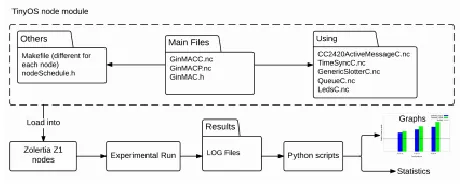
Fig. 1: nesC implementation, deployment and analysis flow
Events speak to equipment occasions that are like a hinder to demonstrate an occasion happening, e.g. gathering of a parcel. Assignments are likewise a piece of the programming dialect which can be called from the two occasions and summons. The work process for usage on TinyOS utilizing the produced nesC source code, and further performing organization and examination is appeared in Fig. 1. For assessment of the produced nesC code the introduced work process is utilized. The created source code alongside an application is arranged for the stage equipment Zolertia Z1 [17]. Moreover, in light of pre-chosen topology, timetable, and area, The Work directed an investigation. The gathered outcomes are put in a log document, which is utilized by python contents to produce charts and measurements. The created GinMAC source code utilizes different off the rack parts to finish the arrangement, e.g., the CC2420ActiveMessageC radio module gave by TinyOS.
Available online: https://edupediapublications.org/journals/index.php/IJR/ P a g e | 834 The segment diagram of the GinMAC nesC
module is appeared in Fiure. The GinMAC convention utilizes the radio capacities gave by the current segment in TinyOS, the CC2420ActiveMessageC part. For time synchronization, a fundamental capacity required for Time Division Multiple Access (TDMA) conventions like GinMAC, The Work utilize the TimeSyncC part. The TimeSyncC gives the Flooding Time Synchronization Protocol (FTSP). As a scheduler, the GinMAC part utilizes the GenericSlotterC segment. The scheduler experiences the superframe structure and executes the comparing opening for the given occasion. The part QueueC is utilized to make a parcel cushion for approaching bundles to be sent. The approaching bolts to the GinMAC module are the highlights that are given by the GinMAC module to the application or the system modules that utilization GinMAC. In the present variant, The Work create code that uses the radio layer in a unique shape. While a more point by point and express control of radio can be executed like the MiXiM code. This is itemized in the execution of MAC layers in TinyOS 2 [5]. With such express control, a MAC convention can control the transmission control at which every packet is sent.
4. PROPOSED SYSTEM
In the proposed approach, the transmission and gathering forms are exclusively demonstrated by two AMCs. These AMCs are built by separating
Available online: https://edupediapublications.org/journals/index.php/IJR/ P a g e | 835 probabilities of progress depend just on the
present express, the state space can be increased to guarantee that the present state decides the change probabilities. In whatever remains of this paper, numerical items (AMC, framework, vector or scalar) related to the bundle transmission process are indicated with a "t" subscript, while scientific articles related to the parcel gathering process are signified with a "r" subscript. While alluding detachedly to the two procedures, the "b" subscript is utilized.
5. CONCLUSION
Model driven Software Engineering is a mainstream approach for outline and advancement of general processing applications. The Work have utilized MDSE standards and connected it to convention plan and advancement in the WSN space. In this article, The Work have utilized model-based improvement systems to create code for two unique stages: reenactment and sending, from a CPN model of the GinMAC convention. The Work have utilized the PetriCode instrument for code age. The Work created layouts for MiXiM, a remote system test system stage, and TinyOS, a working framework for equipment stages. The Work have likewise broke down the created program code to exhibit some execution assessments that can be gotten in view of the produced code. One critical correlation between the traditional procedure utilized for the DMAMAC convention to the MDSE technique
utilized here is that the created stage particular models are firmly connected to the CPN show, consequently give a higher trust in the produced code. The models in each progression of the established strategy then again, are completely in view of necessity detail and no immediate transformations are made. Aside from this, The Work might want to apply the MDSE way to deal with the DMAMAC convention prerequisites to approve its ease of use.
REFERENCES
1. Billington, J., Gallasch, G., Han, B.: A Coloured Petri Net Approach to Protocol Verification. In: Lect. on Concurrency and Petri Nets, pp. 210–290. Springer (2004).
2. Boonma, P., Suzuki, J.: Model-driven performance engineering for Wireless Sensor Networks with feature modeling and event calculus. In: Proceedings of the 3rd BADS Workshop. pp. 17–24 (2011).
3. Brambilla, M., Cabot, J., Wimmer, M.: Model-driven software engineering in practice. Synthesis Lectures on Software Engineering 1(1), 1–182 (2012).
Available online: https://edupediapublications.org/journals/index.php/IJR/ P a g e | 836 5. Hauer, J.H.: Tkn15. 4: An ieee 802.15. 4 mac
implementation for tinyos. TKN Technical Reports Series (2009).
6. Hutchinson, J., Rouncefield, M., Whittle, J.: Model-driven engineering practices in industry. In: Proceedings of the ICSE. pp. 633–642 (May 2011).
7. Jensen, K., Kristensen, L.M., Wells, L.: Coloured Petri Nets and CPN tools for modelling and validation of concurrent systems. International Journal of Software Tools for Technology Transfer 9, 213–254 (2007).
8. Köpke, A., Swigulski, M., Wessel, K., Willkomm, D., Haneveld, P.T.K., Parker, T.E.V., Visser, O.W., Lichte, H.S., Valentin, S.: Simulating wireless and mobile networks in OMNeT++ the MiXiM vision. In: Proceedings of SIMUTools (2008).
9. Kumar S., A.A., Kristensen, L.M., Øvsthus, K.: Simulation-based Evaluation of DMAMAC: A Dual-mode adaptive MAC Protocol for Process Control. In: Proceedings of the 8th SIMUTools Conference. pp. 218–227 (2015).
10. Kumar S., A.A., Øvsthus, K., Kristensen, L.M.: Towards a dual-mode adaptive MAC protocol (DMA-MAC) for feedback-based networked control systems. Procedia Computer Science 34, 505–510 (2014).
11. Kumar S., A.A., Øvsthus, K., Kristensen, L.M.: Implementation and Deployment Evaluation of the DMAMAC Protocol for Wireless Sensor Actuator Networks. In: Proceedings of the 7th ANT Conference. vol. 83, pp. 329–336 (2016).
12. Kumar S., A.A., Simonsen, K.I.F.: Towards a model-based development approach for Wireless Sensor-Actuator Network Protocols. In: Proceedings of CyPhy. pp. 35–39 (2014).
13. Levis, P., Madden, S., Polastre, J., Szewczyk, R., Whitehouse, K., Woo, A., Gay, D., Hill, J., Welsh, M., Brewer, E., Culler, D.: TinyOS: An operating system for sensor networks. In: Ambient Intelligence, pp. 115– 148. Springer (2005).
14. Levis, P., Lee, N., Welsh, M., Culler, D.: TOSSIM: Accurate and scalable simulation of entire TinyOS applications. In: Proceedings of the 1st International Conference on Embedded networked sensor systems. pp. 126–137. ACM (2003).
15. Losilla, F., V Chicote, C., Alvarez, B., Iborra, A., Sanchez, P.: Wireless Sensor Network application development: An architecture-centric MDE approach. In: Software Architecture, LNCS, vol. 4758, pp. 179–194. Springer (2007).
Available online: https://edupediapublications.org/journals/index.php/IJR/ P a g e | 837 framework for modeling, simulation and
automatic code generation of Sensor Network Application. In: Proceedings of SECON. pp. 515–522 (2008)
17. Zolertia: Z1 datasheet. http://www.zolertia.io//, accessed: 03-10-2015
18. Rodrigues, T., Batista, T., Delicato, F., Pires, P., Zomaya, A.: Model-driven approach for building efficient Wireless Sensor and Actuator Network applications. In: Proceedings of the 4th SESENA Workshop. pp. 43–48 (2013).
ABOUT AUTHORS
:
BODALA MANIDEEP