V
OLUMEN
O.
9
(2019),
I
SSUEN
O.
03
(M
ARCH)
ISSN
2231-5756
A Monthly Double-Blind Peer Reviewed (Refereed/Juried) Open Access International e-Journal - Included in the International Serial Directories
Indexed & Listed at:
Ulrich's Periodicals Directory ©, ProQuest, U.S.A., EBSCO Publishing, U.S.A., Cabell’s Directories of Publishing Opportunities, U.S.A., Google Scholar, Indian Citation Index (ICI), J-Gage, India [link of the same is duly available at Inflibnet of University Grants Commission (U.G.C.)],
Index Copernicus Publishers Panel, Poland with IC Value of 5.09 (2012) & number of libraries all around the world.
V
OLUMEN
O.
9
(2019),
I
SSUEN
O.
03
(M
ARCH)
ISSN
2231-5756
INTERNATIONAL JOURNAL OF RESEARCH IN COMMERCE, IT & MANAGEMENT
CONTENTS
Sr.
No.
TITLE & NAME OF THE AUTHOR (S)
Page
No.
1. ROLE OF EMPLOYEE ENGAGEMENT IN IT COMPANIES: AN OVERVIEW
KANTHAMMA H K & Dr. B. SHEKHAR
1
2. ATTITUDE OF VIEWERS TOWARDS IPL AS A PREFERRED FORMAT OF CRICKET
VIS-A-VIS TEST AND ONE DAY MATCHES
Dr. HARSH PUROHIT & SHALINI SHARMA
5
3. MOBILE PHONE USAGE AND MENTAL HEALTH OF COLLEGE STUDENTS: A
LITERATURE REVIEW
VIJAYA U. PATIL & Dr. M. KOMALA
9
4. A STUDY ON DIGITAL ENVIRONMENT: MODES OF DIGITAL PAYMENT IN
INDIA
RAGHAVENDRA
13
5. QUALITIES OF MOST PREFERRED ONLINE SHOPPING PORTALS BY ONLINE
CUSTOMERS
M.RAMYA
18
V
OLUMEN
O.
9
(2019),
I
SSUEN
O.
03
(M
ARCH)
ISSN
2231-5756
INTERNATIONAL JOURNAL OF RESEARCH IN COMMERCE, IT & MANAGEMENT
FOUNDER PATRON
Late Sh. RAM BHAJAN AGGARWAL
Former State Minister for Home & Tourism, Government of Haryana
Former Vice-President, Dadri Education Society, Charkhi Dadri
Former President, Chinar Syntex Ltd. (Textile Mills), Bhiwani
CO-ORDINATOR
Dr. BHAVET
Former Faculty, Shree Ram Institute of Engineering & Technology, Urjani
ADVISOR
Prof. S. L. MAHANDRU
Principal (Retd.), Maharaja Agrasen College, Jagadhri
EDITOR
Dr. PARVEEN KUMAR
Professor, Department of Computer Science, NIMS University, Jaipur
CO-EDITOR
Dr. A. SASI KUMAR
Professor, Vels Institute of Science, Technology & Advanced Studies (Deemed to be University), Pallavaram
EDITORIAL ADVISORY BOARD
Dr. S. P. TIWARI
Head, Department of Economics & Rural Development, Dr. Ram Manohar Lohia Avadh University, Faizabad
Dr. CHRISTIAN EHIOBUCHE
Professor of Global Business/Management, Larry L Luing School of Business, Berkeley College, USA
Dr. SIKANDER KUMAR
Vice Chancellor, Himachal Pradesh University, Shimla, Himachal Pradesh
Dr. JOSÉ G. VARGAS-HERNÁNDEZ
Research Professor, University Center for Economic & Managerial Sciences, University of Guadalajara,
Guadala-jara, Mexico
Dr. TEGUH WIDODO
Dean, Faculty of Applied Science, Telkom University, Bandung Technoplex, Jl. Telekomunikasi, Indonesia
Dr. M. S. SENAM RAJU
Professor, School of Management Studies, I.G.N.O.U., New Delhi
Dr. A SAJEEVAN RAO
Professor & Director, Accurate Institute of Advanced Management, Greater Noida
Dr. D. S. CHAUBEY
Professor & Dean (Research & Studies), Uttaranchal University, Dehradun
Dr. CLIFFORD OBIYO OFURUM
Professor of Accounting & Finance, Faculty of Management Sciences, University of Port Harcourt, Nigeria
Dr. KAUP MOHAMED
Dean & Managing Director, London American City College/ICBEST, United Arab Emirates
Dr. VIRENDRA KUMAR SHRIVASTAVA
Director, Asia Pacific Institute of Information Technology, Panipat
Dr. MIKE AMUHAYA IRAVO
Principal, Jomo Kenyatta University of Agriculture & Tech., Westlands Campus, Nairobi-Kenya
Dr. SYED TABASSUM SULTANA
Principal, Matrusri Institute of Post Graduate Studies, Hyderabad
Dr. BOYINA RUPINI
Director, School of ITS, Indira Gandhi National Open University, New Delhi
Dr. NEPOMUCENO TIU
V
OLUMEN
O.
9
(2019),
I
SSUEN
O.
03
(M
ARCH)
ISSN
2231-5756
INTERNATIONAL JOURNAL OF RESEARCH IN COMMERCE, IT & MANAGEMENT
Dr. SANJIV MITTAL
Professor & Dean, University School of Management Studies, GGS Indraprastha University, Delhi
Dr. RAJENDER GUPTA
Convener, Board of Studies in Economics, University of Jammu, Jammu
Dr. SHIB SHANKAR ROY
Professor, Department of Marketing, University of Rajshahi, Rajshahi, Bangladesh
Dr. SRINIVAS MADISHETTI
Professor, School of Business, Mzumbe University, Tanzania
Dr. NAWAB ALI KHAN
Professor & Dean, Faculty of Commerce, Aligarh Muslim University, Aligarh, U.P.
MUDENDA COLLINS
Head, Operations & Supply Chain, School of Business, The Copperbelt University, Zambia
Dr. EGWAKHE A. JOHNSON
Professor & Director, Babcock Centre for Executive Development, Babcock University, Nigeria
Dr. A. SURYANARAYANA
Professor, Department of Business Management, Osmania University, Hyderabad
P. SARVAHARANA
Asst. Registrar, Indian Institute of Technology (IIT), Madras
Dr. MURAT DARÇIN
Associate Dean, Gendarmerie and Coast Guard Academy, Ankara, Turkey
Dr. ABHAY BANSAL
Head, Department of Information Technology, Amity School of Engg. & Tech., Amity University, Noida
Dr. YOUNOS VAKIL ALROAIA
Head of International Center, DOS in Management, Semnan Branch, Islamic Azad University, Semnan, Iran
WILLIAM NKOMO
Asst. Head of the Department, Faculty of Computing, Botho University, Francistown, Botswana
Dr. JAYASHREE SHANTARAM PATIL (DAKE)
Faculty in Economics, KPB Hinduja College of Commerce, Mumbai
SHASHI KHURANA
Associate Professor, S. M. S. Khalsa Lubana Girls College, Barara, Ambala
Dr. SEOW TA WEEA
Associate Professor, Universiti Tun Hussein Onn Malaysia, Parit Raja, Malaysia
Dr. OKAN VELI ŞAFAKLI
Professor & Dean, European University of Lefke, Lefke, Cyprus
Dr. MOHENDER KUMAR GUPTA
Associate Professor, Government College, Hodal
Dr. BORIS MILOVIC
Associate Professor, Faculty of Sport, Union Nikola Tesla University, Belgrade, Serbia
Dr. LALIT KUMAR
Course Director, Faculty of Financial Management, Haryana Institute of Public Administration, Gurugram
Dr. MOHAMMAD TALHA
Associate Professor, Department of Accounting & MIS, College of Industrial Management, King Fahd University
of Petroleum & Minerals, Dhahran, Saudi Arabia
Dr. V. SELVAM
Associate Professor, SSL, VIT University, Vellore
Dr. IQBAL THONSE HAWALDAR
Associate Professor, College of Business Administration, Kingdom University, Bahrain
Dr. PARDEEP AHLAWAT
Associate Professor, Institute of Management Studies & Research, Maharshi Dayanand University, Rohtak
Dr. ALEXANDER MOSESOV
V
OLUMEN
O.
9
(2019),
I
SSUEN
O.
03
(M
ARCH)
ISSN
2231-5756
INTERNATIONAL JOURNAL OF RESEARCH IN COMMERCE, IT & MANAGEMENT
Dr. ASHOK KUMAR CHAUHAN
Reader, Department of Economics, Kurukshetra University, Kurukshetra
Dr. BHAVET
Former Faculty, Shree Ram Institute of Engineering & Technology, Urjani
YU-BING WANG
Faculty, department of Marketing, Feng Chia University, Taichung, Taiwan
SURJEET SINGH
Faculty, Department of Computer Science, G. M. N. (P.G.) College, Ambala Cantt.
Dr. TITUS AMODU UMORU
Professor, Kwara State University, Kwara State, Nigeria
Dr. RAJESH MODI
Faculty, Yanbu Industrial College, Kingdom of Saudi Arabia
Dr. SAMBHAVNA
Faculty, I.I.T.M., Delhi
Dr. THAMPOE MANAGALESWARAN
Faculty, Vavuniya Campus, University of Jaffna, Sri Lanka
Dr. SHIVAKUMAR DEENE
Faculty, Dept. of Commerce, School of Business Studies, Central University of Karnataka, Gulbarga
SURAJ GAUDEL
BBA Program Coordinator, LA GRANDEE International College, Simalchaur - 8, Pokhara, Nepal
FORMER TECHNICAL ADVISOR
AMITA
FINANCIAL ADVISORS
DICKEN GOYAL
Advocate & Tax Adviser, Panchkula
NEENA
Investment Consultant, Chambaghat, Solan, Himachal Pradesh
LEGAL ADVISORS
JITENDER S. CHAHAL
Advocate, Punjab & Haryana High Court, Chandigarh U.T.
CHANDER BHUSHAN SHARMA
Advocate & Consultant, District Courts, Yamunanagar at Jagadhri
SUPERINTENDENT
V
OLUMEN
O.
9
(2019),
I
SSUEN
O.
03
(M
ARCH)
ISSN
2231-5756
INTERNATIONAL JOURNAL OF RESEARCH IN COMMERCE, IT & MANAGEMENT
CALL FOR MANUSCRIPTS
We invite unpublished novel, original, empirical and high quality research work pertaining to the recent developments & practices in the areas of Com-puter Science & Applications; Commerce; Business; Finance; Marketing; Human Resource Management; General Management; Banking; Economics; Tourism Administration & Management; Education; Law; Library & Information Science; Defence & Strategic Studies; Electronic Science; Corporate Gov-ernance; Industrial Relations; and emerging paradigms in allied subjects like Accounting; Accounting Information Systems; Accounting Theory & Practice; Auditing; Behavioral Accounting; Behavioral Economics; Corporate Finance; Cost Accounting; Econometrics; Economic Development; Economic History; Financial Institutions & Markets; Financial Services; Fiscal Policy; Government & Non Profit Accounting; Industrial Organization; International Economics & Trade; International Finance; Macro Economics; Micro Economics; Rural Economics; Co-operation; Demography: Development Planning; Development Studies; Applied Economics; Development Economics; Business Economics; Monetary Policy; Public Policy Economics; Real Estate; Regional Economics; Political Science; Continuing Education; Labour Welfare; Philosophy; Psychology; Sociology; Tax Accounting; Advertising & Promotion Management; Management Information Systems (MIS); Business Law; Public Responsibility & Ethics; Communication; Direct Marketing; E-Commerce; Global Business; Health Care Administration; Labour Relations & Human Resource Management; Marketing Research; Marketing Theory & Applications; Non-Profit Or-ganizations; Office Administration/Management; Operations Research/Statistics; Organizational Behavior & Theory; Organizational Development; Pro-duction/Operations; International Relations; Human Rights & Duties; Public Administration; Population Studies; Purchasing/Materials Management; Re-tailing; Sales/Selling; Services; Small Business Entrepreneurship; Strategic Management Policy; Technology/Innovation; Tourism & Hospitality; Transpor-tation Distribution; Algorithms; Artificial Intelligence; Compilers & Translation; Computer Aided Design (CAD); Computer Aided Manufacturing; Computer Graphics; Computer Organization & Architecture; Database Structures & Systems; Discrete Structures; Internet; Management Information Systems; Mod-eling & Simulation; Neural Systems/Neural Networks; Numerical Analysis/Scientific Computing; Object Oriented Programming; Operating Systems; Pro-gramming Languages; Robotics; Symbolic & Formal Logic; Web Design and emerging paradigms in allied subjects.
Anybody can submit the soft copy of unpublished novel; original; empirical and high quality research work/manuscriptanytime in M.S. Word format after preparing the same as per our GUIDELINES FOR SUBMISSION; at our email address i.e. [email protected] or online by clicking the link online submission as given on our website (FOR ONLINE SUBMISSION, CLICK HERE).
GUIDELINES FOR SUBMISSION OF MANUSCRIPT
1. COVERING LETTER FOR SUBMISSION:
DATED: _____________
THE EDITOR
IJRCM
Subject: SUBMISSION OF MANUSCRIPT IN THE AREA OF______________________________________________________________.
(e.g. Finance/Mkt./HRM/General Mgt./Engineering/Economics/Computer/IT/ Education/Psychology/Law/Math/other, please specify)
DEAR SIR/MADAM
Please find my submission of manuscript titled ‘___________________________________________’ for likely publication in one of your journals.
I hereby affirm that the contents of this manuscript are original. Furthermore, it has neither been published anywhere in any language fully or partly, nor it is under review for publication elsewhere.
I affirm that all the co-authors of this manuscript have seen the submitted version of the manuscript and have agreed to inclusion of their names as co-authors.
Also, if my/our manuscript is accepted, I agree to comply with the formalities as given on the website of the journal. The Journal has discretion to publish our contribution in any of its journals.
NAME OF CORRESPONDING AUTHOR :
Designation/Post* :
Institution/College/University with full address & Pin Code :
Residential address with Pin Code :
Mobile Number (s) with country ISD code :
Is WhatsApp or Viber active on your above noted Mobile Number (Yes/No) :
Landline Number (s) with country ISD code :
E-mail Address :
Alternate E-mail Address :
Nationality :
* i.e. Alumnus (Male Alumni), Alumna (Female Alumni), Student, Research Scholar (M. Phil), Research Scholar (Ph. D.), JRF, Research Assistant, Assistant
Lecturer, Lecturer, Senior Lecturer, Junior Assistant Professor, Assistant Professor, Senior Assistant Professor, Co-ordinator, Reader, Associate
Profes-sor, ProfesProfes-sor, Head, Vice-Principal, Dy. Director, Principal, Director, Dean, President, Vice Chancellor, Industry Designation etc. The qualification of
V
OLUMEN
O.
9
(2019),
I
SSUEN
O.
03
(M
ARCH)
ISSN
2231-5756
INTERNATIONAL JOURNAL OF RESEARCH IN COMMERCE, IT & MANAGEMENT
NOTES:
a) The whole manuscript has to be in ONE MS WORD FILE only, which will start from the covering letter, inside the manuscript. pdf.
version is liable to be rejected without any consideration.
b) The sender is required to mention the following in the SUBJECT COLUMNof the mail:
New Manuscript for Review in the area of (e.g. Finance/Marketing/HRM/General Mgt./Engineering/Economics/Computer/IT/
Education/Psychology/Law/Math/other, please specify)
c) There is no need to give any text in the body of the mail, except the cases where the author wishes to give any specific message
w.r.t. to the manuscript.
d) The total size of the file containing the manuscript is expected to be below 1000 KB.
e) Only the Abstract will not be considered for review and the author is required to submit the complete manuscript in the first instance.
f) The journal gives acknowledgement w.r.t. the receipt of every email within twenty-four hours and in case of non-receipt of
acknowledgment from the journal, w.r.t. the submission of the manuscript, within two days of its submission, the corresponding author is required to demand for the same by sending a separate mail to the journal.
g) The author (s) name or details should not appear anywhere on the body of the manuscript, except on the covering letter and the cover page of the manuscript, in the manner as mentioned in the guidelines.
2. MANUSCRIPT TITLE: The title of the paper should be typed in bold letters, centeredand fully capitalised.
3. AUTHOR NAME (S) & AFFILIATIONS: Author (s) name, designation, affiliation (s), address, mobile/landline number (s), and email/al-ternate email address should be given underneath the title.
4. ACKNOWLEDGMENTS: Acknowledgements can be given to reviewers, guides, funding institutions, etc., if any.
5. ABSTRACT: Abstract should be in fully Italic printing, ranging between 150 to 300 words. The abstract must be informative and eluci-dating the background, aims, methods, results & conclusion in a SINGLE PARA. Abbreviations must be mentioned in full.
6. KEYWORDS: Abstract must be followed by a list of keywords, subject to the maximum of five. These should be arranged in alphabetic order separated by commas and full stop at the end. All words of the keywords, including the first one should be in small letters, except special words e.g. name of the Countries, abbreviations etc.
7. JEL CODE: Provide the appropriate Journal of Economic Literature Classification System code (s). JEL codes are available at www.aea-web.org/econlit/jelCodes.php. However, mentioning of JEL Code is not mandatory.
8. MANUSCRIPT: Manuscript must be in BRITISH ENGLISH prepared on a standard A4 size PORTRAIT SETTING PAPER. It should be free
from any errors i.e. grammatical, spelling or punctuation. It must be thoroughly edited at your end.
9. HEADINGS: All the headings must be bold-faced, aligned left and fully capitalised. Leave a blank line before each heading.
10. SUB-HEADINGS: All the sub-headings must be bold-faced, aligned left and fully capitalised.
11. MAIN TEXT:
THE MAIN TEXT SHOULD FOLLOW THE FOLLOWING SEQUENCE:
INTRODUCTION REVIEW OF LITERATURE
NEED/IMPORTANCE OF THE STUDY STATEMENT OF THE PROBLEM OBJECTIVES
HYPOTHESIS (ES)
RESEARCH METHODOLOGY RESULTS & DISCUSSION
FINDINGS
RECOMMENDATIONS/SUGGESTIONS
CONCLUSIONS LIMITATIONS
SCOPE FOR FURTHER RESEARCH
REFERENCES
APPENDIX/ANNEXURE
V
OLUMEN
O.
9
(2019),
I
SSUEN
O.
03
(M
ARCH)
ISSN
2231-5756
INTERNATIONAL JOURNAL OF RESEARCH IN COMMERCE, IT & MANAGEMENT
12. FIGURES & TABLES: These should be simple, crystal CLEAR, centered, separately numbered & self-explained, and the titles must beabove the table/figure. Sources of data should be mentioned below the table/figure. It should be ensured that the tables/figures are referred to from the main text.
13. EQUATIONS/FORMULAE: These should be consecutively numbered in parenthesis, left aligned with equation/formulae number placed
at the right. The equation editor provided with standard versions of Microsoft Word may be utilised. If any other equation editor is utilised, author must confirm that these equations may be viewed and edited in versions of Microsoft Office that does not have the editor.
14. ACRONYMS: These should not be used in the abstract. The use of acronyms is elsewhere is acceptable. Acronyms should be defined
on its first use in each section e.g. Reserve Bank of India (RBI). Acronyms should be redefined on first use in subsequent sections.
15. REFERENCES: The list of all references should be alphabetically arranged. The author (s) should mention only the actually utilised
references in the preparation of manuscript and they may follow Harvard Style of Referencing. Also check to ensure that everything
that you are including in the reference section is duly cited in the paper. The author (s) are supposed to follow the references as per the following:
•
All works cited in the text (including sources for tables and figures) should be listed alphabetically.•
Use (ed.) for one editor, and (ed.s) for multiple editors.•
When listing two or more works by one author, use --- (20xx), such as after Kohl (1997), use --- (2001), etc., in chronologically ascending order.•
Indicate (opening and closing) page numbers for articles in journals and for chapters in books.•
The title of books and journals should be in italic printing. Double quotation marks are used for titles of journal articles, book chapters, dissertations, reports, working papers, unpublished material, etc.•
For titles in a language other than English, provide an English translation in parenthesis.•
Headers, footers, endnotes and footnotes should not be used in the document. However, you can mention short notes to elucidatesome specific point, which may be placed in number orders before the references.
PLEASE USE THE FOLLOWING FOR STYLE AND PUNCTUATION IN REFERENCES:
BOOKS
•
Bowersox, Donald J., Closs, David J., (1996), "Logistical Management." Tata McGraw, Hill, New Delhi.•
Hunker, H.L. and A.J. Wright (1963), "Factors of Industrial Location in Ohio" Ohio State University, Nigeria.CONTRIBUTIONS TO BOOKS
•
Sharma T., Kwatra, G. (2008) Effectiveness of Social Advertising: A Study of Selected Campaigns, Corporate Social Responsibility, Edited by David Crowther & Nicholas Capaldi, Ashgate Research Companion to Corporate Social Responsibility, Chapter 15, pp 287-303.JOURNAL AND OTHER ARTICLES
•
Schemenner, R.W., Huber, J.C. and Cook, R.L. (1987), "Geographic Differences and the Location of New Manufacturing Facilities," Jour-nal of Urban Economics, Vol. 21, No. 1, pp. 83-104.CONFERENCE PAPERS
•
Garg, Sambhav (2011): "Business Ethics" Paper presented at the Annual International Conference for the All India Management Asso-ciation, New Delhi, India, 19–23UNPUBLISHED DISSERTATIONS
•
Kumar S. (2011): "Customer Value: A Comparative Study of Rural and Urban Customers," Thesis, Kurukshetra University, Kurukshetra.ONLINE RESOURCES
•
Always indicate the date that the source was accessed, as online resources are frequently updated or removed.WEBSITES
V
OLUMEN
O.
9
(2019),
I
SSUEN
O.
03
(M
ARCH)
ISSN
2231-5756
INTERNATIONAL JOURNAL OF RESEARCH IN COMMERCE, IT & MANAGEMENT
A STUDY ON DIGITAL ENVIRONMENT: MODES OF DIGITAL PAYMENT IN INDIA
RAGHAVENDRA
ASST. PROFESSOR IN COMMERCE
VIVEKANANDA CENTER FOR RESEARCH & PG STUDIES
NEHRU NAGARA
ABSTRACT
A Digital environment defines an economic state whereby financial payments are not discharged with money in the mode of physical coins or banknotes, but rather through the shift of digital information between the transacting parties. A Digital environment is an economic system in which there is less or very less flow of cash in a society and goods and services are bought and paid through cashless mode. A Digital economy is an environment in which payments are made by cheques, debit cards, credit cards or direct transfer from one account to another or one person to another etc. The Government and the Reserve Bank of India (RBI) are pushing several efforts into society to decrease the use of cash in the economic transaction by promoting the cashless payment devices including prepaid instru-ments and cards. RBI’s effort to encourage these new kinds of payment and settlement facilities aims to achieve the goal of a ‘cashless’ society. With less cash in hand and an unbounded masticate in sight; most people are highly attracted towards cashless transactions. Digital payments bring in recondition transparency, scalability, and accountability. The new idea will impel more dealers to accept digital money. Up until that time, it was assumed that money and payment systems had been invented and imposed by the state. Money is a social phenomenon, with its roots in the barter economy; payment systems evolved out of the barter economy-and empowered buyers and sellers-with the development of money as a medium of exchange. Cash may no longer be a leader. There are many types and modes of digital payments. The paper having objective that presenting various modes of digital payments like mobile wallets, debit/credit cards, internet banking, mobile banking, digital payment apps, Unified Payments Interface (UPI) service, Bank prepaid cards, etc.
KEYWORDS
digital environment, mode of digital transactions, mobile wallets, debit card, credit card.
JEL CODES
G20, G21, G29.
1. INTRODUCTION
Digital Environment is an environment in which all modes of payments are carried out through digital means. The circulation of physical currency is nominal. India practices numerous cash transaction. A cashless environment is a structure in which payments are not done predominantly in exchange for physical cash. This does not refer to a complete absence of cash transactions in the economic settings but one in which the amount of cash-based payments is retained to the lowest level. An e-payment system or a cashless economy or environment is a circumstance where there is a bit or very less cash flow in a particular society, meaning thereby; transactions will be made by e-channels like debit cards, internet banking, multi-functional ATMs, mobile payments, and electronic funds transfer internet banking. A cashless environment doesn’t mean a deficiency of cash rather it stipulates a culture of people arranging transactions digitally. In a current economy, money moves electronically. Hence the scatter of e-payment culture along with the extension of infrastructure facilities is required to reach the goal. On November 8, 2016, the eminent Prime minister of India demonetized the two effective denomination notes of INR 500 and INR 1000, bring to an end to be legal tender with rapid effect except for few described reasons. The whole nation was shocked with such huge cash circulation being rendered invalid with just one announcement.
In recent RBI reveal its document on “PAYMENTS AND SETTLEMENT SYSTEMS IN INDIA: VISION 2018” focused at making India a cashless economy. Further, our Prime Minister is working tremendously positive towards his move of Digitization (DIGITAL INDIA). If these two moves (Demonetization and Digitization) reach its goal, then India will become a Cashless Economy. The development of money is not dependent solely on objective characteristics. Subjective valuations play a critical role. Eventually consumers define what form of money is most desirable-people merely substitute cheaper and more suitable forms of money for expensive and unsuitable forms. It is finally through this substitution in use that new money forms implant themselves in the marketplace.
2. OBJECTIVES OF THE STUDY
The objective of the paper is to study the aspect of the Digital environment and analyzing it in Indian circumstances, as part of encouraging cashless idea and converting India into a less-cash or digital means environment, various modes of digital payments are available such as ATM, Banking Cards, NEFT, RTGS, Mobile Banking, Digital Wallets etc.
3. METHODOLOGY
The paper is presented based on the secondary data. Research done on previously published research papers, articles, journals, books, magazines, newspapers, and internet regarding the digital environment and kinds of digital payment or E-payments in India, concept and analysis is ended based on such secondary data research and conclusion.
4. THE CONCEPTS
DIGITAL PAYMENT REQUIREMENTS
TABLE 1: DIGITAL PAYMENT REQUIREMENT CRITERIA CRITERIA NEED FOR CRITERIA
Acceptability Payment foundation should be generally acknowledged.
Anonymity Character of the clients ought to be ensured.
Convertibility Digital cash ought to be convertible to any fund.
Efficiency Cost per transaction ought to be close to zero
Integration Interfaces ought to be made to help the current framework.
Scalability Framework ought not breakdown if new clients and merchants join.
Security Ought to permit monetary exchanges over open systems.
Reliability Ought to maintain a strategic distance from single purposes of disappointment.
Usability Installment ought to be as simple as in reality.
E-PAYMENTS IN INDIA
V
OLUMEN
O.
9
(2019),
I
SSUEN
O.
03
(M
ARCH)
ISSN
2231-5756
INTERNATIONAL JOURNAL OF RESEARCH IN COMMERCE, IT & MANAGEMENT
and debits inside 4 days, and this force succeeded regardless of the various automation tiers of India’s banks. Just recently, the RBI additionally built out the national EFT device for an exclusive EFT (SEFT) device to act as a key element of India’s e-payment device and to resolve last-mile connectivity problems between entities, in accordance to FinancialAsia.com. Payment structures such as ECS and SEFT will in flip promote credit and debit card use in India, while the issuance of chip-based payment cards is anticipated to take off quickly. Once the RBI rolls out its real-time gross settlement system (RTGS), India’s banks and corporations will be a higher capacity to use the Internet to understand the value of e-payments to their operations. For larger automation in India’s payment system, the RBI has also linked clearing houses by using INFINET (Indian Financial Network, a telecom network), set up a centralized cash management device (CFMS), and centralized the payments and settlement systems. While India is not going to obtain a national e-payment infrastructure in the instant future, According to FinanceAsia.com, “banks that do not invest or are unable to improve their technology will be at a massive disadvantage”. New e-payment systems will allow banks to provide their customers' value-added services and guide the propagation of e-payments to their suppliers. Banks doing so optimize the management of their funds and enhance their productivity, while firms improve their receivables administration for larger payments efficiency, reduced operating expenses, and higher threat manage-ment. India’s payments market is still dominated by cash and cheques, however, almost each and every bank issues credit cards, with MasterCard being the stated chief in phrases of market penetration. Merchant and customer use of credit cards in India has been confined both by government laws requiring credit cardholders to lodge a tax return and by way of the anonymity of cash, which does not depart audit trails. Credit card issuers are alternatively on standby to tap an extended market for credit cards that is anticipated to result from a sturdy boom in India’s economy, which is, in turn, boosting average family incomes and demand for credit cards.
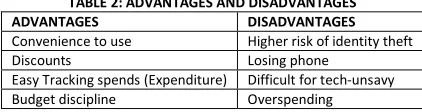
MERITS AND DEMERITS OF GOING DIGITAL ENVIRONMENT
TABLE 2: ADVANTAGES AND DISADVANTAGES
ADVANTAGES DISADVANTAGES
Convenience to use Higher risk of identity theft
Discounts Losing phone
Easy Tracking spends (Expenditure) Difficult for tech-unsavy
Budget discipline Overspending
MODES OF DIGITAL TRANSACTIONS
• Practical Implementation for moving on path of going cashless:
• ATM
• Credit Cards
• Debit Cards
• Internet Banking
• NEFT and RTGS
• Point of sale
• Mobile Banking
• Mobile Wallets
AUTOMATED TELLER MACHINE (ATM)
ATM is designed to perform the most essential characteristic of bank. It is operated through plastic card with its special features. The plastic card is changing cheque, private attendance of the customer, banking hour’s restrictions and paper primarily based verification. ATM itself can furnish records about clients account and also obtain directions from customers— ATM cardholders. An ATM is an Electronic Fund Transfer terminal capable of dealing with money deposits, switch between accounts, balance enquiries, cash withdrawals and pay bills. The on-line ATM allows the client to avail banking facilities from anywhere. In off-line the Internet banking (or E-banking) means any consumer with a private pc and a browser can get connected to his bank -s internet site to operate any of the digital banking functions. In internet banking device the bank has a centralized database that is web-enabled. All the offerings that the bank has authorized on the net are displayed in menu. Any service can be chosen and in addition interplay is dictated by using the nature of service. The traditional branch model of bank is now giving place to a choice delivery channels with ATM network. Once the branch offices of bank are interconnected via terrestrial or satellite links, there would be no physical uniqueness for any branch.
CREDIT CARDS
The Credit Card holder is empowered to spend at any area and each time he needs with his Credit Card inner the limits constant through means of his bank. Credit Card is a postpaid card. Every time a man or lady makes use of this card, the Internet Banking residence receives money transferred to its account from the bank of the buyer. The buyer's account is debited with the genuine amount of purchases. Without a doubt, the primary means of fee used and initiated by way of the Internet for customer transactions till date is the credit card. Credit cards have proved famous for a range of motives as the following:
• The device is acquainted with customers and was broadly used earlier than the introduction of e-commerce, consequently bolstering the users’ confidence.
• Transaction charges are hidden from customers (i.e. essentially met via sellers, and passed on to all customers, no longer just credit card users).
• Payment is easy anywhere and in any currency, thus matching the world reach of the Internet.
• The credit-issuing enterprise shares the transaction risk; supporting overcome consumers’ concern and reluctance to purchase goods they have no longer
certainly seen, from dealers they do not recognize (in the physical world this feature was essential because it enabled sellers to take payment from consumers they do not know; on-line this trust relationship is wished in each direction).
In January 2018, according to Reserve Bank of India usage analysis between January 2017 and January 2018, the number of credit cards increased to around 36.24 million, with 0.7 million new cardholders, India added some 7.39 million credit cards. The number of transaction using credit cards for the 12 month period ending January 2018 was grown up by 9.4%; the total number of transactions through credit cards was 129.8 million. Total amount transacted in January2018, through credit cards increased by 27%, Rs. 41,437 cr. were transacted in 12 month period. An indication of the amount people are ready to spend in one transaction – which is Avg. amount, transacted per transaction using credit cards increased 15.8% between January 2017 and January 2018.
DEBIT CARDS
V
OLUMEN
O.
9
(2019),
I
SSUEN
O.
03
(M
ARCH)
ISSN
2231-5756
INTERNATIONAL JOURNAL OF RESEARCH IN COMMERCE, IT & MANAGEMENT
in the machine and pressing the quantity to be paid, the payee saves time and effort in contrast to falling in line to pay to the teller the remaining amount of money can be checked online or cell phone. Another significance of debit cards is that they are used to withdraw money from ATMs.
In January 2018, according to Reserve Bank of India the number of debit cards increased to around 846 million, with 4 million new cardholders, between January 2017 and January 2018, India added some 28 million debit cards. The number of transaction using debit cards for the 12 month period ending January 2018 was declined by 9.1%; the total number of transactions through debit cards was 298.6 million. Total amount transacted in January through debit cards decreased by 17%, Rs. 40,761 cr. were transacted in 12 month period. An indication of the amount people are ready to spend in one transaction – which is Avg. amount, transacted per transaction using debit cards decreased 8% between January 2017 and January 2018.
INTERNET BANKING
Handling payments is an expensive system that has been a central phase of bank business for the past century. However, it is now being modified via technological developments, and in particular, the Internet. The importance of the payment feature lies in the reality that it ought to inspire convergence between sectors with disparate goals because payment structures are the frequent denominator of all e-commerce transactions. Conceptually, the alternative means of payment on hand for e-commerce may be categorized as both electronic money(e-money) or electronic access Products. The distinction between them is that whereas digital access products basically Provide Internet access to traditional products (credit card payments, bank transfers, and the like), e-money is a new concept, and in specific is viewed to be “private cash not relying on central bank reserves.” Consolidated strategies of payment used for distance selling frequently at the national level, such as cheque, cash-on-delivery, and credit-transfer mechanisms, have confirmed convenient to adapt to digital transactions. The credit card device has to date been the usual payments instrument for goods ordered over the Internet. This is despite security worries and relatively greater transaction cost. Nevertheless, the lack of a broadly accepted e-payment device is not regarded to be an essential barrier for the gearing up of e-commerce. The most essential factors are surely user trust and user confidence. E-payment systems are turning into central to e-commerce as companies appear for approaches to serve customers quicker and at a lower cost. Those historical merchants confronted a number of obstacles, such as conflicting local laws and customs concerning commercial practices, and incompatible and nonconvertible currencies that limited trade. To avoid some of these problems, merchants invented various types of payment instruments, such as promissory notes, bills of exchange, gold coins, and barter. We are on the verge of a similar kind of improvement today with regard to e-payment systems.
ONLINE TRANSFER – NEFT OR RTGS
Another simplest system for the cashless payment is an online transfer of money using NEFT or RTGS. Internet banking facility is needed in order to do an online money transfer. Comparatively online payment using RTGS or NEFT is faster than DD or cheque. Using internet facility online transfer can be done from anywhere in the world.
NEFT is a nation-wide used cashless payment method enabling one-to-one funds handover. NEFT functions in hourly batches -there are 12 clearances from 8 am to 7 pm on week days (Monday through Friday) and from 8 am to 1 pm on Saturdays.
RTGS is defined as the real-time settlement of funds remittance. The RTGS system is mainly meant for huge valued payments. The lowest sum to be paid through RTGS is 2 lakh.
POINT OF SALE (POS)
Point of sale (POS) refers to the physical location at that merchandise or services are purchased and dealing information is captured through electronic money registers or different electronic devices like magnetic card readers, optical and code scanners or some combination of those. The point of sale (or POS) in retail industries uses a software system moreover as hardware, and this could embrace a manual or electronic register, scanners, advisement scales, bit screen terminals, and a good kind of alternative software system or hardware. An example of a degree of sale in a very ancient brick and mortar store is that the scale won’t to weigh merchandise in a very ancient grocery or confectionery.
MOBILE BANKING
Mobile banking is a facility given by a bank or different financial institution that permits its customers to do monetary transactions remotely employing a mobile device like a smartphone or tablet. Unlike the related internet banking it uses software, typically known as an App or Mobile Application, provided by the financial institution for the aim. Mobile banking is typically accessible on a 24/7 hour basis. Some financial institutions have constraints on which accounts may be accessed
through mobile banking, additionally as a limit on the quantity which will be transacted.Mobile banking could embrace following features like getting account
balances and lists of recent transactions, electronic bill payments (Recharge, Gas and Electronic Bill etc.), and money transfers between a customer's or another's accounts.
DIGITAL WALLETS OR MOBILE WALLETS
The modern cashless transaction system is a mobile wallet. No need to carry a credit card, debit card or internet banking password for making transaction. Using IMPS just add cash in the wallet and use it on when it required. Mobile Wallets are created using mobile wallet applications by downloading from Google play store. Mobile Wallets are like PayTM, Freecharge, Mobiwik etc. Using these wallets, people can do the online and offline payment to merchant registered with the mobile wallet service provider. Lacks of users in India are doing their daily payments from small to big amount through essential wallets – as they are benefited with discounts on purchase provided by the mobile wallet service provider.
Type of M- Wallets in India
As claimed by to RBI, there are three forms of mobile wallets –
• Closed wallets
• Semi-close
• Open wallets
CLOSED MOBILE WALLET
Closed mobile wallets are handled only for goods and services for that specific company and it doesn’t provide services like cash withdrawal or redemption. MakeMyTrip, Jabong, etc. are best examples for closed wallets. In case of any cancellation or to return product your registered MakeMyTrip or Jabong In these wallets accounts credited with the refund amount in case of any cancellation of an order. But this amount can only use with that merchant itself.
SEMI-CLOSED WALLET
Semi-closed wallets are those wallets which don’t permit to redeem or withdraw similar like closed wallets. But there is a permission to redeem wallet in listed merchants who have a contract with Wallet Company to receive payment. Paytm, freecharge, MobiKwik, PhonPe etc. are examples of semi-closed e-wallets.
OPEN WALLETS
Open Wallets means the wallets that allow users to redeem plus withdraw cash. Vodafone Powered M-Pesa, Airtel powered by airtel Payment Bank is the perfect example.
UPI APPS
UPI is a mobile payment system is the most popular wallet which allows users to do miscellaneous financial payments on a user’s smartphone. UPI permits its users to send or receive money using virtual payment address (VPA) without typing bank information. Merchants can accept payments using UPI by enrolling with banks. UPI payments feature is allowed in various popular mobile wallets like PayTM, FreeCharge etc.
As per NPCI data in the month between July and August 2018 UPI payments noticed an increase of 32% in the total transaction, In August 2018, amounting to Rs 54,212.26 cr were carried out on total of 312.02 million transactions, compared with Rs 45,845.64 crore were carried out on total 235.7 million transactions in the month of July.
HERE ARE THE MOST TRENDING MOBILE WALLETS COMPANIES OF INDIA PAYTM
V
OLUMEN
O.
9
(2019),
I
SSUEN
O.
03
(M
ARCH)
ISSN
2231-5756
INTERNATIONAL JOURNAL OF RESEARCH IN COMMERCE, IT & MANAGEMENT
payment for any online or offline shopping. The wallet is also used for e-commerce transactions like mobile recharge, DTH recharge, Electronics bill payments, transferring money and much more. Other than the mobile wallet, Paytm is online shopping too; more than 3 million products are available to shop.
As per the report of Economic Times, Paytm claims that Unified Payments Interface (UPI) is accepted by over 5 million offline merchants. 9 million offline merchants are total base of Paytm. Subsequently, Paytm also claimed that offline payments on its UPI platform took place for more than 40% of its whole UPI payments.
OXIGEN WALLETS
Oxigen Wallet is powered by Oxigen Services India Private Ltd. and popular in the online shop for all online and offline payment transactions. This wallet Founded in 2004 and founder is Mr. Parmod Saxena in contract with Blue Label Telecom. Oxigen runs with technology upgrade and secured wallet with most significant payment Solution Company in India. This wallet makes users feel safe and secure with the transaction as every time six-digit one-time password (OTP) sends to the registered mobile number. This wallet already approved by RBI and united with NPCI – for instant money transfer. Oxigen wallet permits users to send money to bank account from mobile wallet. It enveloped almost all major banks in India. Upgrade the wallet balance or space from Rs.10,000 to Rs.50,000 as being use of KYC (Know Your Client). Oxigen wallet application is exclusively available for Android Users.
MOBIKWIK WALLETS
MobiKwik Wallets is another leading mobile wallet in India powered by MobiKwik Systems Private Limited. This wallet is founded in 2009. The founder & CEO of MobiKwik is Bipin Preet Singh and he contributed it to bringing Digital transaction in India. The company headquarter located in Gurgaon. This m-wallet already has the user base over 40 million. This mobile wallet permits users to add money using a debit card, credit card, net banking & door to door cash collection services. This wallet is popular to Make payment for the electricity bill, shop online, recharge your mobile, and get the discount on various deals and it is very easy to use with 24*7 customer support for its users and payment mode is 100% secure and safe.
PAYUMONEY
PayUMoney is powered by PayUMoney mobile wallet service in India. It is the safe and secure stage for making online payment all over India. This wallet permits its users to make the online transaction via credit cards, debit cards, net banking, etc. This mobile wallet is popular among users by giving rewards point on every transaction that can be used also. The good thing about this e-wallet, it gives PayUMoney Buyer Protection which promises that the bought goods reach your door.
FREECHARGE
Freecharge Wallets is another leading mobile wallet in India with over 20 millions of registered users. This mobile wallet is fruitfully giving the mobile payment (M-payment) solution in India. Freecharge founded in 2010 and founded by Kunal Shah and Sandeep Tandon. It does headquarter located in Mumbai. Jason Kothari is present CEO of the MobiKwik. This wallet becomes the most popular app among youth, which permits users to make postpaid, prepaid, DTH and many bill payment and more in a few clicks. Freecharge added one unique special feature in the app from where the user can donate money to the registered NGO’s. Rest features are similar to other m-wallets.
GOOGLE PAY
Google Pay (formerly Google Tez) is an on-line payment app that presents customers with a choice to send or obtain cash over Unified Payments Interface (UPI). Unlike regular payment transfer system like RTGS and NEFT, UPI makes it simpler to send or obtain cash directly from or to a financial institution or Bank account in real time; it’s simple like a text message. It’s easy to set up Google Pay in android phone, Download application from Google Play store, add a bank account and send or obtain cash over UPI.
As per report, Google Pay has 25 million monthly active users and 1.2 million businesses on the platform in India. Company also publicized that since the com-mencement of operation it has managed over 860 million transactions.
PHONEPE
PhonePe is monetary technology company headquarter located in Bangalore, India. It had been founded in Dec, 2015. It provides an online payment system supported Unified Payments Interface (UPI) that could be a new system in electronic funds transfer launched by National Payments Corporation of India (NPCI). It's licensed by the Reserve Bank of India (RBI) for issuing and operation of a Semi Closed prepaid Payment system. PhonePe received their license to work on 26th August, 2014 and commenced its operations in Dec, 2015. However, in April 2016, the corporate was acquired by Flipkart. Flipkart's vice chairman in Marketing- Sameer Nigam was appointed as their new chief executive officer. In August 2016, the company joined with yes Bank to start a UPI-based mobile payment app, reinforced the government-backed UPI platform. On 14th January, 2017, ICICI bank blocked PhonePe transactions, citing the explanations that it failed to meet the NPCI guidelines. Initially, on 19th January, 2017, NPCI instructed ICICI to permit UPI transactions via PhonePe. Throughout this era, Airtel too blocked PhonePe transactions on its platforms. A day later, on 20th January, 2017, NPCI renounced the previous directions citing the reason that PhonePe so profaned the UPI norms. After this, PhonePe closed its operations on Flipkart's web site, to align itself with the terms expressed within the updated finding from NPCI. By February, 2017, PhonePe resolved the problems with ICICI.
As per report over 2 million transactions processed in offline organized outlets in August 2018 using PhonePe and aimed to raise this number to 10 million by December. According to the company, in the last 6 months there is 20x raise in payment transactions. In July, PhonePe claimed 40% share of market became the major UPI-based wallet in the country. In the month of July 2018 Unified Payments Interface (UPI) has stated 235.6 million transactions, out of which, PhonePe had majored over 100 million monthly transactions.
STATE BANK BUDDY
State Bank Buddy is mobile e-wallet app can be used to send money to new and registered customers. This wallet is owned by State bank of India (SBI) named SBI Buddy in August 2016 to promote cashless payments. This e-wallet is useful for online shopping, to book movies, flights and hotels etc. It additionally has elements like reminders to settle dues, recharge and any other payments instantly. This wallet app is accessible in 13 languages and permits customers to set reminders for money transfers and clearing dues. The SBI Buddy app is handy in Google Play Store and Apple App Store. The mobile wallet customers in India are predicted to grow from the present day 200-250 million to around 500 million in the subsequent couple of years. Cab rental offerings like Uber and Ola enable their clients to pay on-line by using mobile wallets. Most digital wallets provide some discount or cashback for on-line payment.
BHIM APP
Bharat Interface for Money (BHIM) is a mobile app developed via National Payments Corporation of India (NPCI), primarily based on the Unified Payment Interface (UPI). As on 30 December 2016, Prime Minester Narendra Modi launched, at Digi Dhan mela at Talkatora Stadium. This application named after B. R. Ambedkar and is meant to facilitate e-payments directly through banks as section of the 2016 Indian banknote demonetisation and force towards cashless transactions. This application supports all Indian banks which use that stage, which is built over the Immediate Payment Service infrastructure and lets in the user to rapidly send cash between bank accounts of any two parties. It can be used on all mobile devices.
5. ANALYSIS OF DIGITAL ENVIRONMENT IN INDIA POST DEMONETIZATION
At present people are again to their historical ways after Demonetization. Cash rules the roost though mobile wallets are modern tool for fancy transaction. Nearly 95 percentages of transactions are executed through cash and cheque books, in accordance to an Economic Times report; only 5 percentages are done via the digital or cashless mode.
As per RBI report in April 2018, Cash payments from ATMs rose 22 per cent to Rs 2.6 lakh crore. Around 759 million of time debit cards were used at ATMs across the nation, which is 26 per cent growth compared from 561 million in Nov 2016.
V
OLUMEN
O.
9
(2019),
I
SSUEN
O.
03
(M
ARCH)
ISSN
2231-5756
INTERNATIONAL JOURNAL OF RESEARCH IN COMMERCE, IT & MANAGEMENT
use of credit card, now cash flow is no more obstacles for growth credit card use. Total value of credit card transaction, actual data point for January 2018 (around Rs.36,000cr).
Prepaid payment instruments shown interesting pattern of growth in post demonetization. There was an initial rise in usage of wallets associated with demoneti-zation, followed by a reasonable fall in mid-2017 as cash returned to the economy. And then, second boost which has put mobile wallet payments again shown raising trend. Total value of mobile transaction, actual data point for January 2018 (around Rs.15,000cr). In December 2017, the Union Cabinet had given up the Merchant Discount Rate (MDR) on all debit cards, BHIM and UPI transactions up to Rs.2000. Starting from January 1, 2018, the Government had added that it will refund the banks for a period of two years. In April 2017, according to NITI Aayog data the total Volume of Digital Payments touched about 1.9 billion, 37% growth registered as compared to 1.4 billion in April 2016.
6. CONCLUSION
Most people are racing towards cashless payments, perhaps limited cash in hand and indefinite munches in sight. Digital payments bring in good liquidity, scala-bility, and accountability. The new step will encourage more merchants to accept e-cash or digital money. Digital payments are enveloped with a bunch of benefits such as Real-time domestic fund transfer, 24 X 7 availability, Simple, fast and easy to use, Fast, Inexpensive and Safe and secure. Cashless modes are more con-venient and easy for payments and are more secure compared to making payments involving cash withdrawal. A cashless society is phases of modernization, development and the payment system; it encourages transparency and accountability, minimizes payment or transaction costs and reduces the dimension of the grey or informal economy. It helps business people to strengthen their customer base and resource pool, far beyond the boundaries of their instant geographic location. Cashless payments are environment-friendly as no tree will be cut for printing paper money. No physical cash no corruption. A cashless environment is safe, it is clean. This is our duty take India towards an increasingly “digital environment”. Despite the government’s drive for digital payment, there seems to be slow consciousness of e-payment ideas in rural regions. People are still afraid to make payments through e-payment methods in Tier-II and Tier-III cities.
REFERENCES
1. BHIM. (2018, December 28). Retrieved from https://en.wikipedia.org/wiki/BHIM
2. Cash crunch: Cashless economy is still far away; Govt hasn't done enough to push digital transactions - Firstpost. (2018, April 19). Retrieved from
https://www.firstpost.com/business/cash-crunch-cashless-economy-is-still-far-away-govt-hasnt-done-enough-to-push-digital-transactions-4437411.html
3. Cashless India. (n.d.). Retrieved from http://cashlessindia.gov.in/digital_payment_methods.html
4. Desk, T. (2018, September 4). How to use Google Pay to send and receive money over UPI. Retrieved from
https://indianexpress.com/article/technol-ogy/techook/how-to-use-google-pay-to-send-and-receive-money-upi-add-bank-account-5339790/
5. Did Demonetisation Change India's Cash Habits? (2018, April 19). Retrieved from
https://www.bloombergquint.com/business/2018/04/19/did-demonetisa-tion-change-indias-cash-habits#gs.haaM5T0
6. Digital Payments Archives - MediaNama. (n.d.). Retrieved from https://www.medianama.com/tag/digital-payments/
7. Ojha, S. (2018, August 23). Top 5 trending mobile wallets in India. Retrieved from
https://www.livemint.com/Companies/fxk2sJoKy7aQd9apRKEXqL/Top-5-trending-mobile-wallets-in-India.html
8. Shashidhar, K. (2018, April 26). Was the boost in digital payments after demonetization temporary? Retrieved from
https://www.livemint.com/Indus-try/yjsk66xEwwIe7OOqcoC92N/Was-the-boost-in-digital-payments-after-demonetization-tempo.html
9. What is a Point of Sale (POS)? (n.d.). Retrieved from https://ecommerce-platforms.com/glossary/point-sale
10. Will India be a cashless economy ever? RBI data shows cash is the king. (2018, June 20). Retrieved from