Electoral Institutions in Non-Democratic Regimes:
The Impact of the 1990 Electoral Reform on Patterns of Party
Development in Mubarak’s Egypt
Submitted by
Hendrik Jan Kratzschmar
For the Degree of Doctor of Philosophy
London School of Economics and Political Science
University of London
UMI Number: U 615867
All rights reserved
INFORMATION TO ALL U SE R S
The quality of this reproduction is d ep en d en t upon the quality of the copy subm itted.
In the unlikely even t that the author did not sen d a com plete m anuscript
and there are m issing p a g e s, th e se will be noted. Also, if material had to be rem oved,
a note will indicate the deletion.
Dissertation Publishing
UMI U 615867
Published by ProQ uest LLC 2014. Copyright in the Dissertation held by the Author.
Microform Edition © ProQ uest LLC.
All rights reserved. This work is protected against unauthorized copying under Title 17, United S ta tes C ode.
ProQ uest LLC
789 East E isenhow er Parkway
Abstract
This PhD researches the development of political parties in Egypt between 1981 and 2000 under the presidency of Husni Mubarak. The starting point of this investigation is the failure of Egypt’s parties to develop into politically-relevant organisations with strong constituency support in society. What we find instead are parties that - since the inception of multipartism in 1977 - remain characterised by their marginal role within the polity and politics of the state, that are little entrenched in society and that expose an underdeveloped and oftentimes fragmented internal structure.
What is more, not only have these parties remained persistently weak, but since the early 1990s they experienced a further weakening of their position in the Egyptian polity. Essentially, this weakening was evident at both the electoral and parliamentary level. In both these domains of politics parties were far more vocal and visibly present during the 1980s than during the 1990s. During the latter decade, in fact, the country’s main parties had become entirely marginalized actors in the electoral and parliamentary arenas.
Table of Contents
List of Tables... 5
List of Graphs... 5
List of Illustrations...5
List of Acronyms... 6
Acknowledgements...8
Introduction... 10
PART I: BACKGROUND, THEORY AND METHODOLOGY... 21
Chapter Two. Patterns of Party Development under the Mubarak Presidency... 21
2.1 Multiparty Politics since 1977... 23
2.2 The Weaknesses of Egypt’s Parties...38 »
2.3 The Marginalisation Hypothesis... 42
Chapter Three. The Determinants of Party Development under the Mubarak Presidency... 50
3.1 The External Sources of Party Weakness... 50
3.2 The Internal Sources of Party Weakness... 62
3.3 Explaining the Electoral Marginalisation of Egypt’s Parties since 1990... 68
Chapter Four. Electoral Institutions, Internal Unity and Visible Representation...80
4.1 The Electoral Connection Literature...81
Electoral Strategies, Unstructured Electorates & Party Development... 85
4.2 The Candidate Recruitment Process...87
Nomination Control... 87
Placement Control... 92
Competitive Constellations... 94
4.3 The Election Campaign...98
Forms of District-level Electoral Cooperation...98
Campaigning Rhetoric & Materials... 102
Party Labels... 104
4.4 Other Institutional Explanations ...106
Chapter Five. Research Method, Conditions and Data... 113
5.1 Research Design and Conditions...113
5.2 Research Method and Data... 120
PART II: FINDINGS & ANALYSIS...128
Chapter Six. Recruitment Patterns... 128
6.1 Nomination Control... 129
Effective Recruitment Control in 1984 & 1987... 130
De-Selection Control in 1984 & 1987... 134
Effective Recruitment Control in 1990,1995 & 2000... 136
De-Selection Control in 1990,1995 & 20000... 139
6.2 Placement Control... 147
Candidate Placement Strategies in 1984 & 1987...149
Candidate Placement Strategies in 1990,1995 & 2000...154
6.3 Concluding Remarks... 157
Chapter Seven. Competitive Constellations...161
7.1 The District - and National Level Constellations of the 1980s...162
7.2 The District - and National Level Constellations of the 1990s...167
Chapter Eight. Forms of Electoral Cooperation... 173
8.1 Intra-Party Cooperation of the 1980s... 174
Individual Campaigning in 1984 & 1987...177
Collective Campaigning in 1984 & 1987....179
8.2 The Emergence of Cross-Party Alliances in the 1990s...184
Cross-Party Cooperation in the Absence of Co-Partisan Competitors... 187
Cross-Party Cooperation in the Presence of Co-Partisan Contenders... 189
Forms of Cross-Party Cooperation...193
Party Political Positions on Cross-Party Cooperation... 195
8.3 Concluding Remarks...200
Chapter Nine. Campaigning Devices... 204
9.1 Campaigning Materials and Rhetoric...204
The Campaigning Materials and Rhetoric o f1984 & 1987...205
The Campaigning Materials and Rhetoric o f1990,1995 & 2000... 211
9.2 Party Labels...219
The Use of Electoral Symbols in 1984 & 1987...221
The Use of Electoral Symbols in 1990,1995 & 2000 ...224
9.3 Concluding Remarks...230
Conclusion... 233
Bibliography... 243
Books, Book Chapters and Journal Articles... 243
Reports and Studies... 247
Legal Documents...248
Egyptian and Arab Press Coverage... 249
Appendices... 255
Appendix No. 1. Party Candidate & Deputy Survey Questionnaire (Arabic Version)...255
Appendix No. 2. Party Candidate & Deputy Survey Questionnaire (English Version)...270
Appendix No. 3. Party Candidate & Deputies Survey Results...287
List of Tables
2.1 Results of the 1976 & 1979 Majlis al-Shaab Elections 29
2.2 Egypt’s Legalised Political Parties, 1977 - 2002 31
2.3 Results of the 1984 & 1987 Majlis al-Shaab Elections 33
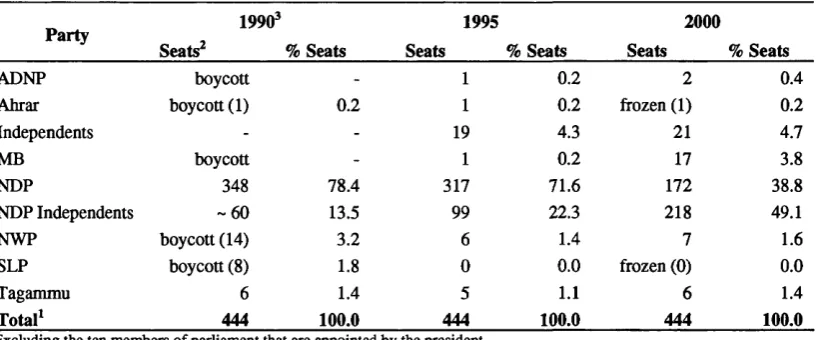
2.4 Results of the 1990,1995 & 2000 Majlis al-Shaab Elections 37
2.5 The Number of Candidates by Year & Political Affiliation, 1984 - 2000 43
2.6 Egyptian Parliamentary Election Results by Seat Totals & Seat Percentages,
1984-2000 45
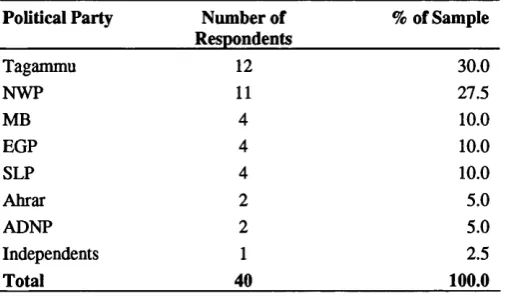
5.1 Interviewed Candidates by Party Affiliation & Parliamentary Experience 123
5.2 Interiviewed Candidates by Geographical Distribution 124
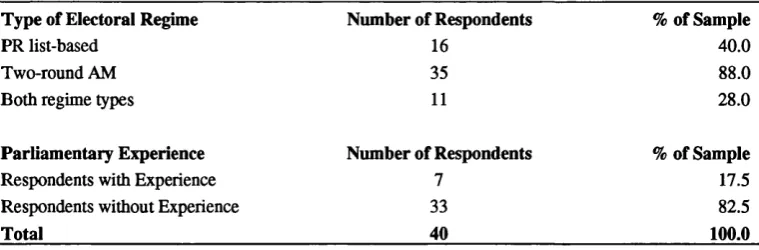
5.3 Interviewed Candidates by Type of Electoral Regime & Parliamentary
Experience 125
5.4 Types and Numbers of Party Respondents Interviewed 126
7.1 Distribution of Party Lists by Political Party & Electoral Districts 163
7.2 Elections of 1984: Competitive Constellations by Party, Govemorate & District 164
7.3 Elections of 1990,1995 & 2000: Number of Candidates by Party & District 168
7.4 Elections of 1990,1995 & 2000: Candidates by Party & District 170
8.1 Examples of District level Alliance Constellations by Party & Ideological
Position 195
9.1 Distribution of Electoral Symbols by Party in 1984 & 1987 222
9.2 Types of Electoral Labels used by Opposition Candidates 225
List of G raphs
2.1 Egypt’s Main Political Forces by Ideological Position 25
List of Illustrations
9.1 Examples of Candidate Posters 213
9.2 Examples of Candidate Leaflets & Fliers 215
9.3 Examples of Electoral Symbols & their Use 227
List of Acronyms
ACPSS Ahram Centre for Political and Strategic Studies
ACRT Almishkat Centre for Research and Training
ADNP Arab Democratic Nasserite Party
AM Absolute Majority
ASEP Arab Socialist Egypt Party
ASU Arab Socialist Union
AUC American University in Cairo
CEDEJ Centre d’Etudes et de Documentation Jurisdiques et Sociales
CHRLA Centre for Human Rights and Legal Aid
CP Centre Party
DGP Democratic Generation Party
DPP Democratic People’s Party
EGP Egyptian Green Party
ENISCR Egyptian National Institute for Sociological and Criminological Research
EOHR Egyptian Organisation for Human Rights
ERC Effective Recruitment Control
FP Future Party
FSCP Free Social Constitutional Party
GDD Group for Democratic Development
ICER Independent Commission for Electoral Review
IDEA Institute for Democracy and Election Assistance
MB Muslim Brotherhood
MENA Middle East and North Africa
MMD Multi-Member District
NAP National Accord Party
NDP National Democratic Party
NWP New Wafd Party
PFT Party Formation Threshold
PPC Political Parties Committee
PR Proportional Representation
RCD Rassemblement Constitutionel Democratique
see
Supreme Constitutional CourtSJP Social Justice Party
SLP Socialist Labour Party
SNTV Single Non-Transferable Vote
SP Solidarity Party
STV Single Transferable Vote
UDP Union Democratic Party
UP Umma Party
Acknowledgements
This PhD is dedicated to my parents, Hillegonda Magaretha and Paul Bemd Kratzschmar,
without whose continuous support and encouragement this project would have ever
materialised. It is also written in memory of my grandmother, Hendrika Alberts-Mulder, who
I miss so dearly.
The idea to this project was bom on a hot Egyptian summer day in 2000, when I was driving
to Alexandria in a packed car together with Mohamed Sherdi, a prominent Wafdist, his
entourage and an Ahrar journalist. Throughout the journey we were discussing the upcoming leadership contest at the NWP, which was necessitated by the sudden death of their long-time
leader Fouad Serrageddin. In the midst of our conversation, which also lead us to discuss the
electoral history of modem Egypt, Sherdi asserted that the position of parties in Egypt, and
particularly that of the opposition, had been far stronger in the 1980s than in the 1990s.
According to him this was by and large the result of the 1990 changes in the electoral law.
Whilst his argument seemed plausible, I was at first hesitant to think that electoral institutions
should matter at all in a regime that is little democratic and that is known for its blatant
manipulation of elections. At the same time, however, I was intreaged by the argument itself
and decided to look into this ‘proposed’ correlation in my further research. Little did I know
at the time that I would be spending the next four years investigating precisely this
relationship between electoral institutions and party development in Egypt. Its results are
finally present here in this PhD.
There are many people who were directly involved in this project or who, by virtue of their
friendship, supported me throughout the past five years. I particularly like to extend my
gratitude to Simon Hix who, as my supervisor, guided me with excellent academic advice
throughout all stages of this PhD. His persistent encouragement and keen interest in the
project have helped me over the years to push ahead with this research. My gratitude is also
extended towards Patrick Dunleavy and Hugh Roberts, who kindly agreed to supervise me
during the initial stages of my PhD. In this vein, I would also like to thank the institutional
sponsors of this PhD, most notably the LSE Ernest Gellner Memorial Fund and the British
Society for Middle Eastern Studies (BRISMES).
Finally, I would like to thank the many Egyptian respondents, who were willing to share their
experience and knowledge on the subject matter. Without their input, it would not have been
In this vein I would also like to mention my brother Christopher and his Egyptian wife Radwa.
Christoper decided to accompany me to Egypt in 2001 and stayed with me in Cairo for the
two years that I conducted field research in the country. It was a most memorable time, in
which we became inseparable brothers. His wife, whom he had met in Cairo and who is a
professional Arabic teacher, helped me enormously in the tedious task of translating all the in-
depth interviews that had been conducted in Arabic.
Last but not least I would like to thank all my friends, who endured me over the past five
years and who experienced all the minor and major hiccups of writing a PhD. My special
thanks go to Babken Babajanian, Barbara Plank, Olaya Hanashiro, Madalena Meyer-
Resendes, Heidi Matisonn, Nicolas Oberlin, Jonathon Gill, Christian Grobel, Eva-Maria Nag,
Introduction
This PhD explores the development of political parties in Egypt between 1981 and 2000
under the presidency of Husni Mubarak. The starting point of this investigation is the failure
of Egypt’s parties to develop cohesive organisations that carry strong electoral constituencies
in society. What we find instead are parties that - since the inception of multipartism in 1977
- remain characterised by their marginal role within the polity and politics of the state, that are
little entrenched in society and that expose an overall underdeveloped and often fragmented
internal structure.
What is more, not only have these parties remained persistently weak, but since the early
1990s they experienced a further weakening of their position as collective actors in the
Egyptian polity. Essentially, this weakening was manifest at both the electoral and
parliamentary levels. This becomes apparent when exploring their development across time,
which reveals that Egypt’s parties were far more vocal and visible in the electoral arena and
the legislatures of the 1980s than in those of the 1990s. During the latter decade, in fact, the
country’s main parties had become completely marginalised actors within these two domains
of politics.
As shall be illustrated below, this marginalisation was both numerical and substantive in
character. Numerically it was evident in two developments. First, it was manifest in a rather
significant decline in the number of political hopefuls that actually entered the electoral fray
on a party ticket and with it a simultaneous rise in the number of candidates who sought their
fortunes as so called ‘independents’. Second, it was observable in parliament, where the
number of MPs elected as independents rose significantly against the total number of MPs
that were elected on a party ticket. At a more substantive level this marginalisation of the
1990s was evident in the emergence of election campaigns that were characterised by a
preponderance of political entrepreneurship and a virtual absence of any meaningful
references to party labels, slogans and programmes. Together these developments were in fact
so pronounced that they prompted local commentators and scholars alike to describe the
current party system as being ‘in crisis’.
The little development of Egypt’s parties since 1977 stands, of course, in rather stark contrast
with the advance of party pluralism in other transitional contexts around the world. Here the
introduction of a formal multiparty framework in the course of democratic change usually
also brought about the gradual emergence of parties that are entrenched in society and that
transitions that took place during the 1980s and 1990s in the south and east of Europe, some
parts of South East Asia and most of Latin America. In most countries in these regions the
introduction of democracy and its consolidation over time bore witness to a gradual
strengthening of the role of political parties within the polity and society.
The question that hence arises is why the development of Egypt’s parties differed so
significantly from that observed in other transitional contexts worldwide. In other words one
is left to wonder why the introduction of a multiparty system in 1977 failed to bring about the
emergence of electorally-relevant and socially-entrenched parties. Instead we are left
pondering about the persistent weakness of these parties in general and their political
marginalisation of the 1990s in particular.
Leading on from there we also ought to explore, of course, what this marginalisation actually
means for the prospects of future political change in Egypt. Does it mean that in the near
future we cannot expect any push towards democracy in Egypt, given that its principal agents
are too weak to induce such changes? Or does it mean that we simply have to look elsewhere
when exploring the prospects for further democratic change, such as for example to the
governing National Democratic Party (NDP) and the generational struggles within it, to other civil society organisations or even to the international community? In this case then, parties as
agents for further political change would have to be discarded, and it is highly questionable
whether Egypt’s parties as they exist today would actually survive any democratic transition,
given their lack of involvement in it.
According to the transitional literature, political parties, and particularly those in opposition,
can of course play a pivotal role in fostering democratic change. Depending on their political
strength, this can either be achieved by pressuring the incumbent regime from outside the
institutional structure, for example through mass demonstrations and strikes, or through
entering negotiations with the moderate forces of the regime. This presupposes, of course,
that opposition parties have been allowed to operate in the polity and that they have attained
some bargaining leverage which enables them to push for such change.
In the Egyptian context, opposition parties have been allowed to participate in the political
process of the country at both the national and local level of government. In fact, since the
introduction of party pluralism under President Anwar Al-Sadat in 1977, a vast number of
multiparty elections have been held for the two chambers of the Egyptian legislature and for
the country’s local councils. In these elections opposition parties have participated vigorously,
never actually translated into a strengthening of their position within the political institutions
of the state and in society. Instead, since 1990 this participation was actually characterised by
a further weakening of parties in both these domains.
When reviewing the literature on current Egyptian politics, we encounter numerous
explanations as to why the country’s main political parties have remained so weak ever since
1977. By contrast, we come across little substantive research on why precisely their position
as collective actors has deteriorated so markedly in the course of the 1990s. As regards their
overall weakness, three explanations feature prominently. To begin with, it has been shown
that this weakness is a direct consequence of the highly restrictive political and legal
environment within which Egypt’s parties have been operating since 1977. It is pointed out
that the introduction of a multiparty system here - in contrast to other democratic transitions -
did not take place within the confines of a broader political transition towards fully fledged
democracy. Instead Egypt underwent a highly state-controlled and limited process of political
liberalisation that - whilst broadening some political and civil liberties - was never intended
to challenge the ultimate power of the incumbent elites. In this vein then, the emergence of
strong political parties and the prospects of power alternation between them were never
actually envisaged by the incumbent regime. Rather it sought to create a multiparty
framework that featured a majority regime-supportive party and a number of minor ‘docile’
opposition forces that were never meant to become strong political competitors in their own
right. To achieve this objective, the authorities essentially employed two tactics. First, they
put a plethora of legal restrictions in place that enabled them to control the licensing of new
parties and virtually all the operational activities of the existing ones. Second, and as is widely
known, they did not shy away from using extra-legal means to contain opposition inroads.
This, of course, is particularly apparent during election times, during which the Egyptian
authorities have regularly resorted to various forms of electoral fraud and intimidation.
In addition to this regime variable, two further explanations have been put forward in the
literature to account for the current weakness of Egypt’s parties. These concern the nature of
political affiliations among the Egyptian electorate on the one side and the internal
functioning of the country’s main political forces on the other. Regarding the former
explanation, for instance, it was found that voting patterns in Egypt have remained highly
personalised and little structured around functional party affiliations. In other words, the
electoral choice of voters, rather than being based on the ideological-programmatic proximity
between the elector and a certain party, tends to revolve around such personal factors as the
candidate’s membership of a certain local community, his or her professional background and
has been very difficult for Egypt’s parties to build up strong electoral constituencies along
ideological-programmatic lines among the country’s electorate. Consequentially then parties
are faced with not only institutional but also severe societal obstacles to build strong mass-
based organisations.
This failure has finally also been attributed to a number of internal troubles that have been
plaguing the day-to-day operations of virtually all parties in Egypt. These concern most
notably their overall poor record in practiced internal democracy, their scarce programmatic
clarity and their lack of cohesive internal structures. Together, these ‘internal illnesses’ so to
speak have constituted a major stumbling block for parties to strengthen their position in
society. This is the case because, above anything else, they have reinforced a perception
among the electorate that the country’s parties are not effective players in the political arena
and that they can hence not be treated as meaningful political alternatives to the incumbent
regime.
When it comes to explaining the further marginalisation of Egypt’s parties since 1990, we are
by contrast, confronted with a far less cohesive body of literature. To begin with, we should
acknowledge that little systematic attention has been given to this specific phenomenon, albeit
the fact that it is widely recognised within both the scholarly and political communities.
Second, when reviewing the existing literature we are also confronted with the fact that to this
day virtually no micro analysis has been conducted on the marginalisation of Egypt’s parties.
In fact, the most comprehensive studies on this subject matter can be found within larger
investigations of the socio-political and economic developments under the Mubarak
presidency. Within these studies the so called ‘deliberalisation hypothesis’ features
prominently. Basically this hypothesis posits that, whilst the 1980s saw a gradual expansion
of civil and political liberties, the 1990s were characterised by a significant contraction of
these liberties. According to the ‘deliberalisationists’, this contraction was regime-induced
and a consequence of two developments. First, it was caused by the Islamist insurgence of the
1990s, which the state sought to curtail with an iron fist. Second, it was caused by the need to
reform the Egyptian economy, which involved painful cuts into the social welfare system of
the state and which the authorities sought to push through with as little opposition as possible.
In concrete terms the regime-induced deliberalisation manifested itself in two domains.
Legally, it was manifest in a far more vigorous application of the existing restrictive legal
system by the Egyptian authorities and in the introduction of new restrictions on civil and
management of local and national-level elections and a far more intolerant attitude towards
opposition activism.
For Egypt’s parties, this deliberalisation was of course of bitter consequence. Indeed, as the
proponents of this hypothesis have shown, it further undermined their capacity to manoeuvre
within the political and societal spheres and thus to enhance their position as viable mass-
based parties in the Egyptian polity. What is more, the increasingly heavy-handed approach
taken by the state during election times, and its need to sustain crushing majorities in the
legislature, also reduced the country’s opposition representation in the chamber to negligible
levels. Consequentially, during the 1990s, Egypt’s parties became marginalised both at the
electoral and parliamentary levels.
This thesis agrees with the overall position taken by the deliberalisationists that the regime-
induced reduction of political and civil liberties severely undermined the capacity of parties to
develop into mass-based political organisations and that it significantly reduced their presence
within the central institutions of the state. In this sense then, the argument presented here
should be read within this train of thought. I argue, however, that we cannot sufficiently
understand the marginalisation of Egypt’s parties, if we look solely at the regime-induced
restrictions imposed on their operations and the more heavy-handed approach taken by the
authorities. Introducing the electoral system variable, this research will show instead that the
marginalisation of Egypt’s parties is in large measure also attributable to the changes that
occurred in the rules of the electoral game under the presidency of Mubarak. Put differently, I
claim here that electoral institutions mattered in the development of Egypt’s parties, and this
even under the restrictive regime conditions. As will become apparent below, this very fact
has received only scant attention by the deliberalisationists, who across the board seem to
have attached little significance to the role of formal electoral institutions in their analysis of
political developments under the Mubarak presidency.
Occurring in 1990, the institutional changes referred to here, basically entailed a shift from a
PR list-based regime in multimember constituencies to a two-round AM system in two-
member districts. In contrast to the other legal developments, this change was not however
directly regime-induced and hence not necessarily intended to aid the authorities in containing
opposition inroads. Rather, and as we shall see below, it was the result of a court-ruling that
challenged the constitutionality of the 1986 electoral law and that forced the authorities to
Particularly interesting in this regard is the fact that this challenge had been brought about and
strongly supported by Egypt’s main opposition forces, which had never shown any
enthusiasm for the list-PR regimes of the 1980s in the first place. In fact, throughout the
1980s there had been repeated calls by the country’s opposition to abolish the existing system
and to introduce a majoritarian electoral regime instead. They not only maintained that the
list-PR system was unconstitutional, but that in fact it was biased towards the ruling party and
that it hence left the opposition with no chance to gain any meaningful representation in
parliament (Al-Shaab, 19/07/1983; Koszinovski 1984: 347; Al-Wafd, 27/02/1986; Al-Ahali,
24/12/1986). Little did they know at the time that it was precisely under list-PR that the
opposition obtained its biggest electoral victories.
What is more, even the Egyptian authorities themselves believed at the time that the newly
introduced majoritarian electoral regime would have virtually no bearing on the nature of
party politics in general and the hegemony of the ruling party in particular. They hence saw
no dramatic effects in altering the rules of the electoral game. As Kassem writes:
‘...the reversion to the old electoral system was perhaps also the result of
President Mubarak’s eventual realisation that electoral laws were of little
significance when his consolidation of power provided him with other means,
such as patronage and electoral malpractice, to ensure that entry to the Assembly
remained stringently controlled’ (Kassem 1999: 61).
Drawing on the electoral connection literature, this thesis posits that neither Mubarak’s zero-
effect assertion, nor the opposition’s claim that they would fare better under a majoritarian
system were in the end correct. Instead it will demonstrate that the 1990 electoral system
change significantly altered the course of party development in Egypt and not for the better.
Rather than strengthening the role of parties in the electoral and parliamentary arenas, this
reform in fact contributed to a further weakening of their already feeble position in both these
domains of politics.
In concrete terms, this reform exerted two effects on patterns of party development. First, it
undermined the capacity of Egypt’s parties to foster an internally unified appearance at the electoral level. In short, it damaged internal unity. Second, it also severely reduced the parties’ prospects to enhance levels of visible representation during election times. Internal unity is here understood as the absence of any political behaviour by either party candidates or cadre that is damaging to the appearance of the party as a collective actor. At the electoral
the occurrence of internal dissent, campaigning methods that are conflictual rather than
cooperative and forms of electioneering that are personality - rather than party-driven. Visible representation is in turn defined as the extent to which there are agents and markers in place that convey party image and message during the election campaign. In the context of this
research, these agents and markers are identified as party candidates and their campaigning
materials.
As just mentioned, the reduction in both these dimensions of party development since 1990
was largely facilitated by changes to the Egyptian electoral law. In fact, it will be theorised
below that these changes altered the existing institutional framework in such a way that it
became far harder for party cadre to control their rank and file and for them to sustain a
nationwide presence in the electoral arena. By the same token, these changes also adversely
affected the capacity or willingness of party candidates to collectivise their activities under a
party umbrella and to campaign along partisan rather than personal lines. In so doing, these
changes thus significantly undermined the prominence of parties as viable collective actors in
the electoral arena, and consequentially contributed to their marginalisation in the Egyptian
polity.
It is important to emphasise however that, whilst the 1990 electoral reform is thought to
matter in the way alluded to above, it is certainly not treated here as the sole bearer of all the
illnesses that have been plaguing Egypt’s parties since 1977. In fact, doing so would
overstretch the explanatory capacity of this particular variable and undervalue the potency of
the other explanatory variables given in the literature. Without doubt the fundamental
weaknesses of Egypt’s parties should in the first instance be traced to the nature of the
Egyptian regime and the unstructured nature of society. It is also not claimed that this
institutional variable constitutes the only factor that has caused the observed marginalisation
of Egypt’s parties at the electoral and parliamentary levels. As mentioned above, this
marginalisation was probably the cause of a multiplicity of factors, most of which have been
succinctly discussed by the deliberalisationists. It is argued here, however, that too little
attention has been paid to the force of formal institutions and that of the electoral law in
particular; and that in fact this variable greatly contributed to the electoral marginalisation of
Egypt’s parties in the course of the 1990s. In this sense then, the argument presented here
ought to be read as an expansion of the deliberalisationist theory, rather than as a refutation of
it.
This latter fact leads on to another theoretical limitation that needs to be addressed here.
electoral level, this thesis refrains from investigating their effects on the nature of political
representation in the Egyptian legislature. In other words, it focuses on the so called
psychological or distal effects of electoral institutions, whilst discarding their mechanical or proximal effects. According to Lijphart ‘...the mechanical or proximal effects are simply the immediate effects of the translation of votes into seats in a particular election’ (Lijphart 1994:
70). The psychological effects by contrast relate to the strategic behaviour of party cadre,
candidates, activists and voters in the electoral arena. In other words, they concern the manner
in which electoral institutions affect the strategic decisions taken by this set of collective
actors. The collective actors of interest here are of course the party cadre and candidates.
The absence of any further investigation into the proximal effects of electoral institutions at this stage is justified by two considerations. To begin with, one should remember that the
claim presented here that electoral institutions matter even under non-democratic conditions is
both novel and daring. It is novel, because very few micro-analyses have hitherto explored the
relationship between electoral institutions, elite strategies and party development, certainly
not in the Egyptian case. It is daring, because there are so many imponderables that can
interfere in the proposed relationship, particularly within the context of illiberal regimes. As
mentioned above, these include most prominently the various legal restrictions imposed on
the operations of parties and the prevalence of outright electoral malpractice and fraud. Any
investigation of this kind thus has to carefully devise a theoretical framework that takes these
potentially intervening factors into consideration. Whilst it seems possible to contain the
distorting influence of these regime factors when exploring the distal effects of electoral
institutions, it seems far more difficult to do so when it comes to any analysis into their
proximal effects. In fact, the rampant use of electoral fraud and malpractice during parliamentary elections in Egypt renders it rather doubtful whether the analysis of election
results will deliver any meaningful results.
What is more, any analysis into the proximal effects of electoral institution is quantitative in nature. This means it requires a large number of N in order to make any meaningful inferences between the type of electoral provisions in place and levels of parliamentary
fractionalisation. Given that Egypt’s multiparty system has only experienced a total of six
parliamentary elections, it would have been necessary to investigate a larger number of
regional polities in order to increase the external validity.1 Whilst this is certainly conceivable
- and possibly even a promising avenue forward - it exceeded by far the scope of this
research the primary objective of which is to explain patterns of party development in Egypt.
It is for these two reasons then, that the following investigation will bracket out any further
investigation of the proximal effects of electoral institutions, and focus on the impact of the
distal effects on patterns of party development only.
The research thus defined is expected to contribute in two ways to the discipline of
Comparative Politics in general and that of Middle Eastern Studies in particular. In the first
instance it seeks to explain, of course, in longitudinal perspective, the electoral
marginalisation of Egypt’s parties under the presidency of Mubarak. In fact, by focusing on
the relationship between electoral institutions and party development, this PhD offers a rather
unique view into the workings of Egyptian party politics at the electoral level. To my
knowledge, it is the first study of its kind that, at the micro level and in comparative
perspective, explores the strategic behaviour of different party actors during the crucial phases
of the election calendar and their bearings on patterns of party development. Looked at from
this perspective, we are dealing with a rather classic single-case analysis, in which the onus of
investigation lies with the political phenomenon under scrutiny.
Although based on a single case, this thesis also claims, however, to carry broader theoretical
significance. Being exploratory in character, it seeks to test, in fact, whether we can expand
the existing electoral connection literature beyond the confines of western liberal democracies
to non-democratic regime contexts. In other words, it seeks to explore whether the hypotheses
developed in this field would yield any explanatory power when tested against evidence
drawn from these types of regimes. To my knowledge very few systematic attempts have
hitherto been undertaken to employ the wealth of theoretical knowledge that is available on
the distal and proximal effect of electoral regimes outside the democratic framework. In fact, as far as the Middle East and North Africa (MENA) region is concerned, I came across not a
single such attempt.
The reluctance within the discipline to explore the propensities of electoral institutions
probably has several root causes, two of which reign prominently. To begin with, scholars
have repeatedly uttered serious doubts that electoral institutions can develop their full
structuring potential under regime conditions that are non-democratic and fraudulent. Because
the electoral environment is not free and fair and the elections but a charade they see little
value in researching an institutional framework that in the end has no formal bearing on the
actual outcome. This is not to say, of course that there is no academic interest in elections
within the region. Yet these elections are usually explored through the prism of authoritarian
politics, their functions within non-democratic regimes and their implications for the future of
Second, this overall scepticism is also paired with the fact that it is difficult to obtain viable
and reliable data. As most scholars point out, in many countries of the MENA region it is
difficult, if not impossible, to obtain authoritative election results or to assess the extent to
which electoral malpractice distorted the outcome. What is more, given the difficult research
conditions in place and particularly the sensitivities of Arab regimes concerning electoral
matters, it has not been easy for scholars to generate reliable knowledge on the subject matter.
Indeed, in many Arab regimes, a plethora of restrictions are in place that make it very difficult
for academics to carry out large-scale interviews and surveys, which are of course necessary
to explore the distal effects of electoral institutions.
Viewed in this light then, this research provides a first testing ground for the possible
expansion of institutional analysis to the study of socio-political processes in the Arab world.
What is more, if successful, we may become far more inclined to expand such analyses to
other non-democratic regimes in the Arab region or even elsewhere in the world. In other
words, it would then be possible to verify the theoretical propositions developed here against
evidence drawn from a wider cross-national comparison.
The research itself is composed of nine substantive chapters. Chapter two provides the
necessary background information to comprehend the narrative at hand. To this end it
recounts the history of multipartism and of parliamentary elections in Egypt under the
presidencies of Sadat and Mubarak. It also gives an overview of the major parties in the
country and the various weaknesses that have been plaguing their existence ever since the
inception of multipartism in 1977. Most importantly however, this chapter substantiates the
central phenomenon under investigation, namely the further electoral marginalisation of
Egypt’s political parties after 1990. It thus discusses in greater detail the various empirical
manifestations of this marginalisation.
Reviewing the existing literature, chapter three then critically reflects upon the different
explanations that have been put forward within academia to account for the weakness of
Egypt’s parties in general and their electoral marginalisation in particular. It will hereby be
shown that of all explanatory variables discussed, the 1990 electoral reform has received
dismally little systematic attention in explaining the phenomenon under scrutiny.
Chapter four establishes the theoretical argument in support of the central proposition made
here, namely that the marginalisation of Egypt’s parties was greatly influenced by the 1990
electoral system change. To this effect, a number of hypotheses are developed that link the
presents the design and methodology used as well as the empirical data generated for the
subsequent hypotheses test.
The actual empirical investigation and its findings are presented in chapters six, seven, eight
and nine. Together these chapters hence verify the electoral connection hypotheses
established in chapter four, testing whether - as anticipated - the 1990 electoral reform indeed
contributed to the marginalisation of Egypt’s parties. Drawing together the essential findings
of this research, the conclusion then presents a number of possible avenues for further fruitful
PART I: BACKGROUND, THEORY AND METHODOLOGY
Chapter Two. Patterns of Party Development under the Mubarak Presidency
As in most Arab polities, the turn to multiparty elections in Egypt and the evolution of party
politics since then took place within the confines of a political regime that never transgressed
the stage of limited political liberalisation towards fully fledged democratisation. Under this
regime, the emerging parties - and particularly those in opposition - were never meant to
become the principal players in the political process of the country. Instead it was the
regime’s intent to retain these forces at the margins of the political spectrum, granting them
only a bare minimum of political participation and institutional representation. So for instance,
whilst a plurality of parties have been allowed to enter the electoral fray, it has always been
clear that their participation would never challenge the hegemony of the regime and its vassal
party, the ruling NDP, let alone produce the possibility of power alternation. What is more,
the Egyptian regime has ensured that all major executive institutions of the state remain
entirely off-limits for any form of party political competition. These include most notably the
presidency of the country, the national executive and the govemorate and local
administrations.2
To sustain this marginal role of parties within the polity - and particularly that of the
opposition - Egypt’s authorities have resorted to various legal and extra-legal means that
effectively bar parties from developing strong mass-based organisations. As will be illustrated
elsewhere, to this day numerous legal restrictions are in place that impede the licensing of
new political parties and that severely hamper the operations of the existing ones. As regards
the operations of parties, for instance, numerous restrictions are in place that delimit the
activities they can pursue, the political issues they can address in public and the types of
gatherings they can organise outside party premises. They also render it very difficult for
parties to create any associational linkages with other sectoral groups in society. In addition to
these legal restrictions the Egyptian authorities have regularly resorted to various extra-legal
means to keep the political opposition at bay. These include most notably the use of electoral
intimidation and malpractice during election times and outright electoral fraud on polling day.
Given this regime context, it is hardly surprising that in the course of the past two decades
Egypt’s parties have not been able to develop into cohesive mass-based organisations as we
have come to know them in liberal democracies. What we encounter instead are parties that
remain politically marginalised, as intended by the Egyptian authorities, that carry no roots in
society and that remain organisationally underdeveloped. This applies of course particularly
to the country’s legalised opposition, which has been the primary target of these regime
restrictions. As we shall see it also applies, however, in some measure to the ruling party itself,
which was never meant to become a political force in its own right. Instead it was conceived
of by the regime as a vassal organisation that serves little purpose but to create the legislative
majorities necessary to control access to the executive institutions of the state and to ensure
the smooth passage of parliamentary legislation.
Having said this, however, it would be incorrect to assume that this overall weakness
precluded any party political developments since 1977. In fact, as posited in the introduction,
a closer observation of developments since then reveals that Egypt’s parties experienced
significant changes in their performance as collective actors between the 1980s and 1990s.
These changes concerned primarily their visibility and appearance at the electoral level, yet
they also concerned their representation in the national legislature, henceforth referred to as
the Majlis al-Shaab (People’s Assembly).
This chapter examines the empirical evidence that informs precisely this latter observation.
To this effect it explores in greater detail the quantitative and qualitative changes that
characterised the performance of Egypt’s major parties at the electoral and the parliamentary
levels between the 1980s and 1990s. Before doing so, however, this chapter will provide a
brief historical recount of the turn to and evolution of multiparty politics since 1977. It is the
purpose of this exercise to provide sufficient contextual information in order to inform the
narrative of the analysis at hand. The chapter will then move on to discuss the overall state of
Egypt’s main political parties, pointing at the various weaknesses that have been plaguing
their existence since the inception of multiparty elections in 1979. This is done to clearly
identify the parameters within which one is to understand the observed changes in the
development of Egypt’s parties over time.
The chapter is divided into three sections. Section 2.1 recounts the historical evolution of
party and electoral politics since 1977. Section 2.2 then sketches a preliminary picture of the
overall state of party politics in the country. Section 2.3 finally fleshes out the so called
‘marginalisation’ hypothesis, thus providing the empirical evidence that informed the
Finally, because this chapter contains various electoral statistics it is neccesary to briefly
comment on the sources of data used here. A more extensive elaboration of the primary data
used within the overall framework of this research will of course be given in the methodology
chapter. The electoral data presented in the subsequent sections is drawn from a number of
secondary sources and this because there are no reliable official publications that one could
draw upon. This fact applies to both the election results presented in Section 2.1 and the
number of parliamentary candidates presented in Section 2.3. Moreover, because the available
data is often contradictory - and this particularly concerning the number of candidates by
elections - it is also important that the numbers presented here should be read as
approximations of the real figures, rather than as authoritative data. The secondary sources of
literature employed here and in the subsequnt chapters are listed below the respective tables.
2.1 Multiparty Politics since 1977
The introduction of a multiparty system in Egypt essentially took the shape of a state-
orchestrated process, in which not only the pace and magnitude but also the very nature of the
emerging party system were determined by the then President Sadat. Looking back, it is fair
to say that the early multiparty configuration was entirely Sadat’s creation, designed on the
political drawing board of the president, rather than being the expression of emerging societal
cleavages. Indeed, between 1977 and 1981 all but one out of the five parties legalised at the
time were established either by presidential decree or with his personal encouragement (Zaki
1995: 76; Kassem 1999: 40-42). As we shall see, it was only under his successor Mubarak,
who ascended to power in 1981, that further parties emerged which had not been directly
created from above.
As of today, Egypt’s multiparty system is composed of eighteen legalised political parties.3
Most of them are, however, minor forces that lack any organisational structure outside the
capital city, that carry no constituency base whatsoever, and that have never actually attained
any representation in parliament. Only six of the currently existing parties can claim to have
gained some prominence in the political arena since 1977, and this primarily because they
have at one point or the other been represented in the Majlis al-Shaab. They include all five parties established under the Sadat presidency and another party that came into existence in
the early 1990s. The five parties established under Sadat are the ruling NDP, the National
Progressive Union Party (commonly referred to as Tagammu4), the Socialist Liberal Party
(commonly referred to as Ahraf), the Socialist Labour Party (SLP) and the New Wafd Party
(NWP).6 The sixth party with some political clout is the Arab Democratic Nasserite Party
(ADNP), which was legalised in 1992. In addition to these six parties one also ought to add
the Islamist Muslim Brotherhood (MB) to the forces with some political influence, depite the fact that the authorities have repeatedly refused the group legal status as a political party.
Nevertheless, as we will see below, during the Mubarak presidency the MB was allowed to
participate in electoral politics alongside the established parties and also made some inroads
into the legislatures of 1984,1987,1995 and 2000.
Politically these seven main political forces represent vastly different ideologies, which have
been graphically depicted in the two-dimensional axes presented below. This axis, although
not exhaustive, carries the two fundamental dividing lines of Egyptian politics. On the
horizontal axis it features an economically-defined left-right divide and on the vertical axis
the secular - islamist divide. In line with its ‘catch-all’ character the NDP radiates around the
centre of the two-dimensional axis (Kassem 1999: 77). Both Tagammu and the ADNP must
in turn be positioned in the upper left-hand field of the axis, whilst the liberal Ahrar and the
NWP are to be positioned in the upper-right hand field of the axis. Classified as an Islamist
party with socialist roots, the SLP is currently probably best positioned in the lower left-hand
field, whilst the MB must be placed in the lower-right hand field of the two dimensional axis
(Tachau 1994: 116,118,123,124,129).
4 ‘Tagammu ’ is the Arabic term for grouping. 5 ‘Ahrar’ is the Arabic term for liberal.
Graph 2.1: E gypt’s Main P olitical Forces by Ideological Position
Secular
ADNP
Left
<-Tagammu
SLP (’7 8 - ‘86)
SLP (‘87-)
NDP NWP
Ahrar
"► Right
MB
Islamist
Source: Own elaboration on the basis of Tachau’s discussion of party platforms in Egypt. See: Tauchau, Frank, ed. 1994. Political Parties o f the Middle East and North Africa. Mansell, pp. 103-132.
It is important to keep in mind however that, whilst indicative of the parties’ ideological
position, this graph represents little more than a crude sketch of the party political spectrum as
it has presented itself under the Mubarak presidency, and this for two reasons. First, and as
will become apparent in chapter three, several of the parties are ideologically far more
heterogeneous than can be depicted here. Take for instance Tagammu or the NDP which are
known to incorporate a diverse spectrum of political currents. Tagammu for that matter
contains amongst others a Marxist, Socialist, Arab nationalist and enlightened Islamist trend
(Hendriks 1983: 262; Tachau 1994: 118). Also, as indicated in the graph, some of Egypt’s
parties have shifted in ideological postion over time. This, for instance, has been the case with
the SLP, which in the mid-1980s shifted from a socialist to an Islamist political outlook
(Singer 1993: 25-31).
The return to multiparty politics itself and the dissolution of the Arab Socialist Union (ASU) was triggered off in 1974, when Sadat announced major economic and political reforms in
what came to be known as the ‘October Paper’ (Waterbury 1983: 365). According to Zaki, the
introduction of a multiparty framework was essentially viewed by Sadat as a means to
channel:
‘...growing participatory demands, while still maintaining control. Besides
lending greater legitimacy to his regime and enhancing its stability, a multiparty
political opening was not brought about as a consequence of mass pressure from
below, but by a deliberate decision from above by the ruling elite who believed
that they could indefinitely maintain a monopoly of power by way of a
hegemonic party’ (Zaki 1995: 77).
This viewpoint is also shared by Tachau, who further elaborates on the restrictive conditions
within which the newly established party system was to function. Discussing Sadat’s
reasoning behind the dissolution of the ASU and the creation of a multiparty system, he
maintains that:
‘Sadat’s purpose seems to have been to construct a loyal opposition. This would
bring dissent out into the open where it could be observed. The opposition would
be robbed of a common focus for its complaints, and the latent divisions among
Marxists, Islamists and nationalists would quickly manifest itself. The ability of
these groups to organise a mass following would be sharply restricted. They
would be allowed a voice but no influence. Should they become either too
strident or too popular [then] the repressive tools of the state could be brought to
bear once again’ (Tachau 1994: 99).
Between 1974 and 1976 Sadat then encouraged a vigorous public debate on the future of
Egypt’s political system and with it that of the ruling ASU. Essentially, it centred on the
question of whether or not the one-party state should be dismantled all together in favour of a
multiparty system or whether, less drastically, the ASU itself should be opened to some form
of internal pluralism. In March 1976 the ASU Committee charged with discussing political
reform, opted against the creation of political parties and in favour of the establishment of so
called platforms, or manabir, within the framework of the ASU. Although around forty tendencies requested legal recognition as minbar, Sadat eventually allowed only three platforms to be legalised and to contest the subsequent parliamentary elections in late 1976
(Waterbury 1983: 365-366; Tachau 1994: 98 - 99)? A centrist platform, called the Egyptian Arab Socialist minbar was to become the dominant political force, supported by the president and led by then Prime Minister Mamdouh Salem. The two opposition platforms were located
to the right and left of the ruling centre respectively. Mustafa Kamel Murad was to lead the so
called Socialist-Liberal platform to the right and Khaled Mohieddin a National-Progressive
platform to the left. Shortly after the elections Sadat then decreed the transformation of these
platforms into political parties and the dissolution of the ASU. The leftist platform came
henceforth to be known as Tagammu, the right as Ahrar and the centre as the Arab Socialist Egypt Party (ASEP) (Al-Din & Khalil, Al-Ahram Weekly, 12 - 18/10/1995).
The formal transition from a single- to a multiparty framework then followed in 1977 with the
enshrinement of ‘party pluralism’ into Article five of the Egyptian constitution and the
enactment of the Political Parties’ Law No. 40/77.8 This law also stipulated the creation of an
essentially government-controlled body, the Committee for the Affairs of Political Parties, or
the so called Political Parties Committee (PPC). Essentially the PPC was established by the regime in order to regulate and control the licensing of new political parties and the
operations of the existing ones (Zaki 1995: 75-76; Kienle 2001: 28 - 29; Kassem 2004: 54).9
On the basis of Law No. 40/77 three new political forces entered the Egyptian political scene
in 1978. First, the PPC granted legal status to the NWP. Immediately after its legalisation,
however, this party had to freeze all its activities, due to a presidential decree prohibiting pre
revolutionary politicians from playing any active role in politics. Obviously, this decree
targeted primarily the Wafdist leadership and thus the newly found NWP, which Sadat came
to view as a major challenge to the political pre-dominance of the ASEP (Waterbury 1983:
369; Baaklini et al. 1999: 228). The party only sprang back to life in 1983, after an
Administrative Court ruling discharged the PPC’s demand that the NWP should re-apply for
an operating licence.
The two other parties formed at the time were again presidential creations. Dissatisfied with
the performance of the ruling ASEP in the face of mounting opposition challenges from
Tagammu and the NWP, Sadat established his own political party, the NDP. Hereby the
president sought to tighten his power over the former single party and ensure its dominant
position within the polity. Immediately after its creation an overwhelming majority of MPs,
originally voted in on an ASEP ticket, rallied behind the new presidential party, turning it
virtually over night into the hegemonic parliamentary force it has remained ever since.10 At
the same time Sadat decreed the merger between the two centrist parties. Salem, who had
resigned as ASEP chairman in protest of this merger, filed a lawsuit in 1981 to re-establish
8 Article five of the 1977 Egyptian Constitution states: ‘The political system o f the Arab Republic of Egypt is based on pluralism of political parties’ (Ministry of Interior 1999, The Arab Republic of Egypt Constitution and its Main Supplementary Laws).
9 The PPC is a subsidiary of the Upper House of Parliament, the so called Majlis al-Shura (Consultative Chamber). According to article eight of the Political Parties’ Law No. 40/77 it is composed of three government ministers -the Ministers of Parliamentary Affairs, Justice and Interior - and three senior judges, who are appointed by -the President. It is presided over by the speaker of the Majlis al-Shura (Political Parties’ Law No. 40/77).
the independence of the ASEP, which he won after a lengthy court battle with the NDP in
1991 (Allam, Al-Ahram Weekly, 23 - 29/11/1995).
Next to the formation of the NDP, Sadat also encouraged his then Minister of Agriculture
Ibrahim Shukri to establish a further regime-supportive opposition party to the left, the SLP.11
The president had deemed this step necessary after relations between him and Tagammu had
deteriorated in the wake of the 1977 bread riots for which he blamed the party alongside
Communist and Nasserite forces. Following its creation however, the SLP developed a
dynamic running counter to the role of a ‘loyal opposition’, as envisioned by Sadat. In fact the
party quickly established itself as a vocal critic of Sadat’s administration, denouncing the
1979 Peace Treaty with Israel and other government policies (Waterbury 1983: 370, 372). By
1987, hence under the tenure of President Mubarak, the party had shifted even further in
ideological outlook from a socialist to an Islamist party. The increasing radicalisation of the
SLP under its Secretary-General Adel Hussein, and a subsequent rift between Islamist and
leftist members of the party eventually caused the PPC to freeze its activities shortly before
the 2000 parliamentary poll (Singer 1993: 25-31; Khalil et al. 2003).
During the tenure of Sadat a total of two pluralist elections were held for the Majlis al-Shaab.
The first of these elections took place in 1976 and the second in 1979. Both of these elections
were conducted under a two-round absolute majority (AM) system in 175 two-member
districts. The chamber itself was composed of 350 directly elected seats in 1976 and 372 seats
in 1979. Under both assemblies an additional ten seats were appointed by the president
(Nohlen et al. 1999: 332, 343). Finally, in what may best be described as a socialist legacy of
the Nasser era, the Egyptian law since 1964 also mandated that half of the assembly be
composed of ‘farmer’ and ‘worker’ representatives.12 To facilitate this demand, both the 1976
and 1979 electoral codes, as well as all subsequent electoral laws, put provisions in place that
ensured that half of the elected deputies are drawn from these two professions. Under the two-
round AM system of the 1970s, this was done by reserving one of the two district seats for
these professional categories (Munoz 1992: 272-273). Political hopefuls entering the electoral
race hence had to decide under which professional category, and hence for which district seat
they were contesting the election. They then had to provide evidence to the registration
authorities that they indeed qualified to run under the selected professional category.
11 The party was actually created with the active involvement of President Sadat, who ‘borrowed’ twenty MPs of his own political party to Shukri and who signed its founding documents (Waterbury 1983: 364ff.).
As will become apparent below, this particular provision of the Egyptian constitution and its
application in each of the past electoral laws is of relevance because it significantly affected
the nature of election campaigning in the 1990s.
The 1976 elections took place shortly after the creation of the three political platforms within
the framework of the ASU. They were hence contested by these platforms and a host of
independent candidates, which for the first time since 1952 had been allowed to run for
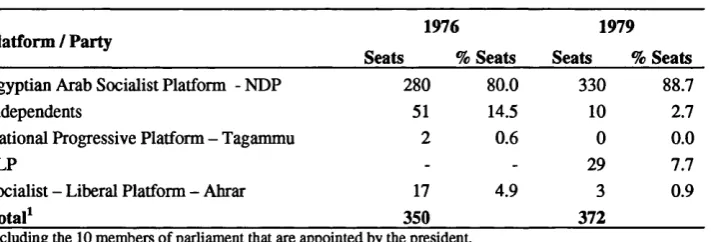
parliamentary elections. As table 2.1 illustrates, these elections produced a sound majority for
the centre platform, which won a total of 280 seats. Ahrar won seventeen seats and Tagammu
[image:31.595.27.383.314.435.2]two, whilst independents gained fifty-one seats.13
Table 2.1: Results of the 1976 & 1979 Majlis al-Shaab Elections
1976 1979
Platform / Party
________________________________________ Seats_____ % Seats Seats % Seats
Egyptian Arab Socialist Platform - NDP 280 80.0 330 88.7
Independents 51 14.5 10 2.7
National Progressive Platform - Tagammu 2 0.6 0 0.0
SLP - - 29 7.7
Socialist - Liberal Platform - Ahrar 17 4.9 3 0.9
Total1 350 372
Excluding the 10 members of parliament that are appointed by the president.
Sources: Zaki, Moheb. 1995. Civil Society and Democratisation in Egypt. Cairo: Konrad Adenauer Foundation & Ibn Khaldoun Centre, p. 80. Nohlen, Dieter, Michael Krennrich, and Bernhard Thibaut. 1999. Elections in Africa: A Data Handbook. Oxford University Press, p. 343.
The second Majlis al-Shaab elections were then organised in 1979, hence after the transformation of the political platforms into distinct political parties and after the formation
of the NDP and the SLP. Again they were contested by all legalised political parties in
addition to a large number of independent candidates. And as in 1976, the ruling party won a
resounding victory, claiming this time a total of 330 out of the 372 parliamentary seats. The
newly founded SLP became the second strongest parliamentary force with twenty-nine seats,
followed by independent candidates with ten and Ahrar with three seats only. Tagammu,
which had also contested the elections, failed to gain any representation in parliament (Zaki
1995: 80). Shortly after the 1979 elections, in 1981, Sadat was assassinated and succeeded by
his Vice-President Husni Mubarak, who has been ruling the country since then.