Semi-Supervised Training for Statistical Word Alignment
Alexander Fraser
ISI / University of Southern California 4676 Admiralty Way, Suite 1001
Marina del Rey, CA 90292 [email protected]
Daniel Marcu
ISI / University of Southern California 4676 Admiralty Way, Suite 1001
Marina del Rey, CA 90292 [email protected]
Abstract
We introduce a semi-supervised approach to training for statistical machine transla-tion that alternates the traditransla-tional Expecta-tion MaximizaExpecta-tion step that is applied on a large training corpus with a discriminative step aimed at increasing word-alignment quality on a small, manually word-aligned sub-corpus. We show that our algorithm leads not only to improved alignments but also to machine translation outputs of higher quality.
1 Introduction
The most widely applied training procedure for statistical machine translation — IBM model 4 (Brown et al., 1993) unsupervised training fol-lowed by post-processing with symmetrization heuristics (Och and Ney, 2003) — yields low quality word alignments. When compared with gold standard parallel data which was manually aligned using a high-recall/precision methodology (Melamed, 1998), the word-level alignments pro-duced automatically have an F-measure accuracy of 64.6 and 76.4% (see Section 2 for details).
In this paper, we improve word alignment and, subsequently, MT accuracy by developing a range of increasingly sophisticated methods:
1. We first recast the problem of estimating the IBM models (Brown et al., 1993) in a dis-criminative framework, which leads to an ini-tial increase in word-alignment accuracy. 2. We extend the IBM models with new
(sub)models, which leads to additional in-creases in word-alignment accuracy. In the process, we also show that these improve-ments are explained not only by the power
of the new models, but also by a novel search procedure for the alignment of highest prob-ability.
3. Finally, we propose a training procedure that interleaves discriminative training with max-imum likelihood training.
These steps lead to word alignments of higher accuracy which, in our case, correlate with higher MT accuracy.
The rest of the paper is organized as follows. In Section 2, we review the data sets we use to validate experimentally our algorithms and the as-sociated baselines. In Section 3, we present itera-tively our contributions that eventually lead to ab-solute increases in alignment quality of 4.8% for French/English and 4.8% for Arabic/English, as measured using F-measure for large word align-ment tasks. These contributions pertain to the casting of the training procedure in the discrim-inative framework (Section 3.1); the IBM model extensions and modified search procedure for the Viterbi alignments (Section 3.2); and the in-terleaved, minimum error/maximum likelihood, training algorithm (Section 4). In Section 5, we as-sess the impact that our improved alignments have on MT quality. We conclude with a comparison of our work with previous research on discriminative training for word alignment and a short discussion of semi-supervised learning.
2 Data Sets and Baseline
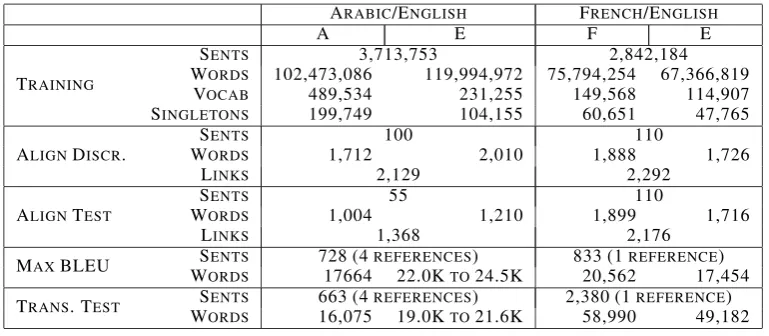
We conduct experiments on alignment and translation tasks using Arabic/English and French/English data sets (see Table 1 for details). Both sets have training data and two gold stan-dard word alignments for small samples of the training data, which we use as the alignment
ARABIC/ENGLISH FRENCH/ENGLISH
A E F E
TRAINING
SENTS 3,713,753 2,842,184
WORDS 102,473,086 119,994,972 75,794,254 67,366,819 VOCAB 489,534 231,255 149,568 114,907
SINGLETONS 199,749 104,155 60,651 47,765
ALIGNDISCR.
SENTS 100 110
WORDS 1,712 2,010 1,888 1,726
LINKS 2,129 2,292
ALIGNTEST
SENTS 55 110
WORDS 1,004 1,210 1,899 1,716
LINKS 1,368 2,176
MAXBLEU WSORDSENTS 728 (417664REFERENCES22.0KTO)24.5K 833 (120,562REFERENCE17,454)
[image:2.595.106.491.61.229.2]TRANS. TEST WSORDSENTS 663 (416,075REFERENCES19.0KTO)21.6K 2,380 (158,990REFERENCE49,182)
Table 1: Datasets
SYSTEM F-MEASUREFTOE F-MEASUREETOF F-MEASUREBESTSYMM. A/E MODEL4: ITERATION4 65.6 / 60.5 53.6 / 50.2 69.1 / 64.6 (UNION) F/E MODEL4: ITERATION4 73.8 / 75.1 74.2 / 73.5 76.5 / 76.4 (REFINED)
Table 2: Baseline Results. F-measures are presented on both the alignment discriminative training set and the alignment test set sub-corpora, separated by /.
discriminative training set and alignment test set. Translation quality is evaluated by translating a held-out translation test set. An additional translation set called the Maximum BLEU set is employed by the SMT system to train the weights associated with the components of its log-linear model (Och, 2003).
The training corpora are publicly avail-able: both the Arabic/English data and the French/English Hansards were released by LDC. We created the manual word alignments ourselves, following the Blinker guidelines (Melamed, 1998).
To train our baseline systems we follow a stan-dard procedure. The models were trained two times, first using French or Arabic as the source language and then using English as the source language. For each training direction, we run GIZA++ (Och and Ney, 2003), specifying 5 iter-ations of Model 1, 4 iteriter-ations of the HMM model (Vogel et al., 1996), and 4 iterations of Model 4. We quantify the quality of the resulting hypothe-sized alignments with F-measure using the manu-ally aligned sets.
We present the results for three different con-ditions in Table 2. For the “F to E” direction the models assign non-zero probability to alignments consisting of links from one Foreign word to zero or more English words, while for “E to F” the models assign non-zero probability to alignments
consisting of links from one English word to zero or more Foreign words. It is standard practice to improve the final alignments by combining the “F to E” and “E to F” directions using symmetriza-tion heuristics. We use the “union”, “refined” and “intersection” heuristics defined in (Och and Ney, 2003) which are used in conjunction with IBM Model 4 as the baseline in virtually all recent work on word alignment. In Table 2, we report the best symmetrized results.
The low F-measure scores of the baselines mo-tivate our work.
3 Improving Word Alignments
3.1 Discriminative Reranking of the IBM Models
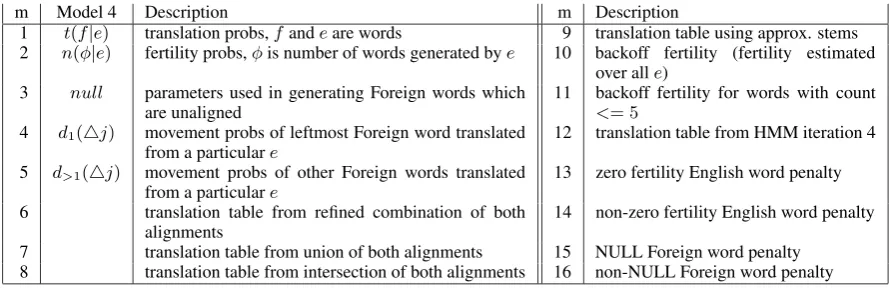
We reinterpret the five groups of parameters of Model 4 listed in the first five lines of Table 3 as sub-models of a log-linear model (see Equation 1). Each sub-modelhmhas an associated weightλm.
Given a vector of these weightsλ, the alignment
search problem, i.e. the search to return the best alignmentˆaof the sentenceseandf according to
the model, is specified by Equation 2.
pλ(f, a|e) = exp(
P
iλihi(a, e, f))
P
a0,f0exp(
P
iλihi(a0, e, f0))
(1)
ˆ
a= argmax a
X
i
m Model 4 Description m Description
1 t(f|e) translation probs,fandeare words 9 translation table using approx. stems
2 n(φ|e) fertility probs,φis number of words generated bye 10 backoff fertility (fertility estimated
over alle)
3 null parameters used in generating Foreign words which
are unaligned 11 backoff fertility for words with count<= 5
4 d1(4j) movement probs of leftmost Foreign word translated from a particulare
12 translation table from HMM iteration 4
5 d>1(4j) movement probs of other Foreign words translated
from a particulare
13 zero fertility English word penalty
6 translation table from refined combination of both
alignments 14 non-zero fertility English word penalty 7 translation table from union of both alignments 15 NULL Foreign word penalty
[image:3.595.76.521.61.205.2]8 translation table from intersection of both alignments 16 non-NULL Foreign word penalty
Table 3: Sub-Models. Note that sub-models 1 to 5 are IBM Model 4, sub-models 6 to 16 are new.
Log-linear models are often trained to maxi-mize entropy, but we will train our model di-rectly on the final performance criterion. We use
1−F-measure as our error function, comparing
hy-pothesized word alignments for the discriminative training set with the gold standard.
Och (2003) has described an efficient exact one-dimensional error minimization technique for a similar search problem in machine translation. The technique involves calculating a piecewise constant function fm(x) which evaluates the
er-ror of the hypotheses which would be picked by equation 2 from a set of hypotheses if we hold all weights constant, except for the weightλm(which
is set tox).
The discriminative reranking algorithm is ini-tialized with the parameters of the sub-modelsθ,
an initial choice of the λ vector, gold standard
word alignments (labels) for the alignment dis-criminative training set, the constant N specifying the N-best list size used1, and an empty master set
of hypothesized alignments. The algorithm is a three step loop:
1. Enrich the master set of hypothesized align-ments by producing an N-best list using λ.
If all of the hypotheses in the N-best list are already in the master set, the algorithm has converged, so terminate the loop.
2. Consider the currentλvector and 999
addi-tional randomly generated vectors, setting λ
to the vector with lowest error on the master set.
3. Repeatedly run Och’s one-dimensional error minimization step until there is no further er-ror reduction (this results in a new vectorλ).
1N = 128for our experiments
3.2 Improvements to the Model and Search 3.2.1 New Sources of Knowledge
We define new sub-models to model factors not captured by Model 4. These are lines 6 to 16 of Table 3, where we use the “E to F” align-ment direction as an example. We use word-level translation tables informed by both the “E to F” and the “F to E” translation directions derived us-ing the three symmetrization heuristics, the “E to F” translation table from the final iteration of the HMM model and an “E to F” translation table de-rived using approximative stemming. The approx-imative stemming sub-model (sub-model 9) uses the first 4 letters of each vocabulary item as the stem for English and French while for Arabic we use the full word as the stem. We also use sub-models for backed off fertility, and direct penal-ization of unaligned English words (“zero fertil-ity”) and aligned English words, and unaligned Foreign words (“NULL-generated” words) and aligned Foreign words. This is a small sampling of the kinds of knowledge sources we can use in this framework; many others have been proposed in the literature.
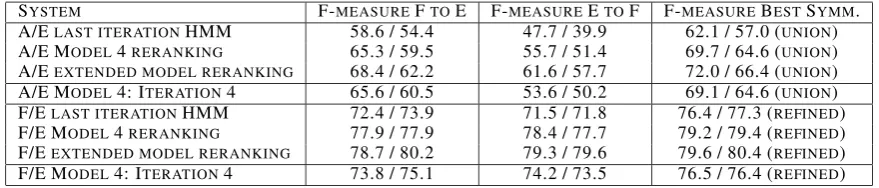
Table 4 shows an evaluation of discriminative reranking. We observe:
1. The first line is the starting point, which is the Viterbi alignment of the 4th iteration of HMM training.
2. The 1-to-many alignments generated by dis-criminatively reranking Model 4 are better than the 1-to-many alignments of four itera-tions of Model 4.
SYSTEM F-MEASUREFTOE F-MEASUREETOF F-MEASUREBESTSYMM.
A/ELAST ITERATIONHMM 58.6 / 54.4 47.7 / 39.9 62.1 / 57.0 (UNION)
A/E MODEL4RERANKING 65.3 / 59.5 55.7 / 51.4 69.7 / 64.6 (UNION)
A/EEXTENDED MODEL RERANKING 68.4 / 62.2 61.6 / 57.7 72.0 / 66.4 (UNION)
A/E MODEL4: ITERATION4 65.6 / 60.5 53.6 / 50.2 69.1 / 64.6 (UNION)
F/ELAST ITERATIONHMM 72.4 / 73.9 71.5 / 71.8 76.4 / 77.3 (REFINED)
F/E MODEL4RERANKING 77.9 / 77.9 78.4 / 77.7 79.2 / 79.4 (REFINED)
F/EEXTENDED MODEL RERANKING 78.7 / 80.2 79.3 / 79.6 79.6 / 80.4 (REFINED)
[image:4.595.78.518.62.156.2]F/E MODEL4: ITERATION4 73.8 / 75.1 74.2 / 73.5 76.5 / 76.4 (REFINED)
Table 4: Discriminative Reranking with Improved Search. F-measures are presented on both the align-ment discriminative training set and the alignalign-ment test set sub-corpora, separated by /.
4. The discriminatively reranked extended model outperforms four iterations of Model 4 in both cases with the best heuristic symmetrization, but some of the gain is lost as we are optimizing the F-measure of the 1-to-many alignments rather than the F-measure of the many-to-many alignments directly.
Overall, the results show our approach is better than or competitive with running four iterations of unsupervised Model 4 training.
3.2.2 New Alignment Search Algorithm Brown et al. (1993) introduced operations defin-ing a hillclimbdefin-ing search appropriate for Model 4. Their search starts with a complete hypothesis and exhaustively applies two operations to it, selecting the best improved hypothesis it can find (or termi-nating if no improved hypothesis is found). This search makes many search errors2. We developed
a new alignment algorithm to reduce search errors:
• We perform an initial hillclimbing search (as
in the baseline algorithm) but construct a pri-ority queue of possible other candidate align-ments to consider.
• Alignments which are expanded are marked
so that they will not be returned to at a future point in the search.
• The alignment search operates by
consider-ing complete hypotheses so it is an “anytime” algorithm (meaning that it always has a cur-rent best guess). Timers can therefore be used to terminate the processing of the pri-ority queue of candidate alignments.
The first two improvements are related to the well-known Tabu local search algorithm (Glover, 2A search error in a word aligner is a failure to find the best alignment according to the model, i.e. in our case a fail-ure to maximize Equation 2.
1986). The third improvement is important for restricting total time used when producing align-ments for large training corpora.
We performed two experiments. The first evalu-ates the number of search errors. For each corpus we sampled 1000 sentence pairs randomly, with no sentence length restriction. Model 4 parameters are estimated from the final HMM Viterbi align-ment of these sentence pairs. We then search to try to find the Model 4 Viterbi alignment with both the new and old algorithms, allowing them both to process for the same amount of time. The per-centage of known search errors is the perper-centage of sentences from our sample in which we were able to find a more probable candidate by apply-ing our new algorithm usapply-ing 24 hours of compu-tation for just the 1000 sample sentences. Table 5 presents the results, showing that our new algo-rithm reduced search errors in all cases, but fur-ther reduction could be obtained. The second ex-periment shows the impact of the new search on discriminative reranking of Model 4 (see Table 6). Reduced search errors lead to a better fit of the dis-criminative training corpus.
4 Semi-Supervised Training for Word Alignments
Intuitively, in approximate EM training for Model 4 (Brown et al., 1993), the E-step corresponds to calculating the probability of all alignments ac-cording to the current model estimate, while the M-step is the creation of a new model estimate given a probability distribution over alignments (calculated in the E-step).
In the E-step ideally all possible alignments should be enumerated and labeled withp(a|e, f),
SYSTEM FTOE ERRORS% ETOF ERRORS%
A/E OLD 19.4 22.3
A/E NEW 8.5 15.3
F/E OLD 32.5 25.9
[image:5.595.193.403.62.115.2]F/E NEW 13.7 10.4
Table 5: Comparison of New Search Algorithm with Old Search Algorithm
SYSTEM F-MEASUREFTOE F-MEASUREETOF F-MEASUREBESTSYMM.
A/E MODEL4RERANKING OLD 64.1 / 58.1 54.0 / 48.8 67.9 / 63.0 (UNION)
A/E MODEL4RERANKING NEW 65.3 / 59.5 55.7 / 51.4 69.7 / 64.6 (UNION)
[image:5.595.87.509.151.205.2]F/E MODEL4RERANKING OLD 77.3 / 77.8 78.3 / 77.2 79.2 / 79.1 (REFINED) F/E MODEL4RERANKING NEW 77.9 / 77.9 78.4 / 77.7 79.2 / 79.4 (REFINED)
Table 6: Impact of Improved Search on Discriminative Reranking of Model 4
step. Because this is not tractable, we make the assumption that the single assumed Viterbi align-ment can be used to update our estimate in the M-step. This approximation is called Viterbi training. Neal and Hinton (1998) analyze approximate EM training and motivate this type of variant.
We extend approximate EM training to perform a new type of training which we call Minimum Er-ror / Maximum Likelihood Training. The intuition behind this approach to semi-supervised training is that we wish to obtain the advantages of both discriminative training (error minimization) and approximate EM (which allows us to estimate a large numbers of parameters even though we have very few gold standard word alignments). We in-troduce the EMD algorithm, in which discrimina-tive training is used to control the contributions of sub-models (thereby minimizing error), while a procedure similar to one step of approximate EM is used to estimate the large number of sub-model parameters.
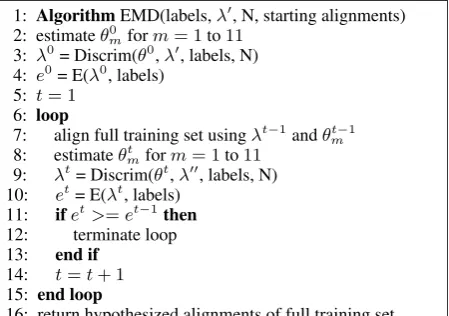
A brief sketch of the EMD algorithm applied to our extended model is presented in Figure 1. Parameters have a superscript t representing their value at iteration t. We initialize the algorithm with the gold standard word alignments (labels) of the word alignment discriminative training set, an initial λ, N, and the starting alignments (the
iter-ation 4 HMM Viterbi alignment). In line 2, we make iteration 0 estimates of the 5 sub-models of Model 4 and the 6 heuristic sub-models which are iteration dependent. In line 3, we run discrimi-native training using the algorithm from Section 3.1. In line 4, we measure the error of the result-ingλvector. In the main loop in line 7 we align
the full training set (similar to the E-step of EM), while in line 8 we estimate the iteration-dependent sub-models (similar to the M-step of EM). Then
1: AlgorithmEMD(labels,λ0, N, starting alignments)
2: estimateθ0
mform= 1to11 3: λ0
= Discrim(θ0
,λ0, labels, N)
4: e0= E(λ0, labels)
5: t= 1
6: loop
7: align full training set usingλt−1
andθt−1
m 8: estimateθt
mform= 1to11 9: λt= Discrim(
θt,
λ00, labels, N)
10: et = E(λt
, labels) 11: ifet
>=et−1
then
12: terminate loop 13: end if
14: t=t+ 1
15: end loop
16: return hypothesized alignments of full training set
Figure 1: Sketch of the EMD algorithm we perform discriminative reranking in line 9 and check for convergence in lines 10 and 11 (conver-gence means that error was not decreased from the previous iteration). The output of the algorithm is new hypothesized alignments of the training cor-pus.
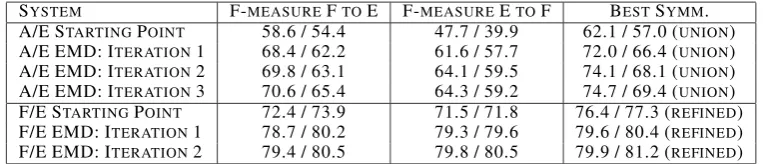
Table 7 evaluates the EMD semi-supervised training algorithm. We observe:
1. In both cases there is improved F-measure on the second iteration of semi-supervised training, indicating that the EMD algorithm performs better than one step discriminative reranking.
2. The French/English data set has converged3
after the second iteration.
3. The Arabic/English data set converged after improvement for the first, second and third iterations.
[image:5.595.308.533.249.407.2]SYSTEM F-MEASUREFTOE F-MEASUREETOF BESTSYMM. A/E STARTINGPOINT 58.6 / 54.4 47.7 / 39.9 62.1 / 57.0 (UNION)
A/E EMD: ITERATION1 68.4 / 62.2 61.6 / 57.7 72.0 / 66.4 (UNION)
A/E EMD: ITERATION2 69.8 / 63.1 64.1 / 59.5 74.1 / 68.1 (UNION)
A/E EMD: ITERATION3 70.6 / 65.4 64.3 / 59.2 74.7 / 69.4 (UNION)
[image:6.595.107.489.62.144.2]F/E STARTINGPOINT 72.4 / 73.9 71.5 / 71.8 76.4 / 77.3 (REFINED) F/E EMD: ITERATION1 78.7 / 80.2 79.3 / 79.6 79.6 / 80.4 (REFINED) F/E EMD: ITERATION2 79.4 / 80.5 79.8 / 80.5 79.9 / 81.2 (REFINED)
Table 7: Semi-Supervised Training Task F-measure
the new algorithm4. Like Ittycheriah and Roukos
(2005), we converted the alignment discrimina-tive training corpus links into a special corpus consisting of parallel sentences where each sen-tence consists only of a single word involved in the link. We found that the information in the links was “washed out” by the rest of the data and resulted in no change in the alignment test set’s F-Measure. Callison-Burch et al. (2004) showed in their work on combining alignments of lower and higher quality that the alignments of higher quality should be given a much higher weight than the lower quality alignments. Using this insight, we found that adding 10,000 copies of the special corpus to our training data resulted in the highest alignment test set gain, which was a small gain of 0.6 F-Measure. This result suggests that while the link information is useful for improving F-Measure, our improved methods for training are producing much larger improvements.
5 Improvement of MT Quality
The symmetrized alignments from the last iter-ation of EMD were used to build phrasal SMT systems, as were the symmetrized Model 4 ments (the baseline). Aside from the final align-ment, all other resources were held constant be-tween the baseline and contrastive SMT systems, including those based on lower level alignments models such as IBM Model 1. For all of our ex-periments, we use two language models, one built using the English portion of the training data and the other built using additional English news data. We run Maximum BLEU (Och, 2003) for 25 iter-ations individually for each system.
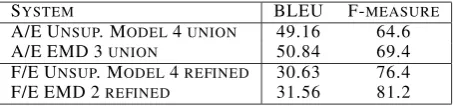
Table 8 shows our results. We report BLEU (Pa-pineni et al., 2001) multiplied by 100. We also show the F-measure after heuristic symmetrization of the alignment test sets. The table shows that
4We would like to thank an anonymous reviewer for sug-gesting that this experiment would be useful even when using a small discriminative training corpus.
our algorithm produces heuristically symmetrized final alignments of improved F-measure. Us-ing these alignments in our phrasal SMT system, we produced a statistically significant BLEU im-provement (at a 95% confidence interval a gain of
0.78is necessary) on the French/English task and
a statistically significant BLEU improvement on the Arabic/English task (at a 95% confidence in-terval a gain of1.2is necessary).
5.1 Error Criterion
The error criterion we used for all experiments is 1−F-measure. The formula for F-measure is
shown in Equation 3. (Fraser and Marcu, 2006) es-tablished that tuning the trade-off between Preci-sion and Recall in the F-Measure formula will lead to the best BLEU results. We tuned α by
build-ing a collection of alignments usbuild-ing our baseline system, measuring Precision and Recall against the alignment discriminative training set, build-ing SMT systems and measurbuild-ing resultbuild-ing BLEU scores, and then searching for an appropriate α
setting. We searchedα = 0.1,0.2, ...,0.9and set
αso that the resulting F-measure tracks BLEU to
the best extent possible. The best settings were
α = 0.2 for Arabic/English and α = 0.7 for French/English, and these settings ofαwere used
for every result reported in this paper. See (Fraser and Marcu, 2006) for further details.
F(A, S, α) = 1 α
Precision(A,S) +
(1−α)
Recall(A,S)
(3)
6 Previous Research
SYSTEM BLEU F-MEASURE
A/E UNSUP. MODEL4UNION 49.16 64.6
A/E EMD 3UNION 50.84 69.4
[image:7.595.185.412.62.115.2]F/E UNSUP. MODEL4REFINED 30.63 76.4 F/E EMD 2REFINED 31.56 81.2
Table 8: Evaluation of Translation Quality
with the baseline (with the exception of (Moore, 2005)). We interleave discriminative training with EM and are therefore performing semi-supervised training. We show that semi-supervised training leads to better word alignments than running unsu-pervised training followed by discriminative train-ing.
Another important difference with previous work is that we are concerned with generating many-to-many word alignments. Cherry and Lin (2003) and Taskar et al. (2005) compared their re-sults with Model 4 using “intersection” by look-ing at AER (with the “Sure” versus “Possible” link distinction), and restricted themselves to consider-ing 1-to-1 alignments. However, “union” and “re-fined” alignments, which are many-to-many, are what are used to build competitive phrasal SMT systems, because “intersection” performs poorly, despite having been shown to have the best AER scores for the French/English corpus we are using (Och and Ney, 2003). (Fraser and Marcu, 2006) recently found serious problems with AER both empirically and analytically, which explains why optimizing AER frequently results in poor ma-chine translation performance.
Finally, we show better MT results by using F-measure with a tunedαvalue. The only previous
discriminative approach which has been shown to produce translations of similar or better quality to those produced by the symmetrized baseline was (Ittycheriah and Roukos, 2005). They had access to 5000 gold standard word alignments, consider-ably more than the 100 or 110 gold standard word alignments used here. They also invested signif-icant effort in sub-model engineering (producing both sub-models specific to Arabic/English align-ment and sub-models which would be useful for other language pairs), while we use sub-models which are simple extensions of Model 4 and lan-guage independent.
The problem of semi-supervised learning is of-ten defined as “using unlabeled data to help su-pervised learning” (Seeger, 2000). Most work on semi-supervised learning uses underlying
distribu-tions with a relatively small number of parame-ters. An initial model is estimated in a supervised fashion using the labeled data, and this supervised model is used to attach labels (or a probability dis-tribution over labels) to the unlabeled data, then a new supervised model is estimated, and this is it-erated. If these techniques are applied when there are a small number of labels in relation to the num-ber of parameters used, they will suffer from the “overconfident pseudo-labeling problem” (Seeger, 2000), where the initial labels of poor quality as-signed to the unlabeled data will dominate the model estimated in the M-step. However, there are tasks with large numbers of parameters where there are sufficient labels. Nigam et al. (2000) ad-dressed a text classification task. They estimate a Naive Bayes classifier over the labeled data and use it to provide initial MAP estimates for unla-beled documents, followed by EM to further re-fine the model. Callison-Burch et al. (2004) exam-ined the issue of semi-supervised training for word alignment, but under a scenario where they simu-lated sufficient gold standard word alignments to follow an approach similar to Nigam et al. (2000). We do not have enough labels for this approach.
We are aware of two approaches to semi-supervised learning which are more similar in spirit to ours. Ivanov et al. (2001) used discrimi-native training in a reinforcement learning context in a similar way to our adding of a discriminative training step to an unsupervised context. A large body of work uses semi-supervised learning for clustering by imposing constraints on clusters. For instance, in (Basu et al., 2004), the clustering sys-tem was supplied with pairs of instances labeled as belonging to the same or different clusters.
7 Conclusion
We presented a semi-supervised algorithm based on IBM Model 4, with modeling and search ex-tensions, which produces alignments of improved F-measure over unsupervised Model 4 training.
The semi-supervised learning literature gen-erally addresses augmenting supervised learning tasks with unlabeled data (Seeger, 2000). In con-trast, we augmented an unsupervised learning task with labeled data. We hope that Minimum Error / Maximum Likelihood training using the EMD al-gorithm can be used for a wide diversity of tasks where there is not enough labeled data to allow supervised estimation of an initial model of rea-sonable quality.
8 Acknowledgments
This work was partially supported under the GALE program of the Defense Advanced Re-search Projects Agency, Contract No. HR0011-06-C-0022. We would like to thank the USC Cen-ter for High Performance Computing and Commu-nications.
References
Sugato Basu, Mikhail Bilenko, and Raymond J. Mooney. 2004. A probabilistic framework for semi-supervised clustering. In KDD ’04: Proc. of the ACM SIGKDD international conference on knowl-edge discovery and data mining, pages 59–68, New York. ACM Press.
Peter F. Brown, Stephen A. Della Pietra, Vincent J. Della Pietra, and R. L. Mercer. 1993. The mathe-matics of statistical machine translation: Parameter estimation. Computational Linguistics, 19(2):263– 311.
Chris Callison-Burch, David Talbot, and Miles Os-borne. 2004. Statistical machine translation with word- and sentence-aligned parallel corpora. In Proc. of the 42nd Annual Meeting of the Association for Computational Linguistics, Barcelona, Spain, July.
Colin Cherry and Dekang Lin. 2003. A probability model to improve word alignment. InProc. of the 41st Annual Meeting of the Association for Compu-tational Linguistics, Sapporo, Japan, July.
Alexander Fraser and Daniel Marcu. 2006. Measur-ing word alignment quality for statistical machine translation. InTechnical Report ISI-TR-616. Avail-able at http://www.isi.edu/ fraser/research.html, ISI/University of Southern California, May.
Fred Glover. 1986. Future paths for integer program-ming and links to artificial intelligence. Computers and Operations Research, 13(5):533–549.
Abraham Ittycheriah and Salim Roukos. 2005. A maximum entropy word aligner for Arabic-English machine translation. InProc. of Human Language
Technology Conf. and Conf. on Empirical Methods in Natural Language Processing, Vancouver, BC.
Yuri A. Ivanov, Bruce Blumberg, and Alex Pentland. 2001. Expectation maximization for weakly labeled data. InICML ’01: Proc. of the Eighteenth Interna-tional Conf. on Machine Learning, pages 218–225. Yang Liu, Qun Liu, and Shouxun Lin. 2005.
Log-linear models for word alignment. In Proc. of the 43rd Annual Meeting of the Association for Compu-tational Linguistics, pages 459–466, Ann Arbor, MI.
I. Dan Melamed. 1998. Manual annotation of trans-lational equivalence: The blinker project. Techni-cal Report 98-07, Institute for Research in Cognitive Science, Philadelphia, PA.
Robert C. Moore. 2005. A discriminative framework for bilingual word alignment. In Proc. of Human Language Technology Conf. and Conf. on Empirical Methods in Natural Language Processing, Vancou-ver, BC, October.
Radford M. Neal and Geoffrey E. Hinton. 1998. A view of the EM algorithm that justifies incremental, sparse, and other variants. In M. I. Jordan, editor, Learning in Graphical Models. Kluwer.
Kamal Nigam, Andrew K. McCallum, Sebastian Thrun, and Tom M. Mitchell. 2000. Text classifi-cation from labeled and unlabeled documents using EM. Machine Learning, 39(2/3):103–134.
Franz Josef Och and Hermann Ney. 2003. A sys-tematic comparison of various statistical alignment models. Computational Linguistics, 29(1):19–51.
Franz Josef Och. 2003. Minimum error rate training in statistical machine translation. InProc. of the 41st Annual Meeting of the Association for Computa-tional Linguistics, pages 160–167, Sapporo, Japan.
Kishore A. Papineni, Salim Roukos, Todd Ward, and Wei-Jing Zhu. 2001. BLEU: a method for auto-matic evaluation of machine translation. Technical Report RC22176 (W0109-022), IBM Research Di-vision, Thomas J. Watson Research Center, York-town Heights, NY, September.
Matthias Seeger. 2000. Learning with labeled and un-labeled data. InTechnical report, 2000. Available at http://www.dai.ed.ac.uk/ seeger/papers.html.
Ben Taskar, Simon Lacoste-Julien, and Dan Klein. 2005. A discriminative matching approach to word alignment. In Proc. of Human Language Technol-ogy Conf. and Conf. on Empirical Methods in Natu-ral Language Processing, Vancouver, BC, October.