The Columbia System in the QALB-2014 Shared Task
on Arabic Error Correction
Alla Rozovskaya Nizar Habash† Ramy Eskander Noura Farra Wael Salloum
Center for Computational Learning Systems, Columbia University
†New York University Abu Dhabi
{alla,ramy,noura,wael}@ccls.columbia.edu
Abstract
The QALB-2014 shared task focuses on correcting errors in texts written in Mod-ern Standard Arabic. In this paper, we describe the Columbia University entry in the shared task. Our system consists of several components that rely on machine-learning techniques and linguistic knowl-edge. We submitted three versions of the system: these share several core elements but each version also includes additional components. We describe our underlying approach and the special aspects of the dif-ferent versions of our submission. Our system ranked first out of nine participat-ing teams.
1 Introduction
The topic of text correction has seen a lot of in-terest in the past several years, with a focus on correcting grammatical errors made by learners of English as a Second Language (ESL). The two most recent CoNLL shared tasks were devoted to grammatical error correction for non-native writ-ers (Ng et al., 2013; Ng et al., 2014).
The QALB-2014 shared task (Mohit et al., 2014) is the first competition that addresses the problem of text correction in Modern Standard Arabic (MSA) texts. The competition makes use of the recently developed QALB corpus (Za-ghouani et al., 2014). The shared task covers all types of mistakes that occur in the data.
Our system consists of statistical models, lin-guistic resources, and rule-based modules that ad-dress different types of errors.
We briefly discuss the task in Section 2. Sec-tion 3 gives an overview of the Columbia system
and describes the system components. In Sec-tion 4, we evaluate the complete system on the de-velopment data and show the results obtained on test. Section 5 concludes.
2 Task Description
The QALB-2014 shared task addresses the prob-lem of correcting errors in texts written in Modern Standard Arabic (MSA). The task organizers re-leased training, development, and test data. All of the data comes from online commentaries writ-ten to Aljazeera articles.1 The training data
con-tains 1.2 million words; the development and the test data contain about 50,000 words each. The data was annotated and corrected by native Arabic speakers. For more detail on the QALB corpus, we refer the reader to Zaghouani et al. (2014). The re-sults in the subsequent sections are reported on the development set.
It should be noted that in the annotation process, the annotators did not assign error categories but only specified an appropriate correction. In spite of this, it is possible, to isolate certain error types automatically, by using the corrections in coordi-nation with the input words. The first type con-cerns punctuation errors. Errors involving punc-tuation account for about 39% of all errors in the data. In addition to punctuation mistakes, another very common source of errors refers to subopti-mal spelling for two groups of letters –Alif (and itsHamzated versions) andYa(and itsundottedor
Alif Maqsura versions). For more detail on this and other Arabic phenomena, we refer the reader to Habash (2010; Buckwalter (2007; El Kholy and Habash (2012). Mistakes associated withAlif and
1http://www.aljazeera.net/
Component System
CLMB-1 CLMB-2 CLMB-3
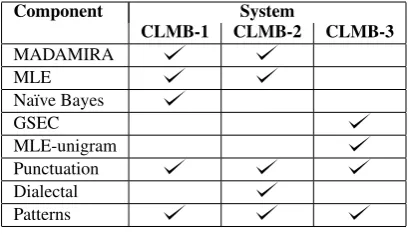
[image:2.595.79.284.62.179.2]MADAMIRA MLE Na¨ıve Bayes GSEC MLE-unigram Punctuation Dialectal Patterns
Table 1:The three versions of the Columbia sys-tem and their components.
Yaspelling constitute almost 30% of all errors.
3 System Overview
The Columbia University system consists of sev-eral components designed to address different types of errors. We submitted three versions of the system. We refer to these as CLMB-1, CLMB-2, and CLMB-3. Table 1 lists all of the components and indicates which components are included in each version. The components are applied in the order shown in the table. Below we describe each component in more detail.
3.1 MADAMIRA Corrector
MADAMIRA (Pasha et al., 2014) is a tool designed for morphological analysis and dis-ambiguation of Modern Standard Arabic. MADAMIRA performs morphological analysis in context. This is a knowledge-rich resource that requires a morphological analyzer and a large corpus where every word is marked with its morphological features. The task organizers provided the shared task data pre-processed with MADAMIRA, including all of the features generated by the tool for every word. In addition to the morphological analysis and contextual morphological disambiguation, MADAMIRA also performs Alif and Ya spelling correction for the phenomena associated with these letters discussed in Section 2. The corrected form was included among the features and can be used for correcting the input. We use the corrections proposed by MADAMIRA and apply them to the data. As we show in Section 4, while the form proposed by MADAMIRA may not necessarily be correct, MADAMIRA performs at a very high precision. MADAMIRA corrector is used in the CLMB-1 and CLMB-2 systems.
3.2 Maximum Likelihood Model
The Maximum Likelihood Estimator (MLE) is a supervised component that is trained on the train-ing data of the shared task. Given the annotated training data, a map is defined that specifies for ev-ery word n-gram in the source text the most likely n-gram corresponding to it in the target text. The MLE model considers source n-grams of lengths between 1 to 3; the MLE-unigram model that is part of the CLMB-3 version only considers n-grams of length 1.
The MLE approach performs well on errors that have been observed in the training data and can be unambiguously corrected without using the sur-rounding context, i.e. do not have many alternative corrections. Consequently, MLE fails on words that have many possible corrections, as well as words not seen in training.
3.3 Na¨ıve Bayes for Unseen Words
The Na¨ıve Bayes component addresses errors for words that were not seen in training. The system uses the approach proposed in Rozovskaya and Roth (2011) that proved to be successful for cor-recting errors made by English as a Second Lan-guage learners. The model operates at the word level and targets word replacement errors that in-volve single tokens. Candidate corrections are generated using a character confusion table that is based on the training data. The model is a Na¨ıve Bayes classifier trained on the Arabic Gigaword corpus (Parker et al., 2011) with word n-gram fea-tures in the 4-word window around the word to be corrected. The Na¨ıve Bayes component is used in the CLMB-1 system.
3.4 The GSEC Model
also be noted that the model was not trained to insert missing characters. The model is a multi-class SVM multi-classifier (Kudo, 2005) that makes use of character-level features using a window of four characters that may occur within the word bound-aries as well as in the surrounding context. Due to a long training time, GSEC was trained on a quarter of the training data. The system is post-processed with a unigram word-level maximum-likelihood model described in Section 3.2. For more detail on the GSEC approach, we refer the reader to Farra et al. (2014).
3.5 Punctuation Corrector
The shared task data contains a large number of punctuation mistakes. Punctuation errors, such as missing periods and commas, account for about 30% of all errors in the data. Most of these errors involve incorrectly omitting a punctuation symbol. Our punctuation corrector is a statistical model that inserts periods and commas. The system is a decision tree model trained on the shared task training data using WEKA (Hall et al., 2009). For punctuation insertion, every space that is not fol-lowed or preceded by a punctuation mark is con-sidered.
To generate features, we use a window of size three around the target space. The features are de-fined as follows:
• The part-of-speech of the previous word
• The existence of a conjunctive or connective proclitic in the following word; that is a “w” or “f” proclitic that is either a conjunction, a sub-conjunction or a connective particle The part-of-speech and proclitic information is obtained by running MADAMIRA on the text.
We also ran experiments where the model is trained with a complete list of features produced by MADAMIRA; that is part-of-speech, gender, number, person, aspect, voice, case, mood, state, proclitics and enclitics. This was done for two pre-ceding words and two following words. However, this model did not perform as well as the one de-scribed above, which we used in the final system.
Note that the punctuation model predicts pres-ence or abspres-ence of a punctuation mark in a spe-cific location and is applied to the source data from which all punctuation marks have been re-moved. However, when we apply our punctuation
model in the correction pipeline, we find that it is always better to keep the already existing peri-ods and commas in the input text instead of over-writing them with the model prediction. In other words, we only attempt to add missing punctua-tion.
3.6 Dialectal Usage Corrector
Even though the shared task data is written in MSA, MSA is not a native language for Arabic speakers. Typically, an Arabic speaker has a native proficiency in one of the many Arabic dialects and learns to write and read MSA in a formal setting. For this reason, even in MSA texts produced by native Arabic speakers, one typically finds words and linguistic features specific to the writer’s na-tive dialect that are not found in the standard lan-guage.
To address such errors, we use Elissa (Salloum and Habash, 2012), which is Dialectal to Standard Arabic Machine Translation System. Elissa uses a rule-based approach that relies on the existence of a dialectal morphological analyzer (Salloum and Habash, 2011), a list of hand-written trans-fer rules, and dialectal-to-standard Arabic lexi-cons. Elissa uses different dialect identification techniques to select dialectal words and phrases (dialectal multi-word expressions) that need to be handled. Then equivalent MSA paraphrases of the selected words/phrases are generated and an MSA lattice for each input sentence is constructed. The paraphrases within the lattice are then ranked us-ing language models and the n-best sentences are extracted from lattice. We use 5-gram language models trained using SRILM (Stolcke, 2002) on about 200 million untokenized, Alif/Ya normal-ized words extracted from Arabic GigaWord. This component is employed in the CLMB-2 system.
3.7 Pattern-Based Corrector
training data. Some of the rules use regular ex-pressions, while others make use of the rule-based Standard Arabic Morphological Analyzer (SAMA) (Maamouri et al., 2010), the same out-of-context analyzer used inside of MADAMIRA.
Rules for splitting words
• All digits are separated from words.
• A space is added after all word medial Ta-Marbutacharacters.
• A space is added after the very common “ElY” ‘at/about/on’ preposition if it is at-tached to the following word.
• If a word has a morphological analysis that includes “lmA” (as negation particle, relative pronoun or pseudo verb), “hA” (a demonstra-tive pronoun), or “Ebd” and “>bw” in proper nouns, a space is inserted after those parts of the analysis.
• If a word has no morphological analysis, but starts with a set of commonly mis-attached words, and the rest of the word has an anal-ysis, the word is split after the mis-attached word sequence.
Rules for merging words
• All lone occurrences of the conjunction w
‘and’ are attached to the following word.
• All sequences of the punctuation marks (., ?, !) that occur between two and six times are merged: e.g ! ! !→!!!.
4 Experimental Results
In Section 3, we described the individual sys-tem components that address different types of errors. In this section, we show how the sys-tem improves when each component is added into the system. System output is scored with the M2 scorer (Dahlmeier and Ng, 2012), the official scorer of the shared task.
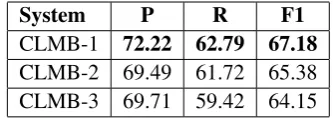
Table 2 reports performance results of each ver-sion of the Columbia system on the development data. Table 3 shows the performance results for the best-performing system, CLMB-1, as each system component is added.
System P R F1
CLMB-1 72.22 62.79 67.18
[image:4.595.332.499.62.121.2]CLMB-2 69.49 61.72 65.38 CLMB-3 69.71 59.42 64.15
Table 2: Performance of the Columbia systems on the development data.
System P R F1
MADAMIRA 83.33 32.94 47.21
+MLE 86.52 42.52 57.02
+NB 85.80 43.27 57.53
+Punc. 73.66 59.51 65.83
[image:4.595.323.511.166.255.2]+Patterns 72.22 62.79 67.18
Table 3:Performance of the CLMB-1 system on the development data and the contribution of its components.
System P R F1
CLMB-1 73.34 63.23 67.91
CLMB-2 70.86 62.21 66.25 CLMB-3 71.45 60.00 65.22
Table 4: Performance of the Columbia systems on the test data.
Finally, Table 4 reports results obtained on the test data. These results are comparable to the per-formance observed on the development data. In particular, CLMB-1 achieves the highest score.
5 Conclusion
We have described the Columbia University sys-tem that participated in the first shared task on grammatical error correction for Arabic and ranked first out of nine participating teams. We have presented three versions of the system; all of these incorporate several components that target different types of mistakes, which we presented and evaluated in this paper.
Acknowledgments
[image:4.595.334.499.313.372.2]References
T. Buckwalter. 2007. Issues in Arabic Morphological Analysis. In A. van den Bosch and A. Soudi, editors,
Arabic Computational Morphology: Knowledge-based and Empirical Methods. Springer.
D. Dahlmeier and H. T. Ng. 2012. Better evaluation for grammatical error correction. InProceedings of NAACL.
A. El Kholy and N. Habash. 2012. Orthographic and morphological processing for English–Arabic sta-tistical machine translation. Machine Translation, 26(1-2).
N. Farra, N. Tomeh, A. Rozovskaya, and N. Habash. 2014. Generalized character-level spelling error cor-rection. InProceedings of ACL.
J. Fiscus. 1998. Sclite scoring package
ver-sion 1.5. US National Institute of Standard
Technology (NIST), URL http://www. itl. nist. gov/iaui/894.01/tools.
N. Y. Habash. 2010. Introduction to Arabic natural
language processing. Synthesis Lectures on Human Language Technologies 3.1.
M. Hall, F. Eibe, G. Holmes, B. Pfahringer, P. Reute-mann, and I. H. Witten. 2009. The WEKA data
mining software: an update. SIGKDD Explorations,
11(1):10–18.
T. Kudo. 2005. YamCha: Yet another multipurpose chunk annotator. http://chasen.org/ taku/software/. M. Maamouri, D. Graff, B. Bouziri, S. Krouna, A. Bies,
and S. Kulick. 2010. LDC Standard Arabic
Mor-phological Analyzer (SAMA) Version 3.1. Linguistic Data Consortium.
B. Mohit, A. Rozovskaya, N. Habash, W. Zaghouani, and O. Obeid. 2014. The first QALB shared task on automatic text correction for Arabic. InProceedings of EMNLP Workshop on Arabic Natural Language Processing.
H. T. Ng, S. M. Wu, Y. Wu, Ch. Hadiwinoto, and J. Tetreault. 2013. The CoNLL-2013 shared task
on grammatical error correction. InProceedings of
CoNLL: Shared Task.
H. T. Ng, S. M. Wu, T. Briscoe, C. Hadiwinoto, R. H. Susanto, and C. Bryant. 2014. The CoNLL-2014 shared task on grammatical error correction. In Pro-ceedings of CoNLL: Shared Task.
R. Parker, D. Graff, K. Chen, J. Kong, and K. Maeda.
2011. Arabic Gigaword Fifth Edition. Linguistic
Data Consortium.
A. Pasha, M. Al-Badrashiny, A. E. Kholy, R. Eskan-der, M. Diab, N. Habash, M. Pooleery, O. Rambow, and R. Roth. 2014. MADAMIRA: A fast, compre-hensive tool for morphological analysis and disam-biguation of arabic. InProceedings of LREC.
A. Rozovskaya and D. Roth. 2011. Algorithm selec-tion and model adaptaselec-tion for ESL correcselec-tion tasks. InProceedings of ACL.
W. Salloum and N. Habash. 2011. Dialectal to stan-dard arabic paraphrasing to improve arabic-english
statistical machine translation. In Proceedings of
the First Workshop on Algorithms and Resources for Modelling of Dialects and Language Varieties. W. Salloum and N. Habash. 2012. Elissa: A dialectal
to standard arabic machine translation system. In
Proceedings of COLING (Demos).
A. Stolcke. 2002. Srilm-an extensible language mod-eling toolkit. InProceedings of International Con-ference on Spoken Language Processing.
W. Zaghouani, B. Mohit, N. Habash, O. Obeid, N. Tomeh, A. Rozovskaya, N. Farra, S. Alkuhlani, and K. Oflazer. 2014. Large scale arabic error
anno-tation: Guidelines and framework. InProceedings