SURVEY ON ATTRIBUTE-BASED DATA SHARING
SCHEME REVISITED IN CLOUD COMPUTING
Mr. Swapnil R. Patil, Prof. N. D. Kale
Computer Engineering Department, PVPIT,
Pune, India
Abstract: Cloud storage is the best and proficient approach to handle our information remotely. In any case, since information proprietors and clients are more often than not outside the trusted area of cloud specialist co-ops the information security and get to control is the critical component at the season of delicate information put away in the cloud. Additionally, now days there are distinctive systems are accessible for information sharing and saving security of information proprietor and client. Key Escrow is the one of the significant issue now a day. We can't keep full trust over the key power focus since they might be abuse their benefits. This is unsatisfactory for data sharing circumstances. In this paper we concentrated the current procedure for sharing the information from information proprietor to information client. The methodology propose an enhanced two-party key issuing convention that can ensure that neither key power nor cloud specialist co-op can bargain the entire mystery key of a client exclusively. The method also present the idea of quality with weight, being given to upgrade the statement of characteristic, which cannot just extend the expression from paired to discretionary state, additionally help the intricacy of get to approach. In this manner, both capacity cost and encryption many-sided quality for a ciphertext are eased. Attribute based encryption is an open key based encryption that empowers get to control over encoded information utilizing access strategies and credited qualities.
Keywords: Data Confidentiality, Key Authority, Access Control policy, Data Sharing, Attribute-based
encryption, Removing escrow, weighted attribute, Cloud computing.
Journal homepage: www.mjret.in
1. INTRODUCTION
In current era there are bunches of quickly developing patterns and cloud registering is one
of them. Cloud gives simple, proficient stage to store information, secure information, and
get to information at any area with the assistance of web. Additionally it gives client
adaptable foundations, storage room and execution. Accordingly, how to securely and
efficiently share user data is one of the toughest challenges in the scenario of cloud
computing [1], [10].
In a CP-ABE, client's mystery key is portrayed by a trait set, and ciphertext is connected with
a get to structure. DO is permitted to characterize get to structure over the universe of traits.
A client can unscramble a given ciphertext just if his/her trait set matches the get to structure
over the ciphertext. Utilizing a CP-ABE framework specifically into a cloud application that
may yield some open issues Firstly, all clients' mystery keys should be issued by a
completely trusted key power (KA). This brings a security hazard that is known as key
escrow issue. By knowing the mystery key of a framework client, the KA can unscramble the
entire client's ciphertext, which remains altogether against to the will of the client. The
weighted attribute is introduced to not only extend attribute expression from binary to
arbitrary state, but also to simplify access policy. Thus, the storage cost and encryption cost
for a ciphertext can be relieved.
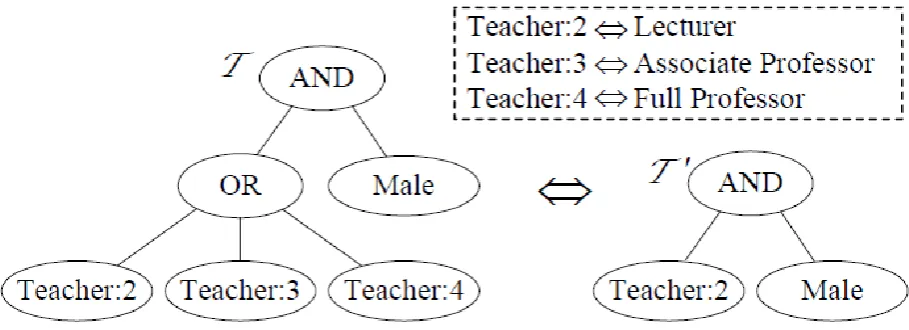
Assume there is a formal structure in college, in which instructors are characterized into
showing partner, speaker, related teacher and full educator [1]. We circulate the heaviness
of the characteristic for every kind of the instructors as 1, 2, 3, and 4. In this way, these
qualities can be indicated as "Educator: 1", "Educator: 2", "Instructor: 3" and "Instructor: 4",
individually. For this situation, they can be signified by one trait which has quite recently
extraordinary weights. Specifically, it can be arbitrary state properties, for example,
"Instructor: showing associate, teacher, relate educator, full teacher". We here accept that
an get to arrangement is spoken to as: T {("Lecturer" OR "Partner Teacher" OR "Full
Professor") AND "Male"}, and the current CP-ABE plans are executed on the type of get to
strategy T . On the off chance that our proposed plan is sent, the T can be rearranged as T ′
{"Teacher: 2" AND "Male"}, since the characteristic "Instructor: 2" indicates the base level in
the get to approach and incorporates {"Teacher: 2", "Instructor: 3" "Instructor: 4"} as a matter
of course. In this manner, the capacity overhead of the comparing ciphertext and the
computational cost utilized as a part of encryption can be lessened. These two structures are
appeared in Fig. 1. Likewise, our technique can be utilized to express bigger quality space
than any time in recent memory under a similar number of qualities. For instance, if both the
n2 distinctive potential outcomes. Interestingly, the current CPABE plots just show 2n
conceivable outcomes.
Fig. 1.Two equivalent access structures of a ciphertext. T represents a general access policy in the existing CP-ABE schemes. T ′denotes an improved access policy in the proposed scheme [1].
2. LITERATURE SURVEY
The literature survey that containing study of differentschemes available in Attribute Based
encryption(ABE).Thatare KP-ABE,CP-ABE, Attribute-based Encryption Schemewith
Non-Monotonic Access Structures, ABE andMABE.Also include advantage, disadvantage and
acomparison table of each scheme based on fine grainedaccesscontrol,efficiency, and
computational overhead andcollusion resistant.
Shulan Wang, Kaitai Liang, Joseph K. Liu, JianyongChen,Jianping Yu, WeixinXie [1] revisit
attribute-based datasharing scheme in order to solve the key escrow issue but alsoimprove
the expressiveness of attribute, so that the resultingscheme is friendlier to cloud computing
applications. Theyproposed an improved two-party key issuing protocol that canguarantee
that neither key authority nor cloud service providercan compromise the whole secret key of
a user individually.Moreover, they introduce the concept of attribute with weight,being
provided to enhance the expression of attribute, whichcan not only extend the expression
from binary to arbitrarystate, but also lighten the complexity of access policy.Therefore, both
storage cost and encryption complexity for acipher text are relieved.
An efficient file hierarchy attribute-based encryptionscheme (FH-CP-ABE) is proposed by
Shulan Wang, JunweiZhou, Joseph K. Liu, Jianping Yu, Jianyong Chen and WeixinXie [2].
The layered access structures are integrated into asingle access structure, and then the
hierarchical files areencrypted with the integrated access structure. The cipher
textcomponents related to attributes could be shared by the files.Therefore, both cipher text
to besecure under the standard assumption. In this study, anefficient encryption scheme
based on layered model of theaccess structure is proposed in cloud computing, which
isnamed file hierarchy CP-ABE scheme (or FH-CP-ABE, forshort). FH-CP-ABE extends
typical CPABE with ahierarchical structure of access policy, so as to achieve simple,flexible
and fine-grained access control.
Kaitai Liang and Willy Susilo proposed [3] a searchableattribute-based proxy re-encryption
system. When comparedto existing systems only supporting either searchable
attributebasedfunctionality or attribute-based proxy re-encryption, thisnew primitive supports
both abilities and provides flexiblekeyword update service. Specifically, the system enables
adata owner to efficiently share his data to a specified group ofusers matching a sharing
policy and meanwhile, the data willmaintain its searchable property but also the
correspondingsearch keyword(s) can be updated after the data sharing. Theserver however
knows nothing about the keyword(s) and thedata. The new mechanism is applicable to many
real-worldapplications, such as electronic health record systems.
Circuit ciphertext-policy attribute-based hybrid encryptionwith verifiable delegation has been
considered in this work[4]. In such a system, combined with verifiable computationand
encrypt-then-mac mechanism, the data confidentiality, thefine-grained access control and
the correctness of thedelegated computing results are well guaranteed at the sametime.
Besides, this scheme achieves security against chosenplaintextattacks under the
k-multilinear Decisional Diffie-Hellman assumption.
The extended CP-ABE mechanism with multi-authorities(MA-ABE) is designed [5] for the
practical application. Inthis paper, authors proposed an efficient and secure multiauthority
access control scheme transfer the computing to thecloud server. This scheme implements
partial decryptionoperation in cloud server and improves the user's decryptionefficiency,
which can be applied to the scenario of access tothe Internet using mobile devices.
An attribute based encryption scheme introduced by Sahaiand Waters in [6] and the goal is
to provide security andaccess control shows that how to reduce a communicationoverhead
between cloud server and data owner using publickey compression technique for fully
homomorphicencryptionscheme over the integers. Whenever we use the cloud, userexpects
Data privacy, search accuracy & less communicationoverhead from the cloud service
providers. In order tackle thisTRSE (Two Round Searchable Encryption) scheme has
beenproposed which achieved high data privacy throughhomomorphic encryption and
search accuracy through vectorspace model. The problem with attribute based encryption
data. The application of this scheme isrestricted in the real environment because it use the
access of monotonic attributes to control user's access in the system.
3. CONCLUSION& FUTURE SCOPE
In this paper, we break down various property based encryption plans: ABE, KP-ABE,
CP-ABE, ABE with non-monotonic get to structure, HABE and MA-ABE. The fundamental get
to policies are KP-ABE and CP-ABE, advance plans are acquired in light of these
arrangements. In light of their kind of get to structure the plans are sorted as either
monotonic or non-monotonic. CH-ABE an adjustment of Attribute Based Encryption
(ABE)for the reasons for giving certifications towards the provenance the delicate
information, and in addition towards the namelessness of the information proprietor; Our
plan additionally empowers dynamic alteration of get to approaches o underpins proficient
on-request client/property denial and break-glass access under crisis situations.
REFERENCES
[1] Shulan Wang, Kaitai Liang, Joseph K. Liu, JianyongChen, Jianping Yu, WeixinXie ,"Attribute-Based Data Sharing Scheme Revisited in Cloud Computing", IEEETransactions on Information Forensics and Security, 2016.
[2] Shulan Wang, Junwei Zhou, Joseph K. Liu, JianpingYu,Jianyong Chen, WeixinXie ,"An Efficient File HierarchyAttribute-Based Encryption Scheme in CloudComputing", IEEE Transactions on Information Forensicsand Security, 2016
[3] Kaitai Liang and Willy Susilo, "Searchable Attribute-Based Mechanism with Efficient Data Sharing for Secure
Cloud Storage", IEEE Transactions on InformationForensics and Security, 2015
[4] JieXu, Qiaoyan Wen, Wenmin Li and ZhengpingJin,"Circuit Ciphertext-policy Attribute-based HybridEncryption with Verifiable Delegation in CloudComputing", IEEE TRANSACTIONS ON PARALLELAND DISTRIBUTED SYSTEMS ,2015
[5] Danwei Chen, Liangqing Wan, Chen Wang, Su Pan,YutingJi, "A Multi-authority Attribute-based EncryptionScheme with Pre-decryption", 2015 IEEE SeventhInternational Symposium on Parallel Architectures,Algorithms and Programming
[6] J. Bettencourt, A. Sahai, and B.Waters”Ciphertext-policy attributebased encryption “in Proceedings of IEEE Symposium on Security andPrivacy, pp. 321V334, 2007.
[7] V Bozovic, D Socek, R Steinwandt, and V. I. Vil-lanyi, “Multiauthorityattribute-based encryption with honest-but-curious centralauthority" International Journal of Computer Mathematics, vol. 89,pp. 3,2012.
[8] V. Goyal, O. Pandey, A. Sahai, and B.Waters”Attribute-basedencryption for fine-grained access control of encrypted data," inProceedings of the 13th ACM conference on Computer andcommunications security, pp. 89{98, 2006}
[9] Q. Liu, G. Wang, and J. Wu, “Time based proxy re-encryptionscheme for secure data sharing in a cloud environment," InformationSciences .In Press, 2012.