Volume 8, No. 3, March – April 2017
International Journal of Advanced Research in Computer Science RESEARCH PAPER
Available Online at www.ijarcs.info
Performance Analysis of AQM Algorithms in Network Congestion Control
Dharamdas Kumhar
Research Scholar: Dept. of Mathematical Sciences & Computer Application, Bundelkhand University
Jhansi (U.P.), India
Avanish kumar
Professor: Dept. of Mathematical Sciences & Computer Application, Bundelkhand University
Jhansi (U.P.), India
Abstract: Today fast communication technologies are the need for modern communication and computer networks as well as the Internet. They are developed for transmission of huge amounts of information, for which Congestion Control Algorithms (CCAs) are most powerful. A congestion control method is one of the essential that keep any network energetic and decent for the users. Various algorithms suggested recently trying to provide an efficient control of congestion that occurs in the network. Active Queue Management (AQM) is one of such method which provides superior control in congestion control.This paper concentrates on active queue management established congestion control algorithms to discuss performance parameters designed for networks stable as well as optimal (minimum) queue length and issues about the merits and demerits of the congestion control algorithms and evaluate their features.
Keywords: Congestion; Congestion Control; Communication Network; Active Queue Management; Throughput, Latency
I. INTRODUCTION
Congestion is the traffic jam in communication networks. When the numbers of incoming packets grow more than the capacity of the outgoing lines, then they start accumulating at the router. When the router cannot accommodate more packets, the incoming packets are dropped and adjacent routers start having the accumulation of unacknowledged packets. This process is known as congestion. Congestion is a network state in which the total demands for resources, i.e. bandwidth remains short in a capacity as the competing users exceed in such case, the available capacity leading to information loss and results in retransmissions [1] [2]. In the computer network at the duration of congestion, queuing delay, packets loss and the number of packets concurrently grow rebroadcasted. In other words, when a network is heavily loaded by congestion, network performances are losses. According to Keshav [3], a network is to be congested from the point of user view if the serviceability levels observe by the user reduces since of grow in the network burden. After all congestion effect information lost and huge delays in information conveying, hence, to prevent congestion personate the challengeable issue in communication network managements and deign. Therefore without suitable congestion control methods, there is the feasibility of incapable resources utilization, eventually, induces to network breakdown [4].
Congestion control is a technique and mechanisms which can be either forbidden congestion before it occurs or discards congestion after it has occurred. Congestion control can be categories into congestion avoidance or congestion recovery. The congestion avoidance also knows open-loop congestion control and congestion recovery also known closed-loop congestion control [5]. The congestion avoidance-type is a benefit to nature. The objective of this is to give the operation of a network which provides the highest power so that condition of congestion will never occur. Whereas, the purpose is to reinstate the operation of a communication network to its ordinary condition after congestion has happened. If congestion recovery technique is not used, then a network may burst completely whenever
congestion occurs. However, if a network used a congestion avoidance technique, congestion recovery method will be needed to maintain the throughput in the case of sudden changes in a network that may cause congestion.
II. CONGESTIONCONTROLINCOMMUNICATION
NETWORK
Throughout congestion control in communication and computer network needs some form of acknowledgments information from the congested link to the source of message jam. Therefore they can adapt their sending data rates according to the available links of communication networks. The acknowledgments data of congestion can be classified into direct or indirect. In the direct acknowledgment, the Transport Layer Protocol (TCP) of the communication network consider maintaining maximum throughput and minimum delay of data packets by estimation services time, adjustment throughput, and adjustment latency and packet drops. The Transport Layer Protocol (TCP) utilize such an indirect acknowledge between time-outs and duplicate feedbacks for destroyed packets. To achieve maximum performance in communication network it is not sufficient to depend on only indirect feedback. Therefore they need to know extra information and direct feedback techniques, Active Queue managements (AQM), manage the congestion in communication networks.
AQM assign an Explicit Congestion Notifications (ECNs) bit in a packet header to feedback the congestion like gateway network, to the end users. These gateways or intermediate computer content of hardware as well as software components that concatenate various types of communication networks consistently. The restricted space in their buffer memory wants suitable management of incoming jam packets. In the gateway, the method which used to transferring any type of information from a source node to any other node is called routing. These node or computers are known as gateway routers in the literature [6]. The gateway will trace packets if last host node approval ECN otherwise it will ignore the packets during congestion.
III. CONGESTIONCONTROL
processing or capabilities of the networks collapse then we prevent the congestion and we make the proper resource reducing steps by steps to reduce the rate of packets sent. The different objects which are used for the analysis the performance of a congestion control algorithms are: to fulfill an extreme link utilization, to assemble to integrity speedily and systematic, to minimize the magnitude of change back and forth, to keep an extreme acceptance, and to coincide fairly and be agreeable with extended established broadly used protocol [7]. The performance of the algorithms has been discussed using many performance parameters [8], [9].
The major network performance parameters used, such as throughput, link utilization, mean queue length, packet loss or latency are defined as:
Throughput: it is specifying as the ratio of the total packet accepted to the one-way delay or it is the rate at which the packets are sent by a network source. It is measured by
Throughput is a prime cause which directly affected the network performances.
Link Utilization: it is defined as the fragment of link capacity being used for conveying packet. It can be represented as decimal points between 0.0 and 1.0 or as in percentage. Hence the current capacity of the network that is in use is a concern as utilization. It is calculated by the formula as
Packet Loss Probability: it is defined as the total number of steep decline packets divided by the total number of input jam over the fixed duration of time. Here packet size is constant; there for packet loss probability can be defined as
Here, we observed that dropping of the packets occurs the packet loss. There is no packets loss due to other regions.
Mean Queue Length: a queuing system in a communication network can be defined as packets arise for services, hold off for services if it is not quickly, and if having waited for service, quit the system after being served. There for mean queue length is an essential attribute to determine that how well the active queue management for congestion control works.
End-to-end or latency: it is the interval of time between the input packet arrivals in the communicate queue to the real packet of transmission of the information. The latency depends on the load on the communication
IV. ACTIVEQUEUEMANAGEMENTALGORITHMS
In AQM at the node, the packets are to be processed is determined by the congestion avoidance and packet drop policy. According to the network performance parameter used to estimate congestion, AQM algorithms can be basically categorized into two types; queue based and rate based. In queue based strategy, congestion is examined by average or expeditious queue length and control goal is to establish the queue length. The demerit of queue based strategy is that an accumulation is essentially necessitated. Rate based strategy exactly guess the link utilization, and dictate congestion and take exertion based on the packets arrival rate. Rate based strategy can provide early feedback for congestion.
Finally, complete content and organizational editing before formatting. Please take note of the following items when proofreading spelling and grammar:
A. Drop Trail Algorithm
F. Postiglione et al [10] discussed Drop Tail (DT) algorithm. DT is the easy and most ordinary used algorithm in the current Internet Router. DT drops packets from the tail of the full queue buffer. The main demerits are a lack of fairness, no safety against the misbehaving or unresponsive flows and no relative Quality of Services (QoS). The QoS is a new concept in the conventional “best effort” Internet [11]. In QoS, we have some guarantees of transmission rate, error rates and so on. The QoS is a concern for the unending transmission of highest- bandwidth video and multimedia information. Transmitting these types of content is difficult in the present Internet with DT.
B. DECbit Algorithm
K.K. Ramakrishnan et al [12] discussed DCEbit algorithm which is one of the algorithms used to control the congestion at a router. In DECbit the bit in the packet header which controls congestion called as congestion indication bit. The indication bit is used to give feedback to the sources for controlling a flow of jam properly. When Mean Queue Length (MQL) exceeds a value of one, Router set congestion indication bit in arriving packet headers. The algorithm uses window based flow control for controlling the jam flow and window of data packets are updated upon once every Round Trip Time (RTT). When congestion indication bit set half of the packets in the last window, source reduces window size exponentially; otherwise, they expand a size of the window linearly.
C. Random Early Detection Algorithm
S. Floyd et al [13] discussed Random Early Detection (RED) Algorithm. RED calculates the average queue size by using a low pass filter with Exponential Weighted Moving Average (EWMA). The computation of the average queue size is compared with the maximum threshold and minimum threshold to create the next action. However RED is the most commonly used AQM algorithm for congestion avoidance and control but it has been examined from various studies [14], [15], [16], and [17] that the performance of RED is mostly dependent upon the circumstances where it is used. It also depends on the way of its parameters adjustments.
D. Adaptive RED Algorithm
upon the setting of maxp i.e. when congestion is low the dropping probability remains also low until mean queue length reaches maximum threshold but in a case of high congestion the dropping probabilities grow quickly as the mean queue length exceeds minimum threshold [19].
E. Proportional Integrator Algorithm
M. Agrawall et al [20] discussed Proportional Integrator (PI) algorithm. PI uses instantaneous queue length and control queue length to a desired queue reference value. PI drop probability is proportional to queue length mismatches. PI drop probability is determined by the difference between the current queue length and a desired target queue length, with the difference between a previous queue length and a desired target queue length. If the result of the subtraction gets positive, drop probability is larger than previous drop probability otherwise, it is smaller.
F. BLUE Algorithm
Wu-Chang et al [21] discussed Blue algorithm which uses packet loss and links idle events to manage congestion. The BLUE algorithm maintains a single probability, Pm, which is use to drop packets when they are enqueued. If a queue buffer is an overflow they continuously dropping packets and BLUE increments Pm, thus increasing the rate at which it sends back the congestion notification? Conversely, if the queues become empty or idle, BLUE decreases its marking probability. This efficiently allows BLUE to “learn” the correct rate it needs to send back congestion notification. Hence to control the arrival rate they used to control variable Pm and maintain the buffer below threshold thus most of the time link not remains idle. Therefore we can say that the algorithm tries to minimize packet loss rate and helps to keep the buffer stable.
G. CHOke Algorithm
Rang Pan et al [22] discussed CHOKe algorithm. According to CHOKe, at the congested router whenever a new packet arrives, a packet is dropped at random from the First In First Out buffer and compared it with the arriving packet. If both dropping packets belong to the same flow, then both are dropped, otherwise, the randomly chosen packet is kept entire and the new incoming packet is entered into the buffer with a probability that dependent upon the congestion level.
H. Random Exponential Marking Algorithm
Sanjeewa Athuraliya et al [23] discussed Random Exponential Marking (REM) Algorithm to accomplish a maximum utilization of link capacity, scalability, insignificant packet loss, and latency. The main objective is to integrate congestion measure from performance measures such as loss or delay. The congestion measures demonstrate overflow demand for bandwidth and must route the number of users. The performance measure preserves around their destination independently of the number of users.
I. Fair Queuing Algorithm
Alan Demers et al [24] discussed Fair Queuing (FQ) Algorithm which is basically used for their fairness and delay
boundedness in the multimedia integrated services networks. The FQ a frame based class is known Weighted Round Robin (WRR). WRR serviced in round robin fashion in proportion to a weight assigned to each flow or queue which is also a router queue scheduling method. Hence, every queue is visited once per round. The Deficit Round Robin is a improve category of Weighted Round Robin.
J. Stochastic Fair Queuing Algorithm
P. E. Mc Kenney [25] discussed Stochastic Fair Queuing (SFQ) algorithm. One of the main drawbacks of the algorithm is unfair behavior with the flows colliding with other flows. Thus, as the name reveals, fair is guaranteed as stochastically. It is suitable for use in high-speed computer networks that covers a wide range of CPU, memory and fairness trade-offs. It offers elegant degradation under overload and sudden failure.
K. Stochastic Fair BLUE Algorithm
W. Feng et al [26] discussed Stochastic Fair Blue (SFB) algorithm which is a First in First out (FIFO) queuing algorithm. The algorithm recognizes and rates limits unresponsive flows based on accounting method. The accounting bins are used to keep the path of queue inhabitation statistics of packets belonging to a particular bin. Based on bin inhabitation, each bin keeps a dropping probability pm which is updated. As a packet appears at the queue, it is mashed into one of the N bins in each of the levels. Pm for the bin is increased if the number of packets mapped to a bin goes above a certain threshold and Pm is decreased if the numbers of packets drop to zero. SFB is most flexible and accomplished fairness using the highly amount of state and a small amount of memory space.
L. Adaptive Virtual Queue Algorithm
S. Kuniyur et al [27] discussed Adaptive Virtual Queue (AVQ) algorithm. According to the algorithm, the virtual queue is renovated when a packet appears at the real queue to signify the new appearing of the packet. When the virtual queue overflows, the packets are dropped. The virtual potential of the link is reform such that total flows appearing each link accomplish a desired utilization of the link.
V. DISCUSSIONSANDCONCLUSION
Table I. Comparison Of AQM Algorithm With Respect to Network Performance Parameters
Sr. No
Algorithm Throughput Mean Queue
Length
Packet Loss Probability
Link utilization Latency
1. DT Full buffer state implies low Throughput
Not applicable packet drops when a queue is full
Provides better bandwidth utilization in case of small queue
Implies high latency in case of full queue
2. DECbit When the extra load is intensity and mode, its parameters adjusted
Delayed for large queue size
4. ARED Maintain maximum rate Depend on Maxp Maintain low packet
loss
Link utilization is less Delay may increase
5. PI Degrades as the number of flow increase
Stable queue length Packet loss rate is high
Efficient queue utilization
Implies low latency in case of full queue 6. BLUE High throughput Small queue length Provide low packet
loss rate
Considerable high Reduced end-to-end delay
7. CHOKe Minimum overhead Average queue length
Minimum overhead Link utilization is High Low delay
8. REM Low throughput for web
Large queue length Loss rate of a packet is low
Utilization of link capacity depend on different source
Max. End-to-end delay
10. SFQ Throughput Moderate Max. Queue length Minimum average loss
High link utilization Low latency
11. SFB Throughput is moderate Average queue length
Minimum average loss
Considerably High Reduced end-to-end delay
12. AVQ High throughput Small when load keeps increasing
Low loss Very high utilization latency increase
We Also for the case of link utilization, it is recorded that most of the algorithms maintained the link utilization. The packet loss probability again an important issue which using the AQM algorithm. The table-1 shows that DECbit, BLUE, REM, FQ, and AVQ are to be considered good enough to keep the packet loss probability low.
However, the differences observed are not significantly enough to distinguish from each other. AVQ, FQ, and SFQ are the good enough algorithms for the congestion control as they provide better performances of the communication network.
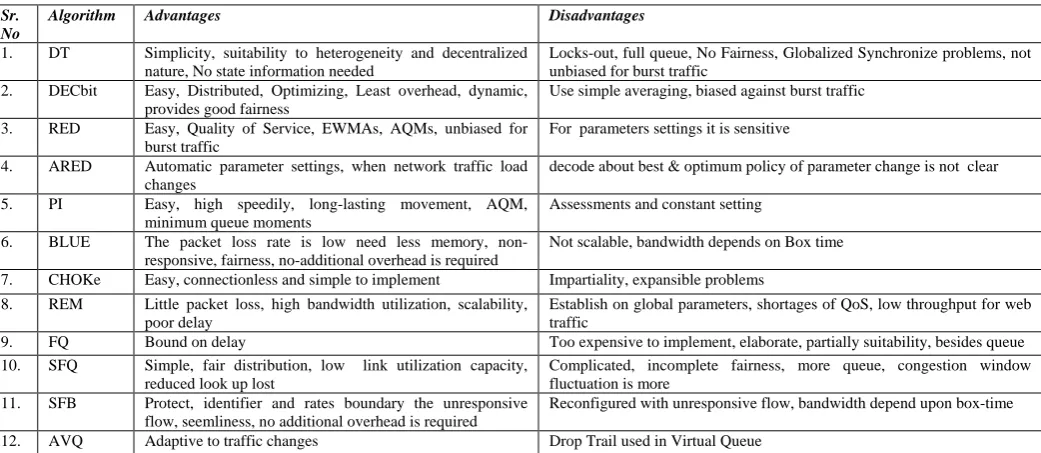
Further, the Table-2 as mentioned below discussed the advantages and disadvantages of the AQM algorithms.
Table II. Comparison Of AQM Algorithm With Respect to Advantage and Disadvantages
Sr. No
Algorithm Advantages Disadvantages
1. DT Simplicity, suitability to heterogeneity and decentralized nature, No state information needed
Locks-out, full queue, No Fairness, Globalized Synchronize problems, not unbiased for burst traffic
2. DECbit Easy, Distributed, Optimizing, Least overhead, dynamic, provides good fairness
Use simple averaging, biased against burst traffic
3. RED Easy, Quality of Service, EWMAs, AQMs, unbiased for burst traffic
For parameters settings it is sensitive
4. ARED Automatic parameter settings, when network traffic load changes
decode about best & optimum policy of parameter change is not clear
5. PI Easy, high speedily, long-lasting movement, AQM, minimum queue moments
Assessments and constant setting
6. BLUE The packet loss rate is low need less memory, non-responsive, fairness, no-additional overhead is required
Not scalable, bandwidth depends on Box time
7. CHOKe Easy, connectionless and simple to implement Impartiality, expansible problems 8. REM Little packet loss, high bandwidth utilization, scalability,
poor delay
Establish on global parameters, shortages of QoS, low throughput for web traffic
9. FQ Bound on delay Too expensive to implement, elaborate, partially suitability, besides queue 10. SFQ Simple, fair distribution, low link utilization capacity,
reduced look up lost
Complicated, incomplete fairness, more queue, congestion window fluctuation is more
11. SFB Protect, identifier and rates boundary the unresponsive flow, seemliness, no additional overhead is required
Reconfigured with unresponsive flow, bandwidth depend upon box-time
It is evident from both Table-1 and Table-2, that AQM algorithms provide well comparatively solutions for the congestion control in any communication network. However, the choice of Communication Network and types of data flow plays the important role in deciding the AQM algorithms performance. Therefore more and more research is needed to achieve the optimal performance of the Communication Network.
VI. REFERENCES
[1] D. Papadimitriou, "Open research issues in Internet Congestion Control", Internet Engineering Task Force, RFC6077, 2011.
[2] A. D. Gaya, H. B. Danbatta, A.G. Musa, “Survey on Congestion Control in High Speed Network”, IJARCSSE, vol. 5, no. 3, pp. 1237-1244, 2015.
[3] S. Keshav, "What is congestion and what is congestion control", In: Presentation at IRTF ICCRG Workshop, PFLDnet, Los Angeles, 2007.
[4] Xu L, Harfoush K, Rhee I, “Binary Increase Congestion Control (BIC) for Fast long- Distance Networks”, In Proceeding of IEEE INFOCOM, 2004.
[5] A. Reddy, C. Yang, “A Taxonomy for congestion control algorithms in packet switching networks", IEEE Network Mag., vol. 4, no. 9, pp. 34-45, 1995.
[6] A. Mankin, K. Ramakrishnan, "Gateway Congestion Control Survey",Network Working Group, RFC1254, 1991.
[7] B. Subramani, T. Karthikeyan, "A Review on congestion control”, IJARCCE, vol. 3, no. 1, pp. 5213-5217, 2014.
[8] Manjaragi S. V., “Comparative study of link utilization, queue, delay and loss Characteristics of Active queue management Schemes in Wireless networks”, IJERT, vol. 2, no. 4, pp. 2465-2471, 2013.
[9] Lowekamp, B. Tierney, B. Cottrell, L. Hughes-Jones, R. Kielmann, T. Swany, "A Hierarchy of Network Performance Characteristics for Grid Application and Services”, GFD-R-P.023, 2004.
[10] F. Postiglione, G. De Marco, M. Longo, "Run Time Adjusted congestion control for multimedia experimental results", Journal of Interconnection Network, vol. 5, no. 3, pp. 249-266, 2004.
[11] E. Crawley, R. Nair and et al., "A Framework for QoS based routing in the Internet”, Network Working Group, RFC2386, 1998.
[12] K. K. Ramakrishnan, R. Jain, "A Binary Feedback Scheme for congestion avoidance in computer network", ACM Transaction on computer system, vol. 8, no. 2, pp. 158-181, 1990.
[13] S. Floyd, V. Jacobson, "Random Early Detection Gateway for congestion avoidance", IEEE/ACM Transaction on Networking, vol. 1, no. 4, pp. 397-413, 1993.
[14] T.J. Ott, T.V. Lakshman, L. Wang, “SRED Stabilized RED”, Pro. IEEE INFOCOM, 1999.
[15] W.R. Stevens, “TCP Slow, Congestion Avoidance, Fast Retransmit, and Fast Recovery Algorithms”, RFC, 2001.
[16] J. Nagle, “Congestion Control in IP/TCP Internetworks”, RFC 896.
[17] Lin, Dong, Robert Morris, “Dynamics of Random Early Detection”, Pro. SIGICOMM, 1997.
[18] S. Shankar, S. Floyd, R. Gummadi, "Adaptive RED: An Algorithm for Increasing the Robustness of RED's Active Queue Management", 2001 Preprint Available at http://www.icir.org/floyd/papers.html.
[19] G.K. Wala, O.P. Gupta, S. Kumar, “Congestion Avoidance in packet networks using network simulator-3 (NS-3)”, OJCST, vo.9, no. 2, pp. 73-80, 2016.
[20] M. Agrawall, N. Tiwari, L. A. S. Chaurasia, J. Saraf, “ Performance comparison of active queue management algorithm”, ISCCC, Pro. Of CSIT, Singapore, Vo. 1, 2011.
[21] Wu –Chung Feng, Kang G. Shin, Dilip D. Kandlur , Debanjan Saha, "The Blue Active Queue Management Algorithm", IEEE ACM Transaction on Networking, 2002.
[22] Rong Pan, Konstantionos Psounis, Balaji Prabhakar, "CHOke: a stateless active queue management scheme for approximating fair bandwidth allocation", IEEE INFOCOM, 2000.
[23] Sanjeewa Athuraliya, Steven H. Low, Victor H. Li, Qinghe Yin, "REM: Active Queue Management," IEEE Network, 2001.
[24] Alan Demers, Srinivasan Keshav, Scott Sheker, "Analysis and simulation of a fair Queueing algorithm", SIGCOMM Symposium on communication Architectures and Protocols, Austin, Texas, pp. 1-12, 1998.
[25] P. E. McKenney, "Stochastic Fairness Queueing", Proc. IEEE INFOCOM2, pp. 733-740, 1990.
[26] W. Feng, D. D. Kandlur, D. Saha, K. G. Shin, “Stochastic Fair Blue: A queue management algorithm for enforcing fairness”, IEEE INFOCOM, 2001.