R E S E A R C H
Open Access
CMI analysis and precoding designs for
correlated multi-hop MIMO channels
Nguyen N Tran
1*, Song Ci
2and Ha X Nguyen
3Abstract
Conditional mutual information (CMI) analysis and precoding design for generally correlated wireless multi-hop multi-input multi-output (MIMO) channels are presented in this paper. Although some particular scenarios have been examined in existing publications, this paper investigates a generally correlated transmission system having spatially correlated channel, mutually correlated source symbols, and additive colored Gaussian noise (ACGN). First, without precoding techniques, we derive the optimized source symbol covariances upon mutual information maximization. Secondly, we apply a precoding technique and then design the precoder in two cases: maximizing the mutual information and minimizing the detection error. Since the optimal design for the end-to-end system cannot be analytically obtained in closed form due to the non-monotonic nature, we relax the optimization problem and attain sub-optimal designs in closed form. Simulation results show that without precoding, the average mutual information obtained by the asymptotic design is very close to the one obtained by the optimal design, while saving a huge computational complexity. When having the proposed precoding matrices, the end-to-end mutual information significantly increases while it does not require resources of the system such as transmission power or bandwidth.
Keywords: Precoding design; MIMO spatially correlated channel; Mutual information and channel capacity; Multi-hop relay network; Colored noise
1 Introduction
With the fast-paced development of computing tech-nologies, wireless devices have enough computation and communication capabilities to support various multime-dia applications. To deliver high-quality multimemultime-dia over a wireless channel, multi-input multi-output (MIMO) nology has been emerging as one of the enabling tech-nologies for the next-generation multimedia systems by providing very high-speed data transmission over wireless channels [1]. In the last decade, MIMO has been adopted by almost all new LTE, 3GPP, 3GPP2, and IEEE standards for wireless broadband transmission to support wireless multimedia applications [2-7]. A fundamental assumption of MIMO system design is placing antennas far enough [3] from each other to make fading uncorrelated. It means that different pairs of transmitting and receiving antennas are uncorrelated so that the channel statistical knowl-edge can be expressed as a diagonal covariance matrix.
*Correspondence: [email protected]
1Faculty of Electronics and Telecommunications, University of Science, Vietnam National University, Ho Chi Minh City, Vietnam
Full list of author information is available at the end of the article
However, this assumption is no longer held true for com-pact embedded multimedia system design due to the small form factor. The compact system design will cause a MIMO spatial correlation problem [8-13], leading to a significant deterioration on the system performance. Furthermore, the pervasive use of computing devices such as laptop computers, PDAs, smart phones, automo-tive computing devices, wearable computers, and video sensors leads to a fast-growing deployment of wireless mesh networks (WMN) [14] to connect these comput-ing devices by a multi-hop wireless channel. Therefore, how to achieve high channel capacity by using multi-hop MIMO transceivers under strict space limitations is the fundamental question targeted in this paper.
In the first part of this paper, we analyze the capacity (or bound on the capacity) of generally correlated wireless multi-hop amplify-and-forward (AF) MIMO channels. For generality, we consider a wireless system, in which the channel at each hop is spatially correlated but inde-pendent of that at the other hops, the source symbols are mutually correlated, and the additive Gaussian noises are colored. Although most previous works on wireless
channel only considerwhitenoise anduncorrelateddata symbols, the assumption of white noise is not always true (see, e.g.,[15-19]). Moreover, in practice, the case of corre-lated data symbols arises due to various signal processing operations at the baseband in the transmitter.
For less than three-hop wireless channel, various works have been done on the capacity or bounds on the capac-ity [1,13,20-24]. For multi-hop relay network, capaccapac-ity analysis was proposed in [25-27]. In [25], the authors considered rate, diversity, and network size in the anal-ysis. In [26,27], the authors assumed that there is no noise at relay nodes, and the number of antennas is very large. Since these assumptions are not feasible in com-pact MIMO design with mutual interference, in this paper, we consider a generally correlated system at the wireless fading channel, data symbols, and additive colored Gaus-sian noises (ACGN). It includes the correlated system assumption in [26,27] as a special case. First, we derive the optimal source symbol covariance to maximize the mutual information between the channel input and the channel output when having the full knowledge of chan-nel at the transmitters. Secondly, the numerical interior point method-based solution and an asymptotic solu-tion in closed form are derived to maximize the average mutual information when having only the channel statis-tics at the transmitters. Although the asymptotic design is very simple and comes by maximizing an upper bound of the objective function, simulation results show that the asymptotic design performs well as the numerically optimal design.
In the second part of this paper, we apply the precod-ing technique and then design the precodprecod-ing matrix to either maximizing the mutual information or minimiz-ing the detection error. It has been shown in [20] that beamforming, which can be considered as a particular case of precoding, increases the mutual information of single-hop MIMO channel. In [28], the outage capacity of multi-hop MIMO networks is investigated, and the per-formance of several relaying configurations and signaling algorithms is discussed. In [25], the authors considered rate, diversity, and network size in the analysis. The multi-hop capacity of OFDM-based MIMO-multiplexing relay-ing systems is derived in [29,30] for frequency-selective fading channels. Apparently, in the literature, only refer-ences [26,27] actually study the asymptotic capacity and precoding design for wireless correlated multi-hop MIMO relay networks. Under a special case of wireless chan-nels having only white noise at the destination, no noise at all relay levels, and the number of antennas is very large (to infinity); references [26,27] provide the precod-ing strategy and asymptotic capacity. Since the special wireless channel assumption in [26,27] is not always feasi-ble for compact MIMO design with space limitation and mutual interference at various signal-to-noise ratio (SNR)
levels, in this paper, we design precoders for the gener-ally correlated AF system. Obviously, the optimal capacity and precoding design cannot be analytically obtained in closed form as the design problem is very complicated and neither convex nor concave. Similarly to [26,27], for gen-erally correlated multi-hop MIMO channels, we propose asymptotic designs in closed form.
First, instead of designing the optimal precoding strat-egy to maximize the end-to-end mutual information, we derive the sub-optimal precoding strategy by optimally maximizing the mutual information between the input and output signals at each hop. Since the mutual infor-mation and detection error have a very close relationship, we further propose the other sub-optimal precoding strat-egy by optimally minimizing the mean square error (MSE) of the soft detection of the transmitted signal at each hop. Simulation results show that the asymptotic precod-ing designs are efficient. They significantly increase the end-to-end mutual information, while do not require any resource of the system such as transmission power or bandwidth.
The paper is organized as follows. Section 2 first describes the correlated wireless multi-hop MIMO model without any precoding techniques and then designs the source signal covariance to maximize the mutual infor-mation in two cases: having full knowledge of channel state information at the transmitters and having only the channel statistics at the transmitters. Section 3 first proposes the precoding design to maximize the mutual information and then proposes the precoding design to minimize the soft detection error. Simulation results are provided in Section 4 and Section 5 concludes the paper.
Notation:Boldface upper and lower cases denote matri-ces and column vectors. Superscript∗andH depict the complex conjugate and the Hermitian adjoint operator, while⊗stands for the Kronecker product.INis theN×N identity matrix. Sometimes, the indexNare omitted when the size of the identity matrix is clear in the context.E{z}
is the expectation of the random variablez andtr{A}is the trace of the matrixA.I(.)andH(.)denote the mutual information and the entropy, respectively.Rxydepicts the covariance matrix of two random variablesxandy.A≤B
(A < B, respectively) for symmetric matrices AandB
means that B− A is a positive semi-definite (definite, respectively) Hermitian matrix.
2 The correlated channel and mutual information maximization
2.1 Spatially correlated wireless multi-hop MIMO channel
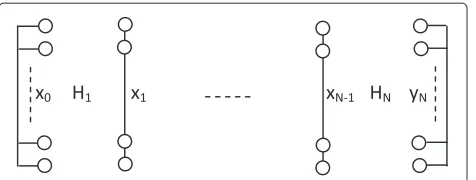
Consider anN-hop wireless MIMO channel as presented in Figure 1. The MIMO system has a0 antennas at the
Figure 1AnN-hop wireless MIMO channel with spatial correlations at both transmitting and receiving sides.
hop is represented by the Kronecker model [11,12,31-35] as: covariance matrices that capture the correlations of the transmitting and receiving antenna arrays, respectively. The matrixHwiis anai×ai−1matrix whose entries are
independent and identically distributed (i.i.d.) circularly symmetric complex Gaussian random variables of vari-anceσhi2, i.e.,CN(0,σhi2). The known matricesriandti are assumed to be invertible and have the following forms:
ti= tively) reflects the correlated fading between thei-th and the j-th (n-th and m-th, respectively) elements of the transmitting (receiving, respectively) antenna array. The channel at each hop undergoes correlated MIMO Rayleigh flat fading. However, the fading channels of any two differ-ent hops are independdiffer-ent. Moreover, the channel at each hop is quasi-static block fading with a suitable coherence time for the system to be in the non-ergodic regime.
The ACGN ati-th hop is definied asniwith zero-mean and covariance matrixE{ninHi } =Ri,i= 1,. . .,N. Addi-tionally,n1,. . .,nN are all independent of each other, i.e., the colored noise at each hop is statistically uncorrelated with the colored noise at the other hops.
The vector x0 that contain the data symbols at the source is modeled as complex random variables with covariance matrixRx0 =E
βIa0for the case of uncorrelated data symbols.
Accordingly, the received signal at the destination can be expressed as:
be the end-to-end equivalent channel, and
˙
n=nN+HNnN−1+HNHN−1nN−2+. . . +HNHN−1. . .H2n1
be the end-to-end equivalent noise with the noise covari-ance matrix being
Therefore, Equation 2 can be rewritten as:
˙
yN =GNx0+ ˙n. (4)
2.2 Mutual information maximization and channel
capacity when having channel state information at the transmitters
The conditional mutual information (CMI) [36] between the transmitted signal x0 and the received signal y˙N in Equation 4 is given by:
I(x0;y˙N)=H(x0)−H(x0|˙yN) (5)
=H(y˙N)−H(y˙N|x0). (6)
For the MIMO channel in Equation 4, the capacity is defined as [36]:
C=max
p(x) I(x0;y˙N), (7)
Note that we have the fundamental condition [37] det(I+XY)=det(I+YX). By Theorem 3 and Theorem 4 in the Appendix, the CMI in Equation 6 can be expressed as:
To obtain the channel capacity, we now design the transmitted signal covariance to maximize the mutual information in Equation 8:
under the allowed transmitted signal power P0. For
simple cases of channel characteristics, the solution of Equation 10 can be derived from the Hadamard inequal-ity argument [36]. We now give a direct solution method based on spectral optimization for the general case.
LetQ=Rx0 ≥0 andP=GHNR−n˙1GN >0. Equation 10 can be written as:
max
Q≥0,tr(Q)≤P0log det(I+QP), (11)
where its optimal solution Qcan be obtained in closed form by the following theorem.
Theorem 1. The optimal solutionQto the maximization problem
max
Q≥0,tr{Q}≤P0log det(I+QP), (12)
isQ=UHD−P1XU. Here,Uis the unitary matrix obtained from the singular value decomposition (SVD) of P = UHDPU, andXis the diagonal matrix having its diagonal elements X(i,i)satisfy:
D−P1(i,i)X(i,i)=(μ−1−D−P1(i,i))+, (13)
where x+ = max{0,x} and μ is chosen such that Trace(D−P1X)=P0.
Proof of Theorem 1. : See Appendix.
2.3 Average mutual information maximization and
channel capacity with only the channel statistics at the transmitters
The end-to-end mutual information between the trans-mitted signal x0 and received signal y˙N in Equation 4
is given by Equation 6. When considering the mutual information for a long time period, the average end-to-end mutual information between channel input x0 and
channel output(y˙N,GN)can be expressed as:
Under the transmitted power constraintP0, we have to
solve the this optimization problem:
max
to obtain the capacity in the non-ergodic regime of the system. Since the objective function is the expectation of a concave function with respect to the to-be-designed variable, obtaining the optimal solution in closed form to this problem is very difficult or almost impossible. We propose to use ‘SeDuMi’ [38] or ‘SDPT 3’ [39] solver for a numerically optimal solution. To reduce the computa-tional complexity, an asymptotic solution in closed form is also derived by relaxing the objective function.
Since the functionRx0 → log det
I+Rx0GHNR−n˙1GN
is concave, it is obvious that:
EGN
Therefore, instead of maximizing the average end-to-end mutual information between the channel input and channel output, we now maximize an upper bound of the mutual information. Simulation results will show that this upper bound is closed to the true mutual information value. The relaxed optimization problem is now expressed as: it can be seen that Problem (15) is now in the form of (11), and hereby, the solution to (15) can be optimally obtained.
3 Precoding design for spatially correlated wireless multi-hop MIMO channel
3.1 PrecodedN-hop wireless MIMO channel formulation
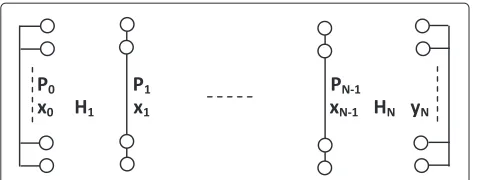
By applying the precoding technique to the wireless sys-tem, a precoded N-hop wireless MIMO channel is pre-sented in Figure 2. Before transmitting over the wireless channel, the source signalx0is linearly precoded by a
lin-ear precoder P0 such that the transmitted signal at the
source is:
¯
Figure 2A precodedN-hop wireless MIMO channel with spatial correlations at both transmitting and receiving sides.
For the sake of saving transmission bandwidth, all pre-coding matrices considered in this paper are square, i.e., non-redundancy precoder. The purpose of precoding technique here is to re-form the transmitted signal and re-allocate the transmitted power such that the transmit-ted signal can effectively combat the spatial correlation and colored noise in the eigen-mode. For single-hop wire-less channels, the non-redundancy precoders to cope with spatial correlations and colored noises have been success-fully proposed in [35,40] and in [19], respectively.
The received signal at the first hop can be expressed as:
x1=H1x¯0+n1=H1P0x0+n1.
Since the AF strategy is considered, the received signalxi at thei-th hop is also the source signal at the next hop. Before transmitting over the wireless channel, the source signalxi is also linearly precoded by a linear precoderPi such that the transmitted signal at thei-th transmitter is:
¯
xi=Pixi, Pi∈Cai×ai, i=1,. . .,N−1.
To keep the transmitted power unchanged after precod-ing, the precoder matrices are restricted as:
trPiRxiP H i ≤tr
Rxi , i=0,. . .,N−1, (16)
such that they satisfy the per-node long-term average power constraint:
trR¯xi =tr
Ex¯ix¯iH
=trPiRxiP H i ≤trRxi =tr
ExixHi
. (17)
The received signal at the destination is given by:
¯
yN = ¯GNx0+ ¯n, (18)
where
¯
GN =HNPN−1HN−1PN−2. . .H2P1H1P0 (19)
is the end-to-end equivalent channel, and:
¯ n=nN
+HNPN−1nN−1
+HNPN−1HN−1PN−2nN−2 +. . .
+HNPN−1HN−1. . .H3P2n2 +HNPN−1HN−1. . .H3P2H2P1n1
(20)
is the end-to-end equivalent colored noise. The noise covariance matrix is calculated as:
Rn¯=E
¯ nn¯H =RN
+HNPN−1RN−1PHN−1HHN
+HNPN−1HN−1PN−2RN−2PHN−2HHN−1PHN−1HHN +. . .
+HNPN−1HN−1. . .H3P2R2PH2HH3. . .HHN−1PHN−1HHN +HNPN−1HN−1. . .H3P2H2P1R1PH1HH2PH2HH3 . . . ×HHN−1PHN−1HHN.
(21)
By Theorem 3 and Theorem 4 in the Appendix, the instantaneous end-to-end mutual information between the system inputx0and the system outputy¯Nis given by:
I(x0;y¯N)=H(x0)−H(x0|¯yN) =log det(πeRx0)
−log det
πe
Rx0−RT¯yNx0R
†
¯ yNRy¯Nx0
=log detI+Rx0G¯HNR−n¯1G¯N
.
(22)
Fori=1,. . .,N, the capacity of the system is
C=max Pi−1
log detI+Rx0G¯NHR−n¯1G¯N
s.t. trPi−1Rxi−1P H i−1 ≤tr
Rxi−1 .
(23)
The maximum is taken over all possible precoding matricesPi−1,i=1,. . .,N. The design problem is how to
obtain the optimal set of precoding matricesPi−1to
max-imize the mutual information and consequently attain the channel capacity (Equation 23) of the correlated MIMO multi-hop wireless channel.
3.2 Asymptotic capacity and precoder design to maximize the individual mutual information
Since the objective function in Equation 23 is very com-plicated and neither a convex nor a concave function with respect to the to-be-designed variablesPi−1,
the objective function to obtain an asymptotic solution in closed form.
Instead of maximizing only the end-to-end mutual information between the source and the destination, we propose to maximize the individual mutual information between the transmitted signal and received signal at all hops. Based on each maximization problem at each hop, one after the others, each precoding matrix is designed.
Similarly to single-hop wireless models, it can be seen that the input-output relationship at each hop can be expressed as:
xi=Hix¯i−1+ni=HiPi−1xi−1+ni,i=1,. . .,N. (24)
Note that we have the fundamental condition [37] det(I+XY)=det(I+YX). By Theorem 3 and Theorem 4 in the Appendix, the mutual information between the sys-tem inputxi−1and the system outputxiat thei-th hop is
by solving the maximization problems:
max
Fori=1, the maximization problem (26) becomes:
max
where its optimal solution Qcan be obtained in closed form by Theorem 1. It can be be seen that the variable change Q = P0Rx0PH0 ≥ 0 is legal as for every known
matrixQ, one can easily find out a corresponding matrix
P0=Q1/2R−x01/2.
From the optimal value ofQ, it is obvious to have the optimal value ofP0sinceRx0is semi-definite. After having the optimal value ofP0, from Equation 24, the covariance
matrixRx1 can be calculated easily. It is also obvious to see thatRx1 is semi-definite. Consequently, by using the optimal precoding matrices in the previous hops, the pre-coding matrixPi−1,i = 2,. . .,N in the currenti-th hop
can be optimally obtained by solving the maximization problems:
3.3 Precoding design to minimize the detection error
When designing a wireless system, one criterion which is usually used for this purpose is the minimization of the detection error. To detect the source signalx0from the
received signal in Equation 18, the minimum mean square error (MMSE) estimator ofx0is [41]:
x0=
finalharddecisionx0is obtained by appropriately
round-ing up each element ofx0to the nearest signal point in the
constellation. The mean square error (MSE) in the MMSE estimation of the source symbols from the received signal at the destination is given by [41]:
tr
R−x01+ ¯GHNR−n¯1G¯N
−1
. (30)
In order to improve the detection performance, instead of designing the precoding matricesPi−1,i= 1. . .,N to
maximize the end-to-end mutual information as shown in the above sections, we now design the precoding matrices
Pi−1to minimize the MSE (Equation 30) under the power
constraint in Equation 16.
Similar to the design for mutual information maxi-mization, it can be seen that the objective function in Equation 31 is very complicated and neither a convex nor a concave function with respect to the to-be-designed variables Pi−1. Since it is impossible to obtain the
opti-mal solution in closed form for Problem (31), we relax the optimization problem (31) for an asymptotic solution in closed form.
The precoding matricesPi−1are obtained by solving the This optimization problem has the same form and solu-tion as those in [19], Equasolu-tion 12. The optimal solusolu-tion is summarized in the following.
LetMbe the rank ofQi. Make the following SVDs of Qi=UHQQUQandRxi−1 =UHxi−1xi−1Uxi−1. Here,Q= diagMQ2 0, withMQ>0, is a diagonal matrix having the eigenvalues of Qi on its main diagonal in decreas-ing order and UQ is the unitary matrix whose columns are the corresponding eigenvectors of Qi. Analogously,
xi−1 >0 is the diagonal matrix having the eigenvalues of Rxi−1in decreasing order on its main diagonal, andUxi−1is the unitary matrix whose columns are the corresponding eigenvectors.
Theorem 2. The optimal precoder matrices Pi−1 to be
used with the MMSE detection at each hop are:
Pi−1=UHQ diag
This section provides simulation results to illustrate the performance of the proposed designs. In all simulation results presented in this section, colored noise is gener-ated by multiplying a matrixGiwith white noise vectorwi [19], whose components areCN(0,σ2
w). This means that the covariance matrix of colored noise isRi = σw2GiGHi . To have the average power of colored noise the same as that of white noise,Giis chosen such thattr{GiGHi } =ai, i=1,. . .,N. The average transmitted power is chosen to be unity, the signal-to-noise ratio (SNR) in dB is defined asSNR = −10log10σw2, and the average noise power can be calculated asσw2=10−SNR/10.
The wireless channel model is assumed to be quasi-static block fading and spatially correlated by the Kronecker model withσhi2 = 1. The one-ring model in
([13], Equation 6) is used to generate the elements of the covariance matricesriandti. Specifically,ti(n,m)≈ (in radian) of the transmitter and the receiver at thei-th hop;dti = 0.5λ anddri = 0.3λare the spacings of the transmitting and receiving antenna arrays at thei-th hop; λ is the wavelength andJ0(·) is the zeroth-order Bessel
function of the first kind. Note that the angle spreads, tiandri, the wavelengthλ, and the antenna spacings, dtianddri, determine how correlated the fading is at the transmitting and receiving antenna arrays at each hop.
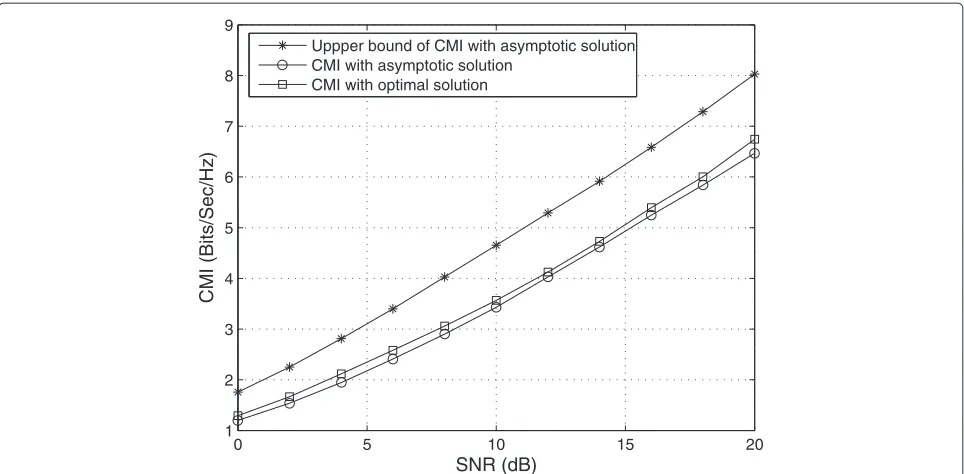
Figure 3 presents the mutual information of correlated four-hop wireless channels under colored noise with ideal channel state information at the transmitters (CSIT) when having 2×2 and 4×4 MIMO antennas. We used ‘SeDuMi’ [38] solver for the numerically optimal solution. It can be observed that the closed-form solution and the numerical solution yield the same optimal mutual information value. Figure 4 shows the mutual information of two-hop wireless 2× 2 MIMO channels under colored noise in three cases: 1) the upper bound of the average end-to-end mutual information with the asymptotic design solution obtained from Section 2.3, 2) the average end-to-end mutual information with the asymptotic design, and 3) the average end-to-end mutual information with the optimal design solution obtained from the numerical interior-point-method. It can be seen in Figure 4 that the average end-to-end mutual information with asymptotic design is very closed to that obtained by the numerical interior point method. However, these mutual informa-tion values are less than and closed to the upper bound of the mutual information obtained by the asymptotic
0 5 10 15 20
0 5 10 15 20 1
2 3 4 5 6 7 8 9
SNR (dB)
CMI (Bits/Sec/Hz)
Uppper bound of CMI with asymptotic solution CMI with asymptotic solution
CMI with optimal solution
Figure 4Comparison of average mutual information for a correlated four-hop MIMO channel under colored noise with only the channel statistics at the transmitters.
solution. It verifies that the asymptotic design can effi-ciently yield an acceptable mutual information while sav-ing a huge computational complexity compared to the numerical design, especially when the system size is large. When precoding technique is applied, the wireless channel model has 4×4 MIMO antennas, and the vector
x0ofa0correlated source symbols are generated asx0 =
Gss0, wheres0is a length-a0vector of uncorrelated
sym-bols drawn from the Gray-mapped quadrature phase-shift keying (QPSK) constellation of unit energy. The matrix
Gsis generated arbitrarily but normalized such thatGsGHs has unit elements on the diagonal. This ensures the same transmitted power as in the case of uncorrelated data symbols. Note that the correlation matrix of the source symbols isRx0 =GsGHs .
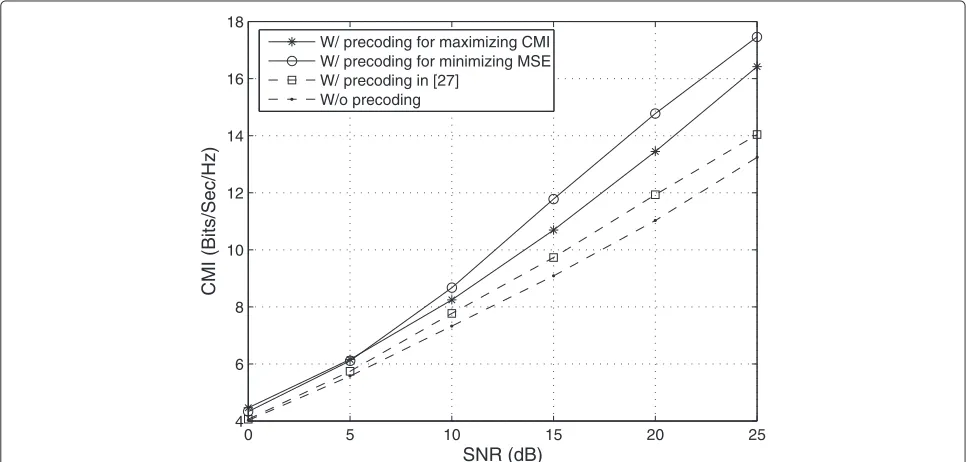
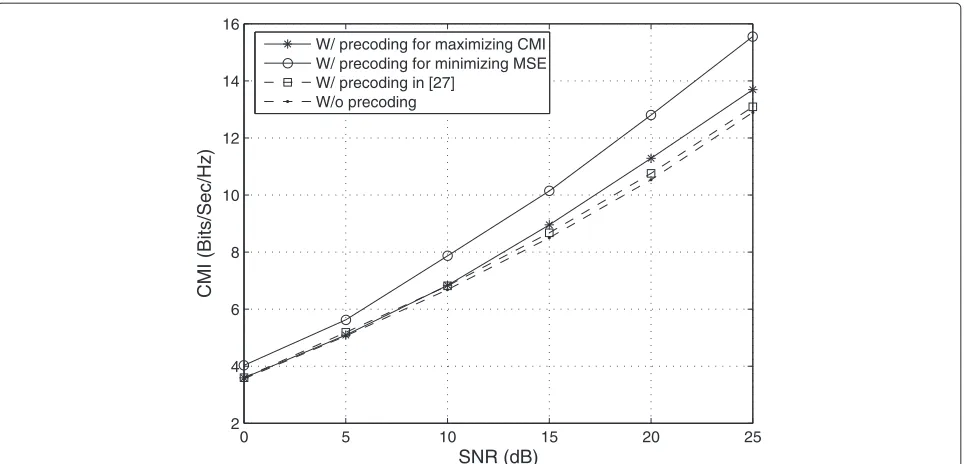
Figures 5, 6, and 7 present the end-to-end mutual information values of correlated wireless MIMO channels having correlated source symbols under colored noise in four cases: 1) with the precoding design in Section 3.2 to maximize the individual mutual information, 2) with the precoding design in Section 3.3 to minimize the indi-vidual soft detection error, 3) with the precoding design in ([27], Section V-C), and 4) without the precoding techniques.
In Figure 5, the wireless channel under consideration has only one hop. In this single-hop scheme, the proposed design to maximize the mutual information is obviously optimal as the end-to-end mutual information is also the mutual information at the only hop. As expected, three systems having the precoding techniques perform better
than the system without being applied the precoding tech-nique. It can be observed that the mutual information with the precoding design to maximize the mutual information is better than that of the precoding design to minimize the soft detection error. However, the more important observation is that both the end-to-end mutual informa-tion values of the wireless systems having the proposed precoding designs are larger than the mutual information value of the design in ([27], Section V-C). This perfor-mance gain is reasonable as the design in ([27], Section V-C) only proposed optimal precoding directions with equal power allocation, while in our designs two precod-ing problems of transmitted power allocation and trans-mitted signal direction are optimally designed at each hop.
In Figure 6, the simulation results for the two-hop wireless MIMO channels are illustrated. In this two-hop scheme, although the end-to-end mutual information val-ues of the wireless systems having the proposed precoding designs are better than that of the wireless system hav-ing the precodhav-ing design in ([27], Section V-C), it is very interesting that the precoding design to minimize the soft detection error gives a better capacity performance than that of the precoding design to maximize the mutual information.
0 5 10 15 20 25 4
6 8 10 12 14 16 18 20
SNR (dB)
CMI (Bits/Sec/Hz)
W/ precoding for maximizing CMI W/ precoding for minimizing MSE W/ precoding in [27]
W/o precoding
Figure 5 Comparison of end-to-end mutual information for correlated wireless single-hop MIMO channels with and without precoding techniques.
all the proposed precoding designs for four-hop wireless channels have a better performance than that of the sys-tem without the precoding technique.
5 Conclusions
In this paper, the closed-form source symbol covari-ance is designed to maximize the mutual information between the channel input and the channel output of
correlated wireless multi-hop MIMO systems when hav-ing the full knowledge of channel at the transmitters. When having only channel statistics at the transmitters, the numerically optimal source symbol covariance and a sub-optimal source symbol covariance in closed form are designed to maximize the average end-to-end mutual information. Moreover, two sets of precoding matrices are sub-optimally designed for generally correlated multi-hop
0 5 10 15 20 25
4 6 8 10 12 14 16 18
SNR (dB)
CMI (Bits/Sec/Hz)
W/ precoding for maximizing CMI W/ precoding for minimizing MSE W/ precoding in [27]
W/o precoding
0 5 10 15 20 25 2
4 6 8 10 12 14 16
SNR (dB)
CMI (Bits/Sec/Hz)
W/ precoding for maximizing CMI W/ precoding for minimizing MSE W/ precoding in [27]
W/o precoding
Figure 7Comparison of end-to-end mutual information for correlated wireless four-hop MIMO channels with and without precoding techniques.
MIMO channels. The first design is obtained by max-imizing the mutual information between the input and output signals at each hop while the second design is obtained by minimizing the MSE of the soft detection at each hop. Simulation results show that the proposed precoding designs significantly increase the end-to-end mutual information of the wireless system, while it does not spend system resources such as transmission power or bandwidth.
Appendix
Theorem 3. ([42], p. 522) Suppose that y and x are two random variables of zero mean with the covariance matrix:
Rx,y=
Ry Ryx RTyx Rx0 =
EyyH EyxH ExyH ExxH
Then, the conditional distribution x|y has the covari-ance:
Rx0−R T yxR†yRyx.
Here,R†yis the pseudo-inverse ofRy.
Theorem 4. ([1], Lemma 2) For any zero-mean random vector xwith the covarianceE{xxH} = Rx0, the entropy [36] ofxsatisfies:
H(x)≤log det(πeRx0)
with equality if and only if x is a circularly symmetric complex Gaussian random variable with zero mean and covarianceRx0, i.e., among the random variables with the
same mean and covariance, the Gaussian one gives the largest entropy.
Proof of Theorem 1.The function F(Q) = log det(I+ QP) is not readily spectral. However, we can deduce Equation 11 to spectral optimization by making the SVD of P = UHDPU and changing the variable X = √
DPUQUH√DP in Equation 12, it can be seen that tr(Q) = tr(UHD−P1/2XDP−1/2U) = tr(D−P1X). Therefore, the optimization problem (12) is now expressed as follows:
max X≥0,tr(D−P1X)≤P
log det(I+X) (35)
where the functionX→log det(I+X)is spectral and the functionX → Trace(D−P1X) is linear and thus differen-tiable. According to [43]:
!
log det(I+X)"=VH(I+DX)−1V=(I+X)−1,
Trace(D−P1X)
=D−P1,
whereX=VHDXVby SVD.
For simplicity, we relax the constraint X ≥ 0 in Equation 35 by Xii ≥ 0, i.e., instead of Equation 35 we consider:
max Xii≥0,Tr(D−P1X)≤P
log det(I+X). (36)
the same optimal solution. The Lagragian of Equation 36 convex so Equation 36 is a convex programming. Accord-ing to the Karush-Kuhn-Tucker (KKT) condition [44] for the optimality of convex programming, the optimal solu-tion to the optimizasolu-tion problem in Equasolu-tion 36 and the corresponding Lagrange multipliers must satisfy the following necessary and sufficient conditions:
0= ∂L(α,μ)
From Equation 37, it is clear that X is diagonal, and therefore, Equations 35 and 36 are equivalent. Solving Equations 37 and 38 gives the following water-filling solu-tion:
The authors declare that they have no competing interests.
Acknowledgements
This research is funded by Vietnam National Foundation for Science and Technology Development (NAFOSTED) under grant number 102.02-2012.28.
Author details
1Faculty of Electronics and Telecommunications, University of Science, Vietnam National University, Ho Chi Minh City, Vietnam.2Department of Computer and Electronics Engineering, University of Nebraska-Lincoln, Omaha NE 68182, USA.3School of Engineering, Tan Tao University, Tan Duc E-city, Duc Hoa, Long An, Vietnam.
Received: 7 September 2014 Accepted: 5 April 2015
References
1. IE Telatar, Capacity of multi-antenna Gaussian channels. Eur Trans. Tele.
10, 585–595 (1999)
2. IS Association. IEEE 802.11: Wireless LAN medium access control (MAC) and physical layer (PHY) specifications, 2007 edition. http://standards. ieee.org/getieee802/download/802.11-2007.pdf, 2007
3. Linksys, Linksys WRT54G. http://www.speedguide.net/broadband-view. php?hw=36, 2006
4. 3GPP TSG RAN TR 25.848 v4.0.0, Physical Layer Aspects of UTRA High Speed Downlink Packet Access (release 4) (2004)
5. 3GPP2 TSG C.S0002-C v1.0 Physical Layer Standard for cdma2000 Spread Spectrum Systems (1999)
6. A Doufexi, S Armour, M Butler, A Nix, D Bull, J McGeehan, P Karlsson, A comparison of the HIPERLAN/2 and IEEE 802.11a wireless LAN standards. IEEE. Commun. Mag.40, 172–80 (2002)
7. IEEE Std 802.16g, Local and Metropolitan Area Networks Part 16: Air Interface for Fixed Broadband Wireless Access Systems (2002) 8. JP Kermoal, L Schumacher, PE Mogensen, KI Pedersen, inProc. IEEE Veh.
Technol. Conf. (VTC-Fall). Experimental investigation of correlation properties of MIMO radio channels for indoor picocell scenario, (2000), pp. 14–21
9. H Bolcskei, D Gesbert, AJ Paulraj, On the capacity of OFDM-based spatial multiplexing systems. IEEE Trans. Commun.50, 225–234 (2002) 10. H Zhang, Y Li, A Reid, J Terry, Optimum training symbol design for MIMO
OFDM in correlated fading channels. IEEE Trans. Wireless Commun.5, 2343–2347 (2006)
11. H Bolcskei, M Borgmann, AJ Paulraj, Impact of the propagation environment on the performance of space-frequency coded MIMO-OFDM. IEEE J. Selected Areas Commun.21, 427–439 (2003) 12. M Enescu, T Roman, V Koivunen, State-space approach to spatially
correlated MIMO OFDM channel estimation. Signal Process. ScienceDirect.87, 2272–2279 (2007)
13. D Shiu, G Foschini, M Gans, J Kahn, Fading correlation and its effect on the capacity of multielement antenna systems. IEEE Trans. Commun.48, 502–513 (2002)
14. I Akyildiz, X Wang, A survey on wireless mesh networks. IEEE Commun. Magazine.43, S23–S30 (2005)
15. K Shi, E Serpedin, P Cibat, Decision- directed fine synchronization in OFDM systems. IEEE Trans. Commun.53, 408–412 (2005)
16. T Wong, B Park, Training sequence optimization in MIMO systems with colored interference. IEEE Trans. Commun.12, 1939–1947 (2004) 17. YP Lin, S Phong, Optimal ISI-Free DMT transceiver for distorted channels
with colored noise. IEEE Trans. Signal Process.49, 2702–2712 (2001) 18. CD Richmond, Mean-squared error and threshold SNR prediction of
maximum-likelihood signal parameter estimation with estimated colored noise covariances. IEEE Trans. Inf. Theory.52, 2146–2164 (2006) 19. NN Tran, HD Tuan, HH Nguyen, Training signal and precoder designs for
OFDM under colored noise. IEEE Trans. Veh. Technol.57, 3911–3917 (2008) 20. S Jafar, S Vishwanath, A Goldsmith, inProc. Inter. Conf. Conmun. (ICC).
Channel capacity and beamforming for multiple transmit and receive antennas with covariance feedback, (2001), pp. 2266–2270 21. A Goldsmith,Wireless Communications. (Cambridge, University press,
2005)
22. SL Loyka, Channel capacity of two-antenna BLAST architecture. Electron. Letter.35, 1421–1422 (1999)
23. B Wang, J Zhang, A Hst-Madsen, On the capacity of MIMO relay channels. IEEE Trans. Inform. Theory.51, 29–43 (2005)
24. H Bolcskei, R Nabar, O Oyman, A Paulraj, Capacity scaling laws in MIMO relay networks. IEEE Trans. Wireless Commun.5, 1433–1444 (2006) 25. S Borade, L Zheng, R Gallager, Amplify-and-forward in wireless relay
networks: rate, diversity, and network size. IEEE Trans. Inform. Theory.53, 3302–3318 (2007)
26. N Fawaz, K Zarifi, M Debbah, D Gesbert, inIEEE ITW08, Information Theory Workshop. Asymptotic capacity and optimal precoding strategy of multi-level precode & forward in correlated channels, (2008), pp. 209–213 27. N Fawaz, K Zarifi, M Debbah, D Gesbert, Asymptotic capacity and optimal precoding in MIMO multi-hop relay network. IEEE Trans. Infor. Theory.57, 2050–2069 (2011)
28. Y Fan, JS Thompson, inProc. IEEE GLOBECOM 2005. On the outage capacity of mimo multihop networks, (2005), pp. 2208–2213 29. AI Sulyman, G Takahara, HS Hassanein, M Kousa, inProc. IEEE ICC 2009.
Multi-hop capacity of MIMO-multiplexing relaying in WiMAX Mesh networks, (2009), pp. 1–5
30. AI Sulyman, G Takahara, HS Hassanein, M Kousa, Multi-hop capacity of MIMO-multiplexing relaying systems. IEEE Trans. Wireless Commun.8, 3095–3103 (2009)
32. K Yu, M Bengtsson, B Ottersten, D McNamara, P Karlsson, Modeling of wideband MIMO radio channels based on NLoS indoor measurements. IEEE Trans. Veh. Technol.53, 655–665 (2004)
33. JH Kotecha, AM Sayeed, Transmit signal design for optimal estimation of correlated MIMO channel. IEEE Trans. Signal Process.52, 546–557 (2004) 34. H Bolcskei,Principles of MIMO-OFDM wireless systems.CRC Handbook on
Signal Processing for Communications. (M Ibnkahla, ed.), (2004). to appear, online at http://www.nari.ee.ethz.ch/commth/pubs/p/crc03 35. NN Tran, HD Tuan, HH Nguyen, Superimposed training designs for
spatially correlated MIMO-OFDM systems. IEEE Trans. Wireless Commun.
53, 876–880 (2010)
36. T Cover, J Thomas,Elements of Information Theory. (Wiley, New York, 1991) 37. RA Horn, CR Johnson,Matrix Analysis. (University Press, Cambridge, 1985) 38. O Romanko, I Pólik, T Terlaky, The homepage for SeDuMi. http://sedumi.
ie.lehigh.edu/
39. KC Toh, MJ Todd, RH Tutuncu, SDPT3 version 4.0 (beta) - A MATLAB software for semidefinite-quadratic-linear programming. http://www. math.nus.edu.sg/~mattohkc/sdpt3.html
40. HR Bahrami, T Le-Ngoc, Precoder design based on correlation matrices for MIMO systems. IEEE Trans. Wireless Commun.5, 3579–3587 (2006) 41. SM Kay,Fundamentals of Statistical Signal Processing. (Prentice Hall PTR,
New Jersey, 1993). vol. I - estimation theory
42. C Rao,Linear Statistical Inference and its Applications. (John Wiley and Sons, New Jersey, 1973)
43. A Lewis, Derivatives of spectral functions. Math. Oper. Res.21, 576–588 (1996)
44. D Luenberger,Linear and Nonlinear Programming. (Springer, New York, 2003)
Submit your manuscript to a
journal and benefi t from:
7Convenient online submission
7Rigorous peer review
7Immediate publication on acceptance
7Open access: articles freely available online
7High visibility within the fi eld
7Retaining the copyright to your article