ISSN: 2319-8753
I
nternational
J
ournal of
I
nnovative
R
esearch in
S
cience,
E
ngineering and
T
echnology
(An ISO 3297: 2007 Certified Organization)
Vol. 2, Issue 10, October 2013
Copyright to IJIRSET www.ijirset.com 5177
Comparative Analysis of Various Wavelet
Families used for R-Wave Detection of ECG
Waveforms
Shweta Jain
1, M.P. Parsai
2PG student, Dept. of Electronics Engineering, JEC, Jabalpur, India1 Professor, Dept. of Mechanical Engineering, JEC, Jabalpur, India2
Abstract: Automatic interpretation of ECG Signals from ECG Machines has become need of the hour. Digital processing of the ECG signals via Discrete Wavelet Transform (DWT) is a fruitful option for Features’ Extraction and Disease Classification. Selection of correct mother wavelet as the basis for DWT plays an important role in whole processing of ECG signals. This research paper proves how various mother wavelets affect the Noise and Detection
performance of the Features’ Extractor used.
Keywords:Discrete Wavelet Transform, ECG Signals, ECG Features’ Extraction, Mother Wavelets I. INTRODUCTION
The analysis of ECG signal has been widely used for diagnosing many cardiac diseases. The Electrocardiograph is a graphic record of the direction and magnitude of the electrical activity of heart, which is generated by depolarization and repolarization of the atria and ventricles. One cardiac cycle in an ECG signal consists of the P-QRS-T waves [1]. Clinicians can evaluate the conditions of a patient's heart from the ECG signal and can perform further diagnosis.
The recorded ECG data is often contaminated by noise and artifacts, such as electrical activity of muscles (EMG), that can be within the frequency band of interest and can manifest with similar characteristics of the ECG signal. In order to extract useful information from these noisy ECG signals, they need to be processed to eliminate noises. After the Pre-processing step the signal undergoes the process of Features’ Extraction. This paper proposes a comparative analysis of various mother wavelets being used for decomposing the ECG signal with Discrete Wavelet Transform, for
the detection of “R” wave of the ECG Signal.
II. MATERIALS A. Wavelet Transform
The first step of De-noising procedure using wavelet transform is selection of mother wavelet which forms a set of basis functions (family of wavelets). The Wavelet Transform is given as the convolution of the wavelet function
with the signal Orthonormal dyadic discrete wavelets are associated with scaling functions φ . The scaling function can be convolved with the signal to produce approximation coefficients [4]. The discrete wavelet transform (DWT) can be written as
∫
(1)By choosing an orthonormal wavelet basis we can reconstruct the original. The approximation coefficient of the signal at the scale m and location n can be written as:
ISSN: 2319-8753
I
nternational
J
ournal of
I
nnovative
R
esearch in
S
cience,
E
ngineering and
T
echnology
(An ISO 3297: 2007 Certified Organization)
Vol. 2, Issue 10, October 2013
Copyright to IJIRSET www.ijirset.com 5178 But the discrete input signal is of finite length . So the range of scales that can be investigated is Hence a discrete approximation of the signal can be written as:
∑
(3)Where the mean signal approximation at scale is and detail signal approximation corresponding to scale , for finite length signal is given by
∑
(4)The signal approximation at a specific scale is a combination of the approximation and detail at the next lower scale.
(5)
B. ECG Database
The Database has been prepared from the MIT-BIH Arrythmia Database directory of ECG Signals from Phyionet Bank, where the source of ECG signals is Beth Israel Hospital Arrhythmia Laboratory [5]. The database contains 48 records.
The database is described by – a text header file (.hea), a binary file (.dat) and a binary annotation file (.atr). Header file describes the detailed information about the number of samples, sampling frequency, format of the ECG signal, type and number of ECG leads, patient’s history and the other clinical information. In Binary Data file (.dat), the signal is stored in 212 format. The Annotation file contains the beat annotations.
C. WFDB Toolbox
The WFDB Toolbox obtained from Physionet Bank provides MATLAB functions that are interfaces to some of the most useful stand-alone applications [6].
III. METHODOLOGY
The ECG signals in the form of .dat files are first made readable in MATLAB and only the lead-II signals are used for processing. Then the signal is de-noised by filtering, thresholding and de-trending the signal and its details, using DWT as the tool.
The obtained signal then undergoes the process of R wave detection by using the detection algorithm based on DWT. The DWT uses following mother wavelets as its basis function, used for comparative analysis:
Debauchies 4 wavelet
Debauchies’ 6 wavelet
Symlet 4 wavelet
ISSN: 2319-8753
I
nternational
J
ournal of
I
nnovative
R
esearch in
S
cience,
E
ngineering and
T
echnology
(An ISO 3297: 2007 Certified Organization)
Vol. 2, Issue 10, October 2013
Copyright to IJIRSET www.ijirset.com 5179 Fig. 1: Debauchies’ 4 & 6 wavelet and Symlet’s 4 & 6 waveform
IV. RESULTS AND VALIDATIONS
The database contains 48 MIT-DB records, each of 30 min of duration, but 15 of these records are tested for 30 s in this experiment. Each record comprises of the signal file, annotation file and the file specifying the signal attributes. First of all, the signal file is made readable in MATLAB using the WFDB toolbox [6]. Then the program for removal
of different types of noises and detection of “R” wave from the raw ECG data is run.
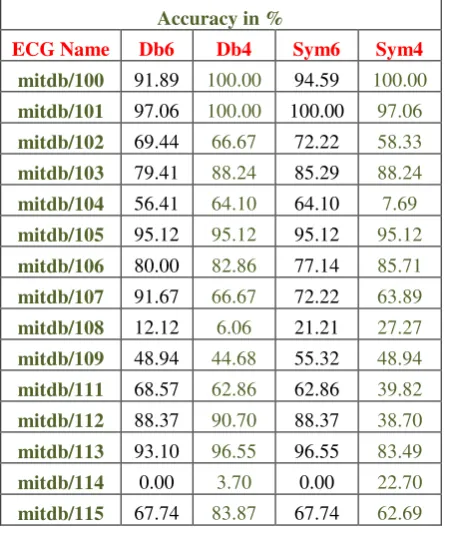
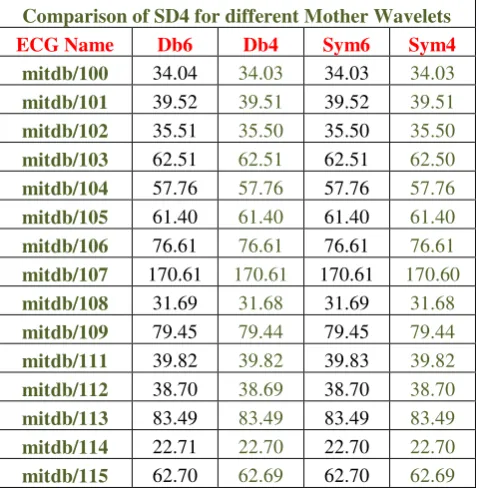
Accuracies and False Detection of the 15 ECG wave forms of the detector that uses different mother wavelets as the basis function for DWT, are calculated and tabulated in Table 1 and Table 2 respectively. Table 3 gives the comparison of Standard Deviations of ECG waveforms using different mother wavelets in DWT.
Table 1: Comparison of Accuracies of Detector by using: (1) Debauchies’ 6 wavelet (Db6), (2) Debauchies’ 4 wavelet (Db4), (3) Symlet’s 6 wavelet (Sym6) and (4) Symlet’s 4 wavelet (Sym4)
Accuracy in %
ECG Name Db6 Db4 Sym6 Sym4
mitdb/100 91.89 100.00 94.59 100.00
mitdb/101 97.06 100.00 100.00 97.06
mitdb/102 69.44 66.67 72.22 58.33
mitdb/103 79.41 88.24 85.29 88.24
mitdb/104 56.41 64.10 64.10 7.69
mitdb/105 95.12 95.12 95.12 95.12
mitdb/106 80.00 82.86 77.14 85.71
mitdb/107 91.67 66.67 72.22 63.89
mitdb/108 12.12 6.06 21.21 27.27
mitdb/109 48.94 44.68 55.32 48.94
mitdb/111 68.57 62.86 62.86 39.82
mitdb/112 88.37 90.70 88.37 38.70
mitdb/113 93.10 96.55 96.55 83.49
mitdb/114 0.00 3.70 0.00 22.70
ISSN: 2319-8753
I
nternational
J
ournal of
I
nnovative
R
esearch in
S
cience,
E
ngineering and
T
echnology
(An ISO 3297: 2007 Certified Organization)
Vol. 2, Issue 10, October 2013
Copyright to IJIRSET www.ijirset.com 5180 Table 2: Comparison of False Detection Rate of Detector by using: (1) Debauchies’ 6 wavelet (Db6), (2) Debauchies’ 4 wavelet (Db4), (3) Symlet’s 6 wavelet (Sym6) and (4) Symlet’s 4 wavelet (Sym4)
False Detection in %
ECG Name Db6 Db4 Sym6 Sym4
mitdb/100 10.53 2.63 7.89 2.63
mitdb/101 5.71 2.86 2.86 5.71
mitdb/102 16.67 29.41 7.14 32.26
mitdb/103 22.86 14.29 17.14 25.00
mitdb/104 42.11 44.44 34.21 41.03
mitdb/105 7.14 7.14 7.14 7.14
mitdb/106 24.32 29.27 30.77 33.33
mitdb/107 62.07 72.09 67.90 71.25
mitdb/108 55.56 50.00 30.00 18.18
mitdb/109 60.34 60.38 51.85 54.90
mitdb/111 33.33 38.89 38.89 38.89
mitdb/112 13.64 11.36 13.64 6.82
mitdb/113 12.90 20.00 17.65 22.22
mitdb/114 100.00 50.00 100.00 100.00
mitdb/115 53.33 38.10 48.78 36.59
Table 3: Comparison of Standard Deviations of ECG waveforms after applying DWT using the following mother wavelets: (1) Db6, (2) Db4, (3) Sym6 and (4) Sym4 Wavelet
Comparison of SD4 for different Mother Wavelets
ECG Name Db6 Db4 Sym6 Sym4
mitdb/100 34.04 34.03 34.03 34.03
mitdb/101 39.52 39.51 39.52 39.51
mitdb/102 35.51 35.50 35.50 35.50
mitdb/103 62.51 62.51 62.51 62.50
mitdb/104 57.76 57.76 57.76 57.76
mitdb/105 61.40 61.40 61.40 61.40
mitdb/106 76.61 76.61 76.61 76.61
mitdb/107 170.61 170.61 170.61 170.60
mitdb/108 31.69 31.68 31.69 31.68
mitdb/109 79.45 79.44 79.45 79.44
mitdb/111 39.82 39.82 39.83 39.82
mitdb/112 38.70 38.69 38.70 38.70
mitdb/113 83.49 83.49 83.49 83.49
mitdb/114 22.71 22.70 22.70 22.70
ISSN: 2319-8753
I
nternational
J
ournal of
I
nnovative
R
esearch in
S
cience,
E
ngineering and
T
echnology
(An ISO 3297: 2007 Certified Organization)
Vol. 2, Issue 10, October 2013
Copyright to IJIRSET www.ijirset.com 5181 V. CONCLUSION
Depending upon the type of application of ECG waveforms different mother wavelets are suitable. For the purpose of carrying out Pre-processing of ECG waveforms Db4 and Sym4 wavelets show good results but for carrying out
Features’ Extraction Db6 and Sym6 wavelets show good results. REFERENCES
[1] The Expert Systems Solutions website.[Online]. “Investigation of ECG Signal using DSP Processor and Wavelets”. Available: http://www.expertsystemsolutions.com/search-and-documentation/publications/
[2] E. Castillo, D. P. Morales, A. García, F. Martínez-Martí, L. Parrilla, and A. J. Palma, “Noise Suppression in ECG Signals through Efficient One-Step Wavelet Processing Techniques”, Journal of Applied Mathematics, vol. 2013, Article ID: 763903, 13 pages, 2013.
[3] The National Instruments’ Website. [Online]. Available: http://www.ni.com/white-paper/6349/en/
[4] K.V.L.Narayana and A.Bhujanga Rao, “Wavelet based QRS detection in ECG using MATLAB”, ISSN 1727 (Paper) ISSN
2222-2871(Online), vol. 2, No. 7, 2011
[5] The Massachusetts Institute of Technology Website, MIT-BIH ECG Database. [Online] Available: http://ecg.mit.edu [6] George B. Moody, WFDB Programmer’s guide (Tenth Edition, 2003).
[7] S. Z. Mahmoodabadi, A. Ahmadian, M. D. Abolhasani, M. Eslami, and J. H. Bidgoli, “ECG Feature Extraction Based on Multiresolution Wavelet Transform”, IEEE Trans. Biomed. Eng., 2005.
[8] Lippincott Williams & Wilkins, ECG Interpretation an Incredibly visual Pocket Guide, WK India Pub., 2010. [9] Paul S. Addison, The illustrated wavelet transform handbook, IOP Pub., 2002.
[10] Hari Mohan Rai and Anurag Triedi, “De-Noising of ECG Waveforms based on Multi-resolution Wavelet Transform”, International Journal of Computer Applications, vol. 45-No. 18, May 2012.
[11] C. E. Robertson, F. Sterz, G. R. Clegg, J. N. Watson, M. Holzer and P. S. Addison, “Evaluating Arrhythmias in ECG Signals Using Wavelet Transfroms”, IEEE Trans. Biomed. Eng., Sept2000, pp. 104-109.
[12] Amara Grap, “An Introduction to Wavelets”, IEEE Comp. Sc. And Eng., Vol. 2, No. 2, 1995.
[13] L. David, L. Szilagyi, S. M. Szilagyi and Z. Benyo, “Adaptive Wavelet –Transform-Based ECG Waveforms Detection”, Proc. Of the 25th
Annual International Conf. of the IEEE EMBS, Cancum, Mexico-Sept. 2003, pp. 2412-2415.