R E S E A R C H
Open Access
Systematic network coding for two-hop
lossy transmissions
Ye Li
*, Steven Blostein and Wai-Yip Chan
Abstract
In this paper, we consider network transmissions over a single or multiple parallel two-hop lossy paths. These scenarios occur in applications such as sensor networks or WiFi offloading. Random linear network coding (RLNC), where previously received packets are re-encoded at intermediate nodes and forwarded, is known to be a capacity-achieving approach for these networks. However, a major drawback of RLNC is its high encoding and decoding complexity. In this work, a systematic network coding method is proposed. We show through both analysis and simulation that the proposed method achieves higher end-to-end rate as well as lower computational cost than RLNC for finite field sizes and finite-sized packet transmissions.
Keywords: Network coding; Systematic; Two-hop transmission
1 Introduction
Multi-path multi-hop transmission is commonly seen in many communication scenarios, where one or more inter-mediate nodes may connect the source and destination nodes along a single path and multiple such paths may exist in parallel. Network coding [1–3] can be beneficial in such scenarios. When packets pass through lossy multi-hop links, if intermediate nodes re-encode packets with previously received ones, coding can achieve the max-flow capacities of the links [4] and therefore improve the end-to-end transmission rate while offering protection against erasures. Importantly, this improvement is achieved with-out the need of either acknowledgements between nodes or estimation of link qualities. Random linear network coding (RLNC) [5], in which the re-encoded packets are random linear combinations of packets received at the intermediate node, can achieve this in a distributed man-ner. RLNC is known to be asymptoticallyrate-optimal, i.e., it achieves the max-flow capacity when the size of the arithmetic field used for coding goes to infinity.
However, an important drawback of RLNC is complex-ity. Decoding of RLNC, performed onMsource packets each with K symbols from a finite field of size q, Fq, requires the solution of a linear system of equations in
*Correspondence: [email protected]
Department of Electrical and Computer Engineering, Queen’s University, K7L 3N6 Kingston, Canada
Munknowns, which requiresO(M3+M2K)operations for unstructured matrices, e.g., via Gaussian elimination (GE). For some scenarios wherein nodes have limited computing capability and battery power, this computa-tional cost may be prohibitively high. Moreover, the rate optimality of RLNC relies on a sufficiently large field size, which, as a consequence, requires a larger packet header to carry coding vectors as well as more computational resources when performing finite field arithmetic (for example, larger look-up tables may be needed to speed up multiplication [6]). On the other hand, when the field size is small, for example,q=2 (i.e., binary), the achieved rate using RLNC can be much lower than the max-flow capac-ity, especially when the number of source packets is also small.
In this paper, we propose a systematic network cod-ing method for networks with one or more parallel paths of two-hop lossy links. The proposed scheme possesses similar rate performance as RLNC but at significantly lower encoding/decoding computational cost. The pro-posed scheme first sends uncoded packets in their original order and then sends a potentially unlimited number of coded packets using RLNC. Combined with the pro-posed re-encoding strategy at the intermediate nodes, which forwards received uncoded packets or else per-forms RLNC, the scheme will be shown to achieve higher rate than RLNC and require less computation. In appli-cations where the field size and the number of source
packets are not very large, the improvement of the pro-posed scheme over using RLNC is significant.
The transmission scheme where a source node sends uncoded packets first and then sends coded packets has recently appeared in the literature for one-hop links. For example, in [7–9], the benefits of reducing decod-ing complexity and completion time are explored. For the single-path two-hop link, a scheme is presented in [10] (Section 3.2) in which fountain-coded packets (e.g., using LT codes [11]) are transmitted in the first hop; the inter-mediate node forwards the received packets from the first hop and sends some re-encoded packets from the buffer after forwarding. The method is studied from a coding theory point of view in the asymptotic regime. In [12], a scheme with a similar transmission strategy in the first hop as ours is proposed. However, the method in [12] assumes a direct link between the source and destination nodes and only sends coded packets from the buffer on the second hop after all uncoded packets are transmitted and does not make use of possible transmission oppor-tunities on the second hop before uncoded packets are finished. Therefore, the achievable rate of the scheme in [12] is strictly lower than the max-flow capacity of the link. A particular application example of the proposed method is WiFi offloading [13]. WiFi offloading is an effi-cient way to address the rapid increase in data traffic that poses great challenges to current cellular networks. A notable cause is video streaming to smart phones and tablets. An offloading path may be established via a WiFi access point (AP) to transmit packets from the packet data network gateway (GW) to the user equipment (UE), forming a two-hop lossy path. A parallel path going from GW to UE via base-station (BS), which also forms a two-hop lossy path, may or may not be available simulta-neously. The multi-path TCP (MPTCP) [14, 15] protocol can be used to seamlessly establish/close the two-hop connections. In [16], it has been shown that incorporat-ing RLNC with MPTCP may achieve higher throughput than MPTCP without network coding when links are lossy. The “seen packet” concept proposed in [17] can be used to address the compatibility issue of network coding with TCP.
This paper considers systematic network coding in two scenarios. First, we consider transmission over a single two-hop link. We prove that the proposed systematic net-work coding outperforms RLNC in terms of both end-to-end rate and encoding/decoding costs. An analysis based on finite absorbing Markov chains is provided to statis-tically characterize the end-to-end rate of transmission. Second, we consider the case where two parallel paths can be used to speed up the transmission. In this case, packets are sent from the source node to the destination node over two parallel two-hop links simultaneously. We show that the proposed scheme again outperforms RLNC.
We formulate a packet allocation problem to schedule the transmission of uncoded packets among the two paths such that the expected end-to-end rate is maximized with minimized decoding cost.
We remark that although the proposed method per-forms better than RLNC, RLNC is rate optimal for mul-ticasting in unknown network topologies. In other words, the benefits of the proposed method in the paper come from exploiting the known topology. To reduce com-plexity of RLNC in networks with unknown or complex topologies, other approaches such as generation-based network coding [18–24] may be used.
2 System model
2.1 Transmission model
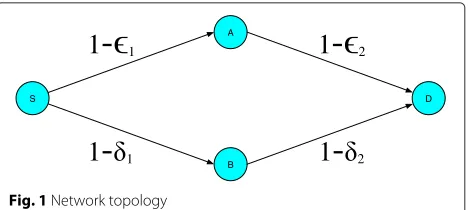
Suppose that a source node, denoted as S, has M data packetsS= {s1,s2,. . .,sM}to send to a destination node D. Each packet consists ofK symbols fromFq. Separate source and channel coding are assumed. Source packets are independent and identically distributed (i.i.d.) to max-imize the information rate. The transmission may involve two paths as shown in Fig. 1; each is a two-hop lossy link. We use S-A-D and S-B-D to refer to the two two-hop links through the two intermediate nodes A and B, respectively. We assume that A and B operate in the half-duplex mode. Transmission occurs successively on the two hops of each path and the two successive transmissions are referred to as a use of the path. Let rate R1 define the number of packets that are sent on S-A or A-D per use of S-A-D, and let R2 define the number of packets that are sent on S-B or B-D per use of S-B-D. Given the rates R1andR2, let1,2,δ1andδ2denote the corresponding packet loss probabilities on links S-A, A-D, S-B and B-D, respectively. The max-flow capacities of the parallel two paths can then be expressed asC1=R1(1−max{1,2}) andC2=R2(1−max{δ1,δ2})packets per path use, respec-tively. Anetwork userefers to using each path once. The max-flow capacity of the network is thenC1+C2packets per network use.
Throughout transmission, we assume that no feedback is available between nodes to indicate loss/reception of packets except that D can immediately inform S, A, and B to stop transmission when D finishes recovering allM
S
A
1
-
1D
1
-
2B
1
-
11
-
2source packets. We denote the number of network uses that are needed by D to complete decoding of all pack-ets as the completion time of the transmission, T. The end-to-end rate,R= MT.
2.2 Random linear network coding
In the RLNC scheme, S always sends random linear com-binations of source packets while A and B send random linear combinations of packets in their buffers, respec-tively. The received packets at D are in the form ofr =
M
i=1gisi, wheregiis a random coding coefficient chosen fromFq. The vector [g1,. . .,gM] is referred to as thecodin
g vectorofr. D does not need to distinguish whether the received packets are from A or B.
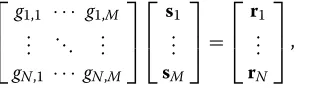
Suppose thatN packetsr1,r2,. . .,rN are received. The recovery of source packets corresponds to solving the linear system of equations
⎡
where the matrix on the left-hand side is referred to as thedecoding matrix, whose rows comprise the coding vec-tors of the received packets, and theN ×K right-hand side matrix comprises the coded source symbols of the received packets. Aninnovative packetrefers to a received packet whose coding vector is not in the span of the cod-ing vectors of all previously received packets. Decodcod-ing is only possible ifMinnovative packets are received, i.e., when the decoding matrix is full rank. As the decod-ing matrix in (1) is unstructured for RLNC, O(M3 + M2K)operations are required for GE over the finite field, where anoperationrefers to a multiply-and-add finite field operation. If F2 is used, all operations reduce to taking exclusive-or’s (XORs).
RLNC is capacity achieving in the asymptotic regime; it achieves the minimum expected completion timeTmin=
M
C1+C2 whenMandqare arbitrarily large [5].
2.3 Systematic 2-hop network coding
The proposed scheme, systematic 2-hop network coding (S2HNC), for the network topology of Fig. 1 refers to where the firstM1andM2packets sent from S to A and B, respectively, are uncoded source packets. After that, RLNC-coded packets (i.e., random linear combinations of packets) are sent until D successfully decodes allMsource packets. At both A and B, every received packet is stored in a buffer. If A or B receives an uncoded packet, the
packet is forwarded to D; if no packet is received or the received packet is RLNC coded, a RLNC packet is gener-ated from the buffer for transmission to D. The ordered pair(M1,M2)denotes anuncoded packet allocationof the S2HNC scheme; different choices of (M1,M2) result in different performances as we will show. The decoding at D is similar to that of RLNC except that some received packets may be uncoded, which means that some rows in the decoding matrix are singleton, i.e., contain only one nonzero element.
3 S2HNC for two-hop lossy transmission
We now consider using only one path for transmission of Msource packets. Packets from S are all sent to D via A where the loss probabilities of the two hops are1and2, respectively, as shown in Fig. 1. We analyze the expected end-to-end rates of S2HNC and RLNC and show that the rate of S2HNC is always higher than that of RLNC, while the required decoding cost of S2HNC is lower. For ease of exposition, we analyze the expected completion times of the two schemes. The end-to-end rate is inversely proportional to the completion time.
3.1 Expected completion time of S2HNC
It is known that asMgets large, RLNC achieves the max-flow capacity of the network [5]. In practice, however, where M may not be large, we would experience some loss in the end-to-end rate. In this section, we employ a Markov chain model to calculate the expected completion time of S2HNC in the smallMregime for given link era-sure rates. In [25], a Markov chain model is proposed to analyze the two-hop network-coded transmission, where RLNC of infinite field size is assumed. In the follow-ing, we use a similar approach but applied to finite field sizes.
We use Markov chains C1 and C2 to characterize the process of D collecting innovative packets. The one denoted as C1 is for the period of time when S is send-ing uncoded packets and the other one, C2, is for when S is sending coded packets. The state spaces of the two Markov chains are the same and can be expressed in a two-tuple state,(k,r), wherekandrrepresent the num-bers of innovative packets received by A and D at the beginning of each S-A transmission, respectively. The state transitions that may occur at each step is shown in Fig. 2. It is noted thatr≤kbecause D cannot receive more information than A at any time. This results in a total of n= (M+1)(2M+2) two-tuple states.
(k,r) (k,r+1) (k+1,r) (k+1,r+1)
When S transmits uncoded packets, the probability that kincreases by 1 after a network use ispk→k+1 = 1−1 fork<M, i.e., a successful transmission on S-A and 0 for k=M. The increment ofris dependent onk’s evolution. Fork<M, we havepr→r+1|k→k+1=1−2for a success-ful forward by A orpr→r+1|k→k=(1−2) 1− qk1−r
for a successful transmission of an innovative packet coded from A’s buffer. The term 1
qk−r is the probability that a uni-formly distributed randomk-dimensional vector overFq lies in the span of rlinearly independentk-dimensional vectors. For k = M, we have pr→r+1|k→k = (1− 2)
1−qM1−r
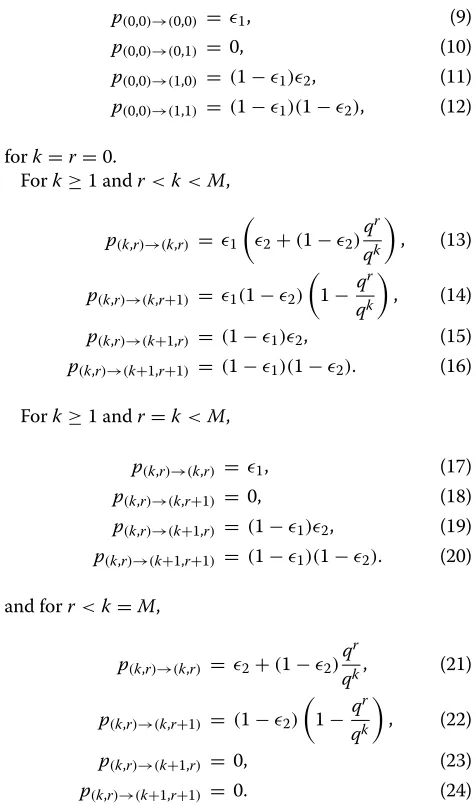
. The evolution of (k,r) for C1 can then be characterized. Denotingp(k,r)→(k+1,r+1)as the probability thatkandrare each increased by 1 after a network use, it is seen that it is equal topk→k+1pr→r+1|k→k+1forr≤k< M. Similarly, we can obtainp(k,r)→(k,r),p(k,r)→(k+1,r), and
p(k,r)→(k,r+1).
When S starts sending coded packets, the transition probabilities change as follows: when in state (k,r), kis increased with probabilitypk→k+1=(1−1) 1−qM1−k
fork≤M. Whenk <M, the probability thatrincreases ispr→r+1|k→k=(1−2) 1− qk1−r
andpr→r+1|k→k+1=
(1 − 2) 1− qk+11−r
, where the term qk+11−r is due to one more innovative packet received at A before it gen-erates a coded packet. When k = M, pr→r+1|k→k = (1 − 2) 1− qM1−r
. With the above probabilities, we can obtain p(k,r)→(k,r), p(k,r)→(k+1,r), p(k,r)→(k,r+1), and p(k,r)→(k+1,r+1) for C2. Expressions for the transition probabilities of C1 and C2 are provided in Appendix 1.
The calculation of the expected completion time of S2HNC consists of determining the state of C1 after exactly M steps (i.e., M network uses) starting from (0, 0) and the expected number of additional steps that are needed for C2 to transit from that state to (M,M). To simplify the computation, we label each two-tuple state with a single index. We order the states as (0, 0), (1, 0), (1, 1), (2, 0), (2, 1), . . ., (M,M− 1), (M,M), and we label state (k,r) using index i = k(k2+1) + r, i.e., we relabel states as 0, 1, 2, 3,. . . instead of (0, 0), (1, 0), (1, 1), (2, 0),. . .. Below, we will interchangeably use i or (k,r) to refer to a two-tuple state. A con-sequence of this labeling choice is that state i cannot transit to a state j < i. With this notation, we can express the transition matrix of C1 as 1, which is an upper-triangular matrix with elements πij1 denoting the probability of transition from state i to j. Similarly, the transition probabilities of C2 form the state transition matrix2.
AfterMsteps starting from(0, 0)with transition matrix 1, the probability that the system is in statei is equal to the ith element of e1nM1, where e1n is a
length-n n= (M+1)(2M+2) row vector with all-zero elements except the first element being a 1. The probability vector e1nM1 is the “input” of C2, which is an absorbing Markov chain in which (M,M) is the only absorbing state. It is easy to verify that1and2can be expressed in the form
Qi Ri 0 1
, i = 1, 2, respectively. Q1 andQ2 are each of
size t×t; t = n−1 is the number of transient states. The expected number of steps,M, that is needed by C2 to enter the absorbing state given e1nM1 as the initial probability vector of states is [26]
M =e1tQM1(It−Q2)−11t, (2)
where It is a t × t identity matrix and 1t is a
length-t column vector whose entries are all 1. The expected completion time of S2HNC is then
E{T} =M+M. (3)
We note that the cost of computing the expected com-pletion time from (2) could be high for large M, even though that Q1 and Q2 are very sparse. For example, the computation of M for M = 500 involves matri-ces Q1 and Q2 that each of dimension 125,750. How-ever, since S2HNC asymptotically achieves the max-flow capacity for largeM, we only require the above calcula-tion of expected complecalcula-tion time for small M, which is feasible.
Note that the above analysis includes the calculation of expected time for RLNC scheme as a special case, in which no uncoded packets are sent and C2 with ini-tial state(0, 0)characterizes the whole transmission pro-cess. For RLNC, the expected number of steps before the process entering the absorbing state is then equal toe1t(It−Q2)−11t.
The variances of the completion time can also be obtained. Note that the initial state probabilities of C2 aree1nM1 for S2HNC and are e1n for RLNC. LetN = (It−Q2)−1; we have [26]
Var{T} =v(2N−It)N1t−(vN1t)2, (4)
wherevise1tQM1 for S2HNC andvise1tfor RLNC.
3.2 Advantage in end-to-end rate
Since S2HNC has the same behavior (which is char-acterized by the Markov chain C2) as RLNC after M transmissions from S, we only need to compare the two schemes during the firstMtransmissions from S. We con-sider S2HNC first. Recall that for the state(k,r),kandr denote the numbers of innovative packets that have been received by A and D at the beginning of each S-A trans-mission,r ≤k. During the firstMtransmissions from S, the probability that D receives an innovative packet after two successive transmissions on S-A and A-D is equal to
pS2HNC(k,r)=(1−2)
which corresponds to when an uncoded packet is success-fully forwarded (which is innovative for D with probability 1) or when the coded packet from thekinnovative packets at A is innovative for D.
Now, consider the RLNC scheme. For the samekandr, the probability that a new innovative packet is received by D after two successive transmissions on S-A and A-D is equal to
corresponds to when the coded packet sent from A is innovative for D when a packet was successfully received by A.
3.3 Advantage in decoding complexity
ForMsource packets, it is expected thatMu=(1−1)× (1 − 2)M uncoded packets are received by D using S2HNC. Therefore, S2HNC only needs to decode the remaining M− Mu packets from RLNC-coded packets using GE. ForK M, the number of operations that are needed using GE is approximatelyM2Kfor RLNC and is (M−Mu)2Kfor S2HNC. This corresponds to a savings of a factor of (M−MM2Ku)2K = (1+21−12)2 computations. This is a considerable saving compared to RLNC when1and 2are small as in many system scenarios encountered in practice.
4 S2HNC for parallel two-hop transmission In this section, we extend the results from a single-path to a parallel-path scenario. We quantify the S2HNC scheme’s savings in the expected completion time and the amount of computation over that of RLNC, as a function of given packet loss probabilities.
4.1 Completion time
Lemma 1.A necessary condition for S2HNC to achieve a shorter expected completion time than RLNC is that the transmitted uncoded packets on the two paths be distinct.
Proof.LetM1andM2be the numbers of packets trans-mitted on the two paths, respectively. AnyM=M1+M2 received RLNC packets at D are mutually linearly inde-pendent as q → ∞. Therefore, the RLNC scheme is expected to finish atTmin = C1M+C2 with(R1+R2)Tmin packets sent from S asq → ∞[5]. Now, assume that the same number of packets are sent from S using S2HNC, among which there areM1+M2uncoded packets. At D, this results inMu=(1−1)(1−2)M1+(1−δ1)(1−δ2)M2 expected number of uncoded packets andM−Mucoded packets. As q → ∞, decoding is successful if and only if theMu uncoded packets are distinct. However, if any uncoded packet is sent more than once, then there is a constant probability (depending on packet loss probabili-ties but not onq) that would not decrease to zero asq→ ∞that an uncoded packet is received more than once at D, i.e., the probability that theMupackets are distinct does not approach zero as q → ∞, resulting in a non-zero decoding failure probability atTmin. The expected com-pletion time of such a S2HNC scheme cannot be shorter than that of RLNC.
Theorem 1.Any S2HNC-uncoded packet allocation with distinct uncoded packets transmitted on the two paths has shorter expected completion time than the RLNC scheme.
Proof.See Appendix 2.
In the sequel, S2HNC is fashioned to send distinct uncoded packets on the two paths. Note that Theorem 1 holds regardless of the values of M, q and the packet loss probabilities of the links. RLNC’s minimum comple-tion time is achieved asymptotically asq → ∞. In the finite regime whenqmay be small, S2HNC has a shorter expected completion time.
0.60 0.62 0.64 0.66 0.68 0.70 0.72 0.74 0.76 0.78 0.80
0 100 200 300 400 500 600 700 800 900 Number of Source Packets
S2HNC RLNC
0 100 200 300 400 500 600
0 100 200 300 400 500 600 700 800 900 Number of Source Packets
S2HNC RLNC
Fig. 3End-to-end rate and decoding complexity for1=0.05,2=0.2
Proof. The proof follows straightforwardly from the proof of Theorem 1, in which it is shown that any received uncoded packet at D is innovative with a higher probability compared to that if a coded packet were received.
4.2 Computational cost and uncoded packet allocation Depending on how many uncoded packets are received by D, S2HNC exhibits a different computational cost com-pared to that of RLNC. Assume thatMuuncoded packets are received, then D needs to decode only the remaining
M−MuRLNC-coded packets. This corresponds to a com-putational savings by a factor of (M−MM2u)2 in solving the linear system of equations.
To reduce computational cost, we can maximize Mu. Based on Corollary 1, maximizing Mu results in an uncoded packet allocation that achieves the minimum expected co mpletion time. The maximization can be for-mulated as an optimization problem in the variablesM1 andM2. The optimization, however, requires knowledge of the link parameters R1, R2, 1, 2, δ1, and δ2. The allocation problem is as follows:
0.58 0.60 0.62 0.64 0.66 0.68 0.70 0.72 0.74 0.76 0.78 0.80
0 100 200 300 400 500 600 700 800 900 Number of Source Packets
S2HNC RLNC
0 100 200 300 400 500 600
0 100 200 300 400 500 600 700 800 900 Number of Source Packets
S2HNC RLNC
0.10 0.12 0.14 0.16 0.18 0.20
0 50 100 150 200 250 300 350 400 450 Number of Source Packets
S2HNC RLNC
0 50 100 150 200 250 300
0 50 100 150 200 250 300 350 400 450 Number of Source Packets
S2HNC RLNC
Fig. 5End-to-end rate and decoding complexity for1=2=0.8
maximize M1,M2 (
1−1)(1−2)M1+(1−δ1)(1−δ2)M2
subject to M1+M2≤M M1
R1 ≤ M C1+C2 M2
R2 ≤ M C1+C2 M1,M2∈Z∗,
(7)
where the first constraint ensures that at mostMdistinct uncoded packets are sent and the next two constraints ensure that uncoded packets on either path be transmit-ted within the firstTminnetwork uses. These constraints
arise to avoid uncoded packets being “over-allocated” to either path and ensure that all distinct uncoded packets be transmitted before D finishes decoding.
We observe thatM1+M2=Malways holds according to Corollary 1, because S has to send at leastMpackets and that sending distinct uncoded packets is always supe-rior to sending coded ones. We can therefore solve (7) and obtainM1in closed form as
M1=
MR1
C1+C2 (1−1)(1−2) >(1−δ1)(1−δ2) M− MR2
C1+C2 otherwise,
(8)
0.58 0.60 0.62 0.64 0.66 0.68 0.70 0.72 0.74 0.76 0.78 0.80
10 20 30 40 50 60 70 80 90
Number of Source Packets
RLNC S2HNC LT-Code RLNC (analysis) S2HNC (analysis)
0 5 10 15 20 25 30 35 40 45 50 55
10 20 30 40 50 60 70 80 90
Number of Source Packets RLNC
S2HNC LT-Code
0.04 0.06 0.08 0.1 0.12 0.14 0.16 0.18 0.2
10 20 30 40 50 60 70 80 90
S2HNC RLNC S2HNC (analysis) RLNC (analysis)
Fig. 7Expected completion times scaled by standard deviations of S2HNC and RLNC for smallM,1=0.05,2=0.2
andM2 = M−M1, where· is the floor function. The solution corresponds to that one of the second and the third inequalities of (7) achieves equality.
With M1 and M2 as above, S can choose any dis-joint subsets of source packets of sizes M1 and M2 as the initially transmitted packets on S-A and S-B, respectively.
5 Numerical and simulation results
In this section we simulate the performance of S2HNC and compare it with that of RLNC in the one-path and
two-path scenarios. The simulations useK = 8192 bits per packet and coding is performed inF2 = {0, 1}. Each simulated curve represents averaging over 10,000 Monte Carlo trials. We count the number of operations, Nops, that are needed to recover all the data in the trials. The computational cost measure we use is the average num-ber of operations per bit for successful decoding, which is equal to NMKops.
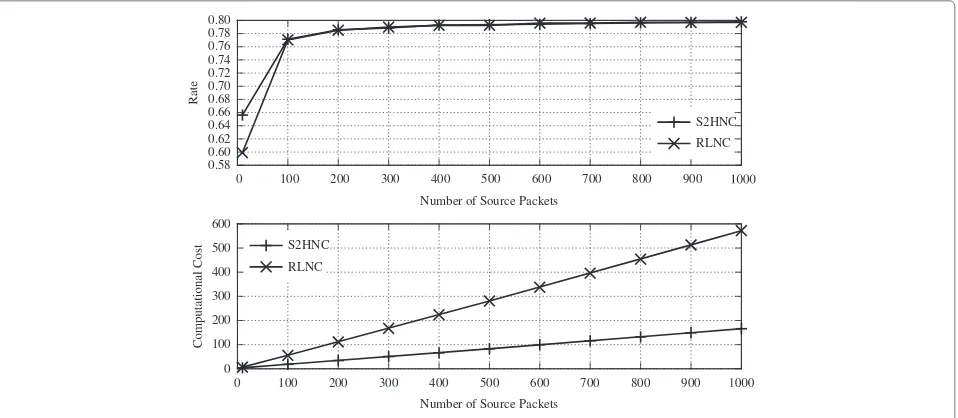
We first consider the single-path case. We compare S2HNC with RLNC in the cases where1=0.05,2=0.2 and1 = 0.2,2 = 0.05, which correspond to where the
1.6 1.8 2 2.2 2.4 2.6
10 20 30 40 50 60 70 80 90 100 110 120 130 140 150 160 170 180 190 RLNC
S2HNC (all-via-A) S2HNC (all-via-B) S2HNC (optimized)
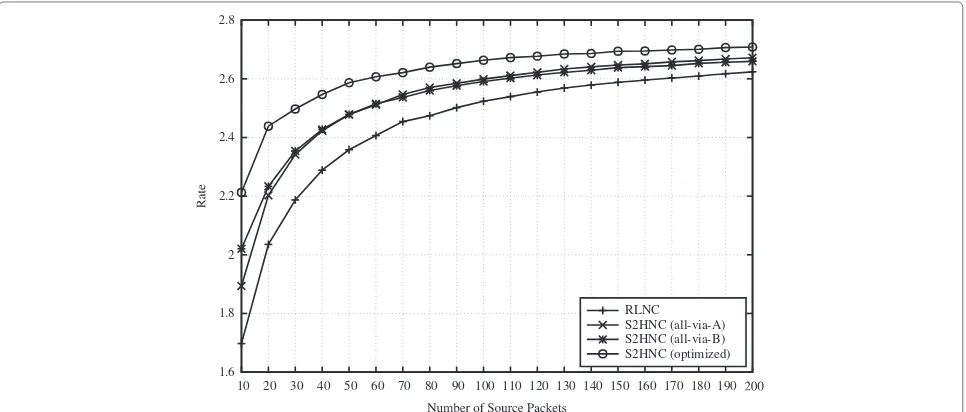
Fig. 8Rate of using RLNC and S2HNC as a function of the number of source packets,M, for several uncoded packet allocation schemes, andR1=1,
0 20 40 60 80 100
10 20 30 40 50 60 70 80 90 100 110 120 130 140 150 160 170 180 190 RLNC
S2HNC (all-via-A) S2HNC (all-via-B) S2HNC (optimized)
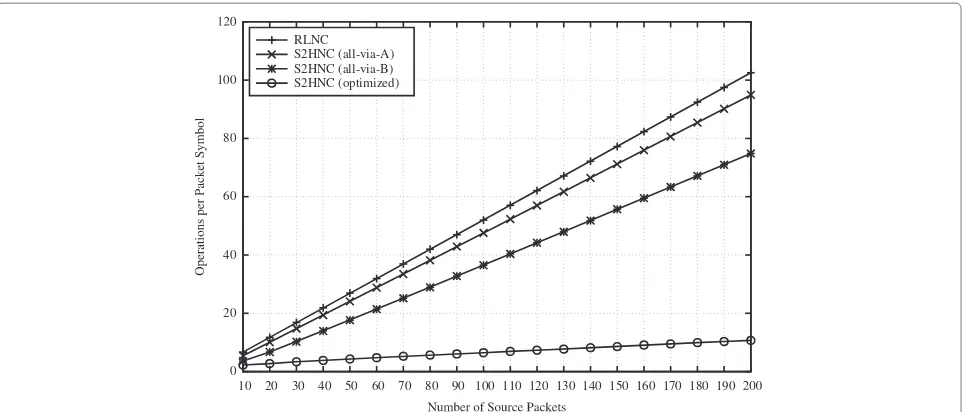
Fig. 9Computational costs of using RLNC and S2HNC as a function of number of source packets,M, for several uncoded packet allocation schemes, andR1=1,R2=2,1=0.01,2=0.05,δ1=0.01,δ2=0.1
quality of the first hop is better and worse than that of the second hop, respectively. The max-flow capacity of the two-hop link is 0.8 packets per network use for both cases. The number of packets varies fromM=10 to 1000.
The rate and complexity performances are shown in Figs. 3 and 4. Clearly, the rate of S2HNC is always higher, even though the gap narrows and both schemes approach capacity asMincreases. The lower decoding complexity of S2HNC is quite obvious. It is seen that the rate improve-ment of S2HNC is more significant in Fig. 3. This is not surprising since more uncoded packets are received at A when the first hop link is better and packets are always innovative for D when using S2HNC. On the other hand, if the first hop is worse, S2HNC resembles RLNC at A because more coded packets would be sent. In practice, the former case is commonly found in applications such as WiFi offloading, where the first hop is the link from a packet gateway to either a WiFi access point or base station.
We note that when the link quality is poor, i.e., the era-sure rates of S-A and A-D are high, the performance gap between S2HNC and RLNC shrinks. An example of this is shown in Fig. 5, where the two hops have equal era-sure probability 0.8 and the performances of S2HNC and
Table 1Optimized uncoded packet allocations forR1=1,R2=2,
1=0.01,2=0.05,δ1=0.01,δ2=0.1, as a function of the
number of source packets,M
M 20 40 60 80 100 120 140 160 180 200
M1 7 14 21 29 36 43 50 58 65 72
M2 13 26 39 51 64 77 90 102 115 128
RLNC are almost identical. This is anticipated because the advantage of S2HNC comes from its use of uncoded packets, which are innovative for downstream nodes with probability one while requiring no decoding. As an extreme case when links are highly lossy, very few uncoded packets would be received and S2HNC reduces to RLNC.
1.6 1.7 1.8 1.9 2 2.1 2.2 2.3 2.4 2.5 2.6
10 20 30 40 50 60 70 80 90 100 110 120 130 140 150 160 170 180 190 RLNC
S2HNC (all-via-A) S2HNC (all-via-B) S2HNC (optimized)
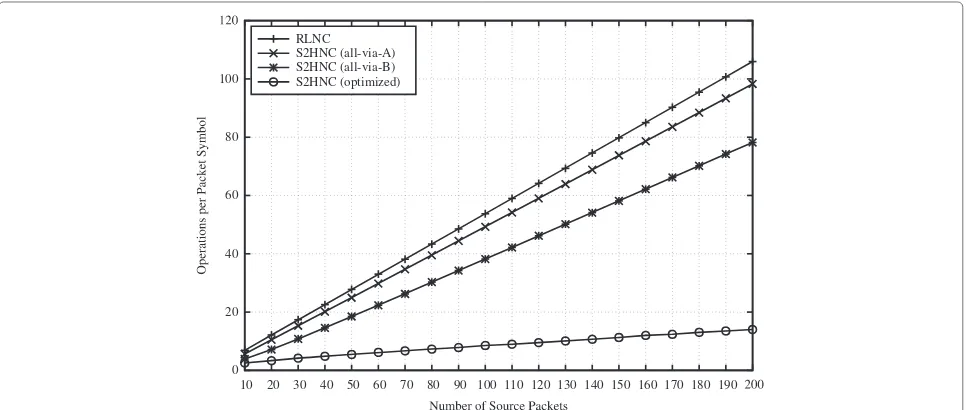
Fig. 10Rate of using RLNC and S2HNC as a function of the number of source packets,M, for several uncoded packet allocation schemes, and R1=1,R2=2,1=0.01,2=0.05,δ1=0.1,δ2=0.01
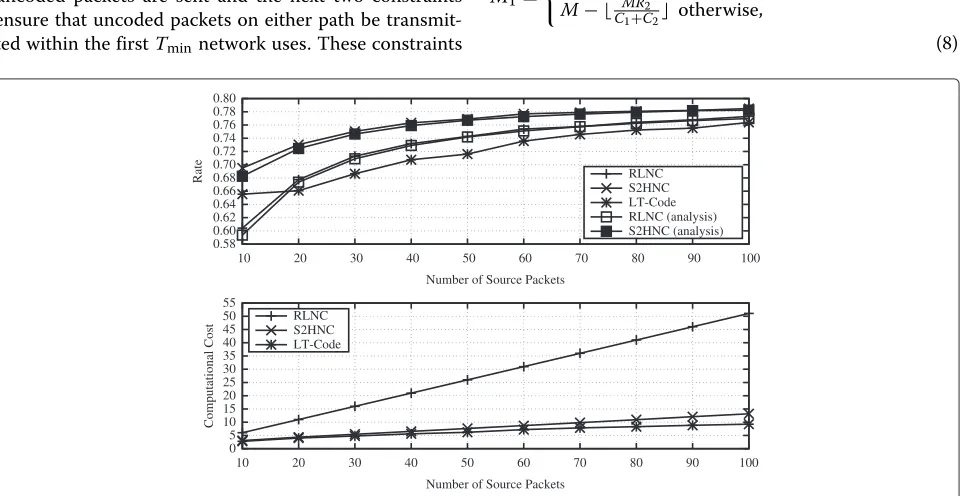
(i.e., square root of the variance) of the completion time. We show both analytical results calculated using (4) and the simulated results. From Fig. 7, it is seen that the standard deviations of the completion times of the dif-ferent methods are comparable and small relative to the completion times themselves, confirming that S2HNC’s rate does not vary significantly and is at least that of RLNC.
We now compare the performances of RLNC and S2HNC for the parallel-path scenario. The first set of
network parameters for simulations areR1 = 1,R2 = 2, 1 = 0.01, 2 = 0.05, δ1 = 0.01, and δ2 = 0.1. In Figs. 8 and 9, we show the averaged end-to-end rate and computational cost of the two schemes, respectively. The uncoded packet allocation solutions of (7) for someM’s are given in Table 1. In addition to the optimized allo-cation obtained by solving (7), for comparison, we also include two other allocations, namely via-A and all-via-B in which uncoded packets are only sent to A and B, respectively. Achieving the minimum completion time
0 20 40 60 80 100
10 20 30 40 50 60 70 80 90 100 110 120 130 140 150 160 170 180 190 RLNC
S2HNC (all-via-A) S2HNC (all-via-B) S2HNC (optimized)
2.6 2.8 3 3.2 3.4 3.6 3.8 4 4.2
10 20 30 40 50 60 70 80 90 100 110 120 130 140 150 160 170 180 190 RLNC
S2HNC (all-via-A) S2HNC (all-via-B) S2HNC (optimized)
Fig. 12Rate of using RLNC and S2HNC as a function of number of source packets,M, for several uncoded packet allocation schemes, andR1=1,
R2=4,1=0.01,2=0.5,δ1=0.01,δ2=0.01
is equivalent to achieving the max-flow capacity between S and D, which is equal toC1+C2 = 2.75 packets per network use for the parameters used.
It is clear that S2HNC when using any of the allocations achieves a higher end-to-end rate than RLNC. Although the gap decreases asMincreases, the rate improvement is considerable for smallM. As expected, RLNC requires the most computations in decoding. Different allocations of
uncoded packets result in different computational costs. The optimized allocation results in the least computa-tional cost and a significant saving in computacomputa-tional cost compared to RLNC is obtained. In Figs. 10 and 11, we show the results for the same set of parameters except that we exchange erasure probabilities of the two hops of S-B-D. The optimized allocation in this case is the same as Table 1 according to (8). We see that the
improve-0 10 20 30 40 50 60 70 80 90 100
10 20 30 40 50 60 70 80 90 100 110 120 130 140 150 160 170 180 190 RLNC
S2HNC (all-via-A) S2HNC (all-via-B) S2HNC (optimized)
ment slightly shrinks because the first hop of S-B-D is worse.
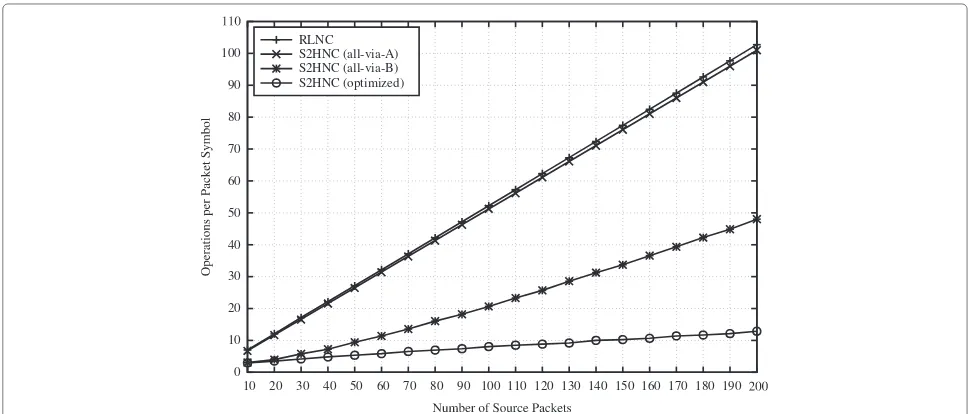
It is illustrative to present simulation results for a differ-ent set of parameter valuesR1 = 1,R2 = 4,1 = 0.01, 2 = 0.5,δ1 = 0.01, andδ2 = 0.05, which corresponds to having one lower quality path in terms of both trans-mission rate and packet loss rate. The max-flow capacity of the scenario isC1+C2=4.3 packets per network use. The achieved rates and required computational costs of using RLNC and S2HNC with different uncoded packet allocations are shown in Figs. 12 and 13, respectively. Again, all S2HNC schemes achieve higher rates and lower computational costs than RLNC.
Since the S-B-D path has a higher rate and better quality than S-A-D in this scenario, we expect the all-via-B alloca-tions to have performances close to that of the optimized allocation. The optimal allocation solution is provided in Table 2, where most of the uncoded packets are allocated to the S-B-D path. In Fig. 12, the achieved rates of all-via-B and optimized allocations are almost the same. However, it is seen in Fig. 13 that the two allocations have differences in computational costs at the receiver.
6 Conclusions
In this paper, we proposed a systematic network coding method for transmission over single or parallel two-hop lossy links. For these network topologies, we showed that it is not necessary to perform the high-complexity random linear network coding in order to approach the max-flow capacity. Sending all the uncoded packets first is shown to be advantageous compared to sending randomly coded packets all of the time.
Compared to random linear network coding, which is capacity achieving for large numbers of source pack-ets and sufficiently large finite field sizes, the proposed scheme is observed to provide better performance in terms of both end-to-end rate and decoding complex-ity. The improvement is appreciable when the number of source packets is small and the binary field is used. A par-ticular interesting application of this operating condition is WiFi offloading, where frequent transmissions of small numbers of data packets are common.
It is noted that the proposed technique may be directly extended to networks that contain more parallel paths and/or more than two hops. The extension, however, is left for future work.
Table 2Optimized uncoded packet allocations forR1=1,R2=4,
1=0.01,2=0.5,δ1=0.01,δ2=0.05, as a function of number
of source packets,M
M 20 40 60 80 100 120 140 160 180 200
M1 2 3 5 6 7 9 10 12 13 14
M2 18 37 55 74 93 111 130 148 167 186
Appendix
Appendix 1: transition probabilities of the Markov chains modeling S2HNC
For the period of time when S is sending uncoded packets, we have the following transition probabilities for different combinations of(k,r)in Markov chain C1. We have
For the period of time when S is sending coded packets, i.e., for Markov chain C2, we have
Fork≥1 andr<k<M,
Appendix 2: proof of Theorem 1
We prove the theorem by examining the probability that a received packet at D is innovative with respect to (w.r.t.) previously received packets. S2HNC will be shown to have a larger such probability at any time than RLNC. The com-pletion time is inversely proportional to this probability because the process of D collecting innovative packets is Markovian, i.e., the probability whether a received packet is innovative only depends on the number of innovative packets that D has received so far.
Consider a S2HNC with fixedM1andM2. In the first
network uses, packets transmitted on paths S-A and S-B are all distinct uncoded packets. The information flows on the two paths are therefore indepen-dent. Using the results from Section 3, it is clear that on
either path, using S2HNC will result in more innovative packets at D than using RLNC afterT1network uses.
During the time period fromT1toT2=max MR11,MR22
, one of the paths will be transmitting RLNC packets coded over theMsource packets while the other one is trans-mitting uncoded packets. Without loss of generality, we assume that S-A is the one transmitting RLNC packets, i.e., M1
R1 <
M2
R2. Now, the proof reduces to showing that transmitting uncoded packets on S-B while transmitting RLNC-coded packets on S-A is indeed beneficial com-pared to transmitting RLNC-coded packets on both S-B and S-A.
Let r(T1)
1 and r(
T1)
2 denote the numbers of innovative packets that have been received by D through S-A-D and S-B-D after T1 network uses, respectively. Let r1(t) and r(2t) denote the numbers of innovative packets that are received through S-A-D and S-B-D during(T1,t),T1 ≤ t ≤ T2. A newly received packet aftertnetwork uses is innovative if and only if it is linearly independent w.r.t. all ther(T1)
2 packets. For a given number of innovative packets at B, if S-B was unsuccessful, the prob-ability that D receives an innovative packet from B in the next transmission is the same using S2HNC or RLNC. If S-B was successful when using S2HNC, however, a new uncoded packet would be received by B. This packet is innovative with probability 1 w.r.t. the previously received innovative packets at B (which are uncoded) and is also innovative w.r.t. ther(T1) packets are in the span of the other distinct uncoded pack-ets. The forwarded uncoded packet is non-innovative if and only if it is in the span of ther1(t)RLNC packets. The probability of such event is no larger than that when using RLNC because a RLNC-coded packet may also be in the span of the otherr(T1)
1 +r
(T1)
2 +r
(t)
2 packets. Again, uncoded packets are innovative for B with probability 1 and there-fore B collects more innovative packets than the RLNC scheme. Therefore, transmitting uncoded packets on S-B is advantageous.
Therefore, in the firstT2network uses, S2HNC always results in more innovative packets at A, B, and D com-pared to RLNC. AfterT2, S2HNC and RLNC have the same behavior. Altogether, S2HNC achieves a shorter completion time.
Competing interests
The authors declare that they have no competing interests.
Authors’ contributions
All authors have contributed to this publication. All authors read and approved the final manuscript.
Acknowledgements
Received: 1 July 2015 Accepted: 24 September 2015
References
1. R Ahlswede, N Cai, S-YR Li, RW Yeung, Network information flow. IEEE Trans. Inf. Theory.46(4), 1204–1216 (2000). doi:10.1109/18.850663 2. S-YR Li, RW Yeung, N Cai, Linear network coding. IEEE Trans. Inf. Theory.
49(2), 371–381 (2003). doi:10.1109/TIT.2002.807285
3. R Koetter, M Medard, An algebraic approach to network coding. IEEE/ACM Trans. Netw.11(5), 782–795 (2003). doi:10.1109/TNET.2003.818197 4. RW Yeung,Information Theory and Network Coding. (Springer, New York,
2008)
5. T Ho, M Medard, R Koetter, DR Karger, M Effros, J Shi, B Leong, A random linear network coding approach to multicast. IEEE Trans. Inf. Theory. 52(10), 4413–4430 (2006). doi:10.1109/TIT.2006.881746
6. H Shojania, B Li, inProc. 18th International Workshop on Network and Operating Systems Support for Digital Audio and Video. Random network coding on the iPhone: fact or fiction? (2009), pp. 37–42. doi:10.1145/ 1542245.1542255, http://doi.acm.org/10.1145/1542245.1542255 7. J Heide, MV Pedersen, FHP Fitzek, T Larsen, inProc. IEEE Int. Conf.
Communications Workshops. Network coding for mobile devices—systematic binary random rateless codes, (2009), pp. 1–6. doi:10.1109/ICCW.2009.5208076
8. B Shrader, NM Jones, inProc. IEEE Military Communications Conf. MILCOM. Systematic wireless network coding, (2009), pp. 1–7.
doi:10.1109/MILCOM.2009.5380081
9. DE Lucani, M Medard, M Stojanovic, inProf. IEEE International Symposium on Information Theory (ISIT). Systematic network coding for time-division duplexing, (2010), pp. 2403–2407. doi:10.1109/ISIT.2010.5513768 10. P Pakzad, C Fragouli, A Shokrollahi, inProc. IEEE Int. Symp. Information
Theory. Coding schemes for line networks, (2005), pp. 1853–1857 11. M Luby, inProc. 43rd Annual IEEE Symp. Foundations of Computer Science.
LT codes, (2002), pp. 271–280. doi:10.1109/SFCS.2002.1181950 12. G Giacaglia, X Shi, M Kim, D Lucani, M Médard, Systematic network
coding with the aid of a full-duplex relay. CoRR abs/1204.0034, 3312–3317 (2013). doi: 10.1109/ICC.2013.6655057
13. 3G LTE WiFi Offload Framework, White Paper (2011). http://www. qualcomm.com/media/documents/3g-lte-wifi-offload-framework 14. A Ford, C Raiciu, M Handley, O Bonaventure, TCP extensions for multipath
operation with multiple addresses. IETF, RFC6824 (2013). http://www.ietf. org/rfc/rfc6824.txt
15. MAP Gonzalez, T Higashino, M Okada, inInformation Networking (ICOIN), 2013 International Conference On. Radio access considerations for data offloading with multipath tcp in cellular/wifi networks, (2013), pp. 680–685. doi:10.1109/ICOIN.2013.6496709
16. J Cloud, F du Pin Calmon, W Zeng, G Pau, LM Zeger, M Medard, inProc. IEEE 78th Vehicular Technology Conference (VTC Fall). Multi-path TCP with network coding for mobile devices in heterogeneous networks, (2013), pp. 1–5. doi:10.1109/VTCFall.2013.6692295
17. JK Sundararajan, D Shah, M Medard, S Jakubczak, M Mitzenmacher, J Barros, Network coding meets TCP: theory and implementation. Proc. IEEE.99(3), 490–512 (2011). doi:10.1109/JPROC.2010.2093850
18. PA Chou, Y Wu, K Jain, inProc. 41st Allerton Conference on Communication, Control, and Computing, Vol. 41, No. 1. Practical network coding, (2003), pp. 40–49
19. P Maymounkov,Online codes. (Technical report, New York University, 2002)
20. D Silva, W Zeng, FR Kschischang, inProc. Workshop Network Coding, Theory, and Applications (NetCod). Sparse network coding with overlapping classes, (2009), pp. 74–79. doi:10.1109/NETCOD.2009.5191397
21. Y Li, E Soljanin, P Spasojevic, Effects of the generation size and overlap on throughput and complexity in randomized linear network coding. IEEE Trans. Inf. Theory.57(2), 1111–1123 (2011). doi:10.1109/TIT.2010.2095111 22. A Heidarzadeh, AH Banihashemi, inProc. IEEE Information Theory Workshop
(ITW). Overlapped chunked network coding, (2010), pp. 1–5. doi:10.1109/ITWKSPS.2010.5503153
23. Y Li, W-Y Chan, SD Blostein, inProc. International Symposium on Network Coding (NetCod). Network coding with unequal size overlapping generations, (2012), pp. 161–166. doi: 10.1109/NETCOD.2012.6261902
24. Y Li, SD Blostein, W-Y Chan, inProc. IEEE Globecom International Workshop on Cloud Computing Systems, Networks, and Applications. Large file distribution using efficient generation-based network coding, (2013), pp. 427–432. doi: 10.1109/GLOCOMW.2013.6825025
25. X Shi, M Medard, DE Lucani, Whether and where to code in the wireless packet erasure relay channel. IEEE J. Selected Areas Commun.31(8), 1379–1389 (2013). doi:10.1109/JSAC.2013.130803
26. JG Kemeny, JL Snell,Finite Markov Chains. (D. Van Nostrand Company, Inc., Princeton, New Jersey, 1976)
27. A Shokrollahi, M Luby, Raptor codes. Found. Trends Commun. Inf. Theory. 6(13-4), 213–322 (2009)
Submit your manuscript to a
journal and benefi t from:
7Convenient online submission
7Rigorous peer review
7Immediate publication on acceptance
7Open access: articles freely available online
7High visibility within the fi eld
7Retaining the copyright to your article