A new model for probabilistic multi-period multi-objective
project selection problem
KHALILI-DAMGHANI, K., POORTARIGH, M. and PAKGOHAR, Alireza
Available from Sheffield Hallam University Research Archive (SHURA) at:
http://shura.shu.ac.uk/22728/
This document is the author deposited version. You are advised to consult the
publisher's version if you wish to cite from it.
Published version
KHALILI-DAMGHANI, K., POORTARIGH, M. and PAKGOHAR, Alireza (2017). A new
model for probabilistic multi-period multi-objective project selection problem. 24th
International Conference on Production Research (ICPR 2017), 598-603.
Copyright and re-use policy
See
http://shura.shu.ac.uk/information.html
Sheffield Hallam University Research Archive
24th International Conference on Production Research (ICPR 2017) ISBN: 978-1-60595-507-0
A NEW MODEL FOR PROBABILISTIC MULTI-PERIOD MULTI-OBJECTIVE
PROJECT SELECTION PROBLEM
K. Khalili-Damghani1, M. Poortarigh2, A. Pakgohar3
1Department of Industrial Engineering, Tehran South Branch, Islamic Azad University, Tehran, Iran 2Economic Sciences University, Tehran, Iran
3Department of Finance, Accounting and Business Systems, Sheffield Business School, Sheffield, United Kingdom
Abstract
The project selection problem is considered as one of the most imperative decisions for investor organizations. Due to non-deterministic nature of some criteria in the real world projects in this paper, a new model for project selection problem is proposed in which some parameters are assumed probabilistic. This model is formulated as a non-linear, multi-objective, multi-period, zero-one programming model. Then the epsilon constraint method and an algorithm are applied to check the Pareto front and to find optimal solutions. A case study is conducted to illustrate the applicability and effectiveness of the approach, with the results presented and analysed. Since the proposed model is more compatible with real world problems, the results are more tangible and trustable compared with deterministic cases. Implications of the proposed approach are discussed and suggestions for further work are outlined.
Keywords:
Project selection, multi objective programming, chance constraint, epsilon constraint method.
1 INTRODUCTION
Decision making about selection or rejection of a project is considerable from both theoretical and practical aspects and it depends on satisfaction of financial and non-financial constraints of the problem. In the real world project selection problems there are normally more than one objective function. This makes the solution algorithm more complicated and time consuming.
The purpose of this paper is decision making about selection of N projects in T periods of time such that the profit gets maximum and total cost of equipment, human resources and used raw materials become minimum. In real world problems many of parameters are unlikely to be deterministic and ignoring the stochastic model can lead to unreliable results. In this paper a new framework is proposed for modeling a project selection problem relying on the concept of risk and by applying a linear approximation on probabilistic constraints. The mentioned model is called “Mean-Risk” model which the main idea of it is maximizing the expected profit of selecting a project such that risk curve of this selection always be below of the confidence curve. Here without loss of generality and just for simplification, the confidence is assumed a linear function.
Since some parameters are probabilistic, the constraints include these parameters are also probabilistic constraints. Chance constrained programming was developed as a means of describing constraints in the form of probability levels of attainment. Consideration of chance constraints allows the decision maker to consider objectives in terms of their attainment probability.
This approach changes constraints with stochastic parameters to constraints with a confidence level as the threshold of decision maker, using variance-covariance matrix. If α is a predetermined confidence level desired by the decision maker, the implication is that a constraint will have a probability of satisfaction of α.
After transforming the problem from probabilistic mode to deterministic mode, the resulting model is still multi objective and the optimal solution can be found on a Pareto front set. The method for solving multi objective problems used here is called augmented epsilon constraint method (AUGMECON). The AUGMECON method has been coded in Lingo 11, a widely used modeling language. The mentioned algorithm searches optimal solution by checking all points in the space of grid
points while some of these points may be infeasible and algorithm wastes a lot of time by searching among infeasible points. More over by increasing the number of objective functions, the run time grows exponentially. An innovative addition to the algorithm is the early exit from the nested loop when the problem becomes infeasible and there is no need to further restrict the corresponding objective function. This innovation significantly accelerates the algorithm in the case of several (more than three) objective functions. The rest of the paper is arranged as follows: Literature of past works which is presented in section 2 .In section 3 the problem will be illustrated, then the AUGMECON method will be introduced and an algorithm for this method will be presented. The results are shown in part 4. Finally the paper will be ended with conclusion remarks and further researches proposal in section 5.
2 LITERATURE OF PAST WORKS
Huang [1] introduced different types of mathematical programming to model a portfolio selection problem which there is no certainty the rate of return of investment and other parameters. He analyzed uncertainty under both conditions: variables with known distributions and parameters with unknown distributions. Defining risk curve and confidence curve, he presented Mean-Risk model to formulate portfolio selection problem with maximum utility regard to the risk curve achieved from combination of this selection which must be always under confidence curve that is under control of decision maker.
Rafiee et al. [2] analyzed and formulated the joint problem of project selection and project scheduling under uncertain environment. In this article a multi period project selection and scheduling problem is introduced and modeled by multi stage stochastic programming which is effective for solving long term planning problems under uncertainty. Assuming resources of the projects are limited and renewable, the aim was maximization of the present value of profits of projects as the objective function.
Olson et al. [3] presented a linear approximation for chance constrained programming in their article which can be used in either the single or multiple objective cases. The approximation presented will place a bound on the chance constraint at least as tight as the true nonlinear form, thus it overachieves the chance constraint at the expense of other constraints or objectives.
Mavrotas [4] made effort to effectively implement the epsilon constraint method for producing the Pareto optimal solutions in a MOMP. He proposed a novel version of the method AUGMECON that avoids producing weakly Pareto optimal solutions and accelerates the whole process by avoiding redundant iterations.
Atalay et al. [5] developed a method for transforming the chance constrained programming problem into a deterministic problem. In this article they considered the problem under this assumption that the random variables a_ij are independent with Gamma distribution. This new method used estimation of the distance between distributions of some of these independent random variables having Gamma or normal distributions. Probabilistic constraints obtained via Essen inequality which has been made deterministic using the approach suggested by Poly. The model studied on has been solved under the assumption of both Gamma and Normal distributions and the obtained results have been compared.
Khalili-Damghani et al. [6] developed a decision support system (DSS) to solve sustainable multi objective project selection problem with multi period planning horizon. First a TOPSIS based fuzzy goal programming (FGP) is proposed which considered uncertain DM preferences on priority of achievement level of fuzzy goals. The output of FGP and other affecting factors were treated as inputs of a fuzzy rule based system to estimate fitness value of an investment.
Pagnoncelli et al. [7] studied sample approximations of chance constrained problems. In particular they considered the sample average approximation (SAA) approach and discussed the convergence properties of the resulting problem and how good candidate solutions can be obtained by this method. In addition they presented a method for constructing statistical lower bounds for the optimal value of the considered problem and discussed how one should tune the underlying parameters.
Ekhtiari et al. [8] used multi objective stochastic programming to solve manpower allocation problem. They presented a novel combination of the chance constrained programming and the global criterion model for that which is called chance constrained global criterion. The proposed model is a deterministic equivalent for the multi objective problem of manpower allocation. To illustrate the model a tri-objective stochastic manpower allocation case problem for determining optimal number of manpower in a job-shop manufacturing system is formulated and solved and then the competitive advantages of the model were discussed.
Stochastic programming is one of the major approaches to deal with randomness or uncertainty involved in mathematical programming problems. Sakawa and. Kato [9] focused on multi objective linear programming problems with random variable coefficients in objective functions and/or constraints in his book. He used several stochastic models such as an expectation optimization model and a fractional criterion optimization model in chance constraint programming in order to transform the stochastic programming problems into deterministic ones. Ackooij et al. [10] used joint chance constrained programming for hydro reservoir management in the paper. They presented an iterative algorithm for solving similarly structured joint chance constrained programming problems that requires a Slater point and the computation of the gradients. They also presented an individual chance constrained problem and a robust model. They illustrated the interest of chance constrained programming by comparing the results obtained by a realistic hydro valley with those obtained from the alternative models.
Ivanov [11] proposed a setting for a bi-level stochastic linear programming problem with quantile criterion and presented a deterministic equivalent of the problem for the case of the scalar random parameter. He showed an equivalent problem in the form of the two-stage stochastic discrete distribution of random parameters, the problem reduces to a mixed linear programming problem.
3 MATHEMATICAL PROGRAMMING MODEL 3.1 Problem description
There is T distinct independent periods of time and N projects in this problem. The decision maker must make decision about selection or rejection of a project such that all of objective functions will be optimized regard to the constraints, include resource and budget. Resources are involved in three groups of human, machine and raw material which are allocated independently in any period of time. The model is formulated as follows:
j number of projects, j=1,2,…,n i type of human resources, i=1,2,…,m k machine kind, k=1,2,…,s
o type of raw material, o=1,2,…,z
Parameters:
maximum available human resources of type I in period t p/h requirement of human resource i in project j (person-hour)
maximum available machine-hour of type k in period t requirement of machine-hour of type k in project j
maximum available raw material of type o in period t requirement of raw material o in project j
maximum available budget for project j in period t per hour cost of human resources I in period t
per hour cost of machine type k in period t unit cost material o in period t
total net profit or project j in period t Rate of return of project j in period t duration of project j in period t
minimum attractive rate of return in period t The decision variable of the model is considered as below:
Eq. (1) tries to maximize the net profit of selected projects:
Eq. (2) tries to minimize the total cost of selected projects:
Eq. (4) the last objective function tries to minimize total unused resources of the optimum selections:
Constraints (5) which should be held for all projects express that each selected project must be selected only one time through the planning horizon:
Constraints (6) which should be held for all projects present that each selected project must be completed in planning horizon:
Constraints (7) which should be held for all human resources and planning horizons, insures that human resources availability is met during the procedure of project selection. The set of constraints (8) and (9) have the same description of constraints (7) but they are applied for machine-hour and raw materials, respectively:
The set of constraints (10) , which should be held for all planning horizons and all projects, checks the budget availability in the project selection procedure:
Constraints (11) checks if total cost of a selected project is less than its profit. They are also held for all projects in all planning horizons:
Constraints (12) insure that the selected projects have a minimum internal rate of return equal to minimum attractive rate of return (MARR):
Constraints (13) refer projects could be selected in each planning horizon:
3.2 Mean-Risk Model
The main idea of this model is based on ensuring safety of the investment in the first priority, then maximizing or minimizing other objective functions. In the other word one should invest on a project if its risk curve is below of its confidence curve. The concept of confidence level for probabilistic condition is used. Here for simplification and without loss of generality the authors use a linear function as the confidence curve:
Which r is a non-negative variable and represent the amount of loss, a, b, c, d and e are coefficients of function .
R(r) =Pr
r
With above description, the mean-risk model will be formulated as follows:
Max E [ ]
Subject to:
R ( ,
(16) Now the project selection problem is re-written as a mean-risk model under this assumption that some parameters are probabilistic. So objective functions and constraints include these probabilistic parameters will change as follows:
Min E [ ] Min E [ ] Subject to: Pr (
Pr ( (17)
As it is shown the second and forth objective functions which involve stochastic variables, changed and their expectation values are optimized. In addition, their corresponding constraints are added to the constraint set. Since z2 and z4 are minimization, their negative form must be put in the model. Other parts of the project selection problem model will stay unchanged.
3.3 Chance constraints
The constraints (7), (8), (9), (10), (11) include stochastic variables and are not solvable. To overcome this problem authors used chance constrained programming which uses variance-covariance matrix and modified the constrains as follows:
Moreover, two sets of constraints related to objective functions described in (17) will be added to the constrain set.
3.4 The augmented epsilon constraint method The problem is considered as a multi objective, non-linear and zero one optimization problem. Generally in multi objective optimization problem there is no unique answer that can optimize all of objective functions simultaneously. Generally, a MODM problem with maximum objective functions can be formulated as follows:
Max (
(23)
St x
In epsilon constraint method, decision maker optimizes one of the objective functions using the other functions as constraints, incorporating them in the constraint part of the model as shown below:
Max
st
(24)
x
By parametrical variation in the RHS of the constrained (ei) the efficient solutions of the problem are obtained. The point of attention is that the optimal solution of problem (24) is guaranteed to be an efficient solution only if all the (p-1) objective function’s constraints are binding. Otherwise if there are alternative optima, the obtained optimal solution of problem (34) is not in fact efficient, but it is a weekly efficient solution. In order to overcome this ambiguity the authors proposed the transformation of the objective function constraints to equalities by explicitly incorporating the appropriate slack or surplus variables. In the same time, these slack or surplus variables are used as a second term in the objective function, forcing the program to produce the efficient solutions. The new problem becomes:
Max (
St
x
(25)
Where eps is an adequately small number (usually between and . In order to avoid any scaling problem, it is recommended to replace the s_i in the second term of the objective function by ), where is the range of the ith objective function. Thus the objective function of the epsilon constraint method becomes like (25).
4 IMPLEMENTATION
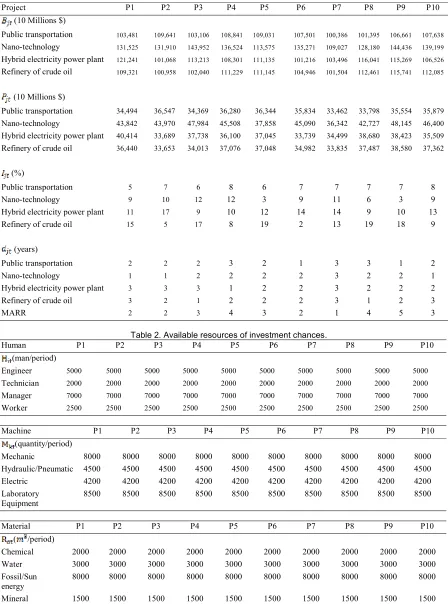
The proposed model was applied in historical data of project selection of an Iranian financial and credit institution. The projects had been treated as investment chances. A set of four different investment chances including development of Public Transportation, Nano-Technology, Hybrid Electricity Power Plant and Refinery of Crude Oil were considered during a ten-year planning period (P1, P2, . . ., P10). Budgets, profit, internal rates, duration and MARR of investment chances are shown in Table1. The available resources for each project also depicted in Table 2. Due to the page limit of this paper the author is unable to provide other input data. However, full illustration will be presented at the conference session. In this article it is assumed that the variables are independent and normally distributed. The objective functions have equal values for DM and there is no priority among them.
The Pareto border is divided into 4 distinct sections and algorithm runs with step length of 0.25. Epsilon is assumed . The confidence function is linear and is variable from 0.2 to 0.9.
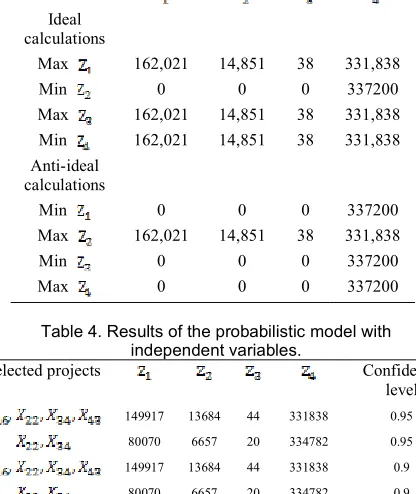
The results are shown in tables 3 and 4. The confidence curve is a continuous and decreasing function but in result’s tables some special points of confidence curve which include the best solutions, were calculated. Regard to the data used in this article and the constraints, the model for confidence levels which are less than 0.82 will be infeasible. These results emphasize that such an investment involves a great deal of risk for investors. The models were coded by Lingo 11and the final solutions which are global optimal answers were obtained in different iterations of algorithm. It is obvious that in deterministic condition the objective functions have better results and gradually with increase of constraints in probabilistic condition, it gets worse.
5 CONCLUSION
Table 1. Budgets, profit, internal rates, duration and MARR of investment chances.
Project P1 P2 P3 P4 P5 P6 P7 P8 P9 P10 (10 Millions $)
Public transportation 103,481 109,641 103,106 108,841 109,031 107,501 100,386 101,395 106,661 107,638
Nano-technology 131,525 131,910 143,952 136,524 113,575 135,271 109,027 128,180 144,436 139,199
Hybrid electricity power plant 121,241 101,068 113,213 108,301 111,135 101,216 103,496 116,041 115,269 106,526
Refinery of crude oil 109,321 100,958 102,040 111,229 111,145 104,946 101,504 112,461 115,741 112,085
(10 Millions $)
Public transportation 34,494 36,547 34,369 36,280 36,344 35,834 33,462 33,798 35,554 35,879
Nano-technology 43,842 43,970 47,984 45,508 37,858 45,090 36,342 42,727 48,145 46,400
Hybrid electricity power plant 40,414 33,689 37,738 36,100 37,045 33,739 34,499 38,680 38,423 35,509
Refinery of crude oil 36,440 33,653 34,013 37,076 37,048 34,982 33,835 37,487 38,580 37,362
(%)
Public transportation 5 7 6 8 6 7 7 7 7 8 Nano-technology 9 10 12 12 3 9 11 6 3 9 Hybrid electricity power plant 11 17 9 10 12 14 14 9 10 13 Refinery of crude oil 15 5 17 8 19 2 13 19 18 9
(years)
Public transportation 2 2 2 3 2 1 3 3 1 2
Nano-technology 1 1 2 2 2 2 3 2 2 1
Hybrid electricity power plant 3 3 3 1 2 2 3 2 2 2 Refinery of crude oil 3 2 1 2 2 2 3 1 2 3
[image:7.612.75.523.72.676.2]MARR 2 2 3 4 3 2 1 4 5 3
Table 2. Available resources of investment chances.
Human P1 P2 P3 P4 P5 P6 P7 P8 P9 P10 (man/period)
Engineer 5000 5000 5000 5000 5000 5000 5000 5000 5000 5000
Technician 2000 2000 2000 2000 2000 2000 2000 2000 2000 2000
Manager 7000 7000 7000 7000 7000 7000 7000 7000 7000 7000
Worker 2500 2500 2500 2500 2500 2500 2500 2500 2500 2500
Machine P1 P2 P3 P4 P5 P6 P7 P8 P9 P10 (quantity/period)
Mechanic 8000 8000 8000 8000 8000 8000 8000 8000 8000 8000 Hydraulic/Pneumatic 4500 4500 4500 4500 4500 4500 4500 4500 4500 4500 Electric 4200 4200 4200 4200 4200 4200 4200 4200 4200 4200 Laboratory
Equipment
8500 8500 8500 8500 8500 8500 8500 8500 8500 8500
Material P1 P2 P3 P4 P5 P6 P7 P8 P9 P10 ( /period)
Chemical 2000 2000 2000 2000 2000 2000 2000 2000 2000 2000 Water 3000 3000 3000 3000 3000 3000 3000 3000 3000 3000 Fossil/Sun
energy 8000 8000 8000 8000 8000 8000 8000 8000 8000 8000 Mineral 1500 1500 1500 1500 1500 1500 1500 1500 1500 1500
Table 3. Payoff matrix of single objective optimization. Ideal calculations 331,838 38 14,851 162,021 Max 337200 0 0 0 Min 331,838 38 14,851 162,021 Max 331,838 38 14,851 162,021 Min Anti-ideal calculations 337200 0 0 0 Min 331,838 38 14,851 162,021 Max 337200 0 0 0 Min 337200 0 0 0 Max
Table 4. Results of the probabilistic model with independent variables. Confidence level Selected projects 0.95 331838 44 13684 149917 0.95 334782 20 6657 80070 0.9 331838 44 13684 149917 0.9 334782 20 6657 80070 0.85 331838 44 13684 149917 0.85 334782 20 6657 80070 0.82 331838 44 13684 149917
6 REFERENCES
[1] Huang X., 2010, Portfolio Analysis From Probabilistic to Credible and Uncertain Approaches. Springer Verlag, Berlin Heidelberg. Studies in Fuzziness and soft Computing, Vol:250.
[2] Rafiee M., Kianfar F., Farhadkhani M., 2014, A Multi-Stage Stochastic Programming Approach in Project Selection and Scheduling, Springer-Verlag. 70, 2125-2137.
[3] Olson D.L., Swenseth S.R., A Linear Approximation for Chance Constrained Programming. The Journal of Operational Research Society, 1987, 38, 260-267. [4] Mavrotas G., Effective Implementation of the Epsilon
Constraint Method in Multi Objective Mathematical Programming, Applied Mathematics and Computation, 2009, 213, 455-465.
[5] Atalay K.D., Apaydin A., 2011, Gamma Distribution Approach in Chance-Constrained Stochastic Programming Model, Springer, Journal of Inequalities and applications.
[6] Khalili-Damghani K., Sadi-Nejad S., A Decision Support System for Fuzzy Multi Objective Multi Period Sustainable Project Selection, Computer and Industrial Engineering Journal, 2013, 64, 1045-1060. [7] Pagnoncelli B.K., Ahmed S., Shapiro A., Sample
Average Approximation Method for Chance Constrained Programming : theory and application, Springer Science+Business Media, 2009, 142, 399-416.
[8] Ekhtiari M., Ghoseiri K., 2013, Multi Objective Stochastic Programming to Solve Manpower Allocation Problem. Springer-Verlag, 65, 183-196.
[9] Sakawa M., Kato K., 2008, Interactive Fuzzy Multi Objective Stochastic Linear Programming, Springer Science+Business Media
[10] Ackooij W.V., Henrion R., Mollar A., Zorgati R., 2014, Joint Chance Constrained Programming for Hydro Reservoir Management. Springer Science+Business Media, 15, 509-531.