Abstract—Partner selection of virtual enterprise is the process that selects suitable cooperative enterprises for virtual enterprise. It is an important problem in virtual enterprise. This paper adopts a five-phase partner selection model that can select partners for multiple products/services considering the synergy effects between products/services. The proposed partner selection model is realized by a multi-agent system. An extended TOPSIS technique is implemented in the pre-selection phase to indentify qualified potential partners. An auction-based approach is adopted in the final selection phase to generate the optimum combination of partners for the provision of multiple products in consideration of synergy effects.
Index Terms—multi-agent systems, negotiation, partner selection, virtual enterprise
I. INTRODUCTION
HE ever-increasing fierce global competition and the rapid development of modern information and communication technologies have reinforced the requirements for stronger, more flexible, and more collaborative supply chain management (SCM). Many manufacturers have adopted the concept of virtual enterprise (VE), to establish agile and flexible coalitions with the appropriate collaborative partners in the supply chain networks. Virtual enterprise (VE) is a form of cooperative network for several enterprises to work together, to accomplish business opportunities collaboratively. There are many definitions of VE, broadly, VE is a temporary alliance of enterprises that come together to share skills or core competencies and resources in order to better respond to business opportunities, and whose cooperation is supported by computer networks [1]. The enterprise that initiates a VE is the VE initiator which is responsible for the establishment and coordination of the VE with other VE partners.
According to the distributed, cooperative and intelligent characteristics of multi-agent system (MAS), it has been considered suitable to model a VE as a distributed MAS [1]. A multi-agent system (MAS) is a system composed of several agents. An agent can be a hardware or software-based computer system that is autonomous, reactive, pro-active and able to interact and communicate with other artificial and human agents [2]. The MAS should therefore be capable of Chunxia Yu is with the Industrial and Manufacturing Systems Engineering Department, the University of Hong Kong, Hong Kong (phone: 852-67449649; fax: 852-28586535; e-mail: cxyu@ hku.hk).
T. N. Wong is with the Industrial and Manufacturing Systems Engineering Department, the University of Hong Kong, Hong Kong (e-mail: [email protected]).
accomplishing goals that are difficult to achieve by an individual agent or a monolithic system. In the context of VE, a MAS can be established to facilitate the formation and operation of the VE. Typically, the MAS should comprise agents representing the members and functions of VE. For the kind of VE in a supply chain network, the MAS may consist of agents representing the various VE entities including the VE initiator and VE partners.
VE is a dynamic organization such that VE partners join or leave the VE according to business opportunity. The functioning of a VE depends on the collaboration and cooperation of the VE partners. Accordingly, the performances of partners determine whether the business opportunity can be accomplished. Thus it is vital to choose the appropriate members in the formation of the VE. To establish a VE for the supply chain, the VE initiator has to select partners capable of providing right quality products/services at the right price and at the right time. With respect to SCM applications, VE partner selection has to incorporate both qualitative and quantitative criteria. In general, this kind of partner selection problem can be viewed as a multi-criteria decision making (MCDM) problem that involves trade-offs between conflicting criteria.
The supply chain and VE partner selection problem has attracted the attention of many researchers. Some researchers [3-5] have focused on the multi-criteria decision making process of partner selection. There are also researches [6-8] focusing on the automated negotiation process among agents in MAS-based partner selection system. However, most of the previous studies have been on the selection of partners for a single product or service, not much research effort has been spent on partner selection for multiple products/services, especially the synergy effects between products/services. One common approach is to decompose the requirement into a number of sub-problems, with each of them involving the selection of partners for the provision of one product/service. In reality, the business opportunity of VE may involve multiple products/services. The VE initiator is required to select partners providing the combination of these products/services. This will take into account of the synergy effects between products/services which exist commonly, for example, the complementary and substitutable relationships between products/services.
The objective of this paper is to propose a VE partner selection model for multiple products/services, with the consideration of the synergy effects between products/services. The proposed partner selection model is implemented in a multi-agent system. It is realized by a hybrid methodology of TOPSIS based pre-selection method for potential partners and automated negotiation-based final
Multiple Products Partner Selection Model of
Virtual Enterprise based on Multi-agent Systems
Chunxia Yu, T. N. Wong
selection method for cooperative partners. The remainder of this paper is organized as follows. Section 2 describes the workflow and framework of the proposed MAS-based partner selection model. In section 3, the methodologies used in the proposed partner selection model are explained. An example of proposed partner selection model and experimental results are described in section 4. Finally, section 5 presents the concluding remarks.
II. WORK FLOW AND FRAMEWORK OF MAS-BASED PARTNER SELECTION MODEL
A. Partner Selection Process
The partner selection process of VE can be considered as a five-phase process [9] as shown in Fig. 1. The five phases are problem definition, criteria formulation, pre-selection of potential partners, final selection of cooperative partners, and monitoring of cooperative partners. The functions of these phases are illustrated as follows:
Problem Definition
-- Identify the goal of VE.
-- Decompose the goal into multiple products/services. -- Determine the synergy effects between
products/services.
-- Identify the requirements of partners for each product/service.
Criteria Formulation
-- Determine criteria for pre-selection phase. -- Determine criteria for final selection phase.
-- Define interdependences between final selection criteria.
Pre-Selection phase
-- Rank interested partners for each product/service considering the synergy effects between
products/services.
-- Form the shortlist of potential partners for final selection phase.
Final Selection Phase
-- Negotiate with recommended potential partners. -- Select optimal cooperative partners for VE considering
the synergy effects between products/services. -- Award contract to selected cooperative partners. Monitoring Phase
-- Restart partner selection process when accidents occur. -- Evaluate the performance of selected cooperative
partners.
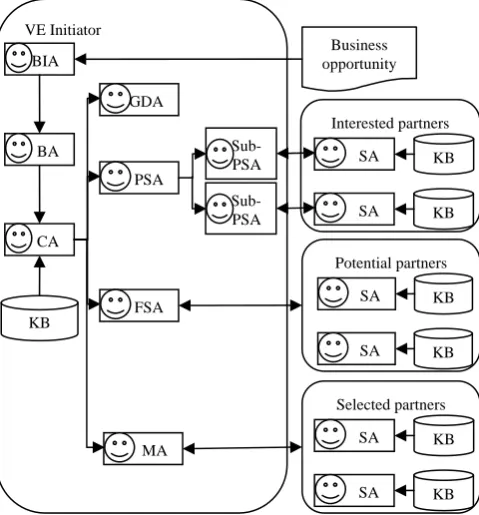
B. Framework of MAS-based Partner Selection Model The partner selection of VE can be abstracted as the buyer-seller relationship in a typical supply chain. The five-phase partner selection model for multiple products/services is modeled as a distributed MAS as shown in Fig. 2. In the MAS, the buyer agent represents VE initiator and the seller agents represent VE partners. For example, the VE initiator can be a manufacturer which needs to acquire subassemblies or raw materials from its vendors or supplier; the VE partners are then the vendors or suppliers which are able to supply the subassemblies or materials. The MAS-based partner selection model is composed of a number of agents, namely, buyer interface agent (BIA), buyer agent (BA), seller agent (SA), coordinator agent (CA), goal decomposition agent (GDA), pre-selection agent (PSA), sub pre-selection agent (Sub-PSA), final selection agent (FSA), and monitoring agent (MA). According to the partner selection process of VE, the functions of these agents are shown as follows.
Business opportunity Identification
Problem definition
Criteria formulation
Pre-selection phase
Final selection phase
Monitoring phase
Successful Cooperation
Accidents occur? Yes
[image:2.595.107.228.299.558.2]No
Fig. 1. Workflow of partner selection
Business opportunity
Fig. 2. Architecture of MAS-based partner selection model Potential partners
SA KB
SA KB
Selected partners
SA KB
SA KB
Interested partners
SA KB
SA KB
Sub- PSA
Sub- PSA BIA
BA
CA
KB
MA GDA
[image:2.595.307.547.452.710.2]Problem Definition
-- The decision maker sets preferences by BIA.
-- BA obtains the business opportunities requirements by BIA.
-- BA informs the business opportunities requirements to CA.
-- CA solicits GDA to decompose the business goal into multiple products/services
-- GDA decomposes the goal into multiple products/services
-- CA Identify the requirements of partners for each product/service.
-- CA determines the synergy effects between products/services
Criteria Formulation
-- CA determines criteria for pre-selection phase. -- CA determines criteria for final selection phase.
-- CA defines the interdependences between final selection criteria.
Pre-Selection phase
-- CA solicits PSA to start pre-selection of potential partners for these products/services.
-- PSA creates Sub-PSA for each product/service.
-- Sub-PSA search all interested SAs for specific product/service.
-- Sub-PSA rank the performances of interested SAs based on pre-selection criteria.
-- Sub-PSA forms the shortlist of potential SAs for specific product/service.
-- Sub-PSA informs pre-selection results to PSA. -- PSA informs all pre-selection results to CA. Final Selection Phase
-- CA solicits FSA to start final selection of cooperative SAs for these products/services.
-- FSA calls for bids from all potential SAs.
-- Potential SAs propose all potential bids of these products/services to FSA.
-- FSA selects optimal combination of SAs based on these bids from potential SAs.
-- FSA awards contract to selected cooperative SAs. Monitoring Phase
-- CA solicits MA to monitor the operation of selected cooperative SAs.
-- MA informs CA to restart partner selection process when any cooperative SA encounters uncertainties. -- MA evaluates selected cooperative SAs when they
finish the operations.
III. METHODOLOGY OF PROPOSED PARTNER SELECTION MODEL
Criteria identification, pre-selection of potential partners and final selection of cooperative partners are the key issues of partner selection process. The way to resolve these issues are explained as follows.
A. Criteria Identification
Partner selection criteria can be categorized into nonnegotiable issues and negotiable issues. Nonnegotiable issues are characteristics pertaining to interested partners, such as history cooperation performance, reputation,
technology, financial condition and so on. While negotiable issues are the bids contents of potential partners for specific product/service in negotiation process, for example price, quality, delivery and service. In general, nonnegotiable issues are used to evaluate the qualification of interested partners in pre-selection phase, and negotiable issues are used to evaluate the bids of potential partners in final selection phase.
The proposed partner selection model is used to select partners for multiple products/services. In reality, there are synergy effects between products/services. The concept of synergy can be defined in terms of super-additive return or sub-additive cost [10]. Super-additive return synergies can be derived when the utility of buying complementary products in bundling from a single partner is bigger than from separately multiple partners. For two products (a) and (b): R(a,b)>R(a)+R(b). Sub-additive cost synergies (or economies of scope) can be obtained if the use of common factors of production reduces joint production costs of the business units. For two products (a) and (b): C (a,b)<C(a)+C(b). In this paper the definition of super-additive return synergies is adopted to define synergy effects between products/services in buyer side while the definition of sub-additive cost synergy effects are adopted in the seller side. The synergy effects affect decision maker’s choice of partners. So synergy effects between products/services should be used as a criterion to evaluate partners in both the pre-selection phase and the final selection phase. Complementarities and substitutability are the two most popular synergy effects.
Both the pre-selection phase and final selection phase can be viewed as MCDM problems that involve trade-offs between conflicting criteria. In order to facilitate the expression of the decision-maker’s assessments of partners efficiently under multi-criteria perspective, the criteria can be expressed both in qualitative and quantitative forms. For qualitative criteria, five linguistic values {very good, good, medium, poor, very poor} are selected and the corresponding numeric values are shown in Table I. In order to compute conveniently, the assessments of interested partners should be normalized. For benefit criteria, it can be normalized by equation (1). For cost criteria, it can be normalized by equation (2). In these equations, r represents the normalized value of specific criteria value c, and cmin and cmax represent the min and max value of specific criteria.
min
max min
c c r
c c
(1)
max
max min
c c r
c c
(2)
B. Pre-selection Phase
competitive potential partners, and then evaluates and negotiates with these competitive potential partners in detail. In this paper, the pre-selection of potential partners is defined as the process of ranking the performance of interested partners and forming the shortlist of competitive potential partners.
The pre-selection of potential partners can be viewed as a MCDM problem on criteria history cooperation performance, reputation, technology, financial condition and production capacity which used to reflect the synergy effects between products/services. Various techniques, e.g. AHP (analytical hierarchy process), TOPSIS (technique for order preference by similarity to ideal solution) and metaheuristics including neural networks and evolution algorithms, etc, have been adopted in solving different kinds of MCDM problems. In this paper, TOPSIS is adopted to deal with the MCDM problem in the partner pre-selection phase. TOPSIS is one of the commonly used approaches to deal with MCDM problems. TOPSIS was first developed by Hwang and Yoon [11], it is based on the concept that the chosen alternative should have the shortest distance from the positive ideal solution (PIS) and the farthest from the negative ideal solution (NIS). The ultimate decision criterion is the similarity to the ideal solution. TOPSIS method can consider both qualitative and quantitative criteria and rank the alternatives in ascending or descending order on these criteria.
The TOPSIS method can be implemented easily in MAS to make it suitable for the selection of potential partners in the partner pre-selection phase. In this paper, the TOPSIS method is extended to complete the pre-selection of potential partners for multiple products/services considering the synergy effects between products/services. The synergy effects are reflected by an additional criterion production capacity. The positive solution of proposed pre-selection method are partners with good history performance, reputation, technology, and financial condition, reputation, advanced technology, financial condition and production capacity providing complimentary products/services. The negative ideal solution is the opposite. In reality, a decision maker may have different preferences of partners on different
products/services. For example, the decision maker may prefer high reputation partners for key products/services, while low price partners for common products/services. According to the autonomous, reactive, pro-active and social characteristics of agents, these Sub-PSAs for different products/services can have different knowledge to reflect decision maker’s different preferences. In the proposed MAS-based partner selection model, all the Sub-PSAs start the pre-selection process simultaneously based on their own knowledge. The TOPSIS-based pre-selection method used in every Sub-PSA is shown in Fig. 3.
C. Final-selection Phase
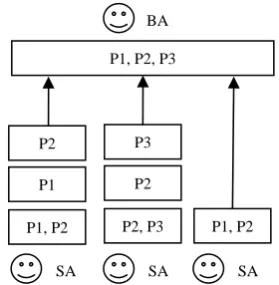
In the final selection phase of partner selection for multiple products/services, the synergy effects between products/services are considered both in the buyer side and the seller side. The subset of products/services is known as bundle. It is necessary to propose bundling bids to exploit the possible synergy effects between products/services. Potential partners can propose multiple bids based on different bundles of multiple products/services as shown in Fig. 4. These bids are composed of single product/service information or bundling products/services information. The buyer prefers bids that propose complementary products/services in bundle. The solution of the partner selection of VE is the combination of bids proposed by all the potential partners for these products/services. The final selection phase is to select the optimal combinations of these bids.
The final selection phase can be realized by a negotiation-based method by which VE initiator can obtain products/services information in detail. Bargain and auction are two popular negotiation mechanisms. According to our previous work [12], bargaining is suitable for partner selection for single product/service considering multiple criteria. In the partner selection problems for multiple products/services auction is more suitable, for example, combinatorial auction allows complex bids such as bundle bids. It provides a useful negotiation mechanism when there are complementarities or substitutability between products/services [13]. In combinatorial auctions, the bidder can express more fully. This is particularly important when items are complementary or substitutable. In addition, combinatorial auctions can lower the overall spending and transaction costs for multi-issue negotiations. From the
BA
P1, P2, P3
SA
SA SA
P3
P2
P2, P3 P2
P1
[image:4.595.57.281.401.572.2]P1, P2 P1, P2
[image:4.595.355.495.417.560.2]Fig. 4. Bids example in combinatorial reverse auction
Fig. 3. Pre-selection model based on extended TOPSIS method Calculate the normalized decision matrix
Calculate the weighted normalized value
Determine the positive ideal solution and the negative ideal solution
Calculate the distance of each alternative from the positive ideal solution and the negative ideal solution
perspective of VE partners, combinatorial auctions provide market transparency and high allocative efficiency. Combinatorial auctions are suitable to accomplish the partners’ selection for multiple products/services. In the proposed MAS-based partner selection model, the FSA which is responsible for final selection phase is the auctioneer and potential SAs recommended by PSA are bidders. Combinatorial reverse auction is adopted to realize the final selection of optimal cooperative partners of VE.
IV. EXAMPLE
The proposed MAS-based partner selection model has been implemented on JADE (Java Agent Development Environment). JADE is an open source software framework and is the state of the art tool used for developing multi-agent systems. An example is implemented to test the feasibility and efficiency of the proposed MAS-based partner selection model for multiple products/services.
In this example, the length of the potential partners’ shortlist is 3 and the, multiple products are composed of P1, P2 and P3. Among these three products, P1 and P2, P1 and P3 have complementary synergy effect. Table II shows the basic information of interested partners used to evaluate the qualifications of interested partners in pre-selection phase. For criteria including reputation, financial condition, technology, and history performance, VE initiator can obtain their values directly from its own knowledge database; and for criterion production capacity, VE initiator gets its value based on the synergy effects between products in production capacity proposed by every interested partner. Table III shows rank information of interested partners for these three products in descending order based on the proposed extended TOPSIS-based pre-selection method. According to the given length of potential partners’ shortlist, shortlist (S1, S3, S4), (S3, S4, S6), and (S5, S7, S9) are formed for multiple products P1, P2, and P3. In the final selection phase, potential partners can propose multiple bids with different product number and product information. Both the proposal for specific product and synergy effects between products in a bid are considered in final selection phase. A proposal for specific product is composed of price, quality, delivery, and service. These issues can be negotiated in the final selection process. Table IV shows the value ranges of these negotiable issues. For the criterion reflects synergy effects, VE initiator can also get its value by analyzing the synergy effects between products in a bid. Table V shows the possible bids of potential partners, and specific proposal for every product in a bid. The solution of partner selection for multiple products P1, P2, and P3 are combinations of bids proposed by potential partners, for example, {(700, VG, 7, G), (600, VG, 8, G), (650, M, 14, M)}. The optimal solution selected by the proposed auction-based final-selection method for this scenario is {(650, VG, 10, G), (550, VG, 10, G), (680, VG, 7, VG)}, and hence (S3, S3, S5) is the set of corresponding partners for the multiple products partner selection problem. So S3 and S5 are the cooperative partners selected by the proposed partner selection model for multiple products P1, P2 and P3. As illustrated in this example, the proposed MAS-based VE model is able to select the set of partners for multiple products.
TABLEI
QUALITATIVE CRITERIA INFORMATION
Linguistic variable Abbreviation Numeric value
Very good VG 1
Good G 0.75
Medium M 0.5
Poor P 0.25
Very poor VP 0
TABLEII
BASIC INFORMATION OF INTERESTED PARTNERS Seller Reputation Financial
conditio n
Technology History performance
Production capacity
S1 VG M G VG P1
S2 G VP VG M P1
S3 G VG G VG P1,P2
S4 M VG VP M P1,P2
S5 P M VG P P1,P3
S6 VG M VG G P2
S7 M P M VP P2,P3
S8 VP M G P P2,P3
S9 VG P G VG P3
S10 P VP G M P3
TABLEIII PRE-SELECTION RESULTS
Product Rank Results P1 S3>S4>S1>S5>S2 (S1,S3,S4) P2 S3>S6>S4>S7>S8 (S3,S4,S6) P3 S9>S5>S7>S8>S10 (S5,S7,S9)
TABLEIV
NEGOTIABLE ISSUES VALUE RANGE
Issue Value price [500,1000]
quality Very good, Good, Medium, Poor, Very poor delivery [1,30]
service Very good, Good, Medium, Poor, Very poor
TABLEV BIDS OF POTENTIAL PARTNERS
Seller Bids S1 {(700,VG,7,G), null, null}
S3 {(710,VG,12,G), null, null },{null,(600,VG,8,G),null}, {(650,VG,10,G), (550,VG,10,G),null}
S4 {(720,G,8,VG), null, null },{null,(620,G.8.VG),null}, {(660,G,6,VG),(560,V,6,VG),null}
S5 {null, null, (680,VG,7,VG)} S6 {null, (610,VG, 6, VG), null} S7 {null, null, (650, M, 14, M)} S9 {null, null, (680, G, 10,G)}
V. CONCLUSION
REFERENCES
[1] Camarinha-Matos, L. and H. Afsarmanesh, Virtual enterprise modeling and support infrastructures: applying multi-agent system approaches. Multi-Agent Systems and Applications, 2006: p. 335-364.
[2] Wooldridge, M. and N.R. Jennings, Intelligent agents: Theory and practice. The knowledge engineering review, 1995. 10(02): p. 115-152. [3] Crispim, J.A. and J.P.d. Sousa, Partner selection in virtual enterprises.
International Journal of Production Research, 2008.
[4] Sari, B., T. Sen, and S. Kilic, Ahp model for the selection of partner companies in virtual enterprises. The International Journal of Advanced Manufacturing Technology, 2008. 38(3): p. 367-376. [5] Zhao, Q., X. Zhang, and R. Xiao, Particle swarm optimization
algorithm for partner selection in virtual enterprise. Progress in Natural Science, 2008. 18(11): p. 1445-1452.
[6] Lai, G. and K. Sycara, A generic framework for automated multi-attribute negotiation. Group Decision and Negotiation, 2009. 18(2): p. 169-187.
[7] Kraus, S., Automated negotiation and decision making in multiagent environments. Multi-Agent Systems and Applications, 2006: p. 150-172.
[8] Jennings, N.R., et al., Automated negotiation: prospects, methods and challenges. Group Decision and Negotiation, 2001. 10(2): p. 199-215. [9] Sonmat, M., Review and critique of supplier selection process and
practices. Business school papers series. Vol. 1. 2006: Loughborough University.
[10] Cho, W.J., IT portfolio selection and IT synergy. 2010.
[11] Hwang, C.L. and K. Yoon, Multiple attribute decision making: methods and applications: a state-of-the-art survey. Vol. 13. 1981: Springer-Verlag New York.
[12] YU, C.X., T.N. Wong, and G. Wang. An agent-based negotiation model to support partner selection in a virtual enterprise. in The 40th International Conference on Computers & Industrial Engineering. 2010. Awaji