Volume-7 Issue-1
International Journal of Intellectual Advancements
and Research in Engineering Computations
A study on problems faced by women due to obesity and overweight with
special reference to Erode District
Mr. N. Thamilchelvam., MBA., (Ph.D.), Dharani. N. V
Assistant Professor, Department Of Management Studies, Nandha Engineering College,
Perundurai-638052
2
ndMBA Nandha Engineering College
ABSTRACT
Obesity is a public health problem that has become epidemic worldwide. Substantial literature has emerged to show that overweight and obesity are major causes of co-morbidities, including type II diabetes, cardiovascular diseases, various cancers and other health problems, which can lead to further morbidity and mortality. The related health care costs are also substantial. Therefore, a public health approach to develop population -based strategies for the prevention of excess weight gain is of great importance. However, public health intervention programs have had limited success in tackling the rising prevalence of obesity. This paper reviews the definition of overweight and obesity and the variations with a ge and ethnicity; health consequences and factors contributing to the development of obesity; and critically reviews the effectiveness of current public health strategies for risk factor reduction and obesity prevention.
INTRODUCTION
Obesity is a medical condition in which excess body fat has accumulated to an extent that it may have a negative effect on health. People are generally considered obese when their body mass index (BMI), a measurement obtained by dividing a person's weight by the square of the person's height, is over 30 kg/m2; the range 25–30 kg/m2 is defined as overweight. The evidence for the adverse effects of obesity on women's health is overwhelming and indisputable. The prevalence of obesity is rising. The World Health Organization estimates that more than 1 billion people are overweight, with 300 million meeting the criteria for obesity. Twenty-six percent of non-pregnant women ages 20 to 39 are overweight and 29% are obese. Obesity is a public health problem that has raised concern worldwide.
STATEMENT OF THE PROBLEM
Obesity and overweight have a global epidemic now. The problem of overweight or obesity is no more restricted only to the developed world. Presently, the epidemic poses new challenges in developing countries and urges immediate attention and prevention. Hence, the goal of this paper is to review previous literature and discuss why obesity related chronic diseases are emerging health problems among women.
OBJECTIVE OF THE STUDY
To identify the Demographic Profile of Respondents.
SCOPE OF THE STUDY
This study helps to know about the problem faced by the women who is having obesity and overweight.
The present study will This study helps to know about the reasons for obesity and overweight of women.
LIMITATIONS OF THE STUDY
It has been difficult to find the overweight people.
Many respondents hesitated to till the from, because question is based on overweight. They gave very formal answers since it is based
on their personal.
LITRETURE REVIEW
Katz, D.L.; O'Connell, M.; Njike, V.Y.; Yeh, M.C.; Nawaz, H in International Journal of Obesity volume 32, pages 1780–1789 (2008) has determined the effectiveness of school-based strategies for obesity prevention and control using methods of systematic review and meta-analysis.
Angelopoulos, P.D.; Milionis, H.J.; Grammatikaki, E.; Moschonis, G.; Manios, Y in European Journal of Public Health, Volume 19, Issue 3, 1 June 2009, aims aims to evaluate the effectiveness of an intervention program, based on the Theory of Planned Behaviour (TPB), on obesity indices and blood pressure (BP).
Polikandrioti Maria, Stefanou Evagelia in Health Science Journal,2009 said that obesity is considered as the major health problems in developing and developed countries.
RESEARCH METHODOLOGY
Research design
A Master plan that specifies the method and procedures for collecting and analysing needed information.
Descriptive design
Descriptive research design is used for the study; it is a fact finding investigation with adequate interpretation.
Sample design
Sampling is the process of selecting a sufficient number of elements from the population. A Sample Design is a definite plan for obtaining a sample from the sampling frame. It refers to the technique or the procedure the researcher would adopt in selecting some sampling units from which inferences about the population is drawn.
Non- probability sampling
Non-Probability sampling is a sampling technique where the samples are gathered in a process that does not give all the individuals in the population equal chances of being selected.
Convenience sampling
Convenience sampling (also known as Availability Sampling) is a specific type of non-probability sampling method that relies on data collection from population members who are conveniently available to participate in study.
Size of the sampling
The Sample size is 100.
Data collection method
Primary data
These are data which are collected for the first time directly by the Researcher for the Specific study undertaken by researcher. In this research primary data are collected directly from the Respondent by using Questionnaire cum Enumeration Method.
Secondary data
These are data which are already collected and used by someone preciously. The data are collected from journals, magazines and websites.
Statistical tools used
Simple percentage analysis
To analyse and interpret collected data the following simple percentage and ranking were used.
Formula
Number of respondents
Percentage analysis = --- X 100
Total number of respondents
Henry garret ranking method
Garrett’s ranking technique to find out the most significant factor which influences the
respondents; Garrett’s ranking technique was used. As per this method, respondents have been asked to assign the rank for all factors and the outcomes of such ranking have been converted into score value with the help of the following formula: Percent Position
= 100 (Rij – 0.5) Nj Where Rij = Rank given for the ith
variable by jth respondents Nj= Number of variable
ranked by jth respondents.
DATA ANALYSIS
The Respondents participated in the research are from diversified background with gender, age group, marital status, educational qualification, height, and weight.
TABLE NO 1: DEMOGRAPHIC PROFILE OF THE RESPONDENTS Details of the respondents No. of the respondents percentage
Age Below 20 years 10 10
21-30 years 45 45
31-40 years 34 34
Above 40 years 11 11
Total 100 100
Academic qualification Below 10th 10 10
10th-12th 24 24
UG 53 53
PG 13 13
Total 100 100
Occupation Student 32 32
Government 12 12
Private 43 43
Business 13 13
Total 100 100
Marital status Married 59 59
Unmarried 41 41
Total 100 100
Height (cm) Below 150 19 19
150-160 45 45
160-170 32 32
Above 170 4 4
Total 100 100
Weight (kg) Below 60 23 23
60-70 36 36
70-80 32 32
Above 80 9 9
Total 100 100
Interpretation
From this study it is evident that age group of the 45% of the respondents fall under the category of 21 – 30 years, 53% of the respondents’ academic qualification is Under Graduate, the occupation of 43% of the respondents fall under
the category of Private, 59% of the respondents fall under the category of Married, 45% of the respondents fall under the category of 150-160 cm height, 36% of the respondents fall under the category of 61-75 kg weight.
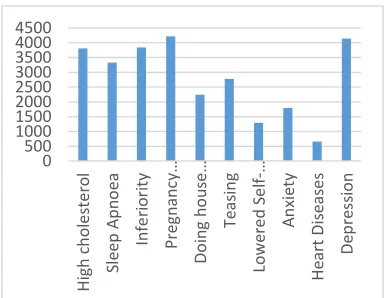
Table no 2: Rank of the problems faced by women due to obesity and overweight S. No Problems Mean score Total score Rank
1 High cholesterol 381 3810 4
2 Sleep apnoea 555 3330 5
3 Inferiority 549 3843 3
4 Pregnancy problem 527 4216 1
5 Doing household chores 560 2240 7
6 Teasing 556 2780 6
7 Lowered self-esteem 648 1296 9
8 Anxiety 595 1794 8
9 Heart diseases 660 660 10
10 Depression 460 4140 2
Source: Primary Data
Interpretation
From this study, it is found that from the table it is evident that, PREGNANCY PROBLEM is
ranked as no.1 with the total score of 4216, DEPRESSION is ranked as no.2 with the total score of 4140, INFERIORITY is ranked as no.3 with the total score of 3843.
Figure no 1: Problems faced by women due to obesity and overweight
FINDINGS
Pregnancy Problem is ranked as no.1 with the total score of 4216,
Depression is ranked as no.2 with the total score of 4140,
Inferiority is ranked as no.3 with the total score of 3843.
SUGGESTIONS
More tablet usage during pregnancy can be reduced and proper traditional diet can be followed.
Problem solving therapy can be undergone. We can avoid our inner negative desires and
CONCLUSION
The health risks and health care costs associated with overweight and obesity are considerable. The prevention and reduction of overweight and obesity depend ultimately on individual lifestyle changes, and future research on
motivations for behaviour change would be important in combating the obesity epidemic. Therefore, psychological and behavioural issues play significant roles in obesity. Hence if can be resolved by our good diet and desires.
REFERENCES
[1]. Khan, L.K.; Sobush, K.; Keener, D.; Goodman, K.; Lowry, A.; Kakietek, J.; Zaro, S.; Centers for Disease, C.; Prevention Recommended community strategies and measurements to prevent obesity in the United States. MMWR 58, 2009, 1-26.
[2]. Sallis, J.F.; Glanz, K. Physical activity and food environments: solutions to the obesity epidemic. Milbank Quart. 87, 2009, 123-154.