RISK MODEL OF U.S. OVERSEAS OPERATIONS LOGISTICS
BASED ON FUZZY COMPREHENSIVE EVALUATING
METHOD
1XIN MU, 1JIKUN GUO, 1YONGJIE NIU, 1MINGLIANG JIA
1Department of Oil Application & Management Engineering, Logistical Engineering University,
Chongqing 401311, China
ABSTRACT
The study purpose of this paper is looking for a method, which can accurately evaluate and quantize the security risk problem in the U.S. overseas operations; it can provide the positive effect for formulating the risk precautionary measures. This paper adopts the fuzzy comprehensive evaluation method to construct the risk evaluation model of US overseas operations logistics, and finds out the key factors of being related to risk of the US overseas operations, which are the foundation of the further quantitative analysis study of US overseas operations logistics problem. At last, the evaluation model is proved to be reasonable, effective and feasible via case analysis and calculation.
Key words: Risk Evaluation Model; Overseas Operations Logistics Support
1.
INTRODUCTION1.1 Research background
The requirements of modern warfare for logistics quantity and quality are in a rising trend, especially in overseas operations; it is difficulty to meet the needs of the requirements relying solely on logistics support force itself. Therefore, the privatization of U.S. armed forces logistics in overseas operations is a commonly used method. This phenomenon implies that there is more and more local manpower resource and material resources applied to the logistics of overseas operations. As the U.S. troops conducting operations in the outlying overseas land, due to the heavy logistics supply pressure, sometimes it must purchase some common logistics material resources and sign contracts with local private enterprises. This approach can effectively improve the logistics service quality and reduce the cost; therefore, it has become a current U.S. overseas combat logistics practice [1].
1.2 Current state of the research
There are many researches about how to evaluate the logistics risk, but how to accurately evaluate the special risk problems, which are caused by overseas operations logistics supply, is a relatively new edge subject. Few people studied on it. Thanks to many researchers’ study on the uncertain problem, they provide the fundamental train of thought about the clue of how to deal with the special risk in the evaluating process. And in recent years, the modern
mathematic methods are extensively used in risk evaluating mode. All of these offer the risk mode with mathematical evaluation mode which integrates the qualitative analysis and the quantitative analysis. At last, many studies about classical risk theory could be used for reference [2, 3].
1.3 Advantages of my solution
This paper uses a method of fuzzy comprehensively evaluation to evaluate the risk for U.S. Overseas Operations Logistics. It is mainly based on three considerations as follows:
First of all, in evaluating risk for U.S. Overseas Operations Logistics, there are a lot of factors whose quantitative values are difficult to obtain. Instead, the evaluators can only give qualitative and fuzzy evaluation and judgment for them.
In the next place, the method of fuzzy comprehensive evaluation is a combination of qualitative and quantitative methods with a solid theoretical basis. Taking account of the fact that the system of evaluation indexes in actual decision-making is multi-tier, this paper adopts the comparison method to determine the weight coefficient. With this method adopted, it is easier to reflect the actual situation accurately.
aspects, the probability of accident occurrence and the loss severity accident consequence [4].
R= ×P C (1)
In formula (1), R means the importance of risk;
P means the probability of accident occurrence;
C means the loss severity of accident consequence.
2.
THE MAIN FACTORS OF EVALUATINGThe premise of establishing the U.S. Overseas Operations Logistics risk assessment index system is to find out the main factors affecting risk rising. Under this premise, the further work of the construction of the index system is coming true. According to the classical risk theory, this paper divides those factors which are related to risk evaluating mode into two parts as follows.
2.1 The Probability Of Accident Occurrence
The probability of accident occurrence is an important factor to affect the security of U.S. Overseas Operations Logistics. It includes two parts, the probability of special accident occurrence and the probability of inherent accident occurrence.
2.1.1 Special accident
The probability of special accident occurrence means something bad would only take place in U.S. Overseas Operations Logistics, but not in other situations. For example, in overseas operations, U.S. military force would suffer military attack come from enemy at very large possible, but this situation would not occur in domestic operations. Special risk only comes up in special situation for special people and special affairs.
2.1.2 Inherent accident
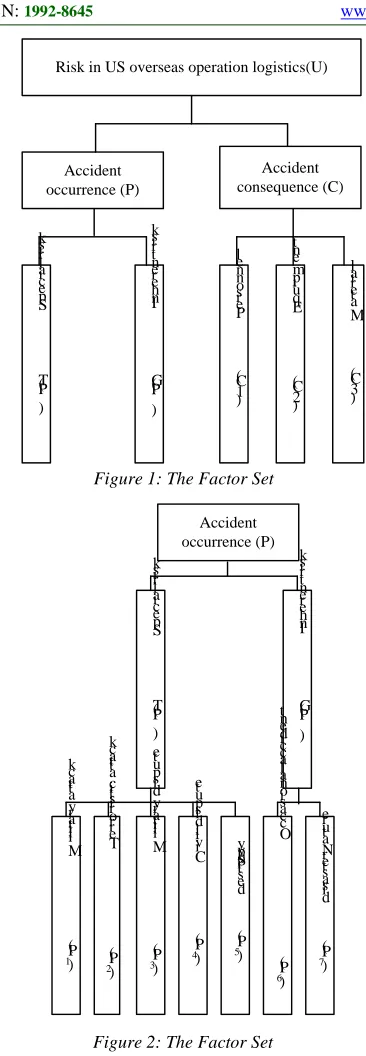
The probability of inherent accident occurrence means that there is risk exiting almost in the every similar style thing. The related scope is bigger than special situation. For example, fire is a terrible disaster, it takes place not only in U.S. Overseas Operations Logistics, but also take place in domestic operations, and it could take place in any place everywhere in the world. In a word, relative to the special accident, inherent accident means not special. The difference between the special accident and the inherent accident is very important; carefully observing the Figure 1 and Figure 2 is helpful to understand it.
2.2 The Loss Severity Of Accident Consequence
We can analyze the loss severity of accident consequence from 3 aspects.
2.2.1 Personnel
During the total loss of the accident consequence, the personnel are key factor. It can be said that the
overall quality and quantity of the personnel are the most important and most complex factors in many influencing factors. The personnel loss is the biggest loss; it can directly affect logistic support ability.
2.2.2 Equipment
Equipment and facilities status are also the key factors of the U.S. Overseas Operations Logistics risk assessment; they are the material and technical basis of completing the logistic support task. Its condition is good or bad, and the use of scientific and technological content and other factors have a direct impact on the safety. Equipment and facilities security risks exist two main reasons: First reason is the congenital engineering design flaws; second reason is the use of poor quality products; Third reason is artificial destroy of equipment and facilities.
2.2.3 Materials
The characteristics of logistic materials are an important factor to affect the security of logistics. First of all, the physical-chemical characteristics are very important. For example, as a style of logistic goods and materials resource, oil itself has the physical-chemical characteristics as follows: volatile, incendiary, explosive, liquidity and toxic. Obviously, oil’s security risk is higher than other goods and materials resource. And then, alternative of the resource is another important factor we must taking into account. The alternative and the risk are usually inversely proportional. For example, wheat flour could buy everywhere; therefore, its risk is low. But, bullet could not buy at any time and everywhere, so, its risk is higher than wheat flour.
3.
RISK EVALUATINGMODEL3.1 Establish the factor set
Factor is the attributes or properties, which can reflect the comprehensive quality of object. Evaluation of the impact of each factor consists of a collection of objects is called the factor set, denoted by U. According to the actual situation this paper determines the evaluation factors as figure 1 shows.
{
, , 1, 2, 3}
Accident occurrence (P)
Risk in US overseas operation logistics(U)
[image:3.612.103.286.76.604.2]Accident consequence (C) S p ec ia l ri sk (PT ) In h er en t ri sk (PG ) P er so n n el (C 1 ) E q u ip m en t (C 2 ) M at er ia l (C 3 )
Figure 1: The Factor Set
[image:3.612.307.527.337.557.2]Accident occurrence (P) S p ec ia l ri sk (PT ) In h er en t ri sk (PG ) M il it ar y a tt ac k (P 1) T er ro ri st ic a tt ac k (P 2) M il it ar y d is p u te (P 3) C iv il d is p u te (P 4) S p y d es tr o y (P 5) O cc as io n al a cc id en t (P 6) N at u re d is as te r (P 7)
Figure 2: The Factor Set
3.2 Establish The Evaluation Set
The judgment set is a collection of things for evaluation, which is the performance index set. The purpose of evaluating US overseas operations logistics is quantizing risk degree, so the evaluation results should be at a certain level of horizontal section. Therefore, the evaluation set up to as follows
[5]
.{
v
1,
v
2,
v
3,
v
4,
v
5}
V
=
(3)Among them: v1 for the highest risk; v2 for higher risk; v3for the high risk; v4for as the lower risk; v5for the lowest risk.
3.3 Establish The Weight Set
The index weight of evaluation index is the degree of importance of object effect, which is reflected in various aspects of the system link. In order to make the evaluation results more close to the thing itself, due to a variety of factors are emphasized to varying degrees, in the evaluation process we give different weight to the different index. This paper adopts " comparison method" to determine the weights, namely through the various influence factors between the two comparison to determine the weight of each index, considered relatively important indexes is 1, another indexes is 0. In order to simplify process, we only compare the last level index; the results are as table 1
[6]
.Table 1: Table weight set
In
d
ex
process G
o al W eig h t
1 2 3 4 5 6 7 8 9 10
PT 1 0 0 0 1 0.1
PG 1 0 0 0 1 0.1
C1 1 1 1 1 4 0.4
C2 1 1 0 0 2 0.2
C3 1 1 0 1 3 0.3
total 1 1 1 1 1 1 1 1 1 1 10 1
As shown in table 1, the weigh set is as follows.
1 2 3
( , , , , ) (0.1, 0.1, 0.4, 0.2, 0.3)
= =
A PT PG C C C (4)
Obviously, the weight set satisfy the normalization condition and non-negative condition.
5
1
(0.1 0.1 0.4 0.2 0.3) 1
0( 1, 2, , 5)
i i i a a i = = + + + + = ≥ = ……
∑
(5)3.4 Evaluation Set classification
Specific standards are shown in table 2
[7]
.Table 2: Table specific standards parameters
Grade Interval
The highest probability of occurrence or the
most worst consequence 100~90 The higher probability of occurrence or the
worse consequence 89~75 high probability of occurrence or bad
consequence 74~60 The lower probability of occurrence or the
lower bad consequence 59~45 The lowest probability of occurrence or the
[image:3.612.316.521.591.713.2]4.
EXAMPLES OF THE EVALUATION PROCESS4.1 Single Factor Fuzzy Evaluations
According to table 3, there are a certain number of experts who knows the actual situation of logistic support in US overseas operation gives their evaluating interval. For each fact, the results are shown as follows.
1 2 3 4 5
1 2 3 4 5
1
1 2 3 4 5
2
1 2 3 4 5
3
1 2 3 4 5
0.49 0.31 0.11 0.06 0.03
0.51 0.34 0.13 0.01 0.01
0.60 0.28 0.09 0.01 0.02
0.47 0.29 0.16 0.04 0.04
0.36 0.33 0.16 0.04 0.01
PT
v v v v v
PG
v v v v v
C
v v v v v
C
v v v v v
C
v v v v v
= + + + +
= + + + +
= + + + +
= + + + +
= + + + +
(6)
According to formula 6, we can get a single factor evaluation matrix R (7)
[8]
.0.49, 0.31, 0.11, 0.06, 0.03 0.51, 0.34, 0.13, 0.01, 0.01 0.60, 0.28, 0.09, 0.01, 0.02 0.47, 0.29, 0.16, 0.04, 0.04 0.36, 0.33, 0.16, 0.04, 0.01
R
=
(7)
4.2 Fuzzy Comprehensive Evaluations
Single factor fuzzy evaluation, reflects only a factor to judge object effect, but the scientific evaluation need a comprehensive consideration of all factors. Therefore, it is necessary to run the process of fuzzy comprehensive evaluation. As the single factor evaluation matrix was given, we can use the formula (8) to deal with it
[9, 10]
.(
1, 2, ,3 4, 5)
B= × =A R b b b b b (8)
Adopt the formula (8) to calculate B, the result as follows.
(
)
0.49, 0.31, 0.11, 0.06, 0.03 0.51, 0.34, 0.13, 0.01, 0.01 0.1, 0.1, 0.4, 0.2, 0.3 0.60, 0.28, 0.09, 0.01, 0.02 0.47, 0.29, 0.16, 0.04, 0.04 0.36, 0.33, 0.16, 0.04, 0.01
B
= ×
(9)
(0.542, 0.334, 0.140, 0.031, 0.023)
B= (10)
5.
CONCLUSIONThis paper uses the weighted average method to calculate the matrix (10) for obtaining the results of comprehensive evaluation. We can classify the risk grade as follows.
(0.85, 0.70, 0.55, 0.40, 0.25)V = (11)
1
1
0.542 0.85 0.334 0.70 0.140 0.55 0.031 0.40 0.023 0.25 0.542 0.334 0.140 0.031 0.023
0.78965 1.07 0.74
n j j j
n j j
b v U
b
=
=
=
× + × + × + × + ×
=
+ + + +
= ≈
∑
∑
(12)
The comprehensive evaluation results show that the fuzzy comprehensive evaluation of the results is between 0.85 and 0.70. It shows that in this US overseas operation, military logistics risk is in the higher lever, the more defense force and prevention measures are needed.
A
CKNOWLEDGEMENTSThis work was supported by institute innovation fund project.
REFERENCES:
[1] S. Snake, “Civilization of U.S. Armed Forces Logistics in 21st Century”, Military, Vol. 5, 2009, pp. 96-99.
[2] D CHAI, J SHEN, G LI, “Study on Risk of Virtual Logistics Organizations Based on WBS-RBS and AHP Method”, Journal of Beijing
Jiaotong University (Social Sciences Edition),
Vol. 5, 2006, pp. 32.
[3] L PENG, D JIANG, “Application of Fuzzy Comprehensive Evaluating Method in Virtual Logistics Evaluation”, Logistics technology, Vol. 6, 2006, pp. 28.
[4] C ZHENG, F WANG, J LI, S LUO, “On the Risk of Virtual Logistics Organizations”, Logistics
technology, Vol. 2, 2005, pp. 11.
[5] Yossi Steffi, James B- Rice, “Supply chain responses to global terrorism: A situation scan”,
The International Journal of Logistics
Management, Vol. 12, 2005, pp.2.
Fuzzy Information”, International Journal of
Digital Content Technology and Applications,
vol. 6, 2012, pp. 369-375.
[7] Shujuan Li, Zigang Zhang, Price Strategy in Risk-averse Dual-channel Supply chain. Advances
Information Sciences and Service Sciences, vol.
4, 2012, pp. 78-87.
[8] WeiHua Li, “The Research on The Emergency Logistics Risk Analysis with Incomplete Information”, International Journal of
Advancements in Computing Technology, vol.
4, 2012, pp. 304-310.
[9] Shi Hui-bin, Liu Lu, Wang Li, “A Credit Risk Assessment System for The Small and Medium Enterprise in China”, Journal of convergence
information technology, vol. 7, 2012, pp.
277-284.