DESIGN AND ANALYSIS OF ELIMINATION OF
HARMONICS USING WIND ENERGY CONVERSION
SYSTEMS
Dr.S.K.PURUSHOTHAMAN Associate Professor – Department of EEE
Sri Venkateswara College Of Engineering And Technology, Thirupachur – 631203 E-mail : [email protected]
ABSTRACT
In this paper we describe design and analysis of elimination of harmonics using wind energy conversion systems. Distortion of the voltage waveforms i.e. harmonics may cause overheating of neutral conductors and electrical distribution transformers, the malfunction of electronic equipment and the distortion of communication systems. Doubly Fed Induction Generator (DFIG) applied to wind energy conversion system (WECS) using variable speed operation is being used more frequently in wind turbine application. Variable speed systems have several advantages over the traditional method of operating wind turbines, such as the reduction of mechanical stress and an increase in energy capture. AC-DC converter is used to convert variable voltage from the DFIG to DC voltage, thereby producing DC power. The DC is converted back to AC that is appropriate for electrical utilizations in the grid. However, the use of converters introduces high intensity of low frequency current harmonic content into the power system. This leads to reduction in efficiency in WECS and also decreases the life span of the generator. A case study on a 9 MW wind turbine is used to explain Harmonic Mitigation in Wind Turbine Energy Conversion Systems. In this paper, harmonic voltage and current measurements performed at different points of a wind farm comprising six DFIG wind turbines are analyzed and their most important characteristics are discussed. It presents a comparative simulation study between with and without three phase harmonic filters applied to power system model connected to wind farm.
Keywords:Harmonics, Wind Energy, Inverter, Voltage, Filters, Rectifiers
1 INTRODUCTION
Distortion of the voltage waveforms i.e. harmonics may cause overheating of neutral conductors and electrical distribution transformers, malfunction of
electronic equipment, faulty operation of
protective devices, nuisance tripping of sensitive load and the distortion of communication systems. Harmonics levels are increasing in power systems due to proliferation of non linear loads like rectifiers, variable frequency drives (VFD), uninterruptible power supplies (UPS), switched mode power supplies (SMPS) in appliances, arc and induction furnaces, fluorescent lamps with electronic ballasts, etc. Field surveys indicate that the harmonics are significant in many industries as reported in. Harmonic resonance occurs in a power system when the power system’s natural frequency corresponds to the frequency of a source of harmonic current. Every power system has a
natural frequency which is a function of the system reactance and the amount of power factor correction (PFC) capacitors connected to the system. In the event that there is a source of excitation with a frequency near or equal to the system’s natural frequency, large resonant currents can result. The capacitors themselves are not a source of natural frequency excitation current, but can have the effect of magnifying such currents. It is common for power systems that are corrected with capacitors to near unity power factor to have a natural frequency in the vicinity of 300Hz or 350Hz or the fifth or seventh harmonics. This magnification has implications in two aspects: reduced effective power factor and unreasonable
indication of harmonic indices. Harmonic
magnification can be reduced by relocation of PFC capacitors.
One of the biggest problems in power quality aspects is the harmonic contents in the electrical system. Generally, harmonics may be divided into two types: 1) voltage harmonics, and 2) current harmonics. Current harmonics is usually generated by harmonics contained in voltage supply and depends on the type of load such as resistive load, capacitive load, and inductive load. Both harmonics can be generated by either the source or the load side. Harmonics generated by load are caused by nonlinear operation of devices, including power converters, arc-furnaces, gas discharge lighting devices, etc. Load harmonics can cause the overheating of the magnetic cores of transformer and motors. On the other hand, source harmonics are mainly generated by power supply with non-sinusoidal voltage waveform. Voltage and current source harmonics imply power losses, Electromagnetic Interference (EMI) and pulsating torque in AC motor drives. Any periodic waveform can be shown to be the superposition of a fundamental and a set of harmonic components.
By applying Fourier transformation, these
components can be extracted. The frequency of each harmonic component is an integral multiple of its fundamental. There are several methods to indicate of the quantity of harmonics contents. The most widely used measure in North America is the total harmonics distortion (THD), which is defined in terms of the amplitudes of the harmonics, Hn, at frequency nW0, where Wo is frequency of the fundamental component whose amplitude of H1 and n is integer. The THD is mathematically given by
1.2 Harmonics ILL Effects
Harmonics produce many ill effects such as: very high neutral currents in 3P-4W system, high neutral to ground voltages, over heating of neutral conductor, reduced power factor, failure of PFC
capacitors, overloading of distribution
transformers, distorted voltage waveforms to other
loads, nuisance breaker tripping, incorrect meter functioning, failure of protection relays, increased system losses as heat, etc.
2 STANDARDS FOR HARMONICS
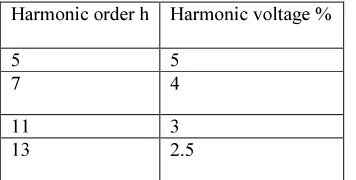
[image:2.595.303.481.379.469.2]Harmonic voltages have to be kept within acceptable limits; the limits depend on network specification, such as harmonic impedance and voltage level. IEC 61000-3-6 can be used as a guide to find these limits. Table 1 shows indicative planning levels for the normal harmonics in a power grid and the ones considered in this paper, planning levels are equal to or lower than compatibility levels. The indicative planning levels for the total harmonic distortion for MV are THDMV=6.5%.
Table 1: Indicative planning levels for harmonic voltages (in percent of the fundamental voltage) for medium level voltages (<35 kV)
Harmonic order h Harmonic voltage %
5 5
7 4
11 3
13 2.5
3 NEED FOR HARMONIC REDUCTION
Fig 1 : Voltage Source And Transformer Connected To Nonlinear Load
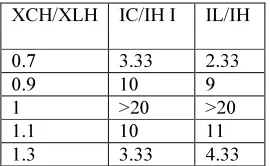
The value of the harmonic inductive reactance XLH increases in proportion with harmonic order, while the harmonic reactance XCH of the capacitor bank decreases inversely with the harmonic order. Perfect resonance occurs at XLH = XCH but even partial resonance XLH ≈ XCH can have important effects. Table 2 shows several XCH/XLH ratios in the vicinity of resonance and corresponding IC/IH and IL/IH multipliers, illustrating the danger of overheating the capacitor and primary and secondary windings of the transformer, and ultimately the importance of controlling and reducing the harmonics.
Table 2: Amplification Of Current IH
XCH/XLH IC/IH I IL/IH
0.7 3.33 2.33
0.9 10 9
1 >20 >20
1.1 10 11
1.3 3.33 4.33
4 WIND TURBINE MODEL
The wind turbine consists of a rotor that extracts energy from the wind and converts it into mechanical power. In practice, the characteristics of a wind turbine can be represented in a simplified form of power performance coefficient
(Cp ) and tip speed ratio (λ ). The Cp –λ curve is
usually used in industry to describe the characteristics of a wind turbine. The tip speed ratio of a wind turbine is given by:
Where:
R - the turbine rotor radius in meters (m); ωr - turbine rotor speed in radians per second (rad/s);
V - the wind speed in meters per second (m/s).
5 POWR SYSTEM MODEL - WIND FARM
USING DFIG
The WECS considered for analysis consist of a DFIG driven by a wind turbine, rotor side converter, DC to DC intermediate circuit and grid side converter. Fig.2 shows a schematic of the wind energy conversion system having DFIG and power electronic interface that will be discussed in this paper. The turbine output power is controlled in order to follow a pre-defined power-speed characteristic, named tracking characteristic. The electrical output power at the grid terminals of the wind turbine is added to the power losses and is compared with the reference power obtained from
[image:3.595.121.256.469.552.2]Fig.2 Power System Model
In rotor side converter system, AC voltage and VAR are regulated. DC to DC intermediate circuit consists of two converters: Converter 1 (DC to AC) and Converter 2 (AC to DC). The control system of DC to DC intermediate circuit consists of DC voltage and current regulation and pitch control system. The pitch angle is regulated at zero degree by pitch angle regulator until the speed
reaches desired speed of the tracking
consisting of six 1.5 MW wind turbines connected to 440V distribution system through power electronic interface. The wind speed is maintained constant at 15 m/s. The reactive power produced by the wind turbine is regulated at 0 MVAR. This model is well suited for observing harmonics and
control system dynamic performance over
relatively short periods of times. Fig.2 shows power system model used. The harmonic filters are connected to buses B1 to B4 as shown in Fig.2.
6 HARMONIC MITIGATION BY HARMONIC FILTERS
Harmonic filters reduce distortion by diverting harmonic currents in low impedance paths. In order to achieve an acceptable distortion, several banks of filters of different types are usually connected in parallel. The total harmonic distortion (THD) can be calculated as follows:
One Double-Tuned Filter to 11/13th harmonic of 100 MVAR and -One High-Pass Filter Tuned to the 24th harmonic of 100 MVAR The total MVAR rating of the filters set is then 400 MVAR. Fig.3 shows three phase harmonic filters connected to grid, which are used to improve power quality and reduce harmonic distortion. The entire harmonic filter set, 1st, 3rd, 11th/13th and 24th, are connected to bus B1 and B2. Harmonic filters 1st, 3rd and 11th/13th are connected to B3. Only harmonic filter 3rd is connected to B4. This is done because it is observed that connection of
other harmonic filters i.e. 24th to B3 and 1st, 11th/13th and 24th to B4 distort the results or harmonic distortion is increased.
Fig.3 Three Phase Harmonic Filters
7 RESULTS AND DISCUSSIONS
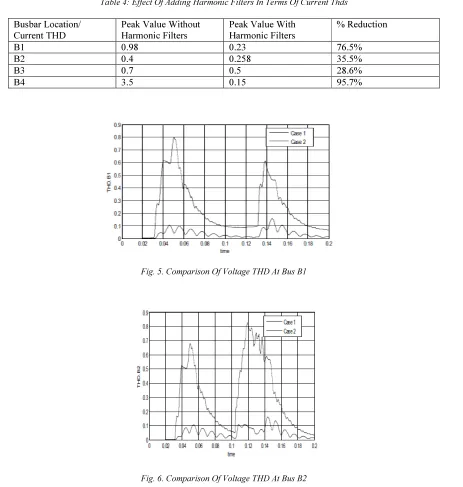
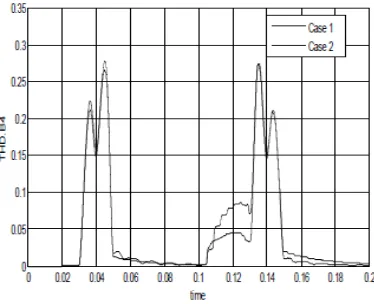
In this section the simulated results for the grid connection of three phase harmonic filters described above are presented. Two cases are considered to investigate the impact of harmonic filters on power grid connected with wind energy. One case (Case 1) is that harmonic filters are not connected to power grid and another case (Case 2) is taken as harmonic filters connected to AC power grid.
power system starting from lowest voltage, a stage will come when it will cause increase in harmonic
level.
Table3: Effect Of Adding Harmonic Filters In Terms Of Voltage Thds
Busbar Location / Voltage THD
Peak Value Without Harmonic Filters
Peak Value With Harmonic Filters
% Reduction
B1 0.8 0.16 80%
B2 0.82 0.161 80.36%
B3 1.5 0.15 90%
[image:6.595.74.537.259.746.2]B4 0.253 0.255 -0.8%
Table 4: Effect Of Adding Harmonic Filters In Terms Of Current Thds
Busbar Location/ Current THD
Peak Value Without Harmonic Filters
Peak Value With Harmonic Filters
% Reduction
B1 0.98 0.23 76.5%
B2 0.4 0.258 35.5%
B3 0.7 0.5 28.6%
B4 3.5 0.15 95.7%
Fig. 5. Comparison Of Voltage THD At Bus B1
Fig. 7. Comparison of Voltage THD at Bus B3
Fig. 8. Comparison of Voltage THD at Bus B4
8. CONCLUSION AND FUTURE WORK
Harmonics analysis is an essential part of the grid impact studies needed for new wind farms. That can lead to the earlier detection of potential series and parallel resonance problems. Consequently, a harmonics mitigation solution is examined in this paper. The simulated results on transients of a power system grid integrated with wind power are presented. In this paper, we attempted to compare the impact, in terms of voltage THDs and currents THDs, of adding three phase harmonic filters to wind integrated power system consisting of DFIG. Two different cases are considered examining the influence of adding harmonic filters. The results have clearly demonstrated the ability of harmonic filters to reduce transients and harmonic distortion in power system. It has been proven that with the
[image:7.595.197.384.330.482.2]control loop for the harmonics, enabling the inverter and its control circuit to detect and counteract the harmonics. In simulations, an average of 50-60% harmonic reduction for the 5th, 7th, 11th, and 13th harmonic was achieved. There is also done a wind farm application of the harmonic reducing inverters. Different park configurations are tried out as regards to the effect on the harmonics, and the harmonic reducing inverters. Cable length from turbines to main transformer station, length from main transformer to nearest connection point onshore and number of turbines in wind farm are configurations tried out for application. The method is shown to be an effective harmonic filter in most applications.
It would be very interesting to try and implement the harmonic control structure developed in this paper in a laboratory demonstration. Experiments with different grid properties, for instance with a load on the high voltage side, could be done. Also further studies should be done when the transmission cable is situated on the high voltage side. Further development on the model could be to ad a generator and a rectifier. Experiments with applying the harmonic control structure in the rectifier to try and reduce low frequency harmonics from the generator could be done. The structure itself could also be developed to give a faster response and also reduce the harmonics further or even eliminate them completely.
REFERENCES
[1] Birk, J., & Andresen, B. (2007).
Parallel-connected converters for optimizing
efficiency, reliablility and grid harmonics in a wind turbine. EPE. Aalborg.
[2] Calderaro, V., Galdi, V., Piccolo, A., & Siano, P. (2007). Design and implementation of a
fuzzy controller for wind generators
performance optimisation. EPE. Aalborg. [3] Hansen, A. D. (2005). Generators and Power
Electronics for Wind Turbines. In T. Ackermann, Wind Power in Power Systems (pp. 53-78). John Wiley .
[4] Harmonic phase sequences. (n.d.). Retrieved May 12, 2008, from All About Circuits:
http://www.allaboutcircuits.com/vol_2/chpt_ 10/8.html
[5] Larsson, A. (2005). Practical Experience with Power Quality and Wind Power. In T. Ackermann, Wind Power in Power Systems (pp. 349-363). John Wiley & Sons, Ltd. [6] H. M. Kojabadi, L. Chang, T. Boutot,
“Development of a novel wind turbine simulator for wind energy conversion
systems using as inverter-controlled
induction motor”, IEEE Transactions on
Energy Conversion, vol. 19, no. 3, pp.
547-552, Sept.2004.
[7] L. Mihet-Popa, F. Blaabjerg, I. Boldea, “Wind turbine generator modeling and simulation where rotational speed is the controlled
variable”, IEEE Transactions on Industry
Applications, vol. 40, no. 1, pp. 3-10,
January/February 2004.
[8] Francis M. Fernandez, P. S.Chandramohanan
Nair, .Influence of Power Factor
Compensating Capacitors on Estimation of Harmonic Distortion., 9th Int. conference on Electrical Power quality and Utilisation, Barcelona, 2007.
[9] Mark Mcgranaghan Scott Peele and Dan Murray, .Solving Harmonic Resonance Problems On The Medium Voltage System., CIRED, 19th International Conference on Electricity Distribution, Vienna, 21-24 May 2007.
[10] Zhang, S Tseng, K Vilathgamuwa, M. Nguyen, D.,” Design of a Robust Grid Interface System for PMSG-based Wind Turbine Generators”. In: IEEE Transactions on Industrial Electronics, Issue 99, 2010. [11] H. Akagi, "Active Harmonic Filter," In:
Proceedings of the IEEE, 2005, pp. 2128-2141.
[12] J. Arrillaga and N. R. Watson, Power System Harmonics, 2nd ed. NJ:Wiley, 2003.
[13] R. S. Herrera, P. Salmeron, and H. Kim, “Instantaneous Reactive Power Theory
Applied to Active Power Filter
Compensation: Different Approaches,
Assessment, and Experimental Results,” In: IEEE Trans. Ind. Electron., Jan. 2008, Vol. 55, No. 1, pp. 184–196.