Volume 2007, Article ID 80194,13pages doi:10.1155/2007/80194
Research Article
A Versatile Propagation Channel Simulator for
MIMO Link Level Simulation
Jean-Marc Conrat and Patrice Pajusco
France Telecom NSM/R&D/RESA/NET 6, avenue des Usines, BP 382, 90007 Belfort Cedex, France
Received 29 March 2006; Revised 2 November 2006; Accepted 7 May 2007
Recommended by Thushara Abhayapala
This paper presents a propagation channel simulator for polarized bidirectional wideband propagation channels. The generic channel model implemented in the simulator is a set of rays described by geometrical and propagation features such as the delay, 3D direction at the base station and mobile station and the polarization matrix. Thus, most of the wideband channel models including tapped delay line models, tap directional models, scatterer or geometrical models, ray-tracing or ray-launching results can be simulated. The simulator is composed of two major parts: firstly the channel complex impulse responses (CIR) generation and secondly the channel filtering. CIRs (or CIR matrices for MIMO configurations) are processed by specifying a propagation model, an antenna array configuration, a mobile direction, and a spatial sampling factor. For each sensor, independent arbitrary 3D vectorial antenna patterns can be defined. The channel filtering is based on the overlap-and-add method. The time-efficiency and parameterization of this method are discussed with realistic simulation setups. The global processing time for the CIR generation and the channel filtering is also evaluated for realistic configuration. A simulation example based on a bidirectional wideband channel model in urban environments illustrates the usefulness of the simulator.
Copyright © 2007 J.-M. Conrat and P. Pajusco. This is an open access article distributed under the Creative Commons Attribution License, which permits unrestricted use, distribution, and reproduction in any medium, provided the original work is properly cited.
1. INTRODUCTION
Multiple antenna radio access (MIMO) based on antenna ar-rays at both the mobile station (MS) and the base station (BS) have recently emerged as a key technology in wireless com-munications for increasing the data rates and system perfor-mances [1,2]. The benefits of multiple antenna technolo-gies can be shown by achieving link-level simulations. The reliability of the results from link-level simulations depends strongly on a realistic modeling of the propagation channel. This is particularly true for wideband MIMO systems, when polarization and spatial diversities are foreseen at the base station (BS) or at the mobile station (MS).
There are basically two MIMO propagation channel types [3,4]: physical and nonphysical models. Nonphysical models are based on the statistical description of the channel using nonphysical parameters such as the signal correlation between the different antenna elements at the receiver and transmitter [5,6]. In contrast, physical models provide ei-ther the location and electromagnetic properties of scatterers or the physical description of rays. For instance, geometrical models [7–9], directional tap models [10–12], or ray tracing
[13,14] are examples of physical models. Both approaches have advantages and disadvantages but physical models seem to be more suitable for MIMO applications because they are independent from the antenna array configuration [15]. Fur-thermore, they inherently preserve the joint properties of the propagation channel in temporal, spatial, and frequential do-mains. By taking into account antenna diagrams, Doppler spectrum or correlation matrices can be coherently deduced from a physical model.
Azimuth (φ)
Figure1: Reference system for ray characterization.
time domain, the 3D direction at BS and MS. The propaga-tion characteristics are the channel complex gains depending on the transmitted and received polarization. The main ob-jective of this paper is not to describe all theoretical concepts of the physical modeling but to underline how they can be efficiently implemented in a propagation simulator.
This paper is divided into six major parts. The first four parts contain the theoretical concepts of Mascaraa: ray gen-eration, impulse response processing, and channel filtering.
Section 5 describes the software implementation and gives some details about the processing time performances. Fi-nally, a simulation example is given inSection 6.
2. RAY GENERATION
This section describes the properties of each ray and explains how Mascaraa processes a set of rays from four usual wide-band propagation models. As the topic of this paper is to in-troduce a propagation simulator, the advantages and disad-vantages of these different models will not be discussed here.
2.1. Ray characteristics
Each ray is characterized by its geometrical properties and electromagnetic properties. The geometrical properties of a ray are the length and the azimuth/elevation at BS and MS. Usually, the elevation is defined as being the angle between axisZ and the ray direction (seeFigure 1). The elevation is set between 0◦and 180◦. The azimuth is defined as being the angle between axisXand the perpendicular projection of the ray in thex-yplan. The azimuth varies in a range of 360◦. We denote byθandφthe elevation and azimuth.
The electromagnetic properties of rays allow the determi-nation of the received field as a function of the transmitted field. By assuming the plane wave propagation hypothesis,
the transmitted or received field is always perpendicular to the propagation direction. It is thus more convenient to ex-press this field in the spherical base (Er,Eθ,Eφ) than in the
base (Ex,Ey,Ez) common for all directions. VectorErhas the
same direction as vector OP. Vector Eθ is perpendicular to OP and is contained in the zOP plan. VectorEφ is perpen-dicular to OP and is included in thex-yplan. Whatever the polarization of the wave,Ercomponent is always null (plane
wave assumption). IfEφ is null, the polarization is vertical.
IfEθ is null, the polarization is horizontal. As the propaga-tion channel causes a complex attenuapropaga-tion and a rotapropaga-tion of the polarization vector about the ray axis, the received field is given by the following matrix equation:
completely characterize the electromagnetic properties of the ray. They can represent either the relative or the absolute complex attenuation and depend on the carrier frequency. The matrixAis called the polarization matrix and depends on the link direction. IfAis the polarization matrix for the direct link, the polarisation matrix for the reverse link isAT. The reverse link is obtained by permuting the transmitter and the receiver. Generally, the polarisation matrix is given by assuming that the base station is the transmitter.
From a strictly theoretical point of view, a set of rays with constant properties models a constant channel. Practically, a constant set of rays also models a wide sense stationary sit-uation as the mobile motion over a short distance. Between two mobile locations, only a phase offset is added to the po-larization matrix, all the other ray characteristics remain un-changed (seeSection 3.3).
2.2. Ray generation from usual channel models
2.2.1. Tapped delay line models
Tapped delay line (TDL) models are the most popular wiband propagation models. The power delay profile is de-scribed by a limited number of paths. A path is characterized by a relative amplitude, a Doppler spectrum, and a relative delay. The common Doppler spectra are the Rayleigh spec-trum also called classical specspec-trum, the flat specspec-trum, and the Rice spectrum [17,18]. TDL models are generally defined for the vertical polarization and do not provide any indica-tion on the depolarizaindica-tion. OnlyGθθcan be determined from
the relative amplitude of each path. By default,Gθφ,Gφθ, and
Gφφare set to zero.
in 3D. A Rice Doppler spectrum is the addition of a Rayleigh Doppler spectrum with a strong single ray.
The method implemented in Mascaraa to calculate the DoAs at MS from a Doppler spectrum is based on con-clusions of previous studies [19–22]. The authors of these references have developed methods to generate a Rayleigh Doppler spectrum from a sum-of-sinusoids signal. Three recommendations can be made from the synthesis of all methods: asymmetrical DoA arrangements, random initial phases, high number of sinusoids (at least 10). For the par-ticular case of the Rayleigh Doppler spectrum, these recom-mendations imply the following.
(i) The phase ofGθθis a random variable uniformly dis-tributed between 0 and 2π.
(ii)θi=(2π/N)(i−1+α),i∈[1,N] withθithe azimuth of theith subray,Nthe total number of subrays per path, andαaU[0, 1] random variable.
TDL models do not define the DoAs at BS. In order to be used in MIMO simulation chains, they can be improved by adding to each path an elevation/azimuth at BS [23].
2.2.2. Ray tracing/launching models
The ray-tracing and ray-launching models process all pos-sible rays between a transmitter location and a receiver lo-cation. Simulations are based on geometrical optics and the uniform theory of diffraction. They require geographical databases that contain the description of the indoor and/or outdoor environment. This type of models provides im-mediately all the ray characteristics and is implemented in Mascaraa by reading a result file from a tracing or ray-launching simulation.
2.2.3. Scattering or geometrical models
The scattering or geometrical models define a spatial distri-bution of scatterers in relation to the transmitter or receiver location. A group of near scatterers is called a cluster and could represent a building that reflects waves. Rays are gen-erated by joining the BS to the MS, passing through one or more scatterers.Gθθ is deduced from a path loss model. By
default,Gθφ,Gφθ,Gφφare set to zero. The phase ofGθθ is a
random variable with uniform distributionU(0, 2π).
2.2.4. Directional tap models
Directional tap models are based on TDL models. The Doppler spectrum is replaced by two statistical distributions that characterize the power angular spectrum (PAS) at BS and MS. The Laplacian function is generally used. The mean value defines the main path direction. The path-splitting method in subrays is similar to the one described for TDL models, except for the direction at MS or BS that will re-spect the power angular distribution mentioned above. This can be done by: splitting each path in equally spaced subrays whose amplitude is given by the PAS distribution or by split-ting each path in equally powered subrays whose direction is
more or less concentrated around the path direction accord-ing the PAS distribution. An analysis of the different splittaccord-ing methods can be found in [24] for the Gaussian distribution.
2.2.5. Polarization modeling
Most of the geometrical models or tap models determine only theGθθ component. They can be completed by
polar-ization models that give statistical distributions to charac-terize three depolarization ratios,Gθφ/Gθθ,Gφθ/Gθθ,Gφφ/Gθθ
[25,26]. The depolarization ratios can be specific to each ray, identical for all rays or identical for all rays belonging to a same cluster or path. The phase ofGθφ,Gφθ,Gφφare random
variables with uniform distributionU(0, 2π).
3. GENERATING CHANNEL COEFFICIENTS
3.1. Weighting by antenna pattern
We denote by hdirac the complex impulse response of the
propagation channel
If the reference system of the antenna pattern is the same as the reference system of the polarization matrix, hdirac is
given by the following equation:
hdirac(t)=
nents of the MS antenna gain in the direction of theith ray.
GBS
φ (i) andGBSθ (i) are, respectively, theEφandEθcomponents
of the BS antenna gain in the direction of theith ray. Equa-tion (3) is valid for any kind of antenna polarization (e.g., linear or circular).
3.2. MIMO cases
Figure 2shows a MIMO configuration withnbBsSensor sen-sors at BS andnbMsSensorsensors at MS. A MIMO propa-gation model will provide annbBsSensor∗nbMsSensor ma-trix of impulse responses. We denote by hdirac
mn the impulse
Propagation channel
Mobile station Base station
Sensorm Sensorn
nbBsSensor
antennas nbMsSensorantennas
Figure2: Example of MIMO configuration.
[27]. In this case, (3) can be extended to the MIMO cases by adding a phase offset:
hdirac
mn (t)= nbRays
i=1
a(i)ejϕm(i)ejϕn(i)δt−τ(i), (4)
whereejϕm(i)is the phase offset ofith ray applied to themth
BS-sensor andejϕn(i)the phase offset applied to thenth
BS-sensor. These offsets depend on the 3D relative position of the sensor compared to the antenna center and the 3D ray orientation. If the antenna array is assumed to be a uniform linear array, the phase offset between two successive sensors is equal to 2π·δx·cos(α)/λ,δxbeing the distance between sensors,λthe wavelength, andαthe ray direction compared to the antenna array (seeFigure 3). Indexprepresents either the BS sensors index or the MS sensors index.
3.3. Mobile motion simulation
The basic way to compute a series of impulse responses cor-responding to the mobile motion is to sample spatially the mobile route and then to compute the set of rays for each position. This solution is very time expensive. The most effi-cient solution to simulate the fast fading is to refresh only the phase of the channel coefficients according to the mobile mo-tion. The amplitude, delay, and direction remain unchanged during the simulation.
This solution is very similar to that adopted for the ex-tension of SISO models to MIMO applications. The different locations of the mobile can be viewed as a virtual array. In this paragraph, the only case that is considered is a vehicle linear trajectory with a constant speed. This is generally the case over a WSS distance of a few tens of wavelengths. But the method described below could be generalized for other simulation scenarios.
InFigure 3, the expressions “sensorp” and “sensorp+ 1” are replaced by the expressions “mobile positionp” and “mo-bile position p+ 1.” The phase offset of a ray incident to the linear trajectory with an angle αis equal to 2π ·δx· cos(α(i))/λ.αis deduced from the ray azimuth, the ray eleva-tion and the trajectory direceleva-tion.δxis the distance between
δx α
Ray Wave plane
Sensorp Sensorp+ 1
Figure3: Phase offset between two sensors.
two mobile positions. We denote byhdirac
mn,p(t) the impulse
re-sponse at positionp,
hdirac
mn,p+1(t)=
nbRays
i=1 a
mn,p+1(i)δ
t−τ(i)
=
nbRays
i=1 a
mn,p(i)e2·π j·δx·cos(α(i))/λδ
t−τ(i) (5)
withamn,0(i)=ejϕn(i)ejϕm(i)ej·start(i).
(6)
ej·start(i) are random-starting phases attributed to each
ray using aU(0, 2π) distribution. They simulate a random-starting position on the virtual mobile trajectory.
The ratioδx/λis called spatial step and is an important parameter of Mascaraa. The setting of this parameter allows the generation of spatial series of correlated or uncorrelated CIRs. A spatial series of correlated CIRs accurately samples the short-term fading.Figure 4shows an example with a high spatial selectivity. The fading is generated by recombination of 50 rays having the same delay, the same amplitude, and uniformly distributed around the mobile (typical Rayleigh configuration). A fast fading repetition, approximately equal toλ/2, is observed. A spatial step equal toλ/10 is unsatisfac-tory, the amplitude difference between two consecutive posi-tions is obviously too high. A spatial step ofλ/100 gives better results. Amplitude discontinuities are lower than 1% of the amplitude maximal variation. An intermediate value ofλ/50 is a good tradeoffbetween accuracy and fast processing time (seeSection 5).
0 0.5 1 1.5 2 Distance (λ)
−15
−10
−5
0 5
Re
ce
iv
ed
p
o
w
er
(d
B
)
λ/100 λ/10
Figure4: Fading generated from a 360◦azimuth distribution.
0 20 40 60 80 100
Distance (enλ)
−15
−10
−5
0 5
Re
ce
iv
ed
p
o
w
er
(d
B
)
λ/100
Figure5: Fading generated from a 10◦azimuth distribution.
4. FILTERING
4.1. Impulse response shaping
Section 3described a method to process the continuous-time impulse response but a propagation block used in link-level simulation requires a discrete-time impulse response, sam-pled at a frequencyfsequal to the signal sampling frequency. The main problem of the continuous-to-discrete conversion is that the ray delays are not multiples of the sampling period
ts. A method to sample the impulse response consists in ap-proximating the ray delay to the nearest multiple ofts[28]. This ray mapping method is generally used for tap models with a reduced tap numbernbTap. In this case, the channel filtering is equivalent to a filter of lengthnbTap. The received
f s/2 0
Frequency SignalBW
Mascaraa filter g(t)
FilterBW Transmission
signal spectrum
Figure6: Frequency response of the Mascaraa shaping filter.
signal is the sum ofnbTapcopies of the transmitted signal that are multiplied bya(i) and delayed byτ(i). Although this mapping method is very simple, it significantly modifies the space-time characteristics of the original channel and con-sequently the system performances. Increasing the ray delay accuracy by oversampling the signal could reduce this disad-vantage but will increase the filtering processing time. As a result, this method was not adopted in Mascaraa.
Mascaraa processes the filtered time-discrete impulse re-sponsehmn(k) following (7),
hmn(k)=
nbRays
i=1 a
mn(i)g
k·ts−τ(i), (7)
withanm(i)=a(i)ejϕn(i)ejϕm(i)ej·δx·cos(a)ej·start(i).
(8)
g(t) is the temporal response of the Mascaraa shaping filter. We denote byg(f) the frequency response of this fil-ter.g(f) is a raised cosine filter as shown inFigure 6. The flat bandwidth is equal to the transmit signal bandwidth sig-nalBW and the maximum total bandwidthfilterBW is equal to fs/2in order to respect the Shannon sampling theorem.
fsandsignalBW are two input parameters of Mascaraa. This particular frequency response allows the spectral properties of the transmitted signal to remain unchanged. In case of an ideal channel (dirac with null delay and amplitude of 1), the received signal is equal to the transmitted signal.
The shaping filter method has several advantages.
(i) It does not quantize the ray delays. The simulated power delay profile and Doppler spectrum are contin-uous even if the signal bandwidth is high. For each bin of the impulse response, the fast fading is due to the interferences of nonresolvable rays compared to the Mascarraa filter bandwidth.
0 0.25 0.5 0.75 1 1.25 1.5 Ratio frequency/signalBW
−55
−45
−35
−25
−15
−5
5
A
m
plitude
(dB)
Realized Specified
Figure7: Realized filter transfer function.
4.2. Mascaraa shaping filter synthesis
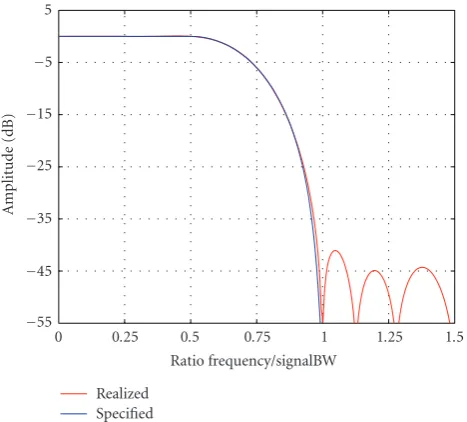
g(t) is generated in two steps. Step 1 is the theoretical defini-tion ofg(f) as indicated in the previous section. Step 2 is the temporal truncation ofg(t) that is theoretically time infinite.
g(t) is a succession of decreasing amplitude sidelobes. The temporal truncation is done by suppressing the sidelobes, the amplitude of which is below a given threshold of about 40 dB. This truncation method does not necessarily optimize the length ofg(t) but minimizes the difference between the specified filter and the realized filter. When the total band-width is higher than twice the signal bandband-width, this differ-ence is quasi-null (seeFigure 7).
The impulse response calculated in (6) is the discrete-time baseband impulse response of the propagation channel. By default, it does not include system specifications as the
RxorTxFilter used in digital modulation.g(t) is not to be confused with the pulse shaping filter used in digital modu-lation. The expressions “transmitted signal” or “received sig-nal” are not related to digital sequences but, respectively, to the discrete-time baseband version of the signal before the
Tx-antenna and the discrete-time baseband version of the signal after theRx-antenna.
In some configurations, it could be possible to merge the Mascaraa shaping filter with the Rx/Tx filters or with the transfer function of RF components. This item is not dis-cussed in this paper because it depends on the link-level sim-ulation requirements and cannot be generalized for any kind of simulations.
4.3. Ray delay accuracy
According to (6), it would be theoretically possible to com-pute the impulse response from a set of rays with arbitrary delays. Practically, the continuous-time functiong(t) may be not analytically defined because of the filter synthesis method
1 1.5 2 2.5 3 3.5 4
Ratio filterBW/signalBW 0
10 20 30 40 50 60 70
Len
gt
h
F
il
ter
Figure8: Filter length variation.
(Fourier transform and time truncation). Furthermore, the calculation ofg(k·ts−τ(i)) during the simulation is unnec-essary becauseg(t) is constant during all the simulation.
Mascaraa solves these two problems by processing the time-discrete function g(k) before the simulation. g(k) is equal tog(t) oversampled atovSp∗fs.ovSpis chosen in or-der not to affect the characteristics of the propagation chan-nel.h(k) is given by
hmn(k)= nbRays
i=1 a
mn(i)g
k·ovSp−floor
ovSp·τ (i)
ts + 0.5
.
(9)
The delay accuracy is constant for the whole simulation but can be user defined by changing the value ofovSp. In-creasing the delay accuracy requires a little more memory space to store g(k) but do not affect the impulse response processing time. By default in Mascaraa,ovSpis set to 50.
4.4. Impulse response length optimization
The impulse response length strongly influences the running time performances of the simulator. It is thus important to evaluate, for a given value ofsignalBW, the optimal values offilterBW andfsthat minimize the length of the impulse responselengthIR.lengthIRis the sum of the length ofg(t) notedlengthFilterand the length of the propagation channel notedlengthChannel.lengthChannelis given by (10):
lengthChannel=floor
Maxτ(i)−Minτ(i)
f s
. (10)
Figure 8gives the relation betweenlengthFilter and the ratiofilterBW/signalBW.FilterBWis equal tofs.
4.5. Amplitude and delay normalization
If a propagation model provides the ray delays and the polar-ization matrices with absolute values, the impulse response calculated according to (6) expresses an absolute gain as a function of an absolute delay. In this case, the effects due to the transmitter-receiver distance are included in the channel impulse response as well as the wideband effects. Usually, this solution does not suit the simulation requirements for two reasons.
(i) The results of link-level simulations are usually pre-sented in the form of performance tables that give the error rate as a function to the signal-to-noise ratio (S/N). A convenient way to modify the S/N value is to assume that the average received power remains con-stant and that the noise power is set to have the re-quired S/N. In this case, the impulse response power has to be normalized to assure a constant average level at the output of the propagation simulator. Further-more, to avoid processing errors due to the limited computer precision, it is generally recommended to process data that have the same order of length. (ii) The beginning of the absolute impulse response
con-tains null values equivalent to the shortest ray delay. This null part of the impulse response would unneces-sarily slow down the channel filtering while it could be with relative simplicity simulated by shifting the input or output signal of the propagation simulator.
Mascaraa normalizes the absolute impulse response in time and in amplitude. The relative impulse response is given by (11):
hrelative
mn (k)=habsolutemn k+ delayabs
gainabs. (11)
delayabsis the time normalizing factor. It is equal to the
index of the first nonnull coefficient of the absolute impulse response. It can be negative if the delay of the shortest ray is lower than half of the length ofg(t).gainabsis the power
nor-malizing factor. It is calculated in order that the total power of the power delay profile is equal to 1.
4.6. Filtering
The channel filtering implemented in Mascaraa is based on the over-and-add method (OA method) [29,30]. The time efficiency of this method is discussed inSection 5by com-paring the OA method with two other convolution methods: direct method and tap method.
To illustrate the application of this well-known algo-rithm, we consider the input signale(k), the output signal
s(k), and the impulse responseh(k) of lengthlengthIR.e(k) is divided into section oflengthIndata points. Theith section
ei(k) is defined by
ei(k)=
⎧ ⎨ ⎩
e(k) fori·sizeIn≤k <(i+ 1)·sizeIn,
0 otherwise. (12)
Thene(k)=iei(k).
H(f)
h(k) 0
Ei(f)
ei(k) 0
Si(f)
si(k)
h(k) 0
ei+1(k) 0
si+1(k)
Figure9: Overlapp-and-add convolution.
Since convolution is a linear operation, the convolution ofe(k) withh(k) is equal to the sum ofei(k) convolved with
h(k),
s(k)=
i
si(k)= i
ei(k)∗h(k). (13)
si(k) are sections of lengthlengthOut, equal tolengthIn+
lengthIR-1. Sectionssi(k) are overlapped bylengthIR-1points (seeFigure 9).
The convolution is made in frequency domain because the convolution via FFT is more efficient for most simulation configurations (Section 5.3.3). Equation (14) is the transpo-sition in frequency domain of (13):
s(k)=
i
FFT−1Si(f)=
i
FFT−1H(f)·Ei(f). (14)
Si(f) is the FFT ofsi(k).lengthOutis a power of 2.H(f)
is the FFT ofh(k) defined overlengthOutpoints.Ei(f) is the FFT ofei(k) defined overlengthOutpoints. The global com-putational effort is minimized whenlengthOutis equal to the lowest power of 2 and whenlengthIn>lengthIR.
5. SOFTWARE IMPLEMENTATION
5.1. Coordinate reference system and antenna array definition
The coordinate reference system allows the coherent defini-tion of the following.
rotZ3 x
y rotY 3
z
Sensor 2 (x2,y2,z2)
Sensor 3 (x3,y3,z3)
Sensor 1 (x1,y1,z1)
Antenna boresight
Figure10: Sensors rotation and translation definition.
(ii) The direction of rays, paths, or clusters according to the propagation model.
(iii) The location and orientation of the sensors at MS or BS.
(iv) The MS direction.
The Mascaraa coordinate reference system consists of two local Cartesian coordinate systems.
(i) A local Cartesian coordinate system (XBS,YBS,ZBS) is
defined at the base station. AxisZis the vertical. Axis
Xpoints towards the mobile.
(ii) A local Cartesian coordinate system (XMS,YMS,ZMS) is
defined at the mobile. Axis Z is the vertical. Axis X points towards the base station.
The location and orientation of sensors are defined by 6 variables (x,y,z, rotX, rotY, rotZ). x, y, z are either the Cartesian coordinates of MS-sensors in (XMS,YMS,ZMS)
or the Cartesian coordinates of BS-sensors coordinates in (XBS,YBS,ZBS). rotX, rotY, rotZ are three successive
rota-tions, respectively, aboutXMS,YMS,ZMS(orXBS,YBS,ZMS)
to point an MS-sensor (or BS-sensor) in a given direction.
Figure 10illustrates the use of these parameters to create a virtual antenna array for MIMO application. Sensor 1 is de-fined as the origin of the mobile local coordinate system. The Cartesian coordinates of the other sensors set at the four corners of the computer screen depend on the screen size and tilt. For reasons of clarity, only the rotation of sensor 3 is shown. We assume that the sensor 3 radiation pattern was characterized in an original coordinate system (Xsensor,Ysensor,Zsensor) with the antenna boresight in the
di-rection of axisZsensor. rotY 3 and rotZ 3 define, respectively,
the tilt and azimuth of sensor 3.
5.2. Functional block diagram and configuration parameters
Mascaraa is a software library written in C Ansi. It is eas-ily portable on various operating systems or simulation plat-forms. The user functionalities are divided into three cate-gories (seeFigure 11).
(i) Configuration functions: work session initialization, session parameter setting, session configuration file loading or saving. A work session is related to a MIMO link between a mobile and a base station. Mascaraa is able to create several sessions to simulate several mo-bile drops during a same system level simulation. (ii) Preprocessing function: this function gathers all steps
described in Sections2-3-4to successively generate the set of rays, the channel coefficients, and the first im-pulse response.
(iii) Simulation functions: impulse response refreshment and channel filtering. These two processes are com-pletely independent. The user is free to update or not the active impulse response used in the channel filter-ing.
The simulation parameters are the following.
(i) The propagation model name.
(ii) The random seed that initializes the random generator for the channel coefficients initial phase.
(iii) The sensor number at MS or BS. (iv) The carrier frequency.
(v) The signal bandwidth. (vi) The sampling frequency.
(vii) For each sensor at BS or BS, a file name that contains the 3D vectorial and complex antenna pattern (theor-ical or measured).
(viii) The sensor 3D location and orientation at MS given in the MS coordinate system.
(ix) The sensor 3D location and orientation at BS given in the BS coordinate system.
(x) The distance in terms of wavelengths between two suc-cessive CIRs.
(xi) The mobile direction.
5.3. Computing time evaluation
5.3.1. Impulse response processing time
Three propagation models are compared in Table 1. URB MED is a typical urban geometrical model at 2 GHz de-scribed in [7]. Vehicular A is a TDL model with 6 taps. The indicated processing time is given for a single SISO channel. The computer was a PC Pentium IV 1.8 GHz.
Mascaraa computes the channel transfer function re-quired in the OA method by processing the FFT of the im-pulse response. According to (6), the impulse response pro-cessing time depend onnbRaysandlengthFilterbut not on
Configuration
Ray generation Antenna rotation and translation
Shaping filter synthesis Channel coefficient
processing
Time and power normalization Impulse response update
convolution Simulation
Figure11: Mascaraa block diagram.
Table1: Impulse response processing time.
Model name Vehicular A, 20 rays/tap
Vehicular A,
50 rays/tap URB MED
nbRays 120 300 650
SignalBW 5 MHz 5 MHz 5 MHz
Fs 10 MHz 10 MHz 10 MHz
LengthFilter 10 10 10
LengthIR 37 37 19
IR Processing time 13μs 30μs 67μs
The IR processing time includes both the channel coef-ficient generation and the impulse shaping. For the first two models, the processing times required to compute the taps amplitude only are, respectively, equal to 4μs and 9μs.
To evaluate the run-time efficiency of the Mascaraa im-pulse response generation, a comparison is made with a com-mon method to process the impulse response. This method is restricted to TDL and tap directional models. The tap complex amplitudes are considered as filtered i.i.d. complex Gaussian variables. To simplify the comparison, we do not take into account the filtering necessary to obtain a particu-lar Doppler spectrum shape. A previous analysis shows that 70% of the CIR processing time is due to the complex Gaus-sian variables generation [31]. The processing of an impulse response with 6 taps requires the generation of 12 Gaussian variables. Several algorithms to generate random variables have been implemented. These algorithms are described in [32]. The average processing time of 12 Gaussian variables is around 7μs depending on the selected random function. This time has the same order of magnitude as the CIR pro-cessing time. This brief comparison proves that the method implemented in Mascaraa to process CIRs is not computa-tionally intensive if it is properly time optimized. The next
section describes a simple but time-efficient optimization method based on lookup tables.
5.3.2. Use of lookup tables
We slightly reformulate (5) to introduce a new variable
δphase. δphase is calculated during the preprocessing step and do not increase the CIR processing time during the sim-ulation,
From (14), we can evaluate the number of operations required to compute a CIR:nbRays additions and modulo 2π(sum of the angle ofamn,p(i) withδphase),nbRayscosine functions,nbRayssine functions, 2·nbRaysmultiplications, 2·(nbRays-1) additions.
Trigonometric operations are time-consuming func-tions. It is therefore time saving to replace these functions by lookup tables that contain pre-computed values of cosine and sine functions. The first solution is to replace trigono-metric operations by rounding functions (16). We note that
A(i)=a
Round(·) designs the rounding function to the nearest integer. cos[·] and sin[·] are trigonometric lookup tables ofL points. Mascaraa refines this method by suppressing round-ing functions that are time consumround-ing as well:
a
Intβp(i) and Intδphase are integer variables defined in
Table2: CIR processing time optimization.
Method Conventional Lookup tables (rounding)
Lookup tables (Mascaraa)
Time 39μs 20μs 13μs
There are other ways to further decrease the CIR com-puter time. For instance, [31] presents a method that requires no multiplication. The values of Acos(·) and Asin(·) for each ray are stored in lookup tables (2 tables per ray). Ref-erence [19] proposes a hybrid method using linear interpo-lation. Both methods improve the basic concept of trigono-metric lookup tables but make the source code more com-plex. In the point of view of the authors, a simple use of sine and cosine tables is the best tradeoffbetween source code simplicity and processing time efficiency. Furthermore, we will demonstrate in the next sections that the impulse re-sponse processing time is much shorter than the propagation channel convolution time. A reduction of the CIR processing time does not automatically lead to a significant speed im-provement of the whole simulation.
5.3.3. Filtering computational effort
In this section the computational effort of three filter-ing methods is compared: the OA method described in
Section 4.6; the tap method described at the beginning of
Section 4.1(sum ofnbTapshifted copies of the Txsignal); the time method (convolution in time domain). The selected propagation model is a tap model withnbTaptaps. The in-put signal to be filtered by the channel containsnbSamples
and is sampled at twice the chip durationtc. The required tap precision is equal totc/acFact,acFactbeing the accuracy fac-tor. Concerning the OA method implemented in Mascaraa,
nbSamplesis equal tok·lengthIn,kbeing the number of sec-tions. To simplify the comparison, we do not consider the signal oversampling process necessary in the tap method to achieve the required tap precision and the FFT necessary in the OA method to process the Fourier transform of the im-pulse response. The computational effort is the number of complex multiplications.
The OA method computesksections ofnbSamples sam-ples. A section performs two FFTs oflengthOutpoints and an array multiplication of lengthOut points. Our FFT al-gorithm indicates a number of multiplications equal ton· log 2(n)/1.5,nbeing the size of the FFT. The total number of multiplications is then approximately equal tok· (length-Out·(log 2(lengthOut) + 1)). The convolution in time do-main representsk·lengthIn·lengthIRmultiplications. In the case of the tap method, the signal has to be oversampled by a factor ofacFact/2. The number of samples to be filtered is thus equal tok·lengthIn·actFact/2and the multiplication number is equal tok·nbTap·lengthIn·actFact/2.Table 3
compares the computational effort of the three methods for a set of realistic simulation configurations, withk equal to 1. The results show that the OA method is the most time-saving method except in very simplistic configurations where the number of taps and the tap precision are low.
Table3: Comparison of computational effort between different
fil-tering methods.
Computational effort nbTap acFact LengthIR lengthIn Time Tap OA
6 2 17 48 816 288 456
6 2 32 33 1056 198 456
6 2 65 192 12480 1152 2314
6 2 128 129 16512 774 2314
12 2 17 48 816 576 456
12 2 32 33 1056 396 456
12 2 65 192 12480 2304 2314
12 2 128 129 16512 1548 2304
6 4 17 48 816 576 456
6 4 32 33 1056 396 456
6 4 65 192 12480 2304 2314
6 4 128 129 16512 1548 2314
12 4 17 48 816 1152 456
12 4 32 33 1056 792 456
12 4 65 192 12480 4608 2314
12 4 128 129 16512 3096 2314
6 8 17 48 816 1152 456
6 8 32 33 1056 792 456
6 8 65 192 12480 4608 2314
6 8 128 129 16512 3096 2314
12 8 17 48 816 2304 456
12 8 32 33 1056 1584 456
12 8 65 192 12480 9216 2314
12 8 128 129 16512 6192 2314
5.3.4. Global simulation duration
In this section, the global processing time to simulate a trans-mission of 10 minutes (real-time) is evaluated. The simula-tion configurasimula-tion is the following.
(i) Propagation model: vehicular A (20 rays/tap). (ii) Sampling frequency: 10 MHz.
(iii) Signal bandwidth: 5 MHz. (iv) Mobile speed: 10 m/s.
(v) Carrier frequency: 2.2 GHz.
The sections, defined in the OA method, contain 92 sam-ples, equivalent to a duration of 9.2μs. Therefore, 10 minutes of simulation are divided in 6.5E7 sections. Each section
re-quires 37μs of run time. The convolution duration is equal to 2400 seconds. We assume that the impulse response is up-dated everyλ/50. With a carrier frequency of 2.2 GHz and a mobile speed of 10 m/s, a distance of λ/50 is covered in 273μs. During 10 minutes, the impulse response is updated 2.2E6 times. Each impulse response refreshment (impulse
re-sponse processing, FFTs,. . . ) requires 37μs of run time. The added time due to the impulse response refreshment every
−60 −20 20 60
(a) Azimuth-delay power profile at the base station and mobile Station, measured data
−60 −20 20 60
(b) Azimuth-delay power profile at the base station and mobile station, synthesized data
Figure12
6. SIMULATION EXAMPLE
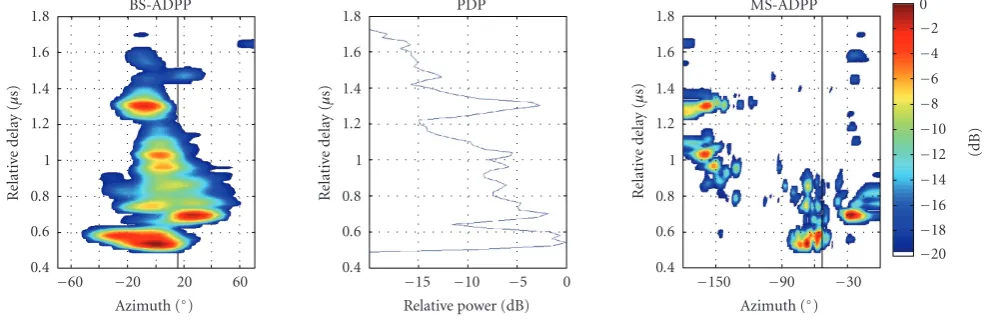
In this section, we give a simulation example where Mascaraa is used to evaluate the performance of a channel parameter estimation method. Estimated parameters are the delay, di-rection at BS, didi-rection at MS, power in vertical polariza-tion. Figure 12 represents the azimuth-delay power profile (ADPP) of the propagation channel at BS station (BS-ADPP) and at MS (MS-ADPP) in macrocell urban environments at 2.2 GHz. Detailed description of the measurement campaign setup, ADPP processing and channel parameters estimation can be found in [12, 33]. Figure 12(a) shows the results obtained directly from the measurement data.Figure 12(b) shows the results obtained from the data simulated by Mas-caraa. The procedure to produceFigure 12was the following. (1) BS-ADPP and MS-ADPP processing with a conven-tional beamforming approach, applied to the measurement data (Figure 12(a)).
(2) Channel parameter estimation trough detection of lo-cal power maxima.
(3) Impulse response matrix generation with Mascaraa. The configuration for the simulation is the same as the ex-perimental configuration including the carrier frequency, the bandwidth, the antenna array geometry, and the antenna pattern.
(4) BS-ADPP and MS-ADPP processing with a conven-tional beamforming approach, applied to the synthesized data in step 3.
A visual comparison between Figures 11.a and 11.b shows that the channel parameters estimation method gives satisfactory results. Only the diffuse component is not well modelled which explains the noncontinuous shape of the power delay profile (PDP).
7. CONCLUSION
The Mascaraa propagation channel simulator was intro-duced in this paper, from its theoretical basis, to its software implementation. The major characteristics of this simulator are the following.
(i) Compatibility with most of propagation models. Each propagation model is converted in a set of rays. (ii) Compatibility with all wireless communication
stan-dards.
(iii) Free choice of any antenna array geometry or any po-larization or any antenna pattern.
(iv) Optimized algorithms to process the impulse re-sponses and perform the channel filtering efficiently. (v) Compatibility with multisensor radio access schemes:
impulse response matrices instead of single impulse response are generated.
(vi) Simulation of the mobile motion: MIMO correlation matrices can be computed with a relative simplicity. (vii) Arbitrary delays of rays or paths: they are independent
from the signal sampling frequency.
(viii) High operating system or simulation platform porta-bility (written in standard C).
All these functionalities explain why Mascaraa is a versa-tile and efficient propagation channel simulator mainly ded-icated to MIMO link-level simulations. Future work will fo-cus on the use of Mascaraa to explore an important issue in MIMO technologies: the joint-impact of antenna array design and signal processing algorithms on system perfor-mances.
Mascaraa is licensed under the GNU General Public Li-cense. C-language routines that implement this design are available via e-mail from the authors.
REFERENCES
[1] D. Gesbert, M. Shafi, S. Da-shan, P. J. Smith, and A. Naguib, “From theory to practice: an overview of MIMO space-time coded wireless systems,” IEEE Journal on Selected Areas in Communications, vol. 21, no. 3, pp. 281–302, 2003.
[2] A. Goldsmith, S. A. Jafar, N. Jindal, and S. Vishwanath, “Ca-pacity limits of MIMO channels,”IEEE Journal on Selected Ar-eas in Communications, vol. 21, no. 5, pp. 684–702, 2003. [3] K. Yu and B. Ottersten, “Models for MIMO propagation
chan-nels: a review,”Wireless Communications and Mobile Comput-ing, vol. 2, no. 7, pp. 653–666, 2002.
[4] A. F. Molisch, “Effect of far scatterer clusters in MIMO out-door channel models,” inProceedings of the 57th IEEE Semi-annual Vehicular Technology Conference (VTC ’03), vol. 1, pp. 534–538, Jeju, Korea, April 2003.
[5] J. P. Kermoal, L. Schumacher, K. I. Pedersen, P. E. Mogensen, and F. Frederiksen, “A stochastic MIMO radio channel model with experimental validation,”IEEE Journal on Selected Areas in Communications, vol. 20, no. 6, pp. 1211–1226, 2002. [6] K. I. Pedersen, J. B. Andersen, J. P. Kermoal, and P. P.
Mo-gensen, “A stochastic multiple-input-multiple-output radio channel model for evaluation of space-time coding algo-rithms,” inProceedings of the 52nd Vehicular Technology Con-ference (VTC ’00), vol. 2, pp. 893–897, Boston, Mass, USA, September 2000.
[7] R. B. Ertel, P. Cardieri, K. W. Sowerby, T. S. Rappaport, and J. H. Reed, “Overview of spatial channel models for antenna ar-ray communication systems,”IEEE Personal Communications, vol. 5, no. 1, pp. 10–22, 1998.
[8] A. F. Molisch, “A generic model for MIMO wireless propaga-tion channels in macro- and microcells,”IEEE Transactions on Signal Processing, vol. 52, no. 1, pp. 61–71, 2004.
[9] S. M. Seedahmed, M. Z. Hussain, and P. O’Sheay, “Space-time geometrical-based channel models: a comparative study,” inProceedings of Australian Telecommunication, Networks and Applications Conference (ATNAC ’03), Melbourne, Australia, December 2003.
[10] “Spatial channel model for Multiple Input Multiple Output (MIMO) simulations,” 3GPP TR 25.996 V6.1.0, 2003. [11] H. Xu, D. Chizhik, H. Huang, and R. Valenzuela, “A
gen-eralized space-time multiple-input multiple-output (MIMO) channel model,”IEEE Transactions on Wireless Communica-tions, vol. 3, no. 3, pp. 966–975, 2004.
[12] J.-M. Conrat and P. Pajusco, “Typical MIMO propagation channels in urban macrocells at 2 GHz,” in Proceedings of the 13th European Wireless Conference (EW ’07), Paris, France, April 2007.
[13] F. A. Agelet, A. Formella, J. Mar´ıa, J. M. H. R´abanos, F. I. de Vicente, and F. P. Font´an, “Efficient ray-tracing acceleration techniques for radio propagation modeling,”IEEE Transac-tions on Vehicular Technology, vol. 49, no. 6, pp. 2089–2104, 2000.
[14] T. Fugen, J. Maurer, T. Kayser, and W. Wiesbeck, “Verifica-tion of 3D ray-tracing with non-direc“Verifica-tional and direc“Verifica-tional measurements in urban macrocellular environments,” in Pro-ceedings of the 63rd IEEE Vehicular Technology Conference (VTC ’06), pp. 2661–2665, Melbourne, Australia, May 2006. [15] M. A. Jensen and J. W. Wallace, “A review of antennas
and propagation for MIMO wireless communications,”IEEE Transactions on Antennas and Propagation, vol. 52, no. 11, pp. 2810–2824, 2004.
[16] M. Steinbauer, A. F. Molisch, and E. Bonek, “The double-directional radio channel,” IEEE Antennas and Propagation Magazine, vol. 43, no. 4, pp. 51–63, 2001.
[17] J. Kivinen, X. Zhao, and P. Vainikainen, “Empirical character-ization of wideband indoor radio channel at 5.3 GHz,”IEEE Transactions on Antennas and Propagation, vol. 49, no. 8, pp. 1192–1203, 2001.
[18] X. Zhao, J. Kivinen, P. Vainikainen, and K. Skog, “Charac-terization of Doppler spectra for mobile communications at 5.3 GHz,”IEEE Transactions on Vehicular Technology, vol. 52, no. 1, pp. 14–23, 2003.
[19] Y. Li and X. Huang, “The simulation of independent Rayleigh faders,”IEEE Transactions on Communications, vol. 50, no. 9, pp. 1503–1514, 2002.
[20] Y. R. Zheng and C. Xiao, “Simulation models with correct sta-tistical properties for Rayleigh fading channels,”IEEE Transac-tions on CommunicaTransac-tions, vol. 51, no. 6, pp. 920–928, 2003. [21] M. F. Pop and N. C. Beaulieu, “Limitations of
sum-of-sinusoids fading channel simulators,” IEEE Transactions on Communications, vol. 49, no. 4, pp. 699–708, 2001.
[22] M. Paetzold and F. Laue, “Statistical properties of Jakes’ fading channel simulator,” inProceedings of the 48th IEEE Vehicular Technology Conference (VTC ’98), vol. 2, pp. 712–718, Ottawa, Canada, May 1998.
[24] M. P¨atzold,Mobile Fading Channels, John Wiley & Sons, New York, NY, USA, 2002.
[25] L. Vuokko, A. Kainulainen, and P. Vainikainen, “Polarization behavior in different urban radio environments at 5.3 GHz,” inProceedings of Wireless Summit & Wireless Personal Multi-media Communications (IWS/WPMC ’05), Aalborg, Denmark, September 2005.
[26] A. Dunand and J.-M. Conrat, “Dual-polarized spatio-temporal characterization in urban macrocells at 2 GHz,” in Proceedings of the 66th IEEE Vehicular Technology Conference (VTC ’07), Baltimore, Md, USA, September-October 2007. [27] K. H. Ng, E. K. Tameh, and A. R. Nix, “Modelling and
per-formance prediction for multiple antenna systems using en-hanced ray tracing,” inProceedings of IEEE Wireless Commu-nications and Networking Conference (WCNC ’05), vol. 2, pp. 933–937, New Orleans, La, USA, March 2005.
[28] S. Morosi, M. Tosi, E. Del Re, R. Fantacci, and P. Riva, “Im-plementation of a wideband directional channel model for a UMTS link level simulator,” inProceedings of IEEE Global Telecommunications Conference (GLOBECOM ’03), vol. 6, pp. 3381–3385, San Francisco, Calif, USA, December 2003. [29] M. C. Jeruchim, P. Balaban, and K. S. Shanmugan,Simulation
of Communication Systems, Plenum Press, New York, NY, USA, 1992.
[30] E. C. Ifeachor and B. W. Jervis, Digital Signal Processing: A Pratical Approach, Addison-Wesley, Reading, Mass, USA, 1993.
[31] M. P¨atzold, R. Garcia, and F. Laue, “Design of high-speed simulation models for mobile fading channels by using table look-up techniques,”IEEE Transactions on Vehicular Technol-ogy, vol. 49, no. 4, pp. 1178–1190, 2000.
[32] W. H. Press, W. T. Vetterling, S. A. Teukolsky, and B. P. Lan-nery,Numerical Recipes in C, The Art of Scientific Comput-ing, Cambridge University Press, Cambridge, UK, 2nd edition, 1992.
[33] J.-M. Conrat and P. Pajusco, “Clusterization of the propa-gation channel in urban macrocells at 2 GHz,” in Proceed-ings of the 8th European Conference on Wireless Technology (ECWT ’05), pp. 39–42, Paris, France, October 2005. [34] A. Guill´en i F`abregas, M. Guillaud, D. T. M. Slock, et al.,