Volume 2007, Article ID 98186,15pages doi:10.1155/2007/98186
Research Article
SmartMIMO
: An Energy-Aware Adaptive MIMO-OFDM Radio
Link Control for Next-Generation Wireless Local Area Networks
Bruno Bougard,1, 2Gregory Lenoir,1Antoine Dejonghe,1Liesbet Van der Perre,1
Francky Catthoor,1, 2and Wim Dehaene2
1IMEC, Department of Nomadic Embedded Systems, Kapeldreef 75, 3001 Leuven, Belgium
2K. U. Leuven, Department of Electrical Engineering, Katholieke Universiteit Leuven, ESAT, 3000 Leuven, Belgium
Received 15 November 2006; Revised 12 June 2007; Accepted 8 October 2007
Recommended by Monica Navarro
Multiantenna systems and more particularly those operating on multiple input and multiple output (MIMO) channels are cur-rently a must to improve wireless links spectrum efficiency and/or robustness. There exists a fundamental tradeoffbetween po-tential spectrum efficiency and robustness increase. However, multiantenna techniques also come with an overhead in silicon implementation area and power consumption due, at least, to the duplication of part of the transmitter and receiver radio front-ends. Although the area overhead may be acceptable in view of the performance improvement, low power consumption must be preserved for integration in nomadic devices. In this case, it is the tradeoffbetween performance (e.g., the net throughput on top of the medium access control layer) and average power consumption that really matters. It has been shown that adaptive schemes were mandatory to avoid that multiantenna techniques hamper this system tradeoff. In this paper, we derivesmartMIMO: an adaptive multiantenna approach which, next to simply adapting the modulation and code rate as traditionally considered, de-cides packet-per-packet, depending on the MIMO channel state, to use either space-division multiplexing (increasing spectrum efficiency), space-time coding (increasing robustness), or to stick to single-antenna transmission. Contrarily to many of such adap-tive schemes, the focus is set on using multiantenna transmission to improve the link energy efficiency in real operation conditions. Based on a model calibrated on an existing reconfigurable multiantenna transceiver setup, the link energy efficiency with the pro-posed scheme is shown to be improved by up to 30% when compared to nonadaptive schemes. The average throughput is, on the other hand, improved by up to 50% when compared to single-antenna transmission.
Copyright © 2007 Bruno Bougard et al. This is an open access article distributed under the Creative Commons Attribution License, which permits unrestricted use, distribution, and reproduction in any medium, provided the original work is properly cited.
1. INTRODUCTION
The performance of wireless communication systems can drastically be improved when using multiantenna transmis-sion techniques. Specifically, multiantenna techniques can be used to increase antenna gain and directionality (beam-forming, [1]), to improve link robustness (space-time cod-ing [2,3]), or to improve spectrum efficiency (space divi-sion multiplexing [4]). Techniques where multiple anten-nas are considered both at transmit and receive sides can combine those assets and are referred to as multiple-input multiple-output (MIMO). On the other hand, because of its robustness in harsh frequency selective channel combined with a low implementation cost, orthogonal frequency di-vision multiplexing (OFDM) is now pervasive in broadband wireless communication. Therefore, MIMO-OFDM schemes turn out to be excellent candidates for next generation broad-band wireless standards.
Transmitter
PDSP+MAC(25%) PTx(8%)
PDAC(6%)
PFE(20%) PPA(41%)
Receiver
PFE(25%) PFEC(35%)
PDSP+MAC(25%) PADC(15%)
Figure1: Power consumption breakdown of typical single-antenna OFDM transceivers [6,7]. At the transmit part, the power amplifier contribution (PTx+PPA), which can scale with the transmit power and linearity if specific architectures are considered [8], accounts for 49%. At the receiver, the digital baseband processing (PDSP), forward error correction (PFEC), and medium access control (PMAC) units are dominant and do not scale with the transmit power. The power of the analog/digital and digital/analog converters (PADC+PDAC) and the fixed front-end power (PFE) are not considered because they are constant.
(total energy spent in the transmission and the reception per bit of data) that really matter. Characterizing how a diversity gain, a multiplexing gain, and/or a coding gain influence that system-level tradeoffremains a research issue.
The transceiver power consumption is generally made of two terms. The first corresponds to the power amplifier(s) consumption and is a function of the transmit power, in-ferred from the link budget. The second corresponds to the other electronics consumption and is independent of the link budget. We refer, respectively, to dynamic and static power consumption. The relative contribution of those terms is il-lustrated inFigure 1where the typical power consumption breakdown of single-antenna OFDM transceivers is depicted. The impact on power consumption of multiantenna transmission (MIMO), when compared with traditional single-antenna transmission (SISO), is twofold. On the one hand, the general benefit in spectral efficiency versus signal-to-noise ratio can be exploited either to reduce the required transmit power, with impact on the dynamic power con-sumption, or to reduce the transceiver duty cycle with im-pact on both dynamic and static power contributions. On the other hand, the presence of multiple antennas requires duplicating part of the transceiver circuitry, which increases both the static and dynamic terms.
The question whether multiantenna transmission tech-niques increase or decrease the transceiver energy efficiency has only recently been addressed in the literature [9–11]. In-terestingly, it has been shown that for narrow-band single-carrier transmission, multiantenna techniques basically de-crease the energy efficiency if they are not combined with adaptive modulation [9]. It has also been shown, in the same context, that energy efficiency improvement is achievable by adapting the type of multiantenna encoding to the transmis-sion condition [10,11].
The purpose of this paper is first to extend previously mentioned system-level energy efficiency studies to the case of broadband links based on MIMO-OFDM. Therefore, we investigate the performance versus energy efficiency tradeoff of two typical multiantenna techniques—space-time block code (STBC) [3] and space-division multiplexing (SDM)
[4]—and compare it to the single-antenna case. Both are im-plemented on top of a legacy OFDM transmission chain as used in IEEE 802.11a/g/n and proceed to spatial processing at the receiver only. The IEEE 802.11 MAC has been adapted to accommodate those transmission modes. For the sake of clarity, without hampering the generality of the proposed ap-proach, we limit the study to 2×2 antennas systems.
Second, we propose smartMIMO, a coarsely adaptive MIMO-OFDM scheme that, on a packet-per-packet basis, switches between STBC, SDM, and SISO depending on the channel conditions to simultaneously secure the through-put and/or robustness improvement provided by the mul-tiantenna transmission and guarantees an energy-efficiency improved compared with the current standards. Contrarily in other adaptive scheme [12–16], using SISO still reveal ef-fective in many channel condition because of the saving in static power consumption.
The remainder of the paper is structured as follows. In Section 2, we present some related work. The MIMO-OFDM physical (PHY) and medium access control (MAC) layers are described inSection 3. The unified performance and en-ergy models used to investigate the average throughput ver-sus energy-efficiency tradeoffare presented inSection 4. The impact of SDM and STBC on the net throughput versus energy-efficiency tradeoffis discussed inSection 5. Finally, inSection 6, we present thesmartMIMOscheme and evalu-ate its benefit on the aforementioned tradeoff.
2. RELATED WORK
The question whether multiantenna techniques increase or decrease the energy efficiency has only very recently been addressed. Based on comprehensive first order energy and performance models targeted to narrow-band single car-rier transceivers (as usually considered in wireless microsen-sor), Shuguang et al. have evaluated, taking both static and dynamic power consumption into account, the impact on energy efficiency of single-carrier space-time block coding (STBC) versus traditional single antenna (SISO) transmis-sion [9]. Interestingly, it is shown that in short-/middle-range applications such as sensor networks—and by exten-sion, wireless local area networks (WLANs)—nonadaptive STBC actually degrades the system energy efficiency at same data rate. However, when combined with adaptive mod-ulation in so-called adaptive multiantenna transmission, energy-efficiency can be improved. Liu and Li have extended those results by showing that energy-efficiency can further be improved by adaptively combining multiplexing and diver-sity techniques [10,11]. Adaptive schemes are hence manda-tory to achieve both high-throughput and energy-efficient transmissions.
In [13], a pragmaticcoarse grainadaptation scheme is eval-uated. Modulation, forward error correction (FEC) cod-ing rate and MIMO encodcod-ing are adapted accordcod-ing to CSI estimator—specifically, the average signal-to-noise ratio (SNR) and packet error rate (PER)—to maximize the eff ec-tive throughput. More recently,fine grainadaptive schemes have been proposed [14, 15]. The modulation and multi-antenna encoding are here adapted on a carrier-per-carrier basis. The main challenge with such schemes is however to provide the required CSI to the transmitter with minimal overhead. This aspect is tackled, for instance in [16].
The approaches mentioned above have been proven to be effective to improve net throughput and/or bit-error rate (BER). Some are good candidate to be implemented in com-mercial chipset. However, in none of those contributions, the electronics power consumption is considered in the opti-mization. Moreover, most adaptive policies are designed to maximize gross data-rate and/or minimize (uncoded) bit-error rate without taking into account the coupling between physical layer data rate and bit-error rate incurred in medium access control (MAC) layer [17].
In this paper, adaptive MIMO-OFDM schemes are looked at with as objective to jointly optimize the average link throughput (on top of the medium access control layer) and the average transceiver energy efficiency. The total transceiver power consumption is considered, including the terms that vary with the transmit power and the fixed term due the ra-dio electronics.
To enable low-complexity policy-based adaptation and to limit the required CSI feedback, coarsely adaptive schemes, as defined in [13], are considered. For this, pragmatic em-pirical performance, energy, and channel state information models are developed based on observation and measure-ments collected on the reconfigurable MIMO-OFDM setup previously described in [18].
3. MIMO PHYSICAL AND MAC LAYERS
3.1. MIMO-OFDM physical layer
The multiantenna schemes considered here are orthogonal space-time block coding (STBC) [2,3] and space-division multiplexing with linear spatial processing at the receiver (SDM-RX) [4]. Both are combined with OFDM so that mul-tiantenna encoding and/or receive processing is performed on a per-carrier basis. The N OFDM carriers are QAM-modulated with a constellation size set by the link adapta-tion policy presented in [17]. The same constellaadapta-tion is con-sidered for the different carriers of a given symbol, therefore we refer to “coarse grain” adaptation in opposition to fine grain adaptation where the subcarriers can receive different constellation.
Figure 2illustrates the general setup for MIMO-OFDM on which either SDM or STBC can be implemented.
For SDM processing, a configuration withUtransmit an-tenna andAreceive antenna is considered. The multiantenna preprocessing reduces to demultiplexing the input stream in sub-streams that are transmitted in parallel. Vertical encod-ing is considered: the original bit stream is FEC encoded,
interleaved, and demultiplexed between the OFDM modu-lators. The MIMO processors at the receiver side take care of the spatial interference mitigation on a per-subcarrier ba-sis. We consider a minimum mean-square–error-(MMSE-) based detection algorithm. Although the MMSE algorithm is outperformed by nonlinear receiving algorithm such as suc-cessive interference cancellation [4], its implementation ease keeps it attractive in low-cost, high-throughput solution such as wireless local area networks.
In STBC mode, space-time block codes from orthogo-nal designs [2,3] are considered. Such scheme reduces to an equivalent diagonal system that can be interpreted as a SISO model where the channel is the quadratic average of the MIMO sub-channels [3].
Channel encoding and OFDM modulation are done ac-cording to the IEEE 802.11a standard specifications, trans-mission occurs in the 5 GHz ISM band [19].
As mentioned previously, from the transceiver energy-efficiency perspective, it may still be interesting to operate transmission in single-antenna mode. In that case, a single finger of the transmitter and receiver are activated and the MIMO encoder and receive processor are bypassed.
3.2. Medium access control layer
The multiantenna medium access control (MAC) protocol we consider is a direct extension of the IEEE 802.11 dis-tributed coordination function (DCF) standard [19]. A car-rier sense multiple access/collision avoidance (CSMA/CA) medium access procedure performs automatic medium ac-cess sharing. Collision avoidance is implemented by mean of the exchange of request-to-send (RTS) and clear-to-send (CTS) frames. The data frames are acknowledged (ACK). The IEEE 802.11 MAC can easily be tuned for adaptive mul-tiantenna systems. We assume that the basic behavior of each terminal is single-antenna transmission. Consequently, single-antenna exchange establishes the multiantenna fea-tures prior to the MIMO exchange. This is made possible via the RTS/CTS mechanism and the data header. A signaling relative to the multiple-antenna mode is added to the physi-cal layer convergence protocol (PLCP) header.
Further, the transactions required for channel estima-tion need to be adapted. In the considered 2×2 configura-tion, not only one but four-channel path must be identified. Therefore, the preamble structure is adapted as sketched in Figure 3. The transmitter sends preambles consecutively on antennas 1 and 2. The receiver can then easily identify all channel paths. The complete protocol transactions to trans-mit a packet of data in the SDM and STBC modes are detailed in Figures4and5, respectively. For SISO transmission, one relies on the standard 802.11 CSMA/CA transaction and on the standard preambles.
4. UNIFIED PERFORMANCE AND ENERGY MODEL
MIMO encoder
1
MIMO encoder
N
IFFT
IFFT
Par
alle
l
to
se
ri
al
Par
alle
l
to
se
ri
al
TX filter
TX filter
RX filter
RX filter
Par
alle
l
to
se
ri
al
Par
alle
l
to
se
ri
al
FFT
FFT
MIMO-RX processor 1
MIMO-RX processorN
Figure2: Reconfigurable multiantenna transceiver setup supporting SDM, STBC, and SISO transmissions.
t1 t2 t3 t4 t5 t6 t7 t8 t9 t10 G2 T1 T2 G2 T1 T2
10×0.8=8μs 2×0.8 + 2×3.2=8μs 2×0.8 + 2×3.2=8μs 8 +U×8μs
2×0.8 + 2×3.2=8μs 0.8 + 3.2=4μs 0.8 + 3.2=4μs 0.8 + 3.2=4μs
G2 T1 T2 G1 Signal G1 Payload 1 G1 Payload 2
Service + payload Rate length
ChannelUestimation Signal detect
AGC diversity selection
Coarse frequency offset estimation timing synchronize
Channel and fine frequency offset estimation
Channel 2 estimation
Figure3: Channel estimations from the preamble for a 2×2 system.
multiantenna processing, and the channel state. To enable simple policy-based adaptation scheme and limit the re-quired CSI feedback, a coarse channel state model is needed to capture the CSI in a synthetic way. The proposed model should cover the system performance and energy consump-tion of the different multiantenna techniques under consid-eration.
An important aspect is to identify tractable channel state parameters that dominate the instantaneous packet error probability. The average packet errors rate (PER) as
(1) TX sends RTS in SISO. the PLCP header contains:
(i) 2 bits specifying the MIMO exchange type (here channel state extraction at RX)
(ii) 2 bits for the number of TX antennas that will be activated for the next MIMO exchange (nTX) and that have to be considered in the channel extraction (iii) 2 bits for the minimum numbers of RX antennas to
activate for next reception.
(2) RX sends CTS.
(3) TX send DATA preamples in time division: 10 short train-ing sequences for coarse synchronization (t1· · ·t10−8μs) and 2×nTX long training sequences (G2T1T2−8μs, called
C-C sequence). Each TX antenna transmits after each other its C-C sequence. RX activates its antennas and ex-tracts information about each channel that each antenna sees. PLCP header is sent from the last TX antenna and conveys 2 bits for the mode (here SDM-RX) and 2 bits for the number of streams. finally, TX sends the DATA in MIMO.
(4) RX sends ACK.
Figure4: Considered SDM protocol extension.
(1) TX sends RTS in SISO. the PLCP header contains:
(i) 2 bits specifying the MIMO exchange type (here channel state extraction at RX)
(ii) 2 bits for the number of TX antennas that will be activated for the next MIMO exchange (nTX) and that have to be considered in the channel extraction (iii) 2 bits for the minimum numbers of RX antennas to
activate for next reception.
(2) RX sends CTS.
(3) TX send DATA preamples in TDMA: 10 short training se-quences for coarse synchronization (t1· · ·t10−8μs) and 2×nTX long training sequences (G2T1T2−8μs, called C-C sequence). Each TX antenna transmits after each other its C-C sequence. RX activates its antennas and extracts information about each channel that each antenna sees. PLCP header is sent from the last TX antenna and con-veys 2 bits for the mode (here STBC) and 4 bits for the code used. Finally, TX sends the DATA in MI-SO/MO de-pending on the number of recieved antenna (nRX). (4) RX sends ACK.
Figure5: Considered STBC protocol extension.
Possible coarse channel state information (CSI) indica-tors for MIMO-OFDM are discussed in [13]. An empiri-cal approach based on multiple statistics of the postprocess-ing SNR (the SNR after MIMO processpostprocess-ing) and runnpostprocess-ing- running-average PER monitoring is proposed. Yet, it is difficult to define such SNR-based indicators consistently across diff er-ent MIMO schemes. Moreover, relying on PER information
results in a tradeoffbetween accuracy and feedback latency, both with potential impact on stability.
As already proposed in [20], based on the key observation that energy efficiency and net throughput are actually weak functions of the packet error probability [21], we prefer to use the outage probability—that is, the probability that the channel instantaneous capacity is lower that the link spec-trum efficiency—as indicator of the packet error probability. The instantaneous capacity depends on the average signal-to-noise ratio (SNR), the normalized instantaneous channel responseH, and the multiantenna encoding. The instanta-neous capacity can be easily derived for the different multi-antenna encoding. Practically, it is convenient to derive the capacity-over-bandwidth ratio that can be compared to the transmission spectrum efficiencyηinstead of absolute rate.
In the remainder of this session, we first derive the instan-taneous capacity expressions for the different transmission mode considered (Section 4.1). Then, we derive the condi-tion for quasi-error-free packet transmission (Seccondi-tion 4.2). Based on that, we compute the expressions of the net throughput and the energy per bit (Sections4.3and4.4). Fi-nally, we discuss the derivation of the coarse channel model required to develop policy-based radio link control strategies (Section 4.5).
4.1. Instantaneous capacity
LetH = (hn
ua) be a normalized MIMO-OFDM channel
re-alization. The coefficienthn11corresponds to the (flat) chan-nel response between the single active transmit antenna and the single active receive antenna for the subcarriern (includ-ing transmit and receive filters). Theinstantaneous capacity
of the single-antenna channel is given by (1), whereWis the signal bandwidth andNis the number of subcarriers. SNR is the average link signal-to-noise ratio. If SNR is high com-pared to 1, the capacity relative to the bandwidth can be de-composed in a term proportional to SNR and independent ofHand a second term function ofHonly:
C=W·1
In the STBC case, as mentioned in Section 3, the MIMO channel can be reduced to equivalent SISO channel corre-sponding to the quadratic average of the subchannels be-tween each pairs of transmit and receive antennas [3]. The
instantaneous capacitycan then be computed just as for SISO:
C
the output of the interference cancellation filter. LetHnand Fn, respectively, denote the MIMO channel realization for the subcarriern, and the corresponding MMSE filter (4):
Fn=HnH·HnHnH+σ2IAxA −1
. (4)
In the considered 2×2 case, let us assume an equal transmit power at both transmit antennasp1 = p2 = p/2 and let us denote withfn
1,f2n,hn1,hn2, respectively, the first row, second row, first column, second column of the matricesHnandFn. The substream postprocessing SNRsγ1andγ2 can then be computed as
SNR is again the average link signal-to-noise ratio. The in-stantaneouscapacitycan then be computed in analogy with (2) and (3) as follows:
This development can easily be extended to more than 2×2 antenna setups.
4.2. Condition for quasi-error-free packet transmission on a given channel
Because the link throughput and energy efficiency (our ob-jective functions) are weak functions of the packet error probability [21], one does not need to estimate the latter ac-curately in order to define adaptation policies that optimize the formers. It is sufficient to derive a condition under which the packet error rate is sufficiently low in order not to sig-nificantly affect the aforementioned objective functions. It is easy to verify that the accuracy obtained on the throughput on top of the MAC and on the energy efficiency is of the same order of magnitude that the packet error rate.
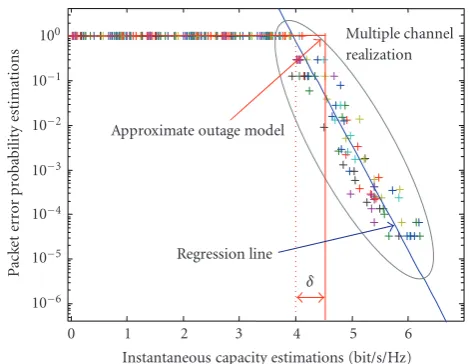
Based on Monte Carlo simulations, we have verified that, for the purpose of computing the average throughput on top of the MAC and the transceiver energy consumption per bit, the packet error event probability can be approximated by the outage without significant prejudice to the accuracy (Figure 6). We hence assume that, the channel being known,
Pe, equals 1 if the spectrum efficiencyηexceedsC/W. To
ac-count for the nonoptimality of the coding chain, we apply an empirical marginδ = 0.5 bit/s/Hz, calibrated from simula-tion:
Instantaneous capacity estimations (bit/s/Hz) Approximate outage model
Regression line
δ
Multiple channel realization
Figure6: Packet error probability and instantaneous capacity ob-servation on a link with spectrum efficiency 4 for a large set of channel realizations. One can observe the strong correlation and the steep descend of the regression line beyond the point where the in-stantaneous capacity breaks the spectrum efficiency line. The net throughput and energy per bit are weak function of the packet er-ror probability; these observations motivate considering an outage model to derive policy-based adaptive schemes.
4.3. Net throughput
Assuming that the channel capacity criteria is met and, hence, the PER is close to zero, knowing the physical layer throughput (Rphy) and the details of the protocols, thenet throughput(Rnet) can be computed as follows:
Rnet To better understand that expression, refer toFigure 7and notice that the denominator corresponds to the total time re-quired for the transmission of one packet of data sizeLdwith
aLh-bit header according to the 802.11 DCF protocol [19].
TSIFSis the so-called short interframe time.Rdphyis the phys-ical layer data rate.Lctrlcorresponds to the aggregate length of all control frames (RTS, CTS, and ACK) transmitted at the basic rate (Rbphy) andTplcpis the transmission time of the PLCP header.TDIFSis the minimum carrier sense duration andTCW holds for the average contention time due to the
CSMA procedure. The physical layer data rate Rdphycan be expressed as a function of modulation order (Nmod) and the code rate (Rc), considering the number of data carrier per
4.4. Energy per bit
To compute the energy efficiency, the system power con-sumption needed to sustain the required average SNR must be assessed. The latter consists of a fixed term due to the elec-tronics, and a variable term, function of the power consump-tion
Psysten=Pelec+PTx
ε , (11)
whereεdenotes the efficiency of the transmitter power am-plifier (PA), that is, the ratio of the output power (PTx) by the power consumption (PPA). In practical OFDM transmitters, class A amplifiers are typically used. The power consump-tion of the latter component only depends on its maximum output power (Pmax) (12). Next, the transmitter signal-to-distortion ratio (S/DTx) can be derived as a function of the sole backoff(OBO) of the actual PA output power (PTx) to Pmax (13)-(14). The latter relation is design dependent and usually not analytical. In this study, we consider an empirical curve-fitted model calibrated on the energy-scalable trans-mission chain design presented in [8], which has as key fea-ture to enable both variable output power (PTx) and variable linearity (S/DTx) with a monotonic impact on the power con-sumption;
PPA=Pmax
2 , (12)
OBO= Pmax PTx
, (13)
(S/D)Tx= f(OBO). (14)
The path-loss being known, SNR can then be computed as a function of OBO andPTx(15).PN is the thermal noise level
depending of the temperature (T), the receiver bandwidth (W), and noise factor (Nf),kis the Boltzmann constant:
1
SNR =
1 (S/D)Tx +
PN×PL
PTx
, (15)
PN =k·T·W·Nf. (16)
The PA power can be expressed as a function of those two parameters (17):
PPA=2×
PTX×OBO
. (17)
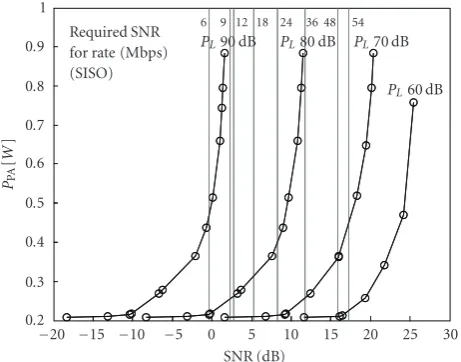
The achievablePPA versus SNR tradeoffobtained with the design as presented in [8] is illustrated for different average link path-loss values inFigure 8. Notice that in case the out-put power has to stay constant, the proposed reconfigurable architecture still has the possibility to adapt to the linearity requirements. This has less but still significant impact on the power consumption.
4.5. Coarse channel model
At this point in the development, we have relations to com-pute the link throughput and the transceiver energy con-sumption per bit for given multiantenna encoding,
modu-lation and code rate, provided that the link SNR is sufficient to satisfy the quasi error free transmission condition.
The latter condition depends also on the actual chan-nel responseH(equations (2), (3), (5), (6), and (7)). Exten-sive work has already been done to model broadband chan-nel at that level of abstraction (physical level). In the case of MIMO-OFDM WLAN as considered here, a reference chan-nel model is standardized by the IEEE [22]. However, to be able to derive simple policy-based adaptation schemes that take that channel state information into account, one has to derive a model that captures this information in a more com-pact way. A valid approach is to operate an empirical classifi-cation of the channel merit. This can easily be done based on the instantaneous capacity indicators.
As an example, let us consider the second term of the in-stantaneous SISO capacity. According to [22], the values of the carrier fadinghn
uaare Rayleigh distributed. However, due
to the averaging across the carriers, which are only weakly correlated, the distribution of the second term of the instan-taneous capacity is almost normal distributed (seeFigure 9). Since the first term of the capacity indicator is independent ofHand therefore not stochastic, the capacity indicator can then also be approximated as normal-distributed. One can verify that the same observation holds also for the STBC and SDM instantaneous capacity indicators (seeFigure 9).
Let us, respectively, denote the average and variance of the instantaneous capacity for a given mode as μmode and σ2
mode. These quantities depend only on SNR. Their evolution in a function of SNR is plotted inFigure 10for the different multiantenna encoding. It can be observed that for a given mode and a sufficiently large SNR,μmodegrows linearly with SNR in dB whileσ2
modestays sensibly constant. Therefore, a linear regression can be operated. The parameters of the ex-tracted linear model are summarized inTable 1.
Based on the normal distribution of the instantaneous capacity and the linear models for the parameters of that dis-tribution, a channel merit scale can be defined. A given chan-nel instance receives a merit index for a given multi-antenna mode and a given SNR depending on how its actual instanta-neous capacity compared to the capacity distribution for that mode and that SNR. The empiric scale we consider goes from 1 (worst) to 5 (best) with the class boundaries as defined in Table 2(3 first columns).
For each class index (channel merit), a worst-case error-free transmission condition is defined, comparing the signal-ing spectrum efficiency (η) to the upper bound of the instan-taneous capacity class for this channel merit (Table 2, fourth column).
4.6. Usage of the model
One can now compute, for a given channel merit as defined above, what will be the link throughput and the transceiver energy consumption per bit for a given multiantenna mode, a given modulation and a given code rate. The computation occurs as follows.
DIFS
RTS Data
SIFS SIFS SIFS
CTS ACK
Source
Destination
Other
DIFS
NAV (RTS)
NAV (CTS)
CW
Defer Access Backoff
Figure7: Packet transmission transaction according to the IEEE 802.11 protocol modified to support multiantenna operation.
Table1: Instantaneous capacity indicator average and standard de-viation as a function of the average SNR.
μ=A×SNR+B
σ
A B
SISO 0.33 −0.84 1.41
SDM 0.6 −2.54 2.41
STBC 0.33 −0.24 0.73
satisfy the worst-case quasi-error-free transmission condi-tion (for the given multi-antenna mode and channel merit) is computed using the appropriate inequality fromTable 2, fourth column, and the linear model exposed inTable 1.
Step 2. Knowing the multi-antenna mode, the modulation and the code rate, assuming quasi-packet-error-free trans-mission, the link throughput is computed according to (8). The condition is calibrated for a packet error rate of<1%, yielding an accuracy of 1% of the estimated throughput and energy efficiency.
Step 3. Based on the power model exposed inSection 4.4, as-suming a given average path loss, the transmitter parameters (output power, backoff) to achieve the link SNR computed in Step1, and subsequently the transmitter power consump-tion, are computed.
Step 4. From the transmitter power and the net throughput, the energy per bit can be computed.
5. IMPACT OF MIMO ON THE AVERAGE RATE VERSUS AVERAGE POWER TRADEOFF
The proposed performance and energy models enable com-puting the net throughputand energy efficiency as func-tions of the system-level parameters (mode, modulation, code rate, transmit power, and power amplifier backoff). The
0.2 0.3 0.4 0.5 0.6 0.7 0.8 0.9 1
PPA
[
W
]
−20 −15 −10 −5 0 5 10 15 20 25 30 SNR (dB)
6 9 12 18 24 36 48 54
PL90 dB PL80 dB PL70 dB
PL60 dB
Required SNR for rate (Mbps) (SISO)
Figure8: Power consumption versus link SNR tradeoffachieved with the energy scalable transmitter for average path-loss, PL =
60 dB, 70 dB, 80 dB, 90 dB. The tradeoffcurves are compared to the SNR level required for 20 MHz SISO-OFDM transmission with PER
<10% at various rates.
considered settings for those parameters are summarized in Table 3. Capitalizing on those models and using the tech-niques already proposed in [17], one can derive a set of close-to-optimal transmission adaptation policies that optimize the average energy efficiency for a range of average through-put targets and, then, analyze the resulting tradeoff.
In this section, we derive these tradeoffs separately for the STBC and SDM modes and compare with SISO. This is done in two steps.
Table2: Definition of the channel merit.
Channel merit Channel instance instantaneous capacity indicator Maximum spectrum efficiency for quasi error free transmission
Min Max
Figure9: Distribution of the instantaneous capacity observation for the different modes (SISO, STBC, SDM) over a large set of chan-nel instances generated with the physical chanchan-nel model.
Step 2. For a given average throughput target, a policy is de-rived to select which working points from the Pareto optimal set has to be used for each channel merit value in order to minimize the average energy per bit (Section 5.2).
The resulting average throughput versus energy-per-bit tradeoffs is finally analyzed in Section 5.3. It should be no-ticed that this approach assume that the channel merit is known at the transmitter (limited CSI at transmit). That in-formation can be acquired during the reception of the CTS
−10
Figure10: Capacity indicator mean and standard deviation as a function of SNR for the various modes.
Table3: System-level parameters considered.
MIMO mode SISO, SDM2×2, STBC2×2
Nmod BPSK, QPSK, 16QAM, 64QAM
Rc 1/2, 2/3, 3/4
PTx[dBm] 0, 5, 10, 15, 20, 23
OBO [dB] 6, 8, 10, 12, 14
frame or piggy-backed in the CTS, assuming that the channel is stable during RTS/CTS/packet transaction. The assump-tion is valid in nomadic scenario as considered in case of WLAN (typical coherence time of 300 milliseconds).
5.1. Net throughput versus energy-per-bit
12 14 16 18 20 22 24
En
er
g
y
p
er
b
it
(n
J)
26 28 30 32
Goodput (Mbit/s) 60 dB
(a)
20 40 60 80 100 120
En
er
g
y
p
er
b
it
(n
J)
26 28 30 32
Goodput (Mbit/s) 70 dB
(b)
50 100 150 200 250
En
er
g
y
p
er
b
it
(n
J)
20 25 30
Goodput (Mbit/s) 80 dB
(c)
0 50 100 150 200 250 300 350
En
er
g
y
p
er
b
it
(n
J)
16 18 20 22 24 26 Goodput (Mbit/s)
90 dB
(d)
Figure11: Net throughput versus energy-per-bit tradeofffor channel merit 3 and various path-losses. The (·) corresponds to the SISO working points, the (+) corresponds to the STBC, and the (×) corresponds to the SDMs. In each case, the Pareto optimal set is interpolated with a step curve.
all system-level parameter combinations, the ones bound-ing the tradeoffhave to be derived. The limited range of the functional parameters still allows us to proceed efficiently to this search with simple heuristics [17]. This optimization can be proceeded to at design time, which limits to a great extend the complexity of the adaptation scheme.
The resulting tradeoffpoints are plotted inFigure 11for different path losses and an average channel merit (which is 3). For each mode, we only keep the nondominated trade-offpoints, leading to Pareto optimal sets, which are interpo-lated by step curves. We generally observe that SDM enables reaching higher throughput but that SISO stays more energy efficient for lower rates. STBC becomes attractive in case of large path losses. Similar tradeoffshapes can be observed for the other channel merit values.
5.2. Derivation of the control policies
From the knowledge of the Pareto optimal net throughput versus energy-per-bit tradeoffand the channel merit proba-bilities, which can be obtained from the Monte Carlo anal-ysis of the physical-level channel model, given an average throughput constraint, we applied the technique presented in [17] to derive the adaptation policy that minimizes the energy per transmitted bit. Such a policy, valid for a given multiantenna mode, a given average path loss, and a given average throughput constraints, maps the possible channel merit to the appropriate setting of the transmission parame-ters.
Let (ri j,ei j) denote the coordinates of theith Pareto point
40
Run time controller performance for MATCH 60 dB
(a)
Run time controller performance for MATCH 70 dB
(b)
Run time controller performance for MATCH 80 dB
(c)
Run time controller performance for MATCH 90 dB
(d)
Figure12: Average net throughput versus average energy-per-bit tradeofffor SISO (o), STBC (+), and SDM (×) at various path-loss.
powerPand rateRcorresponding to a given control policy— that is, the selection of one point on each throughput energy efficiency tradeoff—can then be expressed by (18). In these equations,xi jislif the corresponding point is selected, 0
oth-erwise, andψjis the probability of the channel merit j. The
energy per bit can be computed asP/R: We introduce the notationpi jandri j corresponding,
respec-tively, to the power and rate when the channel merit isjand the ith point is selected on the corresponding curve, both
weighted by the probability to be in that channel state. Only one tradeoffpoint can be selected for a given channel merit, resulting in the following constraints:
i
xi j=1 ∀j, xi j∈ {0, 1}. (19)
For a given average rate constraintR, the optimal control pol-icy is the solution of the following problem:
min
1 1.5 2 2.5 3 3.5 4 4.5 5
ch
anne
l
m
er
it
fo
r
S
TB
C
1 1.5 2 2.5 3 3.5 4 4.5 5 channel merit for SDM
0.05 0.1 0.15 0.2 0.25 0.3 0.35 0.4 0.45
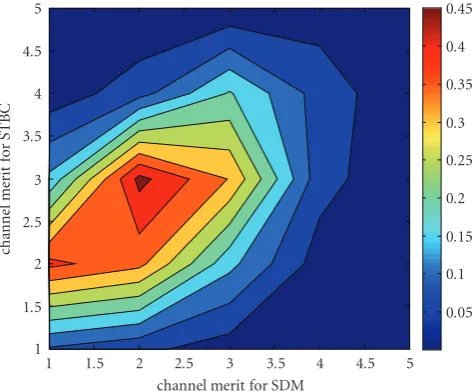
Figure13: Histogram of the channel merit for STBC and SDM.
strategy. Let us denote askjthe index of the point selected on
thejth Pareto curve. Formally,kj =i⇔ xi j = 1. A control
policy can be represented by the vectork = {kj}. The
con-trol strategy, denoted{k(n)}corresponds to the set of points {(R(n),P(n))}in the average throughput versus average power plane. A good approximation of the optimal control strategy (i.e., that bounds the tradeoffbetweenRandP) can be de-rived iteratively with the greedy heuristic explained in [17].
5.3. Average throughput versus average energy-per-bit
From the knowledge of the Pareto optimal net throughput versus energy-per-bit tradeofffor each channel merit, next to the channel merit probabilities one can now derive, given an average rate constraintR, the control policy that mini-mizes the energy per bit. By having the constraintRranging from 0 to its maximum achievable valueRmax, the average throughput versus average energy-per-bit tradeoff, when ap-plying the proposed policy-based adaptive transmission, can be studied. The tradeoff (for each mode separately) is de-picted inFigure 12for path losses 60, 70, 80, and 90 dB.
The results for SDM and STBC are compared with the tradeoffachieved with a SISO system. One can observe that for low path loss (60–70 dB), SISO reveals, on the average, to be the most energy efficient in almost the whole range it spans. SDM enables, however, a significant increase of the maximum average rate. STBC is irrelevant in this situ-ation. At average path loss (80 dB), abreakpointrate (around 20 Mbps) exists above which both SDM and STBC are more energy efficient than SISO, although SDM is still better than STBC. At high path loss (90 dB), STBC is the most efficient between 20 and 25 Mbps. It is though still beaten by SDM for data rate beyond 25 Mbps and by SISO for smaller data rate.
6. SMARTMIMO
In the previous section, we have observed that STBC or SDM enable a significant average rate and/or range extension but hardly improve the energy efficiency. This is especially true when the average data rate is lower than 50% of the ergodic capacity of the MIMO channel.
Based on that observation, in this section, we propose to extend the policy-based adaptive scheme not only to adapt the transmission parameters with a fixed multiantenna en-coding, but also to vary the latter encoding on a packet-per-packet basis. Beside, since it has been observed that SISO transmission is still most energy-efficient in certain condi-tion, it is also considered as a possible transmission mode in the adaptive scheme.
Observing the histogram of the channel merits for the reference 802.11n channel model (Figure 13), one can notice that the merit indexes of a given channel for STBC or SDM are weakly correlated. Since the energy efficiency of a given mode is obviously better on a channel with a high merit, an average energy-efficiency improvement can be expected by letting the adaptation policy select one or the other trans-mission mode depending on the channel state.
6.1. Extended adaptation policy
The approach followed in Section 5 can be generalized to handle multiantenna mode adaptation, besides the other transmission parameters. For a given average path-loss and a given average rate target, the adaptation policy will now map a compound channel merit (namely, the triplets of channel merit values for the three possible multiantenna mode) to the system-level parameter settings, extended with the deci-sion on which multiantenna mode to use.
As previous, the adaptation policies are derived in two steps.
Step 1. For each possible compound channel merit combi-nation (with our scale, 5×5×5=125 combinations), the Pareto optimal tradeoffbetween throughput and energy per bit is derived. This tradeoffcan be derived by combining the single-mode Pareto tradeoffs for the corresponding single-mode channel merits. This combined Pareto set corresponds basically to the subset of nondominated points in the union of the Pareto sets to be combined.
Step 2. Based on the throughput versus energy-per-bit trade-offfor each compound channel merits and the knowledge of the compound channel merit probabilities, obtained again by Monte Carlo analysis of the physical-level channel model, one can derive the adaptation policy that minimizes the aver-age energy per bit for a given averaver-age throughput target. This derivation is identical as inSection 5.
40
Run time controller performance for MATCH 60 dB
(a)
Run time controller performance for MATCH 70 dB
(b)
Run time controller performance for MATCH 80 dB
(c)
Run time controller performance for MATCH 90 dB
(d)
Figure14: Average rate versus average energy-per-bit tradeoffforsmartMIMO(bold line), superposed to the single-mode results. The energy efficiency is improved by up to 30% when compared to the single-mode results.
6.2. Average rate versus average energy-per-bit
By varying the average throughput constraint from 0 to the maximum achievable value (Rmax), one can derive the set of extended control policies that lead to the Pareto optimal tradeoffbetween average throughput and average energy per bit. This tradeoffis depicted inFigure 14for different path losses. The results of the multiantenna mode specific trade-offcurves are superposed for the sake of comparison.
Globally, it can be observed that the tradeoffachieved with the extended control policies always dominate the tradeoffachieved with the multiantenna mode-specific poli-cies. An average power reduction up to 30% can be ob-served. The resulting throughput-energy tradeoffeven
dom-inates SISO in the whole range, meaning thatsmartMIMO
always brings a better energy per bit than any single mode. Moreover, this improvement does not affect the maximum throughput and range extension provided, respectively, by SDM and STBC. The energy benefit comes from a better adaptation to the channel conditions.
7. CONCLUSIONS
architecture level, multiantenna techniques also come with an overhead in power consumption due, at least, to the du-plication of part of the transmitter and receiver radio front ends. Therefore, from a system perspective, it is the trade-offbetween performance (e.g., the net throughput on top of the medium access control layer) and the average power consumption that really matters. It has been shown, in re-lated works, that, in the case of narrow band single-carrier transceivers, adaptive schemes were mandatory to avoid that multiantenna techniques hamper this system-level tradeoff. In the broadband case, orthogonal frequency division mul-tiplexing (OFDM) is usually associated with multiantenna processing. Adaptive schemes proposed so far for MIMO-OFDM optimize either the baseline physical layer through-put or the robustness in terms of bit-error rate. Energy ef-ficiency is generally disregarded as well as the effects intro-duced by the medium access control (MAC) layer.
In this paper, the impact of adaptive SDM-OFDM and STBC-OFDM on the net data rate (on top of the MAC layer) versus energy-per-bit tradeoffhas been analyzed and com-pared to adaptive SISO-OFDM. It has been shown that de-pending on the channel conditions, the one or the other scheme can lead to the best tradeoff. Up to a path loss of 80 dB, SISO always leads to the best energy efficiency up to a breakpoint rate (depending on the path loss) from where SDM is the most energy efficient. STBC improves the energy efficiency in a significant range of data rates only in case of large path loss (>90 dB).
Next, we derived and discussedSmartMIMO, an adaptive multiantenna scheme that controls, packet-per-packet, the basic OFDM links parameters (carrier modulation, forward error correction coding rate) as well as the type of multiple-antenna encoding (SISO, SDM, or STBC) in order to opti-mize the link net data rate (on top of the MAC) versus en-ergy efficiency tradeoff. Based on a model calibrated on an existing multiantenna transceiver setup, the link energy effi -ciency with the proposed scheme is shown to be improved by up to 30% when compared to nonadaptive schemes. The average rate is, on the other hand, improved by up to 50% when compared to single-antenna transmission.
ACKNOWLEDGMENTS
This work has been partially published in the Proceeding of the 20th IEEE Workshop on Signal Processing Systems (SiPS06) in October 2006. The project has been partially supported by Sony Corporation, the Samsung Advanced Institute of Technology (SAIT), and the Flemish Institute for BroadBand Telecommunication (IBBT, Ghent, Belgium). Bruno Bougard was Research Assistant delegated by the Bel-gian Foundation for Scientific Research (FWO) until October 2006.
REFERENCES
[1] A. B. Gershman, “Robust adaptive beamforming: an overview of recent trends and advances in the field,” inProceedings of the 4th International Conference on Antenna Theory and Tech-niques (ICATT ’03), vol. 1, pp. 30–35, Sevastopol, Ukraine, September 2003.
[2] S. M. Alamouti, “A simple transmit diversity technique for wireless communications,”IEEE Journal on Selected Areas in Communications, vol. 16, no. 8, pp. 1451–1458, 1998. [3] V. Tarokh, H. Jafarkhani, and A. R. Calderbank, “Space-time
block codes from orthogonal designs,”IEEE Transactions on Information Theory, vol. 45, no. 5, pp. 1456–1467, 1999. [4] G. J. Foschini, G. D. Golden, R. A. Valenzuela, and P. W.
Wolni-ansky, “Simplified processing for high spectral efficiency wire-less communication employing multi-element arrays,”IEEE Journal on Selected Areas in Communications, vol. 17, no. 11, pp. 1841–1852, 1999.
[5] L. Zheng and D. N. C. Tse, “Diversity and multiplexing: a fun-damental tradeoffin multiple-antenna channels,”IEEE Trans-actions on Information Theory, vol. 49, no. 5, pp. 1073–1096, 2003.
[6] M. Zargari, D. K. Su, C. P. Yue, et al., “A 5-GHz CMOS transceiver for IEEE 802.11a wireless LAN systems,”IEEE Jour-nal of Solid-State Circuits, vol. 37, no. 12, pp. 1688–1694, 2002. [7] A. Behzad, L. Lin, Z. M. Shi, et al., “Direct-conversion CMOS transceiver with automative frequency control for 802.11a wireless LANs,” inProceedings of IEEE International Solid-State Circuits Conference (ISSCC ’03), vol. 1, pp. 356–357, San Fran-cisco, Calif, USA, February 2003.
[8] B. Debaillie, B. Bougard, G. Lenoir, G. Vandersteen, and F. Catthoor, “Energy-scalable OFDM transmitter design and control,” inProceedings of the IEEE 43rd Design Automation Conference (DAC ’06), pp. 536–541, San Francisco, Calif, USA, July 2006.
[9] C. Shuguang , A. J. Goldsmith, and A. Bahai, “Energy-constrained modulation optimization for coded systems,” in
Proceedings of IEEE Global Telecommunications Conference (Globecom ’03), vol. 1, pp. 372–376, San Francisco, Calif, USA, December 2003.
[10] W. Liu, X. Li, and M. Chen, “Energy efficiency of MIMO trans-missions in wireless sensor networks with diversity and multi-plexing gains,” inProceedings of IEEE International Conference on Acoustics, Speech and Signal Processing (ICASSP ’05), vol. 4, pp. 897–900, Philadelphia, Pa, USA, March 2005.
[11] X. Li, M. Chen, and W. Liu, “Application of STBC-encoded cooperative transmissions in wireless sensor networks,”IEEE Signal Processing Letters, vol. 12, no. 2, pp. 134–137, 2005. [12] R. W. Heath Jr. and A. J. Paulraj, “Switching between
diver-sity and multiplexing in MIMO systems,”IEEE Transactions on Communications, vol. 53, no. 6, pp. 962–972, 2005. [13] S. Catreux, V. Erceg, D. Gesbert, and R. W. Heath Jr., “Adaptive
modulation and MIMO coding for broadband wireless data networks,”IEEE Communications Magazine, vol. 40, no. 6, pp. 108–115, 2002.
[14] M. H. Halmi and D. C. H. Tze, “Adaptive MIMO-OFDM com-bining space-time block codes and spatial multiplexing,” in
Proceedings of the 8th IEEE International Symposium on Spread Spectrum Techniques and Applications (ISSSTA ’04), pp. 444– 448, Sydney, Australia, August 2004.
[15] M. Codreanu, D. Tujkovic, and M. Latva-aho, “Adaptive MIMO-OFDM systems with estimated channel state infor-mation at TX side,” inProceedings of IEEE International Con-ference on Communications (ICC ’05), vol. 4, pp. 2645–2649, Seoul, Korea, May 2005.
[16] P. Xia, S. Zhou, and G. B. Giannakis, “Adaptive MIMO-OFDM based on partial channel state information,”IEEE Transactions on Signal Processing, vol. 52, no. 1, pp. 202–213, 2004. [17] B. Bougard, S. Pollin, A. Dejonghe, F. Catthoor, and W.
and consequences on system-level architecture,” Signal Pro-cessing, vol. 86, no. 8, pp. 1792–1803, 2006.
[18] M. Wouters, T. Huybrechts, R. Huys, S. De Rore, S. Sanders, and E. Umans, “PICARD: platform concepts for prototyp-ing and demonstration of high speed communication sys-tems,” inProceedings of the 13th IEEE International Workshop on Rapid System Prototyping (IWRSP ’02), pp. 166–170, Darm-stadt, Germany, July 2002.
[19] IEEE Std 802.11a, “Part 11: wireless LAN medium access con-trol (MAC) and physical layer (PHY) specifications,” IEEE, 1999.
[20] S. Valle, A. Poloni, and G. Villa, “802.11 TGn proposal for PHY abstraction in MAC simulators,” IEEE 802.11, 04/0184, February, 2004,ftp://ieee:[email protected]/ 11/04/11-04-0184-00-000n-proposal-phy-abstraction-in-mac-simulators.doc.
[21] C. Schurgers, V. Raghunathan, and M. B. Srivastava, “Power management for energy-aware communication systems,”
ACM Transactions on Embedded Computing Systems, vol. 2, no. 3, pp. 431–447, 2003.
[22] V. Erceg, L. Schumacher, P. Kyritsi, et al., “TGn channel mod-els,” Tech. Rep. IEEE 802.11-03/940r4, Wireless LANs, 2004. [23] K. M. Miettinen, Non-Linear Multi-Objective Optimization,