Seismic Demand Study on RC Structural
Systems using Pushover Analysis
-
An Overview
S.Devi 1, Dr.G.Nandini Devi 2
P.G. Student, Department of Civil Engineering, Adhiyamaan College of Engineering, Hosur, Tamil Nadu, India 1
Professor, Department of Civil Engineering, Adhiyamaan College of Engineering, Hosur, Tamil Nadu, India 2.
ABSTRACT: This paper deals with an overview of response reduction factor of various RC structural systems. The response reduction factor (R) also known by the name response modification factor depending on the perceived seismic damage performance of the structure, characterized by ductile or brittle deformation. The concept of R factor is to de-amplify the seismic force and accounts nonlinearity with the help of over-strength, redundancy and ductility. Ductile detailing is to increase the ductility and to reduce the amount of damage compared to non-ductile detailed structure. The design seismic forces are reduced drastically by using higher values of R and higher ductility. Nonlinear Static Pushover Analysis is carried out by using various softwares such as ETABS, SAP2000, IDRAC-2D, DRAIN-2DX, SeismoStruct, OPEN sees etc. Pushover curves (base shear vs. roof displacement) are obtained from the analysis. Various seismic demand parameters such as overstrength factor, ductility factor, response reduction factor are obtained for different structural systems are calculated in various papers.
KEYWORDS: Response Reduction factor, Building systems, Pushover analysis.
I. INTRODUCTION
Structures designed to resist earthquakes must have sufficient stiffness and strength to control deflection and prevent any possible collapse. The response reduction factor (R) also known by the name response modification factor depending on the perceived seismic damage performance of the structure, characterized by ductile or brittle deformation. The concept of R factor is to de-amplify the seismic force and incorporate nonlinearity with the help of over-strength, redundancy and ductility. Ductile detailing is to increase the ductility and to reduce the amount of damage compared to non-ductile detailed structure. The design seismic forces are reduced drastically by using higher values of R and incorporating higher ductility.
II. LITERATURE REVIEW
[1] Mohamed S. Issa et al (2015) conducted study on application of pushover analysis for the calculation of behavior factor for reinforced concrete moment-resisting frames. Four RC OMRF each of 7, 5 and 3 stories with 2, 3, 4 and 5 bays are considered. Both material and geometric nonlinearities are considered when plotting the capacity curves. It was concluded that the inelastic behavior of the structure when subjected to severe earthquakes can be accounted for by reducing the earthquake loads using the behavior factor (q-factor). The smallest value obtained for the behavior factor is 2.3 and this is on the conservative side when compared with the more safe value of 1.5 suggested by the Eurocode 8- Part 1 (Eurocode 8 Committee 2003) for non-dissipative structures. The method of Uang 1991 is suitable for the calculation of the force reduction factor.
FEMA356 provisions were used to take into account the material nonlinearity. According to their outcomes, Large increase in lateral strength and stiffness of the RC braced frame was observed as compared to bare RC frame was observed. The response reduction factor of asymmetric RC frame is considerably affected by the arrangements of the bracing systems. Provision of bracing/shear wall in alternate bays increases the values of responses reduction factor nearly 2.81 to 2.94 times respectively as compared to the bare RC frame respectively.
[3] Sanmi Deshpande et al (2015) suggested the formulation of the seismic response reduction factor for earthquake resistant design.Four storey RC SMRF with shear wall was analysed using non-linear static pushover analysis using SAP 2000.The structure is designed and detailed as per IS 456:2000, IS 1893(part1):2002 and IS 13920:2002. The moment-curvature characteristics of various RC sections are developed by using the modified Kent and Park model. It was concluded that the value obtained from the analysis for both the X and Y directions is higher than that given in the IS code. The percentage variation in the value of R in the X-direction is 72.6% and in the Y-direction is 41.6%. There is significant difference between the value of the Response reduction factor given in the IS code and that obtained from this analysis. An accurate estimation of the fundamental period is necessary for estimating a realistic R value for a structure.
[4] Abhijit P. Ghadi et al (2015) performed an evaluation of response reduction factor for reinforced concrete frame. Four story reinforced concrete structure intended for a regular office building is considered here. The seismic demand of structure is calculated as per IS1893:2002 and the design is done as per IS 456 and IS 13920. The analysis is done using SAP2000. As per ATC-40, the performance level for given frame is found to be immediate occupancy. Based on their results, it was concluded that the response reduction factor for present structural system considered is on higher side as compared to IS code value. Based on performance limit of given structure (ATC-40, inter-story drift ratio), IS 1893:2002 over-estimate the value of design base shear for given structure.
[5] Santoshkumar B. Naik et al (2015) conducted seismic performance evaluation of reinforced concrete frames with irregular elevations using nonlinear static pushover analysis. Medium rise reinforced concrete frames with irregular elevation subjected seismic loads is taken. Irregularity in elevation was introduced in terms of percentage reduction in height such as 20%, 40% and 60%. The frame was designed as per guidelines of IS 456:2000 (Rev).Based on the obtained results, it was concluded that as the percentage of irregularity in elevation increases the base shear decreases, thus reducing the lateral load carrying capacity of the structure. Hence utmost care should be taken by the structural engineers while designing the irregular structure. There is significant decrease in performance of structure in respect of responses such as lateral displacement, storey drift, and storey, though the deformation is increasing due to formation of collapse mechanism. The analysis shows that, the seismic performance is very much dependent on the mass, stiffness, strength regularity and ductile or non-ductile behavior.
[6] Branci Taïeb et al (2014) investigated the accounting for ductility and overstrength in seismic design of reinforced concrete structures. Three bay six storey moment resisting frame structures (regular and irregular in elevation) and one 6-storey frame wall structure are assessed. The structures are designed and detailed in accordance with the Algerian seismic code (RPA99/v.2003) and Algerian code for concrete structures (CBA 93). The analysis of structures was carried out using SAP2000 software. The analysis includes an elastic and inelastic range. The result showed that the overstrength factor increases when the ductility of the frame increases. The decrease in strength of the structure results in decrease in overstrength. The structures with vertical geometric irregularity have lower demands than regular structures.
[7] Mohammed Irfan et al (2014) conducted an evaluation of seismic response of symmetric and asymmetric multistoried buildings. In this study, 3D analytical model of four and nine storied buildings have been generated for
symmetric and asymmetric building models and analyzed using structural analysis tool “ETABS Nonlinear”. For the
[8] Umesh.R.Biradar et al (2014) have performed seismic response of reinforced concrete structure by using different bracing system. 11 storey symmetric RC bare frame & with different bracings were analyzed using linear static & response spectrum analysis using ETABS. There are different types of bracing systems in common use such as single diagonal bracing, X bracing, V bracing, K bracing, inverted V bracing. The building frame is designed and detailed as per IS 456, IS 1893.Results such as fundamental time period , seismic base shear, storey displacement and storey drift have been evaluated and compared with bare frame model. RC frame with X bracing system is showing better seismic performance out of all the models. The seismic base shear obtained from IS Code is not in a good agreement with the values obtained from ESA and RSA using ETABS. When the effect of different types of bracings are provided in different models the storey drift and storey displacement get reduced leading to a safe and stiff model.
[9] Hemchandra Chaulagai et al (2014) carried out analysis to calculate response reduction factor of irregular RC buildings in Kathmandu valley. In this study, twelve existing irregular reinforced concrete moment resisting frame (RC-MRF) structures are selected for analysis. All of these building configurations are typical of seismically active regions like Kathmandu valley. Calculation of the displacement ductility demand of the structure is based on the ATC-40 procedure. Based on this, it was concluded that frames that do not meet the criteria of ‘strong column-weak beam’ do not meet the high ductility demand required by special moment resisting frames. The buildings where the
column/beam capacity (C/B) ratio is satisfied and that have a complete load path, obtained a higher ‘R’ value than
buildings with an incomplete load path. If the overstrength factor is greater, the total response reduction factor can be
achieved even if the ductility factor is less. The ‘R’ value is highly dependent on the C/B ratio of the structures.
Structures with a C/B ratio of < 1.1 have a minimum ‘R’ value when compared to structures that have a C/B ratio of >
1.1.
[10] Kalyanrao et al (2014) carried pushover analysis of sloping ground RC buildings. Three dimensional RC frame of 3, 4, 5 stories of setback, stepback & setback-stepback building is analysed by pushover analysis using ETABS. In sloping regions, engineered construction is constrained by local topography resulting in the adoption of either a set-back, step-back or stepback setback configuration as a structural form for buildings. The Setback Buildings have moderate ductility demand and Stepback & Setback-Stepback buildings have high ductility ratio which shows high ductility demand. For the buildings studied, it is found that the plastic hinges are more in case of Setback and Stepback buildings compared to Setback-Stepback building. Hence the structural elements which lies in the range of collapse point increases the seismic vulnerability of the structure and such elements requires retrofitting. The Stepback and Setback-Stepback buildings possess high ductility demand. The performance of the structure increases as less hinges are formed in the structure.
[11] Ami A. Shah et al (2014) performed the seismic evolution of RC space frame with rectangular and equivalent square column by pushover analysis. RC frame structures of G+15 storey which consisting of rectangular shaped column as against equivalent square shaped column is taken. The mathematical models developed are subjected to pushover analysis as per ATC-40 provisions using ETABS software. The building is designed and detailed as per IS codes. The numbers of plastic hinges developed in rectangular column RC frame are more as compared to square
column RC frame as in rectangular column one direction is weaker direction. The behaviourof square column is better
than rectangular column when the comparison is in terms of storey drift, base shear and roof displacement.
[12] Ravi Kumar et al (2013) conducted seismic vulnerability assessment of RC buildings with shear wall. The study includes seismic vulnerability assessment of ten storey RC-SMRF building without shear wall, with shear wall at centre, shear wall at diagonal corners, shear wall at mid along X-direction, and shear wall at mid along Y-direction, lastly shear wall at mid along X&Y-directions. This model is analysed by static pushover analysis using ETABS. The two systems are designed to resist the total design force in proportion to their lateral stiffness considering the interaction of the dual system at all floor level. Finally it was concluded that time period will be very less when shear wall is constructed at X-direction. Maximum story displacement will be less when shear wall is at X direction. Comparatively less when provided in other locations and high when wall is not provided. Maximum story drift will increase slightly when shear wall is provided at different locations.
resisting frame (SMRF) with and without shear wall using static nonlinear (pushover) analysis by SAP2000. Calculation of Response reduction factor(R) is done as per the new formulation of Response reduction factor (R) given
by Applied Technology Council (ATC)-19 which is the product of Strength factor (Rs), Ductility factor (Rμ) and
Redundancy factor (RR). Based on their observation, The Response reduction factor without shear wall is almost
reduced by 50% considering displacement ductility ratio as compared to IS Code values. In case of buildings without shear wall considering displacement ductility ratio there is significant difference between Response reduction factors and IS code values.
[14] Apurba Mondal et al (2013) conducted performance-based evaluation of the response reduction factor for ductile RC frames. Reinforced Concrete (RC) regular frame structures are designed and detailed as per Indian standards IS
456, IS 1893and IS 13920. Four typical symmetric-in-plans RC framed structures having two-, four-, eight and
12-storied configurations, intended for a regular office building are performed by NSPA using the DRAIN-2DX analysis software. Based on their results, according to Performance Limit 1 (ATC-40 limits on inter storey drift ratio and member rotation capacity), the Indian standard overestimates the R factor, which leads to the potentially dangerous underestimation of the design base shear. Based on Performance Limit 2, the IS 1893 recommendation is on the conservative side. It should however be noted that this limit does not include any structure level behaviour such as
interstorey drift. R (for PL1) comes to be close to the IS 1893 recommended value if P–∆effects are not considered. So,
R = 5.0 may be safe for a design where P–∆ effects are actually negligible at the ultimate state.
[15] Mohammad Parsaei Maram et al (2013) have studied the effect of location of lateral force resisting system on seismic behaviour of RC building. 4 types of 10 storey RC frame structure with different positions of shear wall on the symmetrical floor plans. Nonlinear pushover analysis has been performed using ETABS software in according with IS1893-2002. Over strength and ductility were obtained from nonlinear static pushover analysis that has been suggested in FEMA365 and ATC40. All the four models are designed and analyzed as per IS456:2000. Finally it was concluded that There is no mention for the effect of torsional irregularity in IS1893-2002, thus result shows that when shear walls shift to the inner core the ratio of maximum storey drift to the average storey drift, increase to more than allowable value 1.2. In this case the value of accidental torsional (5%) must be increase. It can be seen that when structural ductility increases, response reduction factor (R), increases. In case of building without shear wall according to its value of response reduction factor R= 5.10 it can be observed that the buildings have less value of R as compared to building with shear wall.
[16] Mohd Zulham Affandi Mohd Zahid et al (2012) have assessed an evaluation of overstrength factor of seismic designed low rise RC buildings. Six frame models regular and irregular in elevation, each are designed to gravity load only and designed to resist seismic load with medium ductility and high ductility class. The nonlinear static analysis or also known as pushover analysis (POA) is used to determine the performance of the buildings. Based on their work, the seismic designed building has greater load carrying-capacity, top displacement capacity and ductility supply compared to the gravity load designed buildings and the overstrength factor increases as the ductility supply of the building increases.
[17] Mohammad AlHamaydeh et al (2011) evaluated the seismic design factors for RC special moment resisting frames in Dubai, UAE. This study investigates the seismic design factors for three reinforced concrete (RC) framed buildings with 4, 16 and 32-stories in Dubai, UAE utilizing nonlinear analysis. The buildings are designed according to the response spectrum procedure defined in the 2009 International Building Code (IBC’09). The nonlinear dynamic
responses to the earthquake records are computed using IDARC-2D. Second order P-Delta effects are included in the
nonlinear analyses as well as the hysteretic strength deterioration and the stiffness degradation. It was concluded that The results of the nonlinear time history analysis showed an increase in the inelastic drift, Cd, R and Rd factors in the
range of 2 to 4 times. The Ωo factor, on the other hand, show a nominal 30% increase. Based on the observed trends,
period-dependent R and Cd factors are recommended if consistent collapse probability in moment frames with varying
heights is to be expected.
& 100 synthetic repeated ground motions, applied in 2 directions orthogonally are taken. P-∆ effect is considered. It
was concluded that repeated earthquakes significantly affect behaviour factor, q, of RC buildings and Behaviour factor required for RC buildings excited by repeated far-field earthquakes is about 1.5-1.8 times larger than the value provided in EC 8 (single earthquake).
III. RESPONSE REDUCTION FACTOR
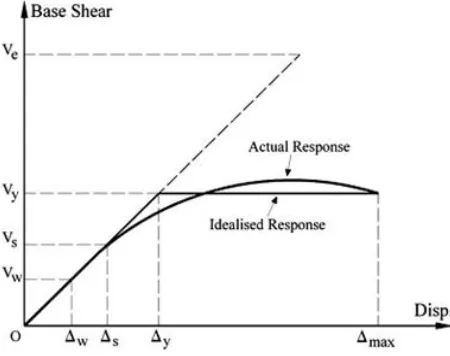
Response Reduction factor (R) is the ratio of the strength required to maintain the elastic to the inelastic design strength of the structure. R factor is the factor by which the actual base shear should be reduced, to obtain the design lateral force.
Commonly the Response reduction factor is expressed as a function of various parameters of the structural system, such as strength, ductility, damping and redundancy:
R=RS Rµ Rξ RR Where,
RS is the strength factor,
RR is the redundancy factor,
Rµ is the ductility factor,
Rξ is the damping factor.
The strength factor (RS) is a measure of the built-in overstrength in the structural system and is obtained by dividing the
ultimate base shear (Vu) by the design base shear (Vd).
RS=Vu/Vd
The ductility factor is a measure of the global nonlinear response of a structural system in terms of its plastic deformation capacity.
Rµ=1+ (µ-1) T/0.70
Where, μ is the ductility capacity which is the ratio of the ultimate displacement to the yield displacement and, T is the fundamental time period of the structure.
The damping factor Rξ accounts for the effect of added viscous damping and is primarily applicable for structures
provided with supplemental energy dissipating devices. Without such devices, the damping factor is usually assigned a value equal to 1.0.
The redundancy factor, (RR)is measure of redundancy in a lateral load resisting system. The redundancy factor Rd for
redundant structures is taken as 1.0.
Table 1.1: Values of Response Reduction Factor as per IS 1893(part 1):2002
Building frame systems
Ordinary RC moment resisting frame (OMRF) - 3.0 Special RC moment resisting frame (SMRF) - 5.0
Building with shear wall
Ordinary reinforced concrete shear wall - 3.0 Ductile shear wall - 4.0
Building with dual systems
Ordinary shear wall with OMRF - 3.0 Ordinary shear wall with SMRF - 4.0 Ductile shear wall with OMRF - 4.5 Ductile shear wall with SMRF - 5.0
Table 1.2: Values of the behaviour factor for RC framed structures, as per EC8.
Medium ductility class (DCM) - 3.0Vu/Vy = 3.90 High ductility class (DCH) - 4.5 Vu/Vy = 5.85
Table 1.3: Values of R factor for RC framed structures, as per ASCE7.
Ordinary moment frame - 3.0 Intermediate moment frame - 5.0 Special moment frame - 8.0
IV. PUSHOVER ANALYSIS
Pushover analysis is defined as an analysis wherein a mathematical model directly incorporating the nonlinear load-deformation characteristics of individual components and elements of the building shall be subjected to monotonically increasing lateral loads representing inertia forces in an earthquake until a target displacement is exceeded. Target displacement is the maximum displacement of the building at roof expected under selected earthquake ground motion. The structural Pushover analysis assesses performance by estimating the force and deformation capacity and seismic demand using a nonlinear static analysis algorithm. The seismic demand parameters are storey drifts, global displacement, storey forces, and component deformation and component forces. The analysis accounts for material inelasticity, geometrical nonlinearity and the redistribution of internal forces. . Response characteristics that can be obtained from the pushover analysis are summarized as follows:
a) Estimates of force and displacement capacities of the structure and Sequence of the member yielding and the
progress of the overall capacity curve.
b) Estimates of force (axial, shear and moment) demands on potentially brittle elements and deformation demands
on ductile elements.
c) Estimates of global displacement demand, corresponding inter-storey drifts and damages on structural and
non-structural elements expected under the 20 earthquake ground motion considered.
d) Sequences of the failure of elements and the consequent effect on the overall structural stability.
e) Identification of the critical regions, when the inelastic deformations are expected to be high and identification
V. CONCLUSION OF THE LITERATURE REVIEW
The smallest value of q obtained is 2.3, which is on the conservative side when compared with the more safe
value of 1.5 suggested by the Eurocode 8- Part 1(2003) for non-dissipative structures.
R factor without shear wall is almost reduced by 50% considering displacement ductility ratio as compared to
IS Code values.
Structures with uniform profile in elevation have more lateral load capacity compare to structures with
non-uniform profile in elevation.
The strong-column-weak-beam criterion in design does not make any major difference in terms of R.
The IS 1893 and the ASCE7 lateral load distributions gives R almost in the same range.
Ductility ratio is maximum for bare frame structures & it gets reduced when the effect of infill wall is
considered
Bare frame structures are having highest R value as compared to the infill frame structures.
Provision of bracing/shear wall in alternate bays increases the values of R factor nearly 2.81 to 2.94 times as
compared to the bare RC frame.
Fundamental time period decreases when the provisions of different types of bracings are considered.
Structures with a column/beam capacity ratio of < 1.1 have a minimum ‘R’ value, when compared to
structures that have a C/B ratio of > 1.1.
The behavior factor decreased as the share of braces increase.
Seismic performance is very much dependent on the mass, stiffness, strength regularity and ductile or
non-ductile behavior.
The inelastic behavior of the structure when subjected to severe earthquakes can be accounted for by
reducing the earthquake loads using the behavior factor (q-factor).
The behavior factor obtained by Miranda and Bertero is higher than one obtained by Newmark and Hall.
The behavior factor decreased as the share of braces increase.
Behavior of square column is better than rectangular column, in terms of storey drift, base shear & roof
displacement.
REFERENCES
[1] Abhijit P. Ghadi, P. R. Barbude, T. N. Boob (2015) ‘Evaluation of response reduction factor for reinforced concrete frame’- International journal of pure and applied research in engineering and technology (IJPRET), Vol.3, Issue. 9, pp.98-108.
[2] Ade Faisal, Mohd. Irwan Adiyanto and Prof. Dr. Taksiah A. Majid (2011) ‘Behaviour Factors for RC Buildings Excited by Repeated Earthquakes’- JMM, Petaling Jaya, university sains Malaysia.
[3] Ami A. Shah, B. A. Shah (2014) ‘Seismic evolution of RC space frame with rectangular and equivalent square column by pushover analysis’- International Journal of Research in Engineering and Technology ( IJRET) Vol.3, Issue. 7, pp.265-272.
[4] Apurba Mondal, Siddhartha Ghosh G.R. Reddy (2013) ‘Performance-based evaluation of the response reduction factor for ductile RC frames’- Elsevier pp.1808–1819.
[5] Branci Taïeb, Bourada Sofiane (2014) ‘Accounting for ductility and overstrength in seismic design of reinforced concrete structures’- Proceedings of the 9th International Conference on Structural Dynamics
[6] Hemchandra Chaulagain, Hugo Rodrigues, Enrico Spacone, Ramesh Guragain,Radhakrishna Mallik and Humberto Varum(2014) ‘Response reduction factor of irregular RC buildings in Kathmandu valley’ - Earthquake engineering and engineering vibration, Vol.13, Issue.3, pp. 454-470.
[7] Kalyanrao, Gude Ramakrishna (2014) ‘Pushover Analysis of Sloping Ground RC- Buildings’- International Journal of Engineering Research & Technology (IJERT) Vol.3 Issue.6, pp.866-870.
[8] Kruti J. Tamboli, J A. Amin (2015) ‘Assessment of Response Reduction Factor for Asymmetric RC frame building’- International Journal of Advance Engineering and Research Development IJAERD, Vol.2, Issue.6, pp.9-15.
[9] C.M. Ravi Kumar, M. B. Sreenivasa, Anil Kumar, M. Vijay Sekhar Reddy (2013) ‘Seismic Vulnerability Assessment Of RC Buildings With Shear Wall’ - International Journal of Engineering Research and Applications (IJERA) Vol.3, Issue.3, pp.646-652.
[10] Mohammad AlHamaydeh, Sulayman Abdullah, Ahmed Hamid and Abdilwahhab Mustapha (2011) ‘Seismic design factors for RC special moment resisting frames in Dubai, UAE’ - Earth Engineering and Earthquake Vibration Issue.10, pp.495-506.
[11] Mohammed Irfan, Dr. Sunandan Reddy, K.Mythili(2014) ‘ Evaluation of Seismic Response of symmetric and Asymmetric Multistoried Buildings’- International Journal of Science Engineering and Advance Technology IJSEAT, Vol.2, Issue.10, pp.505-509.
[13] Mohammad Parsaei Maram, Dr. K Rama Mohana Rao (2013) ‘Effect Of Location Of Lateral Force Resisting System On Seismic Behaviour Of RC Building’-International Journal of Engineering Trends and Technology (IJETT) Vol.4, Issue.10, pp.4598-4603.
[14] Mohd Zulham Affandi Mohd Zahida, Debbie Roberta, Fatehah Shahrin (2013) ‘An Evaluation of Overstrength Factor Of Seismic Designed Low Rise RC Buildings’ - Malaysian Technical Universities Conference on Engineering & Technology 2012, MUCET 2012 Part 3- Civil and ChemicalEngineering Procedia Engineering 53, pp.48-51.
[15] Santoshkumar B. Naik, Mohd. Zameeruddin Mohd. Saleemuddin, Keshav K. Sangle (2015) ‘Seismic Performance Evaluation of Reinforced Concrete Frames with Irregular Elevations using Nonlinear Static Pushover Analysis’- International Journal of Modern Trends in Engineering and Research vol.2, Issue.7, pp.648-653.
[16] Sanmi Deshpande, P. R. Barbude, P. V. Muley (2015) ‘Formulation of the seismic response reduction factor for earthquake resistant design’- International Journal of Engineering Research, Vol.3, Issue.2, pp.250-254.
[17] Dr. S. N. Tande and R. V. Ambekar (2013) ‘An Investigation of Seismic Response Reduction Factor for Earthquake Resistant Design’-International Journal of Latest Trends in Engineering and Technology (IJLTET) Vol.2, Issue.4 pp.391-396.