Available Online atwww.ijcsmc.com
International Journal of Computer Science and Mobile Computing
A Monthly Journal of Computer Science and Information Technology
ISSN 2320–088X
IJCSMC, Vol. 3, Issue. 7, July 2014, pg.968 – 973
RESEARCH ARTICLE
DETECTION
OF
PLACES
BASED
ON
PLACE
EXTRACTION
ALGORITHM
USING
IMAGES
Miss. Shilpa Tuteja
1, Mrs. R. B. Talmale
21
Final Year M. Tech CSE, Tulsiramji Gaikwad Patil College of Engineering & Technology Nagpur 2
HOD of CSE Department Tulsiramji Gaikwad Patil College of Engineering & Technology Nagpur Email: [email protected], [email protected]
Abstract - Research on place extraction has been of interest for the detection of meaningful places that users visit. According to location-based applications interpretations of meaningful places may be different, a universal place extraction algorithm that is able to detect all kinds of meaningful places needs to be developed. Unfortunately, previously proposed place extraction algorithms are not able to generate accurate result and also failed to perfectly detect meaningful places. This work proposes a new place extraction algorithm that can significantly enhance the accuracy of place extraction. The basic concept used in system is a hidden markov model. It is model used to find nearest possible location from irrelevant
information return from yahoo API. Our algorithm shows remarkable detection accuracy in place
extraction, significantly higher than any other previously proposed algorithms. Furthermore, the proposed algorithm can efficiently operate in mobile environments because its computations are simple.
Index Terms- Location dependent and sensitive, pervasive computing, place extraction
I. Introduction
Location is mostly used as source of situational information. Whereas other sources of situational information for e.g., activity or social context are difficult to identify or measure, location information can be readily accessed. Location also plays a fundamental role in our daily lives. For example, location information is widely used in human communication .Location can also influence the user's information needs or to give clues about other users' communication context. Contemporary mobile phones readily support at least one location technology. The location systems that mobile devices support typically provides location information as a pair of coordinates (e.g., latitude and longitude).However, humans do not refer to locations as a pair of coordinates, but using semantic expressions that are imbued with meanings, such as at home or in a library .Thus there is more to location than mere coordinates. The notion of place provides a way to represent location information that is consistent with the way people themselves refer to location information. Places are roughly defined as physical locations that are linked with semantically descriptions and meaningful activities. This suggests that place information could be used, e.g., in applications and services that support social interactions. The rest of the paper is organized as follows. Section II surveys related work. Section III proposed work, Section IV Conclusion.
II.Related Work
In this paper K-means clustering algorithm is used to extract place, a system that automatically clusters GPS data taken over an extended period of time into meaningful locations at multiple scales. These locations are then incorporated into a Markov model that can be consulted for use with a variety of applications in both single user and collaborative scenarios [1].
(DJ-Cluster algorithm) Various methods are available for clustering algorithm to discover places. It is also defined as a set of essential evaluation metrics and an interactive evaluation framework. Then a large-scale experiment is conducted that collects real users’ location data and personally meaningful places. K-Means clustering algorithm is used for place discovery with reasonable accuracy.
Partitioning Clustering method is used K-Means clustering algorithm to learn a user’s significant locations from location history data. K-Means clustering algorithm is efficient and iterative. It minimizes an error term which is the sum of the squared distances of each point to its cluster center, a mean vector. The algorithm initially assigns all points to a predefined number of clusters randomly. Then it iterates through each point, finds the cluster center nearest that point, and assigns the point to the cluster that the center belongs to. This iteration is repeated until the error term is deemed small or not decreasing much. A density-based approach forms a cluster where point density is high. Note that a density density-based cluster can have arbitrary shapes. they frequent. Second, all points are included in the final clustering results, which makes the results quite sensitive to noise. A single noisy or uninteresting location reading far from other points can pull a cluster center toward it much more than it should, because the squared-distance error term heavily weights distant outliers. Third, the K-Means algorithm is nondeterministic: the final clustering depends on the initial random assignment of points to clusters [2].
rate of over 63% even for places someone returns to only once or visits for less than 10 minutes, increasing to 80% accuracy for places visited twice[3].
This paper helps in diversifying the radii used in the clustering algorithm. These two algorithms has adopted the clustering concept to place extraction, but their detection accuracy was relatively low because they ignored the coordinates’ time information in the clustering process[4].
In this paper we use Place Lab to collect traces of location coordinates. Place Lab provides a way for a Wi-Fi-enabled client device to automatically determine its location by listening to RF-emissions from known 802.11 access points (APs) in the environment. Specifically, the system exploits the fact that each AP periodically broadcasts its unique MAC address as part of its management beacon. A client holds a database of (MAC address, latitude and longitude) pairs which it uses to compute its location from heard beacons. When the client device receives beacon messages from nearby APs, it retrieves each AP’s location from the database and computes its own location as the average of retrieved coordinates, using a simple centroid tracking scheme. Place Lab’s accuracy depends on the density and the arrangement of APs (denser, evenly spaced APs provide better accuracy). Today, many cities and towns around the world have a high density of APs to provide location estimates with a median accuracy of 20-30m. Thus Place Lab works best in urban areas and inside buildings, while GPS works best in open outdoor areas. Various drawbacks of GPS include its inability to function well indoors, its occasional lack of accuracy due to the geometry of visible satellites, and loss of signal in urban canyons and other “shadowed” areas. Early work on place extraction with GPS used loss of signal to infer the location of important indoor places [5].
III. System Model
Two techniques are used to developed system first is hidden markov model and k-means algorithm.
1. In this system we take input image as we know image consist of metadata to extract that metadata. In java jar file are available i.e. Ex if datareader.jar file is used to extract metadata. metadata provides information about a certain item's content it consist of various information like date, time, contact information, copyright information, GPS Coordinates etc.
2. We pass GPS Coordinates to yahoo API to get more information about that place. Yahoo API provides information related to that place and consist of irrelevant information. For this purpose hidden markov model is used.
a. Hidden markov model
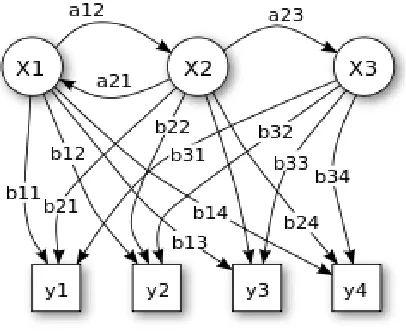
In its discrete form, a hidden Markov process can be visualized as a generalization of the Urn problem (where each item from the urn is returned to the original urn before the next step)Consider this example, in a room that is not visible to an observer there is a genie. The room contains urns X1, X2, X3, ... each of which contains a known mix of balls, each ball labeled y1, y2, y3, ... . The genie chooses an urn in that room and randomly draws a ball from that urn. It then puts the ball onto a conveyor belt, where the observer can observe the sequence of the balls but not the sequence of urns from which they were drawn. The genie has some procedure to choose urns; the choice of the urn for the n-th ball depends only upon a random number and the choice of the urn for the (n − 1)-th ball.
FIG 2 Hidden Markov Model
B. k-means algorithm
k-means is one of the simplest unsupervised learning algorithms that solve the well known clustering problem. The procedure follows a simple and easy way to classify a given data set through a certain number of clusters (assume k clusters) fixed apriori.
Algorithmic steps for k-means clustering
Let X = {x1,x2,x3,……..,xn} be the set of data points and V = {v1,v2,…….,vc} be the set of centers.
1) Randomly select ‘c’ cluster centers.
2) Calculate the distance between each data point and cluster centers.
3) Assign the data point to the cluster center whose distance from the cluster center is minimum of all the cluster centers..
4) Recalculate the new cluster center using:
Where, ‘ci’ represents the number of data points in ith cluster.
5) Recalculate the distance between each data point and new obtained cluster centers.
6) If no data point was reassigned then stop, otherwise repeat from step 3).
IV.CONCLUSION
knowledge into information-extraction models. In particular, our method take into account that phrases and states must have matching types, and that phrase state must emit complete phrases. We have also introduced a novel medication of HMMs in which observations can be featured vectors. With respect to previous work on incorporating grammatical knowledge , our main contribution is an approach that takes advantage of grammatical information represented at multiple scales. An appealing property of our approach is that it generalizes to additional levels of description of the input text. These experiments demonstrate that incorporating a hierarchical representation of grammatical structure improves extraction accuracy in hidden Markov models.
V. Future Work
In this system we are using a few images restricted to some known places to find the location. It can be further developed to find the places in more wide areas having even more distance than the local places. Again, we can enhance this project by including MUI (Many University Interpretation) while this is based on Traditional Probabilistic Interpretation. This will also allow us to search multiple places at the same time and pinpoint the locations of them on the map and then visit them one by one. Also it will help us to determine different locations with similar structures so that it will help the user to differentiate between them and find the exact location of the places.
References
[1] D. Ashbrook and T. Starner, “Using GPS to Learn Significant Locations and Predict Movement across Multiple Users,” Personal Ubiquitous Computing, vol. 7, no. 5, pp. 275-286, Oct. 2003.
[2] C. Zhou, D. Frankowski, P. Ludford, S. Shekhar, and L. Terveen,“Discovering Personally Meaningful Places: An Interactive Clustering Approach,” ACM Trans. Information Systems, vol. 25, no. 3,article 12, 2007.
[3] J. Hightower, S. Consolvo, A. LaMarca, I. Smith, and J. Hughes,“Learning and Recognizing the Places We Go,” Proc. Seventh Int’l Conf. Ubiquitous Computing (Ubicomp ’05), pp. 159-176, Sept. 2005.
[4] F. Schmid and K.F. Richter, “Extracting Places from Location Data Streams,” Proc. Second Int’l Workshop Ubiquitous Geographical Information Services (UbiGIS ’06), Sept. 2006.
[5] J. Kang, W. Welbourne, B. Stewart, and G. Borriello, “Extracting Places from Traces of Locations,” Proc. Second ACM Int’l Workshop Wireless Mobile Applications and Services on WLAN Hotspots, pp. 110-118, Sept./Oct. 2004.
[6] D.H. Kim, J. Hightower, R. Govindan, and D. Estrin, “Discovering Semantically Meaningful Places from Pervasive RF-Beacons,” Proc. 11th Int’l Conf. Ubiquitous Computing (Ubicomp ’09), pp. 21-30, Sept./Oct. 2009.