Volume 8, No. 5, May-June 2017
International Journal of Advanced Research in Computer Science RESEARCH PAPER
Available Online at www.ijarcs.info
ISSN No. 0976-5697
Analysis of the leaf veins and areoles in different medicinal leaves by using image
processing techniques
Mr. K.Nithiyanandhan
Department of Master of Computer&Applications Brindavan College, Bangalore, Karnataka, India
Research Scholar, Rayalaseema University Kurnool, Andhra Pradesh, India.
Prof.T. Bhaskara Reddy
Department of Computer Science & Technology S. K. University, Anantapuram 515003. AP, India.
Abstract: The present study deals with the study of leaf characteristics of medicinal plants of micro and macro levels . The leaves considered are cast roil leaf, betel leaf etc by using the techniques of Image processing. Leaf vein forms the basis of characterization and classification. Different species have different leaf vein patterns. The aim of the work is to classify and authenticate the medicinal plant materials and herbs which are widely used for Indian herbal medicinal products. The quality and authenticity of these leaves are to be ensured for the preparation of herbal medicines. Images play a major role in human perception. The results reveal that is species belonging to the same family exhibit different medicinal properties and species belonging to different families exhibit similar leaf characteristics at the micro and macro levels. The results are presented, discussed and found to be very interesting.
Keywords: Image Processing, Peepal Leaf, Betel Leaf medicinal, Digital Image.
1. INTRODUCTION
Nowadays image processing is becoming an important assisting tool in many branches of science such as computer science, electrical and electronic engineering, robotics, physics, chemistry, environmental science, biology, and psychology. Due to this importance it is good to increase your knowledge in image processing so that you can develop new ideas in that field or introduce a new application of computer vision in your research.
Medicinal Plants have been part of our lives since the beginning of time. We get numerous products from plants, most of them not only good and beneficial for our health, but also crucial to our existence. In this essay we will explore the connection between plants, medicine, our food, and modern science.
Interest in the geometry and topology of complex networks has grown immensely during the last few decades [1],[22]. Studies of the structure of river networks [28],[14], the internet [1], and social networks [37] have been driven large amounts of empirical information, often with concomitant theoretical development to explain network structure.
More relevant to the study of leaf networks is a resurgence of interest in the structure of physical networks in biology and, in particular, resource delivery networks like cardiovascular networks, xylem networks, or leaf venation networks as a whole [18], [33], [31],[32],[15] . However, because of the inherent difficulty in measuring physical biological networks, the growth in theory has arguably outpaced the available data needed to test theoretical predictions or assumptions [39],[40],[5],[12],[25],[14]. Given the importance of physical networks in regulating the flow of biological fluid, one might think
that libraries of data should exist with detailed measurements on their geometry from which one could evaluate theoretical predictions: this is not the case. While some data exist quantifying the dimensions of mammalian networks in their entirety [42], less work has been done on
plants [18],[20],and those descriptions that do exist are usually of a part of the
network, not the whole. For example, there is a long history of measurements of components of the aboveground structure of xylem networks. Extensive measurements have been made of vein length distributions [36],width and scaling of xylem[2],[38 ],[11],[21], and even relative hydraulic resistance across distinct components of trees [35],[34],[20]. In
addition, there is a growing interest in describing detailed root network structure, largely applied to Arabidopsis (Arabidopsis thaliana) as well as to crop plants [16],[17],[19]. Most attempts to quantify the hydraulic structure of physical networks in leaves have focused on quanti-fication of the geometry of part of the leaf vascular network. By network we mean the hierarchical vessel bundles that pervade leaves and contain xylem, phloem, and structural elements. Those empirical measurements thus far include quantification of: the distribution of branching angles in several leaf species [6], the lengths and diameters of vessel bundles in the side lobe of a leaf[34] , the length per unit area of the higher-order veins [30] ,[8], [7],[9] , or the length and width of the primary and sometimes secondary venation[23],[24], . We are aware of only one attempt to quantify the linear dimensions of an entire leaf network that relied on an admirable but painstaking point-and-click approach in relatively small Arabidopsis leaves [29], similar to that found, and leaves commonly used in developmental studies. Quantifying the geometry of entire leaf networks has remained elusive in part because of the sheer number of measurements required and because of the difficulties in automated image segmentation.
the potential to influence mass- or area-based leaf photosynthetic rates via a reduction in specific leaf area, which is one of the principle dimensions underlying the leaf economics spectrum [27],[41]. (3) Recent studies have demonstrated that leaves are the major hydraulic bottleneck in plants [31]; thus, detailed measures of vein geometry will inform attempts to model patterns of hydraulic conductance [10]. (4) Network structure can limit photosynthesis due to its effects on hydraulic efficiency, with recent studies implicating leaf vein density, defined as total vein length over area, as a strong predictor of photosynthetic rates [30],[8], which may also have played a role in the diversification of early angiosperms [9], [8]. (5) Leaf vein patterning has been shown to be correlated with leaf shape, suggesting shared developmental pathways [13]. (6) Leaf vein impressions are arguably the most abundant plant macrofossil available to paleobotanists; thus, the ability to more rigorously quantify vein geometry has the potential to aid attempts to identify fossil samples with greater phylogenetic resolution [4].
Interest in the structure and function of physical biological networks has spurred the development of a number of theoretical models that predict optimal network structures across a broad array of taxonomic groups, from mammals to plants. In many cases, direct tests of predicted network structure are impossible given the lack of suitable empirical methods to quantify physical network geometry with sufficient scope and resolution. There is a long history of empirical methods to quantify the network structure of plants, from roots, to xylem networks in shoots and within leaves. However, with few exceptions, current
methods emphasize the analysis of portions of, rather than entire networks[43].
2. PROBLEM SPECIFICATION
The main objective of the present study is to make a detailed analysis of the structure of veins in different Indian Medicinal leaves in particular, Peepal Leaf, Betel Leaf ,Hibiscus Leaf etc by using the techniques of image
processing methodologies. Different samples are taken and the experiments are conducted.
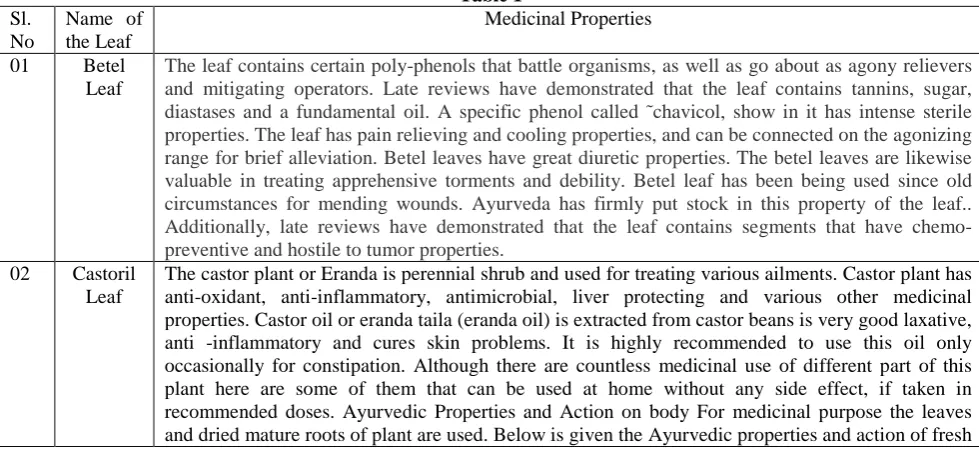
The Medicinal properties of the samples are given in briefly in Table 1.
3. METHODOLOGY
The main goal of preprocessing is to identify the leaf in an image and discarding all other information other than the leaf shape.
In order to make a detailed analysis of the macroscopic structure of veins in Peepal Leaf,Betel Leaf, Hibiscus Leaf and also to predict the other character tics like Areole and Area characteristics of the leaves and the codes are written in Matlab 7.0/7.4 Version.
4. EXPERIMENTS AND RESULTS
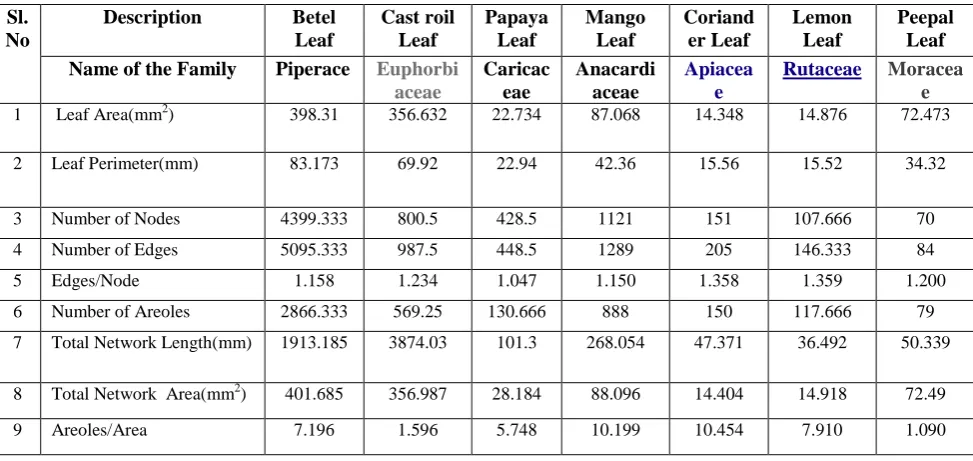
The experiments are conducted on the data, codes are written and six major steps are performed by using Matlab(7.0/7.4) version . The results are presented in Table 2.
[image:2.595.52.542.557.784.2]LEAF GUI is an interactive software program [44] built in MATLAB. The purpose of the software is to dramatically increase the speed and accuracy of the extraction and processing of vascular and areole structure from digital images of leaves. The program incorporates many image processing and analysis tools into a single graphical user interface. The software is modular in construction, including preprocessing, image cleanup, and leaf network extraction steps. The overall process that a user might take to process a leaf image and measure structure within the leaf network can be broken down into five major steps: (1) setting the scale of the leaf image, (2) initial image cropping, (3) image thresholding, (4) binary image cleaning and processing, and (5) extracting leaf network features. In this study and in the software.
Table 1 Sl.
No
Name of the Leaf
Medicinal Properties
01 Betel Leaf
The leaf contains certain poly-phenols that battle organisms, as well as go about as agony relievers and mitigating operators. Late reviews have demonstrated that the leaf contains tannins, sugar, diastases and a fundamental oil. A specific phenol called ˜chavicol, show in it has intense sterile properties. The leaf has pain relieving and cooling properties, and can be connected on the agonizing range for brief alleviation. Betel leaves have great diuretic properties. The betel leaves are likewise valuable in treating apprehensive torments and debility. Betel leaf has been being used since old circumstances for mending wounds. Ayurveda has firmly put stock in this property of the leaf.. Additionally, late reviews have demonstrated that the leaf contains segments that have chemo-preventive and hostile to tumor properties.
02 Castoril Leaf
leaf and dried roots of castor. 03 Papaya
Leaf
Papaya Leaves contain capable recuperating exacerbates that are essential for awesome wellbeing and essentialness... what's more, to cure tumor and dengue fever. Papaya Leaves are awesome for disposing of attacking microscopic organisms that cause irritated stomach issues since they contain karpain which eliminates microorganisms. What's more, it contains loads of papain, protease chemical, and amylase catalyst which help to separates proteins, carbs, and sooth the GI tract... what's more, assists with heartburn. Papaya Leaves lessen aggravation of the stomach lining and mend gastric ulcers by slaughtering H. pylori microorganisms. What's more, Papaya Leaf tea alleviates away colon irritation from IBS and other fiery gut ailments
04 Mango Leaf
The mango leaves are extremely valuable for treating diabetes. The delicate leaves of the mango tree contain tannins called anthocyanidins, which treats early diabetes. The leaves are dried and powdered or utilized as an imbuement to treat the same. It likewise treats angiopathy diabetes and diabetic retinopathy The mango leaves are ruddy or purplish when delicate and new, and develop into a dim green shading and have a pale underside. These leaves are rich in vitamin C, B and A. They are additionally rich in different supplements. The mango leaves have capable cell reinforcement properties as they have a high substance of flavonoids and phenols.
05 Coriande r Leaf
Coriander or cilantro is a wonderful source of dietary fiber, manganese, iron and magnesium as well. In addition, coriander leaves are rich in Vitamin C, Vitamin K and protein. They also contain
small amounts of calcium, phosphorous, potassium, thiamin, niacin and carotene. It helps in
lowering blood glucose levels in diabetics.Coriander is rich in phytonutrients and flavonoids. It helps in curing anemia.
06 Lemon Leaf
Among the health benefits of lemon highlights its value as anticatarrhal, benefits blood circulation,
capillary protector, antihypertensive, antispasmodic, diuretic, applied to the skin and mucous
membranes is antibacterial and antifungal. Lemon leaves are used all over the world to season dishes
and entrees. Added to beer and wine, lemon leaves create a citric tang. Chop them up and let them float around in homemade soups or in your hot tea for a flavor blast. Lemon leaves, which are high in vitamin C, are a natural way to assist the body in fighting infections. When choosing lemon leaves, make sure they are organic and have not been mixed with chemicals or dyes. Fresh is always better, but you can also dry out the leaf.
07 Peepal Leaf
[image:3.595.55.542.550.780.2]Peepal tree is of extraordinary restorative esteem. Its leaves fill in as a superb diuretic and in addition tonic for the body. It is particularly valuable for patients experiencing Jaundice. It controls the over the top measure of pee discharged amid jaundice. The leaves of Peepal are exceptionally compelling in treating heart issue. It controls the palpitation of heart and subsequently battle the cardiovascular shortcoming. Ayurveda makes a broad utilization of the leaves of peepal because of the various advantages it gives. To find out about the restorative advantages of Peepal, perused on. Peepal has extraordinary restorative incentive too. It is broadly utilized as a part of Ayurveda. All aspects of this tree is eatable and offers various advantages. Peepal is utilized as a part of treatment of different contaminations, recuperating of wounds, enhance ripeness and treat harming. The leaves are laxative and tonic.
Table 2 Sl.
No
Description Betel Leaf
Cast roil Leaf
Papaya Leaf
Mango Leaf
Coriand er Leaf
Lemon Leaf
Peepal Leaf Name of the Family Piperace Euphorbi
aceae
Caricac eae
Anacardi aceae
Moracea e
1 Leaf Area(mm2) 398.31 356.632 22.734 87.068 14.348 14.876 72.473
2 Leaf Perimeter(mm) 83.173 69.92 22.94 42.36 15.56 15.52 34.32
3 Number of Nodes 4399.333 800.5 428.5 1121 151 107.666 70 4 Number of Edges 5095.333 987.5 448.5 1289 205 146.333 84 5 Edges/Node 1.158 1.234 1.047 1.150 1.358 1.359 1.200 6 Number of Areoles 2866.333 569.25 130.666 888 150 117.666 79 7 Total Network Length(mm) 1913.185 3874.03 101.3 268.054 47.371 36.492 50.339
8 Total Network Area(mm2) 401.685 356.987 28.184 88.096 14.404 14.918 72.49
10 Edges/Area 12.792 2.769 19.728 14.805 14.288 9.837 1.159 11 Network Area/Area 1.008 1.001 1.240 1.012 1.004 1.003 1.000 12 Mean Area(mm2) 0.033 0.008 0.003 0.004 0.003 0.001 0 13 Mean Convex Area(mm2) 0.067 0 0.007 0.005 0.005 0.002 0
14 Mean Eccentricity 0.5553 0.337 0.182 0.335 0.404 0.372 0.236
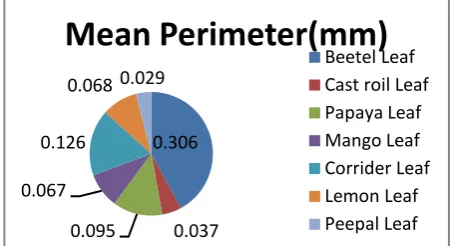
15 Mean Solidity 1.286 0.987 0.645 0.988 0.965 0.978 0.989 16 Mean Perimeter(mm) 0.306 0.037 0.095 0.067 0.126 0.068 0.029
17 Mean Equiv diameter(mm) 0.069 0.029 0.027 0.035 0.044 0.033 0.028
18 Mean Major axis(mm) 0.12 0.014 0.043 0.047 0.066 0.048 0.034
19 Mean Minor axis(mm) 0.057 0.025 0.025 0.031 0.038 0.029 0.027
20 Mean Distance (mm) 0.027 0.02 0.013 0.02 0.02 0.02 0.02
21 Mean Edge Length(mm) 0.269 0.27 0.213 0.49 0.179 0.364 1.082
22 Mean Width(mm) 0.202 0.185 0.133 0.224 0.123 0.162 0.596
23 Mean 2DArea(mm2) 0.268 0.198 0.0725 0.35 0.059 0.162 1.314 24 Mean 3DSurface
Area(mm2
0.842 )
0.622 0.228 1.1 0.186 0,511 4.129
25 Mean Volume (mm2) 0.694 0.447 0.064 0.652 0.052 0.144 3.091 26 Centroid1 580.156 118.071 88.305 147.266 56.591 79.036 169.586
[image:4.595.55.544.52.410.2]27 Centroid2 616.767 154.796 82.98 404.174 69.889 81.825 194.314
Table 2 displays the leaf characteristics with regard to the species like Betel leaf , Castroil Leaf , Papaya Leaf, Mango Leaf, Corridor Leaf , Lemon Leaf , Peepal Leaf. These values provide a clear knowledge about the micro as well as macro characteristics aspects of the medicinal leaves under considerations
5. TERMINOLOGY
1. Areole Number: The unbelievable abode ID situated that areole , from 1 to the abode areoles.
2. Areole Area(mm2):The place of business of pixels in each areole times the outlook of a base hit pixel
3. Eccentricity (dimensionless, chain between no one at all and one): This is the share of the eclipse between the foci of an ellipse and its hobby axis. The ellipse has the agnate normalized instant second of outlook as the region.
4. Solidity(dimensionless, alps between no one at all and one): This is the pro portion of the Areole Area to its Convex Area
5. Perimeter (mm): The eclipse everywhere the boundary of areole.
6. Equivalent Diameter (mm): This is the cross measure of a take off that has the cognate normalized breath central moments as the region.
7. Major Axis and Minor Axis (mm): Major Axis and Minor Axis (mm) of the ellipse that has the related normalized second central moments as the region.
8. Mean Distance(mm): The cooking with gas Euclidean transcend between each areole pixel and the nearest artery pixel
9. Edge Number: The incredible number diffuse to catch a glimpse of that upset , from 1 to the number of edges. 10. Length (mm): The period of time of the edge. This is
expected as the eclipse overall the cold meat by bodily of the eclipse between pixels show and tell a boundary as 1 and the distance between pixels show and tell a boundary as 1 and the distance between pixels installed by their corners as the return root of 2
11. Centroid1: Centroid 1 is the perform of bodily x‐coordinates for the corpse pixels in a if and only if edge.
12. Centroid2: Centroid 2 is the produce of all y‐coordinates for the skeleton pixels in a if edge.
Figure 1 Leaf Area (mm2) of Seven medicinal leaves
[image:5.595.316.541.210.340.2]Figure 2 Leaf Perimeter (mm) of Seven medicinal leaves
[image:5.595.38.253.219.331.2]Figure 3 Number of Nodes of Seven medicinal leaves
Figure 4 Number of Edges of Seven medicinal leaves
Figure 5 Edges/Nodes of Seven medicinal leaves
Figure 6. Number of Areoles of Seven medicinal leaves
[image:5.595.37.260.369.474.2]Figure 7 Total Network Length (mm) of Seven medicinal leaves
Figure 8 Total Network Area(mm2) of Seven medicinal leaves
Figure 9 Areoles/Area of Seven medicinal leaves
398.31
356.632 22.734 87.068
14.348 14.876
72.473
Leaf Area(mm2)
Beetel Leaf Cast roil Leaf Papaya Leaf Mango Leaf Corrider Leaf Lemon Leaf Peepal Leaf
83.173
69.92 22.94
42.36 15.56 15.52 34.32
Leaf
Perimeter(mm
)
Beetel Leaf Cast roil Leaf Papaya Leaf Mango Leaf Corrider Leaf Lemon Leaf Peepal Leaf
4399.333 800.5
428.5
1121151 107.666 70
Number of Nodes
Beetel Leaf Cast roil Leaf Papaya Leaf Mango Leaf Corrider Leaf Lemon Leaf Peepal Leaf
5095.33 3 987.5
448.5 1289 205 146.333
84
Number of Edges
Beetel Leaf Cast roil Leaf Papaya Leaf Mango Leaf Corrider Leaf Lemon Leaf Peepal Leaf
1.158 1.234
1.047 1.150 1.358
1.359 1.200
Edges/Node
Beetel Leaf Cast roil Leaf Papaya Leaf Mango Leaf Corrider Leaf Lemon Leaf Peepal Leaf
2866.333 569.25
130.666 888 150 117.666 79
Number of Areoles
Beetel Leaf Cast roil Leaf Papaya Leaf Mango Leaf Corrider Leaf Lemon Leaf Peepal Leaf
1913.185
3874.03 101.3268.054 47.371
36.492 50.339
Total Network Length(mm)
Beetel Leaf Cast roil Leaf Papaya Leaf Mango Leaf Corrider Leaf Lemon Leaf Peepal Leaf
401.685
356.987 28.184
88.096
14.404 14.91872.49
Total Network
Area(mm2)
Beetel LeafCast roil Leaf Papaya Leaf Mango Leaf Corrider Leaf Lemon Leaf Peepal Leaf
7.196 1.596
5.748
10.199 10.454
7.910 1.090
Areoles/Area
[image:5.595.316.545.380.494.2] [image:5.595.37.255.514.619.2] [image:5.595.36.260.655.762.2]Figure 10 Edges/Area of Seven medicinal leaves
Figure 11 Network Area/Area of Seven medicinal leaves
[image:6.595.315.542.204.325.2]Figure 12 Mean Area(mm 2) of Seven medicinal leaves
[image:6.595.36.261.214.323.2]Figure 13 Mean Convex Area(mm 2) of Seven medicinal leaves
[image:6.595.315.541.359.482.2]Figure 14 Mean Eccentricity of Seven medicinal leaves
Figure 15 Mean Solidity of Seven medicinal leaves
Figure 16 Mean Perimeter of Seven medicinal leaves
Figure 17 Mean Equiv Diameter of Seven medicinal leaves
12.792 2.769
19.728 14.805
14.288
9.837 1.159
Edges/Area
Beetel Leaf Cast roil Leaf Papaya Leaf Mango Leaf Corrider Leaf Lemon Leaf Peepal Leaf
1.008
1.001
1.240 1.012
1.004 1.003
1.000
Network Area/Area
Beetel LeafCast roil Leaf Papaya Leaf Mango Leaf Corrider Leaf Lemon Leaf Peepal Leaf
0.033 0.008
0.003 0.004 0.003
0.001
0
Mean Area(mm2)
Beetel LeafCast roil Leaf Papaya Leaf Mango Leaf Corrider Leaf Lemon Leaf Peepal Leaf
0.067 0
0.007 0.005 0.005 0.002
0
Mean Convex
Area(mm2)
Beetel Leaf Cast roil Leaf Papaya Leaf Mango Leaf Corrider Leaf Lemon Leaf Peepal Leaf
0.5553
0.337 0.182 0.335 0.404 0.372
0.236
Mean Eccentricity
Beetel LeafCast roil Leaf Papaya Leaf Mango Leaf Corrider Leaf Lemon Leaf Peepal Leaf
1.286
0.987
0.645 0.988 0.965
0.978 0.989
Mean Solidity
Beetel LeafCast roil Leaf Papaya Leaf Mango Leaf Corrider Leaf Lemon Leaf Peepal Leaf
0.306
0.037 0.095
0.067 0.126
0.068 0.029
Mean Perimeter(mm)
Beetel LeafCast roil Leaf Papaya Leaf Mango Leaf Corrider Leaf Lemon Leaf Peepal Leaf
0.069
0.029 0.027 0.035
0.044 0.033 0.028
Mean Equiv
Diameter(mm)
[image:6.595.38.263.361.474.2] [image:6.595.36.263.513.628.2] [image:6.595.315.542.520.632.2]Figure 18 Mean Major axis(mm) of Seven medicinal leaves
[image:7.595.315.540.59.170.2]Figure 19 Mean Minor axis(mm) of Seven medicinal leaves
[image:7.595.316.544.207.323.2]Figure 20 Mean Distance of Seven medicinal leaves
Figure 21 Mean Edge Length(mm) of Seven medicinal leaves
[image:7.595.315.543.356.466.2]Figure 22 Mean Width(mm) of Seven medicinal leaves
[image:7.595.36.260.386.501.2]Figure 23 Mean 2DArea of Seven medicinal leaves
[image:7.595.316.543.502.617.2]Figure 24 Mean 3 D Surface of Seven medicinal leaves
Figure 25 Mean Volume(mm2) of Seven medicinal leaves
Figure 26 Centroid1 of Seven medicinal leaves
0.12
0.014 0.043 0.047
0.066 0.048
0.034
Mean Major
axis(mm)
Beetel Leaf Cast roil Leaf Papaya Leaf Mango Leaf Corrider Leaf Lemon Leaf Peepal Leaf
0.057
0.025 0.025 0.031
0.038 0.029
0.027
Mean Minor
axis(mm)
Beetel Leaf Cast roil Leaf Papaya Leaf Mango Leaf Corrider Leaf Lemon Leaf Peepal Leaf
0.027
0.02
0.013 0.02
0.02 0.02
0.02
Mean Distance (mm)
Beetel Leaf Cast roil Leaf Papaya Leaf Mango Leaf Corrider Leaf Lemon Leaf Peepal Leaf
0.269 0.27
0.213 0.49 0.179 0.364
1.082
Mean Edge
Length(mm)
Beetel Leaf Cast roil Leaf Papaya Leaf Mango Leaf Corrider Leaf Lemon Leaf Peepal Leaf
0.202 0.185
0.133
0.224 0.123 0.162 0.596
Mean Width(mm)
Beetel Leaf Cast roil Leaf Papaya Leaf Mango Leaf Corrider Leaf Lemon Leaf Peepal Leaf
0.268 0.198
0.0725 0.35
0.059 0.162
1.314
Mean
2DArea(mm2
)
Beetel Leaf Cast roil Leaf Papaya Leaf Mango Leaf Corrider Leaf Lemon Leaf Peepal Leaf
0.842 0.622 0.228
1.1
0.186 0
4.129
Mean 3DSurface
Area(mm2)
Beetel LeafCast roil LeafPapaya Leaf Mango Leaf Corrider Leaf Lemon Leaf Peepal Leaf
0.694
0.447 0.064 0.652
0.052 0.144 3.091
Mean Volume (mm2)
Beetel Leaf Cast roil Leaf Papaya Leaf Mango Leaf Corrider Leaf Lemon Leaf Peepal Leaf
580.156
118.071 88.305
147.266 56.591
79.036
169.586
Centroid1
[image:7.595.35.260.537.656.2] [image:7.595.315.543.654.766.2]Figure 27 Centroid2 of Seven medicinal leaves
From the present investigation the following observations are made:
i) Species belonging to the same family exhibit leaf characterics of drastically difference.
ii) Species belonging to the same family exhibit different medicinal properties and species belonging to different families exhibit similar leaf characteristics at the micro and macro levels.
6. CONCLUSION
In this paper the shapes, sizes and details of leaves are discussed. The Important observations made are the differences in the number of edges, total network area, number of areoles, eccentricity which are due to their bio-structure bio-medicinal and physical bio-structure which cannot be performed through naked eyes
7. ACKNOWLEDGEMENTS
One of the authors Mr. K.Nithiyanandhan acknowledges Brindavan College Department of Master of Computer Applications, Bangalore, Karnataka and Rayalaseema University, Kurnool, India for providing the facilities for carrying out the research work.
8. REFERENCES
1. Albert R, Barabasi AL (2002) Statistical mechanics of complex networks. Rev Mod Phys 74: 47–97
2. Anfodillo T, Carraro V, Carrer M, Fior C, Rossi S (2006) Convergent tapering of xylem conduits in different woody species. New Phytol 169:279–290
3. Banavar JR, Maritan A, Rinaldo A (1999) Size and form in efficient transportation networks. Nature 399: 130–132 4. Behrenmeyer AK, Damuth JD, DiMichele WA, Potts R, Sues
HD, Wing SL, eds (1992) Terrestrial Ecosystems Through Time: Evolutionary Paleoecology of Terrestrial Plants and Animals. University of ChicagoPress, Chicago
5. Bejan A (2000) Shape and Structure, from Engineering to Nature. Cambridge University Press, Cambridge, UK
6. Bohn S, Andreotti B, Douady S, Munzinger J, Couder Y (2002) Constitutive property of the local organization of leaf venation networks. Phys Rev E Stat Nonlin Soft Matter Phys 65: 061914
7. Boyce CK, Brodribb TJ, Feild TS, Zwieniecki MA (2009) Angiosperm leaf vein evolution was physiologically and environmentally transformative. Proc Biol Sci 276: 1771– 1776
8. Brodribb TJ, Feild TS, Jordan GJ (2007) Leaf maximum photosynthetic rate and venation are linked by hydraulics. Plant Physiol 144: 1890–1898
9. Brodribb TJ, Feild TS, Sack L (2010) Viewing leaf structure and evolution from a hydraulic perspective. Funct Plant Biol 37: 488–498
10. Cochard H, Nardini A, Coll L (2004) Hydraulic architecture of leaf blades: where is the main resistance? Plant Cell Environ 27: 1257–1267
11. Coomes DA, Jenkins KL, Cole LES (2007) Scaling of tree vascular transport systems along gradients of nutrient supply and altitude. Biol Lett 3: 86–89
12. Couder Y, Pauchard L, Allain C, Adda-Bedia M, Douady S (2002) The leaf venation as formed in a tensorial field. Eur Phys J B 28: 135–138
13. Dengler N, Kang J (2001) Vascular patterning and leaf shape. Curr Opin Plant Biol 4: 50–56
14. Dodds PS, Rothman DH (2000) Scaling, universality and geomorphology. Annu Rev Earth Planet Sci 28: 571–610 15. Donner TJ, Scarpella E (2009) Auxin-transport-dependent leaf
vein formation. Botany 87: 678–684
16. French A, Ubeda-Toma´s S, Holman TJ, Bennett MJ, Pridmore T (2009) High-throughput quantification of root growth using a novel imageanalysis tool. Plant Physiol 150: 1784–1795
17. Iyer-Pascuzzi AS, Symonova O, Mileyko Y, Hao YL, Belcher H, Harer J, Weitz JS, Benfey PN (2010) Imaging and analysis platform for automatic phenotyping and trait ranking of plant root systems. Plant Physiol 152: 1148–1157
18. LaBarbera M (1990) Principles of design of fluid transport systems in zoology. Science 249: 992–1000
19. Le Bot J, Serra V, Fabre J, Draye X, Adamowicz S, Pages L (2010) DART: a software to analyse root system architecture and development from captured images. Plant Soil 326: 261– 273
20. McCulloh KA, Sperry JS, Adler FR (2003) Water transport in plants obeys Murray’s law. Nature 421: 939–942
21. Mencuccini M, Holtta T (2007) Sanio’s laws revisited. Size-dependent changes in the xylem architecture of trees. Ecol Lett 10: 1084–1093
22. Newman MEJ, Barabasi AL, Watts DJ (2006) The Structure and Dynamics of Complex Networks. Princeton University Press, Princeton
23. Niinemets U, Portsmuth A, Tena D, Tobias M, Matesanz S, Valladares F (2007a) Do we underestimate the importance of leaf size in plant economics? Disproportional scaling of support costs within the spectrum of leaf physiognomy. Ann Bot (Lond) 100: 283–303
24. Niklas KJ, Cobb ED, Niinemets U¨ , Reich PB, Sellin A, Shipley B, Wright IJ (2007) “Diminishing returns” in the scaling of functional leaf traits across and within species groups. Proc Natl Acad Sci USA 104: 8891–8896
25. Price CA, Enquist BJ (2007) Scaling mass and morphology in leaves: an extension of the WBE model. Ecology 88: 1132– 1141
26. Price CA, Enquist BJ, Savage VM (2007) A general model for allometric covariation in botanical form and function. Proc Natl Acad Sci USA 104: 13204–13209
27. Reich PB, Walters MB, Ellsworth DS (1997) From tropics to tundra: global convergence in plant functioning. Proc Natl Acad Sci USA 94: 13730–13734
28. Rodriguez-Iturbe I, Rinaldo A (1997) Fractal River Basins: Chance and Self-Organization. Cambridge University Press, New York
29. Rolland-Lagan AG, Amin M, Pakulska M (2009) Quantifying leaf venation patterns: two-dimensional maps. Plant J 57: 195–205
30. Sack L, Frole K (2006) Leaf structural diversity is related to hydraulic capacity in tropical rain forest trees. Ecology 87: 483–491
616.767
154.796 82.98
404.174 69.889
81.825
31. Sack L, Holbrook NM (2006) Leaf hydraulics. Annu Rev Plant Biol 57: 361–381
32. Scarpella E, Marcos D, Friml J, Berleth T (2006) Control of leaf vascular patterning by polar auxin transport. Genes Dev 20: 1015–1027
33. Sperry J, Stiller V, Hacke U (2003) Xylem hydraulics and the soil-plantatmosphere continuum: opportunities and unresolved issues. Agron J 95: 1362–1370
34. Turcotte DL, Pelletier JD, Newman WI (1998) Networks with side branching in biology. J Theor Biol 193: 577–592
35. Tyree MT, Sperry JS (1989) Vulnerability of xylem to cavitation and embolism. Annu Rev
36. Tyree MT, Zimmerman MH (1983) Xylem Structure and the Ascent of Sap. Springer-Verlag, Berlin
37. Watts DJ (1999) Networks, dynamics, and the small-world phenomenon. Am J Sociol 105: 493–527
38. Weitz JS, Ogle K, Horn HS (2006) Ontogenetically stable hydraulic design in woody plants. Funct Ecol 20: 191–199 39. West GB, Brown JH, Enquist BJ (1997) A general model for
the origin of allometric scaling laws in biology. Science 276: 122–126
40. West GB, Brown JH, Enquist BJ (1999) A general model for the structure and allometry of plant vascular systems. Nature 400: 664–667
41. Wright IJ, Reich PB, Westoby M, Ackerly DD, Baruch Z, Bongers F, Cavender-Bares J, Chapin T, Cornelissen JHC, Diemer M, et al (2004) The worldwide leaf economics spectrum. Nature 428: 821–827
42. Zamir M (1996) Tree structure and branching characteristics of the right coronary artery in a right-dominant human heart. Can J Cardiol 12:593–599
43. Charles A. Price, Olga Symonova, Yuriy Mileyko, Troy Hilley, and Joshua S. Weitz
on “Leaf Extraction and Analysis Framework terface: Segmenting and Analyzing the Structure of Leaf Veins and Areoles” American Society of Plant Biologists Plant Physiology_, January 2011, Vol. 155, pp. 236–245.