Analytical Method Validation for Quantitative
Estimation of Chloropicrin by HPLC Method
R. Swathi1, K.Aruna2 & N.Venkatasubba Naidu3
Research Scholar, Department of Chemistry, S.V. University, Tirupati, A.P, India1
Associate Professor, Department of Chemistry, Government Degree & PG College, Puttur, A.P, India2
Professor, Department of Chemistry, S.V. University, Tirupati, A.P, India3
ABSTRACT: A simple, selective, precise and accurate High Performance Liquid Chromatographic method for the analysis of Chloropicrin in its formulations was developed and validated in the present study. The mobile phase consists of a mixture of acetonitrile and water in the proportion 50: 50 (v/v). This was found to give sharp peak of Chloropicrin at a run time of 10 min. HPLC analysis of Chloropicrin was carried out at a wave length of 220 nm with a flow rate of 1.0mL/ min. The linear regression analysis data for the calibration curve showed a good linear relationship with a regression coefficient 0.999 in the concentration range of 50% to 150%. The linear regression equation was y =2055 x – 109.6. The developed method was employed with a high degree of precision and accuracy for the analysis of Chloropicrin. The method was validated for accuracy, precision, robustness, ruggedness and specificity. The Precision, accuracy, sensitivity, short retention time and composition of the mobile phase indicated that this method is useful for the quantification of Chloropicrin.
KEYWORDS: Chloropicrin, HPLC Method Development and Validation.
I. INTRODUCTION
Chloropicrin is also known as Trichloronitromethane, Nitrotrichloromethane, Chlorpikrin, Trichlornitromethan, Chloropicrine, and nitrochloroform. Chloropicrin is a widely used soil fumigant and an old chemical warfare agent and is a chemical compound commonly used as a broad-spectrum antimicrobial agent, fungicide, herbicide, insecticide, and nematicide. [1, 2]Chloropicrin was manufactured for use as poison gas in World War I[3] and a riot control agent. In agriculture, chloropicrin is injected into soil prior to planting a crop in order to fumigate soil. Chloropicrin affects a broad spectrum of fungi, microbes, and insects.[4,5] for the non-deciduous (falling off at maturity) fruits, and fumigant for crops like tomatoes, tobacco, potatoes, onions, beans, other field crops like cotton, peanuts, sugar beets, & deciduous fruits & nuts, other vegetables, floral crops, lawns, turf, & ornamentals, commodities, space, & structural pest control, miscellaneous soil fumigation. It is commonly used as a stand- alone treatment or in combination or co-formulation with methyl bromide and 1, 3-Dichloropropene [5, 6]. Chloropicrin is used as an indicator and repellent while fumigating residences for insects with sulfuryl fluoride which is an odorless gas. [7, 8]
One of the oldest soil fumigants, chloropicrin’s primary agricultural use in soils is as a fungicide, although it does have herbicidal and nematicidal activity. It is often added to 1, 3-D formulations in order to increase their fungicidal activity. Fumigation with Chloropicrin is used to control pests in buildings (structural fumigation), soil, grain, and also used during processing of goods to be imported or exported to prevent transfer of exotic organisms. This method also affects the structure itself, affecting pests that inhabit the physical structure, such as woodborers and dry wood termites.[9] The compound is acutely toxic and carcinogenic and is used in liquid formulations. In 1997, it was the 25th most abundantlyused U.S. pesticide.[10]Chloropicrin (PS) is an irritant with characteristics of a tear gas, and it has an intensely irritating odor. Inhalation of 1 ppm causes eye irritation and can warn of exposure. Trade names of chloropicrin areAcquinite, Dojyopicrin, Dolochlor, Microlysin, Tri-Clor, Metapicrin, Picfume, Picride.[11]
and Gas chromatography with electron capture detection,[15]chemical ionization (CI) method,[16] Gas-Liquid Chromatography[17] and Spectrophotometric determination.[18] Polarographic determination[19, 20]of chloropicrin and the quantitative determination of Chloropicrin has been performed by total chlorine method,[21] and Colorimetric method.[22] However, these methods require a great deal of trouble and most of these methods are complicated, tedious, used large amounts of solvent and time-consuming and expensive. Therefore, there is a need for better methods of analysis and this article describes the novel application of a modified QuEChERS method for Chloropicrin determination in its formulations.
The HPLC method described here is simple, sensitive, and reproducible for determination in formulations with low background interference. An attempt has been made to develop and validate to ensure their accuracy, precision and other analytical method validation parameters as mentioned in various gradients. For pesticide formulation the proposed method is suitable for their analysis with virtually no interference of the usual additives presented in pesticide formulations.
Structure:
Figure-6.1: Chemical structure of Chloropicrin
Chemical name: Trichloro(nitro)methane [76-06-2]
Molecular Formula: CCl3NO2
Molecular Weight: 164.375 g/mol
II. INSTRUMENTS REQUIRED
High performance liquid chromatography, with UV / PDA detector, HPLC Analytical column of RP - C18, 25mm x 4.6mm x 5µ,Analytical weighing balance - Mettler Toledo B204S, Millipore Nylon 0.2µm.
III. CHEMICALS REQUIRED
Chloropicrin working Standard,Dow Agro sciences Chloropicrinare 96%,Acetonitrile – AR, Hydrochloric Acid, Sodium hydroxide andMillipore water.
IV. CHROMATOGRAPHIC CONDITIONS
Column : RP - C18, 25mm x 4.6mm x 5µ
Mobile Phase : For isocratic system, prepared a mixture of Acetonotrile and water in the proportion 50: 50 respectively. Mixed well. Filtered through 0.2 µ Nylon membrane filter paper and degassed prior to use.
Wavelength : 220 nm
Flow Rate : 1.0 ml / minute
Injection volume : 20 μl
Run time : 10 minutes
Blank solution : Acetonitrile
V. PREPARATION OF STANDARD SOLUTION
Accurately 50mg of Chloropicrin working standard is weighed and transferred to a 50ml volumetric flask. 10 ml of diluents was added and sonicated to dissolve. Diluted to volume with diluent and mixed. Transferred 1.0 ml of solution into a 10 ml of volumetric flask and diluted to volume with the diluent and mixed.
VI. PREPARATION OF TEST SOLUTION
Weighed accurately about 52 mg of sample and transferred to a 50 ml volumetric flask. Added 10 ml of diluent and sonicated to dissolve. Diluted to volume with diluent and mixed. Transferred 1.0 ml of solution into a 10 ml of volumetric flask and diluted to volume with the diluent and mixed.
VII. SYSTEM SUITABILITY SOLUTION
Procedure: Chloropicrin standard working solution is used as system suitability solution. Equal volumes of blank, five replicate injections of system suitability solution were injected separately. Then injected two injections of test solution and recorded the chromatograms. Any peak due to blank in the test solution is disregarded. % RSD of five replicate injections of system suitability solution was calculated. Tailing factor and theoretical plates of the peak in the chromatogram obtained with 5th injection of system suitability solution is checked and results are recorded in table-1.1.
The limits are as below,
1) Theoretical plates should be not less than 3000. 2) Tailing factor should be less than 2.0.
3) % RSD should be not more than 2.0%.
Table -1.1: System suitability - Selectivity
S. No. Area of Chloropicrin
1 2088.67
2 2099.11
3 2095.82
4 2092.47
5 2049.53
Mean 2085.12
Standard Deviation (±) 20.27
(%) Relative Standard Deviation 0.97
VIII. VALIDATION PARAMETERS
(i). Specificity / Selectivity:
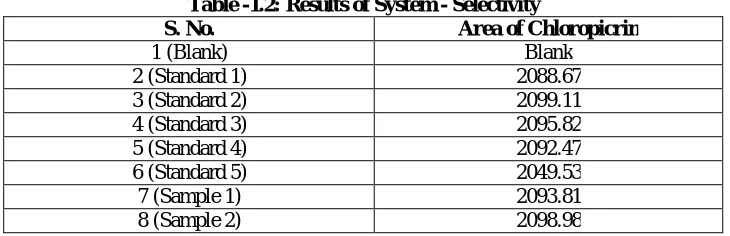
Selectivity was performed by injecting the diluent blank solution, excipient blend, system suitability solution, test solution and results are recorded in table-1.2.
Table -1.2: Results of System - Selectivity
S. No. Area of Chloropicrin
Mean 2088.34
Standard Deviation (±) 17.50
(%) Relative Standard Deviation 0.84
Acceptance criteria:The Chloropicrin peak should be well resolved from any other peak and from each other. The diluent blank solution, excipient blend solution should not show any peak at the retention time of the Chloropicrin.
(ii). Linearity
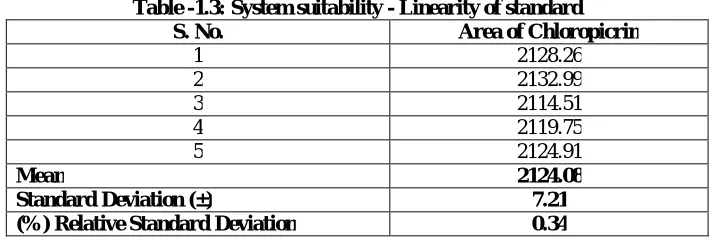
For the linearity study five standard solutions of Chloropicrin were prepared from the range starting from 50% to 150% of the theoretical concentration of assay preparation. The system suitability solution and the linearity solutions were injected. The linearity graph of concentration against peak response was plotted and the correlation coefficient was determined. The system suitability linearity standard solutions were injected and results are mentioned in table -1.3.
Table -1.3: System suitability - Linearity of standard
S. No. Area of Chloropicrin
1 2128.26
2 2132.99
3 2114.51
4 2119.75
5 2124.91
Mean 2124.08
Standard Deviation (±) 7.21
(%) Relative Standard Deviation 0.34
The average peak area of Chloropicrin peak at each concentration level was determined and the linearity graph was plotted against the sample concentration in percentage. The results of linearity study are as given in table -1.4.
Table -1.4: Results of linearity of standard
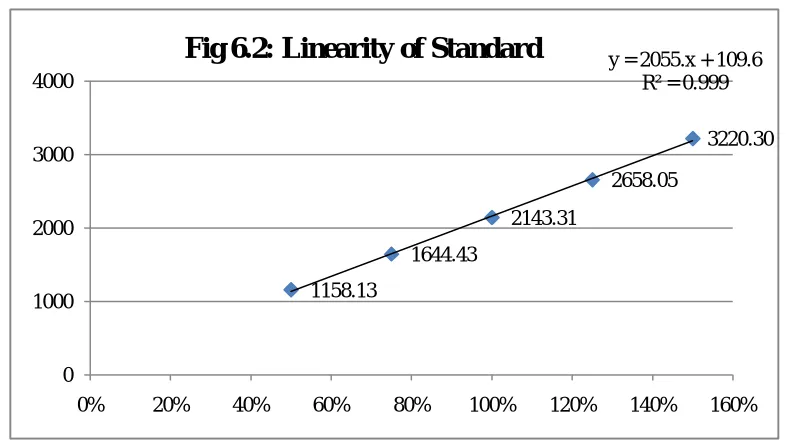
The linearity plot of peak area of Chloropicrin Vs. standard concentration in percentage is presented in figure-1.2 and the correlation coefficient was determined.
Acceptance Criteria: Correlation coefficient should be greater than or equal to 0.999.
Linearity Level
Sample Concentration
(In %)
Sample Concentration
(in ppm)
Peak Area Correlation Coefficient
Level – 1 50 50 1158.13
0.999
Level – 2 75 75 1644.43
Level – 3 100 100 2143.31
Level – 4 125 125 2658.05
Figure 1.2: Linearity graph of Chloropicrin standard
The linearity graph of concentration against peak response was plotted and shown in figure- 1.3.
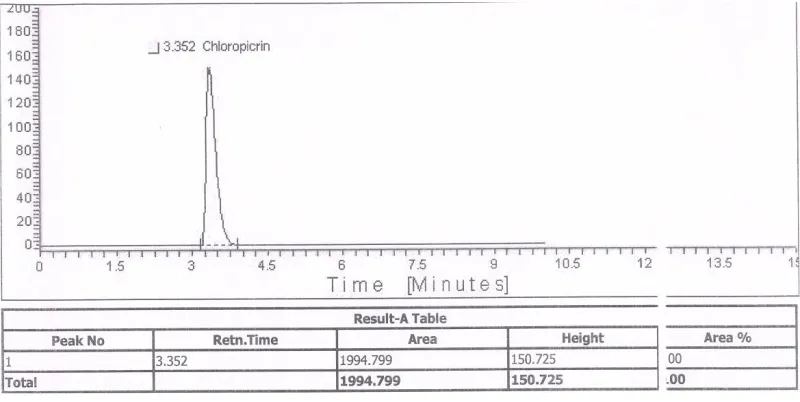
Figure-1.3: Chromatogram of Chloropicrin Sample
(iii). Precision: a. System Precision:
Procedure: The system precision was performed by injecting 10 replicate injections of system suitability solution and the chromatograms are reviewed for the system suitability criteria and results are recorded in table - 1.5.
1158.13
1644.43
2143.31
2658.05
3220.30 y = 2055.x + 109.6
R² = 0.999
0 1000 2000 3000 4000
0% 20% 40% 60% 80% 100% 120% 140% 160%
Table -1.5: System precision
S. No. Area of Chloropicrin
1 1994.79
2 1986.48
3 1992.55
4 1979.77
5 1999.45
6 1993.76
7 1983.93
8 1978.35
9 1988.25
10 1985.69
Mean 1988.30
Standard Deviation (±) 6.79
(%) Relative Standard Deviation 0.34
Acceptance Criteria:
% RSD of peak areas of ten replicate injections of system suitability solution should not be more than 2.0% and system suitability criteria should pass as per analytical method.
Figure-1.4: Chromatogram of Chloropicrin Sample (System Precision)
b. Method Precision:
Table -1.6: System suitability - Method precision Analyst – 1, HPLC No.: EH/R&D/HPLC-024
S. No. Area of Chloropicrin
1 2104.25
2 2102.04
3 2103.03
4 2107.40
5 2118.60
Mean 2107.06
Standard Deviation (±) 6.76
(%) Relative Standard Deviation 0.32
Method Precision of Test Solution:
Six test solutions of Chloropicrin in Dow AgroSciences Chloropicrinare 96%and were prepared as per the analytical method. The % RSD of % assay of six test solutions was calculated. The results of assay obtained from six test solutions preparations are presented in table -1.7.
Table -1.7: Results of Method precision
Test Solution % Assay of Chloropicrin
1 100.22
2 100.10
3 98.00
4 101.99
5 99.64
6 101.87
Mean 100.30
Standard Deviation () 1.49
(%) Relative Standard Deviation 1.48
Acceptance Criteria: % RSD of peak areas of six test solutions should not be more than 2.0%.
c. Intermediate Precision:
Procedure: The system suitability criteria were found to meet the pre-established acceptance criteria as per the analytical method. Refer to table- 1.8 for system suitability results.
Table -1.8: System suitability - Intermediate precision
Analyst – 2, HPLC No.: EH/R&D/HPLC-023
S. No. Area of Chloropicrin
1 2306.35
2 2314.53
3 2311.61
4 2304.19
5 2320.76
Mean 2311.49
Standard Deviation (±) 6.61
(%) Relative Standard Deviation 0.29
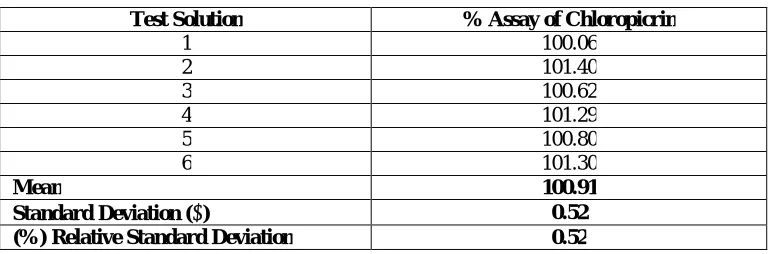
Table -1.9: Results of Intermediate precision
Test Solution % Assay of Chloropicrin
1 100.06
2 101.40
3 100.62
4 101.29
5 100.80
6 101.30
Mean 100.91
Standard Deviation () 0.52
(%) Relative Standard Deviation 0.52
(iv). Ruggedness:
The % RSD of assay results of twelve test solutions (six samples from method precision and six samples from intermediate precision) was calculated. Results are noted in table -1.10.
Table -1.10: Results of twelve test solutions of Chloropicrin in Dow AgroSciences Chloropicrinare 96% (six of Method precision & six of intermediate precision)
Analysis performed during Method precision studyBy Analyst 1 on system 1 and on column 1 on day 1
Same column % Assay of Chloropicrin
1 100.22
2 100.10
3 98.00
4 101.99
5 99.64
6 101.87
Analysis performed during intermediate precision studyBy Analyst 2 on system 2 and on column 2 on day 2
Column S. No. 015337030136 01
Test Solution % Assay of Chloropicrin
7 100.06
8 101.40
9 100.62
10 101.29
11 100.80
12 101.30
Mean of twelve samples 100.61
Standard Deviation () 1.11
(%) Relative Standard Deviation 1.10
(v). Robustness:
Prepare two test solutions of the same lot of Chloropicrin in Dow AgroSciences Chloropicrinare 96%as per analytical method. Inject this solution along with diluent blank solution and system suitability solution along different chromatographic conditions as shown below:
Change in column lot (same make, different serial no.) Change in flow rate ( 0.2 ml/minute)
Change in wavelength (± 2 nm)
Change in composition of mobile phase (± 20ml)
a. Change in Column Lot:
Normal Experimental Condition:RP - C18, 25mm x 4.6mm x 5µ. The system suitability criteria were found to meet the pre-established acceptance criteria as per the analytical method. Results recorded in table -1.11 for system suitability.
Table -1.11: System suitability - Robustness with Change in Column Lot
S. No.
Area of Chloropicrin
Same column Diff column
1 2114.36 2028.26
2 2107.06 2052.37
Mean 2110.71 2040.32
Standard Deviation (±) 5.16 17.05
(%) Relative Standard Deviation 0.24 0.84
The assay results obtained with different Column lot conditions are as given in table -1.12.
Table -1.12: Results for Change in Column Lot
Flow rate Same column Diff column
Sample % Assay
Test solution 100.17 99.54
Average assay result from Method precision 100.30 100.30
Mean 100.24 99.92
Standard Deviation () 0.09 0.54
(%) Relative Standard Deviation 0.09 0.54
b. Change in Flow Rate ( 0.2 mL/minute):
Table -1.13: System suitability - Robustness with change in flow rate
S. No.
Area of Chloropicrin
0.8mL/minute 1.2 mL/minute
1 2122.45 2132.99
2 2134.16 2116.64
Mean 2128.31 2124.82
Standard Deviation (±) 8.28 11.56
(%) Relative Standard Deviation 0.39 0.54
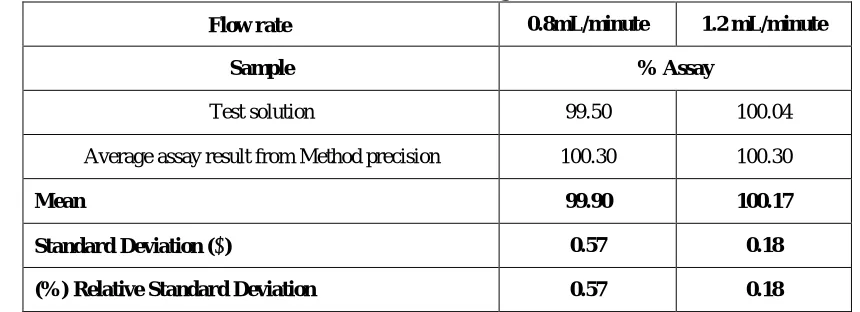
The assay results obtained with different flow rate conditions are as given in table- 1.14.
Table -1.14: Results for change in flow rate
Flow rate 0.8mL/minute 1.2 mL/minute
Sample % Assay
Test solution 99.50 100.04
Average assay result from Method precision 100.30 100.30
Mean 99.90 100.17
Standard Deviation () 0.57 0.18
(%) Relative Standard Deviation 0.57 0.18
c. Change in Wavelength (± 2 nm):
Normal Experimental Condition: 220nm. The system suitability criteria were found to meet the pre-established acceptance criteria as per the analytical method. Results are recorded in table-1.15 for system suitability.
Table -1.15: System suitability - Robustness with change in wavelength
S. No. Area of Chloropicrin
218 nm 222 nm
1 1974.74 2068.74
2 2052.81 2071.82
Mean 2013.78 2070.28
Standard Deviation () 55.20 2.18
The assay results obtained with different wavelength conditions are as given in table -1.16.
Table -1.16: Results for change in wavelength
Wavelength 218 nm 222 nm
Sample % Assay
Test solution 100.05 98.20
Average assay result from Method precision 100.30 100.30
Mean 100.18 99.25
Standard Deviation () 0.18 1.48
(%) Relative Standard Deviation 0.18 1.50
d. Change in composition of Mobile Phase (± 20ml):
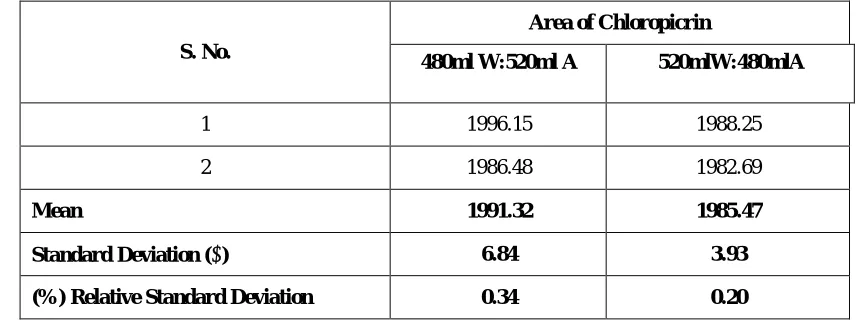
Normal Experimental Condition: Water: Acetonitrile = 500ml: 500ml. The system suitability criteria were found to meet the pre-established acceptance criteria as per the analytical method. Results are recorded in table-1.17 for system suitability.
Table -1.17: System suitability - Robustness with change in composition of mobile phase
S. No.
Area of Chloropicrin
480ml W:520ml A 520mlW:480mlA
1 1996.15 1988.25
2 1986.48 1982.69
Mean 1991.32 1985.47
Standard Deviation () 6.84 3.93
(%) Relative Standard Deviation 0.34 0.20
The assay results obtained with change in composition of mobile phase are as given in table-1.18.
Table -1.18: Results for change in composition of mobile phase
Composition of Acetonitrile & water 480Wml:520Aml 520Wml:480Aml
Sample % Assay
Test solution 99.31 99.45
Average assay result from Method precision 100.30 100.30
Mean 99.81 99.88
Standard Deviation () 0.70 0.60
IX. FORCED DEGRADATION
The forced degradation studies are performed to establish the stability indicating nature of the assay Method and to observe any degraded compounds. Chloropicrin working standard and Samples are subjected to stress with 5N HCl, 5N NaOH, Thermal degradation and UV degradation. The stress conditions are followed for degradation mentioned in table- 1.19.
Table - 1.19: Conditions – Forced Degradation
Sample stress condition Description of stress condition
Acid degradation 5N HCl heated at about 60C for 10 min on a water bath. Alkali degradation 5N NaOH heated at about 60C for 10 min on a water bath. Thermal degradation 105ºC for 12 hours in Hot-Air oven
UV degradation expose to UV-radiation for 7 days
All the above solutions are analyzed and recorded the chromatograms and results recorded in table-1.20.
Table -1.20: System suitability – Forced Degradation S. No. Area of Chloropicrin
1 2063.30
2 2072.04
3 2058.64
4 2053.67
5 2066.99
Mean 2062.93
Standard Deviation (±) 7.14
(%) Relative Standard Deviation 0.35
Acceptance criteria: The degradation peaks should be well separated from each other. The peak purity should pass. The system suitability criteria were found to meet the pre-established acceptance criteria as per the analytical method. The results are presented in table-1.21.
Table -1.21: Results - Forced Degradation
Acid Stress % Degradation
Standard 0.666
Sample 0.017
Alkali Stress % Degradation
Standard 0.029
Sample 0.025
Thermal Stress % Degradation
Standard 0.011
Sample 0.009
UV Stress % Degradation
Standard 0.011
Sample 0.007
X. STABILITY OF ANALYTICAL SOLUTION
48 hrs and analyzed these solutions on 48 hrs with freshly prepared test solution. The system suitability solution was prepared freshly at the time of analysis. The results are presented in table-1.22.
Table -1.22: Results of Analytical solution Stability
TIME Std Area Avg std
area Spl area
Avg Spl area
0th hr 2017.27 2015.105 2001.20 2008.04 2012.94 2014.88
12th hr 2017.37 2022.74 2025.10 2023.4 2028.11 2021.70
24 hr 2033.13 2035.98 2029.78 2031.07 2038.83 2032.36
36 hr 2048.41 2041.465 2059.62 2057.245 2034.52 2054.87
48 hr 2050.65 2042.18 2055.32 2059.755 2033.71 2064.19
Mean 2031.49 2031.49 2035.90 2035.90
Standard Deviation () 12.83 12.03 21.38 22.25
(%) Relative Standard Deviation 0.63 0.59 1.05 1.09
The assay of Dow AgroSciences Chloropicrinare 96% in the sample was calculated. The assay results obtained during solution stability experiment are as given in table-1.23.
Table -1.23: Results for solution stability
Acceptance Criteria: The analyte is considered stable if there is no significant change in the assay.
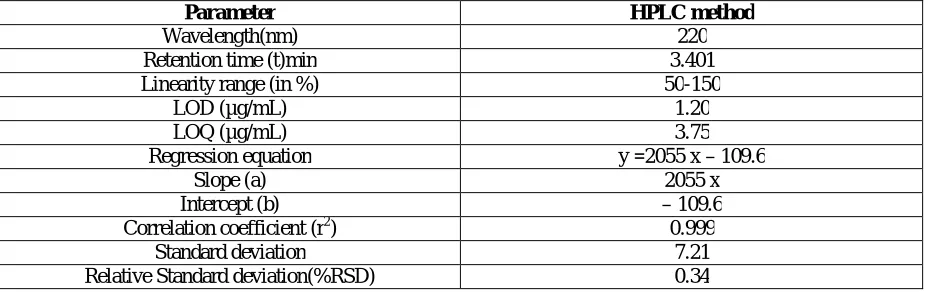
Table-6.24: Performance calculations, detection characteristics, system precision and method precision of the proposed method for Chloropicrin.
Parameter HPLC method
Wavelength(nm) 220 Retention time (t)min 3.401 Linearity range (in %) 50-150
LOD (µg/mL) 1.20
LOQ (µg/mL) 3.75
Regression equation y =2055 x – 109.6
Slope (a) 2055 x
Intercept (b) – 109.6 Correlation coefficient (r2) 0.999
Standard deviation 7.21 Relative Standard deviation(%RSD) 0.34
% Assay results calculated against the freshly prepared system suitability standard
Sample % Assay of Chloropicrin
0th hr 99.48
12th hr 99.84
24 hr 99.59
36 hr 100.60
48 hr 100.69
Mean 100.04
Standard Deviation () 0.57
XI. RESULTS AND DISCUSSION i). System selectivity:
All the injections were processed at the wavelength provided in the method. There was no interference observed from diluents blank solution, excipients blend solution with Chloropicrin peak. The system suitability criteria were found to meet the pre-established acceptance criteria as per the analytical method. Hence this method is selective.
ii). Linearity and Range of Standard:
Linearity graph of the average area at each level against the concentration in v/v% is plotted and is found to be a straight line graph. The correlation coefficient is found to be more than 0.999.Hence it is concluded that the method is found to be linear in the range of 50% to 150% of the working concentration.
Correlation coefficient= 0.999 Range= 50% to 150%
iii). Precision:
The analysis was carried out on six test solutions of the same lot of the pesticide by two different analysts using two different equipments within the same laboratory using two different columns of the same make but having different serial numbers on two different days. The % RSD of the twelve assay results which six of method precision and six from intermediate precision is found to be less than 2.0%. Thus, the method is found to be rugged and precise.
System precision= % RSD= 0.34 Method precision= % RSD= 1.48 Intermediate precision= % RSD= 0.52 iv). Robustness:
The analysis of the same lot of Dow AgroSciences Chloropicrinare 96% was carried out at different conditions of column lot, flow rate, wavelength, and change in composition of mobile phase. The % RSD between results obtained with changed condition and average result of method precision is not more than 2.0%.The analytical method meets the pre-established acceptance criteria for robustness study. Thus, the method is robust.
v). Forced degradation:
There is no interference between the peaks obtained for the chromatograms of degradation preparations. The degradation peaks under forced degradation are well separated from each other. The peak purity criteria were found to pass at each condition of degradation for both standard and sample. Hence, the method is very precise, selective and specific to the estimation of assay of Chloropicrin in Dow AgroSciences Chloropicrinare 96% by HPLC, as the degraded products are well separated from Chloropicrin and as well from each adjacent peak.
vi). Stability of Analytical solution:
The % RSD between assay results obtained for freshly prepared test solution and the stored test solutions is less than 2.0%. There is no significant change in assay level observed up to 48 hours for test solution at room temperature. The system suitability was found to meet the pre-established criteria and it can be concluded that the solution is stable up to 48 hours at room temperature.
XII.SUMMARY AND CONCLUSION
The above summary and the validation data summarized in this paper shows that the analytical method of assay of Chloropicrin in Dow AgroSciences Chloropicrinare 96% by HPLC is found to be suitable, selective, specific, precise, linear, accurate and robust. The analytical solution is found to be stable up to 48 hours at room temperature.
Hence, it is concluded that the analytical method is validated and can be used for routine analysis and for stability study.
REFERENCES
1. http://agritech.tnau.ac.in/crop_protection/crop_prot_nematode_nematicide.html
2. "RED Fact Sheet: Chloropicrin" (PDF). US Environmental Protection Agency. 10 July 2008. p. 2. Retrieved 20 September 2013. 3. Ayres, Leonard P. (1919). The War with Germany (Second ed.). Washington, DC: United States Government Printing Office. p. 80. 4. "Chloropicrin - Background". 20 September 2013.
6. Amos Alfred Fries; Clarence Jay West (1921). Chemical warfare. McGraw-Hill Book Company, inc. p. 144. 7. http://termitetenting.com
8. "Chloropicrin Mitigation Proposal" (PDF). Department of Pesticide Regulation - California Environmental Protection Agency. 15 May 2013. p. 1. 9. U.S. EPA “Use and Usage of Soil Fumigants”, June,2005
10. http://agritech.tnau.ac.in/crop_protection/crop_prot_nematode_nematicide.html 11. https://www.cdc.gov/niosh/ershdb/emergencyresponsecard_29750034.html
12. Do, Jung-Ah; Choi, Jeong-Heui; Park, Hyejin; Park, Yong-Chun; Yoon, Hae-Jung; Choi, Dongmi; Oh, Jae-Ho; Development of an Analytical Method for Chloropicrin Determination in Hulled Rice by GC-ECD and GC-MS .Journal of Food Hygiene and Safety, Volume 28, Issue 3, 2013, pp.222.
13. Carmen Ferrer , M. Jose Gómez, Juan F. García-Reyes , Imma Ferrer, E. Michael Thurman , Amadeo R. Fernández-Alba. Determination of pesticide residues in olives and olive oil by matrix solid-phase dispersion followed by gas chromatography/mass spectrometry and liquid chromatography/tandem mass spectrometry. Journal of Chromatography A. Volume 1069, Issue 2, Pages 153-294 (1 April 2005)
14. Carrick WA, Cooper DB and Muir B. : Retrospective identification of chemical warfare agents by high-temperature automatic thermal desorption-gas chromatography-mass spectrometry. J. Chromatography A 925(1-2), 241-249 (2001).
15. US EPA. Method 551.1: Determination of chlorinated disinfection byproducts, chlorinated solvents, and halogenated pesticides/ herbicides in drinking water by liquid/liquid extraction and gas chromatography with electron capture detection. Cincinnati, OH: U.S. EPA Office of Ground Water and Drinking Water/Technical Support Center (1995).
16. Murty MR1, Prabhakar S, Lakshmi VV, Saradhi UV, Reddy TJ, Vairamani M.Mass spectral analysis of chloropicrin under negative ion chemical ionization conditions. Analytical chemistry 2005 May 15;77(10):3406-10
17. Jun Kanazawa. Determination of Chloropicrin in Fumigants by Gas-Liquid Chromatography. Agricultural and Biological Chemistry, Vol. 27, No. 3, p. 159-161, 1963.
18. J.A Castro, H.Godoy. Spectrophotometric determination of chloropicrin in water. Analytica Chimica Acta Vol-33, 1965, Pages 679-683.
19. Ben Berck. Grain Fumigant Determination, Polarographic Determination of Methyl Bromide, Ethylene Dibromide, Acrylonitrile, Chloropicrin, and Carbon Tetrachloride in Air. J. Agric. Food Chem., 1962, 10 (2), pp 158–162.
20. B. Berek and J. Solomon, Quantitative determination of Chloropicrin by polarography. ibid. 34, 514 (1962).
21. F.A. Gunther and R.C. Blinn, Analysis of Insecticides and Acaricides ", The quantitative determination of Chloropicrin by total chlorine method. Interscience Publishers, 1955, p. 357.
22. L. Feinsilver and F.W. Oberst, Quantitative determination of Chloropicrin by colorimetric method. Anal. Chem., 25, 820 (1953).
23. Wilhelm S.N: Chloropicrin as a Soil Fumigant. Niklor Chemical Company, Inc., Chairman, Chloropicrin Manufacturers Task Force, Long Beach, CA 90810-1695. Available at http:// www.ars.usda.gov/is/np/mba/july96/wilhel1.html (1996).
24. O'Neil M.J: The Merck Index-An Encyclopedia of Chemicals, Drugs, and Biologicals (14th Edition - Version 14.9). Merck Sharp & Dohme Corp., a subsidiary of Merck & Co., Inc... Online version available at: http://www.knovel.com/web/ portal/browse/display_EXT_KNOVEL_DISPLAY_bookid=1863&VerticalID=0 (2012).
25. Meister R.T. and Sine C.: Farm Chemicals Handbook. Meister Publishing Company. Willoughby, Ohio, USA (1998).
26. Roark R.C: USDA Miscellaneous Publication No. 176. A Bibliography of Chloropicrin 1848 - 1932. United States Department of Agriculture. Washington, DC (1934).
27. Agnihothrudu V. and Mithyantha M.S.: Pesticide Residues - a review of Indian Work. Rallis India Ltd., Bangalore (1978).
28. US Environmental Protection Agency. Pesticide Environmental Fate One Line Summary: Chloropicrin. US EPA Environmental Fate and Effects Division. Washington, DC (1992).
29. Shepler K, Hatton C, and Ruzo L.: Aerobic Soil Metabolism of Chloropicrin. PTRL West Inc. Richmond, CA. (Unpublished study submitted to USEPA) (1995).
30. Hazardous Substances Data Bank (HSDB): Accession Number 977. National Library of Medicine, Bethesda, MD. CD ROM version: Micromedix Inc., Denver CO. (1993).
31. Lee H. and Moreno T: Photohydrolysis of Chloropicrin. Bolsa Research Associates. Hollister, CA. (Unpublished study submitted to USEPA) (1993). 32. Muir B., Carrick W.A. and Cooper D.B.: Application of central composite design in the optimization of thermal desorption parameters for the trace