_____________________________________________________________________________________________________
How Effectively Value Engineering Practices are
Being Implemented in Qatar on Infrastructure
Projects
Zeeshan Irshad
1*1University College of Estate Management, RG1 4BS, Reading, UK.
Author’s contribution
The sole author designed, analysed, interpreted and prepared the manuscript.
Article Information
DOI: 10.9734/JERR/2019/v9i117006 Editor(s): (1) Dr. Guang Yih Sheu, Associate Professor, Chang-Jung Christian University, Taiwan. Reviewers: (1) Ahmad Nasser Mohd Rose, University Malaysia Pahang, Malaysia. (2)Sergei N. Polbitsyn, Ural Federal University, Russia. Complete Peer review History:http://www.sdiarticle4.com/review-history/53157
Received 28 September 2019 Accepted 03 December 2019 Published 17 December 2019
ABSTRACT
The purpose of this paper is to evaluate the effectiveness of Value Engineering (VE) practices being used in Qatar mainly on infrastructure projects. This study will further explore the deficiencies in adopted overall VE processes and subsequently recommend the solutions to overcome current problems or difficulties.
To conduct this study a mixed method approach was adopted, which is a combination of quantitative and qualitative date. Survey questionnaire was used to collect the quantitative date and it was sent to 72 professionals belongs to different construction groups currently involved on infrastructure projects in Qatar. Semi structured interviews were conducted to collect the qualitative date. Interviews were conducted with 06 professionals working as value engineer on different infrastructure projects in Qatar to obtain further practical information about VE processes in Qatar and know about the real difficulties they encountered.
This research reveals that the value engineering processes being used in Qatar are in line with international standards set by the SAVE International. This study further reveals that only 5 percent to 7 percent cost savings are being achieved on infrastructure projects in Qatar. This is in addition to the improvements in HSE, quality and time of project.
However, where this study has shown cost benefits from VE implementation, it also highlighted that significant improvement is required to extend the cost benefits from 7 percent to maximum 12 percent for which VE is known without compromising on functionality and quality requirements.
Irshad; JERR, 9(1): 1-8, 2019; Article no.JERR.53157
This is a clear indication that current practices need to be improved. The identified improvements include starting VE process at the end of preliminary design stage, more involvement of clients and by considering whole life cycle costs of the projects by introduction of sustainable, environment friendly and innovative alternatives design solutions and construction materials.
Keywords: Value management; value engineering; construction industry; engineering and construction.
1. INTRODUCTION
1.1 Value Engineering and Value
Management
In daily life, the term Value engineering and value management seems to be synonyms. Different authors have different opinions in this regard. For instance, according to Kelly et al. [1], Value Management (VM) deals with the overall project objectives while Value Engineering (VE) is subdivision of Value Management. RICS [2] had defined VM as a multidisciplinary approach and usually used to deal with strategy and with highly complex problems. On other hand, VM deal with the technical issues during the project design and construction phases [3].
In author’s opinion, VM is a systematic process to provide the value of money to clients by deriving out excessive or unnecessary cost. The purpose of VE is to identify functionality requirements, establish the values for them and to develop the alternatives to perform required functions. While VM is holistic process to understand and define what establish value for the project and to provide the value for money. VM is a macro level approach to improve the value while the VE is a micro level approach to maximise the value.
1.2 Value Engineering Concept and Its Effectiveness
A common misconception is that VE is just a cost cutting process [2]. Dallas [4] clarifies that VE is not just a cost cutting process; it is a process to identify and eliminate unnecessary costs. Green [5] differentiate VE from value planning by stating that it focuses on function. He further added that there is three-way relationship between function, cost and value as expressed below.
Function Cost
The effectiveness of VE can be measured by analysing its benefit to the project outcome. In
this study to measure the effectiveness, factors such as cost reduction without compromising on function and quality, improvement in project duration and safety, were considered and based on these questionnaire and interviews were conducted.
1.3 When to Conduct Value Engineering
Different authors have different opinions about the time when to carry out the VE studies. For instance, Male and Kelly [6], Witschey and Wulff (2007) and Hunter and Kelly [7] believes that VE process shall start at the early design stage. Dallas [4] agreed with above authors by stated that changes are easy to handle during initial stage of the project, therefore, VE process shall be started at the end of preliminary design stage [8].
Palmer et al. [9] stated that VE process should commence when the design is 30–35% completed. According to RICS [2], the best time to implement VE studies is at end of scheme design. However, RICS [2] stated that the VE / VM process can be implemented during the entire project duration. The author believes that application of VE studies at the end of preliminary design is more productive, however, author is agreed with RICS [2] that VE can be implemented throughout project duration [8].
1.4 Background of Value Engineering in Construction Industry
VE in the construction industry was introduced during the 1960s in the USA and during the 1980s in the UK (Perera et al. 2011) [10,11,1]. Since then VE has become the choice for many construction projects across the globe [8]. In Qatar, the use of VE in the construction industry has increased during the last decade. The aim of VE is to provide the best value for money to end users. Despite its benefits, VE is not widely used in Qatar. This study will find out the effectiveness of VE with infrastructure projects in Qatar and subsequently make some recommendations on how this can be improved [8].
Fig. 1. Opportunities of changes over project life cycle (Source
1.5 Research Background
Declining oil prices have affected the economy of many Gulf Cooperation Countries (GCC) including Qatar. The Construction industry in Qatar has been negatively impacted due to the oil price dip. Many of the construction projects have been delayed or have been cancelled. However, the government of Qatar is committed to hosting mega events, such as the 2022 FIFA World Cup and the accomplishment of the Q national Vision (QNV) 2030 (QIA, 2018). Projects related to these events are dominating activities in the construction sector in Qatar. Successful delivery of the World Cup will require the Qatari government to complete the infrastructure development required by FIFA. Despite cancelling or suspending many projects, according to, Qatar is spending $500m every week on major infrastructure projects However, lower oil prices have led to tighter spending and a greater focus on value engineering. In addition, due to the increasing expectations of clients and great competition it has become essential to adopt value engineering techniques in order to provide the best value for money to end users. Utilizing value engineering techniques can provide better control of money, hence its use has continued to grow over the last decade in Qatar’s construction industry. This research aims to find out the effectiveness of current VE practices in place for infrastructure projects in Qatar [8].
1.6 Research Limitations
The research is based on the current application of VE techniques in infrastructure projects in Qatar. The assumption is made that current VE
Opportunities of changes over project life cycle (Source [4])
Declining oil prices have affected the economy of many Gulf Cooperation Countries (GCC) including Qatar. The Construction industry in negatively impacted due to the oil price dip. Many of the construction projects have been delayed or have been cancelled. However, the government of Qatar is committed to hosting mega events, such as the 2022 FIFA World Cup and the accomplishment of the Qatar 2018). Projects related to these events are dominating activities in the construction sector in Qatar. Successful delivery of the World Cup will require the Qatari government to complete the infrastructure required by FIFA. Despite cancelling or suspending many projects, according to, Qatar is spending $500m every week on major infrastructure projects [12]. However, lower oil prices have led to tighter spending and a greater focus on value dition, due to the increasing expectations of clients and great competition it has become essential to adopt value engineering techniques in order to provide the best value for money to end users. Utilizing value engineering control of money, hence its use has continued to grow over the last decade in Qatar’s construction industry. This research aims to find out the effectiveness of current VE practices in place for infrastructure
The research is based on the current application of VE techniques in infrastructure projects in Qatar. The assumption is made that current VE
practices meet the basic principles of VE and technical compliance with technical requirements of different engineering disciplines is outside the scope of this research. Therefore, the outcome of this study is based on costs benefits being achieved on infrastructure projects in Qatar. The recommendations are based on the comparison of international VE practices with VE practices currently used in Qatar [8].
2. RESEARCH METHODOLOGY
A mixed methods approach has been used in this study. This methodology is a combination of both quantitative and qualitative methods which enables exploring more complex aspects and relations of the human and social world
2.1 Data Collection
This section discusses the methods used to collect the data and their advantages and disadvantages. It also includes the measures taken to overcome the disadvantages. To conduct the study on the effectiveness of VE process with infrastructure projects in Q
data is collected using two methods i.e. Questionnaire and interviews
questionnaire and interviews were designed considering the research objectives. The questions for both were developed concentrating on study objectives i.e. insight in to current value engineering practices, to find out VE effectiveness and to make recommendation for further improvements. The questionnaire was designed with closed ended question while interview questions were designed with open ended questions to gain in depth information. The reason for using the mixed data collection practices meet the basic principles of VE and technical compliance with technical requirements gineering disciplines is outside the scope of this research. Therefore, the outcome of this study is based on costs benefits being achieved on infrastructure projects in Qatar. The recommendations are based on the comparison ith VE practices
2. RESEARCH METHODOLOGY
A mixed methods approach has been used in this study. This methodology is a combination of both quantitative and qualitative methods which enables exploring more complex aspects and relations of the human and social world [8].
Irshad; JERR, 9(1): 1-8, 2019; Article no.JERR.53157
method was to overcome the disadvantages of both methods and to collect more accurate data.
2.2 Questionnaire
The survey questionnaire approach was used to conduct this study. For this research, an internet survey is used using the Survey Monkey platform. An attempt is made to keep the questionnaire close to the study objectives. The survey was sent using emails and weblinks to 73 people out of which 69 have responded. The questionnaire was sent to key personnel engaged with VE studies in Qatar. These include clients, design consultants, project management consultants, quantity surveyors, value engineering specialists, and contractors, for the broader viewpoint and to avoid bias. A total of 13 questions were used with close ended questions [8].
2.3 Interviews
A Semi-structured approach is selected for the interview aiming to provide the interviewee an opportunity to develop ideas and speak in-depth on the issues raised by the researcher providing a competitive edge over both structured and un-structured interview approach Due to the time constraints, the interviews were conducted with six VE practitioners currently working on infrastructure projects in Qatar. The aim of these interviews was to get an insight into how VE practitioners view VE implementation in Qatar on infrastructure projects [8].
2.4 Data Analysis
Survey Monkey is used to analyse the data obtained from the questionnaire in the form of table and charts. The Survey Monkey has automatically organized and analysed the data and provided key descriptive statistics for use. To
analyse the data from the interviews, the transcripts were read multiple times to identify the ideas and issues. These ideas and issues are then codified as cost, time, quality and safety [8].
3. RESULTS AND DISCUSSION
3.1 Survey Questionnaire and Interviews Answers
Majority of respondents were from the professionals working with contractors followed by project management consultants. There was good response from quantity surveyors, design consultants, client and VE consultants. The figure below shows the results against each profession [8].
3.1.1 Value engineering concept
When the respondents were asked about the value engineering concept. The results show that 64% of respondents understand the VE process quite well while 33% of respondents profess that they understand the VE process very well. On other hand, 3% of respondent believe that they do not understand VE process very well. This question was subjective in nature, but results are derived after combination of results of other questions below [8].
3.1.2 Purpose of value engineering
Most of the respondents (72%) agreed that the VE purpose is to reduce unnecessary costs and increase value confirming the main objective of VE according to SAVE [13]. 16% of respondent believe that VE is to reduce the cost to increase value partially satisfying VE objective. However, there is misconception about the VE purpose among 10% of respondents who believes that VE aim is to reduce the cost, quality and time [8].
5
Table 1. Summary of findings
S. no. Research objectives / question
Findings
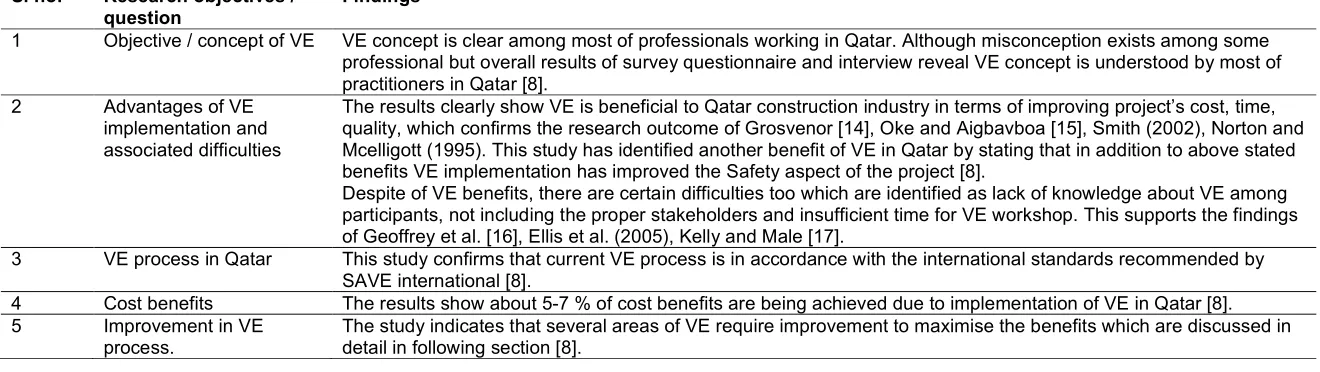
1 Objective / concept of VE VE concept is clear among most of professionals working in Qatar. Although misconception exists among some professional but overall results of survey questionnaire and interview reveal VE concept is understood by most of practitioners in Qatar [8].
2 Advantages of VE
implementation and associated difficulties
The results clearly show VE is beneficial to Qatar construction industry in terms of improving project’s cost, time, quality, which confirms the research outcome of Grosvenor [14], Oke and Aigbavboa [15], Smith (2002), Norton and Mcelligott (1995). This study has identified another benefit of VE in Qatar by stating that in addition to above stated benefits VE implementation has improved the Safety aspect of the project [8].
Despite of VE benefits, there are certain difficulties too which are identified as lack of knowledge about VE among participants, not including the proper stakeholders and insufficient time for VE workshop. This supports the findings of Geoffrey et al. [16], Ellis et al. (2005), Kelly and Male [17].
3 VE process in Qatar This study confirms that current VE process is in accordance with the international standards recommended by SAVE international [8].
4 Cost benefits The results show about 5-7 % of cost benefits are being achieved due to implementation of VE in Qatar [8].
5 Improvement in VE
process.
Irshad; JERR, 9(1): 1-8, 2019; Article no.JERR.53157
3.1.3 Effectiveness of current VE practices in Qatar
The results indicated that 65% of respondents are agreed on effectiveness of current VE practices in Qatar, however, 35% believe that current VE practices are not effectively implemented in Qatar [8].
3.1.4 Benefits from VE to Qatar construction industry
The results show that 91% of respondents believe that current VE practices are beneficial to construction industry in Qatar. Other respondents (9%) have contradicting view, as they do not believe that current VE practices are beneficial. However, overall result shows that the VE practices are beneficial to construction industry in Qatar [8].
This is also to establish the respondent’s opinion about the four factors (cost, time, quality and HSE) in benefiting from the VE process in Qatar. The results indicate that 78% of respondents express their opinion in favour of improving quality; however, 22% have contradicting view by stating that the VE did not participated in improving quality. For improvement in safety, there are two different types of thinking. 68% of respondents agreed that VE participated in
safety improvement, however, 32% of
respondent are disagree. Similarly, for time, respondents are divided in two groups. However, high percentage of participants admired that VE has improved the project duration compared to
18% who believes that there was no
improvement in project duration due to VE implementation. In term of cost improvement majority (91%) of respondents, accept VE participation in improving cost, comparing to only 9% who have contradicting view. The overall survey results indicate that VE implementation has improved the above four factors to great extent [8].
3.1.5 At what stage VE is being implemented
The studyreveal that respondents have varying opinions. Highest percentage (29%) of respondents stated that process should be started during developed design following with 26% who believe it should be started at concept design. 16% agreed that process shall be started during the technical design as compared to 14% who think it should be overlapped with construction stage. For strategic definition and
preparation and brief stages, only 9% and 6% (respectively) respondents think the VE process should be started, which strengthen the misconception about VE in Qatar, because in author’s opinion, during these stages VE is not conducted. The overall results indicate the starting VE process during end of preliminary design is more productive [8].
3.1.6 Hindrances in VE implementation
The research find that main hindrance is ‘not starting the process early enough as it is supported by 61% of respondents, following with the other hindrance which is not including the appropriate stakeholders supported by 54%. Not enough time and lack of precision are ranked as third hindrance and supported by 30% of respondents. Revisiting the previous decisions is ranked as fourth major hindrance in effective VE
process. The overall results indicate there are five major hindrances in effective VE process
[8].
3.2 Summary of Findings
This section addresses the research objectives, question/issues arise from about survey results. This also contain the comparison of this study findings with other researchers’s observations/ findings [8].
4. CONCLUSION
4.1 This Section States the Main
Research Findings to Demonstrate
How This Study has Met His
Objectives. It also Contains the List of
Recommendations for the
Improvement of Current VE Practices in Qatar for Infrastructure Projects
4.1.1 Research objectives
it also highlighted that starting VE process at end of preliminary stage is more productive. This indicates deficiency as VE process in Qatar is not fully being carried out at the end of preliminary design stage. To obtain maximum benefits of VE, clients in Qatar should ensure to start the VE process during early stages of project [8].
Objective Two -Insight in to current VE practices in Qatar: The research was able to
identify that about 5-7% of cost benefits are being achieved due to implementation of VE in Qatar. It is widely considered that VE
process can result in project cost reduction while maintaining the functionality requirements,
up to 5-12%. This indicates that more cost
saving can be made by introducing some improvement in current VE process in
Qatar [8].
Objective Three – Improvement in VE practices in Qatar: The study indicates that several areas of VE require improvement to maximise the benefits [8]. These are discussed in detail in the following section.
Early start of process.
Involvement of contractor
Allocate enough time for VE workshops
More involvement of clients
Auditing of VE benefits
Use of BIM in VE process
Need to consider Life cycle costing
Introduction of sustainable and innovative alternatives
5. RECOMMENDATIONS
This section relates to the third objective of this study. This research was able to identify certain areas for improvements for design and construction stages of the projects [8].
5.1 Recommended Improvements for
Design Stage
To obtain the maximum benefits, conduct VE at the end of preliminary design stage.
Need to involve all stakeholders and to build a common understanding of problem and recommended solutions.
More involvement of clients/ end users. VE consultants should inform clients about VE importance and its benefits.
Consideration of the sustainable,
environment friendly and innovative materials as design alternatives.
Consideration shall be given Life Cycle Costing of alternative material and design.
Terms and condition of VE in contract shall be clearly defined.
5.2 Recommended Improvements during Construction Stage
Introduction and use of Building
Information Modelling to manage the project effectively.
Cost benefits shall be shared among
project stakeholders on projects procured through traditional procurement
paths to encourage the contractor to use of VE.
Establish a system to monitor and audit VE benefits.
Only those material shall be recommended as an alternative which are easily available to avoid any delay.
CONSENT AND ETHICAL APPROVAL
The researcher has ensured that all participants are fully informed in advance about the aims. In addition, all the participants were informed about the context in which the research is carried out, by conveying to them that the purpose of this research is not to highlight the behaviour or thoughts of any individuals. Furthermore, the participants are offered anonymity while conducting interviews or responding to the questionnaire [8].
COMPETING INTERESTS
Author has declared that no competing interests exist.
REFERENCES
1. Kelly J, Male S. Value management. In J. Kelly, R. Morledge, & S. Wikinson (Eds.), Best value in construction. London: Blackwell; 2006.
2. Royal Institute of Chartered Surveyors, Value management and value engineering- RICS guidance note, 1st edition, London; UK; 2017.
Irshad; JERR, 9(1): 1-8, 2019; Article no.JERR.53157
4. Dallas MF. Value and risk management a guide to best practice. Lackwell Publishing Ltd, U.K; 2006.
5. Stuart Green. The essential of value engineering. Facilities. 1990;8(10). 6. Hunter K, Kelly J. The supporting factors
that make value management attractive option in meeting the best value requirements of the UK public service sector. SAVE International Knowledge Bank A; 2007.
Available:www.value-eng.org [Accessed on 20 /05/18]
7. Zeeshan Irshad. Effectiveness and Imple-mentation of Value Engineering Practices in Qatar UCEM, RG1 4BS, Reading, UK; 2018.
8. Palmer A, Kelly J, Male S. Holistic appraisal of value engineering in construction in United States. Construction Engineering and Management. 1996;324– 326.
9. De Leeuw CP. Value management—The new frontier for the quantity surveyor. Paper presented at the 22nd Biennial Conference/General Meeting on Quantity Surveying. Abuja: Nigerian Institute of Quantity Surveyors; 2006.
10. Kelly J, Male S, Graham D. Value management of construction projects. Oxford: Wiley; 2014.
11. Ali al-Emadi. Qatar spending $500m a week on World Cup infrastructure projects. BBC; 2017.
12. American society of Value Engineer. About Value Engineering - SAVE International; 2010.
Available:https://www.value-eng.org/page/AboutVE?&hhsearchterms= %22value+and+engineering%22
[Accessed 5 Jun. 2018]
13. Grosvenor. Introduction to value
management. The Hongkong Institute of Value Management. 1997;3(4):5-7.
14. Oke A, Aigbavboa C. Sustainable value management for construction projects’ (1st edn), Springer International; 2017.
15. Geoffrey QP, Chung JKH. A group decision support system for value management studies in the construction industry. International Journal of Project Management. 2002;20:247-252.
16. Kelly J, Male S. Value management in design and construction. E & FN Spon; 1993.
17. Male S, Kelly J. A re – Appraisal of value methodologies in construction. SAVE International Knowledge Bank; 2004. Available:www.value-eng.org [Accessed on 20 /05/18]
© 2019 Irshad; This is an Open Access article distributed under the terms of the Creative Commons Attribution License (http://creativecommons.org/licenses/by/4.0), which permits unrestricted use, distribution, and reproduction in any medium, provided the original work is properly cited.
Peer-review history:
![Fig. 1. Opportunities of changes over project life cycle (Source Opportunities of changes over project life cycle (Source [4])](https://thumb-us.123doks.com/thumbv2/123dok_us/9829823.1969104/3.612.120.498.95.257/opportunities-changes-project-source-opportunities-changes-project-source.webp)