RESEARCH
Comparative transcriptomic analysis
of a wing-dimorphic stonefly reveals candidate
wing loss genes
Graham A. McCulloch
1*, Andrew Oliphant
2, Peter K. Dearden
2, Andrew J. Veale
1,3, Charles W. Ellen
1and Jonathan M. Waters
1Abstract
Background: The genetic basis of wing development has been well characterised for model insect species, but remains poorly understood in phylogenetically divergent, non-model taxa. Wing-polymorphic insect species poten-tially provide ideal systems for unravelling the genetic basis of secondary wing reduction. Stoneflies (Plecoptera) represent an anciently derived insect assemblage for which the genetic basis of wing polymorphism remains unclear. We undertake quantitative RNA-seq of sympatric full-winged versus vestigial-winged nymphs of a widespread wing-dimorphic New Zealand stonefly, Zelandoperla fenestrata, to identify genes potentially involved in wing development and secondary wing loss.
Results: Our analysis reveals substantial differential expression of wing-development genes between full-winged versus vestigial-winged stonefly ecotypes. Specifically, of 23 clusters showing significant similarity to Drosophila wing development-related genes and their pea aphid orthologues, nine were significantly upregulated in full-winged stonefly ecotypes, whereas only one cluster (teashirt) was substantially upregulated in the vestigial-winged ecotype. Conclusions: These findings suggest remarkable conservation of key wing-development pathways throughout 400 Ma of insect evolution. The finding that two Juvenile Hormone pathway clusters were significantly upregulated in vestigial-winged Zelandoperla supports the hypothesis that Juvenile Hormone may play a key role in modulating insect wing polymorphism, as has previously been suggested for other insect lineages.
Keywords: Vestigial winged, Wing development, Gene expression, Zelandoperla fenestrata
© The Author(s) 2019. This article is distributed under the terms of the Creative Commons Attribution 4.0 International License (http://creat iveco mmons .org/licen ses/by/4.0/), which permits unrestricted use, distribution, and reproduction in any medium, provided you give appropriate credit to the original author(s) and the source, provide a link to the Creative Commons license, and indicate if changes were made. The Creative Commons Public Domain Dedication waiver (http://creativecommons.org/ publicdomain/zero/1.0/) applies to the data made available in this article, unless otherwise stated.
Background
The unparalleled diversity of insects is often attributed to the evolution of insect flight, ca. 400 Ma [1–5]. Specifi-cally, wing evolution has carried numerous advantages, including an increased ability for insects to access novel resources and ecosystems, improved predator avoidance, and enhanced mate location [1]. This dispersal capacity has, however, been subsequently lost in numerous insect lineages, across almost all winged orders [6, 7].
The development and maintenance of wings requires significant energy expenditure, and some wing-dimorphic
insect species thus exhibit apparent ‘trade-offs’ between flight-ability versus reproductive output [8–12]. Environ-mental conditions may also contribute to the evolution of wing-reduced lineages [6, 13], with flight loss particu-larly common in stable ecosystems that lack predators [14, 15]. Wing-reduced lineages are also disproportion-ally abundant in isolated areas, where there is a high level of mortality in dispersing individuals, and in areas where the energetic costs of flight are high [1, 16]. Likewise, wing loss is particularly common at higher altitudes [17], with recent studies implying that exposure, modulated by the alpine treeline, may be a key driver of insect wing reduction [18, 19].
Wings have been completely lost in many insect spe-cies, whereas some species comprise distinct winged
Open Access
*Correspondence: [email protected]
1 Department of Zoology, University of Otago, P.O. Box 56, Dunedin 9054,
New Zealand
and wingless ecotypes, often associated with differing environmental conditions [20–22]. As the distinct phe-notypes of wing-dimorphic species have very similar genetic backgrounds, such taxa present ideal systems for exploring the molecular basis of wing loss. Previous stud-ies of wing-dimorphic specstud-ies have suggested that wing polymorphism can be genetically determined [23–27], controlled by environmentally driven gene expression (polyphenism; [11, 28–30]), include both genetic and environmental components [31], or be under the control of epigenetic factors [32, 33].
Given the range of environmental, genetic, and epige-netic factors that may contribute to wing polymorphism, elucidating the developmental basis of wing loss can be challenging. While the gene networks underpinning wing development have been well-characterised in model organisms such as Drosophila melanogaster [34, 35] and
Tribolium castaneum [36], very little is known about the underlying molecular biology of wing development in non-model insect taxa. Several recent studies, however, have identified the key genes underlying wing develop-ment in non-model taxa by comparing gene-expression across winged and wingless morphs of wing polymor-phic species (see Additional file 1: Table S1). While some portions of the key insect gene networks appear to be conserved among a variety of holometabolous and hem-imetabolous taxa [37–40], the extent of their phyloge-netic conservation across class Insecta remains unclear.
The New Zealand stonefly Zelandoperla fenestrata
species group (hereafter simply referred to as Z. fenes-trata) contains both full-winged and vestigial-winged ecotypes, with the wing-reduced phenotype particularly common at higher altitudes [20, 41]. The distinct mor-photypes were traditionally considered distinct species (full-winged: Zelandoperla fenestrata or Zelandoperla tillyardi, vestigial-winged: Zelandoperla pennulata) [41], but more recent molecular studies demonstrate that vestigial-winged lineages have evolved independently on numerous occasions [20, 21]. In addition, a recent study identified several outlier loci strongly associated with vestigial versus full-winged ecotypes of Z. fenestrata, strongly suggesting a genetic basis for wing-length varia-tion in this species [42].
In this study, we use quantitative RNA-seq to com-pare gene-expression patterns between the sympatric nymphs of full-winged versus vestigial-winged Z. fenes-trata, to identify genes involved in wing development, wing growth and wing differentiation in this dimorphic species. Additionally, we assessed expression differences in candidate genes involved in the juvenile hormone (JH) pathway, as these genes have previously been dem-onstrated to play a role in insect wing polymorphisms [11, 28]. We identified genes that were significantly
differentially expressed between vestigial-winged and full-winged ecotypes, with a particular focus on genes known to be involved in the wing-development networks.
Results
Transcriptome sequencing, assembly, and annotation Sequencing yielded 204,011,700 125-bp paired reads. After initial adapter trimming and quality filter, 147,396,767 reads remained (Additional file 1: Table S2). These raw RNA-seq reads have been deposited in the NCBI repository under BioProject PRJNA525904. De novo assembly using Trinity generated 552,851 tran-scripts hierarchically clustered into 442,924 Trinity ‘genes’, with a mean length of 587.6 bp and an N50 of 887 bp (Additional file 1: Table S2). 98.6% of BUSCO proteins were identified as full-length proteins, with only 1.0% fragmented and 0.4% missing (Additional file 1: Table S2). Over 84% of input reads aligned as proper pairs one or more times, and the overall alignment was over 97% (Additional file 1: Table S2). TransDecoder pre-dicted open reading frames in 108,209 transcripts and BLASTp annotated over 70% of these ORFs (UniProt/ Swiss-Prot database) (Additional file 1: Table S3).
Corset clustering reduced the number of transcripts to 227,791, which were assigned to 140,592 clusters with a mean transcript length of 1023.5 bp and an N50 of 1668 bp (Additional file 1: Table S2). 98.5% of BUS-COs were found to be complete with 0.7% missing and 0.8% fragmented (Additional file 1: Table S2). 84% of input reads aligned concordantly one or more times, and the overall alignment was over 96% (Additional file 1: Table S2).
Genes differentially expressed across the full‑winged and vestigial‑winged ecotypes
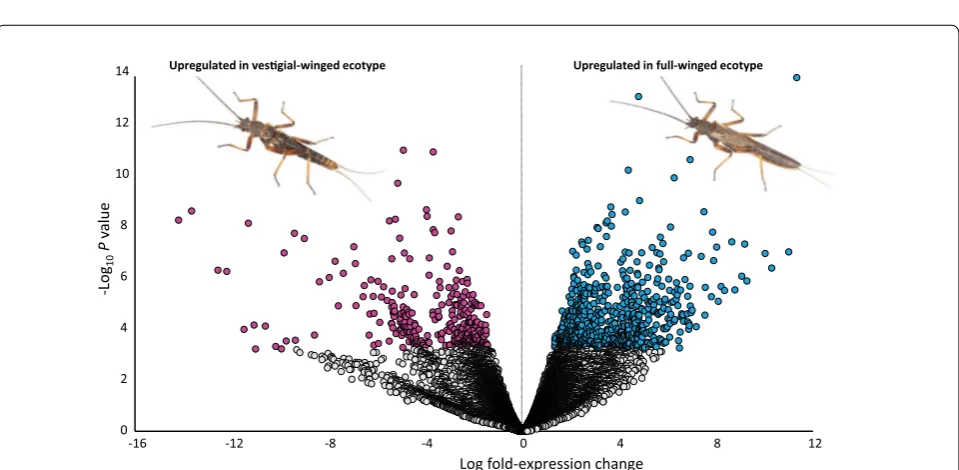
DE analysis identified 1042 clusters differentially expressed at FDR ≤ 0.01 and LogFC ≥ 1.5 or ≤− 1.5. Of the 1042 DE clusters, 511 contained TransDecoder-pre-dicted longest ORFs which were annotated by emapper. Of these, 332 clusters were more abundant in full-winged individuals, whilst 179 clusters were more highly expressed in vestigial-winged notum (Fig. 2). Forty-three clusters were annotated with GO:0035220, biological process ‘wing disc development’; 17 of which were more highly expressed in full-winged notum, whilst 26 were more abundant in vestigial-winged notum. All clusters with FDR ≤ 0.01 and LogFC ≥ 1.5 or ≤− 1.5, including annotations, are provided in Additional file 2: Table S4.
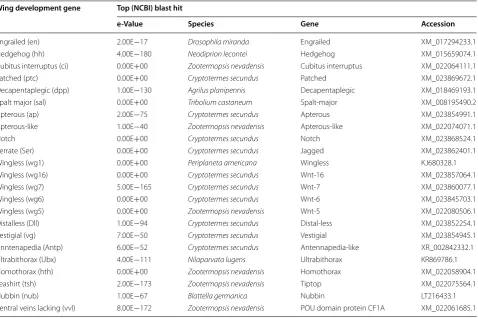
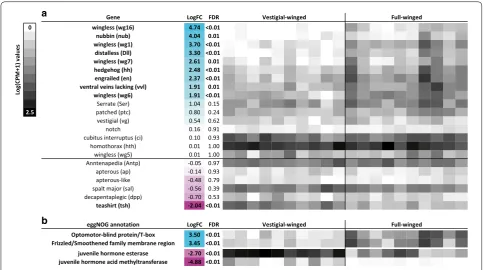
each of the four wing development pathways, as well as homeobox genes (Table 1). As a result of low numbers of reads aligning to the transcripts of one of these clusters, statistics and expression data were available for only 22 clusters. Just over half of these clusters were not signifi-cantly differentially expressed across ecotypes (Fig. 3a). However, nine clusters were significantly more expressed in the notum of full-winged individuals (at FDR ≤ 0.01, LogFC ≥ 1.5), including wingless, nubbin, distalless,
hedgehog, ventral veins lacking, and engrailed (Fig. 3a). By contrast only a single cluster (teashirt) was upregulated in the vestigial-winged ecotype (Fig. 3a). DE analysis also revealed two clusters with known roles in wing develop-ment; optomotor-blind protein and a frizzled receptor family member. Both were more highly expressed in full-winged individuals (Fig. 3b).
In addition to wing development genes (above), a juve-nile hormone acid methyltransferase cluster was identi-fied as differentially expressed between the two ecotypes, being significantly upregulated in the vestigial-winged samples (Fig. 3b). A juvenile hormone esterase cluster was also significantly differentially expressed between vestigial-winged and full-winged ecotypes, being more abundant in vestigial-winged ecotypes (Fig. 3b).
Discussion
In this study, we compared the expression of genes in the notum of full-winged versus vestigial-winged ecotypes of the wing-dimorphic stonefly Zelandoperla fenestrata.
The former specimens had prominent wing-bud devel-opment, whereas the latter did not (Fig. 1). We identi-fied over 20 clusters with significant similarity to genes previously implicated in wing development in Drosophila melanogaster. Over 1000 clusters were significantly dif-ferentially expressed among the two ecotypes, including numerous clusters annotated as genes involved in key wing development pathways (Figs. 2, 3). We discuss the implications of these findings, particularly in reference to identifying the key gene/s potentially involved in wing loss, below.
Some of the clusters with differential expression between full-winged and vestigial-winged forms of Z. fenestrata stoneflies are also critical components of wing patterning in D. melanogaster. While it is unclear how stonefly wing development differs from Drosophila, the key genes appear conserved, and the common ances-try of these insect lineages implies that some aspects of the patterning system are likely conserved, especially those involved in initial patterning. This finding suggests
Table 1 Wing development genes predicted in the notum of vestigial- and full-winged Zelandoperla fenestrata
Wing development gene Top (NCBI) blast hit
e‑Value Species Gene Accession
Engrailed (en) 2.00E−17 Drosophila miranda Engrailed XM_017294233.1
Hedgehog (hh) 4.00E−180 Neodiprion lecontei Hedgehog XM_015659074.1
Cubitus interruptus (ci) 0.00E+00 Zootermopsis nevadensis Cubitus interruptus XM_022064111.1
Patched (ptc) 0.00E+00 Cryptotermes secundus Patched XM_023869672.1
Decapentaplegic (dpp) 1.00E−130 Agrilus planipennis Decapentaplegic XM_018469193.1
Spalt major (sal) 0.00E+00 Tribolium castaneum Spalt-major XM_008195490.2
Apterous (ap) 2.00E−75 Cryptotermes secundus Apterous XM_023854991.1
Apterous-like 1.00E−40 Zootermopsis nevadensis Apterous-like XM_022074071.1
Notch 0.00E+00 Cryptotermes secundus Notch XM_023868524.1
Serrate (Ser) 0.00E+00 Cryptotermes secundus Jagged XM_023862401.1
Wingless (wg1) 0.00E+00 Periplaneta americana Wingless KJ680328.1
Wingless (wg16) 0.00E+00 Cryptotermes secundus Wnt-16 XM_023857064.1
Wingless (wg7) 5.00E−165 Cryptotermes secundus Wnt-7 XM_023860077.1
Wingless (wg6) 0.00E+00 Cryptotermes secundus Wnt-6 XM_023845703.1
Wingless (wg5) 0.00E+00 Zootermopsis nevadensis Wnt-5 XM_022080506.1
Distalless (Dll) 1.00E−94 Cryptotermes secundus Distal-less XM_023852254.1
Vestigial (vg) 7.00E−50 Cryptotermes secundus Vestigial XM_023854945.1
Anntenapedia (Antp) 6.00E−52 Cryptotermes secundus Antennapedia-like XR_002842332.1
Ultrabithorax (Ubx) 4.00E−111 Nilaparvata lugens Ultrabithorax KR869786.1
Homothorax (hth) 0.00E+00 Zootermopsis nevadensis Homothorax XM_022058904.1
Teashirt (tsh) 2.00E−173 Zootermopsis nevadensis Tiptop XM_022075564.1
Nubbin (nub) 1.00E−67 Blattella germanica Nubbin LT216433.1
Fig. 1 Dorsal view of Z. fenestrata nymphs sequenced in this study illustrating the extent of wing-bud development in a the vestigial-winged ecotype, and b the full-winged ecotype. P pronotum, M1 mesonotum, M2 metanotum, W1/W2 wing-buds
0 2 4 6 8 10 12 14
-16 -12 -8 -4 0 4 8 12
Upregulated in vesgial-winged ecotype Upregulated in full-winged ecotype
Log fold-expression change
-Log
10
P
va
lu
e
a remarkable conservation of these key developmen-tal pathways, as the ancestors of Plecoptera and Diptera diverged ca. 400 Ma [4].
About half of these candidate wing-development genes were not significantly differentially expressed across the two ecotypes (Fig. 3a). This result is unsurprising, as many of these genes are highly pleiotropic, having addi-tional important developmental roles [40]. Several key wing-development genes were, however, significantly differentially expressed across vestigial-winged and full-winged ecotypes (Fig. 3a). The prominent wing-buds in the full-winged specimens indicate that wing develop-ment is already well underway; it, therefore, seems likely that the lower expression level of these wing-develop-ment genes in the vestigial-winged ecotype may repre-sent the down-stream consequences of wing reduction, rather than representing the underlying causes of wing reduction.
In Drosophila, three sets of genes act to define the ante-rior–posterior, the dorsoventral and the proximo-distal axes (reviewed by [43, 44]). The anterior–posterior axis is defined by the expression of engrailed [45]. Engrailed
causes the expression of hedgehog [46], which diffuses across the anterior–posterior boundary of the wing, to
activate decapentaplegic [47, 48]. Expression of engrailed
and hedgehog is reduced in vestigial-winged compared to full-winged stoneflies, as is the expression of optomotor
-blind (a gene acting downstream of decapentaplegic), confirming these genes play crucial roles in stonefly wing development.
The dorsoventral axis of the Drosophila wing is pat-terned by wnt signalling molecules, especially wingless
(wg1) [49–52]. Wingless and three other wg molecules (wg 6, 7, and 16) have reduced expression in vestigial-winged stoneflies, as do their receptors, frizzled. A downstream patterning factor responding to wingless,
ventral-veinless (also known as drifter) [53] is also signifi-cantly lower in expression in vestigial-winged stoneflies.
Proximo-distal growth of the Drosophila wing is regu-lated by two key genes, teashirt and nubbin [54]. Nubbin
is down-regulated in vestigial-winged stoneflies, while
teashirt is up-regulated. Teashirt is known to be highly expressed in the notum and wing-hinge of Drosophila
[55], so increased expression was not unexpected in the vestigial-winged nymphs given the slightly higher pro-portion of notum tissue in the vestigial-winged extrac-tions (see Fig. 1). However, this slightly higher proportion of notum tissue is unlikely to explain the fourfold change a
b
in expression we observed (Fig. 3a). While it is not clear what the consequences for wing outgrowth of these changes in gene expression are, they imply mechanisms of proximo-distal axis growth of the wing differ between full-winged and vestigial-winged forms. In Drosophila, repression of teashirt is required for the initiation of wing development [55]. That this gene is upregulated in vestig-ial-winged stoneflies implies that down-regulation may not occur, potentially providing a proximate mechanism (rather than the ultimate cause) of wing reduction.
Differences in gene expression between full-winged versus vestigial-winged forms of stonefly encompass mechanisms that define and pattern all three wing axes, implying that all aspects of wing growth and patterning may be reduced in vestigial-winged stoneflies. Given the relatively rapid evolution of this trait (see [19]), it seems very unlikely that simultaneous changes across all of these networks underlie the causative changes in the evolution of vestigial-winged forms. We, therefore, suggest that the causative changes may lie upstream of wing patterning and growth, perhaps in juvenile hormone (JH) signalling. JHs regulate several key processes in insect physiology [56], and have previously been associated with wing polymor-phism in both Orthoptera [28, 57] and Hemiptera [58, 59].
Two JH pathway clusters were significantly upregulated in the vestigial-winged ecotype, suggesting JH may play a role in modulating wing polymorphism in Z. fenestrata. JH levels in insects can vary both within and across devel-opmental instars, with JH levels typically lower in later instars, but with levels also dropping significantly directly before moulting [56]. Populations of Z. fenestrata may comprise individuals at a variety of developmental stages, as the species has an extended emergence ‘window’ (see [60]). Although the wild-caught nymphs used in this study were all late instars, we were unable to tightly con-trol for their developmental stage, and as a result, some variation in the expression of key JH-related genes might be expected among individuals (e.g. within ecotypes). For instance, the finding that JH acid methyltransferase expression varied substantially among vestigial-winged specimens (Fig. 3b) might potentially reflect minor devel-opmental differences among these specimens. How-ever, there is no evidence for systematic developmental asynchrony among these ecotypes where they co-occur, and indeed there are several localities at which we have simultaneously collected both full-winged and vestigial-winged adults [19, 42]. Systematic differences among ecotypes in the expression of JH-related genes are thus unlikely to result solely from (minor) differences in devel-opmental stage. For instance, JH acid methyltransferase expression is consistently low across all full-winged speci-mens (despite likely developmental variation within this ecotype, see Fig. 3b), but variable among vestigial-winged
individuals. Similarly, JH esterase expression is consist-ently high across all vestigial-winged specimens, but is highly variable in full-winged individuals. In both cases, the extensive differentiation among ecotypes is unlikely to reflect developmental timing, suggesting that the repression of these genes may play an important role in
Z. fenestrata wing development.
In addition to the extensive evidence for effects of JHs on insect wing development, these genes have previ-ously been associated with delayed metamorphosis [61], and variation in several other insect life-history traits (e.g. fecundity; [62]). It is thus conceivable that JH could simultaneously modulate both wing phenotype variation and additional developmental differentiation between high-altitude and low-altitude stonefly lineages (such as differences in body size and emergence timing, see [60, 63]). Future molecular and ecological studies will aim to unravel the potential role of JH in explaining ecotypic var-iation within and among wing-polymorphic stonefly taxa.
Conclusion
Our study reveals differential expression of wing-devel-opment genes between closely related full-winged and vestigial-winged stonefly ecotypes, consistent with pre-vious data from Drosophila, suggesting remarkable con-servation of key wing development pathways throughout 400 Ma of insect evolution. The significant gene expres-sion differentiation observed among stonefly ecotypes potentially provides fertile new directions for future evo-lutionary research on insect wing reduction.
Methods
Sample collection
Late instar Z. fenestrata nymphs were collected by hand from beneath rocks in the stream at an altitude of 670 m in Lug Creek, Rock and Pillar Range, Otago, New Zealand, in July 2017. This site is just above the alpine tree line, and is part of a narrow zone where full-winged and vestigial-winged ecotypes are found in sympatry [19]. Nymphs were stored in containers in water from their natal stream, and kept cool in an ice bath while they were returned to the laboratory. Nymphs were characterised as either full-winged or vestigial-full-winged based on clear differences in wing-bud development (Fig. 1), as previous work has indi-cated that these two wing-bud development types are cor-related with the distinct adult ecotypes [19, 41, 42].
RNA extraction
we instead extracted RNA from the complete notum (including wing-buds) of both ecotypes. This consistent approach allowed us to directly compare gene expres-sion across full-winged and vestigial-winged ecotypes, although we note the ratio of wing-bud tissue to notum tissue differed across vestigial-winged and full-winged specimens (see Fig. 1). Nymphs were immobilised briefly on dry ice, then pinned through the head and abdo-men under a binocular dissection scope before the mes-onotum (M1; Fig. 1) and metanotum (M2; Fig. 1) were removed as a single sample. A shallow incision using a razorblade was made across the dorsal surface between the protonotum and M1. A lateral incision was then made on each side separating M1 and M2 from the meso- and metapleuron. A final incision between M2 and the first tergal segment was used to free M1 and M2. Care was taken to remove any fat bodies or viscera that were attached centrally to M1 or M2 to maintain consistency between samples. Once dissected, the notum samples were immediately frozen on dry ice and stored at − 80 °C.
Tissue was homogenised with hard plastic homogenis-ing probes in RTL buffer (supplied as part of the Qiagen RNeasy kit) using an Omni Tissue Homogenizer. RNA isolation was then completed following the protocol supplied with the RNeasy kit (Qiagen), including an on-column DNAse digestion. Once extracted and washed, samples were eluted with 35 μL of RNAse-free water and then stored at − 80 °C.
Library preparation
The 260/230 and 260/280 ratios were examined using a NanoDrop spectrophotometer (Thermo Scientific), and the concentrations were assessed using a Qubit fluorom-eter (Thermo-Fisher Scientific) with the RNA HS kit. RNA integrity was also assessed on a 1.5% agarose gel after electrophoresis. We used a poly-A capture to select for mRNA, and created a library using a TruSeq Stranded mRNA Library Prep Kit (Illumina), with each individual tagged to separate reads bioinformatically after sequenc-ing. Library quality was assessed using the Agilent 2100 Bioanalyzer and TBS 380 Fluorometer (Turner Bio-systems, Sunny-vale, CA, USA), and all libraries were paired-end sequenced (2 × 125 bp) on a single lane of an Illumina HiSeq 2500.
Transcriptome assembly
The combined vestigial-winged- and full-winged-notum transcriptome was de novo assembled using Trinity v2.8.4 [64, 65]. Reads were quality trimmed using Trim-momatic, run as part of the Trinity package with default settings [66, 67], and normalised in silico prior to assem-bly. Descriptive statistics were calculated using TrinityS-tats.pl. Transcriptome completeness was assessed using
BUSCO v3.0.2 (an arthropod_odb9 database of 1066 BUSCOs covering 60 species; [68, 69]) and RNA-seq read representation following the trinityrnaseq-wiki (github. com/trinityrnaseq/trinityrnaseq/wiki). Transcript clus-ters, clustered using Corset (see below), were quality checked in the same way.
The Trinity transcriptome was annotated using Trino-tate v3.1.1 [70] and associated packages (TransDecoder v5.5.0, SQLite, blast + v, hmmer v3.2.1, Rnammer v1.2, signalP v4.1, tmhmm v2.0, trinotateR). Annotation of differentially expressed clusters (see below) used emap-per-1.0.3 [71] based on eggNOG orthology data [72] with sequence searches performed using HMM and diamond [73, 74]. ‘Contigs of interest’ (i.e. differentially expressed clusters of contigs) were extracted from the Trinity tran-scriptome fasta file using ‘fetchClusterSeqs.py’ script (github.com/Adamtaranto/Corset-tools) and protein sequences predicted using TransDecoder v 5.5.0. Anno-tation of the longest ORFs was performed using emapper and two methods: HMMER, using the arthropod protein database artNOG, and diamond, using the eggNOG pro-tein database.
Identification of differentially expressed transcripts
Differential gene expression between vestigial-winged and full-winged individuals was assessed using Cor-set v1.07 [75] and with read alignment using bowtie2 (v2.3.4.1) with multi-mapping enabled. Statistical analy-sis used edgeR in R i386 3.5.1 [76]. Analysis followed the Corset wiki (github.com/Oshlack/Corset/wiki).
Genes of interest
In addition to identifying differentially expressed genes, expression data for genes with known roles in wing development were sought. Local blast searches were done using Drosophila wing development-related genes and orthologues from the pea aphid, Acyrthosiphon pisum [40], as query terms (taken from the NCBI web-site: http://www.ncbi.nlm.nih.gov), and using BioEdit software [77]. Searches were done against clusters (Cor-set clustered transcripts).
Supplementary information
Supplementary information accompanies this paper at https ://doi.
org/10.1186/s1322 7-019-0135-4.
Additional file 1: Table S1. Recent studies examining the genetic basis for wing development in Pterygota. Table S2. Descriptive statistics for
Zelandoperla fenestrata notum transcriptome. Table S3. Annotation statis-tics for Zelandoperla fenestrata notum transcriptome.
Acknowledgements
We thank Caroline Beck for assisting in the laboratory, and Brodie Fos-ter for assisting with field collections. In addition, we thank Aaron Jeffs (Otago Genomics & Bioinformatics Facility) for conducting the RNA library preparation.
Authors’ contributions
JW, PD and AV designed the study. AV and JW conducted the field work. AV and CE extracted and prepared RNA for RNA-seq. AO, PD, and GM analysed the data. GM wrote the initial draft of the manuscript, with significant input from JW, AO, and PD. All authors read and approved the final manuscript.
Funding
This work was supported by Marsden Contract UOO1412 (Royal Society of New Zealand).
Availability of data and materials
The dataset supporting the conclusions of this article is available in the NCBI repository under BioProject PRJNA525904.
Ethics approval and consent to participate Not applicable.
Consent for publication Not applicable.
Competing interests
The authors declare that they have no competing interests.
Author details
1 Department of Zoology, University of Otago, P.O. Box 56, Dunedin 9054, New
Zealand. 2 Genomics Aotearoa and Department of Biochemistry, University
of Otago, P.O. Box 56, Dunedin 9054, New Zealand. 3 Landcare Research,
Private Bag 92170, Auckland Mail Centre, Auckland 1142, New Zealand.
Received: 12 March 2019 Accepted: 24 August 2019
References
1. Wagner DL, Liebherr JK. Flightlessness in insects. Trends Ecol Evol. 1992;7:216–20.
2. Kingsolver JG, Koehl M. Selective factors in the evolution of insect wings. Annu Rev Entomol. 1994;39:425–51.
3. Daly HV, Doyen JT, Ehrlich PR. Introduction to insect biology and diversity: McGraw-Hill Book Company.; 1978.
4. Misof B, Liu S, Meusemann K, Peters RS, Donath A, Mayer C, et al. Phylog-enomics resolves the timing and pattern of insect evolution. Science. 2014;346:763–7.
5. Medved V, Marden JH, Fescemyer HW, Der JP, Liu J, Mahfooz N, et al. Origin and diversification of wings: insights from a neopteran insect. Proc Natl Acad Sci USA. 2015;112:15946–51.
6. Roff DA. The evolution of flightlessness: is history important? Evol Ecol. 1994;8:639–57.
7. Trautwein MD, Wiegmann BM, Beutel R, Kjer KM, Yeates DK. Advances in insect phylogeny at the dawn of the postgenomic era. Annu Rev Ento-mol. 2012;57:449–68.
8. Roff DA. The evolution of wing dimorphism in insects. Evolution. 1986;40:1009–20.
9. Roff DA, Bradford MJ. Quantitative genetics of the trade-off between fecundity and wing dimorphism in the cricket Allonemobius socius. Heredity. 1996;76:178–85.
10. Roff DA, Fairbairn DJ. Wing dimorphisms and the evolution of migratory polymorphisms among the Insecta. Am Zool. 1991;31:243–51. 11. Zera AJ, Denno RF. Physiology and ecology of dispersal polymorphism in
insects. Annu Rev Entomol. 1997;42:207–30.
12. Vogler AP, Timmermans MJ. Speciation: don’t fly and diversify? Curr Biol. 2012;22:R284–6.
13. Harrison RG. Dispersal polymorphisms in insects. Annu Rev Ecol Syst. 1980;11:95–118.
14. Roff DA. Habitat persistence and the evolution of wing dimorphism in insects. Am Nat. 1994;144:772–98.
15. Denno RF, Roderick GK, Peterson MA, Huberty AF, Dobel HG, Eubanks MD, et al. Habitat persistence underlies intraspecific variation in the dispersal strategies of planthoppers. Ecol Monogr. 1996;66:389–408.
16. Roff DA. The evolution of flightlessness in insects. Ecol Monogr. 1990;60:389–421.
17. Hodkinson ID. Terrestrial insects along elevation gradients: species and community responses to altitude. Biol Rev. 2005;80:489–513. 18. McCulloch GA, Foster BJ, Ingram T, Waters JM. Insect wing loss is tightly
linked to the treeline: evidence from a diverse stonefly assemblage. Ecography. 2019;42:811–3.
19. McCulloch GA, Foster BJ, Dutoit L, Ingram T, Hay E, Veale AJ, et al. Ecologi-cal gradients drive insect wing loss and speciation: the role of the alpine treeline. Mol Ecol. 2019;28(13):3141–50.
20. McCulloch GA, Wallis GP, Waters JM. Do insects lose flight before they lose their wings? Population genetic structure in subalpine stoneflies. Mol Ecol. 2009;18:4073–87.
21. Dussex N, Chuah A, Waters JM. Genome-wide SNPs reveal fine-scale dif-ferentiation among wingless alpine stonefly populations and introgres-sion between winged and wingless forms. Evolution. 2016;70:38–47. 22. Van Belleghem SM, Roelofs D, Hendrickx F. Evolutionary history of a
dispersal-associated locus across sympatric and allopatric divergent populations of a wing-polymorphic beetle across Atlantic Europe. Mol Ecol. 2015;24:890–908.
23. Aukema B. Wing-length determination in two wing-dimorphic Calathus
species (Coleoptera: Carabidae). Hereditas. 1990;113:189–202. 24. Jackson DJ. XXVII.—The inheritance of long and short wings in the
wee-vil, Sitona hispidula, with a discussion of wing reduction among beetles. Earth Environ Sci. 1928;55:665–735.
25. Lindroth CH. Inheritance of wing dimorphism in Pterostichus anthracinus
Ill. Hereditas. 1946;32:37–40.
26. Harrison R. Flight polymorphism in the field cricket Gryllus pennsylvanicus. Oecologia. 1979;40:125–32.
27. Rose D. Dispersal and quality in populations of Cicadulina species (Cicadellidae). J Anim Ecol. 1972;1:589–609.
28. Zera AJ. The endocrine regulation of wing polymorphism in insects: state of the art, recent surprises, and future directions. Integr Comp Biol. 2003;43:607–16.
29. Lin X, Yao Y, Wang B, Emlen DJ, Lavine LC. Ecological trade-offs between migration and reproduction are mediated by the nutrition-sensitive insulin-signaling pathway. Int J Biol Sci. 2016;12:607–16.
30. Xu H-J, Xue J, Lu B, Zhang X-C, Zhuo J-C, He S-F, et al. Two insulin receptors determine alternative wing morphs in planthoppers. Nature. 2015;519:464–7.
31. Honěk A. Factors and consequences of a non-functional alary polymor-phism in Pyrrhocoris apterus (Heteroptera: Pyrrhocoridae). Res Popul Ecol. 1995;37:111–8.
32. Zhou X, Chen J, Shike Liang M, Wang F. Differential DNA methylation between two wing phenotypes adults of Sogatella furcifera. Genesis. 2013;51:819–26.
33. Liang S-K, Liang Z-Q, Zhou X-S, Chen J-L, Li G-H, Wang F-H. CpG methyl-ated ribosomal RNA genes in relation to wing polymorphism in the rice pest Sogatella furcifera. J Asia-Pac Entomol. 2015;18:471–5.
34. Williams JA, Carroll SB. The origin, patterning and evolution of insect appendages. BioEssays. 1993;15:567–77.
35. Azpiazu N, Morata G. Function and regulation of homothorax in the wing imaginal disc of Drosophila. Development. 2000;127:2685–93.
36. Consortium TGS. The genome of the model beetle and pest Tribolium castaneum. Nature. 2008;452:949–55.
37. Weatherbee SD, Nijhout HF, Grunert LW, Halder G, Galant R, Selegue J, et al. Ultrabithorax function in butterfly wings and the evolution of insect wing patterns. Curr Biol. 1999;9:109–15.
38. Abouheif E, Wray GA. Evolution of the gene network underlying wing polyphenism in ants. Science. 2002;297:249–52.
•fast, convenient online submission
•
thorough peer review by experienced researchers in your field
• rapid publication on acceptance
• support for research data, including large and complex data types
•
gold Open Access which fosters wider collaboration and increased citations maximum visibility for your research: over 100M website views per year
•
At BMC, research is always in progress.
Learn more biomedcentral.com/submissions
Ready to submit your research? Choose BMC and benefit from: salt marsh beetle Pogonus chalceus (Coleoptera, Carabidae). PLoS ONE.
2012;7:e42605.
40. Brisson JA, Ishikawa A, Miura T. Wing development genes of the pea aphid and differential gene expression between winged and unwinged morphs. Insect Mol Biol. 2010;19:63–73.
41. McLellan ID. A revision of Zelandoperla Tillyard (Plecoptera: Gripopterygi-dae: Zelandoperlinae). New Zeal J Zool. 1999;26:199–219.
42. Veale AJ, Foster BJ, Dearden PK, Waters JM. Genotyping-by-sequencing supports a genetic basis for alpine wing-reduction in a New Zealand stonefly. Sci Rep. 2018;8:16275.
43. de Celis JF. Pattern formation in the Drosophila wing: the development of the veins. BioEssays. 2003;25:443–51.
44. Klein T. Wing disc development in the fly: the early stages. Curr Opin Genet Dev. 2001;11:470–5.
45. Bate M, Arias AM. The embryonic origin of imaginal discs in Drosophila. Development. 1991;112:755–61.
46. Guillén I, Mullor JL, Capdevila J, Sánchez-Herrero E, Morata G, Guerrero I. The function of engrailed and the specification of Drosophila wing pat-tern. Development. 1995;121:3447–56.
47. Tanimoto H, Itoh S, ten Dijke P, Tabata T. Hedgehog creates a gradient of DPP activity in Drosophila wing imaginal discs. Mol Cell. 2000;5:59–71. 48. Zecca M, Basler K, Struhl G. Sequential organizing activities of engrailed,
hedgehog and decapentaplegic in the Drosophila wing. Development. 1995;121:2265–78.
49. Cadigan KM, Fish MP, Rulifson EJ, Nusse R. Wingless repression of Dros-ophila frizzled 2 expression shapes the Wingless morphogen gradient in the wing. Cell. 1998;93:767–77.
50. Couso JP, Bate M, Martinez-Arias A. A wingless-dependent polar coordi-nate system in Drosophila imaginal discs. Science. 1993;259:484–9. 51. Neumann CJ, Cohen SM. Long-range action of Wingless
organ-izes the dorsal-ventral axis of the Drosophila wing. Development. 1997;124:871–80.
52. Ng M, Diaz-Benjumea FJ, Vincent J-P, Wu J, Cohen SM. Specification of the wing by localized expression of wingless protein. Nature. 1996;381:316–8. 53. Certel K, Hudson A, Carroll SB, Johnson WA. Restricted patterning of
vestigial expression in Drosophila wing imaginal discs requires synergistic activation by both Mad and the drifter POU domain transcription factor. Development. 2000;127:3173–83.
54. Zirin JD, Mann RS. Nubbin and Teashirt mark barriers to clonal growth along the proximal–distal axis of the Drosophila wing. Dev Biol. 2007;304:745–58.
55. Wu J, Cohen SM. Repression of Teashirt marks the initiation of wing development. Development. 2002;129:2411–8.
56. Nijhout H. Insect hormones. Princeton: Princeton University Press; 1994. p. 267.
57. Zera AJ. Juvenile Hormone and the endocrine regulation of wing polymorphism in insects: new insights from circadian and functional-genomic studies in Gryllus crickets. Physiol Entomol. 2016;41:313–26. 58. Braendle C, Davis GK, Brisson JA, Stern DL. Wing dimorphism in aphids.
Heredity. 2006;97:192–9.
59. Ishikawa A, Gotoh H, Abe T, Miura T. Juvenile hormone titer and wing-morph differentiation in the vetch aphid Megoura crassicauda. J Insect Physiol. 2013;59:444–9.
60. McCulloch GA, Waters JM. Testing for seasonality in alpine streams: how does altitude affect freshwater insect life cycles? Freshw Biol. 2018;63:483–91.
61. Riddiford LM. Juvenile hormone-induced delay of metamorphosis of the viscera of the cecropia silkworm. Biol Bull. 1975;148:429–39.
62. Flatt T, Kawecki TJ. Juvenile hormone as a regulator of the trade-off between reproduction and life span in Drosophila melanogaster. Evolu-tion. 2007;61:1980–91.
63. McCulloch GA, Waters JM. Does wing reduction influence the relation-ship between altitude and insect body size? A case study using New Zealand’s diverse stonefly fauna. Ecol Evol. 2018;8:953–60.
64. Grabherr MG, Haas BJ, Yassour M, Levin JZ, Thompson DA, Amit I, et al. Trinity: reconstructing a full-length transcriptome without a genome from RNA-Seq data. Nat Biotechnol. 2011;29:644–52.
65. Haas BJ, Papanicolaou A, Yassour M, Grabherr M, Blood PD, Bowden J, et al. De novo transcript sequence reconstruction from RNA-seq using the Trinity platform for reference generation and analysis. Nat Protoc. 2013;8:1494.
66. Bolger AM, Lohse M, Usadel B. Trimmomatic: a flexible trimmer for Illu-mina sequence data. Bioinformatics. 2014;30:2114–20.
67. MacManes MD. On the optimal trimming of high-throughput mRNA sequence data. Front Genet. 2014;5:13.
68. Waterhouse RM, Seppey M, Simão FA, Manni M, Ioannidis P, Klioutchnikov G, et al. BUSCO applications from quality assessments to gene prediction and phylogenomics. Mol Biol Evol. 2017;35:543–8.
69. Simão FA, Waterhouse RM, Ioannidis P, Kriventseva EV, Zdobnov EM. BUSCO: assessing genome assembly and annotation completeness with single-copy orthologs. Bioinformatics. 2015;31:3210–2.
70. Bryant DM, Johnson K, DiTommaso T, Tickle T, Couger MB, Payzin-Dogru D, et al. A tissue-mapped axolotl de novo transcriptome enables identifi-cation of limb regeneration factors. Cell Rep. 2017;18:762–76.
71. Huerta-Cepas J, Forslund K, Coelho LP, Szklarczyk D, Jensen LJ, von Mer-ing C, et al. Fast genome-wide functional annotation through orthology assignment by eggNOG-mapper. Mol Biol Evol. 2017;34:2115–22. 72. Huerta-Cepas J, Szklarczyk D, Forslund K, Cook H, Heller D, Walter MC,
Rattei T, Mende DR, Sunagawa S, Kuhn M, Jensen LJ. eggNOG 4.5: a hierarchical orthology framework with improved functional annota-tions for eukaryotic, prokaryotic and viral sequences. Nucleic Acids Res. 2015;20:D286–93.
73. Buchfink B, Xie C, Huson DH. Fast and sensitive protein alignment using DIAMOND. Nat Methods. 2015;12:59–60.
74. Eddy SR. Accelerated profile HMM searches. PLoS Comput Biol. 2011;7:e1002195.
75. Davidson NM, Oshlack A. Corset: enabling differential gene expres-sion analysis for de novo assembled transcriptomes. Genome Biol. 2014;15:410.
76. Robinson MD, McCarthy DJ, Smyth GK. edgeR: a Bioconductor package for differential expression analysis of digital gene expression data. Bioin-formatics. 2010;26:139–40.
77. Hall TA. BioEdit: a user-friendly biological sequence alignment editor and analysis program for Windows 95/98/NT. Nucleic Acids Symp Ser. 1999;41:95–8.
Publisher’s Note