MIDDLEWARE ARCHITECTURE FOR NATIONAL
ELECTRONIC ID CARD: THE CASE OF E-KTP IN
INDONESIA
1
DEDY RAHMAN WIJAYA
1 Telkom University, Telkom Applied Science School, Department of Information Technology, Bandung
E-mail: 1dedyrw@tass
.
telkomuniversity.ac.id, [email protected]ABSTRACT
Since a few years ago Indonesian government began to perform the application of the concept of the internet of things (IoT). Application of the IoT by the Indonesian government aims to provide ease in identification of people or objects and their attributes so it can be used as reference data in their policy or implement some rules. Some programs have been implemented such as e-KTP (e-ID Card) program, subsidized fuel control system using Radio Frequency Identification (RFID) technology, and electronic ticketing system for electric railways. Start from 2011, Indonesia Government has been implementing RFID technology for e-Identification. This program is called e-KTP which aims to realize single ID and establish complete and accurate demographic database. Indonesian e-KTP card store demographic data consisting of biographical data, signature, photograph, biometrics, and other data related to aspects of data security and card management. e-KTP refers to the standard ISO/IEC 14443A/B that works at a frequency 13,56 MHz. However, utilization of the e-KTP card is still not optimal because its utilization is not much different from the conventional ID card. This study will be discussed regarding the design and implementation of e-KTP middleware. This middleware architecture can be adopted by government or private agencies to improve their services by conduct the data collecting of customer transactions by linking the e-KTP card with the enterprise database with the specific rules. Thus the Indonesian people have truly single ID that can be used for many purposes such as for health care system, attendance management system, electronic payment system, and so on.
Keywords: Internet of Things, Radio Frequency Identification, e-KTP, Middleware, Single ID
1. INTRODUCTION
The Internet of Things (IoT) is a novel paradigm that is rapidly gaining ground in the scenario of modern wireless telecommunications. The basic idea of this concept is the pervasive presence around us of a variety of things or objects – such as
Radio-Frequency Identification (RFID) tags,
sensors, actuators, mobile phones, etc. – which, through unique addressing schemes, are able to interact with each other and cooperate with their neighbors to reach common goals [1]. Whereas according to [5] IoT defined as “Things having identities and virtual personalities operating in smart spaces using intelligent interfaces to connect and communicate within social, environmental, and user contexts”.
Some enabling technologies of IoT are RFID and middleware [4]. Radio frequency identification (RFID) is a generic term that is used to describe a system that transmits the identity (in the form of a unique serial number) of an object or person wirelessly, using radio waves. It's grouped under the broad category of automatic identification technologies [11]. In a distributed computing system, middleware is defined as the software layer that lies between the operating system and the applications on each site of the system. The role of middleware is to make application development easier by providing programming abstraction in
general to hide the diversity,
Currently, implementations IoT concept in Indonesia have been growing. Some of them are the application of RFID technology such as e-KTP (e-ID Card) program, subsidized fuel control system using Radio Frequency Identification (RFID) technology, and electronic ticketing system for electric railways. Application of the IoT by the Indonesian government aims to provide ease in identification of people or objects and their attributes so it can be used as reference data in their policy or implement some rules.
Until now, the government is still trying to implement the e-KTP for e-ID card that all of Indonesian citizens can have an e-KTP card. Utilization of e-KTP card itself it is still not optimal so that almost no difference with the old or conventional ID card. The RFID chip in the e-KTP card can be utilized for various purposes, especially for the improvement of service to the society. The e-KTP card is a type of Proximity Smart Cards that works at a frequency of 13.56 MHz with a reading distance of about 10 cm. The standard used in this technology is ISO/IEC 14443 A/B [10]. Basically potential of the e-KTP technology itself is very large. The e-KTP card can be used for public health care system (e-Health), the electronic payment system (e -Payment), and many others.
This research will be discussed regarding the design and development of middleware for ISO/IEC 14443 A/B in particular e-KTP card with the primary purpose is the use of e-KTP cards that can be used by government and private agencies to improve their services to the public. Some related research conducted by Jihyun Yoo and Yongjin Park is about middleware platform for logistics systems [3] , in the another research Yi - Wei Ma explained in his writings about the RFID middleware load balancing mechanism to reduce the processing time and packet lost ratio [12] . There is also research to create efficient data processing to handle large amounts of data so as to avoid duplication of data and identify valid data [8]. Other studies have attempted to define the
functional requirements of middleware and
compare several existing middleware based on the needs of the market [2] .
2. RFID MIDDLEWARE
2.1 RFID Middleware Architecture
According to [9] IoT middleware must has the functional components are as interoperation,
context detection, device discovery and
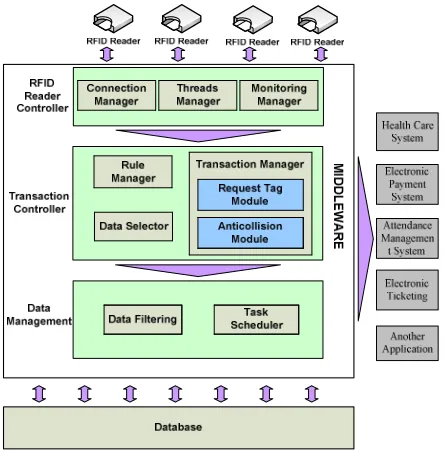
[image:2.612.313.535.242.467.2]management, security and privacy, and managing data volume. In his research Sun Pei-Ran, RFID middleware categorize into three types: One-to-one RFID middleware, One-to-many RFID middleware, and Many-to-many RFID middleware [7]. In this works the category of middleware that will be developed is a One-to-many RFID middleware which is connected with many of the RFID Reader. This configuration is chosen for reasons of ease of management as well as more efficient in terms of resources. Developed middleware architecture can be seen in Figure 1 below:
Figure 1:High Frequency RFID Middleware Architecture for e-KTP
RFID Middleware is developed consisting of three main parts:
1. RFID Reader Controller
This section is a section that deals directly with the RFID Reader. RFID Reader controller section is divided into several modules, such as:
a. Connection manager.
This module serves to create and manage connections with RFID Reader devices. RFID Reader that will be used must be registered first so that when the middleware run, they can automatically connect. Likewise when the newly installed RFID Reader registered then middleware can automatically detected the new RFID reader. b. Threads Manager
serves to regulate how devices are managed by a thread.
c. Monitoring Manager
Function of monitoring manager is to periodically check the connection between the middleware with all RFID reader. In the event of disruption to connections then this module will change the status to offline and sends an alert to the administrator via SMS and Email.
2. Transaction Controller
Transaction controller is part which organize transaction conducted through the RFID Reader for example whether a transaction is valid or not and how response of RFID Reader to inform the user about the status of transactions that have been carried out. This part consists of several modules as follows:
a. Rule Manager
Rule manager consist of set of rules for determine status of a transaction. It also has set of routines that we can manage, for example we can add or activate rule for reject the tag that not registered in the system.
b. Data Selector
The role of data selector is conduct to initial transaction data filtering. Data selector works based on set of rules which define by rule manager. c. Transaction Manager
The function of transaction manager is sending the command to RFID Reader for read the data on the tag. The data that read is the UID of each tag, UID chosen because it is unique so impossible duplicated in conducting the identification of tag. In addition UID can only be read and its value can’t be changed so more secure from counterfeiting. Such is the value of the UID can be read by unauthorized parties then the meaning of the code can’t be understood because all the data associated with this UID is stored in a database server. The transaction manager also organizes the transaction process so as not to clash / collision in the event of reading more than one tag at a time (anti-collision).
3. Data Management
Data management is a further part of the transaction data set management.
a. Data Filtering
The function of this module is to compile transaction data that has been entered. Transaction data is usually stored temporarily in a semi-permanent tables that will be further processed for certain purposes. It is useful to distinguish between transactional data with historical data in order to
improve system performance. Data filtering module can be a block PL / SQL or a routine program. b. Task Scheduler
Task scheduler is a module to schedule execution of data filtering module periodically.
3. TESTING AND IMPLEMENTATION
3.1 Test Scenario
From the design and prototype of middleware that have been created, testing has been conducted
focusing on RFID Reader Controller and
Transaction Manager by measuring the time
required transactions. While for the data
management part is not taken into transaction time because of the time required in this section varies greatly depending on the complexity of the data filtering rules and timescales in the task scheduler. In addition this section is intended to run separately with another section (offline).
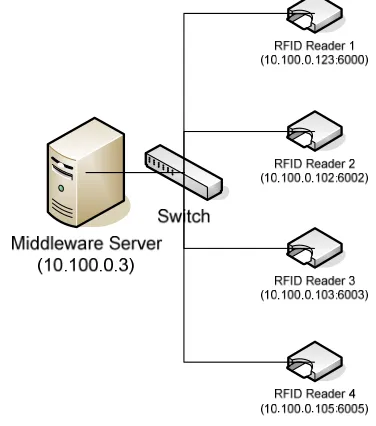
[image:3.612.323.511.390.603.2]The testing scheme is performed with four RFID Reader connect simultaneously with middleware using TCP/IP protocol. The testing scheme can be seen in Figure 2 below:
Figure 2: The testing scheme
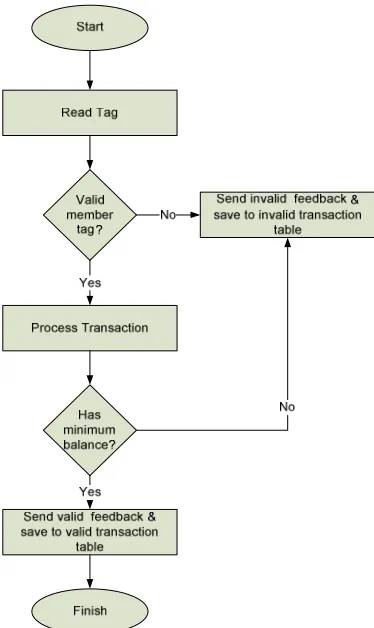
Scenario tests conducted are simulations for electronic ticketing system. Rule manager will check whether the RFID tags are used member or not. If the RFID tag is valid then the system will check if the member still has a balance above the minimum or not. The flow diagram can be seen in Figure 3 below:
Figure 3: Simulation for electronic ticketing system rules
3.2 Prototype of Middleware and Testing Result
The testing environment has been configured in accordance with the planned test scenarios as shown in the figure 4. Every RFID Reader has a unique IP address and communication port to communicate with the middleware which installed on the notebook. Tests performed on isolated network to minimize disruption and noise. There are three threads are used to handle the four RFID Reader.
Figure 4:The testing environment
[image:4.612.100.287.184.498.2]Testing has been done with the transaction simultaneously on four RFID readers. No error occurred and middleware are still very stable despite running more than six hours which can be seen in Figure 5. This middleware stores information about the UID tag, device address, and time of the transaction.
Figure 5: e-KTP RFID Middleware
[image:4.612.313.534.375.515.2]Test results can be seen in Table 1 that the average transaction time for all reader is 37.175825 ms.
Table 1: Testing result
RFID Reader Number of
Transaction
Average Time (milisecond)
Reader-1 34 37.6471
Reader-2 35 36.9714
Reader-3 38 35.9737
Reader-4 36 38.1111
[image:4.612.307.518.570.654.2]4. CONCLUSION
This work has resulted in the proposed architecture and a prototype middleware for e-KTP. By adopting this architecture, the use of e-KTP cards especially in Indonesia will be more comprehensive, especially for improving public services. Architecture and prototype of the middleware can be used by government or private agencies to take advantage of the e-KTP card by conduct the data collecting of customer transactions by linking the e-KTP card with the enterprise database with the specific rules. Thus the Indonesian people really have a single-id that can be used for various purposes such as the health care system, attendance management system, electronic ticketing system, payment system services, and so on.
REFERENCES:
[1]. D. Giusto, A. Iera, G. Morabito, L. Atzori.
"The Internet of Things." (Springer) 2010.
[2]. Jameela Al-Jaroodi, NaderMohamed.
"Service-oriented middleware:A survey." Journal of Network and ComputerApplications, 2012.
[3]. Jihyun Yoo, Yongjin Park. "An Intelligent
Middleware Platform and Framework for RFID Reverse Logistics." International Journal of
Future Generation Communication and
Networking.
[4]. Luigi Atzori, Antonio Iera, Giacomo Morabito.
"The Internet of Things: A survey." Edited by E. Ekici. Computer Networks (Elsevier) 54 (2010): 2787–2805.
[5]. NANOSYSTEMS, INFSO D.4
NETWORKED ENTERPRISE & RFID
INFSO G.2 MICRO &. Internet of Things in 2020: Roadmap for The Future. Vol. 1.1. European Commission Information Society and Media, 2008.
[6]. objectweb. 7 2013.
http://middleware.objectweb.org (accessed 7 21, 2013).
[7]. Pei-Ran, Sun. "Radio frequency identification
(RFID) middleware service based on service-oriented architecture." African Journal of Business Management 6 (February 2012): 2248-2254.
[8]. Sih-Ying Li, Hsu-Yang Kung, Chi-Hua Chen,
Wen-Hsi Lydia Hsu. "An Efficient RFID Data Processing Scheme for Data Filtering and Recognition." International Journal of u- and e- Service, Science and Technology V (June 2012).
[9]. Soma Bandyopadhyay, Munmun Sengupta,
Souvik Maiti and Subhajit Dutta. "Role Of Middleware For Internet Of Things: A Study." International Journal of Computer Science & Engineering Survey (IJCSES), 2011.
[10]. Husni Fahmi, Hammam Riza, Gembong
Wibowanto, Anto Satriyo Nugroho.
"Rancangan TIK untuk Penerapan KTP Elektronik secara Nasional." International Conference on Chief Information Officer (ICCIO). Bandung, 2010.
[11]. www.rfidjournal.com.
http://www.rfidjournal.com (accessed 12 7, 2013).
[12]. Yi-Wei Ma, Han-Chieh Chao, Jiann-Liang
Chen, Cheng-Yen Wu. "Load-balancing
mechanism for the RFID middleware