www.wjpr.net Vol 3, Issue 3, 2014. 4527
DEVELOPMENT AND VALIDATION OF STABILITY INDICATING
HPLC METHOD FOR ESTIMATION OF
RAMOSETRON HCl
Zarana M Patel*, Mr. Darshil B. Shah, Dr. Dilip G Maheshwari.
Department Of Quality Assurance, L.J. Institute Of Pharmacy, Ahmedabad-382 210.
ABSTRACT
A simple, specific, accurate, and stability indicating high-performance liquid chromatographic method was developed for the determination of Ramosetron HCl, using a Enamel C18 column and a mobile phase composed of Methanol:Water (50:50). The retention time of Ramosetron HCl found to be 3.59 min. Linearity was established for of Ramosetron HCl in the range of 200-600 ng/ ml. The percentage recoveries of was found to be in the range of 98.33-98.86 %. The drug was subjected to acid and base hydrolysis, oxidation, photolytic, and thermal degradation conditions. The degradation products of Ramosetron HCl were well resolved from the pure drug with
significant differences in their retention time values. This method can be successfully employed for quantitative analysis of Ramosetron HCl in pure and tablet.
Key words: Ramosetron HCl, degradation products, stability - indicating method, HPLC.
INTRODUCTION
Ramosetron HCl (6R)-6-(1-methyl-1H-indole-3-carbonyl)-4,5,6,7-tetrahydro-1H-1,3-benzodiazole hydrochloride. It is a white crystalline, soluble in water and Methanol. Ramosetron is a 5-HT3 receptor antagonist. It exerts its antiemetic property by blocking of serotonin to 5-HT3 receptors present in the afferent vagal nerve-endings in the GI mucosa. Ramosetron HCl is not official in any pharmacopoeia. Several analytical methods that have been reported for the estimation of Ramosetron HCl in biological fluids include HPLC Method. The objective of the work was to develop simple, accurate, precise and economic Stability indicating RPHPLC method development and validation for the estimation of Ramosetron HCl in pharmaceutical dosage form.
Article Received on 08 March 2014,
Revised on 30 March 2014, Accepted on 23April 2014
*Correspondence for Author Zarana M Patel
www.wjpr.net Vol 3, Issue 3, 2014. 4528 MATERIALS AND METHOD
MATERIALS
Pure sample of Ramosetron HCl was obtained from Cadila Healthcare Ltd, Ahmedabad, Gujarat, India. The commercial pharmaceutical preparation Ibset containing 5µg of Ramosetron HCl were procured from local pharmacy. All reagents were obtained from Merck chem Ltd, India. High purity deionised water was obtained from [Millipore, Milli-Q] purification system.
METHODS
Preparation of Solution
Preparation of mobile phase
Mobile Phase comprising Water: Methanol in the ratio of 50:50. Mobile phase was prepared by mixing 500mL Methanol and 500 ml Water
Preparation of Stock Solution
Accurately weighed 10mg of Ramosetron HCl was transferred to volumetric flask and make up volume with Methanol and Water up to10ml (1000µg/ml).
Preparation of Sample Solution
From the stock solution 0.1 ml was taken and diluted up to 10 ml with Methanol and Water (10 µg/ml).
Preparation Of Diluent
Diluent was prepared by using 500 ml methanol, 500 ml water. This mixture was sonicated and filtered through 0.45 µm membrane filter and used as a diluents.
Table 1: Instruments and Apparatus Detail
Name Company Model No.
UV spectrophotometer Shimadzu UV-1800 HPLC Shimadzu LC 20 AT FTIR spectrometer Nicolet 6700
Weighing balance Shimadzu AUX 220 pH meter Elico LI 127
EXPERIMENTAL SECTION
Calibration curves of Ramosetron HCl
www.wjpr.net Vol 3, Issue 3, 2014. 4529 Analysis of dosage form
Twenty tablets were weighed their mean weight determined, and crushed in mortar. An amount of powdered mass equivalent to one tablet content was transferred into a 10ml volumetric flask containing of Methanol and Water, mechanically shaken for 10 min, ultrasonicated for 5 min, and then diluted to volume with Methanol and Water.
RESULTS AND DISCUSSION Forced degradation study
Acid Degradation: Take 1 ml of Ramosetron HCl from Standard stock solution into 10 ml of volumetric flask; add 1.0 ml of 1N HCl, kept at room temp. for 6 hr., after that neutralized with 1 ml of 1N NaOH solution, shake solution for 5 min., make up volume up to the mark with diluent, and then go for HPLC analysis.
0.0 1.0 2.0 3.0 4.0 5.0 6.0 7.0min -20
-10 0 10 20 30 40 50
mAU
[image:3.595.164.432.320.471.2]213nm,4nm (1.00)
Fig 1: Chromatogram of Acid degradation
Alkali Degradation: Take 1ml of Ramosetron HCl from Standard stock solution into 10 ml of volumetric flask; add 1.0 ml of 0.1N NaOH, kept at room temp. for 10 min., after that neutralized with 1 ml of 1N HCl solution, shake solution for 5 min., make up volume up to the mark with diluent, and then go for HPLC analysis.
0.0 1.0 2.0 3.0 4.0 5.0 6.0 7.0 8.0 9.0 10.0 11.0 min 0
25 50 75
mAU
213nm4nm (1.00)
[image:3.595.164.432.593.734.2]www.wjpr.net Vol 3, Issue 3, 2014. 4530 Oxidative Degradation: Take 1 ml of Ramosetron HCl from Standard stock solution into 10 ml of volumetric flask; add 1.0 ml of 3% H2O2 kept at room temp for 1 hr, shake solution for 5 min., make up volume up to the mark with diluent, and then go for HPLC analysis.
Photolytic Degradation: Take 1 ml of Ramosetron HCl from Standard stock solution in to 10 ml of volumetric flask and kept in U.V chamber 6 hr., after that shake solution for 5 min., make up volume up to the mark with diluent, and then go for HPLC analysis.
0.0 1.0 2.0 3.0 4.0 5.0 6.0 7.0 min -10
0 10 20 30 40 50
mAU
[image:4.595.165.431.216.363.2]213nm,4nm (1.00)
Fig 3: Chromatogram of Photolytic Degradation
Thermal Degradation: Take 1 ml of Ramosetron HCl from Standard stock solution into 10 ml of volumetric flask and kept in 70ºC for 24 hr., after that shake solution for 5 min., make up volume up to the mark with diluent, and then go for HPLC analysis.
0.0 1.0 2.0 3.0 4.0 5.0 6.0 7.0 min -10
0 10 20 30 40 50
mAU
213nm4nm (1.00)
Fig 4: Chromatogram of Photolytic Degradation
Chromatographic conditions
[image:4.595.161.432.474.619.2]www.wjpr.net Vol 3, Issue 3, 2014. 4531 Selection of Mobile Phase
After assessing the solubility of drug in different solvent as well on the basis of literature Survey; the mobile phase was selected is the mixture of Methanol:Water (50:50)
Selection of Detector and Detection Wavelength
UV detector was selected, as it is reliable and wavelength was set to 213nm.
Table 2: Result of System Suitability for Assay Method Theoretical plate 2262.386 Tailing Factor 1.57 Retention time 3.59 min
Table 3: Summary of Force degradation study of Ramosetron HCl
Sr.No.
Condition %Degradation Remark
1 Acid Degradation (1N HCl)
15.52 Degradation observed
2 Alkali Degradation (0.1N NaOH)
25.27 Degradation observed
3 Peroxide Degradation (3% H2O2) v/v
4.32 Less Degradation Observed
4 Photolytic Degradation
15.17 Degradation observed
5 Thermal Degradation (70oC)
15.43 Degradation observed
Stability indicating assay: Degradation was observed for Ramosetron HCl sample during stress conditions like acid, alkaline, Oxidative, Photolytic, and in thermal condition. Graph shows test results confirmed Ramosetron HCl peak is homogeneous in all the stress
Sample Chromatogram
0.0 1.0 2.0 3.0 4.0 5.0 6.0 7.0 min -10
0 10 20 30 40 50 60
mAU
[image:5.595.168.430.587.730.2]213nm,4nm (1.00)
www.wjpr.net Vol 3, Issue 3, 2014. 4532 VALIDATION OF METHOD
[image:6.595.150.443.106.288.2]Linearity, LOD & LOQ
Fig 6: Calibration Curve of Ramosetron HCl (200 – 600ng) for Assay Method
ACCURACY
Table 5: Result of Accuracy for Assay Method
Drug
Test amount (ng/ml)
Spiked STD amount
(ng/ml)
Total amount (ng/ml)(n=3)
Amount found (ng/ml)
% Recovery Ramosetron
HCl 200
160 360 354 98.33 200 400 396 99 240 440 435 98.86
PRECISION
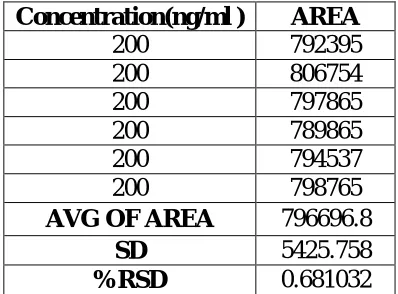
Method Precision (Repeatability)
Table 6:- Result of Method Precision (Repeatability) for Assay Method
Concentration(ng/ml ) AREA 200 792395 200 806754 200 797865 200 789865 200 794537 200 798765 AVG OF AREA 796696.8
SD 5425.758
[image:6.595.198.397.560.707.2]www.wjpr.net Vol 3, Issue 3, 2014. 4533 Table 7: Intraday Precision of Ramosetron HCl
Drug Conc. (ng/ml)
Area
Average SD %RSD
1 2 3
Ramosetron HCl
300 1257561 1284362 1267653 1269859 11052.06 0.870338 400 1795754 1774745 1753432 1774644 17278.03 0.973606 500 2087695 2065421 2033526 2062214 22230.37 1.077985
Table 8: Interday Precision of Ramosetron HCl
Drug Conc.
(µg/ml)
Area
Average SD %RSD
D1 D2 D3
Ramosetron HCl
300 1250274 1285478 1267876 1267876 14371.97 1.133547 400 1753776 1756987 1798654 1769806 20440.93 1.154982 500 2192598 2195674 2134765 2174346 28015.92 1.288476
Table 9: Change Flow Rate of Ramosetron HCl
Drug Flow Rate
(ml/min) Area Average SD %RSD Ramosetron
HCl
0.9(ml) 806754 815436 809756 810648.7 3600.178 0.444111 1.0(ml) 792395 795643 789654 792564 2447.918 0.308861 1.1(ml) 776532 769854 769875 772087 3143.101 0.407092 Table 10: Change Mobile Phase Ratio of Ramosetron HCl
Drug Ratioof
Mobile Phase Area Average SD %RSD Ramosetron
HCl
[image:7.595.137.460.581.762.2]45:55 796754 786598 793425 792259 4227.351 0.533582 50:50 792395 798754 799564 796904.3 3205.681 0.402267 55:45 789865 796543 793421 793276.3 2728.201 0.343916
Table 11: summery of Ramosetron HCl
Sr.
No. Validation Parameter Ramosetron HCl
1
System Suitability Parameter
Retention time 3.59 min
Resolution ---
Tailing Factor 1.57
Theoretical Plate 2262.386 2
Linearity
Regression Equation y = 4539.x – 99894 Regression Coefficient 0.998
3 Range(ng/ml) 200-600
www.wjpr.net Vol 3, Issue 3, 2014. 4534 5
Precision (%RSD)
Repeatability 0.68
Intraday 0.87-1.07
Inter-day 1.13-1.28
6 LOD (ng/ml) 29.44
7 LOQ (ng/ml) 89.22
CONCLUSION
A simple, precise and accurate analytical simple and stability indicating RP-HPLC Methods has been developed for estimation of Ramosetron HCl drug in Tablet Formulation. The developed methods have been validated as per ICH guidelines, and it meets all the acceptance criteria given in ICH guidelines. The degraded product peaks were well resolved from the pure drug peak with significant. Difference in their retention time. The results of forced degradation within the acceptance Criteria So that simple assay method could be used for the routine analysis of Ramosetron HCl.
ACKNOWLEDGEMENT
The authors are highly thankful to Dr. K. Pundarikakshudu, Director of L. J. Institute of Pharmacy, Ahmedabad, India for providing all the facilities to carry out the research work. The authors are thankful to Cadila Healthcare Ltd. Ahmedabad, Gujarat, India for providing gift sample of Ramosetron HCl.
REFERENCE
1. Tripathi KD, “Essential of medical pharmacology”,jaypee Brothers publication,fifth edition, pg no.661-663
2. “Ramosetron hydrochloride information from DrugsUpdate”,Feb 2013, http://www.drugsupdate.com/generic/view/1111
3. “Ramosetron hydrochloride”,Feb 2013
http://www.Curepluscureplus.org/i/111127/43.html .
4. http://www.chemicalbook.com/ChemicalProductProperty_EN_CB1397525.html.
5. The Merck Index. In An encyclopaedia of chemicals, drugs and biological; 14th Edn published by Merck Research Laboratories Division of Merck and co. Inc.USA,2006, pp1395
6. http://www. en.chembase.cn/substance-396167.html 7. “ Chemical Base”
www.wjpr.net Vol 3, Issue 3, 2014. 4535 8. Antispasmodics & intestinal motility http://www.drug2day.com
9. http://www.genericpedia.com/generic/Ramosetron-Hcl/