Leaf Disease Detection using SVM and PNN based
on Image Processing
Manoj Kumar S B1, Darshan Kumar S2,Chandana C M3,Gowthami Gowda H M 4,Nandinisri T R5
1
Assistant Professor, 2, 3, 4, 5Student Department of Electronics and Communication Engineering, VTU University
Abstract: Nowadays several of the farmers and agro facilitate center use the various new technologies to boost the agriculture production. Plants have become important source of energy. There is a unit many diseases that have an effect on plants with the potential to cause economic and social losses. Generally here we use PNN and SVM classifier to find put the disease. The studies of the plant diseases mean the studies of visually discernible patterns seen on the plant. The ability to identify the diseases on crops in yielding lands increases the productivity and hence the profitability. These two factors may diminish if the crops are infected due to pests. This planned work is regarding, automatic detection of leaf diseases of plants. Here, image processing is employed for the detection of plant diseases. Many of disease are most popular such as disease spots occur on the sugar cane plant leaves. If the sickness isn’t detected initially stage than it's a lot of Harm full to production. To find out particular disease we use Digital image processing which helps to find disease and provide prevention for particular disease by finding which types of pesticide is required to prevent disease ,here we achieve 100 percent accuracy in SVM compare to PNN.
Keywords: Morphological process, PNN classifier, Feature Extraction, Leaf disease.
I. INTRODUCTION
India is an agriculture dependent country and contributes to broadest economic sector, moreover plays a crucial role in social-economic growth of the country. It is the largest producers of fruits and vegetables. Agriculture is the back bone for the countries development in the early stages. Due to industrialization and globalization concepts the field is facing hurdles. Disease infection to agricultural product ends up in degradation of quality and amount and productivity of agriculture product which may directly have an effect on the money supply of agriculturists and also the human health. On top of that the awareness and the necessity of the cultivation need to be instilled in the minds of the younger generation. Improper management leads to loss in agricultural products support an accurate detection of leaf diseases in a less computational effort. Trendy agriculture is currently aiming at manufacturing the most quantity of yield with the minimum expenditure of resources, energy and time to fulfill the demands of a huge and growing population.
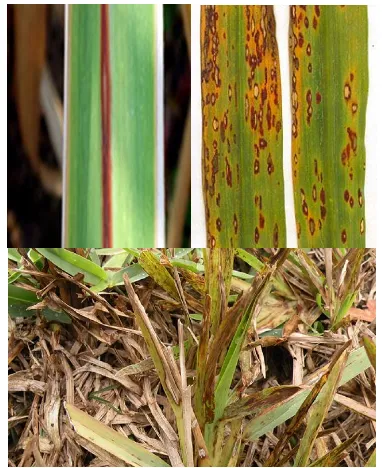
Figure1. Healthy Plant leaf
II. TYPES OF PLANT DISEASE
Most plant diseases area unit caused by fungi, bacteria, and viruses. Fungi are known primarily from their morphology, with stress placed on their procreative structures. Bacteria are thought-about a lot of primitive than fungi and customarily have easier life cycles. With few exceptions, bacterium exist as single cells and increase in numbers by dividing into 2 cells throughout a method known as binary fission Viruses are extraordinarily little particles consisting of macromolecule and genetic material with no associated macromolecule. The term illness is sometimes used just for the destruction of live plants. The disease usually occurs in sugar cane are:
A. Brown spot.
B. Red rot.
C. Drowny mildew.
D. Red Stripe.
[image:2.612.114.496.233.701.2]E. Sugarcane Mosaic.
III. METHODOLOGY
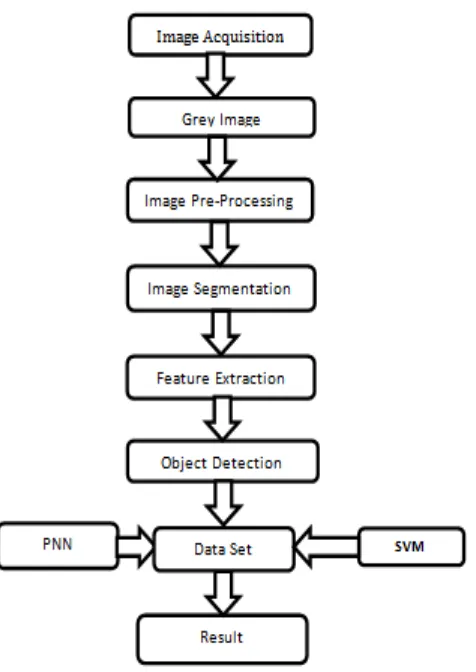
Figure 3.Working Flow of Analyzing Disease
These proposed works are more focus on Detection of disease on the sugar cane leaf using Mat lab. Firstly capture image from digital camera (mobile camera). Most probably the camera with some limitations and criteria will be considered. The captured image will be considered for further feature extraction, using one of the above algorithms. There are many features of images that are to be extracted, but we in our proposed system are going to consider some of them. The below system architecture shows the actual work flow of the concept that we are working on. The main focus of this proposed work is to help the farmers, suffering from loss due to incomplete knowledge of various diseases.
A. Working Flow Of Proposed Approach Includes Following Steps
1) Take RGB image.
2) Image Colour transformation of RGB to Gray scale.
3) Image segmentation using k c means clustering.
4) Feature extractions.
5) Object detection.
6) Getting the result based on PNN training.
a) Image Acquisition: Disease detection start with taking input image from digital camera, those are in RGB format. Better quality resolutions are used for image analysis that images are in the format such as TIF, JPEG, PNG, BMP etc.
Figure 4.RGB to Gray scale.
c) Image Pre-Processing: By using image pre-processing reject unwanted part of data from the image such as filter the noise image processing feature include the colour, size and texture of image.
Figure 5.Image pre processed steps.
d) Image Segmentation: The result of input image segmentation for a plant disease detection system is to preserve only the infected area in the output image for detection purpose. However, due to the diversity of disease types, the plants are growth in different environmental conditions. To predicate the final result it may be hard to detect and problem of accuracy. There is information need for prediction of disease is physical location of plant in environment and its infected area of disease according to this information prediction is done. Process for image segmentation based on colour of image
e) Feature Extraction: Feature extraction is used for identification of an object. The features such as color, texture and Morphology can be used for plant disease detection.
f) Object Detection: Identification of only affected area of the leaf.
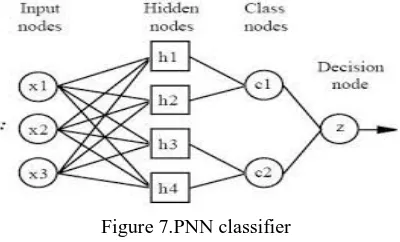
[image:5.612.208.408.197.318.2]g) PNN Classifier: A probabilistic neural network (PNN) is a feed forward, which is widely used in classification and pattern recognition problems. In the PNN formula, the parent likelihood distribution perform (PDF) of every category is approximated by a Parzen window and a non-parametric perform. Then, mistreatment PDF of every category, the category likelihood of a brand new computer file is calculable and Bayes’ rule is then used to portion the category with highest posterior probability to new input data. By this method, the probability of miss-classification is minimized. This type of ANN was derived from the Bayesian network and a statistical algorithm called Kernel Fisher discriminate analysis.
Figure 7.PNN classifier
a) SVM Classifier: A support vector machine comes under supervised learning model in the machine learning. SVM’s are mainly used for classification and regression analysis. SVM has got to be related to learning formula to provide associate output. SVM has given better performance for classifications and regressions as compare to other processes. There square measure sets of coaching that belong to 2 completely different classes. The SVM training algorithm creates a model that allots new examples into one category or into the other category, which makes it non-probabilistic binary linear classifier. The representation in SVM shows points in space and also they are mapped so the examples come across as they have been divide by a gap which is as wide as possible.
Figure 8.SVM Classifier
b) Data Set: Database contained large amount of image samples files which are containing the disease image and non-disease images. According to Image feature extraction techniques, the features will be extracted and then that image file will be stored in the database.
B. Morphological Processing
[image:5.612.205.410.425.557.2]C. Comparison Of SVM And PNN
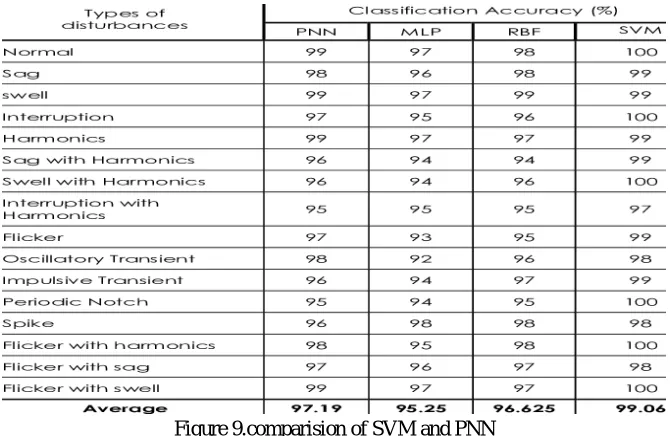
Figure 9.comparision of SVM and PNN
D. K-Means Clustering
Could be a methodology of quantisation, originally from signal process, that's fashionable for cluster analysis in data processing. K-means bunch aims to partition observations into k clusters during which every observation belongs to the cluster with the closest mean, serving as a epitome of the cluster. This ends up in a partitioning of the information area into Voronoi cells. The problem is computationally tough (NP-hard); but, economical heuristic algorithms converge quickly to an area optimum. These are typically almost like the expectation-maximization algorithmic rule for mixtures of mathematician distributions via an repetitious refinement approach utilized by each k-means and mathematician mixture modelling. They both use cluster centres to model the data; however, k-means clustering tends to find clusters of comparable spatial extent, while the expectation-maximization mechanism allows clusters to have different shapes.
The algorithm has a loose relationship to the k-nearest neighbour classifier, a popular machine learning technique for classification that is often confused with k-means due to the name. Applying the 1-nearest neighbour classifier to the cluster centres obtained by k-means classifies new knowledge into the present clusters. This is called nearest centre of mass classifier or Rocchio algorithmic rule.
IV. RESULT
To evaluate the SVM and PNN algorithm, we used samples from disease data set which contains the different disease affected leave images. After evaluation, detected disease name is displayed. Highest accuracy is achieved with SVM algorithm compare to PNN algorithm.
[image:6.612.83.529.562.722.2]V. CONCLUSION
This paper explains associate application of texture analysis in police work the plant diseases. The results of this approach will acknowledge the leaf diseases with very little machine effort. The accurate detection and classification of disease affected leaf became easy with the help of digital image processing techniques and MATLAB software by implementing k means clustering and SVM and PNN algorithm made it possible to automatically detect the plant disease. This automatic detection using image processing techniques help farmers to know about the disease in early stage and to take necessary preventive measures so that
farmer can produce effective crops.
VI. ACKNOWLEDGMENT
I would like sincerely thank to DR. NARENDRA B K, Principal and DR. M B ANANDARAJU, Professor BGSIT, BG Nagara for providing the necessary facilities and support, thus making it possible for us obtains the necessary resources required to complete this Research Paper.
REFERENCES
[1] K. Padmavathi, Dr. K. Thangadurai, "Identification of Plant Leaves Disease Detection and Optimal Solution Using Genetic Algorithm”, Berlin, Germany: Springer, 1989, vol. 61.
[2] Manoj Mukherjee,Titan Pal and Debabrata Samanta, “Damaged Paddy leaf detection using image processing", Volume 3, No. 10, October 2012.
[3] K. Dang, H. Sun, J. P. Chanet, J. Garcia-Vidal, J. M. Barcelo-Ordinas, H.L. Shi and K.M. Hou, Wireless Multimedia Sensor Network for plant disease detections", France-China International Workshop18-20 Septembre2013, Clermont-Ferrand, France.
[4] H. Al-Hiary, S. Bani-Ahmad, M. Reyalat, M. Braik and Z. ALRahamneh, "Fast and proper Detection and Classification of Plant Diseases", International Journal of pc Applications (0975 – 8887) Volume 17– No.1, March 2011
[5] Sanjay B. Patil, “Leaf malady Severity measure victimisation Image Processing”, International Journal of Engineering and Technology Vol.3 (5), 2011,
297-301
[6] P.Revathi, "Classification of Cotton Leaf Spot Diseases Using Image Processing Edge Detection Techniques", Research Scholar, Computer Science Karpagam
University Coimbatore - 21, Tamil Nadu, India, 2012 IEEE.
[7] Ravindra Nikam1, Mahesh Sadavarte, "Application of Image Processing Technique", National Conference on Emerging Trends in Computer, Electrical & Electronics (ETCEE-2015) in Mango Leaves Disease Severity Measurement.
[8] Burks TF, “Early detection of citrus diseases using machine vision”, Presentation at ASAE conference, Chicago, USA, 2002.
[9] Akhil Garg, Ankit Garg, K. Tai, S. SreedeepAn integrated SRM-multi-gene genetic programming approach for prediction of issue of safety of three-D soil nailed slope Eng Appl Artif Intell, 30 (2014), pp. 30-40 Article Download PDF View Record in Scopus Google Scholar.
[10] Venkatesh Vijayaraghavan, Akhil Garg, Chee How Wong, Kang Tail, Yogesh Bhalerao Predicting the mechanical characteristics of hydrogen functionalized