A Review on Analysis and Optimization of
EDM Process Parameters
Sathishkumar P1, Arunbharathi R2
Final year PG Student, Department of Mechanical Engineering, Sri Krishna College of Engineering and Technology,
Coimbatore, Tamilnadu, India 1
Assistant Professor, Department of Mechanical Engineering, Sri Krishna College of Engineering and Technology,
Coimbatore, Tamilnadu, India2
ABSTRACT: In Present, manufacturing industries are confronting trials from these advanced materials viz. super alloys, ceramics, and composites, that are hard and tough to machine, needing high precision, surface quality that increases machining cost. To encounter these trials, non-conventional machining procedures are being retained to achieve higher metal removal rate with better surface finish and larger dimensional accuracy, alongside less tool wear. Electric Discharge Machining (EDM), a non-conventional process, has an expansive requests in automotive, defence, aerospace and micro system industries plays an excellent role in the progress of least cost products with more reliable quality assurance. Die sinking EDM, Drilling EDM, Wire Electrical Discharge Machining (WEDM), Dry EDM, Powder mixed EDM (PEDM) are some of the variants methods of EDM. This paper presents a literature survey on the various concepts with current research trends and also their effects in electrical discharge machining characteristics.
KEYWORDS: Electric Discharge Machining (EDM), WEDM, DOE, Process Parameters.
І.INTRODUCTION
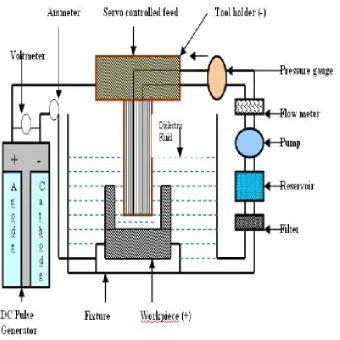
The electrical discharge machining (EDM) is one of the popular manufacturing processes widely used in die and mold making industry to generate deep complex cavities in various classes of materials under roughing and finishing operations. It is a Non-traditional electro-thermal machining process, in which electrical energy is used to generate electrical spark and material removal occurs due to thermal energy produced by the spark. EDM is mainly used to machine high strength temperature resistant alloys and materials difficult-to-machine. EDM can be used to machine irregular geometries in small batches or even on job-shop basis. Work material is to be electrically conductive to be machined by EDM. It is most widely used by many of the industries like mold-making tool and die industries, but is becoming a general method of making prototype and production parts, especially in the aerospace, automobile and electronics industries in which production quantities are relatively low. It is also used for coinage die making, metal disintegration machining. It is well-established advanced machining process for producing complex geometry with close tolerances in these materials that are extremely difficult-to-machine by conventional machining processes. EDM process offers a better alternative or sometimes the only alternative for generating accurate three dimensional complex shapes of macro, micro and Nano features in difficult–to-machine materials among other advanced machining processes. The success of the EDM process depends upon the selection of appropriate process parameters.
stresses, chatter and vibration problems during machining due to absence of physical contact between tool and workpiece. The plasma channel is no longer sustained as the potential difference is withdrawn. It generates shock or pressure waves, which evacuates the molten material forming a crater of removed material all around the region of spark, as the plasma channel collapse. The aim is to remove the material from the work piece by optimum utilization of the machining parameters to get the required shape with quality surface.
II. MAJOR PARAMETERS OF EDM
The Process parameters of electric discharge machining can be divided into following categories,
III. LITERATURE REVIEW
V.Muthukumar et al. [1] presented a Mathematical Modeling for Radial Overcut on Electrical Discharge Machining of Incoloy800 by Response Surface Methodology. The experiments were planned as per central composite design (CCD) method. After conducting 30 experiments, a mathematical model was developed to correlate the influences of these machining parameters and ROC. From the obtained results, It was found that current and voltage have significant effect on the radial overcut. The predicted results based on developed models are found to be in good agreement with the predicted values match the experimental results reasonably well with the coefficient of determination 0.9699 for ROC.
V.B.Chaudhari et al. [2] investigated the effects of electrical process parameters on the performances of die-sinking electrical discharge machining with two types of dielectric medium i) Oxygen and Air (Dry EDM), ii) Kerosene on Incoloy800, the effect of input parameter on responses have been optimized using Taguchi L9 orthogonal Array and it is resulted thatMRR is more for EDM using kerosene as dielectric as compare to dry EDM. It is observed from ANOVA that peak current and pulse on time are most significant parameters for MRR and TWR.
Process parameters
Electrical parameters
1. Polarity 2. Discharge voltage 3. Gap voltage 4. Peak Current 5. Average Current
6. Pulse on time 7. Pulse off time 8. Pulse
frequency 9. Pulse waveform 10. Electrode Gap
11. Duty Factor.
Non electrical parameters
1. Electrode Lift Time 2. Working Time 3. Nozzle flushing 4. Gain 5. Types of dielectric fluid
Powder based parameters
1. Powder type 2. Powder concentration 3. Powder size 4. Powder conductivity 5. Powder density
Electrode based parameters
MuthuKumar.V et al. [3] demonstrated optimization of WEDM process parameters of Incoloy800 super alloy with multiple performance characteristics and concluded that the Grey-Taguchi Method is most ideal and suitable for the parametric optimization of the Wire-Cut EDM process, when using the multiple performance characteristics such as MRR, SR and kerf width.
OmPrakash Sahani et al. [4] presented a detailed experimental investigation of mild steel using copper as an electrode the machining characteristics such as material removal rate was considered and parameters like current, voltage and pulse on time were varied. It has been concluded that the MRR increases nonlinearly with the increases in Voltage then MRR increases with increase in pulse on time up to a certain limit then decreases. Increase in Current provides an initial increase but further increase in current results in decrease in MRR.
Ashok Kumar et al. [5] Investigated the feasibility of machining the En-19 tool steel by using U-shaped copper electrode performed on electrical discharge machine. Where Diameter of U-shaped electrode, Current and Pulse on time are taken as process input parameters and material removal rate, tool wear rate, Overcut on surface of work piece are taken as output parameters. A set of eighteen experiments(Taguchi design) were performed and relationships were developed between input and output parameters. The result indicates that the current increases the MRR is also increases and the pulse on time is increasing the TWR is also increasing. Finally, Overcut is directly proportional to the dia of the electrode. It is also depend on current and pulse on time. As the current increases the overcut is also increasing.
M-G. Her et al. [6] explained the micro-hole machining of a copper plate using the electro-discharge machining (EDM) process. Tungsten carbide was selected as the electrode and compared with a copper-electrode. A precision centerless grinding process was employed to grind the electrode down to the desired diameter. Results have shown that electrode wear and hole enlargement are both smaller when positive polarity machining is selected; whereas electrode wear is larger and machining speed is higher when negative polarity machining is selected. High quality micro-hole machining in copper can be achieved by the proposed method.
Oguzhan Yilmaz et al [7] focused on investigation of electrical discharge machining fast hole drilling of Inconel 718 and Ti–6Al–4V. A series of experiments was carried out using single and multi-channel tubular electrodes made of brass and copper materials. The comparisons were made from the results of material removal rate, electrode wear, microhardness, and scanning electron microscope images are taken from the machined/drilled hole surfaces. The experimental results reveal that the single-channel electrode has comparatively better material removal rates and lower electrode wear ratio. Microstructural changes while drilling operations for both types of electrodes result in an annealing effect on Inconel 718 and a tempering effect on Ti–6Al–4V alloy.
Dinesh Kumar et al. [8] present work on hastelloy steel for investigating using sintered tool electrode of copper tungsten (CuW) with straight and reverse polarity setup in standard EDM oil. The effects of input parameters i.e. polarity, tool electrode material, peak current, pulse on time, duty cycle and gap voltage on the overcut was analyzed using analysis of variance. It was found that Reverse polarity with powder metallurgy tool electrode, The maximum value of ton time and the average value of duty cycle and gap voltage gives the better result for overcut in this study.
Mustafa Ay et al [9] discussed about the gray relational analysis method to optimize the micro-electrical discharge machining drilling process of Inconel 718. A full factorial experimentation was performed based on the micro-EDM parameters of discharge current and pulse duration. The hole taper ratio (Ht) and hole dilation (Hd) were the measured performances. By analyzing the optimization results, it was observed that the pulse current was more efficient on performance characteristics than pulse duration. The characteristics of drilled surfaces and tool electrodes were also investigated by using optical and scanning electron microscopy. The measured and model results were in a good agreement with correlation coefficients Ht and Hd. It is concluded that the EDM hole quality can be improved effectively through this approach.
Wang et al. [10] combine the ANN and genetic algorithm to find an integrated solution to the problem of modeling and optimization of manufacturing processes. The error of the model is 5.6% for MRR and 4.98% for surface roughness. The modeling system established better knowledge about interaction between tool (graphite) and work piece (nickel alloy).
lower wear ratio than in kerosene when a high pulse energy range was used, With distilled water, the machining accuracy was poor but the surface finish was better.
H.K.Kansal [12], optimize the process parameters of powder mixed electrical discharge machining (PMEDM), Response surface methodology has been used to plan and analyze the experiments. Silicon powder was suspended into the dielectric fluid of EDM and an enhanced rate of material removal and surface finish has been achieved. The analysis of variance revealed that the peak current and powder concentration are the most influential parameters on MRR and SR.
Parmod Malhotra et al [13] applied a method of One Factor at a Time Approach(OFAT) of the material of H-11 tool steel with parameters Pulse On Time (T-on), Pulse Off Time (T-off), Current (I) and Flushing Pressure have been investigated to reveal their impact on MRR, TWR and SR. In each experiment one input variable was varied while keeping all other input variables at some mean fixed value. It has been found that MRR increases with increase in the values of T-on. TWR & SR increases with increase in the values of Current and T-off.
M. Durairaj et al [14] conducted an experimental investigation on wire electrical discharge machining of Stainless Steel (SS304) using brass wire of 0.25mm by Taguchi Method. It was concluded that by Taguchi method optimized input parameter combinations to get the minimum surface roughness are 40V, 2mm/min wire feed,6 μs Ton, 10μs T off and similarly by Grey relational analysis optimized conditions to get the minimum kerf width are 50V , 2mm/min Wire Feed, 4 μs Ton,6 μs Toff.
Jahan et al. [15] conducted an experimental investigation with the view of obtaining fine surface finish in die-sinking EDM process of tungsten carbide using different tool electrodes such as tungsten, copper tungsten and silver tungsten. It has been found that the surface finish has been influenced by the discharge energy during machining process. It has been realized that the lower discharge energy has produced good surface finish.
Ravindranadh et al [16] Investigated wire-cut electric discharge machining of hot-pressed boron carbide. The effects of machining parameters, such as TON, IP, FP and spark voltage on material removal rate (MRR) and surface roughness (Ra) of the material, have been evaluated. These parameters are found to have an effect on the surface integrity of boron carbide machined samples. Wear rate of brass wire increases with rise in input pulse energy. It was demonstrated that higher TON and peak current deteriorate the surface finish of boron carbide samples and result in the formation of large craters, debris and micro cracks.
R. Landfried et al. [17] conducted an experiment to find the influence of TiC particle size on the material properties and also on electrical discharge machining. They have focused the same of ZTA-TiC ceramics with 24% TiC, 17% ZrO2 and 59% Al2O3. It was shown that reducing the size of electrical conductive grains strongly increases the electrical conductivity and slightly decreases mechanical properties and also it have considerable impact on the machinability by EDM and at the end concluded that the size of the particle should not be reduced below a threshold.
Vikas et al. [18] compare the MRR for EN-19 and EN-41 material in die sinking EDM machine. The various input factors like pulse on time, pulse off time, discharge current and voltage were considered as the input processing parameters, while the MRR is considered as the output. Optimization using Taguchi method was performed to predict the best combination of inputs towards maximum output. They found that the discharge current in case of the En-41 and EN-19 material had a larger impact as compared to other processing parameters on MRR.
VI. CONCLUSION
The literature survey has revealed that the remarkable machining rates have been achieved mostly with the tap
the accuracy of ANN models. Even so, a proportional sampling should be reserved as validation set for turning ANN model parameters.
ACKNOWLEDGMENT
I would like to thank Mr.Arunbharathi.R, Assistant professor of mechanical engineering department, Sri Krishna College of Engineering and Technology, Coimbatore for his valuable support to develop this project work.
REFERENCES
[1] V.Muthukumar, N. Rajesh, R. Venkatasamy, A. Sureshbabu , N. Senthilkumar, “Mathematical Modeling for Radial Overcut on Electrical Discharge Machining of Incoloy 800 by Response Surface Methodology”, International Conference on Materials Processing and Characterization (ICMPC 2014), Procedia Materials Science 6,pp. 1674 – 1682, 2014
[2] V.B.Chaudhari, S.S.Soni, A.B.Pandey,” Parametric Study Of Incoloy 800 (Super Alloy) In Dry-EDM”, International Journal of Advance Research In Science And Engineering, Vol. No.3, pp.382-389, 2014
[3] Muthu Kumar V., Suresh Babu A., Venkataswamy R.,Raajenthiren M.,“Optimization of the WEDM parameters on machining Incoloy 800 super alloy with multiple quality characteristics”, International Journal of Engineering Science and Technology, Vol. 2 (6), pp. 1538-1547, 2010
[4] Om Prakash Sahani, Rajneesh Kumar, Meghanshu vashista,” Effect of Electro Discharge Machining Process Parameters on Material Removal Rate”, Journal of Basic and Applied Engineering Research, Volume 1, No 2, pp. 17-20, 2014
[5] Ashok Kumar,1kuldeep Singh Bedi,2Karaj Singh Dhillo, 2Rashpal Singh,” Experimental Investigation of Machine parameters For EDM Using U shaped electrode of EN-19 tool steel”, International Journal of Engineering Research and Applications, Vol. 1, Issue 4, pp.1674-1684 [6] M-G. Her and F.-T. Weng,” Micro-hole Machining of Copper Using the Electro-discharge Machining Process with a Tungsten Carbide
Electrode Compared with a Copper Electrode” International Journal of Advance Manufacturing Technology, vol 17, pp 715–719, 2001 [7] Oguzhan Yilmaz & M. Ali Okka,” Effect of single and multi-channel electrodes application on EDM fast hole drilling performance”,
International Journal of Advance Manufacturing Technology, pp. 185–194, 2010
[8] Dinesh Kumar, Naveen Beri, Anil Kumar,” Study Of Overcut During Electric Discharge Machining Of Hastelloy Steel With Different Electrodes Using The Taguchi Method”, International Journal Of Advanced Engineering Technology, Vol 2, Pp. 306-312, 2011
[9] Mustafa Ay & Ulaş Çaydaş & Ahmet Hasçalık,”Optimization of micro-EDM drilling of inconel 718 superalloy”, International Journal of Advance Manufacturing Technology, vol 66, pp. 1015–1023, 2013
[10] K. Wang, H.L. Gelgele, Y. Wang, Q. Yuan, M. Fang, A hybrid intelligent method for modelling the EDM process, International Journal of Machine Tools & Manufacture ,vol 43, pp..995–999.2003
[11] M.L. Jeswani, Effects of the addition of graphite powder to kerosene used as the dielectric fluid in electrical discharge machining, Wear 70 (1981) 133–139.
[12] Kansal, H.K., Singh, S., Kumar, P., 2005, “Parametric optimization of powder mixed electrical discharge machining by response surface methodology.” Journal of Materials Processing Technology, Vol. 169, No. 3, pp. 427–436, 2005
[13] Parmod Malhotra, Amit Kohli,” Performance Study of Electrical Discharge Machining With H-11 Tool Steel Using One Variable at a Time Approach”,International Journal for Science and Emerging Technologies with Latest Trends”, vol 12, pp.15-20, 2013
[14] M. Durairaj, D. Sudharsun, N. Swamynathan,” Analysis of Process Parameters in Wire EDM with Stainless Steel using Single Objective Taguchi Method and Multi Objective Grey Relational Grade” Procedia Engineering, vol 64, pp. 868 – 877, 2013
[15] Jahan et al, "Development, Modeling, and Experimental Investigation of Low Frequency Work piece Vibration-Assisted Micro-EDM of Tungsten Carbide", Journal of Manufacturing Science and Engineering, Vol 132, 2010
[16] Ravindranadh Bobbili a , V. Madhu a & A. K Gogia,” Effect of Wire-EDM Machining Parameters on Surface Roughness and Material Removal Rate of High Strength Armor Steel”, Materials and Manufacturing Processes,vol 28, pp 364–368, 2013
[17] R. Landfried, F. Kern, R. Gadow, ”Electrically conductive ZTA–TiC ceramics: Influence of TiC particle size on material properties and electrical discharge machining”, Institut für Fertigungstechnologie keramischer Bauteile, Universität Stuttgart, Allmandring 7b, D-70569 [18] Vikas, Shashikant, A.k roy, Kaushik kumar, “Effect and optimization of machine process parameter son MRR for EN -19 and EN -41 using