ISSN(Online): 2319-8753 ISSN (Print): 2347-6710
I
nternational
J
ournal of
I
nnovative
R
esearch in
S
cience,
E
ngineering and
T
echnology
(A High Impact Factor, Monthly, Peer Reviewed Journal)
Visit: www.ijirset.com
Vol. 8, Issue 5, May 2019
Design and Implementation of Partition
Multiplier based on Brent Kung Adder
Anshu Kumar1, Shivraj Singh2
M. Tech. Scholar, Department of Electronics and Communication Engineering, Technocrats Institute of Technology, Bhopal, India1
Assistant Professor, Department of Electronics and Communication Engineering, Technocrats Institute of Technology, Bhopal, India 2
ABSTRACT: In this paper a partition multiplier based on Brent Kung adder is presented. Partition multiplier is used in various applications i.e. digital systems, different types of filters and digital signal processing. We have design area efficient and less time consuming partition multiplier with the help of Brent Kung adder. All design is implemented VHDL platform and Xilinx 14.5 software. The Brent–Kung adder is a parallel prefix adder (PPA) and it is types of the carry-look ahead adder (CLA). It has higher normality with the structure of the adder and minimized the wiring issues, reduced complexities, provides better execution, faster and less area which is not the case with the ripple carry adder.
KEYWORDS: - Brent Kung Adder, Partition Multiplier, Delay, Carry Look Ahead Adder.
I. INTRODUCTION
Multiplier is the important function in arithmetic operations and CPU processing performance depends on it. Currently multiplier is used in many digital signal processing applications such as filtering, microprocessors in its arithmetic and logic units and Fast Fourier Transform (FFT). Since execution time of most DSP algorithms depends on the multiplication, so there is need of high speed multiplier. Currently determining the instruction cycle of a DSP chip totally depends on multiplication time. The high speed processing demand has been increasing day by day due to expending computer and signal processing applications. Higher throughput arithmetic operations are important to achieve the higher performance in real time applications and image processing applications, one of the important key is high speed multiplications to achieve this performance and development of high speed multiplier has been subject of interests over decades. In this paper simple 16 bit partition multiplier is proposed which is based on Brent-kung adder. The main concept of this paper is decrease the delay and area of the conventional architecture.
II. PARTITION MULTIPLIER
ISSN(Online): 2319-8753 ISSN (Print): 2347-6710
I
nternational
J
ournal of
I
nnovative
R
esearch in
S
cience,
E
ngineering and
T
echnology
(A High Impact Factor, Monthly, Peer Reviewed Journal)
Visit: www.ijirset.com
Vol. 8, Issue 5, May 2019
Figure 1: Partition multiplier multiplication
III. METHODOLOGY
Brent Kung Adder
The Brent–Kung adder is a carry look ahead adder and it is parallel prefix adder (PPA). In 1982, it is proposed by Richard Peirce Brent and Hsiang Te Kung. It has higher normality with the structure of the adder and has minimize the wiring issues, reduces complexities and provides better execution and less chip region which is not the case with the ripple carry adder (RCA) and also it is very faster than ripple-carry adders (RCA).
ISSN(Online): 2319-8753 ISSN (Print): 2347-6710
I
nternational
J
ournal of
I
nnovative
R
esearch in
S
cience,
E
ngineering and
T
echnology
(A High Impact Factor, Monthly, Peer Reviewed Journal)
Visit: www.ijirset.com
Vol. 8, Issue 5, May 2019
IV. IMPLEMENTATION METHODOLOGY
We consider two K-bit operands aK-1, aK-2,…a2, a1, a0 and bK-1 bK-2…b2 b1 b0 for K by K multiplier, the partial products
of two K-bit numbers are ai bj where i, j go from 0,1,..K-1. The longest two columns in the middle of the partial
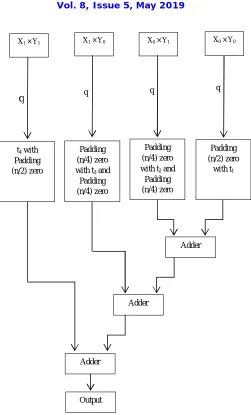
products contribute to the maximum delay. We then proceed to sum up each column of the two parts in parallel. Partition Multiplier Method: - Let X and Y be numbers of p-bits such that multiplication of the inputs X and Y gives the 2p bits product. Here X and Y are split into q numbers as
X
0,
X
1,
X
2...
...
X
q1and1 2
1
0
,
Y
,
Y
...
...
Y
qY
each consisting of r bits Where
r
p
q
(1)Consider the value of p = 8, r =2 Then
q4 (2) X and Y can therefore be expressed as
1
0
)
2
(
0
to
k
X
X
(3)
)
2
1
(
1k
to
k
X
X
(4)
1
0
)
2
(
0
to
k
Y
Y
(5)
)
2
1
(
1k
to
k
Y
Y
(6)Therefore
X
0 contains the even partitions of X andX
1 contains the odd partitions of X, similarlyY
0 contains the even partitions of Y andY
1 contains the odd partitions of Y.X
0Contain multiplier all the partition of Y.X
0is multiplier ofY
0, the lower significant bit (LSB) of theX
0 add with LSB of theY
0bit position and most significant bit (MSB) of theX
0 add with MSB of theY
0 bit position.1 1 0 1 1 0 0
0
Y
X
Y
X
Y
X
Y
X
Y
X
ISSN(Online): 2319-8753 ISSN (Print): 2347-6710
I
nternational
J
ournal of
I
nnovative
R
esearch in
S
cience,
E
ngineering and
T
echnology
(A High Impact Factor, Monthly, Peer Reviewed Journal)
Visit: www.ijirset.com
Vol. 8, Issue 5, May 2019
Figure 3: Flow chart of proposed partition multiplier method
V. SIMULATION RESULT AND DISCUSSION
VHDL Descriptions comprise of essential outline units and auxiliary configuration units. The essential outline units are the Entity and the Package. The optional configuration units are the Architecture and the Package Body. Optional configuration units are constantly identified with an essential outline unit. Libraries are accumulations of essential and optional configuration units.
A regular plan as a rule contains one or more libraries of configuration units. VHDL representation can be seen as content record portraying a computerized framework. The advanced framework can be spoken to in distinctive
X0 × Y0
X0 × Y1
X1 × Y0
X1 × Y1
q q
q
q
Padding (n/2) zero
with t1 Padding
(n/4) zero with t2 and Padding (n/4) zero Padding
(n/4) zero with t3 and Padding (n/4) zero t4 with
Padding (n/2) zero
Adder
Adder
Adder
ISSN(Online): 2319-8753 ISSN (Print): 2347-6710
I
nternational
J
ournal of
I
nnovative
R
esearch in
S
cience,
E
ngineering and
T
echnology
(A High Impact Factor, Monthly, Peer Reviewed Journal)
Visit: www.ijirset.com
Vol. 8, Issue 5, May 2019
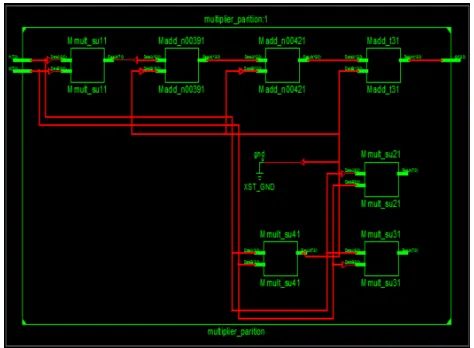
Figure 4: View Technology Schematic of Partition Multiplier
ISSN(Online): 2319-8753 ISSN (Print): 2347-6710
I
nternational
J
ournal of
I
nnovative
R
esearch in
S
cience,
E
ngineering and
T
echnology
(A High Impact Factor, Monthly, Peer Reviewed Journal)
Visit: www.ijirset.com
Vol. 8, Issue 5, May 2019
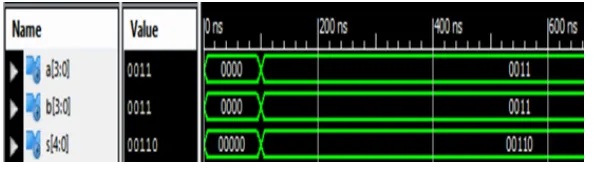
Figure 6: VHDL Test Bench of Partition Multiplier
Figure 7: VTS for 4-bit BK Adder
ISSN(Online): 2319-8753 ISSN (Print): 2347-6710
I
nternational
J
ournal of
I
nnovative
R
esearch in
S
cience,
E
ngineering and
T
echnology
(A High Impact Factor, Monthly, Peer Reviewed Journal)
Visit: www.ijirset.com
Vol. 8, Issue 5, May 2019
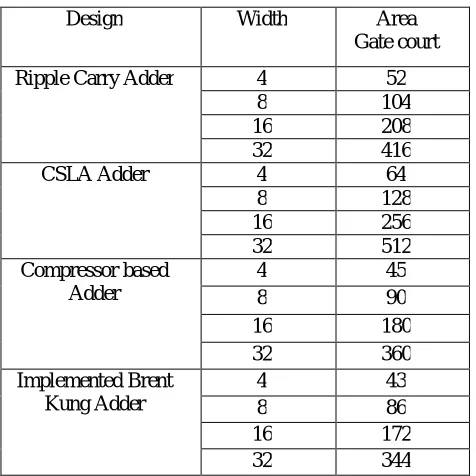
Table I: Comparisons result for implemented design and existing algorithm
Table II: Comparison Result of Previous Multiplier and Proposed Multiplier Bit Previous Vedic
Method
Proposed Partition Method 4-bit 10.43 ns 9.134 ns 8-bit 15.22 ns 11.631 ns 16-bit 19.58 ns 13.816 ns 32-bit 22.32 ns 16.234 ns
VI. CONCLUSION
In previous design, carry look ahead adder was used for designing parallel FIR filter but it was having the drawback that it was consuming more delay and large circuit complexity. So to remove this drawback, we have used Brent Kung adder which is an advanced binary adder. Its advantage is that it reduces the cost and the complexities of the circuit and is much faster than Ripple Carry adder and carry look ahead adder. So it provides better performance and less area to implement in comparison to Kogge Stone adder. The main advantage of Brent Kung adder is that it works on every bit and consumes less space.
REFERENCES
1. Ranjan Kumar Barik, Manoranjan Pradhan, Rutuparna Panda, “Time efficient signed Vedic multiplier using redundant binary representation”,
Journal Engineering 2017, Vol. 2017, Iss. 3, pp. 60–68.
2. Basant Kumar Mohanty, and Pramod Kumar Meher, “High-Performance FIR Filter Architecture for Fixed and Reconfigurable Applications”, IEEE Transactions on Very Large Scale Integration (VLSI) Systems, Vol. 78, No.06, April 2016.
3. Omid Akbari, Mehdi Kamal, Ali Afzali-Kusha, and Massoud Pedram, “Dual-Quality 4:2 Compressors for Utilizing in Dynamic Accuracy
Configurable Multipliers”, IEEE Transactions on Very Large Scale Integration (VLSI) Systems, Vol. 34, Issue 7, 2017.
4. L kholee phimu and Manoj Kumar, “Design and Implementation of Area Efficient 2-Parallel Filters on FPGA using Image System”,
Design Width Area Gate court Ripple Carry Adder 4 52
8 104 16 208 32 416 CSLA Adder 4 64
8 128 16 256 32 512 Compressor based
Adder
4 45 8 90 16 180 32 360 Implemented Brent
Kung Adder
ISSN(Online): 2319-8753 ISSN (Print): 2347-6710
I
nternational
J
ournal of
I
nnovative
R
esearch in
S
cience,
E
ngineering and
T
echnology
(A High Impact Factor, Monthly, Peer Reviewed Journal)
Visit: www.ijirset.com
Vol. 8, Issue 5, May 2019
5. Shahnam Mirzaei, Anup Hosangadi, Ryan Kastner, “FPGA Implementation of High Speed FIR Filters Using Add and Shift Method”, 1-4244-9707-X/06/$20.00@2006 IEEE.
6. Amina Naaz.S, Mr.Pradeep M.N, Satish Bhairannawar and Srinivas halvi, “FPGA Implementation Of High Speed Vedic Multiplier using CSLA For Parallel Fir Architecture”, 2014 2nd International Conference on Devices, Circuits and Systems (ICDCS).
7. Laxman P.Thakre, Suresh Balpande, Umesh Akare, Sudhir Lande, “Performance Evaluation and Synthesis of Multiplier used in FFT operation using Conventional and Vedic algorithms,” Third international conference on emerging trends in Engineering and Technology , IEEE, 2010. 8. S. S. Kerur, Prakash Narchi, Jayashree C N, Harish M Kittur and Girish V. A., “Implementation of Vedic Multiplier for Digital Signal
Processing,” International Conference on VLSI ,Communication & Instrumentation (ICVCI), 2011.
9. G. Vaithiyanathan, K. Venkatesan, S.Sivaramakrishnan, S.Sivaand, S. Jayakumar, “Simulation and implementation of Vedic multiplier using VHDL code,” International Journal of Scientific & Engineering Research, vol.4, 2013.
10. Pushpalata Verma and K. K. Mehta, “Implementation of an Efficient Multiplier based on Vedic Mathematics Using EDA Tool,” International Journal of Engineering and Advanced Technolog(IJEAT), vol.1, June 2012.
11. C. Cheng and K. K. Parhi, “Furthur complexity reduction of parallel FIR filters,” in Proc. IEEE ISCAS, May 2005, vol. 2, pp. 1835–1838. 12. C. Cheng and K. K. Parhi, “Low-cost parallel FIR structures with 2-stage parallelism,” IEEE Trans. Circuits Syst. I, Reg. Papers, vol. 54, no. 2,
pp. 280–290, Feb. 2007.
13. J. G. Chung and K. K. Parhi, “Frequency-spectrum-based low-area low-power parallel FIR filter design,” EURASIP J. Appl. Signal Process., vol. 2002, no. 9, pp. 444–453, Jan. 2002.
14. K. K. Parhi, VLSI Digital Signal Processing systems: Design and Implementation. New York: Wiley, 1999.
15. Nivedita A. Pande, Vaishali Niranjane, Anagha V. Choudhari, “Vedic Mathematics for Fast Multiplication in DSP,” International Journal of Engineering and Innovative Technology (IJEIT) ,vol.2, 2013.