140 |
P a g e
GUIDANCE BASED MULTIHOP BROADCAST
PROTOCOL FOR ASYNCHRONOUS DUTY-CYCLED
WIRELESS SENSOR NETWORKS
Sowmya K M
1, Mrs. Parvathi C
21
Student,
2Asst Prof, Computer Science and Engineering,
Don Bosco Institute of Technology, Karnataka, (India)
ABSTRACT
In this paper, we propose an efficient guidance based multihop broadcast protocol for asynchronous
duty-cycled wireless sensor networks, where each node wakes up according to its own schedule. This adopts two
techniques of the forwarder’s guidance and the overhearing of broadcast messages and ACKs. A node transmits
messages with guidance to neighbor nodes. The guidance presents how the node forwards the broadcast
message to neighbor nodes by using unicast transmissions. The proposed technique significantly reduces
redundant transmissions and collisions. The overhearing of broadcast messages and ACKs helps to reduce the
number of transmissions, thus it minimizes the active time of nodes. The Guidance based broadcast protocol
achieves lower message cost than conventional protocols and significantly improves the energy efficiency in
terms of both duty cycle and energy consumption.
Keywords: Asynchronous Duty Cycling, Multihop Broadcast,Wireless Sensor Networks,
I. INTRODUCTION
The goal of wireless sensor network is to reliably report sensing data to the sink. A broad class of WSN applications necessitates energy efficiency. Nodes in such WSN applications should operate unattended for a
long time on limited battery capacity [1]. Most sleep scheduling protocols today in WSNs utilize duty-cycling
which allows a sensor node to alternate between active and sleeping states to reduce energy consumption. The
duty-cycled MAC protocols in the previous literature are generally divided into two categories: synchronous and
asynchronous. Synchronous sleep scheduling approaches synchronize neighboring nodes before data
transmissions to reduce energy consumption. In S-MAC[2] and T-MAC[3] nodes in the vicinity synchronize
together and form a virtual cluster with the same schedules. Each node in the cluster communicates with its
neighbors only within common active states. Synchronous MAC protocols achieve comparable energy
efficiency by reducing idle listening time, but extra complexity and overhead are required for synchronization.
In asynchronous approaches, each sensor node wakes up and operates independently according to its own duty
cycle schedule. Such protocols use low power listening (LPL) that is one of duty-cycling techniques, where each
node periodically samples the channel for a long preamble continuously transmitted by a sender. LPL reduces
energy consumption by turning off the radio between samples. A sender, in B-MAC, starts to transmit data after
141 |
P a g e
and detects the preamble, it stays awake to receive data following the preamble. However, a node mayunnecessarily stay awake to receive data destined to other nodes. To solve this problem, X-MAC replaces a long
preamble with a bunch of sequential short preambles. Each preamble contains the target address and it allows
nodes not involved in the communication to go to sleep immediately.
1.1 Broadcast in wireless sensor Networks
The common goal of broadcast in WSNs is to deliver data to every node in a network. Broadcast can be divided
into two types: single hop broadcast and multihop broadcast. Single hop broadcast involves transmitting
messages to all neighbor nodes within 1-hop distance from a sender. Multi-hop broadcast involves forwarding a
message to all nodes that compose a network. In multihop broadcast, nodes that received the broadcast message
operate as new senders to forward the message to their neighbor nodes.
1.1.1 Single-Hop Broadcast
Single-hop broadcast is quite simple in synchronous MAC protocols. Synchronized nodes easily exchange
broadcast messages on their common schedules. More-over, one broadcast message can reach multiple neighbor
nodes. However, asynchronous MAC protocols are inherently weak for supporting single-hop broadcast, since
nodes wake up independently. In asynchronous WSNs, nodes wake up according to their own duty cycle
schedules. Therefore, it is challenging to efficiently support single-hop broadcast for asynchronous WSNs.
1.1.2 Multi-Hop Broadcast
Multi-hop broadcast is a crucial service for higher-level operations in WSNs. The goal of multi-hop broadcast is
to deliver a broadcast message to all nodes in a network. For data collection, nodes propagate queries across the
whole network. Multi-hop broadcast is also used for network maintenance services such as network
configuration and network reprogramming. Broadcast is comparatively simple in single-channel communication
protocols, because only one channel is employed for data transmission
II. RELATED WORKS
DW-MAC which is one of synchronous sleep scheduling protocols supports multihop broadcast by using
multihop forwarding. An operational cycle in DW-MAC is divided into three parts: Sync, Data, and Sleep. Each
node synchronizes its clock with its neighbor nodes during the Sync period. During the Data period, a sender
that wants to broadcast transmits a scheduling frame (SCH) which indicates the starting point for the broadcast
transmission that will be performed within a following Sleep period. The sender starts broadcasting a message at
that point. Every node receiving the broadcast message becomes a new sender to forward it to other nodes.
DW-MAC simply extends multihop forwarding without substantially increasing overhead in order to support
multihop broadcast. Multihop broadcast in asynchronous approaches is substantially complicated due to
independent sleep schedules of nodes. However, both schemes are very inefficient because a node receives
multiple copies of the same message. These redundant transmissions cause frequent collisions, followed by
unnecessary energy consumption. Therefore, multihop broadcast for asynchronous approaches should minimize
redundant transmissions and collisions. ADB is recently proposed to support multihop broadcast for
142 |
P a g e
updates the receiver information on the broadcast progress, which enables each node to avoid redundanttransmissions by allowing transmission delegating.
Fig.1. WSN with heterogeneous topologies.
In Figure 1, node S is a source node and node A wakes up earlier than node B. Upon receiving node A’s beacon,
node S sends A a broadcast message including an ADB footer that indicates the broadcast progress and the link
quality information of S. Looking into the footer, node A recognizes that the quality of the link between nodes S
and B is poorer than that of link between itself and B. Node A decides to forward the broadcast message to node
B and inform node S of this fact by sending ACK with a new footer. Upon receiving this ACK, node S delegates
handling of node B to node A. However, ADB does not efficiently support multihop broadcast in polygonal
topologies except triangle shapes. For example, in Figure 1, nodes S, C, E, and D compose a quadrangular
topology where node C and node E are located out of each other’s communication range. Node S sends a
broadcast message including a footer to node C. However, the link quality between nodes S and E in the footer
is useless to node C since C and E cannot communicate with each other.
Similarly, node E also ignores the link quality between nodes S and C after receiving the broadcast message
from S. Both nodes C and E stay active to forward the broadcast message to node D. After node D wakes up,
they simultaneously forward the broadcast message to D and a collision occurs at D. Each of nodes C and E
retransmits the collided message by using backoff. As a result, node D will receive the two identical broadcast
messages after the collision. This problem will lead to the unnecessary energy dissipation and the reduced
lifetime of the network. The frequency of triangles decreases as the network is getting sparser. In sparse
networks, the ADB therefore would show the degraded performance in multihop broadcast.
The proposed Guidance based multihop broadcast protocol efficiently supports the multihop broadcast in sparse
networks by using (i) the forwarder’s guidance. In addition, the proposed protocol makes good use of (ii) the
overhearing of broadcast messages and ACKs to minimize redundant transmissions. As a result, this shows good
performance even in dense networks.
III. MOTIVATION AND NETWORK MODEL
3.1 Motivation
In WSNs, a topology generated by randomly deployed nodes includes various types of polygons (n-gons) such
143 |
P a g e
density which is the average number of 1-hop neighbors per node. Dense networks have higher frequency oftriangles than sparse networks. In other words, the occurrence of n-gons where n is equal to or greater than 4
(referred to as n(≥ 4)-gons) becomes more frequent as the network is getting sparser. If walls or obstacles are
located in a deployment area, the occurrence of n (≥ 4)- gons is more frequent because the number of wireless
links between nodes is reduced. In addition, controlling transmission power is also one of reasons for an
increase in the number of n (≥ 4)-gons.
3.2 Network Model
We consider a WSN consisting of fixed nodes that do not have an ability to move. Topology changes (e.g., the
addition of a new node, or the elimination of a node from the network due to node fault or exhausted battery
power) are infrequent and link quality information are valid for a relatively long time (approximately a few
minutes). In our network model, a transmission of a message is very likely to be unsuccessful when a node
sends the message over a poor link. If this happens, the retransmission is required and therefore results in
additional energy consumption. To avoid retransmissions, a node should send messages over links with as good
quality as possible. Guidance based broadcasting uses knowledge of wireless link quality which can be provided
from existing link estimation mechanisms such as four-bit link estimation [5]. This link estimator uses various
signal and decoding statistics such as RSSI (Received Signal Strength Indicator), SNR (Signal to Noise Ratio),
LQI (Link Quality Indicator). The Guidance Based Broadcasting operates based on RI-MAC and uses a beacon
message generated by a receiver for the start and acknowledgement of a data transmission. RI-MAC achieves
higher throughput, higher energy efficiency, and lower end-to-end delay compared to the prior asynchronous
approaches.
We consider that a MB procedure is to propagate one broadcast message to all nodes in a network. A node may
receive identical broadcast messages from multiple neighbors. In addition, collisions may occur when multiple
senders attempt to transmit broadcast messages to a common node. Both redundant transmissions and collisions
result in longer idle listening and more energy consumption because a node which has a broadcast message
should stay awake and listen the channel until all of its neighbor nodes are covered. A covered node represents
that it already received the broadcast message. Each node maintains a hop neighbor table that consists of a
1-hop neighbor list and quality information of links between itself and each of its neighbor nodes. We denote the
neighbor list of node s as N(s) and we denote the link quality between s and a neighbor node r as LQ(s, r). Node
s generates an advertisement message including the sequenced pairs of N(s) and LQ(s, r). The node s then
exchanges this advertisement message with its neighbor nodes to share the link quality information. We refer to
this as the advertisement procedure.
Advertised information helps for a node to decide either to take responsibility for covering of an uncovered
neighbor node or to delegate this transmission to another node that has a better link. The advertisement
procedure is periodically conducted and the advertising period is configurable by a network administrator. Each
node maintains another table, 2-hop neighbor table which is composed of 2-hop neighbor list and link quality
information obtained through the advertisement procedure. Supporting n(≥ 5)-gon makes the protocol much
144 |
P a g e
supporting n(≥ 5)-gon yields very little performance improvement due to the very low frequency of n(≥ 5)-gon.Therefore, in guidance based broadcasting, it would be enough to maintain 2-hop neighbor information.
IV GUIDANCE BASED BROADCAST PROTOCOL
In this section, we describe the details of guidance based broadcast protocol. We propose two techniques of the
forwarder’s guidance and the overhearing of broadcast messages and ACKs[6]
4.1 Overview of the Forwarder’s Guidance
In broadcast, there are two types of senders: a source node of broadcast and a node that forwards a broadcast
message generated by a source node. We refer to both of them as forwarders. In multihop broadcast, a forwarder
s transmits a broadcast message i, BPKTi, to each neighbor node r. Node r prepares to work as a new forwarder
after receiving BPKTi. If there is a node v which is a common uncovered neighbor of nodes s and r, v will
receive two identical BPKT is from both s and r. In addition, a collision will occur if nodes s and r
simultaneously transmit BPKTi to node v. guidance based broadcasting can significantly reduce redundant
transmissions and collisions by using the forwarder’s guidance.
When a forwarder s sends BPKTi, it constructs sets as shown in Table I. Each set is one of subsets of N(s) and
should satisfy following two conditions:
N(s) = Nicv(s) ∪ Niucv(s), (1)
Nioblg(s) = Niucv(s) − Nidg(s) (2)
TABLE 1
Sets for a forwarder with broadcast message BPK
TiSet
Element
Initial set
Nicv(s) Covered neighbor nodes by BPKTi ɸ
Niucv(s) Uncovered neighbor nodes N(s)
Nioblg(s) Neighbor nodes which forwarder s is obligated to cover Niucv(s)
Nidg(s) Neighbor nodes of which covering is deligated to another node
with better link quality
ɸ
The forwarder s is obligated to send BPKTi to every node in Nioblg(s) by using unicast. We refer to N i
oblg(s) as
the obligation set of the forwarder s. Before the forwarder s transmits BPKTi to a neighbor node r ∈ Nioblg(s), it
generates a guidance list (GL) for r, which is piggybacked in BPKTi. Through the advertisement procedure,
node s has obtained the neighbor list of node r (v1, . . . , v|N(r)| ∈ N(r)) and the link quality information of r
(LQ(r, v1), . . . , LQ(r, v|N(r)|)).
Node s as a forwarder provides the guidance about how node r covers each of neighbor nodes of r. We denote
the guidance from node s to node r as GLsr and it is composed of GLsr [v1], . . . , GLsr[v|N(r)|]. The forwarder s
assigns one of the following guidance states to GLsr [v] for each node v ∈ N(r):
145 |
P a g e
• GLsr[v]= DELEGATED if covering of node v is delegated to another node that can be either the forwarders or any other 1-hop neighbor of node v except node r.
• GLsr[v] = OBLIGATED if node r is obligated to cover node v. Since node r has the best link quality to
node v among the neighbors of node s, r has responsibility for forwarding BPKTi to v.
GLsr is delivered to node r with BPKTi. Before working as a new forwarder, node r eliminates the IDs of
nodes assigned by COVERED or DELEGATED state from its obligation set. The new forwarder r will cover
the reduced set of its neighbor nodes by the aid of the forwarder’s guidance from node s.
4.2 The Forwarder’s Guidance Details
Algorithm 1 Procedure CONSTRUCT GL() 1: // s: forwarder, r: receiver, i: broadcast message i
2: for each node v ∈ N(r) do
3: if v ∈ Nicv(s) or v = s then 4: GLsr[v] ←COVERED
5: else if v ∈ Niucv(s) then 6: if LQ(s, v) ≥ LQ(r, v) then
7: GLsr[v] ←DELEGATED
8: else
9: GLsr[v] ←OBLIGATED
10: Nidg(s) ← Nidg(s) ∪ {v}
11: Nioblg(s) ← Nioblg(s) − {v}
12: end if
13: else // if v /∈ N(s)
14: find the node t which has the best quality link to v among s’s neighbor nodes
15: if r = t then
16: GLsr[v] ←OBLIGATED
17: Nidg(s) ← Nidg(s) ∪ {v}
18: Nioblg(s) ← Nioblg(s)) − {v}
19: else
20: GLsr[v] ←DELEGATED
21: end if
22: end if
23: end for
Before a forwarder s transmits a broadcast message to a receiver r ∈ Nioblg(s), it executes Algorithm 1 to make
GLsr. The procedure of constructing the GL consists of three parts. First, if node v which is a neighbor node of
the receiver r is already covered, GLsr[v] is simply set to COVERED (lines 3 –4). If node r receives GLsr [v] =
146 |
P a g e
The second part (lines 7 – 12) is a case that node v is a common neighbor of nodes s and r (v ∈ N(r) ∩ N(s)).To avoid sending the broadcast message over a poor link, Guidance based broadcasting makes the following
guidance to choose the forwarder which covers node v:
• If v ∈ Niucv(s) and LQ(s, v) ≥ LQ(r, v), GLsr [v] is set to DELEGATED.
• If v ∈ Niucv(s) and LQ(s, v) < LQ(r, v), node s assigns GLsr[v] OBLIGATED and updates Nidg(s) ← Nidg(s)
∪{v} And Nioblg(s) ← Nioblg(s) − {v}.
Node r will work as a new forwarder after receiving GLsr piggybacked in BPKTi from node s. If node r receives
GLsr [v] = DELEGATED, r will not do anything for node v because v will be covered by another node which
has better link quality to v than r. Node r will cover node v only if GLsr [v] is OBLIGATED.
The last part (lines 13 – 21) is a case that node v is not a neighbor of a forwarder s (v ∈ N(r) − N(s)). This part
is executed when a forwarder is one of nodes forming a quadrangular topology. The forwarder s does not have
any knowledge of whether node v is already covered (because nodes s and v cannot communicate with each
other). Assume that there are two or more neighbors of node s can communicate with node v. We denote them
as r1, . . . , rn. If forwarder s assigns OBLIGATED to all of GLsr1 [v], . . . ,GLsr n[v], redundant transmissions
and collisions will occur because all nodes r1, . . . , rn will attempt to cover node v. To prevent this problem, a
forwarder s gives the guidance (OBLIGATED or DELEGATED) to each node of r1, . . . , rn. Node s gives
OBLIGATED only to a node rt which has the best link. Node s, then, gives DELEGATED to other nodes r1, . . .
, rt−1, rt+1, . . . , rn. The node rt receiving GLsr t [v]= OBLIGATED will only attempt to cover node v.
A forwarder s transmits BPKTi with the GL to each neighbor node r ∈ Nioblg(s). Upon receiving BPKTi, each
node r sends an acknowledgement message to node s. Let ACKi be an acknowledgement message to signify
receipt of BPKTi. After receiving ACKi from node r, node s updates the sets as follows:
Ni cv(s) = Ni cv(s) ∪ {r} (3)
Ni ucv(s) = Ni ucv(s) − {r} (4)
Ni oblg(s) = Ni oblg(s) − {r} (5)
If Ni oblg(s) becomes empty, the forwarder finishes broadcast and goes to sleep. A receiver node r executes the
ANALYZE GL procedure after receiving BPKTi. The purpose of this procedure is to analyze a guidance list
delivered from a forwarder s and to follow the guidance. As shown in Algorithm 2, node r decodes the GLsr
piggybacked in BPKTi to decide how to handle each neighbor node v ∈ N(r). First, if GLsr [v] is COVERED,
node r adds the ID of node v into Nicv(r) and removes it from both Niucv(r) and Nioblg(r) (lines 7 – 10). Second, if
GLsr[v] is DELEGATED, node r inserts the ID of node v into Ni dg(r) and eliminates it from Nioblg(r) (lines 11
– 13). Node r examines whether Ni
oblg(r) is empty after analyzing the GLsr . If Ni oblg(r) is empty, node r goes
to sleep immediately. Otherwise, node r serves as a new forwarder and performs the same procedures as
explained above.
Algorithm 2: Procedure ANALYZE GL(s,i) 1: // s: forwarder, r: receiver, i: broadcast message i
2: Nicv(r) ← φ
147 |
P a g e
4: Nioblg(r) ← Niucv(r)5: Nidg(r) ← φ
6: for each node v ∈ N(r) do
7: if GLsr[v] =COVERED then
8: Nicv(r) ← Nicv(r) ∪ {v}
9: Niucv(r) ← Niucv(r) − {v}
10: Nioblg(r) ← Nioblg(r) − {v}
11: else if GLsr[v] =DELEGATED then
12: Nidg(r) ← Nidg(r) ∪ {v}
13: Nioblg(r) ← Nioblg(r) − {v}
14: end if
15: end for
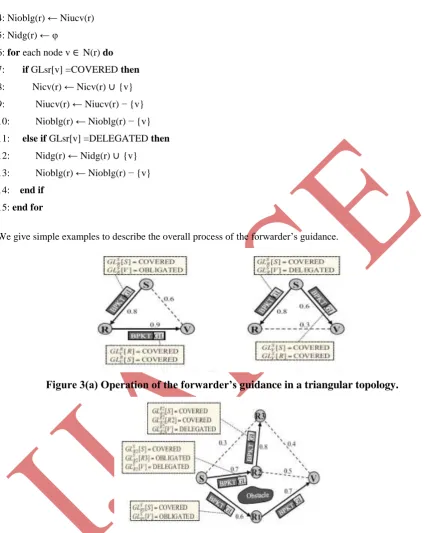
We give simple examples to describe the overall process of the forwarder’s guidance.
Figure 3(a) Operation of the forwarder’s guidance in a triangular topology.
Figure 3(b) Operation of the forwarder’s guidance in a complex topology including a
quadrangle
Figure 3(a) shows the operation of the forwarder’s guidance of EMBA in a triangular topology formed by S, R,
and V . The source node S initiates to broadcast with BPKTi. In the triangle, node S transmits a broadcast
message with GLsr[v ] = OBLIGATED to node R if the link quality between nodes R and V is better than that
between nodes S and V . Node V , therefore, will be covered by node R without any redundant transmissions or
148 |
P a g e
node V is delegated to the original forwarder S. Therefore, node R does not attempt to cover node V and it goesto sleep immediately upon receiving GLsr[v]= DELEGATED.
Figure 3(b) gives an example of the operation of EMBA in a complex topology which includes a quadrangle
formed by four nodes: S, R1, R2, and V . Node S transmits BPKTi to only nodes R1 and R2, but not R3. If
forwarder S sends BPKTi to node R3, the probability of message loss will be increased due to the poor link
between S and R3. Therefore, covering of node R3 is delegated to node R2 which has the better link to R3. If
without the forwarder’s guidance, node V will receive the same broadcast messages from nodes R1, R2, and R3.
In EMBA, node V will be covered only by node R1 since forwarder S gives GLS R1[V ] = OBLIGATED only
to R1 that has the best link quality to V . As a result, nodes R1, R2, and R3 can avoid redundant transmissions
and collisions.
4.3 The Overhearing of Broadcast Messages and ACKs
EMBA adopts another technique of the overhearing of broadcast messages and ACKs (BPKTi and ACKi). If a
forwarder overhears BPKTi or ACKi destined to a certain node during an active state, it can eliminate the ID(s)
of the node(s) specified in the message from its obligation set. Therefore, the number of transmissions required
for covering of neighbor nodes will be reduced. This technique significantly increases energy efficiency by
reducing the active time of each forwarder and the number of transmissions. This proposed technique is more
efficient in dense networks since the number of overhearable messages increases.
If forwarder x overhears BPKTi transmitted from node u to node v during an active state, it updates the sets as
follows:
Nicv(x) ← Nicv(x) ∪ {u} (6)
Niucv(x) ← Niucv(x) − {u} (7)
Nioblg(x) ← Nioblg(x) − {u} (8)
Nidg(x) ← Nidg(x) − {u} (9)
A transmission of ACKi message indicates that both a forwarder and a receiver are already covered.
Overhearing ACKi can reduce the size of the obligation set of a forwarder more quickly than overhearing
BPKTi. If forwarder x overhears ACKi destined from node u to node v, it updates the sets as follows:
Nicv(x) ← Nicv(x) ∪ {u, v} (10)
Niucv(x) ← Niucv(x) − {u, v} (11)
Nioblg(x) ← Nioblg(x) − {u, v} (12)
Nidg(x) ← Nidg(x) − {u, v} (13)
The number of transmissions required to complete broadcast is very closely related to the size of the obligation
set. This simple technique significantly improves the performance of EMBA in terms of both the message cost
and energy efficiency.
4.4 Handling of Network Failure
Guidance based broadcasting makes the best effort to avoid transmissions over poor links. Nevertheless, a
149 |
P a g e
guidance based broadcasting technique follows the network failure resolving mechanism of the MAC protocolcooperated with itself. If BPKTi or ACKi is lost, a forwarder will retransmit the BPKTi after a retransmit
timeout. The retransmission can easily compensate for the loss of BPKTi or ACKi. However, the loss of BPKTi
or ACKi in the overhearing is an important problem. If a forwarder x overhears an ACKi destined from node u
to node v and it is lost, x will eliminate the IDs of u and v from Nioblg(x) but v actually does not receive the
ACKi yet. Since the ACKi is not delivered to node v within a retransmit timeout, v will retransmit the BPKTi to
node u. guidance based broadcast protocol solves this problem in a best effort manner. Each node maintains the
forwarder address, the receiver address, and the broadcast number i of the most recently received BPKTi or
ACKi for a period of n duty cycles. After this duration, it updates its sets.
V. CONCLUSIONS
In this paper, we have proposed an efficient Guidance Based Multihop Broadcast Protocol for asynchronous
duty-cycled WSNs. Guidance based protocol can support multihop broadcast efficiently by using two
techniques of the forwarder’s guidance and the overhearing of broadcast messages and ACKs. The forwarder’s
guidance significantly reduces redundant transmissions and collisions in polygonal topologies such as triangle
(3-gon) and quadrangle (4-gon). This technique greatly improves the energy efficiency in sparse networks by
reducing duty cycle. The overhearing of broadcast messages and ACKs helps to reduce the number of
transmissions. This simple technique minimizes the active time of forwarders, which is more efficient in dense
networks. Guidance based broadcast shows much higher energy efficiency in both sparse and dense networks
compared to the conventional protocols such as ADB and RI-MAC broadcast. This significantly improves the
energy compared to ADB and RI-MAC broadcast. It also shows better performance of the message cost than the
conventional protocols in terms of the message cost ratio (MCR) and the average number of bytes transmitted.
Therefore, we have concluded that guidance based broadcast protocol achieves much higher energy efficiency
and message cost.
REFERENCES
[1] Y. Sun, O. Gurewitz, and D. Johnson, “RI-MAC: a receiver-initiated asynchronous duty cycle MAC
protocol for dynamic traffic loads in wireless sensor networks,” in Proc. 2008 ACM SenSys, pp. 1–14.
[2] ] W. Ye, J. Heidemann, and D. Estrin, “Medium access control with coordinated, adaptive sleeping for
wireless sensor networks,” IEEE/ACM Trans. Networking, vol. 12, no. 3, pp. 493–506, Jun. 2004.
[3] ] T. Dam and K. Langendoen, “An adaptive energy-efficient MAC protocol for wireless sensor networks,”
in Proc. 2003 ACM SenSys, pp.171–180.
[4] M. Buettner, G. Yee, E. Anderson, and R. Han, “X-MAC: a short preamble MAC protocol for duty-cycled
wireless sensor networks,” in Proc. 2006 ACM SenSys, pp. 307–320.
[5] R. Fonseca, O. Gnawali, K. Jamieson, and P. Levis, “Four-bit wireless link estimation,” in Proc. 2007
HotNets.
[6] Ingook Jang, Suho Yang, Hyunsoo Yoon, and DongwookKim, “EMBA: An Efficient multihop Broadcast