R E S E A R C H
Open Access
A low complexity reweighted proportionate
affine projection algorithm with memory and
row action projection
Jianming Liu
1, Steven L. Grant
1*and Jacob Benesty
2Abstract
A new reweighted proportionate affine projection algorithm (RPAPA) with memory and row action projection (MRAP) is proposed in this paper. The reweighted PAPA is derived from a family of sparseness measures, which demonstrate performance similar to mu-law and thel0norm PAPA but with lower computational complexity. The sparseness of the channel is taken into account to improve the performance for dispersive system identification. Meanwhile, the memory of the filter’s coefficients is combined with row action projections (RAP) to significantly reduce computational complexity. Simulation results demonstrate that the proposed RPAPA MRAP algorithm outperforms both the affine projection algorithm (APA) and PAPA, and has performance similar tol0PAPA and mu-law PAPA, in terms of convergence speed and tracking ability. Meanwhile, the proposed RPAPA MRAP has much lower computational complexity than PAPA, mu-law PAPA, andl0PAPA, etc., which makes it very appealing for real-time implementation.
Keywords: Proportionate affine projection algorithm, Sparse system identification, Row action projection, Adaptive filter
1 Introduction
Adaptive filtering has been studied for decades and has found wide areas of application. The most common adap-tive filter is the normalized least mean square (NLMS) algorithm due to its simplicity and robustness [1]. In the 1990’s, the affine projection algorithm (APA), a general-ization of NLMS was found to have better convergence than NLMS for colored input [2, 3]. The optimal step size control of the adaptive algorithm has been widely studied in order to improve their performance [4, 5]. The impulse responses in many applications, such as network echo cancellation (NEC), are sparse, that is, a small percent-age of the impulse response components have a significant magnitude while the rest are zero or small. To exploit this property, the family of proportionate algorithms was pro-posed to improve performance in such applications [2]. These algorithms include proportionate NLMS (PNLMS) [6, 7], and proportionate APA (PAPA) [8], etc.
*Correspondence: [email protected]
1Department of Electrical and Computer Engineering, Missouri University of Science and Technology, Rolla, USA
Full list of author information is available at the end of the article
The idea behind proportionate algorithms is to update each coefficient of the filter independently of the oth-ers by adjusting the adaptation step size in proportion to the magnitude of the estimated filter coefficient [6]. In comparison to NLMS and APA, PNLMS and PAPA have very fast initial convergence and tracking when the echo path is sparse. However, the big coefficients con-verge very quickly (in the initial period) at the cost of slowing down dramatically the convergence of the small coefficients (after the initial period). In order to com-bat this issue, mu-law PNLMS (MPNLMS) and mu-law PAPA algorithms were proposed [9–11]. Furthermore, the l0norm family of algorithms have recently drawn lots of attention for sparse system identification [12]. Therefore, a new PNLMS algorithm based on thel0norm was pro-posed to represent a better measure of sparseness than the l1norm in PNLMS [13].
On the other hand, the PNLMS and PAPA algo-rithms converge much slower than corresponding NLMS and APA algorithms when the impulse response is dis-persive. In response, the improved PNLMS (IPNLMS)
and improved PAPA (IPAPA) were proposed by intro-ducing a controlled mixture of proportionate and non-proportionate adaptation [14, 15]. The IPNLMS and IPAPA algorithms perform very well for both sparse and non-sparse systems. Also, recently, the block-sparse PNLMS (BS-PNLMS) algorithm was proposed to improve the performance of PNLMS for identifying block-sparse systems [16].
In order to reduce the computational complexity of PAPA, the memory improved PAPA (MIPAPA) algorithm was proposed to not only speed up the convergence rate but also reduce computational complexity by taking into account the memory of the proportionate coeffi-cients [17]. Dichotomous coordinate descent (DCD) iter-ations have previous been applied to the PAPA family of algorithms to implement the MIPAPA adaptive filter [18, 19]. Meanwhile, an iterative method based on the PAPA with row action projection (RAP) has been shown to have good convergence properties with relatively low complexity [20].
In [21] the proportionate adaptive filter was derived from a unified view of variable-metric projection algo-rithms. In addition, the PNLMS algorithm and PAPA can both be deduced from a basis pursuit perspective [22, 23]. A more general framework was further pro-posed to derive PNLMS adaptive algorithms for sparse system identification, which employed convex optimiza-tion [24]. Here, a family of PAPA algorithms are firstly derived based on convex optimization, in which PAPA, mu-law PAPA, andl0 PAPA are all special cases. Then, a reweighted PAPA is suggested in order to reduce the computational complexity. Finally, an efficient implemen-tation of PAPA is proposed based on RAP and memory PAPA.
The organization of this article is as follows. The review of various PAPAs is presented in Section 2. Section 3 derives the proposed reweighted PAPA and presents an efficient memory implementation with RAP. The computational complexity is compared with PAPA, mu-law PAPA and l0 PAPA in Section 4. In Section 5, simulation results of the proposed algorithm are pre-sented. The last section concludes the paper with remarks.
2 Review of various PAPAs
The input signal x(n) is filtered through the unknown coefficients to be identified h(n) to get the observed output signald(n).
d(n)=xT(n)h(n)+v(n), (1)
where
x(n)=[x(n),x(n−1),. . .,x(n−L+1)]T,
andv(n)is the measurement noise, andLis the length of impulse response. We define the estimated error as
e(n)=d(n)−xT(n)hˆ(n−1), (2)
where h(ˆ n)is the adaptive filter’s coefficients. Grouping the Mmost recent input vectors x(n)together gives the input signal matrix
X(n)=[x(n),x(n−1),. . .,x(n−M+1)] . Therefore, the estimated error vector is
e(n)=d(n)−XT(n)h(nˆ −1), (3) in which
d(n)=[d(n),d(n−1),. . .,d(n−M+1)]T,
e(n)=[e(n),e(n−1),. . .,e(n−M+1)]T,
whereMis the projection order. PAPA updates the filter coefficients as follows [8]:
P(n)=G(n−1)X(n), (4)
ˆ
h(n)= ˆh(n)+μP(n)(XT(n)P(n)+δIM)−1e(n), (5) in whichμis the step-size,δis the regularization parame-ter,IMis theM×Midentity matrix, and the proportionate step-size control matrixG(n−1)is defined as 0L×1at initialization andρprevents the coefficients from stalling when they are much smaller than the largest coef-ficient. The classical PAPA employs step-sizes that are proportional to the magnitude of the estimated impulse response as below [8]
F(|ˆhl|)= |ˆhl|. (10)
The mu-law PNLMS and the mu-law PAPA algorithm proposed in [9–11] use the logarithm of the coefficient magnitudes rather than magnitudes directly as below:
F(|ˆhl|)=ln(1+σμ|ˆhl|), (11)
in whichσμis a positive parameter.
approximation of thel0norm (l0-PNLMS) were proposed as below [13]:
F(|ˆhl|)=1−e−σl0|ˆhl|, (12) whereσl0is a positive parameter. The main disadvantage of the mu-law orl0norm PAPA algorithms are their heavy computation cost because of theLlogarithmic or expo-nential operations. Therefore, a line segment was given to approximate the mu-law function [9], where
F(|ˆhl|)=
200|ˆhl|, |ˆhl|<0.005;
1, otherwise. (13)
It should be noted that, without loss of performance, the line segment was normalized to be of unit gain for |ˆhl| ≥ 0.005, compared to the original one proposed in [9]. Meanwhile, the exponential form in (12) can be approximated by the first order Taylor series expansions of exponential functions [12]
It is interesting to see that the first order Taylor series approximation ofl0PAPA in (12) is actually the same as the line segment implementation of mu-law PAPA in (11) forσl0=200.
3 The proposed SC-RPAPA with MRAP
Based on the minimization of the convex target, the reweighted PAPA (RPAPA) will be firstly derived from a new sparseness measure with low computational com-plexity. Meanwhile, the sparseness controlled RPAPA (SC-RPAPA) is presented to improve the performance for both sparse and dispersive system identification. Finally, the SC-RPAPA with memory and RAP (MRAP) is proposed by combing the memory of the coefficients with iterative RAP to further reduce the computational complexity.
3.1 The proposed RPAPA
The proportionate APA algorithm can be deduced from a basis pursuitperspective [22]
min ˜h1
subject to d(n)=XTh˜(n), (16)
whereh(˜ n)is the correction component defined as
˜
h(n)=G(n)X(n)[XT(n)G(n)X(n)]−1d(n).
According to [24], the family of PAPA algorithms can be derived from the following target
min J(h˜)=
G−1(n)h˜(n)dh˜ subject to d(n)=XTh(n)˜ ,
(17)
where G−1(n) is the inverse matrix of proportionate matrixG(n), which is also a diagonal matrix. If the opti-mization target in (17) is convex, the family of PAPA algorithms can be derived using Lagrange Multipliers. It should be noted that, using the approximation
G−1(n)h˜(n)dh˜ ≈ 1 2h˜
T(n)G−1(n)h˜(n), (18) the proposed formulation in (17) becomes the variable-metric in [21], which is an approximation of the proposed formulation. The function G(t),t ∈ Rshould satisfy the following properties:
1)G(0)=0,G(t)is even and not identically zero; 2)G(t)is non-decreasing on[ 0,∞);
3) G(tt) is non-increasing on(0,∞).
The above properties follow the requirements of the sparseness measure proposed in [25]. From the perspec-tive of proportionate algorithms, the first two require-ments are intuitive, since the family of the proportionate algorithms should be proportionate to the magnitude of the filter’s coefficients. The third property will guarantee the convexity of the optimization target. PAPA, mu-law PAPA andl0PAPA are all special cases of the sparseness measures fulfilling all three properties. In this paper, con-sidering the computational complexity, we propose using the following reweighted PAPA:
whereσris a small positive constant.
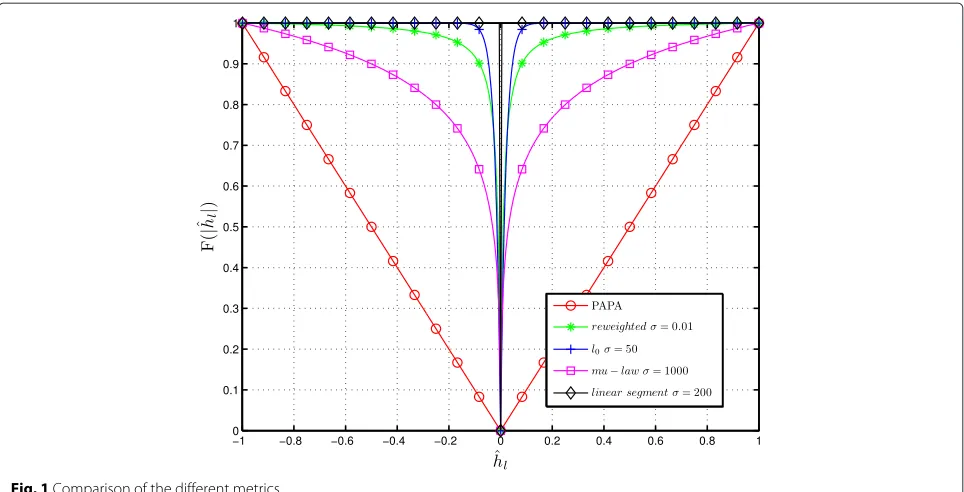
The proposed reweighted metric is compared with PAPA, mu-law PAPA andl0PAPA in Fig. 1. Theσ param-eters for each algorithm were σμ = 1000, σl0 = 50,
σr = 0.01. These parameters were recommended and
Fig. 1Comparison of the different metrics
3.2 The proposed SC-RPAPA
It should be noted that the reweighting factor σr in the proposed RPAPA (19) is related to the sparseness of the impulse system. It is straightforward to verify that ifσr = 0, reweighted PAPA simplifies to APA. If the impulse sys-tem is more sparse, σr should be relatively larger than
hˆl, which makes it more like the PAPA. This agrees with the fact that we fully benefit from PNLMS only when the impulse response is close to a delta function [26]. Therefore, it is natural to take the sparseness of impulse response into account. The sparsity of an impulse response could be estimated as
ˆ The value of(n)ˆ is between 0 and 1. For a sparse channel, the value of the sparseness is close to 1 and for a dispersive channel, this value is close to 0. Therefore, the SC-RPAPA is
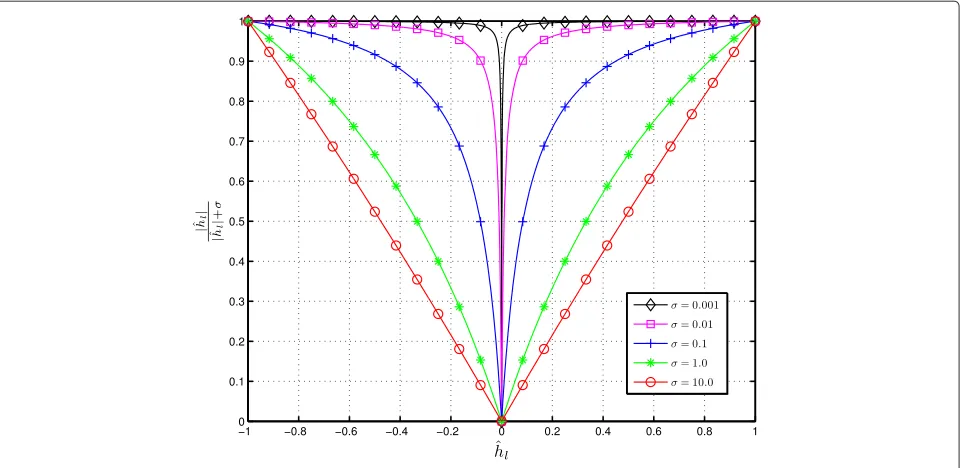
whereσmaxis the maximum value for the sparse system identification. The plot of the reweighted metric for differ-entσs is presented in Fig. 2. In practical implementation, we would like to apply the APA algorithm to the dispersive system under certain sparseness threshold. For example, the sparsity of the dispersive channel is about 0.4, and
a heuristic implementation that works pretty well in the simulations is
3.3 The proposed SC-RPAPA with MRAP
However, the main computational complexity of the fam-ily of PAPA algorithm is the matrix inversion in (5). Reduc-tion in complexity is achieved by using 5MDCD itera-tions, thus requiring about 10M2 additions [18]. Mean-while, a sliding-window recursive least squares (SRLS) low-cost implementation of PAPA is given based on DCD, which does not depend onM. The SRLS implementation is only efficient when the projection order is very high (e.g., such asM= 512) [19]. However, it is known that if the projection order increases, the convergence speed is faster, but the steady-state error also increases.
Fig. 2Reweighted metric with differentσparameters
coefficients for each equation. In this instance, the num-ber of RAP iterations,J is set to one. It should be noted that, by limiting J to one, the solution of the system of equations through RAP is approximate. However, the sim-ulation results will demonstrate that this approximation works pretty well, especially for relatively high projection order. In each sample period a new equation is added to the system of equations and the oldest equation is dropped. Thus,MRAP updates are performed on a given
equation every Msample periods. The PAPA algorithm
with RAP updates the coefficients
Initialize hˆ[0]= ˆh(n−1) Loop m=0, 1,. . .,M−1
α(m)=μ/(xT(n−m)P
m(n)+δ) e[m]=d(n−m)−xT(n−m)hˆ[m]
ˆ
h[m+1]= ˆh[m]+α(m)Pm(n)e[m] m=m+1
Update h(ˆ n)= ˆh[M]
wherePm(n)is themthcolumn ofP(n)defined as
Pm(n)=g(n−1)x(n−m),
in which the operationdenotes the Hadamard product andm=0, 1,. . .,M−1.
The traditional PAPA requiresM×Lmultiplications to calculateP(n), and in order to further reduce the com-putational complexity, we propose to apply the memory of the proportionate coefficients [17] into SC-RPAPA. Therefore, the matrixP(n)in (4) can be approximated as P(n)
P(n)=[g(n−1)x(n),P−1(n−1)] , (23)
whereP−1(n−1)contains the firstM−1 columns ofP(n− 1). Meanwhile, we define
p(n)=[p0(n),p1(n),. . .,pM−1(n)] , in which
pm(n)=xT(n−m)Pm(n),
andPm(n)is themthcolumn ofP(n)defined as
Pm(n)=g(n−m−1)x(n−m).
Considering the time-shift property, the calculation of p(n)could be
p(n)=[xT(n)P0(n),p−1(n−1)] , (24) wherep−1(n−1)contains the firstM−1 values ofp(n−1). The proposed update for the PAPA with memory and RAP is
Initialize hˆ[0]= ˆh(n−1) Loop m=0, 1,. . .,M−1
α(m)=μ/(pm(n)+δ)
e[m]=d(n−m)−xT(n−m)hˆ[m] ˆ
h[m+1]= ˆh[m]+α(m)Pm(n)e[m] m=m+1
Update hˆ(n)= ˆh[M]
Table 1The SC-RPAPA algorithm with MRAP
MPAPA through avoiding the direct matrix inversion and using the memory. The proposed SC-RPAPA with MRAP algorithm is summarized in detail in Table 1.
4 Computational complexity
The computational complexity of the SC-RPAPA with MRAP algorithm is compared with traditional PAPA, MPAPA, RPAPA, and SC-RPAPA in Table 2, in terms of the total number of additions (A), multiplications (M), divisions (D), comparisons (C), square root (Sqrt), and direct matrix inversion (DMI) needed per algorithm iter-ation. All the algorithms require L | · | operations for calculating the magnitude of the filter’s coefficients.
Compared with traditional PAPA, the MPAPA reduced the complexity of GX, but the calculation of XTP still requires M2L multiplications. Meanwhile, due to the memory and the iterative RAP structure, onlyL multipli-cations are needed to updatep(n)instead.
What’s more important is that, both the PAPA and the MPAPA algorithms require aM×Mdirect matrix inver-sion, which is especially expensive for high projection orders. The combination of the memory and the itera-tive RAP structure, not only avoids the M× M direct matrix inversion, but also reduces the computational complexity required for the calculation of both GXand XTGX.
The additional computational complexity for the SC-RPAPA with MRAP algorithm arises from the compu-tation of the sparseness measure ˆ. As in [31], given thatL/(L−√L)can be computed offline, the remaining l-norms require an additional 2Ladditions and L multi-plications. Furthermore, this sparseness measure can be reused in many other sparseness controlled algorithms too, for example [31]. The calculation of the F in (22) requires additionalLdivisions,L+1 additions, one mul-tiplication, and one comparison more than PAPA. The complexity of division is much lower than the L expo-nential or logarithmic operations required by either the mu-law or thel0PAPA. Meanwhile, (22) also offers the robustness to dispersive system identification.
5 Simulation results
The performance of the proposed SC-RPAPA with MRAP was evaluated via simulations. Throughout our simula-tion, the length of the unknown system wasL=512, and the adaptive filter was with the same length. The sampling rate was 8 kHz. The parameters for each algorithm were δ = 0.01/L,ρ = 0.01,q = 0.01. The step-size for all the algorithms was set toμ=0.2.
The algorithms were tested using both the white Gaussian noise (WGN), and colored noise as inputs. The colored input signals were generated by filtering the WGN through a first order system with a pole at 0.8. Indepen-dent WGN was added to the system background with a signal-to-noise ratio (SNR) as 30 dB.
Two impulse responses were used to verify the per-formance of the proposed SC-RPAPA MRAP algorithm, as shown in Fig. 3. The first one in Fig. 3a is a sparse impulse response of typical network echo with sparseness 0.92. Figure 3b is a dispersive channel with sparseness 0.44. In order to demonstrate the tracking ability, an echo path change was incurred through switching the impulse
Table 2Computational complexity of the algorithms’ coefficient updates
Fig. 3Two impulse responses used in the simulationathe sparse network echo path, andbthe dispersive echo path
response from the sparse system in Fig. 3a to the disper-sive one in Fig. 3b.
The convergence state of adaptive filter is evaluated with the normalized misalignment which is defined as
20log10 h− ˆh2
h2
.
5.1 The performance of the proposed RPAPA
The proposed reweighted PAPA in (19) was firstly
com-pared to PAPA, mu-law PAPA, andl0PAPA. The
param-eters for the algorithm wereσμ = 1000,σl0 = 200, and σr = 0.01. The affine projection order was selected as M=2.
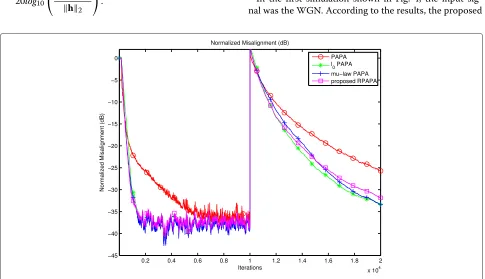
In the first simulation shown in Fig. 4, the input sig-nal was the WGN. According to the results, the proposed
Fig. 5Comparison of RPAPA with PAPA,l0PAPA and mu-law PAPA for colored input, SNR=30 dB,M=2,μ=0.2
RPAPA could outperform PAPA, and has similar perfor-mance with respect to mu-law andl0PAPA. However, the reweighted PAPA has much lower computational com-plexity. In the second simulation, the input signal was colored, and a similar result could be obtained according to Fig. 5.
5.2 The performance of the proposed SC-RPAPA
To demonstrate the benefit of sparseness control, the pro-posed SC-RPAPA algorithm was simulated using an echo path change from the sparse to the dispersive impulse response in Fig. 3. The SC-RPAPA algorithm was com-pared with APA, PAPA, and the above RPAPA algorithms.
Fig. 7Comparison of SC-RPAPA with APA, PAPA, and RPAPA for colored input, SNR=30 dB,M=2,μ=0.2
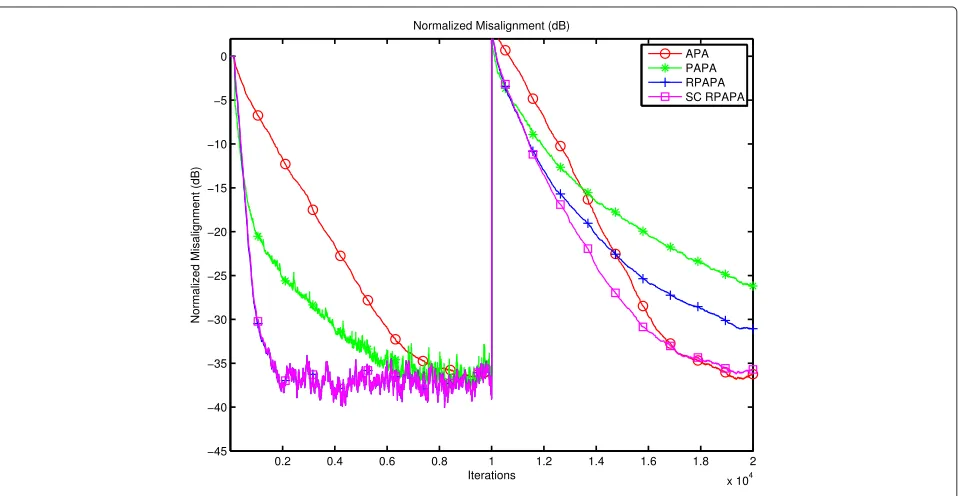
The parameters for the algorithm were σr = 0.01, and σmax = 0.02. The affine projection order was selected as M = 2. In Fig. 6, the input signal was the WGN input. Both the proposed RPAPA and SC-RPAPA algorithms had similar performance for sparse system identification, which outperformed APA and PAPA. Meanwhile, due to the sparseness control, SC-RPAPA outperformed RPAPA
as expected for the dispersive system. The colored input was used in Fig. 7, and similar results are observed.
5.3 The performance of the proposed SC-RPAPA with MRAP
An efficient implementation of the SC-RPAPA algorithm was proposed through combining the memory of the
Fig. 9Comparison of SC-RPAPA MRAP with APA, PAPA and RPAPA for colored input, SNR=30 dB,M=2,μ=0.2
filter’s coefficients with RAP. The new SC-RAPA with MRAP algorithm significantly decreases computational complexity. In this subsection, the performance of the effi-cient implementation was compared with APA, PAPA and SC-RPAPA through simulations.
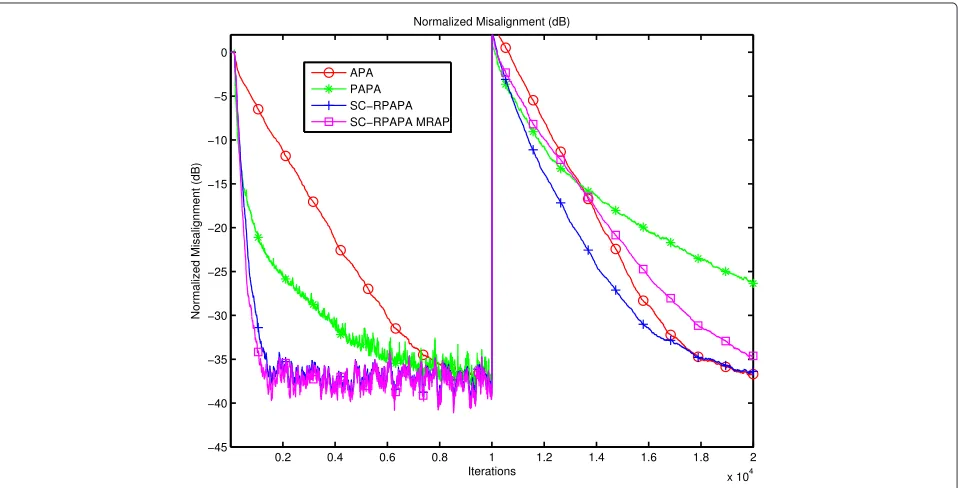
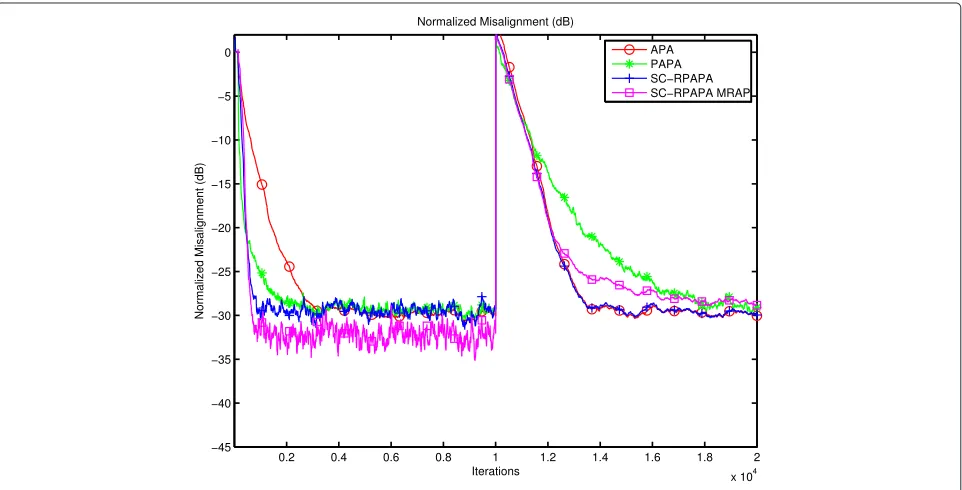
In the first simulation, the WGN input was used. As shown in Fig. 8, SC-RPAPA with MRAP worked as well
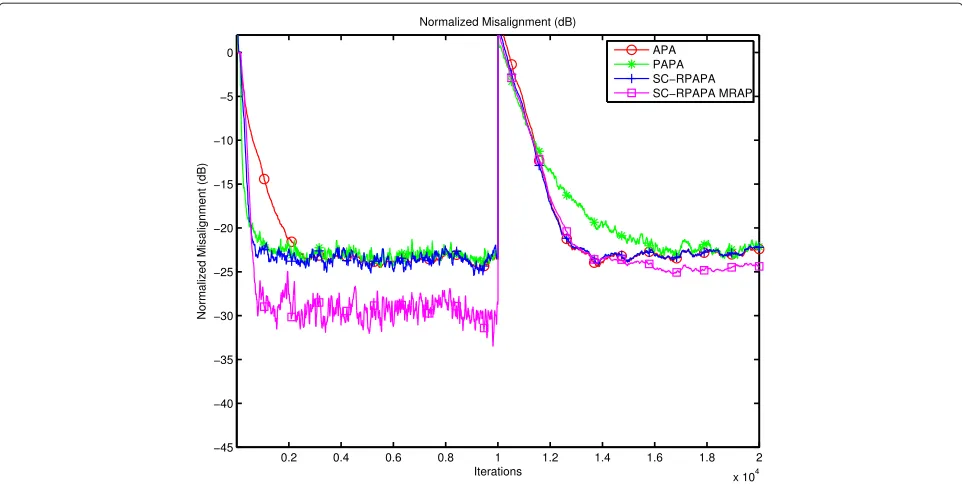
as SC-RPAPA for sparse system identification. However, for dispersive system, the performance of SC-RPAPA MRAP was worse than SC-RPAPA and the APA. This fact becomes more apparent for the colored input as shown in Fig. 9. This was caused by the relatively low projection
order (M = 2), and the implementation of the MRAP
was slower than the direct matrix inversion. However,
Fig. 11Comparison of SC-RPAPA MRAP with APA, PAPA and RPAPA for colored input, SNR=30 dB,M=32,μ=0.2
this drawback could be mitigated through increasing the projection order. Furthermore, the memory of the fil-ter’s coefficients will also improve the performance as the projection order increases. We verify this point through simulations withM= 32 for both the WGN (see Fig. 10) and the colored input (see Fig. 11). It could be observed that the SC-RPAPA with MRAP works better than APA, PAPA, and SC-RPAPA for sparse system identification. Meanwhile, the performance for dispersive system with colored input has been significantly improved too.
6 Conclusion
A low complexity reweighted proportionate affine projec-tion algorithm was proposed in this paper. The sparse-ness of the channel was taken into account to improve the performance for dispersive systems. In order to reduce computational complexity, the direct matrix inver-sion of PAPA was iteratively implemented with RAP. Meanwhile, the memory of the filter’s coefficients were exploited to improve the performance and further reduce the complexity for high projection orders. Simulation results demonstrate that the proposed sparseness con-trolled reweighted proportionate affine projection algo-rithm with memory and RAP outperforms traditional PAPA, with much lower computational complexity com-pared to mu-law andl0PAPA.
Competing interests
The authors declare that they have no competing interests.
Authors’ information
Steven L. Grant was formerly Steven L. Gay.
Acknowledgements
This work was performed under the Wilkens Missouri Endowment. The authors would like to thank the Associate Editor and the reviewers for their valuable comments and suggestions.
Author details
1Department of Electrical and Computer Engineering, Missouri University of Science and Technology, Rolla, USA.2INRS-EMT, University of Quebec, Montreal, Canada.
Received: 2 August 2015 Accepted: 5 November 2015
References
1. E Hänsler, G Schmidt,Acoustic Echo and Noise Control: a Practical Approach, vol. 40. (Wiley, Hoboken, New Jersey, 2005)
2. E Hänsler, G Schmidt,Topics in Acoustic Echo and Noise Control: Selected Methods for the Cancellation of Acoustical Echoes, the Reduction of Background Noise, and Speech Processing. (Springer, Berlin, Heidelberg, 2006)
3. K Ozeki, T Umeda, An adaptive filtering algorithm using an orthogonal projection to an affine subspace and its properties. Electron. Commun. in Japan (Part I: Commun.)67(5), 19–27 (1984)
4. E Hänsler, GU Schmidt, Hands-free telephones–joint control of echo cancellation and postfiltering. Sig. Process.80(11), 2295–2305 (2000) 5. A Mader, H Puder, GU Schmidt, Step-size control for acoustic echo
cancellation filters–an overview. Sig. Process.80(9), 1697–1719 (2000) 6. DL Duttweiler, Proportionate normalized least-mean-squares adaptation
in echo cancelers. Speech Audio Process. IEEE Trans.8(5), 508–518 (2000) 7. K Wagner, M Doroslovacki,Proportionate-type Normalized Least Mean
Square Algorithms. (Wiley, Hoboken, New Jersey, 2013)
8. T Gansler, J Benesty, SL Gay, MM Sondhi, inAcoustics, Speech, and Signal Processing, 2000. ICASSP’00. Proceedings. 2000 IEEE International Conference On. A robust proportionate affine projection algorithm for network echo cancellation, vol. 2 (IEEE Istanbul, 2000), pp. 793–796
9. H Deng, M Doroslovacki, Improving convergence of the PNLMS algorithm for sparse impulse response identification. Signal Process. Lett. IEEE.12(3), 181–184 (2005)
11. L Liu, M Fukumoto, S Saiki, S Zhang, A variable step-size proportionate affine projection algorithm for identification of sparse impulse response. EURASIP J. Adv. Signal Process.2009, 1–10 (2009).
doi:10.1155/2009/150914
12. Y Gu, J Jin, S Mei,l0norm constraint LMS algorithm for sparse system
identification. Signal Process. Lett., IEEE.16(9), 774–777 (2009) 13. C Paleologu, J Benesty, S Ciochina, inAcoustics Speech and Signal
Processing (ICASSP), 2010 IEEE International Conference On. An improved proportionate NLMS algorithm based on thel0norm (IEEE Dallas, TX,
2010), pp. 309–312
14. J Benesty, SL Gay, inAcoustics, Speech, and Signal Processing (ICASSP), 2002 IEEE International Conference On. An improved PNLMS algorithm, vol. 2 (IEEE Orlando, FL, USA, 2002), pp. 1881–1884
15. O Hoshuyama, R Goubran, A Sugiyama, inAcoustics, Speech, and Signal Processing, 2004. Proceedings.(ICASSP’04). IEEE International Conference On. A generalized proportionate variable step-size algorithm for fast changing acoustic environments, vol. 4 (IEEE Montreal, 2004), p. 161 16. J Liu, SL Grant, Proportionate adaptive filtering for block-sparse system
identification (2015). arXiv preprint arXiv:1508.04172
17. C Paleologu, S Ciochin˘a, J Benesty, An efficient proportionate affine projection algorithm for echo cancellation. Signal Process. Lett. IEEE. 17(2), 165–168 (2010)
18. C Stanciu, C Anghel, C Paleologu, J Benesty, F Albu, S Ciochina, inSignals, Circuits and Systems (ISSCS), 2011 10th International Symposium On. A proportionate affine projection algorithm using dichotomous coordinate descent iterations (Iasi, 2011), pp. 1–4
19. Y Zakharov, VH Nascimento, Sliding-window RLS low-cost implementation of proportionate affine projection algorithms. Audio Speech Lang. Process. IEEE/ACM Trans.22(12), 1815–1824 (2014) 20. SL Grant, P Shah, J Benesty, inSignal & Information Processing Association
Annual Summit and Conference (APSIPA ASC), 2012 Asia-Pacific. An efficient iterative method for basis pursuit adaptive filters for sparse systems (IEEE Hollywood, CA, 2012), pp. 1–4
21. M Yukawa, I Yamada, A unified view of adaptive variable-metric projection algorithms. EURASIP J. Adv. Signal Process.2009, 34 (2009) 22. J Benesty, C Paleologu, S Ciochin, Proportionate adaptive filters from a
basis pursuit perspective. Signal Process. Lett. IEEE.17(12), 985–988 (2010) 23. C Paleologu, J Benesty, inCircuits and Systems (ISCAS), 2012 IEEE
International Symposium On. Proportionate affine projection algorithms from a basis pursuit perspective (IEEE Seoul, 2012), pp. 2757–2760 24. J Liu, SL Grant, inSignal and Information Processing (ChinaSIP), 2014 IEEE
China Summit & International Conference On. A generalized proportionate adaptive algorithm based on convex optimization (IEEE Xi’an, 2014), pp. 748–752
25. R Gribonval, M Nielsen, Highly sparse representations from dictionaries are unique and independent of the sparseness measure. Appl. Comput. Harmon. Anal.22(3), 335–355 (2007)
26. SL Gay, inSignals, Systems, Computers, 1998. Conference Record of the Thirty-Second Asilomar Conference On. An efficient, fast converging adaptive filter for network echo cancellation, vol. 1 (IEEE Pacific Grove, CA, USA, 1998), pp. 394–398
27. S Kaczmarz, Angenäherte auflösung von systemen linearer gleichungen. Bulletin International de lAcademie Polonaise des Sciences et des Lettres. 35, 355–357 (1937)
28. J Benesty, T Gänsler, inProc. Int. Workshop on Acoustic Echo and Noise Control (IWAENC). On data-reuse adaptive algorithms (Kyoto, 2003) 29. SL Gay, Fast projection algorithms with application to voice echo
cancellation. PhD thesis, New Brunswick, NJ, USA, 1994
30. P Shah, SL Grant, J Benesty, inAcoustics, Speech and Signal Processing (ICASSP), 2012 IEEE International Conference On. On an iterative method for basis pursuit with application to echo cancellation with sparse impulse responses (IEEE Kyoto, 2012), pp. 177–180
31. P Loganathan, AW Khong, P Naylor, A class of sparseness-controlled algorithms for echo cancellation. Audio Speech Lang. Process. IEEE Trans. 17(8), 1591–1601 (2009)
Submit your manuscript to a
journal and benefi t from:
7Convenient online submission
7Rigorous peer review
7Immediate publication on acceptance
7Open access: articles freely available online
7High visibility within the fi eld
7Retaining the copyright to your article