R E S E A R C H
Open Access
Consensus-based distributed adaptive
target tracking in camera networks using
Integrated Probabilistic Data Association
Khaled Obaid Al Ali
1,2, Nemanja Ili´c
3,2*, Miloš S. Stankovi´c
4,2and Srdjan S. Stankovi´c
5,2Abstract
In this paper, a novel consensus-based adaptive algorithm for distributed target tracking in large scale camera networks is presented, aimed at situations characterized by limited sensing range, high-level clutter, and possibly occulted targets. The concept of Integrated Probabilistic Data Association (IPDA) is introduced in the distributed adaptive tracker design so that the proposed algorithm, named IPDA Adaptive Consensus Filter (IPDA-ACF),
incorporates probabilities of acquiring target-originated measurements, conditioned on either target perceivability or target existence. A distributed adaptation scheme represents the core element of the algorithm, allowing fast convergence under a large variety of operating conditions, emphasizing the influence of the nodes with the highest probability of obtaining target-originated measurements. A theoretical analysis of stability and reduction of noise influence allows getting an insight into the relationship between the local trackers and the global consensus scheme. A comparison with analogous existing methods done by extensive simulations shows that the proposed method achieves the best performance, in spite of lower communication and computation requirements.
Keywords: Camera networks, Distributed target tracking, Integrated Probabilistic Data Association, Consensus, Decentralized adaptation
1 Introduction
Recent rapid improvement in quality and resolution of imaging sensors and availability of low-cost smart cam-eras, together with the development of sensor network technology, have paved the way for creation oflarge scale camera networks. Examples of very successful applica-tions are more and more numerous, especially in the fields of wide-area surveillance, disaster response, and environ-mental monitoring.Detectionandtracking of objects of interest is one of the fundamental functions of camera networks, see, e.g., [1] and the references therein.
In this context, distributed estimation schemes are becoming increasingly popular, due to their high preci-sion and scalability to large number of sensors, with no need for centralized actions, e.g., [2–4]. In spite of the fact that the theoretical fundamentals of target tracking are
*Correspondence:[email protected]
2Vlatacom Institute, Bulevar Milutina Milankovica 5, 11000 Belgrade, Serbia 3College of Technics and Technology, 37000 Kruševac, Serbia
Full list of author information is available at the end of the article
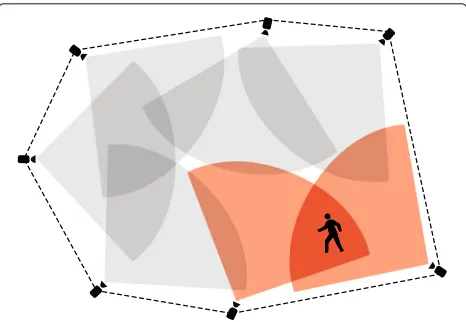
basically the same for different types of sensors (radars, sonars, cameras), camera networks impose some unique and interesting challenges, arising from the fact that (1) most of the cameras are directional and have lim-ited sensing range (LSR) or field-of-view (FoV) so that at each time instant there might be a significant share of sensors that do not observe the target (see Fig. 1 as an illustration) and (2) environment is highly clut-tered and targets can be temporarily occulted. Majority of the existing distributed estimation algorithms of gen-eral type based onconsensus cannot be directly applied in this context. The Kalman-consensus filter (KCF) [5] has been applied to target tracking problems by sensor networks with LSR in [6]. The algorithm assumes inter-node exchange of local target state estimates, together with the so-called information vectors and matrices, which depend on local measurements and their covari-ances. The information-weighted consensus filter (ICF) has been found to outperform KCF under limited local observability scenarios [4]. It uses the fact that the local information contained in the nodes becomes correlated as
Fig. 1Camera network with seven nodes with limited sensing and communication ranges. The dashed lines represent the communication channels between different nodes. The target is observable by two cameras at the given time instant
the state estimates converge. The communication require-ments incorporate, besides those of KCF, the local error covariance matrices. Both KCF and ICF have been applied to distributed tracking problems in cluttered environ-ment [7, 8], incorporating elements of the Probability Data Association (PDA) methodology [9–11]. In [12], an algorithm for decentralized state estimation has been proposed, based on a combination of local estimators of Luenberger type and a flexible dynamic consensus strategy. It assumes exchange of only state estimates between neighboring nodes. Its adaptive modification has been proposed in [2] in the context of target track-ing problems with sensors havtrack-ing limited senstrack-ing range, but without assuming presence of clutter. We shall refer to this algorithm as Adaptive Consensus Filter (ACF). It has been demonstrated that ACF largely outperforms KCF and slightly outperforms ICF, preserving, at the same time, significantly lower communication bandwidth requirements [3].
In this paper, we assume cluttered environment and possibly temporarily occulted targets and propose a new distributed adaptive tracking algorithm for camera net-works, representing an extension of ACF from [2] based on Integrated Probabilistic Data Association (IPDA); this algorithm will be denoted further as IPDA-ACF. The con-cept of IPDA has been introduced by Musicki, Evans, and Stankovic in [13] and further extended in differ-ent directions, see, e.g., [9–11, 14, 15]. The notion of target perceivability [14, 15] has been utilized to con-struct two distinct consensus-based tracking algorithms, having the form of the basic Probabilistic Data Associ-ation (PDA) recursion [9–11]. The algorithms deal with two types of the so-called “β-parameters, representing probabilities of getting a target-originated measurement conditioned either on target perceivability or on target
existence; in this sense, we have the algorithms denoted as IPDA-ACF1 and IPDA-ACF2, respectively. The core element of the proposed algorithm, making it compet-itive and even superior to the algorithms with higher communication requirements proposed in [7, 8], is the distributed adaptation scheme, developed as a substan-tial generalization of the adaptation strategy originally described in [2,3] (see also [16]). The adaptation scheme, aiming at giving emphasis to the nodes with the highest probability of obtaining target-originated measurements, is based on the locally obtained “β-parameters as indi-cators of target observability in cluttered environment; these parameters are used to improve both tracking accu-racy and convergence rate of achieving consensus among the nodes. Stability and noise immunity of the whole distributed tracking method are also theoretically ana-lyzed in detail, by applying the methodology introduced in [2, 12], as well as the recent results concerning prop-erties of the modified deterministic discrete Riccati Eq. [12, 17, 18]. The paper also introduces appro-priate modifications of the original versions of KCF and ICF incorporating IPDA methodology [7, 8], nec-essary for a fair comparison with the proposed algo-rithm (IPDA-KCF and IPDA-ICF). Tracking quality of the proposed algorithm has been analyzed in detail by simulation. The presented results give an insight into the main properties of the algorithm and show that it outperforms both alternative algorithms, in spite of lower communication and computation requirements.
The outline of the paper is as follows. Section 2 is devoted to the problem definition and the basic notions related to the IPDA methodology. Section 3 contains a description of the new distributed tracking algorithm (IPDA-ACF), including the algorithm definition and pre-sentation of the adaptation strategy. A theoretical analysis of stability of the proposed adaptive tracking algorithm, as well as of the reduction of noise influence is given in Section 4. Section 5 is devoted to the formulation of IPDA-KCF and IPDA-ICF algorithms. Section 6 con-tains the results of simulation analysis, and Section 7 concluding remarks.
Notation.In the paper, we shall usetfor discrete time and subscriptito indicateith node (sensor) in a network; more specifically, we shall use the following notations:
x Target state vector
F State transition matrix
e Process noise vector
G Process noise covariance matrix
G Directed graph reflecting the
zi,j j-th measurement
vi Measurement noise vector
Hi Measurement noise covariance matrix Zi(t) Set of all measurements at timet Zit Set of all measurements up to timet Oti Event that the target
is perceivable at timet πi(t|t−1) Predicted probability
of target perceivability πi(t|t) Updated probability
of target perceivability PiD Probability of detection Pig Probability of
target-originated measurement falling inside the gate (FoV)
˜
zi,j Residual of thejth measurement Si Covariance ofz˜i,j
λi Clutter spatial density
Vi Gate volume
θi,j Event that thej-th measurement is target originated
θi,0 Event that
the target-originated measurement is not in the gate or nonexistent β[1]
i,j Probability ofθi,j,j=0, 1,. . .,mi, conditioned onOtiand onZit β[2]
i,j Probability ofθi,j,j=0, 1,. . .,mi, conditioned on the event that the target is present and onZit
Li Kalman gain matrix
C,A Single step consensus operators
ωi Scalar defining node importance
ui Information vector
Ui Information matrix
yi Sum of information vectors
across neighbors
Bi Sum of information matrices
across neighbors
· Spectral norm
2 Problem definition; Integrated Probabilistic
Data Association
Consider a target modeled as a dynamic stochastic linear time-invariant discrete-time system, given by
x(t+1)=Fx(t)+Ge(t), (1)
wheret ∈ I+,I+is the set of nonnegative integers,x ∈ Rnis the target state vector,ezero-mean white Gaussian noise with covariance matrixQ, and F and Gconstant matrices with appropriate dimensions (see, e.g., [19]).
Assume that we have N intelligent sensors forming a network, formally represented by adirected graph G = (N,E), whereN is the set of nodes andEthe set of arcs. Assume also thatNiis the in-neighborhood of the nodei, containing the head nodes of the arcs entering the nodei; define alsoJi=Ni∪ {i}. Eachnode(camera) is supposed to have, in general, limited sensing and communication ranges, which determine at each tthe set of nodes that can observe the target and the sets of neighboring nodes exchanging messages (these sets may contain, in general, low percentage of the total number of nodes). We assume that real measurements arecluttered, i.e., in addition to data originating from the target, a set of measurements corresponds tono targets[9–11,19]. At timet, nodeigets mi(t)measurements, denoted aszi,j(t), j = 1,. . .,mi(t). Under the hypothesis that the measurementzi,j(t) origi-nates from the target, thesensing modelfor theith node is given by
zi,j(t)=Hix(t)+vi(t), (2)
wherezi,j(t) ∈ Rpi is the measurement vector,Hi a con-stant output matrix, and vi zero-mean white Gaussian measurement noise with covariance matrixRi. LetZi(t)=
{zi,1(t),zi,2(t),. . .,zi,mi(t)(t)}denotes the set of allmi(t)= mTi (t)+mfi(t)measurements obtained by nodeiat timet, wheremTi (t)is the number of target-originated measure-ments, and mfi(t) the number of false clutter-originated measurements. LetZit= {Zi(1),. . .,Zi(t)}.
and assume that the target perceivability can be modeled by a first order Markov model, withp11i = POti|Oti−1
andp21i = POti| ¯Oit−1, see [14,15]. Ifπi(t|t−1) and πi(t|t)are the predicted and updated probabilities of tar-get perceivability for a given track, respectively, the total probability theorem gives
πi(t|t−1)=p11i πi(t−1|t−1)+p21i [1−πi(t−1|t−1)] . (3)
According to the basic references related to the IPDA methodology [13–15], the updated and predicted target perceivability probabilitiesare connected by
πi(t|t)= [1−φi(t)]πi(t|t−1) that the target is perceivable),Pigis the probability that a target-originated measurement falls inside the gate (FoV) of the sensori, optimal estimate ofzi,j(t)), andSi(t)its covariance,
μi(t,m)= (λi(t)Vi(t)) tial density andVi(t)the gate volume (under the classical Gaussian assumptionfor the target and thePoisson model for clutter [14,15]).
Let θi,j be the event that the jth measurement of the ith node is target originated, and θi,0 that the target-originated measurement is not in the gate (FoV) or nonex-istent. Define identical to the well-known weights (“β-parameters) of the classical PDA filter [10,11]: bilitiesβi[1],j(t)are used within the formulation of the target perceivability-based PDAF in [15].
In general, it can be of interest to estimate the state of a target that ispresent no matter whether it can be detected or not. One may define the following probabilities [15]:
β[2]
where T stands for the event that a target is present. Following [15], one can show that
β[2] a part of the target existence-based PDAF formulated in [15] and depend on the probabilities (6) and the perceiv-ability probabilities (4). Recently, the concept of target existence probability has been used in the context of multi-target tracking in multi-static passive radar systems [26]. Notice thatβi[2],j (t) ≤ βi[1],j (t), j = 1,. . .,mi(t)and that, consequently, βi[2],0(t) ≥ βi[1],0(t) (see [14, 15] for a more complete discussion).
In the context of distributed target tracking by sensor networks considered in this paper, all the above state-ments hold locally, for each sensor. It will be seen below that the choice betweenβi[1],j (t)andβi[2],j(t)offers an addi-tional possibility for adaptation to the current situation concerning the target, the entire sensor network, and its environment.
3 Adaptive consensus filter: IPDA-ACF
3.1 Tracking algorithm
wherecij(t), i,j = 1,. . .,N, are (generally) time varying weights, such thatN×NmatrixC(t)=[cij(t)] (consensus matrix) isrow-stochasticfor allt, and
Li(t)=Pi(t|t−1)HiTSi(t)−1 (11)
The above algorithm follows structurally the consensus-based overlapping estimation algorithm proposed in [12]. Instead of the local estimators of Luenberger type from [12], we have here trackers of PDA type [10]. The algo-rithm contains two main parts:
1) The filtering part, in which the local measurements are processed
2) The prediction part, in which the agreement between the nodes is enforced through a convex combination of the estimates communicated by the neighboring nodesC(ξi(t|t)).
Obviously, the algorithm requires only the exchange of state estimates (sizen×1). The choice oflinβi[,lj](t)results from a predefined setting. For l = 1, one obtains the estimation scheme resulting directly from the PDAF [10], while forl=2, the algorithm follows the existence-based PDAF from [15] and becomes more capable of coping with high level of clutter and possible target occlusions (typical for camera networks - see, e.g., [27] for a general discussion).
The choice of the consensus matrix C(t) can be based, in general, on different principles, including the well-known standard Metropolis weights (see, e.g., [28] and the ref-erences therein) and optimization procedures providing the fastest convergence to consensus [29,30]. However, in the above context (limited FoV, clutter, target occlusions), such approaches provide insufficient tracking accuracy of the proposed algorithm in real-time applications. One should bear in mind that we have, in the context of the proposed algorithm, the so-called “running consensus” [31,32], consisting of an inseparable pair estimation algo-rithm - consensus algoalgo-rithm, each possessing its own dynamics. It would be possible, in principle, to formulate the problem of defining the consensus matrix in a theoret-ically unified way, including both the estimation algorithm and the consensus scheme; however, such methodologies
can hardly provide results applicable in real time. In order to provide a practically efficient solution, the next subsec-tion contains a presentasubsec-tion of a distributed adaptasubsec-tion applicable in real time, aiming at providing adequate time-varying consensus weights in (10), using the locally avail-able realizations of theβ-parameters, in accordance with the basic principles of the IPDA methodology.
3.2 Distributed adaptation strategy
Distributed adaptation strategy represents the core ele-ment of the IPDA-ACF algorithm. In the context of the scenario considered in this paper, we follow the basic line of thought from [2,3,12] and construct a novel-improved fully distributed adaptation procedure generatingC(t)in (10), dynamically giving more importance to the nodes withhigher probability of receiving target-originated mea-surements, enabling, at the same time, fast information flowthrough the network. In the sequel, we shall first give a short outline of the original adaptive scheme from [2], and then, we shall present the general adaptation strategy for the tracking algorithm presented above.
1)Basic adaptation scheme: no clutter
The distributed adaptive tracking algorithm ACF in [2] has been derived from [12]; it requiresadditional inter-node communicationofβi[1],0(t) ∈ {0, 1}that are available locally (indicators of measurement availability at timet). Using this information, each node computes|Ji|scalars χi
j(t), representing observation histories of the neighbor-ing nodes. The nonnormalized consensus gains are given by cχij(t) = cχij(0)kχji(t), for χi ues; parameterk ∈ (0, 1] determines the rate of change ofcχij(t). The normalized consensus gains, ensuring row
stochasticity, are obtained fromcij(t) = c
χ algorithm from [2] outperforms KCF from [6].
2)General adaptation strategy
The adaptation procedure proposed in this paper essen-tially extends and modifies the basic adaptation scheme from [2] in two principal directions: (1) instead of binary indicators of target presence, we utilize real numbers β[l]
i,0(t) defined by (6) or (8) since they reflect the uncer-tainty of obtaining a target-originated measurement; (2) in order to enable fast diffusion of the target state esti-mates throughout the network, the adaptation scheme incorporates its own, specially designed dynamics.
Formally, we introduce the node importance vector ω(t) = (ω1(t),. . .,ωN(t))T, generated by the following recursion:
which starts from ω(0) = (ω1(0),. . .,ωN(0))T = (0,. . ., 0)T, where γ (t) = (γ1(t), . . .,γN(t))T, γi(t) = 1− βi[,0l](t),A = I+Aadj
rs, where Aadj represents the adjacency matrixof the underlying network graph, and Y = (X)rsdenotes, forN×NmatricesXandY, thatY is obtained fromXin such a way that the elements of its rows are divided by the corresponding row-sums, while α > 0 is a sufficiently small real number. Using the node importance vector, the elements of the consensus matrix C(t)are given by
cij(t)= ωj(t) j∈Jiωj(t)
(14)
forj∈Ji;cij(t)=0 otherwise.
The algorithm requires that each node receives at each treal numbersωj(t)from its neighbors. It is obvious that the recursion (13) is implementable in adistributed way, having in mind that locally
ωi(t+1)= α 1+νi
j∈Ji
ωj(t)+γi(t+1), (15)
where νi is the number of nonzero elements of ith row ofAadj.
The input vector γ (t+ 1) in (13) reflects the current network-wide perceivability, i.e., its elements represent the local probabilities of getting target-originated measure-ments(in the case of no clutter,γi(t)is a binary random variable, equal to one when the target is observed, and to zero otherwise [2]). It can be considered that γi(t) provides a direct measure of “quality” of the current esti-mate of the ith node, obtained after the local filtering phase (prior to the application of the consensus scheme). Namely, when a target is successfully being tracked and ith node receives measurement from it,βi[,lj](t)connected to that measurement has high values (close to one), while all the otherβi[,lj](t)are generally small, as well asβi[,0l](t) (close to zero). On the other hand, if theith node does not receive measurement from the target, allβi[,lj](t)will be
generally close to zero andβi[,0l](t)close to one. Obviously, the difference between the choicesl = 1 andl = 2 lies in the fact that in the second case, the resulting tracking algorithm is less sensitive to the availability of measure-ments than in the case when l = 1; this choice is well adapted to the high level of clutter and to the targets that are temporarily not perceivable (as stated above). Another choice for γi(t) could be γi(t) = maxj=1,...,mi(t)βi[,lj](t), which yielded in our experiments the results comparable to those obtained by the above formulated algorithm.
The role of the first term at the right hand side of (13) containingαAis to enable fastdecentralized diffusionof the local state estimates throughout the whole network. Under the standard assumption that the graph G has a
center node (a node from which all the nodes are reach-able), matrix Ahas one simple eigenvalue at one, while the remaining ones are inside the unit circle. In this case, we have thatAk converges, whenk → ∞, to a constant matrix with equal rows composed of positive elements. This means, having in mind (13), that all the nodes will have asymptotically positive valuesωi(∞),i = 1,. . .,N. The multiplying constantαdefines the memory length of the algorithm; obviously, for α < 1, the recursion (13) is asymptotically stable. The chosen value ofαshould be small, in order to be able to efficiently exploit current measurements, and large enough, in order to sufficiently smooth out stochastic variations in the random sequence
{γ (t)}.
In order to better clarify the basic effects of choosingα andA, consider w.l.o.g. the situation in whichγ (t+1) = in fact,ci1 ≈ 1, while the remaining elements are of the order of magnitude ofα; (2) the rows ofC(∞)withci1=0 contain the nonzero elements having different order of magnitude, depending on graph topology, irrespective of α. In the first case, the convex combination from (9) will give the highest emphasis to the neighbors observing the target with high probability, while in the second, node pri-orities result from the given graph. In the first case, we have prompt reaction for small α, while in the second, diffusion rate of the state estimates is maximized. In our experiments, we adoptedαto be around 0.05.
Asymptotic properties of the proposed adaptation scheme capture the perceivability history in a more effi-cient way than the original scheme from [2]. For example, in the cases when two nodes have the same γi, the first term at the right hand side of (15) gives more weight to the node that previously received information, coming more likely from the nodes that had observed the target (see the example below and the simulation results).
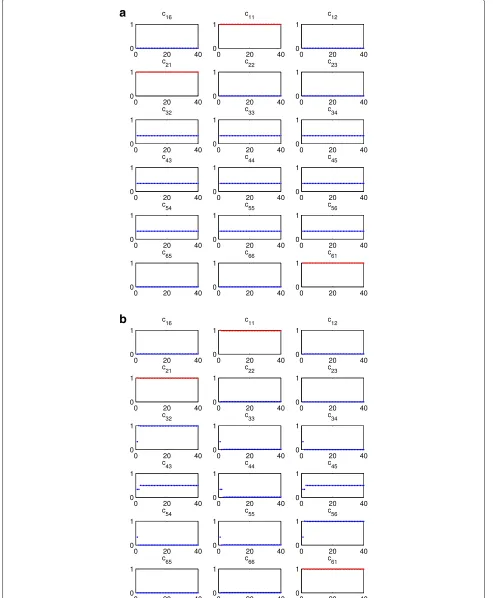
Algorithm 1IPDA-ACFlfor nodeiat timet wise (the proposed general adaptation strategy). Figure2 shows the time evolution of the resulting nonzero con-sensus weights connected to the original scheme (ACF1) and the proposed algorithm (ACF2). It can be seen that the main difference between the algorithms is in the con-sensus weights connected to the nodes that do not have measuring nodes in their neighborhoods. The original algorithm assigns equal consensus weights in the consen-sus matrix rows connected to these nodes (3rd, 4th, and 5th row in Fig.2a), while the proposed general algorithm gives more weight to the nodes that are closer to the mea-suring node (3rd, 4th, and 5th row in Fig.2b), enabling better information flow through the network which, in turn, allows faster convergence and better tracking.
Remark 1The exposed methodology for distributed adaptive generation of the consensus weights in (10) is mainly motivated by the idea to exploit the locally avail-able“β-parameters in order to assign higher importance to the nodes with higher probabilities of getting target-originated measurements; it has no other direct connection with the main state estimation algorithm based on the PDAF. Therefore, it is easy to conclude that the results of this section can be readily used in the context of any non-linear estimation algorithm, provided an estimate of the probabilities contained in the“β-parameters is available. In this sense, it is straightforward to construct adaptive
algorithms based, e.g., on the extended Kalman filter (like in[8]), on the unscented Kalman filter, and particle filters. It is also possible to apply the proposed methodology within the framework of the ML-PDA method applicable in real time[20–25]. The adaptation strategy should again cope mainly with the limited FoVs (or sensing ranges).
4 Stability and reduction of noise influence
4.1 Stability
Stability and noise reduction of the proposed distributed tracking algorithm will be analyzed starting from the following global network model:
To the best of the authors knowledge, no general methodology is directly applicable to the stability analysis of the model (17), not to mention many open questions related to the local recursions of PDA type [17]. We shall here make an attempt to apply the methodology pro-posed in [2, 12] in relation with distributed estimation schemes with overlapping subsystems and to get an addi-tional insight into the complex relationship between the local trackers and the adaptive consensus scheme. Using the basic results from [12,33–35], we define the norm of the block-matrix(t)=[ij(t)] as
(t)∗τ = [ij(t)τ]∞,
where Yτ denotes the norm of a square matrix Y defined asYτ = DτUTYU D−τ1∞, in whichU is an orthogonal matrix in the representation Y = UUT, where is an upper triangular matrix containing the eigenvalues ofYat the diagonal (according to the Schur’s theorem [35]) andDτ =diag{τ,τ2,τ3,. . .,τn}. It is essen-tial to notice that it is possible to find, for any givenε >0, such aτε>0 that, for allτ > τε,ρ(Y)≤ Yτ ≤ρ(Y)+ε, where ρ(Y) is the spectral radius of a square matrix Y [12, 35]. Without going into details related to specific properties of the adopted norm in the case of (17), notice that the main idea behind the adopted definition is to take(t)∗τ as an estimate ofρ((t))based on the local algorithm properties expressed byij(t)τ.
Concentrating on(t), we shall start from the following sufficient conditions for asymptotic stability of the linear time-varying system (17) [36,37]:
a
b
((t)⊗(t)) ≤ μ
the minimal singular value [37].
For τ large enough, FI−1−βj[,0l](t)Lj(t)Hj
τ becomes a good estimate of ρ
Coming back to the system (17), we derive that
limτ→∞(t)∗τ =
At this point, an insight into the local recursions (12) and (11) provides the following general conclusions:
1) WhenPi(t|t)diverges (see [17] for general observations concerning stability properties of PDAF),ρ could be not stabilizing in the sense of ensuring the conditionρFI−1−βj[,0l](t)Lj(t)Hj
<1for alli,j=1,. . .,N. However, in spite of this, the conditionlimτ→∞(t)∗τ <1in (19) may still be achieved, provided the coefficientscij(t)
N
j=1cij(t)=1
are chosen appropriately. The overall stabilizing property results from the network; from this point of view, it is obvious that the adaptation procedure in the proposed algorithm should be such that the nodes with higher detection probability (lowerβi[,0l](t)) should be given higher priority (see the previous subsection for more details). This is exactly provided by the proposed adaptation scheme given in Section3.2;
3) WhenPi(t|t)is stabilizing in the sense that ρFI−1−βj[,0l](t)Lj(t)Hj
<1for all i,j=1,. . .,N[38],limτ→∞(t)∗τ <1for
admissible choice of the consensus weights.
Having in mind the stochastic time-varying nature of the basic recursions (12), the above general conclusions require verification in all particular cases; one should also bear in mind that, to the authors best knowledge, there is no rigorous stability analysis of the PDAF in the general
case which would give a possibility to estimateρ(ij(t)) [17, 39]. In order to provide additional clarifications to the above qualitative statements, we shall focus our atten-tion on an approximaatten-tion of (12), in which the random matricesPi(t|t)and the probabilitiesβi[,0l](t)are replaced by their expected values (see, e.g., [17,39]). Without going here into details, we shall utilize the results from [17,18] and obtain thatPi(t|t) in (12) gives rise to the following modified deterministic discrete Riccati equation
¯ ity condition of the pairs(F,Hi)and positive definiteness of the noise covariance matricesRi, the important result from [18] leads to the conclusion that the recursion (20) converges (irrespective of the initial condition) to the unique positive definite solution of the following modified algebraic Riccati equation, resulting from (12) and (11):
¯ every positive definite solution of (21) renders the matrix
¯
Assume next that the described approximations are adopted instead the original local PDAFs and that the recursions (20) converge to the unique positive definite matrices Pi¯ defined by (21). According to (9), asymp-totic stability of the resulting approximation of the tracker model depends exclusively on the eigenvalues ofF¯i(p(i)), where p(i) = 1 − ¯βi[l] = PD(i)P(Gi), P(Di) representing the local detection probability andPG(i) the local probability that the correct measurement (if the target is detected) lies within the predefined gate [17]. Accordingly, we
imme-diately conclude that forβ¯i[l] < approximation of the tracker model is asymptotically
limτ→∞(t)∗τ = ibut also in the situations when for some nodes, matrix
¯
Fi(1 − ¯βi,0) is not Schur. In this sense, the overall sta-bility of the estimator depends directly on the choice of cij(t): the better the coefficientscij(t)follow the essentially time varying detection probabilities, expressed through the importance of the nodes, the closer the whole system is to stability. A more detailed analysis could be con-nected to specific target and observation models, taking into account the corresponding structure of the solution of (21) and its dependence on the underlying parameters (notice, for example, thatρ(F)=1 for standard kinematic target models). Such an analysis would be beneficial for practice not only from the point of view of stability (which is expected to hold for a large variety of definitions of cij(t)) but also from the point of view of tracking accuracy.
4.2 Reduction of noise influence
In order to provide an insight into the influence of mea-surement noise to the overall estimation error, we can write simplyE(t+1|t)=X(t+1|t)−X(t+1), whereX(t)=
x(t)T,. . .,x(t)TT, and obtain from (17) that the stochas-tic driving term in the relation forE(t+1|t), appearing as a consequence of the measurement noise, is given by Vc(t) = (t)v(t), where v(t) = v1(t)T,. . .,vN(t)T
T . The effect of this driving term to the overall estima-tion error covariance can be immediately seen from the expression for Pc(t) = EVc(t)Vc(t)T. Assuming the deterministic modified Riccati Eq. (20) and the state tran-sition matrix (22), as well as uncorrelatedness of the local measurement noises, we obtain that the covariance of Vc(t)at nodei, conditioned by the consensus weights, is given by
For equal noise covariances Rj = R, we obtain the following inequality Nj=1cij(t)2p(j)2FLRLTFT ≤ FLRLTFT, having in mind row stochasticity ofC(t). The last term represents the covariance of the driving term in the case when only one node has access to measure-ments (p(i)= 1). Evidently, the applied consensus scheme decreases the noise influence by averaging over the set of measuring nodes.
5 Alternative IPDA-based distributed trackers
5.1 Kalman-consensus filter: IPDA-KCF
We shall define information vectors and information matrices asui(t)=HiTR−i1jm=i(1t)βij[l](t)zij(t)andUi(t)= HiTR−i 1Hi, respectively, as well as their sums across
neighbors: yi(t) = j∈Jiuj(t)andBi(t) = j∈JiUj(t) [6,7].
The so-called JPDA Kalman-consensus filter (JPDA-KCF) has been proposed in [7]. In the context of the present paper and the IPDA methodology, it is given in the following form:
whereεis a small positive scalar. The algorithm is derived by decomposing the global Kalman filter for the whole network and adding the consensus term at the filtering level [5]. Notice that the algorithm requires communica-tion of informacommunica-tion vectors (sizen×1) and information matrices (sizen×n) between the neighbors, in addition to the exchange of state estimates (sizen×1).
5.2 Information-weighted consensus filter: IPDA-ICF
where we denote the single step averaging consensus operation
A(xi(t))=xi(t)+ε j∈Ni
(xj(t)−xi(t)). (28)
The algorithm requires inter-node communication of onen×1 vector and twon×nmatrices.
Notice that ICF was originally designed to be applied with multiple consensus steps between two consecutive time instants. This requirement represents a significant communication burden for the whole tracking scheme; in this paper, our focus is on the single consensus step version, compatible with the trackers formulated above.
Remark 2To summarize, the communication require-ments of the above considered algorithms are as follows (per node and per time step): IPDA-ACF: O(n) (more exactly, n+1), IPDA-KCF: On2(more exactly, n2+2n), and IPDA-ICF: On2(more exactly, 2n2 +n). Regard-ing the computational requirements, complexity of all the methods is, in general, On3. However, the algorithms IPDA-KCF and IPDA-ICF require computation of matrix inversions (size n×n, see(25)and(26), respectively), which is not the case with the IPDA-ACF algorithm. Therefore, in addition to favorable communication requirements (which are of crucial importance for the efficiency of large sensor networks), the proposed algorithm exhibits also the lowest computational demands.
6 Simulation results
We shall consider a network ofN = 15 cameras (nodes) aimed at distributed tracking of a target moving within a 500×500 space [4,8]. The cameras are randomly dis-tributed in space with random orientations resulting in overlapping field-of-views (FoVs), represented by equilat-eral triangles with 300 units height. The communication range is set to 200 units. The dynamics of a target is modeled using the constant speed model. The process covarianceQis set to diag(10, 10, 1, 1)[4]. Target’s initial position is randomly selected within the given square area, and its initial speed is set to 2 units per time step, with random direction. The measurement noise covariances
are set to 100I2. The initial state estimates are randomly set around actual target’s initial state, with covariance 10Q. The initial error covariance matrices are set to diag(100, 100, 10, 10)for all the nodes.
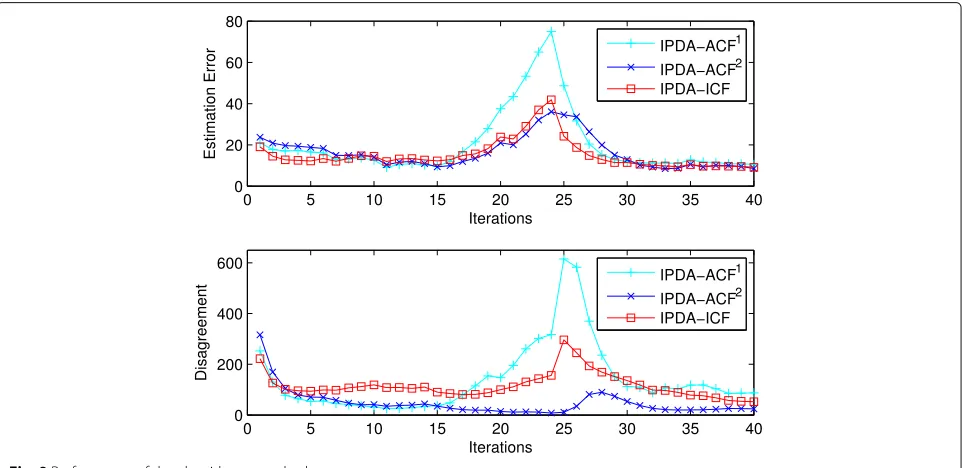
First, we shall examine scenarios with no clutter. An experiment has been performed with 250 Monte Carlo runs, over which estimation errors (average distance per node between the target position estimates and the actual position) and disagreements between the nodes (variance of the estimates) have been computed. Each run uses dif-ferent target trajectory and network topology, designed in the way described above. In the chosen simulation set-ting, at each time iteration, 2.3 nodes on average receive measurements from the target, and one node communi-cates with 5.3 nodes for each network topology. Parameter εin ICF has been set to 1/maxi(|Ni| +1)at each run; parameterεin KCF has been set to 0.07. ACF has been simulated in two described variants, with ACF1 parame-ters chosen as in the example from Section3.2, and withα set to 0.05 for ACF2. Figure3shows the resulting estima-tion errors (top) and disagreements (bottom). It is obvious that, owing to the introduced refined adaptation proce-dure, ACF outperforms both KCF and ICF, in spite of much lower communication requirements.
Fig. 3Performance of the algorithms: no clutter
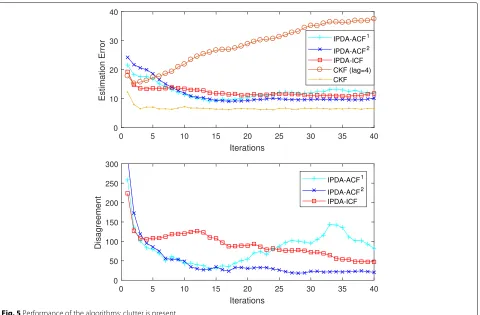
Fig. 5Performance of the algorithms: clutter is present
in the case of the flooding protocols realizable by the simulated networks (see, e.g., [40]), regardless of the com-munication cost. Obviously, depending on the adopted network diameter, different results can be obtained, rep-resented typically as delayed estimates generated by CKF. For the networks simulated in the way described above, the results are much inferior to those obtained by the proposed algorithm (having in mind the intrinsic need for trackingmovingtargets); the average diameter in our experiments has been found to be 4.4. The results pre-sented in Fig.5give an obvious illustration. The proposed algorithm has been found to be superior even in the case of networks with the average diameter equal to one.
To assess the performance of the algorithms in case of different communication topologies, the original commu-nication networks have been pruned to their spanning trees, and random edges progressively added, so that the resulting networks have the average node degreeδ rang-ing from 2 to 14. Parameterεin IPDA-ICF has been set to 1/(δ +1). We can see in Fig. 6 that in terms of the tracking error, all the algorithms exhibit similar behavior, while IPDA-ACF2outperforms IPDA-ICF in terms of the disagreement between the nodes. IPDA-ICF slightly out-performs IPDA-ACF2in terms of the tracking error in the case of dense communication graphs.
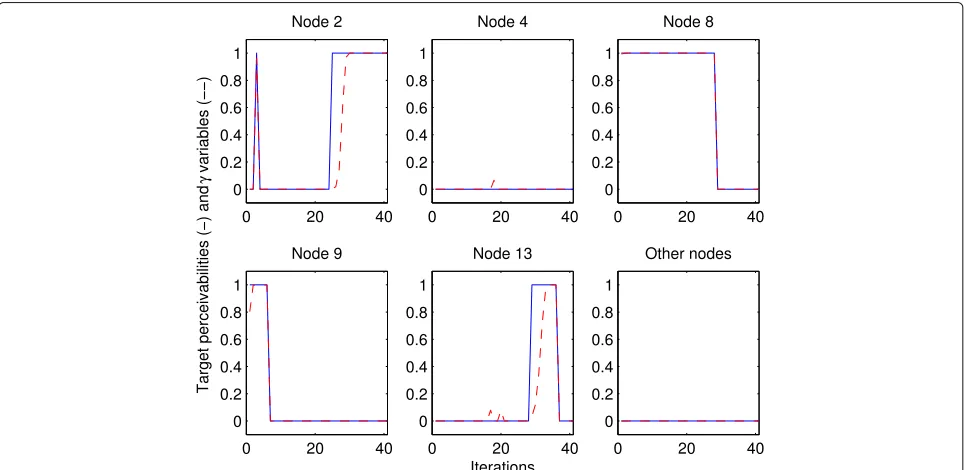
In order to illustrate the idea underneath the consensus scheme design in the proposed adaptation algorithm, we have plotted in Fig.7, for one simulation run, the actual target perceivabilities of the nodes (represented by binary signals equal to 1 when the target is visible and to 0 other-wise), together with the corresponding values ofγi(t)used in (15). It can be seen that, for each node,γi(t) follows the binary perceivability signal, resulting in a consensus scheme which efficiently potentiates the nodes receiving measurements from the target.
Fig. 6Performance of the algorithms att=40 vs. network connectivity
7 Conclusion
In this paper, a new distributed adaptive consensus-based tracking algorithm has been proposed for cam-era networks in the case of limited FoVs, high-level clutter and occulted targets, using the methodology of
(IPDA) [13]. The algorithm is defined either in the perceivability-based or the existence-based form, rep-resenting distributed consensus-based versions of the classical PDA tracker from [10, 11] and the existence-based tracker from [15], respectively. Special care is
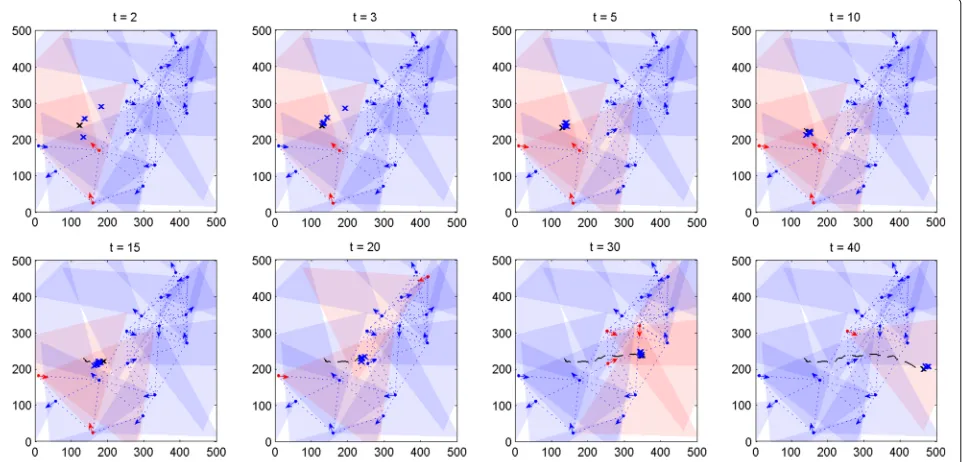
Fig. 8One realization of a sensor network together with the target trajectory (black dashed line). The target is occulted when crossing the white circle
taken of the design of a distributed adaptation pro-cedure, based on utilization of the “β-parameters as a measure of the probabilities of observing the target by particular nodes. A new distributed adaptation algo-rithm, based on the generation of node importance, is proposed for defining appropriate weights in the con-sensus matrix, providing high tracking precision and
fast convergence of the estimates over the network. The paper contains a theoretical analysis of stability and noise rejection capabilities of the proposed algo-rithm. The applied methodology of analysis is based on the idea from [12] and on recent results related to the properties of the modified Riccati equations result-ing from the PDA recursions [18]. It has been shown that the algorithm provides convergence even in the case when some nodes may be unstable, owing to a proper choice of the consensus weights. The proposed algo-rithm has been verified by extensive simulations. It has been shown that it outperforms similar algorithms known from the literature—IPDA-KCF from [7] and IPDA-ICF from [8]—in spite of lower communication requirements; derivation of one-step consensus-based versions of these algorithms, consistent with the form of the proposed algorithm, is given in a separate section. The results related to occulted objects and high-level clutter are of special interest. The proposed algorithm can be readily applied to all distributed target tracking problems (radars, sonars) under analogous assumptions. We do hope that it can become a simple and efficient tool for engineering practice.
Further efforts could be oriented in the direction of the development of complementary distributed track ini-tiation, confirmation, and termination algorithms using IPDA methodology [13, 15]. Generalization of the algo-rithm to the multi-target case in the sense of applying the basic methodology of JPDAF [10, 41] in the distributed multi-agent context represents a complex but straightfor-ward task.
Acknowledgements
Not applicable (no contributors for acknowledgements).
Funding
Not applicable (no sources of funding for the research).
Authors’ contributions
The authors contributed equally to this work.
Availability of data and materials Not applicable.
Competing interests
The authors declare that they have no competing interests.
Publisher’s Note
Springer Nature remains neutral with regard to jurisdictional claims in published maps and institutional affiliations.
Author details
1Etimad, Abu Dhabi, United Arab Emirates.2Vlatacom Institute, Bulevar Milutina Milankovica 5, 11000 Belgrade, Serbia.3College of Technics and Technology, 37000 Kruševac, Serbia.4Innovation Center, Faculty of Electrical Engineering, University of Belgrade, 11000 Belgrade, Serbia.5Faculty of Electrical Engineering, University of Belgrade, 11000 Belgrade, Serbia.
Received: 4 October 2017 Accepted: 7 February 2018
References
1. DE Maggio, DA Cavallaro,Video tracking: theory and practice, 1st edn. (Wiley Publishing, Hoboken, 2011)
2. Ili´c, MS Stankovi´c, SS Stankovi´c, Adaptive consensus-based distributed target tracking in sensor networks with limited sensing range. IEEE Trans. Control Syst. Technol.22(2), 778–785 (2014)
3. N Ili´c, KO Al-Ali, M Stankovi´c, S Stankovi´c, inProc. 3rd IcETRAN Conf. Adaptive consensus based distributed target tracking in camera networks (ETRAN Society, Zlatibor, 2016)
4. AT Kamal, JA Farrell, AK Roy-Chowdhury, Information weighted consensus filters and their application in distributed camera networks. IEEE Trans. Autom. Control.58(12), 3112–3125 (2013)
5. R Olfati-Saber, inProc. IEEE Conf. Decision and Control. Distributed Kalman filtering for sensor networks (IEEE, New Orleans, 2007), pp. 5492–5498 6. R Olfati-Saber, NF Sandell, inProc. American Control Conference.
Distributed tracking in sensor networks with limited sensing range (IEEE, Seattle, 2008), pp. 3157–3162
7. NF Sandell, R Olfati-Saber, inProc. 47th IEEE Conf. Dec. Control. Distributed data association for multi-target tracking in sensor networks (IEEE, Cancun, 2008), pp. 1085–1090
8. AT Kamal, JH Bappy, JA Farrell, AK Roy-Chowdhury, Distributed multi target tracking and data association in vision networks. IEEE Trans. Patt. Anal. Mach. Intel.38, 1397–1410 (2016)
9. Y Bar-Shalom, Tracking methods in a multitarget environment. IEEE Trans. Aut. Control.23, 618–626 (1978)
10. Y Bar-Shalom, F Daum, J Huang, The probabilistic data assocation filter. IEEE Contr. Syst. Magaz.7, 82–100 (2009)
11. TE Fortmann, Y Bar-Shalom, M Scheffe, Sonar tracking of multiple targets using joint probabilistic data association. IEEE J. of Oceaninc Eng.OE-8, 173–184 (1983)
12. SS Stankovi´c, MS Stankovi´c, DM Stipanovi´c, Consensus based overlapping decentralized estimation with missing observations and communication faults. Automatica.45, 1397–1406 (2009)
13. D Musicki, R Evans, S Stankovic, Integrated Probabilistic Data Association. IEEE Trans. Automat. Contr.39, 1237–1241 (1994)
14. J Dezert, N Li, XR Li, inProc. Euro. Contr. Conf. A new formulation of IPDAF for tracking in clutter (IEEE, Karlsruhe, 1999)
15. N Li, XR Li, Target perceivability and its applications. IEEE Trans. Sign. Proc. 11, 2588–2604 (2001)
16. SS Stankovi´c, N Ili´c, KOA Ali, MS Stankovi´c, in2016 IEEE International Conference on Multisensor Fusion and Integration for Intelligent Systems
(MFI). Distributed consensus based IPDAF for tracking in vision networks (IEEE, Baden-Baden, 2016), pp. 304–309
17. TE Fortmann, Y Bar-Shalom, M Scheffe, S Gelfand, Detection thresholds for tracking in clutter—a connection between estimation and signal processing. IEEE Trans. Aut. Control.30, 221–229 (1985)
18. MZQ Chen, L Zhang, H Su, G Chen, Stabilizing solution and parameter dependence of modified algebraic Riccati equations with application to discrete-time network synchronization. Trans. Aut. Control, IEEE.61, 228–233 (2016)
19. Y Bar-Shalom, XR Li,Multitarget-multisensor tracking: principles and techniques, vol. December. (YBS Publishing, Storrs, Connecticut, 1995) 20. C Jauffret, Y Bar-Shalom, Track formation with bearing and frequency
measurements in clutter. IEEE Trans. Aerosp. Electro. Syst.26(6), 999–1010 (1990)
21. D Ciuonzo, PK Willett, Y Bar-Shalom, Tracking the tracker from its passive sonar ML-PDA estimates. IEEE Trans. Aerosp. Electr. Syst.50(1), 573–590 (2014)
22. MR Chummun, Y Bar-Shalom, T Kirubarajan, Adaptive early-detection ML-PDA estimator for LO targets with EO sensors. IEEE Trans. Aerosp. Electro. Syst.38(2), 694–707 (2002)
23. D Ciuonzo, S Horn, in2012 IEEE Aerospace Conference. A hash-tree based approach for a totally distributed track oriented multi hypothesis tracker (IEEE, Big Sky, 2012), pp. 1–9
24. WR Blanding, PK Willett, Y Bar-Shalom, RS Lynch, Directed subspace search ML-PDA with application to active sonar tracking. IEEE Trans. Aerosp. Electro. Syst.44(1), 201–216 (2008)
25. S Schoenecker, P Willett, Y Bar-Shalom, ML-PDA and ML-PMHT: Comparing multistatic sonar trackers for VLO targets using a new multitarget implementation. IEEE J. Oceanic Eng.39(2), 303–317 (2014) 26. YF Shi, SH Park, TL Song, Multitarget tracking in cluttered environment for
a multistatic passive radar system under the DAB/DVB network. EURASIP J. Adv. Signal Process.2017(1), 11 (2017)
27. W Qu, D Schonfeld, M Mohamed, Distributed Bayesian multiple-target tracking in crowded environments using multiple collaborative cameras. EURASIP J. Adv. Signal Process.2007(1), 038373 (2006)
28. R Olfati-Saber, A Fax, R Murray, Consensus and cooperation in networked multi-agent systems. Proc. IEEE.95, 215–233 (2007)
29. L Xiao, S Boyd, Fast linear iterations for distributed averaging. Syst. Control Lett.53, 65–78 (2004)
30. A Olshevsky, JN Tsitsiklis, Convergence speed in distributed consensus and averaging. SIAM Review.53(4), 747–772 (2011)
31. P Braca, S Marano, V Matta, Enforcing consensus while monitoring the environment in wireless sensor networks. IEEE Trans. Signal Process.56, 3375–3380 (2008)
32. P Braca, S Marano, V Matta, P Willett, Asymptotic optimality of running consensus in testing binary hypotheses. IEEE Trans. Signal Process.58, 814–825 (2010)
33. IF Pierce, Matrices with dominating diagonal blocks. J Economic Theory. 9, 159–170 (1974)
34. Y Ohta, D Siljak, Overlapping block diagonal dominance and existence of Lyapunov functions. J. Math. Anal. Appl.112, 396–410 (1985)
35. RA Horn, CA Johnson,Matrix analysis. (Cambridge Univ. Press, Cambridge, 1985)
36. WJ Rugh,Linear system theory. (Prentice Hall, Upper Saddle River, 1996) 37. F Amato, G Celentano, F Garofalo, New sufficient conditions for the
stability of slowly varying linear systems. IEEE Trans. Autom. Control.38, 1409–1411 (1993)
38. RR Bitmead, MR Gevers, IR Petersen, Monotonicity and stabilizability properties of solutions of the Riccati difference equation: propositions, lemmas, theorems, fallacious conjectures and counterexamples. Syst. Control Lett.5, 309–315 (1985)
39. Y-S Kim, K-S Hong, inProc. 39the Conf. Decision and Control. Stability of the modified probabilistic data association filter: Lyapunov function analysis (IEEE, Sydney, 2000), pp. 3896–3901
40. T Li, JM Corchado, J Prieto, Convergence of distributed flooding and its application for distributed Bayesian filtering. IEEE Trans. Signal Inf. Process. Over Netw.3(3), 580–591 (2017)