www.ijemst.com
Flexible Conceptions of Perspectives and
Representations: An Examination of
Pre-Service Mathematics Teachers’
Knowledge
Vanessa R. Pitts Bannister 1
1 University of South Florida
To cite this article:
Bannister, V.R.P. (2014). Flexible conceptions of perspectives and representations: an
examination of pre-service mathematics teachers’ knowledge.
International Journal of
Education in Mathematics, Science and Technology, 2
(3), 223- 233.
This article may be used for research, teaching, and private study purposes.
Any substantial or systematic reproduction, redistribution, reselling, loan, sub-licensing,
systematic supply, or distribution in any form to anyone is expressly forbidden.
Authors alone are responsible for the contents of their articles. The journal owns the
copyright of the articles.
Volume 2, Number 3, July 2014, Page 223-233
ISSN: 2147-611X
Flexible Conceptions of Perspectives and Representations: An Examination
of Pre-Service Mathematics Teachers’ Knowledge
Vanessa R. Pitts Bannister1*
1
University of South Florida
Abstract
The concept of multiple representations of functions and the ability to make translations among representations are important topics in secondary school mathematics curricula (Moschkovich, Schoenfeld, & Arcavi, 1993; NCTM, 2000). Research related to students in this domain is fruitful, while research related to teachers is underdeveloped. This research looks in fine-grained ways at the nature of understanding exhibited by 59 pre-service mathematics teachers as they approached four problems that called for translations between representations of functions. Teachers’ written and verbal responses were examined according to the extent to which they utilized essential constructs of process and object perspectives. Findings suggest that teachers exhibited three conceptions – flexible, disconnected or constrained. Specifically, teachers demonstrated: (1) constructs of both perspectives and operated within algebraic and graphical representations, (2) constructs of both perspectives, but not transitional enough to link them across problems, or (3) constructs of one perspective and did not operate within algebraic and graphical representations.
Key words: Cartesian Connection, Functions, Object and Process perspectives, Representations, Translations, Algebra, Graph.
Introduction
Romberg, Fennema, and Carpenter (1993) assert, “functions are one of the most powerful and useful notions in mathematics” (p. 1), a view that reflects the beliefs of the mathematics and mathematics education communities (Cooney, Thomas, Beckman & Lloyd, 2010; Dubinsky & Harel, 1992; Kleiner, 1989; Lacampagne, Blair & Kaput, 1993; Lloyd, Herbal-Eisenmann & Star, 2011; Moschkovich, Schoenfeld & Arcavi, 1993; NCTM, 2000, 2006, 2009; Sfard 1991, 1992). Teachers, students, mathematicians and scientists have related functions to algebraic representations, algebraic expressions, correspondence, dependency, graphical representations or ordered pairs. In view of this, Kleiner (1989) regards the concept of functions as a “tug of war between two elements, mental images: geometric and algebraic” (p. 282). This “tug of war” between the graphical and algebraic representations of functions is essential in one’s pursuit to understand this domain. Particularly, understanding functions is marked by one’s ability to (1) perceive functions in multiple ways and (2) move flexibly among various representations as one attempts to solve problems (Moschovich, Schoenfeld, & Arcavi, 1993).
Extant literature related to perceptions of functions is plentiful (e.g., Breidenbach, Dubinsky, Hawks & Nichols, 1992), while limited information exists about the nature of knowledge needed to move flexibly or make translations between representations of functions (Romberg, Carpenter & Fennema, 1993; Schoenfeld, 1987). Moreover, this body of literature is usually restricted to instructional strategies for K-12 students (e.g., Star & Rittle-Johnson, 2009) even as secondary pre-service mathematics teachers leave teacher education programs lacking an in-depth understanding of this domain (Even, 1990; Norman, 1993; Tirosh, Even & Robinson 1998). Accordingly, the concerns of this study are as follows.
What is the nature of knowledge exhibited by teachers as they attempt problems that aim to call for translations; and
What forms of knowledge may promote or inhibit teachers’ attempts in making translations?
*
Corresponding Author:
Representations of Functions
Functions and graphs represent one of the earliest points in mathematics at which a student uses one symbolic system to expand and understand another (Leinhardt, Zaslavsky, & Stein, 1990). Yerushalmy and Schwartz (1993) contend that multiple representations “allow students to use a rich set of operations, some of which operate on functions symbolically and some of which operate on functions graphically, which builds a deeper and richer understanding of the mathematics” (p. 42). In recognizing the important role that multiple representations play in students’ mathematics development, the National Council of Teachers of Mathematics (NCTM, 2000) emphasizes that students should be able to: (1) create and use representations to organize, record, and communicate mathematical ideas; (2) select, apply, and translate among mathematical representations to solve problems; and (3) use representations to model and interpret physical, social, and mathematical phenomena. Similarly, leading researchers in mathematics education have recognized multiple representations as a central idea in learning algebra (Lacampagne, Blair, & Kaput, 1993; NCTM, 2001, 2008). The three prominent ways in which functions are represented in secondary school mathematics are tabular, algebraic and graphical representations (Moschkovich et al., 1993).
Researchers suggest that students usually learn ideas related to functions by first operating within the algebraic representation and then proceeding to the graphical representation (Leinhardt, et al., 1990; Romberg, 1993; Yerushalmy & Schwartz, 1993). In spite of the fact that this manner of instruction is not often thought to hinder the development of an understanding of the correspondence between algebraic and graphical representations, students and teachers encounter cognitive obstacles in this domain (Blume & Heckman, 1997; Chiu, Kessel, Moschkovich, Muñoz-Nuñez, 2001; Dreyfus & Vinner, 1989; Dufour-Janvier, Bednerz & Belanger, 1987; Even, 1990, 1993; Goldenberg, 1988; Knuth, 2000; Lesh, Post & Behr 1987; Lloyd & Wilson, 2002; Markovits, Eylon, & Bruckheimer, 1988; Moschkovich, 1999; Norman, 1992; Schoenfeld, Smith III, & Arcavi, 1993; Schwartz & Dreyfus, 1995; Stein, Baxter & Leinhardt, 1990; Vinner, 1989). In order for this sense-making to take place, “more systematic identification is needed of the forms of understanding that are required to see and use the correspondence between the patterns in the structure of an algebraic expression and the features of its graphical representation” (Schoenfeld, 1987, p. 243).
The Issue of Correspondence
The ability of one to demonstrate an understanding of the correspondence between representations characterizes a translation. Janvier (1987) defines the translation process (or “between-system” mappings) as a psychological process involved in going from one mode of representation to another. For instance, from y = x + 3, one can gain (or interpret) meaning of the slope and y-intercept. Specifically, one can determine that the slope is positive 1 and the y-intercept is 3, since the equation is in slope-intercept form (y = mx + b, where m is the slope and b is the y-intercept). This information implies that the corresponding graphical representation should be an increasing line with a slope of 1, which intersects the y-axis at the point (0, 3). This process of making sense or gaining meaning from one representation in light of another representation is referred to as interpretation (Leinhardt et al., 1990). In essence, as one interprets information within algebraic and graphical representations, one must continuously view these representations in one of two ways: process or object perspective. For the process perspective the “focus is on the x and y values and the relationship between them, on the variables in an equation that stand for those numbers, or on the sets of individual points in the Cartesian plane, that collectively, constitute lines” (Moschkovich et al, 1993, p. 79). For the object perspective, the focus is on the associations between the values within a functional relation (e.g., movements or positioning of a graph). Competence of translations consists of being able to switch from constructs of process perspective, which entail viewing a line (or an equation) as a set of individual points that are related in a fixed way (ordered pairs), to constructs of object perspective, which entails viewing a line (or an equation) as an entity that can be manipulated as a whole (Moschkovich et al., 1993).
Methods
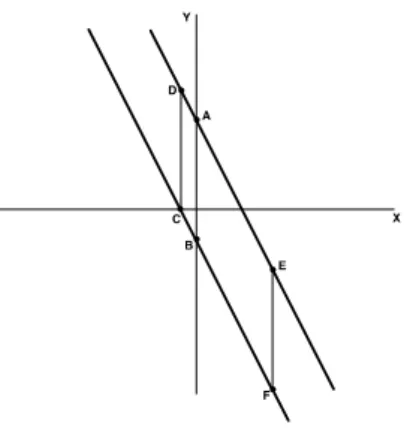
This research looks in fine-grained ways at the nature of understanding exhibited by 59 pre-service mathematics teachers as they approached 4 open-ended problems (see Figure 1) adopted from Moschkovich, Schoenfeld and Arcavi (1993) that called for translations.
Figure 1. Four open-ended problems
1) The following list includes the equations of the two lines. Match each line with its equation. y = 2x + 6 y = 2x - 2 y = - 2x - 2 y = - 2x + 6
2) Find the coordinates of points A, B, C, and D, knowing that the line segments CD and EF are parallel to the y-axis.
3) If the x-coordinate of point E is 5, find its y-coordinate and the coordinates of point F. 4) Find the lengths of segments EF, CD, and AB.
For each problem, pre-service teachers were asked to explain their solution methods. The problems required teachers to perform translations between algebraic and graphical representations and to operate within both process and object perspectives. For instance, problem 1required the participants to consider specific aspects of the graphical representation, which highlight basic structural features of linear functions. Participants were asked to focus on features of the lines as objects (object perspective) and determine how such information from the graph aids in determining appropriate equations. For instance, one could ask the following questions: Where does each line cross the y-axis? Is the slope of the line positive or negative?
Problems 2 and 3 can be solved by using the appropriate equations from problem 1. In order to solve the problems, participants must demonstrate an understanding of the Cartesian Connection, “[a] point is on the
graph of the line L if and only if its coordinates satisfy the equation of L” (Moschkovich et al., 1993, p. 73). For instance, in order to determine the coordinates of point C for problem 2, participants can substitute 0 for ‘x’ (process perspective), since point C is the x-intercept of the line (object perspective), in the equation y = -2x –2. This process yields a value of –2 for ‘y’. Consequently, the coordinates of point C are (0, -2). As information from both the graphical representation (e.g., point C is an x-intercept) and algebraic representation (e.g., substituting 0 for ‘x’ in the equation) is used, solving the problem requires one to switch between representations and perspectives. Similar procedures could be performed to determine coordinates for points A, B, D, E and F.
Problem 4 required the participants to determine the lengths of segments of EF, CD and AB. Participants could arrive at an answer by using information within the graphical or algebraic representation. The answer could be determined by computing the distances between the endpoints of the line segments, which involves components of the graphical representation. The distance between A (0, 6) and B (0, -2) is 8. This same information could be obtained from the algebraic representations by noting the y-intercepts (6 and –2) of the equations. Problems of this type emphasize the linkages between information within the graphical and algebraic representations and can be used to encourage students to switch back and forth between perspectives where it is useful.
Participants
had participated in pre-student teaching experiences. None of the participants had begun student teaching, and all were enrolled in required mathematics methods courses. Thus the findings reflect these prospective teachers’ knowledge gained during their course work, but before they started teaching.
Data Collection and Analysis
Data for this study were collected in two phases. In the first phase, the participants completed open-ended problems. In the second phase, 10 of the 59 pre-service teachers were interviewed. These ten participants who attended the researcher’s university were asked to clarify their survey responses and to respond to additional questions designed to assess their knowledge.
Responses were examined to determine whether they embodied constructs of process perspective, object perspective or both. For instance, if within a response, a participant presented ideas that reflected that of the
process or object perspective, then such portions of the response were respectively coded as process or object. Other segments of the response were analyzed in a similar manner.
After coding each response, responses were categorized as pure process, pure object, hybrid or neither. In cases when a participant did not present evidence of either process or object perspective such responses were categorized as neither. Responses within this category were not necessarily incorrect; instead they could not be interpreted according to either perspective. The categories of responses are summarized in Table 1. Categorizations of responses did not reflect whether they were right or complete – only the approach attempted.
Table 1. Categorizations of Teachers’ Responses
Categorizations Explanations of Categorizations
Pure Process Ideas of a response reflect that of process perspective Pure Object Ideas of a response reflect that of object perspective
Hybrid Ideas of a response reflect that of both process and object perspectives Neither A response does not embody constructs of either process or object perspective The following example illustrates this approach. The example includes one participant’s response to the first problem of the questionnaire. Looking at the two lines, we see that they have a “downward” slope as you move from left to right. This implies a negative slope, so we can eliminate the first two choices as the equations of the two lines [object perspective]. The upper line, which I called l, intersects the axis above the origin so its y-intercept must be positive. Of the remaining choices, only one fits this description which is y = -2x + 6 [object perspective]. Similarly, the lower line, which I called L, intersects the y-axis below the origin so its y-intercept must be negative. So, the only remaining choice, y = -2x –2, makes sense [object perspective].
According to the coding of the participant’s response, this response was categorized as pure object. This categorization was based on theparticipant’s sole utilization of object perspective constructs while solving the problem. A second analysis of the responses was completed to further understand teachers’ conceptions in this domain. In particular, the responses of each teacher were traced from problem 1 to problem 4. Responses were examined to determine the extent to which teachers (1) moved between constructs of process and object perspectives, (2) linked information regarding constructs of process and object perspectives or (3) operated within one perspective.
Results and Discussion
Table 3. Categorizations of Responses (Problems 1-4) Categories of
Teachers’ Responses
Problems 1-4, Questionnaire A
Problem 1 Problem 2 Problem 3 Problem 4 Total
Pure Process 6 0 44 20 70 (30%)
Pure Object 48 10 2 34 92 (39%)
Hybrid 3 38 6 1 47 (20%)
Neither 2 11 7 4 27 (12%)
Total 59 59 59 59 236 (100%)
Pure Object, Pure Process, and Hybrid
Based on the information for Problem 1 in Table 3, a majority of pre-service teachers considered specific aspects of the graphical representation and or highlighted basic structural features of linear functions as they solely demonstrated constructs of object perspective. For instance, one pre-service teacher, Bernice presented the following:
DE: y = -2x+6. I knew from the graph that DE had a negative slope (because as x gets bigger y gets smaller) and a positive intercept (intercept is above the x-axis). Y = -2x + 6 is the only y = mx +b (m=slope, b = y-intercept) that fits.
CF: y = -2x –2. I knew from the graph that CF had a negative slope and a negative y-intercepts (y-intercept is below the x-axis). Y= -2x –2 is the only y =mx +b that fits this description. Bernice’s solution method involved recognizing the sign of the slopes and the positioning of the y-intercepts of the lines. Bernice demonstrated an understanding of the negative slope when she noted that lines have a negative slope when “x gets bigger, y gets smaller” as you read a line from left to right. An understanding of the positioning of the y-intercepts was demonstrated when she noted that an intercept is positive when it is located “above the x-axis” and negative when it is located “below the x-axis.” Bernice connected this notion to information within the function relation y = mx+b, where ‘m’ is the slope and ‘b’ is the y-intercept. Bernice demonstrated an understanding of these values as she appropriately designated that line DE represents y = -2x+6 and line CF represented y = -2x-2. Due to these characteristics of her solution method, this response was categorized as pure object. Pre-service teachers presented a smaller percentage of solution methods that were categorized as pure process. For instance, one pre-service teacher, Annie, solely demonstrated constructs of process perspective (pure process) in the following response.
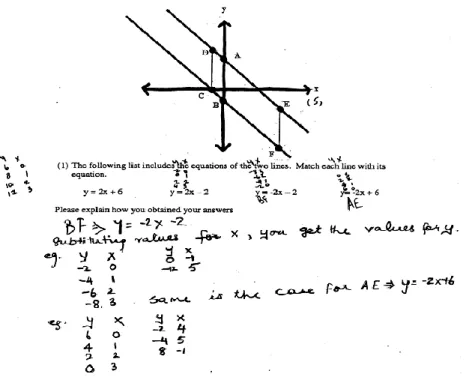
When interviewed, Annie provided the following explanation of her solution method: “I did a table of values. From the table of values I found out from the various equations that’s given on top. Substituted it and found the one that would match the line with the equation”. Annie’s solution method heavily relied on constructs of process perspective and emphasized an understanding of Cartesian Connection (Moschkovich et al., 1993) as she utilized her table of values to determine the appropriate equation for each graph. Fewer teachers presented solution methods that embodied constructs of both process and object perspectives (hybrid). For instance, Annie presented the following: I looked for a negative slope, and then matched the x and y intercepts.
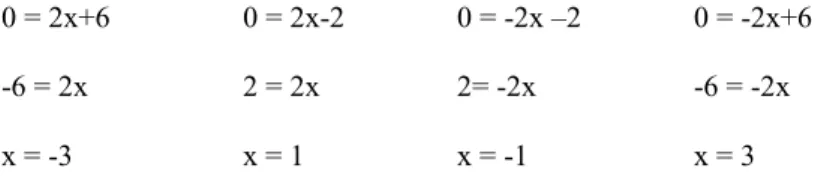
0 = 2x+6 0 = 2x-2 0 = -2x –2 0 = -2x+6
-6 = 2x 2 = 2x 2= -2x -6 = -2x
x = -3 x = 1 x = -1 x = 3
Annie’s solution method focused on aspects of the line (e.g., suggesting that the lines have negative slopes) and the points in the Cartesian plane that made up the lines (e.g., finding x-intercepts of each equation). Focusing on aspects of the line with respect to either slope or y-intercept highlight characteristics of object perspective, while focusing on the equations as a means in which to determine points on the line is an aspect of process perspective. Due to these characteristics of this solution method, this response was categorized as hybrid. A very small percentage of pre-service teachers presented solution methods that did not embody constructs of either process or object perspective (neither). For instance, one pre-service teacher presented the following response.
Figure 3. Teacher’s Response (Neither) – Problem 1
considered the ‘b’ as the x-intercept, since the teacher labeled the x-intercept of line ED as (0, 6), which is the y-intercept. Due to the vagueness of this response, this response was categorized as “neither.”
Flexible, Non-and Constrained Conceptions
A second examination of teachers’ responses rendered similar findings of Moschkovich, Schoenfeld and Arcavi’s (1993) analysis of two students’ responses regarding the problem set presented in Figure 1. Findings indicated that the students demonstrated a conception characterized by students’ demonstrations of constructs of process and object perspective, but failure to link such information. A similar in-depth analysis of teachers’ responses embodied comparable aspects. As teachers completed the tasks they demonstrated three conceptions –
flexible, disconnected and constrained. A flexible conception was characterized by moving flexibly between constructs of process and object perspectives. A disconnected conception was characterized by teachers’
demonstrations of constructs of process and object perspectives, but failure to link such information. A
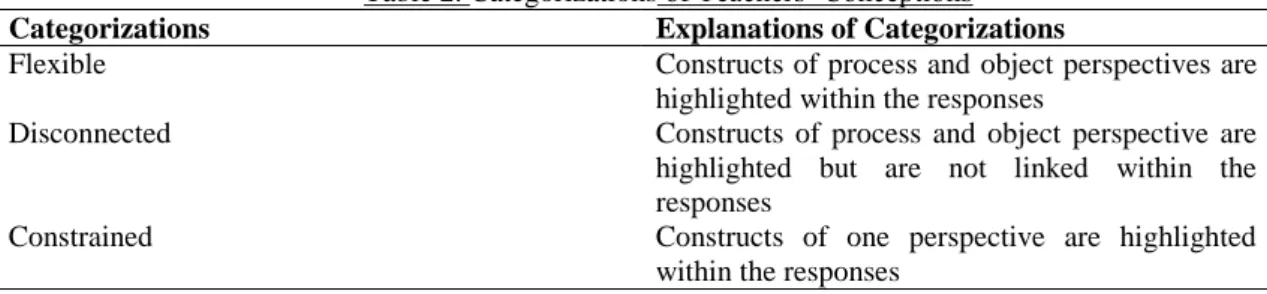
constrained conception was characterized by teachers’ tendency to operate within the constructs of one perspective. The categories of conceptions are summarized in Table 2.
Table 2. Categorizations of Teachers’ Conceptions
Categorizations Explanations of Categorizations
Flexible Constructs of process and object perspectives are
highlighted within the responses
Disconnected Constructs of process and object perspective are highlighted but are not linked within the responses
Constrained Constructs of one perspective are highlighted
within the responses
Teachers moving flexibly (at least once) between constructs of process and object perspectives as they solved the problems characterized flexible conceptions. For instance, one teacher, Evelyn, wrote the following for problem 1.
Line ED is y = -2x+6. The basic form of al line is y = mx+b, where m is the slope and (0, b) is the y-intercept. ED has a positive y-value at its intercept and a negative slope, so it must be y = -2x+6. Line FC is y = -2x –2 since it has negative slope and a negative y-value at its intercept.
Evelyn’s solution method involved recognizing the sign of the slopes of the lines and the positioning of their y-intercepts. She also demonstrated an understanding of the components of ‘y = mx + b’. Due to these characteristics of her responses, this response was categorized as pure object. Evelyn flexibly moved between constructs of process and object perspective as she completed the remaining problems. For instance, she presented the following solution method, which embodied constructs of process perspective, for problem 2. At C, y = 0, -2x+-2=0
-2x-2=0
-2x=2 x = -1
So, C is (-1, 0). It would appear that CD is vertical. If that is true, then D is (-1, 8), x = -1 y = -2(-1) +6
y = 2 + 6 y = 8
Disconnected conceptions were characterized by teachers demonstrating both process and object perspectives as they completed the problems – but not linking appropriate information regarding the perspectives in order to answer certain problems. For instance, one teacher, Katie, wrote the following for problem 1:
Both have negative slope, so that determines the direction of the lines, and the y-intercepts are found by estimation on graph, only 2 choices y = -2x –6 and y = -2x–2.
Katie provided the following explanation of the above response:
intersect the y-axis. So for the first one I said it has to have a positive intercept and then the other one has to have a negative intercept. So that gives you clues whether you need a plus or a minus in your intercept form. And then the other thing I did was just look at the actual slope and you can tell that the slope has to be negative in this case. So I ruled out the first two you had to go with the second two equations.
Katie’s responses highlight constructs of object perspective as she refers to the direction and positioning of the lines. Although Katie accurately determined the appropriate equations by using this information, she failed to exhibit an understanding of the information these equations afforded as she attempted to determine coordinates of points C and D. For instance, she presented the following responses for problem 2:
Point A (0, 6) because it is the y-intercept Point B (0, -2) because it is the other y- intercept.
I do not think the other points can be determined from the given information. When interviewed Katie provided the following explanation of her response.
A and B you can find because from their equations you know what the intercepts are and so…. A would be (0, 6) and B would be (0, -2) and the other two are C and D. For C and D I would say you can’t find very easily because you don’t know how far over they are going or how far up. I mean for C you can find the ‘x’ – just knowing that it is on the intercept. It will be 0. But you wouldn’t know what the ‘y’ is.
Katie acknowledges that ‘b’ within y = mx+b represents the y-intercept. This recognition represents a construct of object perspective. It seems that this information did not suggest that the coordinates of (0, 6) or (0, -2) also satisfied y =-2x +6 and y = -2x –2, respectively. Her failure to link this information leads her to suggest that the ‘y’ coordinate of point C is unobtainable. The understanding exhibited within problem 2 is interesting considering Katie moved beyond constructs of object perspectives as she determined the coordinates for points E and F. She presented the following:
Pt. E E (+5, -4)
y = -2x +6
y = -2(5) + 6 = -10 +6 = -4 (y coordinate of E)
Pt. F F (5, -12)
y = -2x – 2
= -2(5) – 2
= -10 – 2 = -12 (y coordinate of F)
We already determined the equations of the two lines. Using these, with x = 5, we can solve for y. Since point F is one the same vertical line as pt. E, we know it also has an x value of 5. Thus, we can again substitute 5 into the equation of the line.
Katie’ssolution method for problem 3 demonstrated an understanding of the Cartesian Connection, “in order for a point to be on a line it must satisfy the equation of the line” (Moschkovich, et al., 1993). Most important, she demonstrated constructs of process perspective for problem 3 – but did not utilize or coordinate this information to solve problem 2. Teachers demonstrating one perspective as they solved the problems characterized
constrained conceptions. For instance, one teacher, Marie, who accurately identified the equations in problem 1 by utilizing constructs of object perspective, presented the following response for problem 2:
You would not be able to determine the coordinates for A, B, C and D because there were no coordinates given on the graph at all. We know that pt a would have an x value of 0 and a y value less than pt. D, but we don’t know for sure what it would be. This is what we know for sure:
A (0, y1) y1 6 y-int for the equation
B (0, y2) y2 negative -2 y-int of the equation
C (x1, 0) x1 negative
D (x2, y3) [x2 and y3] both negative
beyond that we can’t make any assumptions.
Since E is (5, y1) we know by looking at the graph that F is (5, y2) since we know B’s coordinates are at (0, -2),
E appears to be at (5, [-]3).
Although Marie had access to the equations of the lines, she did not exhibit an understanding of the relationships between the graphical and algebraic representations. For instance, she inappropriately determined the y-coordinate of E by mere approximation. An appropriate y-coordinate for E could be obtained by substituting the given x-coordinate of E into the equation, y = -2x +6. This proposed method embodied constructs of process perspective; constructs that Maria did not demonstrate.
Concluding Remarks
The purpose of this study was to illustrate the nature of knowledge exhibited by pre-service mathematics teachers as they approached problems that call for translations. As prospective teachers completed the problems, they (a) moved back and forth between process and object perspectives, (b) infrequently demonstrated constructs of process and object perspectives, and (c) solely demonstrated constructs of object perspectives. A second analysis of data, which aimed to determine the ways in which prospective teachers demonstrated or failed to demonstrate translations, highlighted three conceptions – flexible, disconnected and constrained. With respect to flexible conceptions, prospective teachers demonstrated facets of constructs of process and object perspectives. Fundamentally individuals with flexible conceptions illustrated translations between algebraic and graphical representations. With respect to disconnected conceptions, prospective teachers demonstrated constructs of process and object perspectives, but failed to interpret information regarding both perspectives and or representations. For instance, Katie exhibited this when she failed to coordinate process perspective constructs of the algebraic representations within her solution method to determine appropriate coordinates for ‘C’ and ‘D’. This breakdown in her solution method led her to suggest “you can’t find [C and D] very easily because you don’t know how far over they are going or how far up. I mean for C you can find the ‘x’ – just knowing that it is on the intercept. It will be 0. But you wouldn’t know what the ‘y’ is”. With respect to constrained conceptions, prospective teachers demonstrated constructs of object perspective, but failed to incorporate constructs of process perspective and facets of the algebraic representations. For instance, Marie demonstrated this as she failed to coordinate process perspective constructs of the algebraic representation within her solution methods to determine an appropriate ‘y’ coordinate for point E. This led her to employ approximation methods as she suggested the following: “Since E is (5, y1) we know by looking at the graph that
F is (5, y2) since we know B’s coordinates are at (0, -2), E appears to be at (5, [-]3)”. In essence, prospective
teachers who exhibited disconnected and constrained conceptions failed to exhibit a flexible understanding of the constructs of process and object perspectives.
Prospective teachers who demonstrate flexible conceptions may be better equipped to analyze varied students conceptions in this domain. As mathematics educators, we must consistently question this hypothesis. For instance, do these teachers possess understandings flexible enough to move beyond the constructs of their conceptions to adequately teach according to students’ diverse conceptions? With regard to teachers who exhibit disconnected or constrained conceptions, we must ask similar questions. For instance, how will their failure to coordinate information concerning process and object perspectives and algebraic and graphical representations inhibit their pedagogical attempts? Will they perform tasks by only utilizing constructs aligned with the constructs of their approaches? Research accentuating the nature of associations between teachers’ content and pedagogical content knowledge with respect to translations is needed.
References
Blume, G.W & Heckman, D.S (1997). What do students know about algebra and function? In P. Kenney & E. Silver (Eds.), Results from the sixth mathematics assessment of the National Assessment of Educational Progress (pp. 225-277). Reston, VA: NCTM.
Breidenbach, D., Dubinsky, E., Hawks, J., & Nichols, D. (1992). Development of the process conception of function. Educational Studies in Mathematics, 23, 247-285.
Chiu, M. M., Kessel, C., Moschkovich, J., & Muñoz-Nuñez, A. (2001). Learning to graph linear functions: A case study of conceptual change. Cognition and Instruction, 19(2), 215-252.
Cooney, T.J., Beckman, S. & Lloyd, G.M. (2010). Developing essential understanding of functions for teaching mathematics in grades 9-12. Essential Understanding Series. Reston, VA: NCTM.
Dreyfus, T., & Vinner, S. (1989). Images and definitions for the concept of function. Journal for Research in Mathematics Education, 20(4), 356-366.
Dufour-Janvier, B., Bednarz, N., & Belanger, M. (1987). Pedagogical considerations concerning the problem of representation. In C. Janvier (Ed.), Problems of Representation in the teaching and learning of mathematics (pp. 125-148). Hillsdale, NJ: Lawrence Erlbaum Associates.
Even, R. (1990). Subject-matter knowledge for teaching and the case of functions. Educational Studies in Mathematics, 21, 521-544.
Even, R. (1993). Subject-matter knowledge and pedagogical content knowledge: Prospective secondary teachers and the function concept. Journal for Research in Mathematics Education, 24, (2), 94-116
Goldenberg, E. Paul (1988). Mathematics, Metaphors, and Human Factors” Mathematical, Technical, and Pedagogical Challenges in the Educational Use of Graphical Representation of Functions. Journal of Mathematical Behavior, 7, 135-173.
Greenes, C. E. (2008). Algebra and algebraic thinking in school mathematics, 70th yearbook of the National Council of Teachers of Mathematics (NCTM).
Kleiner, I. (1989). Evolution of the function concept: A brief survey. College Mathematics Journal, 20, 282-300. Knuth, E. (2000). Student understanding of the cartesian connection: An exploratory study. Journal of Research
in Mathematics Education, 31, 500-508.
Lacampagne, C., Blair, W., Kaput, J. (1993). The Algebra Initiative Colloquium, vols. 1 and 2. U.S. Department of Education.
Leinhardt, G., Zaslavsky, O., & Stein, M.K. (1990). Functions, graphs and graphing: Tasks, learning, and teaching. Review of Educational Research, 60 (1), 1-64.
Lesh, R., Post, T., & Behr, M. 1987. Representations and translation among repre- sentations in mathematics learning and problem solving.” In Problems of representation in the teaching and learning of mathematics, edited by C. Janvier, pp. 33–40. Hillsdale, NJ: Lawrence Erlbaum Associates.
Lloyd, G. M., & Wilson, M. R. (2002). Using a card sort to determine one’s understanding of function. In J. Sowder & B. Schappelle (Eds.), Lessons learned from research (pp. 209-212). Reston, VA: National Council of Teachers of Mathematics.
Lloyd, G. , Herbel-Eisenmann, B. & Star, J.R. (2011). Developing essential understanding of expressions, equation and functions, grades 6-8. Reston, VA: National Council of Teachers of Mathematics.
Moschkovich, J. (1999). Students’ use of the x-intercept as an instance of a transitional conception. Educational Studies in Mathematics, 37, 169-197.
Moschkovich, J., Schoenfeld, A., & Arcavi, A. (1993). Aspects of understanding: On multiple perspectives and representations of linear relations and connections among them. In T. Romberg, E. Fennema, & T. Carpenter (Eds.), Integrating research on the graphical representation of function (pp. 69-100). Hillsdale, NJ: Lawrence Erlbaum Associates.
National Council of Teachers of Mathematics. (2000). Principles and standards for school mathematics. Reston, VA: NCTM.
National Council of Teachers of Mathematics (2006). Curriculum focal points for prekindergarten through grade 8 mathematics: A quest for coherence. Reston, VA: NCTM
National Council of Teachers of Mathematics (2009). Focus in High School Mathematics: Reasoning and Sense Making. Reston, VA: NCTM.
Norman, A. (1992). Teachers’ mathematical knowledge of the concept of function. In E. Dubinsky & G. Harel (Eds.), The concept of function: Aspects of epistemology and pedagogy (pp. 215-232). Washington, D.C.: Mathematical Association of America.
Romberg, T., Fennema, E. Carpenter, T. (1993). Toward a common research perspective. In T. Romberg, E. Fennema & T. Carpenter (Eds.), Integrating research on the graphical representation of function. Hillsdale, NJ: Lawrence Erlbaum Associates.
Schoenfeld, A., Smith III, J., & Arcavi, A. (1993). Learning: The microgenetic analysis of one student’s evolving understanding of a complex subject matter domain. In R. Glaser (Ed.), Advances in Instructional Psychology, vol. 4, (pp. 55-61). Hillsdale, NJ: Lawrence Erlbaum Associates.
Schwartz, B. & Dreyfus, T. (1995). New actions upon old objects: A new ontological perspective of functions. Educational Studies in Mathematics, 29, 259-291.
Sfard, A. (1991). On the dual nature of mathematical conceptions: Reflections on processes and objects on different sides of the same coin. Educational Studies in Mathematics, 22(1), 1-36.
Sfard, A. (1992). Operational origins of mathematical objects and the quandary of reification- the case of function. In E. Dubinsky & G. Harel (Eds.), The concept of function: Aspects of epistemology and pedagogy (pp. 59-84). Washington, D.C.: Mathematical Association of America.
Stein, M.K., Baxter, J., & Leinhardt, G. (1990). Subject-matter knowledge and elementary instruction: A case from functions and graphing. American Educational Research Journal, 27, (4), 639-663.
Tirosh, D., Even, R. & Robinson, N. (1998). Simplifying algebraic expressions: Teacher awareness and teaching approaches. Educational Studies in Mathematics, 35, 51-64.
Vinner, S. (1989). The avoidance of visual considerations in calculus students. Focus on Learning Problems in Mathematcs, 11(2), 149-156.