International Journal of Engineering
J o u r n a l H o m e p a g e : w w w . i j e . i r
Solving a Redundancy Allocation Problem by a Hybrid Multi-objective Imperialist
Competitive Algorithm
R. Azizmohammadi a, M. Amiri b, R. Tavakkoli-Moghaddam c,*, M. Mohammadi c
a Department of Industrial Engineering, Faculty of Engineering, Payam-e-Noor University, Tehran, Iran b Department of Industrial Management, Allameh Tabatabaei University, Tehran, Iran
c Department of Industrial Engineering, College of Engineering, University of Tehran, Tehran, Iran
P A P E R I N F O
Paper history:
Received 30 September 2012 Received in revised form 10 May 2013 Accepted 16 May 2013
Keywords:
Redundancy Allocation Problem Response Surface Methodology Multi-objective Optimization Imperialist Competitive Algorithm
A B S T R A C T
A redundancy allocation problem (RAP) is a well-known NP-hard problem including the selection of elements and redundancy levels to maximize the system reliability under various system-level constraints. In many practical designing situations, reliability apportionment turns to be complicated because of the presence of several conflicting objectives that cannot be combined into a single-objective function. As in telecommunications, manufacturing and power systems are becoming more and more complex. It is becoming increasingly important to develop efficient solutions to the RAP, while requiring short developments schedules and very high reliability. In this paper, a new hybrid multi-objective imperialist competition algorithm (HMOICA), based on imperialist competitive algorithm (ICA) and genetic algorithm (GA) is proposed in multi-objective redundancy allocation problems. In the multi-objective formulation, system reliability is maximized in which cost and volume of the system are minimized simultaneously. In addition, a response surface methodology (RSM) is employed for parameter tuning of ICA. The proposed HMOICA has also been validated by some examples with analytical solutions. It shows its superior performance compared to a non-dominated sorting genetic algorithm (NSGA-II) and Pareto archive evolution strategy algorithm (PAES).
doi:10.5829/idosi.ije.2013.26.09c.10
1. INTRODUCTION1
In many practical designing situations, reliability apportionment is complicated because of the presence of several (mutually) conflicting objectives which cannot be combined into a single-objective function. For instance, a designer needs to minimize cost, weight and volume of system, as well as maximizing system reliability simultaneously. Therefore, a multi-objective function becomes an important aspect in the reliability design of engineering systems. The reliability of a multi-stage system can be improved using more reliable components and adding redundant components in parallel. Redundancy allocation problem (RAP) [1, 2], a well known reliability optimization problem, is essential to design any kind of high-tech complicated system including many components and very stringent reliability requirements such as electrical power
1 * Corresponding Author Email: [email protected] (R.
Tavakkoli-Moghaddam)
systems, transportation systems, safety systems, telecommunication systems, satellite systems and so on. Basically, it involves allocating redundant components into the system to obtain an optimal system design configuration. As we consider more components, the cost of the system increases. This trade-off requires the problem evaluation in the multi-objective context. In multi-objective problems, a set of Pareto solutions are obtained instead of single optimal solution. As complexity of problem increases, exact algorithms usage may be inefficient. Then, using a multi-objective meta-heuristic algorithm (e.g., genetic algorithm, tabu search, ant colony, particle swarm or other problem specific heuristics) is more appropriate to approximate the Pareto solutions of the problem.
named as (1) strictest-selection, (2) lexicographic, and (3) the waltz technique, respectively. A multiple objective formulation of a reliability allocation problem to maximize system reliability and minimize system cost has been considered by Sakawa [2] using surrogate worth tradeoff methods. Inagaki et al. [3] used interactive optimization to design a system with minimum cost and weight and maximum reliability. Sakawa [4] solved a multiple objective reliability and RAP using an approximate technique based on the surrogate worth trade-off method. Nakagawa [5] suggested a combined strategy of narrowing the feasible region, generating Pareto-optimal solutions, and finally selecting the best Pareto-optimal solution based on the designers' experiences. Later on, Sakawa [6] dealt with the mixes integer programming problem (reliability and redundancy allocation) and used a combination of the surrogate worth of trade-off method and the dual decomposition method while still treating the integer variables as continuous variables.
Sakawa [7] proposed a technique called SPOT, which is basically an interactive decision-making procedure of choosing a preferred solution from a set of Pareto-optimal solutions. Misra and Sharma [8] provided and exact yet efficient search method to solve a wide variety of reliability design problems involving integer programming formulation. Misra and Sharma [9] proposed a mathematical formulation of a combined reliability and RAP with multi-objective optimization considering mixed types of redundancy.
Dhingra [10] presented a multi-objective reliability apportionment problem for a series system. His problem was a nonlinear mixed integer programming problem subjected to several design constraints. Sasaki et al. [11] used a fuzzy multiple objective 0-1 linear programming method by making use of tolerance in the system control parameters. Tabu search meta-heuristic algorithm was used to provide solutions to the system reliability optimization problem of redundancy allocation.
Mahaparta and Roy [12] considered multi-objective reliability optimization problem for system reliability, in which reliability enhancement is involved with several mutually conflicting objectives. In this paper, a new fuzzy multi-objective optimization method is introduced and is used for the optimization decision making of the series and complex system reliability with two objectives. Salazar et al. [13] illustrated the use of multi-objective optimization to solve three types of reliability optimization problems. These problems have been formulated as single objective mixed-integer non-linear programming problems with one or several constraints and solved using mathematical programming techniques or special heuristics.
Tian and Zuo [14] proposed physical programming as an effective approach to optimize the system structure within this multi-objective optimization
framework and genetic algorithm (GA) was used to solve the proposed physical programming. Coit and Konak [15] proposed multiple weighted objectives heuristic for system reliability optimization. This heuristic was based on a transformation of problem into a multi-objective optimization problem and then ultimately, transformation into a different single objective problem.
Zhao et al. [16] developed the multi-objective ant colony system (ACS) to provide solutions for the reliability optimization problem of series-parallel systems. This type of problem involves selection of components with multiple choices and redundancy levels that produce maximum benefits, and is subjected to the cost and weight constraints at the system level. Tavakkoli-Moghaddam et al. [17] proposed a GA for a RAP for the series-parallel system when the redundancy strategy can be chosen for individual subsystems. It is demonstrated that genetic algorithm is an efficient method for solving this type of problems.
Sajadi and Soltani [18] presented a heuristic approach to solve a general framework of serial-parallel redundancy problem where the reliability of the system is maximized subject to some general linear constraint. Computational results show that their proposed heuristic approach could provide some promising reliabilities, which are fairly close to optimal solutions in a reasonable amount of time. Azaron et al. [19] used genetic algorithm to solve a multi-objective discrete reliability optimization problem in a k dissimilar-unit non-repairable cold-standby redundant system. They applied a genetic algorithm to solve this multi-objective problem with double string using continuous relaxation based on reference solution updating.
Wang et al. [20] proposed RAP as a multi-objective optimization problem, in which the reliability of system and related designing cost are considered as two different objectives. They utilized non-dominated sorting genetic algorithm II (NSGA-II) to solve multi-objective redundancy allocation problem (MORAP) under a number of constraints. Li et al. [21] proposed a two-stage approach for solving multi-objective system reliability optimization problems. In this approach, a Pareto optimal solution set was initially identified at the first stage. Quite often there are a large number of Pareto-optimal solutions, and it is difficult, if not impossible, to efficiently choose the representative solutions for the overall problem.
Zio and Bazzowe [23] considered the multi-objective optimization of system redundancy allocation and used recently introduced Level Diagrams technique for graphically representing the resulting Pareto front and set. Soylu and Ulusoy [24] considered a bi-objective redundancy allocation problem on a series-parallel system with component level redundancy strategy. Having found the Pareto solutions, they applied a well-known sorting procedure, namely UTADIS, to categorize the solutions into preference ordered. Lins and Droguett [25] considered a multi-objective genetic algorithm coupled with discrete event simulation to solve RAPs in systems subjected to imperfect repairs.
Laxminarayan Sahoo et al. [26] formulated four different multi-objective reliability optimization problems with the help of interval mathematics and proposed order relations of interval valued numbers. Then, these optimization problems were solved by advanced GA and the concept of Pareto optimality. Sadjadi and Soltani [27] developed a honey bee mating optimization algorithm which could efficiently compete with the other existing methods in the literature. Chambari et al. [28] developed a bi-objective RAP (BORAP). The model included non-repairable series-parallel systems in which the redundancy strategy was considered as a decision variable for individual subsystems. To solve the model, two effective objective meta-heuristics, namely NSGA-II and multi-objective particle swarm optimization (MOPSO) were proposed.
Safaie et al. [29] investigated the performance of a particle swarm optimization (PSO) algorithm with annealing-based PSO(APSO) to solve redundant reliability problem with multiple component choices (RAP-MCC). This problem aims to choose an optimal combination of components and redundancy levels for a system with a series-parallel configuration that maximizes the overall system reliability. Chern [30] showed that simple RAP in series system with linear constraints is NP-hard. This concept has promoted recent researches to develop meta-heuristic methods to achieve approximate solution of acceptable quality in reasonable computational time.
Meta-heuristics can also be used to solve complex discrete optimization problems. These methods provide more flexibility and require fewer assumptions on the objective function and the associated constraints. Imperialist competitive algorithm (ICA) is a new meta-heuristic introduced by Atashpas-Gargari and Lucas [31] to solve continuous optimization problems.
According to all of the above, it is concluded that one or double objective function models have been mainly developed in the area of RAP. But in the real world, problems with more than two objective functions may be defined. Therefore, the novelty in this paper is to consider three main objective functions to develop
such kinds of models as mentioned above. In addition, for the first time, imperialist competitive algorithm has been extended while the tuning process of operators is being utilized using response surface methodology (RSM). This context provides an ability to consider three states of system including stand-by, active redundancy and no redundancy in an integrated and uniformed model. We propose a new hybrid meta-heuristic method based on the ICA and GA to find near optimal solution for the above mentioned problem. We do necessary modifications on the ICA to use it for our discrete problem.
2. PROBLEM FORMULATION
The multi-objective model of the series-parallel redundant reliability system with s sub-systems and two separable linear constraints is considered and presented as the following integer nonlinear programming problem [20, 32]. In this model, the components within the same subsystem are of the same type.
2. 1. Notations
s Number of subsystems
ni Number of components used in subsystem (i=1,2,…,S) i
N Set of ni (n1,n2,… ,ns)
nmax, i Upper bound for ni
mi Number of available component choices for a subsystem i (i=1,2,…,s)
zi Index of component choice used for a subsystem (i=1,2,…,s) i
z Set of zi (z1, z2,..., zs)
t Mission time
R(t; z,
n) System reliability at time
t for designing vectors z and n
ri(t) Reliability at time for subsystem i t for the j-th available component
Scale for the exponential distribution
C, V System-level constraint limits for cost and volume
cij, wij, Vij
Cost, weight and volume for the j-th available component for the subsystem i
2. 2. Mathematical model
Max [Min[(1- 1− ) × ( ) ×
(∑
( ! ) ) ]]
(1)
Min ∑ ∑ (3)
s.t. zi1+ zi2+ zi3=1 (4)
λi=∑ (5)
≤M (6)
∑ ∑ ≤ (7)
∑ ∑ ≤ (8)
∑ ∑ ≤ (9)
=∑ (10)
∑ = 1 (11)
yij=0 OR 1 (12) zi =0 OR 1 (13) zi2=0 OR 1 (14) zi3=0 OR 1 (15) M is very large number ≥0 & integer; n ≥0 & integer ; ≥0 & integer (16)
where r is the number of objective function. The power of each Imperialist is calculated after obtaining the normalized cost as shown below and the colonies distributed among the imperialist according to power of each imperialist country.
=
∑ (19)
Then, the initial number of colonies of an empire will be as follows:
NCn=round{ , } (20)
where NCn is the initial number of colonies of the n-th imperialist, and Ncol is the number of all colonies. We randomly select NCn of colonies and give them for each imperialist. Imperialist with bigger power has a greater number of colonies and vice versa.
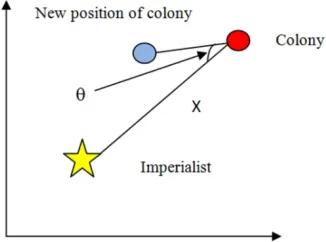
3. 2. Moving the Colonies of an Empire toward the Imperialist (Assimilating) After dividing colonies between imperialists, colonies are moved toward their related imperialist. This movement is shown in Figure 1, in which X is the distance between colony and imperialist. α is a random variable with a uniform (or any proper) distribution between 0 and β×X , in which β
is a number greater than 1. The direction of movement is shown by ө, which is a uniform distribution between
-ץ and ץ.
3. 3. Crossover between Colonies Moreover, colonies share their information by crossover to do themselves better. The best colonies have the most chance than others to share its information because colonies are selected in this section by tournament selection. The population percent, which is sharing information, is shown by P-Crossover.
3. 4. Exchanging Positions of the Imperialist and a Colony First, the best colony which is nominated to replace imperialist with, is located at the top of list, known as in front one, in term of crowding distance.
Figure 1. Moving colonies toward the imperialist with a random angle ө
If the imperialist do not be dominated by the best colony, the second colony will be selected regarding to crowding distance. This procedure is continued until in front one gets empty, and imperialist will be substituted to colony which has high crowding distance. Front one list is sorted according to crowding distance while the high is nominated as imperialist.
3. 5. Total Power of an Empire The total power of an empire is mainly affected by the power of the imperialist country; however, the power of the colonies of an empire has an indigent effect on the total power of the empire. Therefore, the equation of the total cost is shown below [34, 35].
= cost ( )+ ζ mean (colonies of
empire ) (21)
where denotes the total cost of the n-th empire and zeta (ζ) is positive number which is less than 1. The cost of imperialist and colonies are calculated by Equations (17) and (18). The total power of the empire should be determined by the imperialist when the value of ζ is small. If it goes up, it will increase the role of the colonies in determining the total power of an empire.
3. 6. Imperialistic Competition The power of a weaker empire will reduce, and the power of more powerful ones will rise in the imperialistic competition. All empires competition is to take the possession of the weakest colony of the weakest empire. On the other hand, first choosing some (usually one) of the weakest colonies if the weak empire and then the possess of these colonies (or this colony) are given to the winner imperialist among all empires in the imperialistic competition. In this competition, the most powerful empires will not definitely possess these colonies; but, these empires will be probably more to possess them. This competition is modeled by just selecting one of the weakest colonies of the weakest empires and then for calculating the possession probability of each empire first the normalized total cost is obtained as follows:
=max{ }- (22)
where is the normalized total cost of n-th empire, and is the total cost of n-th empire. Having the normalized total cost, the possession probability of each empire is calculated by:
=∑
(23)
Following that, the roulette wheel method is used to assign the mentioned colony to one of empires.
3. 8. Archive Adaption Ranking and sorting is done by the non-dominated and crowding distance for each empire. Then, the members of front one of each empire are selected in order to be added to the archive. Finally, if front one is kept, the members are selected after ranking and sorting solution in the archive.
3.9. Eliminating the Powerless Empires
Powerless empires will collapse and their colonies are distributed among other empires in the imperialistic competition. In this paper, when an empire loses its colonies, we consider it is collapsed.
3. 10. Stopping Criteria In our proposed model, the state in which there is only one empire between all countries is considered as stopping criterion.
4. EXPERIMENTAL RESULTS
The performance of the proposed MOICA is compared to two well-known multi-objective evolutionary algorithms (MOEAs), namely NSGA-II and PAES.
4.1. NSGA-II Non–dominated sorting genetic algorithm II (NSGA-II) is one of the most well-known and efficient multi-objective evolutionary algorithms introduced by Deb et al. [35]. Ranking and selecting the population fronts are performed by non-dominance technique and a crowding distance. Also, the algorithm uses crossover and mutation operators to generate offspring are combined together. Finally, the best solution in terms of non-dominance and crowding distance is selected from combined population as the new population. The non-dominated technique, the calculation of crowding distance, and crowding selection operator will be explained as follows.
Assume that there are r objective functions. When the following conditions are satisfied, the solution X1 dominates solution X2. If X1 and X2 do not dominate each other, they are placed at the same front. For all objective functions, solution X1 is not worse than another solution X2. For at least one of the r objective functions X1 is really better than X2. Front number 1 is made by all solutions that are not dominated by any other solutions. Also front number 2 is built by all solutions that are only dominated by solutions in front number 1.
4. 1. 1. Crowding Distance The crowding distance is a measure for density of solutions. The value of the crowding distance presents an estimate of density of solutions surrounding a particular solution. The measure of crowding distance is used in NSGA-II is shown in Equation (24). The solutions having a lower value of the crowding distance are preferred over solutions with a higher value of crowding distance.
= ∑ , ,
, , , ,
(24)
where r is the number of objective functions. , is the k-th objective function of the(i+1)-th solution and , is the k-th objective function corresponding to the (i -1)-th solution after sorting -1)-the population according to crowding distance of the k-th objective function.
, , and , , are the maximum and minimum
values of objective function k, respectively.
4. 1. 2. Tournament Selection Operator A binary tournament selection procedure has been applied for selecting solution for both the crossover and mutation operators. At first, select two solutions among the population size, then the lowest front number is selected if the two populations are from different fronts. If they become from the same front, the solution with the highest crowding distance is selected.
4. 2. Pareto-Archive Evolution Strategy The Pareto-archive evolution strategy (PAES) is a multi-objective meta-heuristic algorithm [36, 37]. PAES uses a simple (1+1) local search evolution strategy to find diverse solution in Pareto optimal set. This algorithm begins by initialization of a single solution, which is evaluated using the multi-objective cost function. In each iteration, a new solution is generated by using mutation operator. Then, the new solution and current solution are compared together based on what is mentioned by Corneand Knowels [37]. Afterward, the new solution and archive are updated. This process is continued until the iteration number is met.
5. PARAMETERS SETTING
(25)
=
where xi and ri are coded and real variables, respectively. h and l represent high and low levels of a factor.
Factors and their levels are shown in Table 1. Having developed regression models for each problem size separately, tuned parameters of proposed MOICA have been shown in Table 2.
TABLE 1. Parameters and their levels for small and large
sizes
Factors
Coded level
-1 0 +1
S L S L S L
n-Pop 100 150 150 225 200 300
N-imp 4 8 6 10 8 12
PA 0.3 0.4 0.5 0.6 0.7 0.8
PC 0.2 0.3 0.4 0.5 0.6 0.7
PR 0.1 0.2 0.2 0.3 0.3 0.4
ξ 0.1 0.1 0.15 0.15 0.2 0.2
β 1 1 2 2 3 3
TABLE 2. Tuned parameters of the proposed MOICA
Factors Optimal coded value Optimal real value
S L S L
n-Pop 0.85 1 193 300
N-imp -0.2 -1 5 8
PA 0.18 0.2 0.54 0.64
PC 1 0.5 0.6 0.6
PR -0.8 0.19 0.12 0.32
ξ 0.9 -0.5 0.195 0.125
β -0.2 0.15 1.8 2.15
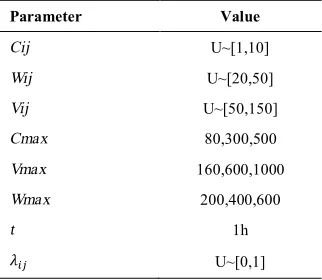
TABLE 3. Data of example parameters
Parameter Value
Cij U~[1,10]
Wij U~[20,50]
Vij U~[50,150]
Cmax 80,300,500
Vmax 160,600,1000
Wmax 200,400,600
t 1h
U~[0,1]
6. NUMERICAL EXAMPLE
The experiments are implemented for 45 problems. For all experiments, the following assumptions are held.
6. 1. Data Generation Table 3 shows the data generation of the parameters.
6. 2. Comparison Metrics To validate the reliability of the proposed ICA, four following comparison metrics are taken into account [38].
6. 2. 1. Quality Metrics This metric is simply measured by putting together the non-dominated solutions found by algorithms and the ratios between non-dominated solutions are reported.
6. 2. 2. Spacing Metric We define the spacing metric (SM) by:
=∑ | |
( ) (26)
where di is the Euclidean distance between consecutive solutions in the obtained non-dominated set of solutions and ̅is the average of these distances. This metric provides an ability to measure the uniformity of the spread of the solution set points. Due to the discontinuous test problem, the trade-off surface of these problems has some holes and leads to difficulty in interpreting this metric. Our approach with this metric is identical to the number of non-dominated solutions on using the ANOVA method, except that the effects are investigated on the spacing metric.
6. 2. 3. Diversiication Metric Diversification metric (DM) measures the spread of the solution set and is defined as:
) 27 (
DM= ∑ max ( − )
where − is the Euclidean distance between non-dominated solution and non-dominated .
6. 2. 4. Mean Ideal Distance It is used for measuring the closeness between Pareto solution and an ideal point (0, 0). This mean ideal distance (MID) metric is formulated as Equation (28). It is clear that less value of the MID is interested. In this equation n denotes the number of non-dominated set and f1i and f2i denote the first and second objective value of the i-th non-dominated solution, respectively.
MID=∑ (28)
7. COMPUTATIONAL RESULTS
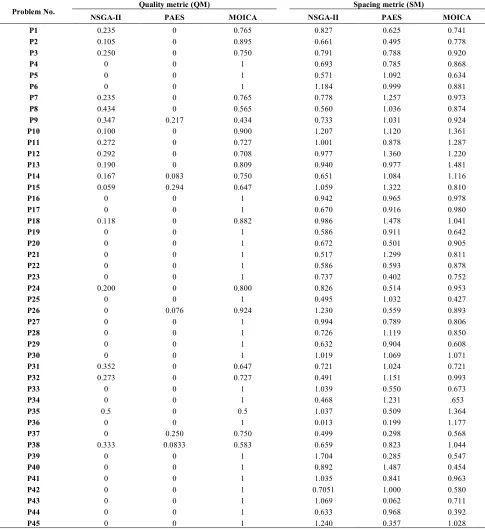
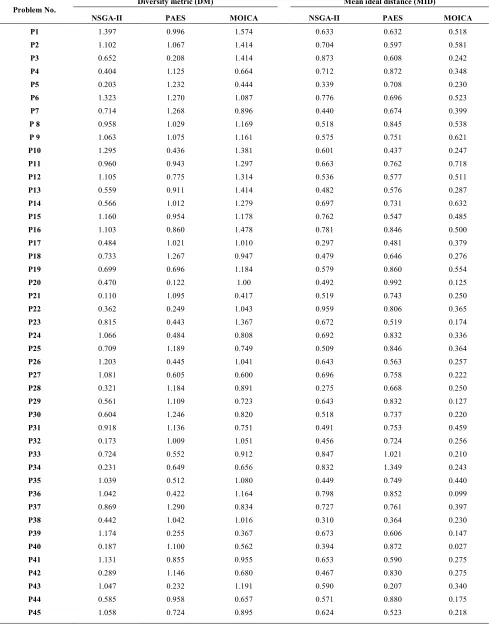
The proposed MOICA is applied to a number of test problems and its performance is compared with NSGA-II and PAES. Table 4 shows QM and SM comparison and Table 5 shows DM and MID comparison. Tables 4 and 5 list the average values of the abovementioned
comparison metrics and show that the proposed MOICA is superior to NSGA-II and PAES in each test problem.
The main reason for existing difference between NSGA-II and MOICA in quality metric is an additional operator in MOICA, called Assimilation, comparing to NSGA-II. The above operator improves MOICA to search a wider solution space for obtaining better solutions.
TABLE 4. QM and SM comparison
Problem No. Quality metric (QM) Spacing metric (SM)
NSGA-II PAES MOICA NSGA-II PAES MOICA
P1 0.235 0 0.765 0.827 0.625 0.741
P2 0.105 0 0.895 0.661 0.495 0.778
P3 0.250 0 0.750 0.791 0.788 0.920
P4 0 0 1 0.693 0.785 0.868
P5 0 0 1 0.571 1.092 0.634
P6 0 0 1 1.184 0.999 0.881
P7 0.235 0 0.765 0.778 1.257 0.973
P8 0.434 0 0.565 0.560 1.036 0.874
P9 0.347 0.217 0.434 0.733 1.031 0.924
P10 0.100 0 0.900 1.207 1.120 1.361
P11 0.272 0 0.727 1.001 0.878 1.287
P12 0.292 0 0.708 0.977 1.360 1.220
P13 0.190 0 0.809 0.940 0.977 1.481
P14 0.167 0.083 0.750 0.651 1.084 1.116
P15 0.059 0.294 0.647 1.059 1.322 0.810
P16 0 0 1 0.942 0.965 0.978
P17 0 0 1 0.670 0.916 0.980
P18 0.118 0 0.882 0.986 1.478 1.041
P19 0 0 1 0.586 0.911 0.642
P20 0 0 1 0.672 0.501 0.905
P21 0 0 1 0.517 1.299 0.811
P22 0 0 1 0.586 0.593 0.878
P23 0 0 1 0.737 0.402 0.752
P24 0.200 0 0.800 0.826 0.514 0.953
P25 0 0 1 0.495 1.032 0.427
P26 0 0.076 0.924 1.230 0.559 0.893
P27 0 0 1 0.994 0.789 0.806
P28 0 0 1 0.726 1.119 0.850
P29 0 0 1 0.632 0.904 0.608
P30 0 0 1 1.019 1.069 1.071
P31 0.352 0 0.647 0.721 1.024 0.721
P32 0.273 0 0.727 0.491 1.151 0.993
P33 0 0 1 1.039 0.550 0.673
P34 0 0 1 0.468 1.231 .653
P35 0.5 0 0.5 1.037 0.509 1.364
P36 0 0 1 0.013 0.199 1.177
P37 0 0.250 0.750 0.499 0.298 0.568
P38 0.333 0.0833 0.583 0.659 0.823 1.044
P39 0 0 1 1.704 0.285 0.547
P40 0 0 1 0.892 1.487 0.454
P41 0 0 1 1.035 0.841 0.963
P42 0 0 1 0.7051 1.000 0.580
P43 0 0 1 1.069 0.062 0.711
P44 0 0 1 0.633 0.968 0.392
TABLE 5. DM and MID comparison
Problem No. Diversity metric (DM) Mean ideal distance (MID)
NSGA-II PAES MOICA NSGA-II PAES MOICA
P1 1.397 0.996 1.574 0.633 0.632 0.518
P2 1.102 1.067 1.414 0.704 0.597 0.581
P3 0.652 0.208 1.414 0.873 0.608 0.242
P4 0.404 1.125 0.664 0.712 0.872 0.348
P5 0.203 1.232 0.444 0.339 0.708 0.230
P6 1.323 1.270 1.087 0.776 0.696 0.523
P7 0.714 1.268 0.896 0.440 0.674 0.399
P 8 0.958 1.029 1.169 0.518 0.845 0.538
P 9 1.063 1.075 1.161 0.575 0.751 0.621
P10 1.295 0.436 1.381 0.601 0.437 0.247
P11 0.960 0.943 1.297 0.663 0.762 0.718
P12 1.105 0.775 1.314 0.536 0.577 0.511
P13 0.559 0.911 1.414 0.482 0.576 0.287
P14 0.566 1.012 1.279 0.697 0.731 0.632
P15 1.160 0.954 1.178 0.762 0.547 0.485
P16 1.103 0.860 1.478 0.781 0.846 0.500
P17 0.484 1.021 1.010 0.297 0.481 0.379
P18 0.733 1.267 0.947 0.479 0.646 0.276
P19 0.699 0.696 1.184 0.579 0.860 0.554
P20 0.470 0.122 1.00 0.492 0.992 0.125
P21 0.110 1.095 0.417 0.519 0.743 0.250
P22 0.362 0.249 1.043 0.959 0.806 0.365
P23 0.815 0.443 1.367 0.672 0.519 0.174
P24 1.066 0.484 0.808 0.692 0.832 0.336
P25 0.709 1.189 0.749 0.509 0.846 0.364
P26 1.203 0.445 1.041 0.643 0.563 0.257
P27 1.081 0.605 0.600 0.696 0.758 0.222
P28 0.321 1.184 0.891 0.275 0.668 0.250
P29 0.561 1.109 0.723 0.643 0.832 0.127
P30 0.604 1.246 0.820 0.518 0.737 0.220
P31 0.918 1.136 0.751 0.491 0.753 0.459
P32 0.173 1.009 1.051 0.456 0.724 0.256
P33 0.724 0.552 0.912 0.847 1.021 0.210
P34 0.231 0.649 0.656 0.832 1.349 0.243
P35 1.039 0.512 1.080 0.449 0.749 0.440
P36 1.042 0.422 1.164 0.798 0.852 0.099
P37 0.869 1.290 0.834 0.727 0.761 0.397
P38 0.442 1.042 1.016 0.310 0.364 0.230
P39 1.174 0.255 0.367 0.673 0.606 0.147
P40 0.187 1.100 0.562 0.394 0.872 0.027
P41 1.131 0.855 0.955 0.653 0.590 0.275
P42 0.289 1.146 0.680 0.467 0.830 0.275
P43 1.047 0.232 1.191 0.590 0.207 0.340
P44 0.585 0.958 0.657 0.571 0.880 0.175
8. CONCLUSION
In many practical designing situations, reliability apportionment is complicated because of the presence of several conflicting objectives which cannot be formulated into a single-objective function. In this paper, we proposed new hybrid multi-objective imperialist competition algorithm (HMOICA) based on the ICA and GA for the first time in multi-objective RAPs. The proposed HMOICA is validated via examples with analytical solutions and shows its superior performance when compared to non-dominated sorting genetic algorithm (NSGA-II) and Pareto archive evolution strategy algorithm (PAES). In this paper, we have proposed a method for a RAP as closer as to real-world cases. However, there are still some gaps to address some constraints, such as use of more than one type components in each sub-system, using fuzzy set theory for weight, cost and volume of components and the like that can be considered for future research directions.
9. REFERENCES
1. Hwang, C., Tillman, F., Wei, W. and Lie, C., "Optimal scheduled-maintenance policy based on multiple-criteria decision-making", Reliability, IEEE Transactions on, Vol. 28, No. 5, (1979), 394-399.
2. Sakawa, M., "Multiobjective optimization by the surrogate worth trade-off method", Reliability, IEEE Transactions on, Vol. 27, No. 5, (1978), 311-314.
3. Inagaki, T., Inoue, K. and Akashi, H., "Interactive optimization of system reliability under multiple objectives", Reliability,
IEEE Transactions on, Vol. 27, No. 4, (1978), 264-267.
4. Sakawa, M., "Multiobjective reliability and redundancy optimization of a series-parallel system by the surrogate worth trade-off method", Microelectronics Reliability, Vol. 17, No. 4, (1978), 465-467.
5. Nakagawa, Y., "Studies on optimal design of high reliable system: Single and multiple objective nonlinear integer programming", (1979).
6. Sakawa, M., "Optimal reliability-design of a series-parallel system by a large-scale multiobjective optimization method",
Reliability, IEEE Transactions on, Vol. 30, No. 2, (1981),
173-174.
7. Sakawa, M., "Interactive multiobjective optimization by the sequential proxy optimization technique (spot)", Reliability,
IEEE Transactions on, Vol. 31, No. 5, (1982), 461-464.
8. Misra, K. B. and Sharma, U., "An efficient approach for multiple criteria redundancy optimization problems", Microelectronics Reliability, Vol. 31, No. 2, (1991), 303-321.
9. Misra, K. B. and Sharma, U., "Multicriteria optimization for combined reliability and redundancy allocation in systems employing mixed redundancies", Microelectronics Reliability, Vol. 31, No. 2, (1991), 323-335.
10. Dhingra, A. K., "Optimal apportionment of reliability and redundancy in series systems under multiple objectives",
Reliability, IEEE Transactions on, Vol. 41, No. 4, (1992),
576-582.
11. Sasaki, M., Gen, M. and Ida., M., "A method for solving reliability optimization problem by fuzzy multi-objective 0-1 linear programming", Electronics and Communications in
Japan Part II: Fundamental Electronic Science, (1992),
106-116.
12. Mahapatra, G. and Roy, T., "Fuzzy multi-objective mathematical programming on reliability optimization model", Applied
Mathematics and Computation, Vol. 174, No. 1, (2006),
643-659.
13. Salazar, D., Rocco, C. M. and Galván, B. J., "Optimization of constrained multiple-objective reliability problems using evolutionary algorithms", Reliability Engineering & System
Safety, Vol. 91, No. 9, (2006), 1057-1070.
14. Tian, Z. and Zuo, M. J., "Redundancy allocation for multi-state systems using physical programming and genetic algorithms", Reliability Engineering & System Safety, Vol. 91, No. 9, (2006), 1049-1056.
15. Coit, D. W. and Konak, A., "Multiple weighted objectives heuristic for the redundancy allocation problem", Reliability,
IEEE Transactions on, Vol. 55, No. 3, (2006), 551-558.
16. Zhao, J.-H., Liu, Z. and Dao, M.-T., "Reliability optimization using multiobjective ant colony system approaches", Reliability Engineering & System Safety, Vol. 92, No. 1, (2007), 109-120. 17. Tavakkoli-Moghaddam, R., Safari, J. and Sassani, F.,
"Reliability optimization of series-parallel systems with a choice of redundancy strategies using a genetic algorithm", Reliability Engineering & System Safety, Vol. 93, No. 4, (2008), 550-556. 18. Sadjadi, S. J. and Soltani, R., "An efficient heuristic versus a
robust hybrid meta-heuristic for general framework of serial–
parallel redundancy problem", Reliability Engineering &
System Safety, Vol. 94, No. 11, (2009), 1703-1710.
19. Azaron, A., Perkgoz, C., Katagiri, H., Kato, K. and Sakawa, M., "Multi-objective reliability optimization for dissimilar-unit cold-standby systems using a genetic algorithm", Computers &
Operations Research, Vol. 36, No. 5, (2009), 1562-1571.
20. Wang, Z., Chen, T., Tang, K. and Yao, X., "A multi-objective approach to redundancy allocation problem in parallel-series systems", in Evolutionary Computation, CEC'09. IEEE Congress on, IEEE. Vol., No., (2009), 582-589.
21. Li, Z., Liao, H. and Coit, D. W., "A two-stage approach for multi-objective decision making with applications to system reliability optimization", Reliability Engineering & System
Safety, Vol. 94, No. 10, (2009), 1585-1592.
22. Liang, Y.-C. and Lo, M.-H., "Multi-objective redundancy allocation optimization using a variable neighborhood search algorithm", Journal of Heuristics, Vol. 16, No. 3, (2010), 511-535.
23. Zio, E. and Bazzo, R., "Level diagrams analysis of pareto front for multiobjective system redundancy allocation", Reliability Engineering & System Safety, Vol. 96, No. 5, (2011), 569-580. 24. Soylu, B. and Kapan Ulusoy, S., "A preference ordered
classification for a multi-objective max–min redundancy allocation problem", Computers & Operations Research, Vol. 38, No. 12, (2011), 1855-1866.
25. Lins, I. D. and Droguett, E. L., "Redundancy allocation problems considering systems with imperfect repairs using multi-objective genetic algorithms and discrete event simulation", Simulation Modelling Practice and Theory, Vol. 19, No. 1, (2011), 362-381.
26. Sahoo, L., Bhunia, A. K. and Kapur, P. K., "Genetic algorithm based multi-objective reliability optimization in interval environment", Computers & Industrial Engineering, Vol. 62, No. 1, (2012), 152-160.
algorithm", Expert Systems with Applications, Vol. 39, No. 1, (2012), 990-999.
28. Chambari, A., Rahmati, S. H. A. and Najafi, A. A., "A bi-objective model to optimize reliability and cost of system with a choice of redundancy strategies", Computers & Industrial
Engineering, Vol. 63, No. 1, (2012), 109-119.
29. Safaei, N., Tavakkoli-Moghaddam, R. and Corey, K., "Annealing-based particle swarm optimization to solve the redundant reliability", Applied Soft Computing, Vol. 12, No. 11, (2012), 3462-3471.
30. Chern, M.-S., "On the computational complexity of reliability redundancy allocation in a series system", Operations Research Letters, Vol. 11, No. 5, (1992), 309-315.
31. Atashpas-Gargari, E. and Lucas, C., "Colonial competitive algorithm", IEEE Congress on Evolutionary Computation, (2007), 4661- 4667.
32. Ebeling, C. E., "An introduction to reliability and maintainability engineering", McGraw Hill New York, NY, (1997).
33. Shokrollahpour, E., Zandieh, M. and Dorri, B., "A novel imperialist competitive algorithm for bi-criteria scheduling of the assembly flowshop problem", International Journal of
Production Research, Vol. 49, No. 11, (2011), 3087-3103.
34. Karimi, N., Zandieh, M. and Najafi, A., "Group scheduling in flexible flow shops: A hybridised approach of imperialist competitive algorithm and electromagnetic-like mechanism", International Journal of Production Research, Vol. 49, No. 16, (2011), 4965-4977.
35. Deb, K., Pratap, A., Agarwal, S. and Meyarivan, T., "A fast and elitist multiobjective genetic algorithm: Nsga-ii", Evolutionary Computation, IEEE Transactions on, Vol. 6, No. 2, (2002), 182-197.
36. Knowles, J. and Corne, D., "The pareto archived evolution strategy: A new baseline algorithm for pareto multiobjective optimisation", in Evolutionary Computation, 1999. CEC 99. Proceedings of the 1999 Congress on, IEEE, (1999).
37. Corne, D. W., Knowles, J. D. and Oates, M. J., "The pareto envelope-based selection algorithm for multiobjective optimization", in Parallel Problem Solving from Nature PPSN VI, Springer, (2000), 839-848.
38. Tavakkoli-Moghaddam, R., Azarkish, M. and Sadeghnejad-Barkousaraie, A., "Solving a multi-objective job shop scheduling problem with sequence-dependent setup times by a pareto archive pso combined with genetic operators and vns", The
International Journal of Advanced Manufacturing
Technology, Vol. 53, No. 5-8, (2011), 733-750.
APPENDIX:
Solving a Redundancy Allocation Problem by a Hybrid Multi-objective Imperialist
Competitive Algorithm
R. Azizmohammadi a, M. Amiri b, R. Tavakkoli-Moghaddam c,, M. Mohammadi c
a Department of Industrial Engineering, Faculty of Engineering, Payam-e-Noor University, Tehran, Iran b Department of Industrial Management, Allameh Tabatabaei University, Tehran, Iran
c Department of Industrial Engineering, College of Engineering, University of Tehran, Tehran, Iran
P A P E R I N F O
Paper history:
Received 30 September 2012 Received in revised form 10 May 2013 Accepted 16 May 2013
Keywords:
Redundancy Allocation Problem Response Surface Methodology Multi-objective Optimization Imperialist Competitive Algorithm.
هﺪﯿﮑﭼ
فوﺮﻌﻣ ﻞﺋﺎﺴﻣ زا ﯽﮑﯾ دازﺎﻣ ءاﺰﺟا ﺺﯿﺼﺨﺗ
NP-Hard
ﯽﻣ ﻪﻨﯿﺸﯿﺑ ياﺮﺑ ﯽﮕﻧوﺰﻓا حﻮﻄﺳ و ءاﺰﺟا بﺎﺨﺘﻧا ﻞﻣﺎﺷ ﻪﮐ ﺪﺷﺎﺑ
ﺖﯾدوﺪﺤﻣ ﺖﺤﺗ نﺎﻨﯿﻤﻃا ﺖﯿﻠﺑﺎﻗ ندﻮﻤﻧ ﺖﺳا ﻢﺘﺴﯿﺳ ﻒﻠﺘﺨﻣ يﺎﻫ
. ﯽﺣاﺮﻃ ﺮﺜﮐا رد ﻪﻧﺎﮔﺪﻨﭼ فﺪﻫ ﻊﺑاﻮﺗ دﻮﺟو ﻞﯿﻟد ﻪﺑ ،ﺎﻫ
ﻨﺑ ﻢﻬﺳ ،دﺎﻀﺘﻣ ﯽﻣ راﻮﺷد و ﺖﺨﺳ نﺎﻨﯿﻤﻃا ﺖﯿﻠﺑﺎﻗ يﺪ
دﻮﺷ . ﻪﻨﯿﺸﯿﺑ ﻞﻣﺎﺷ فﺪﻫ ﻪﺳ ،لﺪﻣ ﻦﯾا رد و نﺎﻨﯿﻤﻃا ﺖﯿﻠﺑﺎﻗ يزﺎﺳ
ﻪﻨﯿﻤﮐ ﯽﻣ راﺮﻗ ﺮﻈﻧ ﺪﻣ ﻪﻨﯾﺰﻫ و ﻢﺠﺣ يزﺎﺳ ﻢﺘﯾرﻮﮕﻟا ﻪﯾﺎﭘﺮﺑ ﺪﯾﺪﺟ ﻪﻓﺪﻫﺪﻨﭼ ﯽﻘﯿﻔﻠﺗ ﻢﺘﯾرﻮﮕﻟا ﮏﯾ ،نآ ﻞﺣ ياﺮﺑ ﻪﮐ دﺮﯿﮔ
يﺎﻫ
ﺟا ﺺﯿﺼﺨﺗ ﻞﺋﺎﺴﻣ رد رﺎﺑ ﻦﯿﻟوا ياﺮﺑ يرﺎﻤﻌﺘﺳا ﺖﺑﺎﻗر و ﮏﯿﺘﻧژ ﯽﻣ دﺎﻬﻨﺸﯿﭘ دازﺎﻣ ءاﺰ
دﻮﺷ . ﯽﺳﺎﻨﺷ ﻪﯾور زا ﻦﯾا ﺮﺑ هوﻼﻋ
ﯽﻣ هدﺎﻔﺘﺳا يدﺎﻬﻨﺸﯿﭘ ﻢﺘﯾرﻮﮕﻟا يﺎﻫﺮﮕﻠﻤﻋ ﻢﯿﻈﻨﺗ ياﺮﺑ ﺦﺳﺎﭘ ﺢﻄﺳ دﻮﺷ
. ﻢﺘﯾرﻮﮕﻟا ود ﺎﺑ ﻪﺴﯾﺎﻘﻣ رد يدﺎﻬﻨﺸﯿﭘ ﻢﺘﯾرﻮﮕﻟا
NSGA-II
و
PAES
ﺖﺳا رادرﻮﺧﺮﺑ يﺮﺗﻻﺎﺑ ﯽﯾارﺎﮐ زا .