Decoding with Syntactic and Non-Syntactic Phrases in a Syntax-Based
Machine Translation System
Greg Hanneman and Alon Lavie Language Technologies Institute
Carnegie Mellon University Pittsburgh, PA 15213 USA
{ghannema, alavie}@cs.cmu.edu
Abstract
A key concern in building syntax-based ma-chine translation systems is how to improve coverage by incorporating more traditional phrase-based SMT phrase pairs that do not correspond to syntactic constituents. At the same time, it is desirable to include as much syntactic information in the system as pos-sible in order to carry out linguistically mo-tivated reordering, for example. We apply an extended and modified version of the ap-proach of Tinsley et al. (2007), extracting syntax-based phrase pairs from a large parallel parsed corpus, combining them with PBSMT phrases, and performing joint decoding in a syntax-based MT framework without loss of translation quality. This effectively addresses the low coverage of purely syntactic MT with-out discarding syntactic information. Further, we show the potential for improved transla-tion results with the inclusion of a syntactic grammar. We also introduce a new syntax-prioritized technique for combining syntactic and non-syntactic phrases that reduces overall phrase table size and decoding time by 61%, with only a minimal drop in automatic trans-lation metric scores.
1 Introduction
The dominance of traditional phrase-based statisti-cal machine translation (PBSMT) models (Koehn et al., 2003) has recently been challenged by the de-velopment and improvement of a number of new models that explicity take into account the syntax of the sentences being translated. One simple ap-proach is to limit the phrases learned by a standard
PBSMT translation model to only those contiguous sequences of words that additionally correspond to constituents in a syntactic parse tree. However, a to-tal reliance on such syntax-based phrases has been shown to be detrimental to translation quality, as the space of phrase segmentation of a parallel sentence is heavily constrained by both the source-side and target-side tree structures. Noting that the number of phrase pairs extracted from a corpus is reduced by around 80% when they are required to correspond to syntactic constituents, Koehn et al. (2003) observed that many non-constituent phrase pairs that would not be included in a syntax-only model are in fact extremely important to system performance. Since then, researchers have explored effective ways for combining phrase pairs derived from syntax-aware methods with those extracted from more traditional PBSMT. Briefly stated, the goal is to retain the high level of coverage provided by non-syntactic PBSMT phrases while simultaneously incorporating and ex-ploiting specific syntactic knowledge.
Zollmann and Venugopal (2006) overcome the re-strictiveness of the syntax-only model by starting with a complete set of phrases as produced by tra-ditional PBSMT heuristics, then annotating the tar-get side of each phrasal entry with the label of the constituent node in the target-side parse tree that subsumes the span. They then introduce new con-stituent labels to handle the cases where the phrasal entries do not exactly correspond to the syntactic constituents. Liu et al. (2006) also add non-syntactic PBSMT phrases into their tree-to-string translation system. Working from the other direction, Marton and Resnik (2008) extend a hierarchical PBSMT
system with a number of features to prefer or dis-prefer certain types of syntactic phrases in different contexts. Restructuring the parse trees to ease their restrictiveness is another recent approach: in partic-ular, Wang et al. (2007) binarize source-side parse trees in order to provide phrase pair coverage for phrases that are partially syntactic.
Tinsley et al. (2007) showed an improvement over a PBSMT baseline on four tasks in bidirectional German–English and Spanish–English translation by incorporating syntactic phrases derived from par-allel trees into the PBSMT translation model. They first word align and extract phrases from a parallel corpus using the open-source Moses PBSMT toolkit (Koehn et al., 2007), which provides a baseline SMT system. Then, both sides of the parallel corpus are parsed with independent automatic parsers, subtrees from the resulting parallel treebank are aligned, and an additional set of phrases (with each phrase corre-sponding to a syntactic constituent in the parse tree) is extracted. The authors report statistically signif-icant improvements in translation quality, as mea-sured by a variety of automatic metrics, when the two types of phrases are combined in the Moses de-coder.
Our approach in this paper is structurally similar to that of Tinsley et al. (2007), but we extend or modify it in a number of key ways. First, we ex-tract both non-syntactic PBSMT and syntax-driven phrases from a parallel corpus that is two orders of magnitude larger, making our system competitive in size to state-of-the-art SMT systems elsewhere. Second, we apply a different algorithm for subtree alignment, proposed by Lavie et al. (2008), which proceeds bottom-up from existing statistical word alignments, rather than inducing them top-down from lexical alignment probabilities. Third, in addi-tion to straightforwardly combining syntax-derived phrases with traditional PBSMT phrases, we demon-strate a new combination technique that removes PBSMT phrases whose source-language strings are already covered by a syntax-derived phrase. This new syntax-prioritized technique results in a 61% reduction in the size of the combined phrase table with only a minimal decrease in automatic transla-tion metric scores. Finally, and crucially, we carry out the joint decoding over both syntactic and non-syntactic phrase pairs in a syntax-aware MT
sys-tem, which allows a syntactic grammar to be put in place on top of the phrase pairs to carry out linguis-tically motivated reordering, hierarchical decoding, and other operations.
After this introduction, we first describe the base MT system we used, its formalism for specify-ing translation rules, and the method for extract-ing syntax-derived phrase pairs from a parallel cor-pus (Section 2). Section 3 gives the two methods for combining PBSMT phrases with our syntactic phrases, and introduces our first steps with includ-ing a grammar in the syntax-based translation frame-work. The results of our experiments are described in Section 4 and are further discussed in Section 5. Finally, Section 6 offers some conclusions and di-rections for future work.
2 Base Translation System
The base MT system used for our experiments is the statistical transfer (“Stat-XFER”) framework (Lavie, 2008). The core of the framework is a transfer en-gine using two language-pair-dependent resources: a grammar of weighted synchronous context-free rules, and a probabilistic bilingual lexicon. Once the resources have been provided, the Stat-XFER framework carries out translation in a two-stage pro-cess, first applying the lexicon and grammar to syn-chronously parse an input sentence, then running a monotonic decoder over the resulting lattice of scored translation pieces assembled during parsing to produce a final string output. Reordering is ap-plied only in the first stage, driven by the syntactic grammar; the second-stage monotonic decoder only assembles translation fragments into complete hy-potheses.
2.1 Lexicon and Grammar Formalism
Each Stat-XFER bilingual lexicon entry has a syn-chronous context-free grammar (SCFG) expression of the source- and target-language production rules, shown in abbreviated format below, wherecsandct represent source- and target-side syntactic category labels and ws and wt represent source- and target-side word or phrase strings.
Each entry in the lexicon is assigned a pair of rule scores (rt|s and rs|t) based on cs, ws, ct, andwt1. The rt|s score is a maximum-likelihood estimate of the distribution of target-language translations and source- and target-language syntactic categories given the source string (Equation 1); this is similar to the usual “target-given-source” phrasal probabil-ity in standard SMT systems. Thers|tscore is sim-ilar, but calculated in the reverse direction to give a source-given-target probability (Equation 2).
rt|s = #(wt, ct, ws, cs)
#(ws) + 1
(1)
rs|t =
#(wt, ct, ws, cs) #(wt) + 1
(2)
The add-one smoothing in the denominators coun-teracts overestimation of the rule scores of lexical entries with very infrequent source or target sides.
Stat-XFER grammar rules have a similar form, shown below via an example.
NP :: NP→[DET1N2deN3] :: [DET1N3N2]
The SCFG backbone may include lexicalized items, as above, as well as non-terminals and pre-terminals from the grammar. Constituent alignment infor-mation, shown here as co-indexes on the non-terminals, specifies one-to-one correspondences be-tween source-language and target-language con-stituents on the right-hand side of the SCFG rule. Rule scoresrt|s and rs|t for grammar rules, if they are learned from data, are calculated in the same way as the scores for lexical entries.
2.2 Syntax-Based Phrase Extraction
In this section, we briefly summarize the automatic resource extraction approach described by Lavie et al. (2008) and recently extended by Ambati and Lavie (2008), which we use here, specifically as ap-plied to the extraction of syntax-based phrase pairs for the bilingual lexicon.
The grammar and lexicon are extracted from a large parallel corpus that has been statistically word-aligned and independently parsed on both sides with
1
If no syntactic category information is available,csandct
can be set to dummy values, but the rule score equations remain unchanged.
automatic parsers. Word-level entries for the bilin-gual lexicon are directly taken from the word align-ments; corresponding syntactic categories for the left-hand side of the SCFG rules are obtained from the preterminal nodes of the parse trees. Phrase-level entries for the lexicon are based on node-to-node alignments in the parallel parse trees. In the straightforward “tree-to-tree” scenario, a given node
nsin one parse treeS will be aligned to a node nt in the other parse treeT if the words in the yield of
nsare all either aligned to words within the yield of
ntor have no alignment at all. If there are multiple nodes nt satisfying this constraint, the node in the tree closest to the leaves is selected. Each aligned node pair(ns, nt)produces a phrase-level entry in the lexicon, where the left-hand sides of the SCFG rule are the labels ofns andnt, and the right-hand sides are the yields of those two nodes in their re-spective trees. In the expanded “tree-to-tree-string” configuration, if no suitable node nt exists, a new noden′sis introduced into T as a projection ofns, spanning the yield of the words inT aligned to the yield ofns. At the end of the extraction process in either case, the entry counts are collected and scored in the manner described in Section 2.1.
3 Combination with PBSMT Phrases
Conceptually, we take the opposite approach to that of Tinsley et al. (2007) by adding traditional PBSMT phrases into a syntax-based MT system rather than the other way around. We begin by running steps 3 through 5 of the Moses training script (Koehn et al., 2007)2, which results in a list of phrase pair in-stances for the same word-aligned corpus to which we applied the syntax-based extraction methods in Section 2.2. Given the two sets of phrases, we ex-plore two methods of combining them.
• Direct Combination. Following the method of
Tinsley et al. (2007), we directly combine the counts of observed syntax-based phrase pairs with the counts of observed PBSMT phrase pairs. This results in a modified probability model in which a higher likelihood is moved onto syntactic phrase pairs that were also ex-tractable using traditional PBSMT heuristics. It
2
Decoder Phrase Type # Phrases METEOR BLEU TER
Stat-XFER Syntactic only, PHR 917,266 0.5654 0.2734 56.49
Stat-XFER Syntactic only, frag 1,081,233 0.5653 0.2741 56.54
Stat-XFER Syntactic only, gra 1,081,233 0.5665 0.2772 56.26
Stat-XFER PBSMT only 8,069,480 0.5835 0.3018 54.26
Stat-XFER Direct combination, PHR 8,071,773 0.5835 0.3009 54.21
Stat-XFER Direct combination, frag 9,150,713 0.5841 0.3026 54.52
Stat-XFER Direct combination, gra 9,150,713 0.5855 0.3034 54.28
Stat-XFER Syntax-prioritized, PHR 2,888,154 0.5800 0.2961 54.79
Stat-XFER Syntax-prioritized, frag 3,052,121 0.5802 0.2979 54.78
Stat-XFER Syntax-prioritized, gra 3,052,121 0.5813 0.2991 54.73
Moses PBSMT only, mono 8,145,083 0.5911 0.3139 53.77
Moses PBSMT only, lex RO 8,145,083 0.5940 0.3190 53.48
Figure 1: Results on the test set for all phrase table configurations. For BLEU, bold type indicates the best Stat-XFER baseline and the configurations statistically equivalent to it (paired bootstrap resampling withn= 1000,p= 0.05).
also allows either extraction mechanism to in-troduce new entries into the combined phrase table that were not extracted by the other, thus permitting the system to take full advantage of complementary information provided by PB-SMT phrases that do not correspond to syntac-tic constituents.
• Syntax-Prioritized Combination. Under this
method, we take advantage of the fact that syntax-based phrase pairs are likely to be more precise translational equivalences than traditional PBSMT phrase pairs, since con-stituent boundaries are taken into account dur-ing phrase extraction. PBSMT phrases whose source-side strings are already covered by an entry from the syntactic phrase table are re-moved; the remaining PBSMT phrases are combined as in the direct combination method above. The effect on the overall system is to trust the syntactic phrase pairs in the cases where they exist, supplementing with PBSMT phrase pairs for non-constituents.
For each type of phrase-pair combination, we test three variants when jointly decoding syntax-based phrases, which come with syntactic information, along with PBSMT phrases, which do not. In the first configuration (“PHR”), all extracted phrase la-bels for syntactic phrases are mapped to a generic “PHR” tag to simulate standard SMT monotonic
de-coding; this matches the treatment given throughout to our extracted non-syntactic phrases. In the sec-ond variant (“frag”), the phrase labels in the large nonterminal sets used by our source- and target-side parsers are mapped down to a smaller set of 19 la-bels that we use for both sides. The same translation phrase pair may occur with multiple category labels in this case if it was extracted with different syn-tactic categories from different trees in the corpus. In a third variant (“gra”), a small manually devel-oped grammar is additionally inserted into the sys-tem. The Stat-XFER system behaves the same way in each variant. All phrase pairs are applied jointly to the input sentence during the parsing stage, get-ting added to the translation according to their syn-tactic category and scores, although phrases tagged as PHR cannot participate in any grammar rules. The second-stage decoder then receives the joint lat-tice and assembles complete output hypotheses re-gardless of syntactic category labels.
4 Experiments
We extracted the lexical resources for our MT sys-tem from version 3 of the French–English Europarl parallel corpus (Koehn, 2005), using the officially released training set from the 2008 Workshop in Statistical Machine Translation (WMT)3. This gives us a corpus of approximately 1.2 million sentence
3
Phrase Table # Entries # Source Sides Amb. Factor
Total syntax-prioritized table 3,052,121 113,988 26.8
Syntactic component 1,081,233 39,105 27.7
PBSMT component 1,970,888 74,883 26.3
Total baseline PBSMT table 8,069,480 113,972 70.8
Overlap with syntax-prioritized 6,098,592 39,089 156.0
Figure 2: Statistical characteristics of the syntax-prioritized phrase table (top) compared with the baseline PBSMT phrase table (bottom). The ambiguity factor is the ratio of the number of unique entries to the number of unique source sides, or the average number of target-language alternatives per source phrase.
pairs. Statistical word alignments are learned in both directions with GIZA++ (Och and Ney, 2003), then combined with the “grow-diag-final” heuristic. For the extraction of syntax-based phrase pairs, we ob-tain English-side constituency parses using the Stan-ford parser (Klein and Manning, 2003), and French-side constituency parses using the Xerox XIP parser (A¨ıt-Mokhtar et al., 2001). In phrase extraction, we concentrate on the expanded tree-to-tree-string scenario described in Section 2.2, as it results in a nearly 50% increase in the number of extracted phrase pairs over the tree-to-tree method. For de-coding, we construct a suffix-array language model (Zhang and Vogel, 2006) from a corpus of 430 mil-lion words, including the English side of our train-ing data, the English side of the Hansard corpus, and newswire data. The “gra” variant uses a nine-rule grammar that is meant to address the most common low-level reorderings between French and English, focusing mainly on the reordering between nouns or noun phrases and adjectives or adjective phrases.
Our test set is the 2000-sentence “test2007” data set, also released as part of the WMT workshop series. We report case-insensitive scores on ver-sion 0.6 of METEOR (Lavie and Agarwal, 2007) with all modules enabled, version 1.04 of IBM-style BLEU (Papineni et al., 2002), and version 5 of TER (Snover et al., 2006).
Figure 1 gives an overall summary of our results on the test2007 data. Overall, we train and test 10 different configurations of phrase pairs in the Stat-XFER decoder. We begin by testing each type of phrase separately, producing one set of baseline sys-tems with only phrase pairs that correspond to syn-tactic constituents (“Synsyn-tactic only”) and one base-line system with only phrase pairs that were
ex-tracted from Moses (“PBSMT only”). We then test our two combination techniques, and their variants, as described in Section 3. Statistical significance is tested on the BLEU metric using paired boot-strap resampling (Koehn, 2004) withn= 1000and
p= 0.05. In the figure, the best baseline system and the configurations statistically equivalent to it are in-dicated in bold type. In addition to automatic met-ric scores, we also list the number of unique phrase pairs extracted for each configuration. (Because of the large number of phrase pairs, we pre-filter them to only the set whose source sides appear in the test data; these numbers are the ones reported.)
As an additional point of comparison, we build and tune a Moses MT system on the same data as our Stat-XFER experiments. The Moses system with a 4-gram language model and a distance-6 lex-ical reordering model (“lex RO”) scores similarly to state-of-the-art systems of this type on the test2007 French–English data (Callison-Burch et al., 2007). Without the reordering model (“mono”), the Moses system is as comparable as possible in design and resources to the Stat-XFER PBSMT-only configu-ration. We do not propose in this paper a head-to-head performance comparison between the Stat-XFER and Moses decoders; rather, we report results on both to gain a better understanding of the im-pact of the non-syntactic lexical reordering model in Moses compared with the impact of the syntactic grammar in Stat-XFER.
5 Discussion
5.1 Phrasal Coverage and Precision
syntax-Source: Il faut que l’ opinion publique soit inform´ee pleinement sur les caract´eristiques du test dont je parle .
Reference: Public opinion must be fully informed of the characteristics of the test I am talking about .
Syntax only: It|is|that|the public|be informed|fully|on|the characteristics|of the test|I am talking about|.
PBSMT only: We must|that public opinion gets noticed|fully|on the characteristics of the |
test|above .
Direct comb.: We must|that public opinion gets noticed|fully on |the characteristics of the|
test|above .
Syntax-prioritized: It is important that|the public|be informed|fully on|the characteristics|of the test|I am talking about|.
Figure 3: A translation example from the test set showing the output’s division into phrases. In the syntax-prioritized translation, English phrases that derived from syntax-based phrasal entries are shown in italics.
based phrases is detrimental to output quality. A likely reason for this, as Tinsley et al. (2007) sug-gested, is that the improved precision and infor-mativeness of the syntactic phrases is not enough to overcome their relative scarcity when compared to non-syntactic PBSMT phrases. (The syntactic phrase table is only 11 to 13% of the size of the PB-SMT phrase table.) It is important to note that this scarcity occurs at the phrasal level: though there are 294 unknown word types in our test set when trans-lating with only syntactic phrase pairs, this num-ber only drops to 277 with the inclusion of PBSMT phrases. The largest phrase table configuration, di-rect combination, yields statistically equivalent per-formance to the baseline system created using stan-dard PBSMT extraction heuristics. Its key benefit is that the inclusion of syntactic information in the phrase pairs, where possible, leaves open the door to further improvement in scores with the addition of a larger syntactic grammar. We have thus addressed the syntax-only phrase coverage problem without giving up syntactic information.
An interesting conclusion is revealed in the anal-ysis of the sizes and relative overlaps of the phrase tables in each of our translation conditions. In the absence of significant grammar, the equiva-lence of scores between the PBSMT-only and direct-combination scenarios is understandable given the minimal change in the size of the phrase table. Out of nearly 8.1 million entries, only 2293 entirely new
entries are provided by adding the syntactic phrase table; further, these phrases are relatively rare long phrases that do not have much effect on the trans-lation of the overall test set. On the other hand, the syntax-prioritized phrase table is extremely different in nature — and only 37.8% of the size of the base-line PBSMT phrase table — yet still attains nearly the same automatic metric scores. There, we can clearly see the effect of the syntactic phrases, since the 3,052,121 phrases used in the fragmented vari-ant of that scenario are more noticibly split between 1,970,888 PBSMT phrases (64.6%) and 1,081,233 syntax-based phrases (35.4%).
Source: Je veux saluer , `a mon tour , l’ intervention forte et substantielle du pr´esident Prodi .
Reference: I too would like to welcome Mr Prodi ’s forceful and meaningful intervention .
PHR I welcome
S , in turn ,
NP
the strong and substantial speech
ADJP strong and substantial
ADJ substantial CON
and ADJ
strong N
speech DET
the
PP of President Prodi
[image:7.612.94.520.59.208.2]PU .
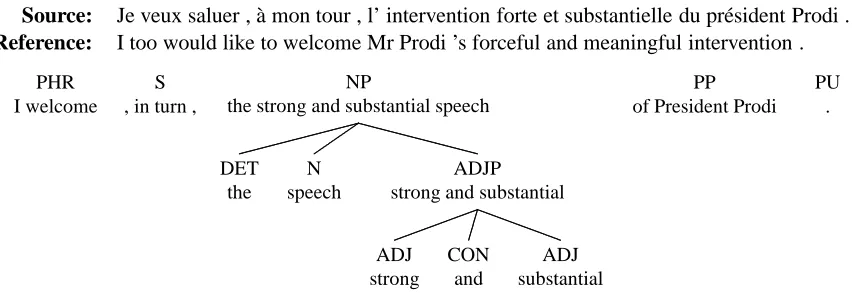
Figure 4: A translation example from the test set showing the result of including the nine-rule grammar in the syntax-prioritized combination. The SMT-only translation of the noun phrase is the decisive intervention and substantial.
phrase pairs. This is a strong indication that, be-cause of the more accurate phrase boundary detec-tion, the syntactic phrases are a much more precise representation of translational equivalence. An ad-ditional benefit is a significant reduction in decoding time, from an average of 27.3 seconds per sentence with the baseline PBSMT phrase table to 10.7 sec-onds per sentence with the syntax-prioritized table with the grammar included.
Improved precision due to the inclusion of syn-tactic phrases can be seen by examining a translation example and the phrasal chunks that produce it (Fig-ure 3). In the syntax-prioritized output, the English phrases deriving from syntax-based phrase pairs are shown in italic, while the phrases deriving from PB-SMT pairs are in normal type. The example shows an effective combination of on-target translations for syntactic constituents, when they are available, with non-syntactic phrases to handle constituent bound-aries or places where parallel constituents are dif-ficult to extract. The translation pieces be informed and I am talking about, though they exist in the base-line PBSMT phrase table, do not make it into the top-best translation in the PBSMT-only scenario be-cause of its high ambiguity factor.
5.2 Effect of Syntactic Information
Although our current experiments do not show a sig-nificant increase in automatic metric scores with the addition of a small grammar, we can see the po-tential power of grammar in examining further sen-tences from the output. For example, in Figure 4, standard PBSMT phrase extraction is able to pick up
the adjective–noun reordering when translating from
intervention forte to decisive intervention. However,
in this sentence we have an adjective phrase follow-ing the noun, and there is no pre-extracted phrase pair for the entire constituent, so our system built from only PBSMT phrases produces the incorrect noun phrase translation the decisive intervention and
substantial. Our nine-rule grammar, specifically
tar-geted for this scenario, is able to correct the structure of the sentence by applying two rules to produce the
strong and substantial speech.
Analysis of the entire test set further suggests that even our small grammar produces correct and pre-cise output across all phrase table configurations, al-though the total number of applications of the nine rules remains low. There are 590 rule applications in the one-best output on the test set in the only configuration, 472 applications in the syntax-prioritized configuration, and 216 applications in the direct combination. In each configuration, we man-ually inspected all rule applications in the first 200 sentences and classified them as correctly reordering words in the English output (“good”), incorrectly re-ordering (“bad”), or “null.” This last category de-notes applications of monotonic structure-building rules that did not feed into a higher-level reordering rule. The results of this analysis are shown in Fig-ure 5. Overall, we find that the grammar is 97% ac-curate in its applications, making helpful reordering changes 88% of the time.
Phrase Table Good Bad Null
Syntactic only 47 3 8
Syntax-prioritized 45 1 3
[image:8.612.92.285.60.117.2]Direct combination 25 0 0
Figure 5: Manual analysis of grammar rule applications in the first 200 sentences of the test set.
Moses resulted in automatic metric gains of only 0.0051 BLEU, 0.0029 METEOR, and 0.29 TER — we believe that further experiments with a much larger syntactic grammar will lead to a more signif-icant improvement in automatic metric scores and translation quality.
6 Conclusions and Future Work
We have extended and applied an algorithm for com-bining syntax-based phrases from a parallel parsed corpus with non-syntactic phrases from phrase-based SMT within the context of a statistical syntax-based translation framework. Using a much larger corpus than has previously been employed for this approach, we produce jointly decoded output sta-tistically equivalent to a monotonic decoding using standard PBSMT phrase-extraction heuristics, re-taining syntactic information and setting the stage for further improvements by incorporating a syntac-tic grammar into the translation framework. Our preliminary nine-rule grammar, targeted for two spe-cific English–French linguistic phenomena, already shows promise in performing linguistically moti-vated reordering that cannot be captured formally by a standard PBSMT model.
We present a syntax-prioritized method of com-bining phrase types into a single phrase table by al-ways selecting a syntax-based phrase pair when one is available for a given source string. This new com-bination style reduces the size of the resulting phrase table and total decoding time by 61%, with only a minor degradation in MT performance. We sug-gest that this is because the syntax-derived phrases, when they can be extracted, are a much more precise method of describing correct translational equiva-lences.
As yet, we have made only minimal use of the Stat-XFER framework’s grammar capabilities. In our experiments, the full tree-to-tree-string
rule-extraction process of Ambati and Lavie (2008) pro-duces more than 2 million unique SCFG rules when applied to a corpus the size of the Europarl. Not only is translating with such a large set computationally intractable, but empirically nearly 90% of the rules were observed only once in the parallel parsed cor-pus, making it difficult to separate rare but correct rules from those due to noise in the parses and word alignments. With the view of moving beyond our manually written nine-rule grammar, but wanting to get only the most useful rules from the entire auto-matically extracted set, we are currently investigat-ing methods for automatic scorinvestigat-ing or selection of a reasonable number of grammar rules for a particular language pair. Given that the majority of our phrase pairs, even in the syntax-prioritized combination, are non-syntactic, we have also conducted preliminary experiments with “syntactifying” them so that they may also be used by grammar rules to produce larger translation fragments.
The experiments in this paper used the grow-diag-final heuristic for word alignment combination be-cause it has been shown to provide the highest preci-sion on the subtree node alignment method by which we extract syntax-based phrase pairs (Lavie et al., 2008). However, this is a trade-off that sacrifices some amount of recall. Experimenting with differ-ent symmetric alignmdiffer-ent heuristics may lead to a more optimal configuration for phrase-pair extrac-tion or combinaextrac-tion with PBSMT phrases. We also suspect that the choice of source- and target-side parsers plays a significant role in the number and nature of phrase pairs we extract; to address this, we are in the process of re-trying our line of exper-iments using the Berkeley parser (Petrov and Klein, 2007) for English, French, or both.
Acknowledgments
This research was supported in part by NSF grant IIS-0534217 (LETRAS) and the DARPA GALE program. We thank the members of the Parsing and Semantics group at Xerox Research Center Europe for parsing the French data with their XIP parser.
References
Proceedings of the Seventh International Workshop on Parsing Technologies, Beijing, China, October. Vamshi Ambati and Alon Lavie. 2008. Improving syntax
driven translation models by re-structuring divergent and non-isomorphic parse tree structures. In Proceed-ings of the Eighth Conference of the Association for Machine Translation in the Americas, pages 235–244, Waikiki, HI, October.
Chris Callison-Burch, Cameron Fordyce, Philipp Koehn, Christof Monz, and Josh Schroeder. 2007. (Meta-) evaluation of machine translation. In Proceedings of the Second Workshop on Statistical Machine Transla-tion, pages 136–158, Prague, Czech Republic, June. Dan Klein and Christopher D. Manning. 2003. Fast exact
inference with a factored model for natural language parsing. In Advances in Neural Information Process-ing Systems 15, pages 3–10. MIT Press, Cambridge, MA.
Philipp Koehn, Franz Josef Och, and Daniel Marcu. 2003. Statistical phrase-based translation. In Proceed-ings of HLT-NAACL 2003, pages 48–54, Edmonton, Alberta, May–June.
Philipp Koehn, Hieu Hoang, Alexandra Birch, Chris Callison-Burch, Marcello Federico, Nicola Bertoldi, Brooke Cowan, Wade Shen, Christine Moran, Richard Zens, Chris Dyer, Ondrej Bojar, Alexandra Con-stantin, and Evan Herbst. 2007. Moses: Open source toolkit for statistical machine translation. In Proceed-ings of the ACL 2007 Demo and Poster Sessions, pages 177–180, Prague, Czech Republic, June.
Philipp Koehn. 2004. Statistical significance tests for machine translation evaluation. In Proceedings of EMNLP 2004, pages 388–395, Barcelona, Spain, July. Philipp Koehn. 2005. Europarl: A parallel corpus for sta-tistical machine translation. In Proceedings of the 10th Machine Translation Summit, pages 79–86, Phuket, Thailand, September.
Alon Lavie and Abhaya Agarwal. 2007. METEOR: An automatic metric for MT evaluation with high levels of correlation with human judgments. In Proceedings of the Second Workshop on Statistical Machine Transla-tion, pages 228–231, Prague, Czech Republic, June. Alon Lavie, Alok Parlikar, and Vamshi Ambati. 2008.
Syntax-driven learning of sub-sentential translation equivalents and translation rules from parsed parallel corpora. In Proceedings of the Second ACL Work-shop on Syntax and Structure in Statistical Transla-tion, pages 87–95, Columbus, OH, June.
Alon Lavie. 2008. Stat-XFER: A general search-based syntax-driven framework for machine translation. In Computational Linguistics and Intelligent Text Pro-cessing, Lecture Notes in Computer Science, pages 362–375. Springer.
Yang Liu, Qun Liu, and Shouxun Lin. 2006. Tree-to-string alignment template for statistical machine trans-lation. In Proceedings of the 21st International Con-ference on Computational Linguistics and 44th Annual Meeting of the ACL, pages 609–616, Sydney, Aus-tralia, July.
Yuval Marton and Philip Resnik. 2008. Soft syntactic constraints for hierarchical phrase-based translation. In Proceedings of ACL-08: HLT, pages 1003–1011, Columbus, OH, June.
Franz Josef Och and Hermann Ney. 2003. A system-atic comparison of various statistical alignment mod-els. Computational Linguistics, 29(1):19–51.
Kishore Papineni, Salim Roukos, Todd Ward, and Wei-Jing Zhu. 2002. BLEU: A method for automatic eva-lution of machine translation. In Proceedings of the 40th Annual Meeting of the Association for Computa-tional Linguistics, pages 311–318, Philadelphia, PA, July.
Slav Petrov and Dan Klein. 2007. Improved inference for unlexicalized parsing. In Proceedings of NAACL HLT 2007, pages 404–411, Rochester, NY, April. Matthew Snover, Bonnie Dorr, Richard Schwartz, Linnea
Micciulla, and John Makhoul. 2006. A study of trans-lation edit rate with targeted human annotation. In Proceedings of the Seventh Conference of the Associ-ation for Machine TranslAssoci-ation in the Americas, pages 223–231, Cambridge, MA, August.
John Tinsley, Mary Hearne, and Andy Way. 2007. Ex-ploiting parallel treebanks to improve phrase-based statistical machine translation. In Proceedings of the Sixth International Workshop on Treebanks and Lin-guistic Theories, pages 175–187, Bergen, Norway, De-cember.
Wei Wang, Kevin Knight, and Daniel Marcu. 2007. Bi-narizing syntax trees to improve syntax-based machine translation accuracy. In Proceedings of the 2007 Joint Conference on Empirical Methods in Natural guage Processing and Computational Natural Lan-guage Learning, pages 746–754, Prague, Czech Re-public, June.
Ying Zhang and Stephan Vogel. 2006. Suffix array and its applications in empirical natural language process-ing. Technical Report CMU-LTI-06-010, Carnegie Mellon University, Pittsburgh, PA, December. Andreas Zollmann and Ashish Venugopal. 2006. Syntax