Augmenting String-to-Tree and Tree-to-String Translation with
Non-Syntactic Phrases
Matthias Huck and Hieu Hoang and Philipp Koehn School of Informatics
University of Edinburgh 10 Crichton Street Edinburgh EH8 9AB, UK
{mhuck,hhoang,pkoehn}@inf.ed.ac.uk
Abstract
We present an effective technique to easily augment GHKM-style syntax-based ma-chine translation systems (Galley et al., 2006) with phrase pairs that do not comply with any syntactic well-formedness con-straints. Non-syntactic phrase pairs are distinguished from syntactic ones in or-der to avoid harming effects. We apply our technique in state-of-the-art string-to-tree and string-to-string setups. For string-to- tree-to-string translation, we furthermore investi-gate novel approaches for translating with source-syntax GHKM rules in association with input tree constraints and input tree features.
1 Introduction
Syntax-based statistical machine translation sys-tems utilize linguistic information that is obtained by parsing the training data. In tree-to-string
translation, source-side syntactic tree annotation is employed, whilestring-to-treetranslation exploits target-side syntax. The syntactic parse tree an-notation constrains phrase extraction to syntacti-cally well-formed phrase pairs: spans of syntactic phrases must match constituents in the parse tree. Standard based and hierarchical phrase-based statistical machine translation systems, in contrast, allow all phrase pairs that are consistent with the word alignment (Koehn et al., 2003; Chi-ang, 2005).
A restriction of the phrase inventory to syntac-tically well-formed phrase pairs entails that possi-bly valuable information from the training data re-mains disregarded. While we would expect phrase pairs that are not linguistically motivated to be less reliable, discarding them altogether might be an overly harsh decision. The quality of an inventory of syntactic phrases depends heavily on the tree
annotation scheme and the quality of the syntac-tic parses of the training data. Phrase pairs that do not span constituents in the tree annotation ob-tained from syntactic parses can provide reason-able alternative segmentations or alternative trans-lation options which prove to be valuable to the decoder.
In this work, we augment the phrase invento-ries of string-to-tree and tree-to-string translation systems with phrase pairs that are not induced in the syntax-based extraction. We extract continu-ous phrases that are consistent with the word align-ment, without enforcing any constraints with re-spect to syntactic tree annotation. Non-syntactic phrases are added as rules to the baseline syntactic grammar with a fill-up technique. New rules are only added if their right-hand side does not exist yet. We extend the glue grammar with a special glue rule to allow for application of non-syntactic phrases during decoding. A feature in the log-linear model combination serves to distinguish non-syntactic phrases from syntactic ones. During decoding, the decoder can draw on both syntactic and non-syntactic phrase table entries and produce derivations which resort to both types of phrases. Such derivations yield hypotheses that make use of the alternative segmentations and translation op-tions provided through non-syntactic phrases. The search space is more diverse, and in some cases all hypotheses from purely syntax-based deriva-tions score worse than a translation that applies one or more non-syntactic phrases. We empiri-cally demonstrate that this technique can lead to substantial gains in translation quality.
Our syntactic translation models conform to the GHKM syntax approach as proposed by Galley, Hopkins, Knight, and Marcu (Galley et al., 2004) with composed rules as in (Galley et al., 2006) and (DeNeefe et al., 2007). State-of-the-art GHKM string-to-tree systems have recently shown very competitive performance in public
evaluation campaigns (Nadejde et al., 2013; Bo-jar et al., 2013). We apply the GHKM approach not only in a string-to-tree setting as in previous work, but employ it to build tree-to-string sys-tems as well. We conduct tree-to-string translation with text input and additionally adopt translation with tree input and input tree constraints as sug-gested for hierarchical translation by Hoang and Koehn (2010). We also implement translation with tree input and feature-driven soft tree matching. The effect of augmenting the systems with non-syntactic phrases is evaluated for all variants.
2 Outline
The remainder of the paper is structured as fol-lows: We review some of the basics of syntax-based translation in the next section (Section 3) and sketch the characteristics of our GHKM string-to-tree and tree-to-string translation frame-works.
In Section 4, we describe our technique to augment GHKM-style syntax-based systems with phrase pairs that do not comply with any syntactic well-formedness constraints.
Section 5 contains the empirical part of the pa-per. We first describe our experimental setup (5.1), followed by a presentation of the translation re-sults (5.2). We also include a few translation ex-amples (5.3) in order to illustrate the differences between the syntax-based baseline systems and the setups augmented with non-syntactic phrases. The empirical part is concluded with a brief dis-cussion (5.4).
In the final part of the paper (Section 6), we give a survey of previous work that has dealt with problems related to overly restrictive syntac-tic grammars for statissyntac-tical machine translation, inadequate syntactic parses, and insufficient cov-erage of syntactic phrase inventories. A broad spectrum of diverse methods has been proposed in the literature, many of which are quite dissimilar from ours but nevertheless related. We conclude the paper in Section 7.
3 Syntax-based Translation
In syntax-based translation, a probabilistic syn-chronous context-free grammar (SCFG) is in-duced from bilingual training corpora. The par-allel training data is word-aligned and annotated with syntactic parses on either target side (string-to-tree), source side to-string), or both
(tree-to-tree). A syntactic phrase extraction procedure extracts rules which are consistent with the word-alignment and conform with certain syntactic va-lidity constraints.
Extracted rules are of the formA,B→ hα,β,∼i.
The right-hand side of the rulehα,βiis a bilingual phrase pair that may contain non-terminal sym-bols, i.e. α ∈(VF∪NF)+ and β ∈(VE∪NE)+,
where VF and VE denote the source and target
terminal vocabulary, and NF and NE denote the
source and target non-terminal vocabulary, respec-tively. The non-terminals on the source side and on the target side of rules are linked in a one-to-one correspondence. The ∼ relation defines this
one-to-one correspondence. The left-hand side of the rule is a pair of source and target non-terminals,A∈NF andB∈NE.
Decoding is typically carried out with a parsing-based algorithm, in our case a customized version of CYK+ (Chappelier and Rajman, 1998). The
parsing algorithm is extended to handle transla-tion candidates and to incorporate language model scores via cube pruning (Chiang, 2007).
3.1 GHKM String-to-Tree Translation In GHKM string-to-tree translation (Galley et al., 2004; Galley et al., 2006; DeNeefe et al., 2007), rules are extracted from training instances which consist of a source sentence, a target sentence along with its constituent parse tree, and a word alignment matrix. This tuple is interpreted as a directed graph (thealignment graph), with edges pointing away from the root of the tree, and word alignment links being edges as well. A set of nodes (the frontier set) is determined that con-tains only nodes with non-overlapping closure of their spans.1 By computing frontier graph
frag-ments—fragments of the alignment graph such that their root and all sinks are in the frontier set— the GHKM extractor is able to induce a minimal set of rules which explain the training instance. The internal tree structure can be discarded to ob-tain flat SCFG rules. Minimal rules can be assem-bled to build largercomposed rules.
TOP
PUNC.
. CS-TOP
S-TOP
NP-OA
NN Autonomie ADJA
politische ART
die ADV
auch
VMFIN
wollten
NP-SB PPER
sie PUNC,
, S-TOP
ADV
. . . leider
[image:3.595.105.489.67.235.2]unfortunately , . . . , they also wanted political autonomy .
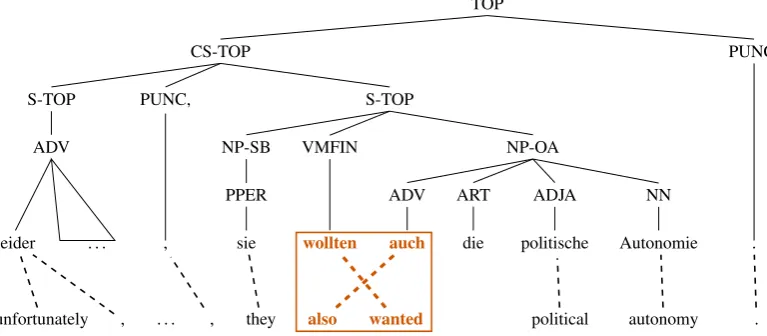
Figure 1: Word-aligned training sentence pair with target-side syntactic annotation.
of (or equal to) the set of constituent labels in the parse tree. It furthermore contains an initial non-terminal symbolQ. Source sides of the rules are not decorated with syntactic annotation. The source non-terminal vocabulary contains a single generic non-terminal symbolX.
In addition to the extracted grammar, the trans-lation system makes use of a specialglue grammar
with aninitial rule,glue rules, afinal rule, andtop rules. The glue rules provide a fall back method to just monotonically concatenate partial deriva-tions during decoding. As we add tokens which mark the sentence start (“<s>”) and the sentence end (“</s>”), the rules in the glue grammar are of the following form:
Initial rule:
X,Q→h<s>X∼0,<s>Q∼0i
Glue rules:
X,Q→hX∼0X∼1,Q∼0B∼1i
for allB∈NE
Final rule:
X,Q→hX∼0</s>,Q∼0</s>i
Top rules:
X,Q→h<s>X∼0</s>,<s>B∼0</s>i
for allB∈NE
3.2 GHKM Tree-to-String Translation The described techniques for GHKM string-to-tree translation can be adjusted for string-to-tree-to-string translation in a straightforward manner. Rules are extracted from training instances which consist of a source sentence along with its constituent parse tree, a target sentence, and a word alignment ma-trix. We omit the details.
For GHKM tree-to-string translation, we inves-tigate three decoding variants:
Tree-to-string translation with text input. The decoder can construct any source-side syn-tactic analysis that the grammar permits, very similar to string-to-tree translation.
Tree-to-string translation with tree input and input tree constraints. Syntactic annotation over the input data is provided to the decoder. The source-side syntactic non-terminals of a tree-to-string translation rule need to match the constituent span in the input sentence, otherwise the rule cannot be applied. This variant follows the method that was sug-gested for hierarchical translation by Hoang and Koehn (2010).
Tree-to-string translation with tree input and input tree features. Syntactic annotation over the input data is provided to the decoder. No hard matching constraints are imposed, but the decoder is informed about matches and mismatches of the syntactic annotation in the rules and in the input tree. It takes them into account for the score computation.
4 Non-Syntactic Phrases for GHKM Translation
The syntactic constraints in GHKM extraction can unfortunately prevent useful phrase pairs from be-ing included in the phrase inventory. Consider the example in Figure 1: the highlighted phrase pair
In the standard phrase-based approach, in con-trast, all continuous phrases that are consistent with the word alignment are extracted (Och et al., 1999; Och, 2002). The set of continuous bilingual phrases BP(fJ
1,eI1,A), given a training instance comprising a source sentence fJ
1, a target sentence
eI
1, and a word alignmentA⊆ {1,...,I}×{1,...,J}, is defined as follows:
BP(fJ
1,eI1,A) =
n hfj2
j1,e
i2
i1i:∃(i,j)∈A:i1≤i≤i2∧j1≤ j≤ j2
∧ ∀(i,j)∈A:i1≤i≤i2↔ j1≤ j≤ j2
o
Consistency for continuous phrases is based upon merely two constraints in this definition: (1.) At least one source and target position within the phrase must be aligned, and(2.)words from inside
the source phrase may only be aligned to words from inside the target phrase and vice versa. The highlighted phrase pair from the example does not violate these constraints.
In order to augment our GHKM syntax-based systems with non-syntactic phrases, we obey the following procedure:
• The setBPis extracted from all training in-stances, and phrase translation probabilities are computed separately from those in the syntactic phrase inventory.
• Non-syntactic phrases are converted to rules by providing a special left-hand side non-terminalX.
• A phrase table fill-up method is applied to enhance the syntactic phrase inventory with entries from the non-syntactic phrase inven-tory. Non-syntactic rules are only added to the final grammar if no syntactic rule with the same (sourceandtarget) right-hand side is present. This method is inspired by pre-vious work in domain adaptation (Bisazza et al., 2011).
• The glue grammar is extended with a new glue rule
X,Q→hX∼0X∼1,Q∼0X∼1i
that enables the system to make use of non-syntactic rules in decoding.
• A binary feature is added to the log-linear model (Och and Ney, 2002) to distinguish non-syntactic rules from syntactic ones, and to be able to assign a tuned weight to the non-syntactic part of the grammar.
5 Empirical Evaluation
We evaluate the effect of augmenting GHKM syntax-based translation systems—both string-to-tree and string-to-tree-to-string—with non-syntactic phrase pairs on the English→German language pair using the standard newstest sets of the Workshop on Sta-tistical Machine Translation (WMT) for testing.2 The experiments are conducted with the open-sourceMosesimplementations of GHKM rule ex-traction (Williams and Koehn, 2012) and decoding withCYK+parsing and cube pruning (Hoang et al.,
2009).
5.1 Experimental Setup
We work with an English–German parallel train-ing corpus of around 4.5 M sentence pairs (af-ter corpus cleaning). The parallel data origi-nates from three different sources which have been eligible for the constrained track of the ACL 2014 Ninth Workshop on Statistical Ma-chine Translation shared translation task: Europarl (Koehn, 2005), News Commentary, and the Com-mon Crawl corpus as provided on the WMT web-site. Word alignments are created by aligning the data in both directions with MGIZA++ (Gao and Vogel, 2008) and symmetrizing the two trained alignments (Och and Ney, 2003; Koehn et al., 2003). For string-to-tree translation, we parse the German target side with BitPar (Schmid, 2004).3 For tree-to-string translation, we parse the English source side of the parallel data with the English Berkeley Parser (Petrov et al., 2006).
When extracting syntactic phrases, we impose several restrictions for composed rules, in partic-ular a maximum number of twenty tree nodes per rule, a maximum depth of five, and a maximum size of five. We discard rules with non-terminals on their right-hand side if they are singletons in the training data.
Only the 100 best translation options per dis-tinct source side with respect to the weighted phrase-level model scores are loaded by the de-coder. The decoder is configured with a maximum chart span of 25 and a rule limit of 100.
A standard set of models is used in the base-lines, comprising phrase translation probabilities and lexical translation probabilities in both
direc-2http://www.statmt.org/wmt14/
translation-task.html
system dev newstest2013 newstest2014 BLEU TER BLEU TER BLEU TER
phrase-based 33.0 48.8 18.8 64.5 18.2 66.9
+ lexicalized reordering 34.2 48.1 19.2 64.5 18.3 67.1 string-to-string(syntax-directed extraction) 32.6 49.4 18.2o
+0.5 65.4
o
−0.4 17.8
o
+0.5 68.0
o
−0.4
+ non-syntactic phrases 33.4 49.0 18.7 65.0 18.3 67.6
string-to-tree 33.6 48.7 19.5o
+0.3 63.9
o
−0.3 18.6
o
+0.5 66.9
o
−0.7
+ non-syntactic phrases 34.3 48.0 19.8 63.6 19.1 66.2
tree-to-string 34.0 48.5 19.5o
−0.2 63.8
o
+0.2 18.5 o
+0.2 67.0
o
−0.4
+ non-syntactic phrases 33.9 48.4 19.3 64.0 18.7 66.6 + input tree constraints 33.7 48.4 19.3o
+0.4 63.9
o
−0.3 18.3
o
+0.3 67.0
o
−0.5
+ non-syntactic phrases 34.2 48.2 19.7 63.6 18.7 66.5 + input tree features 34.3 48.3 19.6o
+0.3 63.7
o
−0.3 18.6
o
+0.2 67.0
o
−0.5
[image:5.595.70.535.63.279.2]+ non-syntactic phrases 34.4 48.1 19.9 63.4 18.8 66.5
Table 1: English→German experimental results (truecase). BLEUscores are given in percentage.
tions, word and phrase penalty, an n-gram lan-guage model, a rule rareness penalty, and the monolingual PCFG probability of the tree frag-ment from which the rule was extracted (Williams et al., 2014). Phrase translation probabilities are smoothed via Good-Turing smoothing.
The language model (LM) is a large inter-polated 5-gram LM with modified Kneser-Ney smoothing (Kneser and Ney, 1995; Chen and Goodman, 1998). The target side of the parallel corpus and the monolingual German News Crawl corpora are employed as training data. We use the SRILM toolkit (Stolcke, 2002) to train the LM and rely on KenLM (Heafield, 2011) for language model scoring during decoding.
Model weights are optimized to maximize BLEU (Papineni et al., 2002) with batch MIRA
(Cherry and Foster, 2012) on 1000-best lists. We selected 2000 sentences from the newstest2008-2012 sets as a development set. The selected sen-tences obtained high sentence-level BLEU scores
when being translated with a baseline phrase-based system, and do each contain less than 30 words for more rapid tuning. newstest2013 and newstest2014 are used as unseen test sets. Trans-lation quality is measured in truecase with BLEU
and TER(Snover et al., 2006).4
We apply a phrase length limit of five when extracting non-syntactic phrases for the fill-up of syntactic phrase tables.
4TER scores are computed withtercomversion 0.7.25 and parameters-N -s.
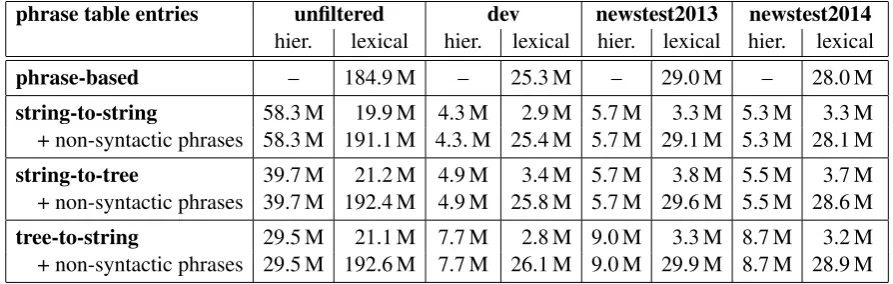
5.2 Translation Results
Table 1 comprises the results of our empirical eval-uation of the translation quality achieved by the different systems.
5.2.1 Phrase-based Baselines
We set up two phrase-based baselines for com-parison. Their set of models is the same as for the syntax-based baselines, with the exception of the PCFG probability. One of the phrase-based systems moreover utilizes a lexicalized reorder-ing model (Galley and Mannreorder-ing, 2008). No non-standard advanced features (like an operation se-quence model or class-based LMs) are engrafted. The maximum phrase length is five, search is car-ried out with cube pruning at a k-best limit of 1000. A maximum number of 100 translation op-tions per source side are taken into account.
a larger amount of hierarchical phrases5 than the string-to-tree system, though the same rules are extracted. The reason is that we discard single-ton hierarchical rules when we normalize the fre-quencies after extraction. Many rules that are sin-gletons when the syntax decoration is taken into account have in fact been seen multiple times if syntactic labels are not distinguished, due to pool-ing of counts.
The string-to-string system is on newstest2013 1.0 points BLEU worse than the phrase-based
system with lexicalized reordering and on news-test2014 0.5 points BLEU. We gain 0.5 points
BLEU on both of the test sets if we augment the
string-to-string system with non-syntactic phrases from the standard phrase-based extractor accord-ing to our procedure from Section 4.
5.2.3 String-to-Tree System
The translation quality of the string-to-tree sys-tem surpasses the translation quality of the bet-ter phrase-based baseline slightly (by 0.3 points BLEUon both test sets). The string-to-tree system
is clearly superior to the string-to-string system, which verifies that syntactic non-terminals are in-deed vital. We get a nice gain of 0.5 points BLEU
and 0.7 points TER on newstest2014 if we
aug-ment the string-to-tree system with non-syntactic phrases. The phrase-based system is outperformed by 0.8 points BLEU.
5.2.4 Tree-to-String Systems
The tree-to-string baseline with text input per-forms at the level of the string-to-tree baseline, but augmenting it with non-syntactic phrases yields only a small improvement or even harms a little (on newstest2013).
Decoding with tree input and input tree con-straints causes a minor loss in translation qual-ity. We however observed a decoding speed-up. If we employ non-syntactic phrases to augment the tree-to-string setup with input tree constraints, we provide the new non-syntactic rules in the gram-mar with a particular property: their left-hand side non-terminalXcan match any constituent span in the input sentence. The decoder would not be able to utilize non-syntactic phrases without this relaxation. Syntactic phrases amount to an in-crease of up to 0.4 points BLEU (newstest2013) 5We define hierarchical phrases as rules with non-terminals on their right-hand side, in contrast to lexical phraseswhich are continuous rules with right-hand sides that contain terminal symbols only.
and 0.5 points TER (newstest2014) in the
tree-constrained setup.
Our best tree-to-string setup takes tree input, but involves soft matching features instead of hard in-put tree constraints. We incorporate two features, one that fires for matches and another one that fires for mismatches. The motivation for not relying on just one feature which would penalize mismatches is that the number of syntactic non-terminals in the derivation can differ between hypotheses. Not all constituent spans need to be matched (or mis-matched) by non-terminals, some can be over-laid through larger rules.6 Tree-to-string transla-tion with input tree features benefits from being augmented with non-syntactic phrases by 0.2 to 0.3 points BLEU. The resulting system is
mini-mally better than the best string-to-tree system on newstest2013, and slightly worse than it on news-test2014.
5.3 Translation Examples
We illustrate the differences between the syntax-based baseline systems and the setups augmented with non-syntactic phrases by means of two trans-lation examples from newstest2014. Both exam-ples are string-to-tree translations.
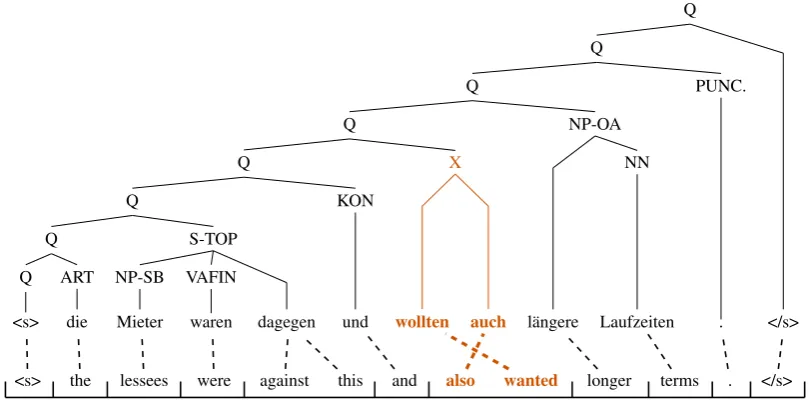
Figures 2 and 3 depict an example that cor-responds well to the word-aligned training sen-tence pair with target-side syntactic annotation from Figure 1. Figure 2 shows the translation, seg-mentation, and parse tree derived by the string-to-tree baseline system as single-best output for the preprocessed input sentence: “the lessees were against this and also wanted longer terms .” The reference translation is: “Die Pächter waren dage-gen und wollten zudem längere Laufzeiten.” Fig-ure 3 shows the translation, segmentation, and parse tree derived by the string-to-tree system aug-mented with non-syntactic phrases. There are two word substitutions with respect to the ref-erence in the latter translation, but they convey the same meaning. The baseline translation fails to convey the meaning, mostly because “terms” is translated to the verb “gesehen”, which is a wrong syntactic analysis in the given context. In-terestingly, the segmentation applied by the two systems is rather similar, apart from the interval “also wanted” which cannot be translated en bloc by the baseline. All rules in the baseline
Q
</s> Q
TOP
. VP-OC
VVPP gesehen mehr
ADV
auch
VMFIN
wollte und
S-TOP
dagegen VAFIN
waren NP-SB
Mieter Q
ART
die Q
<s>
<s> the lessees were against this and also wanted longer terms . </s>
[image:7.595.102.499.66.262.2]Reference:Die Pächter waren dagegen und wollten zudem längere Laufzeiten. Figure 2: Translation and parse tree from the string-to-tree system.
Q
</s> Q
PUNC.
. Q
NP-OA NN
Laufzeiten längere
Q
X
auch wollten
Q
KON
und Q
S-TOP
dagegen VAFIN
waren NP-SB
Mieter Q
ART die Q <s>
<s> the lessees were against this and also wanted longer terms . </s>
[image:7.595.96.501.317.518.2]Reference:Die Pächter waren dagegen und wollten zudem längere Laufzeiten.
Figure 3: Translation and parse tree from the string-to-tree system augmented with non-syntactic phrases.
mar that contain “also wanted” as part of their source side imply a larger source-side lexical con-text that is not present in the given sentence. None of those rules matches the input. The baseline has to translate “also” and “wanted” separately and fails to translate the verb to a plural form German verb. The next rule in bottom-up order is already involved in the incorrect choice of a verb for “terms”. The string-to-tree system aug-mented with non-syntactic phrases applies more glue rules, but this is beneficial in the present example, as it breaks apart the faulty syntactic derivation.
Q
</s> TOP
. S-TOP
AP-PD
beeindruckend ist
, NP-SB
S-RC
VVFIN spielt NP-SB
Team das der in , Weise und Art die , S-TOP
allen von AA-MO
meisten am <s>
<s> most of all , the manner in which the team is playing is impressive . </s>
[image:8.595.89.511.80.224.2]Reference:Vor allem die Art und Weise, wie die Mannschaft spielt, ist beeindruckend. Figure 4: Translation and parse tree from the string-to-tree system.
Q
</s> Q
X
. beeindruckend ist
Q
X
, spielt
Q
NP-SB
Mannschaft die
Q
X
wie , Weise und Art
Q ART
die Q
X allem vor
Q <s>
<s> most of all , the manner in which the team is playing is impressive . </s>
[image:8.595.104.490.306.480.2]Reference:Vor allem die Art und Weise, wie die Mannschaft spielt, ist beeindruckend.
Figure 5: Translation and parse tree from the string-to-tree system augmented with non-syntactic phrases.
phrase table entries unfiltered dev newstest2013 newstest2014 hier. lexical hier. lexical hier. lexical hier. lexical
phrase-based – 184.9 M – 25.3 M – 29.0 M – 28.0 M
string-to-string 58.3 M 19.9 M 4.3 M 2.9 M 5.7 M 3.3 M 5.3 M 3.3 M + non-syntactic phrases 58.3 M 191.1 M 4.3. M 25.4 M 5.7 M 29.1 M 5.3 M 28.1 M string-to-tree 39.7 M 21.2 M 4.9 M 3.4 M 5.7 M 3.8 M 5.5 M 3.7 M + non-syntactic phrases 39.7 M 192.4 M 4.9 M 25.8 M 5.7 M 29.6 M 5.5 M 28.6 M tree-to-string 29.5 M 21.1 M 7.7 M 2.8 M 9.0 M 3.3 M 8.7 M 3.2 M + non-syntactic phrases 29.5 M 192.6 M 7.7 M 26.1 M 9.0 M 29.9 M 8.7 M 28.9 M
[image:8.595.75.522.556.698.2]5.4 Discussion
A drawback of our method is that it increases the size of the synchronous context-free gram-mar massively. Most phrase pairs from standard phrase-based extraction are actually not present in the GHKM rule set, even with composed rules. A large fraction of the extracted non-syntactic phrases is such added to the phrase inventory through phrase table fill-up. Table 2 shows the phrase inventory statistics for the different sys-tems.
Another question relates to the glue rule appli-cations. The application of a non-syntactic rule is always accompanied with a respective glue rule application in our implementation. The string-to-tree baseline utilizes glue rules on average 3.0 times in each single-best translation (measured on newstest2014), the string-to-tree system aug-mented with non-syntactic phrases utilizes glue rules on average 7.0 times. We considered an im-plementation that allows for embedding of non-syntactic rules into hierarchical rules (other than the glue rules) but did not see improvements with it as yet. Furthermore, efficiency concerns become more relevant in such an implementation.
6 Related Work
Issues with overly restrictive syntactic grammars for statistical machine translation, inadequate syn-tactic parses, and insufficient coverage have been tackled from several different directions in the lit-erature.
A proposed approach to attain better tic phrase inventories is to restructure the syntac-tic parse trees in a preprocessing step (Wang et al., 2007; Wang et al., 2010; Burkett and Klein, 2012). This line of research aims at rearranging parse trees in a way that makes them a better fit for the requirements of the bilingual downstream application. Conversely, Fossum et al. (2008) re-tain the structure of the parse trees and modify the word alignments.
Marcu et al. (2006) relax syntactic phrase ex-traction constraints in their SPMT Model 2 to al-low for phrases that do not match the span of one single constituent in the parse tree. SPMT Model 2 rules are created from spans that are consistent with the word alignment and covered by multiple constituents such that the union of the constituents matches the span. Pseudo syntactic non-terminals are introduced for the left-hand sides of
SPMT Model 2 rules. Special additional rules al-low for combination of those non-syntactic left-hand side non-terminals with genuine syntactic non-terminals on the right-hand sides of other rules during decoding.
Another line of research took the hierarchical phrase-based model (Chiang, 2005; Chiang, 2007) as a starting point and extended it with syntactic enhancements. In their SAMT system, Zollmann and Venugopal (2006) labeled the non-terminals of the hierarchical model with composite symbols derived from the syntactic tree annotation. Similar methods have been applied with CCG labels (Al-maghout et al., 2012). Venugopal et al. (2009) and Stein et al. (2010) keep the grammar of the non-terminals of the hierarchical model unlabeled and apply the syntactic information in a separate model. Other authors added features which fire for phrases complying with certain syntactic prop-erties while retaining all phrase pairs of the hier-archical model (Marton and Resnik, 2008; Vilar et al., 2008).
In a tree-to-tree translation setting, Chiang (2010) proposed techniques to soften the syntac-tic constraints. A fuzzy approach with complex non-terminal symbols as in SAMT is employed to overcome the limitations during phrase extrac-tion. In decoding, substitutions of non-terminals are not restricted to matching ones. Any left-hand side non-terminal can substitute any right-hand side non-terminal. The decoder decides on the best derivation based on the tuned weights of a large number of binary features.
Joining phrase inventories that come from mul-tiple origins is a common method in domain adap-tation (Bertoldi and Federico, 2009; Niehues and Waibel, 2012) but has also been applied in the contexts of lightly-supervised training (Schwenk, 2008; Huck et al., 2011) and of forced alignment training (Wuebker et al., 2010). For our purposes, we apply a fill-up method in the manner of the one that has been shown to perform well for domain adaptation in earlier work (Bisazza et al., 2011).
Previous research that resembles our work most has been presented by Liu et al. (2006) and by Hanneman and Lavie (2009).
pipeline. A non-syntactic phrase pair can how-ever only be applied if its source side matches a subtree in the parsed input sentence. Syn-tactic and non-synSyn-tactic phrases are not distin-guished, and overlap between the syntactic and non-syntactic part of the phrase inventory is not avoided. The decoder picks the entry with the higher phrase translation probability, which means that non-syntactic phrase table entries can super-sede syntactic entries. The authors report im-provements of 0.6 points BLEUon the 2005 NIST
Chinese→English task with four reference trans-lations.
Hanneman and Lavie (2009) examine non-syntactic phrases for tree-to-tree translation with the Stat-XFER framework as developed at Carnegie Mellon University (Lavie, 2008). They combine syntactic and non-syntactic phrase in-ventories and reestimate the probabilities for both types of phrase pairs by adding up the observed absolute frequencies. Two combination schemes are evaluated: combination with all extractable valid non-syntactic phrases (“direct combination”) and combination with only those non-syntactic phrases whose source sides are not equal to the source side of any syntactic phrase (“syntax-prioritized combination”). On a French→English translation task, Hanneman and Lavie (2009) re-port improvements of around 2.6 points BLEUby
adding non-syntactic phrases on top of their Stat-XFER syntactic baselines. Their best setup how-ever does not reach the performance of a stan-dard phrase-based system, which is still 1.6 points BLEUbetter.
Apart from the differences in the underly-ing syntax-based translation technology (strunderly-ing- (string-to-tree/tree-to-string GHKM vs. TAT vs. Stat-XFER), our work also constitutes a novel contri-bution as compared to the previous approaches by Liu et al. (2006) and Hanneman and Lavie (2009) with respect to the following:
• The phrase inventory is augmented with non-syntactic phrases by means of a fill-up tech-nique. Overlap is prevented, whereas not only new source sides, but also new target-side translation options can be added.
• The probabilities of syntactic phrase pairs are the same as in the syntax-based baseline, and the probabilities of the non-syntactic phrase pairs are the same as in a phrase-based sys-tem. Counts of syntactic and non-syntactic
phrases are not summed up to obtain new es-timates.
• Non-syntactic phrase pairs are distinguished from syntactic ones with an additional fea-ture.
7 Conclusions
String-to-tree and tree-to-string translation sys-tems can easily be augmented with non-syntactic phrases by means of phrase table fill-up, a special terminal symbol for left-hand sides of non-syntactic rules in the grammar, and an additional glue rule. A binary feature enables the system to distinguish non-syntactic phrases from syntactic ones and—on the basis of the respective feature weight—to favor syntactically motivated phrases during decoding.
Our results on an English→German translation task demonstrate the beneficial effect of augment-ing GHKM translation systems with non-syntactic phrase pairs. Empirical gains in translation qual-ity are up to 0.5 points BLEUand 0.7 points TER
over the baseline on the recent test set of the shared translation task of the ACL 2014 Ninth Workshop on Statistical Machine Translation.
While GHKM-style syntactic translation has typically been utilized in string-to-tree settings in previous research, we have also adopted it to build tree-to-string systems in this work. Source syn-tax establishes interesting further directions for GHKM systems. We investigated two of them: in-put tree constraints and inin-put tree features.
String-to-tree and tree-to-string GHKM sys-tems perform roughly at the same level in terms of translation quality. Our best string-to-tree setup outperforms a phrase-based baseline by up to 0.8 points BLEU and 0.9 points TER (on
newstest2014), our best tree-to-string setup out-performs the phrase-based baseline by up to 0.7 points BLEU and 1.1 points TER (on
news-test2013).
Acknowledgements
References
Hala Almaghout, Jie Jiang, and Andy Way. 2012. Ex-tending CCG-based Syntactic Constraints in Hierar-chical Phrase-Based SMT. InProc. of the Annual Conf. of the European Assoc. for Machine Transla-tion (EAMT), pages 193–200, Trento, Italy, May. Nicola Bertoldi and Marcello Federico. 2009. Domain
Adaptation for Statistical Machine Translation with Monolingual Resources. InProc. of the Workshop on Statistical Machine Translation (WMT), pages 182–189, Athens, Greece, March.
Arianna Bisazza, Nick Ruiz, and Marcello Federico. 2011. Fill-up versus Interpolation Methods for Phrase-based SMT Adaptation. In Proc. of the Int. Workshop on Spoken Language Translation (IWSLT), pages 136–143, San Francisco, CA, USA, December.
Ondˇrej Bojar, Christian Buck, Chris Callison-Burch, Christian Federmann, Barry Haddow, Philipp Koehn, Christof Monz, Matt Post, Radu Soricut, and Lucia Specia. 2013. Findings of the 2013 Workshop on Statistical Machine Translation. In
Proc. of the Workshop on Statistical Machine Trans-lation (WMT), pages 1–44, Sofia, Bulgaria, August. David Burkett and Dan Klein. 2012. Transforming Trees to Improve Syntactic Convergence. InProc. of the Conf. on Empirical Methods for Natural Lan-guage Processing (EMNLP), Jeju Island, South Ko-rea, July.
Jean-Cédric Chappelier and Martin Rajman. 1998. A Generalized CYK Algorithm for Parsing Stochas-tic CFG. In Proc. of the First Workshop on Tab-ulation in Parsing and Deduction, pages 133–137, Paris, France, April.
Stanley F. Chen and Joshua Goodman. 1998. An Empirical Study of Smoothing Techniques for Lan-guage Modeling. Technical Report TR-10-98, Com-puter Science Group, Harvard University, Cam-bridge, MA, USA, August.
Colin Cherry and George Foster. 2012. Batch Tun-ing Strategies for Statistical Machine Translation. In
Proc. of the Human Language Technology Conf. / North American Chapter of the Assoc. for Compu-tational Linguistics (HLT-NAACL), pages 427–436, Montréal, Canada, June.
David Chiang. 2005. A Hierarchical Phrase-Based Model for Statistical Machine Translation. InProc. of the Annual Meeting of the Assoc. for Computa-tional Linguistics (ACL), pages 263–270, Ann Ar-bor, MI, USA, June.
David Chiang. 2007. Hierarchical Phrase-Based Translation. Computational Linguistics, 33(2):201– 228, June.
David Chiang. 2010. Learning to Translate with Source and Target Syntax. InProc. of the Annual
Meeting of the Assoc. for Computational Linguistics (ACL), pages 1443–1452, Uppsala, Sweden, July.
Steve DeNeefe, Kevin Knight, Wei Wang, and Daniel Marcu. 2007. What Can Syntax-Based MT Learn from Phrase-Based MT? In Proc. of the 2007 Joint Conf. on Empirical Methods in Natural guage Processing and Computational Natural Lan-guage Learning (EMNLP-CoNLL), pages 755–763, Prague, Czech Republic, June.
Victoria Fossum, Kevin Knight, and Steven Abney. 2008. Using Syntax to Improve Word Alignment Precision for Syntax-Based Machine Translation. In
Proc. of the Workshop on Statistical Machine Trans-lation (WMT), pages 44–52, Columbus, OH, USA, June.
Michel Galley and Christopher D. Manning. 2008. A Simple and Effective Hierarchical Phrase Reorder-ing Model. InProc. of the Conf. on Empirical Meth-ods for Natural Language Processing (EMNLP), pages 847–855, Honolulu, HI, USA, October.
Michel Galley, Mark Hopkins, Kevin Knight, and Daniel Marcu. 2004. What’s in a translation rule? InProc. of the Human Language Technology Conf. / North American Chapter of the Assoc. for Compu-tational Linguistics (HLT-NAACL), pages 273–280, Boston, MA, USA, May.
Michel Galley, Jonathan Graehl, Kevin Knight, Daniel Marcu, Steve DeNeefe, Wei Wang, and Ignacio Thayer. 2006. Scalable Inference and Training of Context-Rich Syntactic Translation Models. In
Proc. of the 21st International Conf. on Computa-tional Linguistics and 44th Annual Meeting of the Assoc. for Computational Linguistics, pages 961– 968, Sydney, Australia, July.
Qin Gao and Stephan Vogel. 2008. Parallel Implemen-tations of Word Alignment Tool. InSoftware Engi-neering, Testing, and Quality Assurance for Natural Language Processing, SETQA-NLP ’08, pages 49– 57, Columbus, OH, USA, June.
Greg Hanneman and Alon Lavie. 2009. Decoding with Syntactic and Non-syntactic Phrases in a Syntax-based Machine Translation System. InProceedings of the Third Workshop on Syntax and Structure in Statistical Translation, SSST ’09, pages 1–9, Boul-der, CO, USA, June.
Kenneth Heafield. 2011. KenLM: Faster and Smaller Language Model Queries. InProc. of the Workshop on Statistical Machine Translation (WMT), pages 187–197, Edinburgh, Scotland, UK, July.
Hieu Hoang, Philipp Koehn, and Adam Lopez. 2009. A Unified Framework for Phrase-Based, Hierarchi-cal, and Syntax-Based Statistical Machine Transla-tion. InProc. of the Int. Workshop on Spoken Lan-guage Translation (IWSLT), pages 152–159, Tokyo, Japan, December.
Matthias Huck, David Vilar, Daniel Stein, and Her-mann Ney. 2011. Lightly-Supervised Training for Hierarchical Phrase-Based Machine Translation. In
Proc. of the EMNLP 2011 Workshop on Unsuper-vised Learning in NLP, pages 91–96, Edinburgh, Scotland, UK, July.
Reinhard Kneser and Hermann Ney. 1995. Im-proved Backing-Off for M-gram Language Model-ing. InProceedings of the International Conference on Acoustics, Speech, and Signal Processing, vol-ume 1, pages 181–184, Detroit, MI, USA, May.
Philipp Koehn, Franz Joseph Och, and Daniel Marcu. 2003. Statistical Phrase-Based Translation. InProc. of the Human Language Technology Conf. / North American Chapter of the Assoc. for Computational Linguistics (HLT-NAACL), pages 127–133, Edmon-ton, Canada, May/June.
Philipp Koehn. 2005. Europarl: A parallel corpus for statistical machine translation. In Proc. of the MT Summit X, Phuket, Thailand, September.
Alon Lavie. 2008. Stat-XFER: A General Search-Based Syntax-Driven Framework for Ma-chine Translation. In Alexander Gelbukh, editor,
Computational Linguistics and Intelligent Text Pro-cessing, volume 4919 ofLecture Notes in Computer Science, pages 362–375. Springer Berlin Heidel-berg.
Yang Liu, Qun Liu, and Shouxun Lin. 2006. Tree-to-string Alignment Template for Statistical Machine Translation. InProc. of the 21st International Conf. on Computational Linguistics and the 44th Annual Meeting of the Assoc. for Computational Linguistics (ACL), pages 609–616, Sydney, Australia, July.
Daniel Marcu, Wei Wang, Abdessamad Echihabi, and Kevin Knight. 2006. SPMT: Statistical Ma-chine Translation with Syntactified Target Language Phrases. InProc. of the Conf. on Empirical Methods for Natural Language Processing (EMNLP), pages 44–52, Sydney, Australia.
Yuval Marton and Philip Resnik. 2008. Soft Syn-tactic Constraints for Hierarchical Phrased-Based Translation. InProc. of the Annual Meeting of the Assoc. for Computational Linguistics (ACL), pages 1003–1011, Columbus, OH, USA, June.
Maria Nadejde, Philip Williams, and Philipp Koehn. 2013. Edinburgh’s Syntax-Based Machine Transla-tion Systems. InProc. of the Workshop on Statistical Machine Translation (WMT), pages 170–176, Sofia, Bulgaria, August.
Jan Niehues and Alex Waibel. 2012. Detailed Analy-sis of Different Strategies for Phrase Table Adapta-tion in SMT. InProc. of the Conf. of the Assoc. for Machine Translation in the Americas (AMTA), San Diego, CA, USA, October/November.
Franz Josef Och and Hermann Ney. 2002. Discrimina-tive Training and Maximum Entropy Models for Sta-tistical Machine Translation. InProc. of the Annual Meeting of the Assoc. for Computational Linguistics (ACL), pages 295–302, Philadelphia, PA, USA, July.
Franz Josef Och and Hermann Ney. 2003. A System-atic Comparison of Various Statistical Alignment Models. Computational Linguistics, 29(1):19–51, March.
Franz Josef Och, Christoph Tillmann, and Hermann Ney. 1999. Improved Alignment Models for Statistical Machine Translation. In Proc. of the Joint SIGDAT Conf. on Empirical Methods in Nat-ural Language Processing and Very Large Corpora (EMNLP99), pages 20–28, University of Maryland, College Park, MD, USA, June.
Franz Josef Och. 2002. Statistical Machine Transla-tion: From Single-Word Models to Alignment Tem-plates. Ph.D. thesis, RWTH Aachen University, Aachen, Germany, October.
Kishore Papineni, Salim Roukos, Todd Ward, and Wei-Jing Zhu. 2002. Bleu: a Method for Automatic Evaluation of Machine Translation. InProc. of the Annual Meeting of the Assoc. for Computational Linguistics (ACL), pages 311–318, Philadelphia, PA, USA, July.
Slav Petrov, Leon Barrett, Romain Thibaux, and Dan Klein. 2006. Learning Accurate, Compact, and In-terpretable Tree Annotation. InProc. of the 21st In-ternational Conference on Computational Linguis-tics and 44th Annual Meeting of the Assoc. for Computational Linguistics, pages 433–440, Sydney, Australia, July.
Helmut Schmid. 2004. Efficient Parsing of Highly Ambiguous Context-Free Grammars with Bit Vec-tors. In Proc. of the Int. Conf. on Computational Linguistics (COLING), Geneva, Switzerland, Au-gust.
Holger Schwenk. 2008. Investigations on Large-Scale Lightly-Supervised Training for Statistical Machine Translation. InProc. of the Int. Workshop on Spo-ken Language Translation (IWSLT), pages 182–189, Waikiki, HI, USA, October.
Daniel Stein, Stephan Peitz, David Vilar, and Hermann Ney. 2010. A Cocktail of Deep Syntactic Fea-tures for Hierarchical Machine Translation. InProc. of the Conf. of the Assoc. for Machine Translation in the Americas (AMTA), Denver, CO, USA, Octo-ber/November.
Andreas Stolcke. 2002. SRILM – an Extensible Lan-guage Modeling Toolkit. InProc. of the Int. Conf. on Spoken Language Processing (ICSLP), volume 3, Denver, CO, USA, September.
Ashish Venugopal, Andreas Zollmann, Noah A. Smith, and Stephan Vogel. 2009. Preference Grammars: Softening Syntactic Constraints to Improve Statis-tical Machine Translation. In Proc. of the Hu-man Language Technology Conf. / North American Chapter of the Assoc. for Computational Linguistics (HLT-NAACL), pages 236–244, Boulder, CO, USA, June.
David Vilar, Daniel Stein, and Hermann Ney. 2008. Analysing Soft Syntax Features and Heuristics for Hierarchical Phrase Based Machine Translation. In
Proc. of the Int. Workshop on Spoken Language Translation (IWSLT), pages 190–197, Waikiki, HI, USA, October.
Wei Wang, Kevin Knight, and Daniel Marcu. 2007. Binarizing Syntax Trees to Improve Syntax-Based Machine Translation Accuracy. In Proceedings of the 2007 Joint Conference on Empirical Meth-ods in Natural Language Processing and Com-putational Natural Language Learning (EMNLP-CoNLL), pages 746–754, Prague, Czech Republic, June.
Wei Wang, Jonathan May, Kevin Knight, and Daniel Marcu. 2010. Re-structuring, Re-labeling, and Re-aligning for Syntax-based Machine Translation.
Computational Linguistics, 36(2):247–277, June. Philip Williams and Philipp Koehn. 2012. GHKM
Rule Extraction and Scope-3 Parsing in Moses. In
Proc. of the Workshop on Statistical Machine Trans-lation (WMT), pages 388–394, Montréal, Canada, June.
Philip Williams, Rico Sennrich, Maria Nadejde, Matthias Huck, Eva Hasler, and Philipp Koehn. 2014. Edinburgh’s Syntax-Based Systems at WMT 2014. InProc. of the Workshop on Statistical Machine Translation (WMT), Baltimore, MD, USA, June.
Joern Wuebker, Arne Mauser, and Hermann Ney. 2010. Training Phrase Translation Models with Leaving-One-Out. InProc. of the Annual Meeting of the Assoc. for Computational Linguistics (ACL), pages 475–484, Uppsala, Sweden, July.