Using Convolutional Neural Networks to Classify Hate-Speech
Björn Gambäck and Utpal Kumar Sikdar Department of Computer Science
Norwegian University of Science and Technology NO–7491 Trondheim, Norway
[email protected] [email protected]
Abstract
The paper introduces a deep learning-based Twitter hate-speech text classifica-tion system. The classifier assigns each tweet to one of four predefined categories: racism, sexism, both (racism and sex-ism) and non-hate-speech. Four Con-volutional Neural Network models were trained on resp. character 4-grams, word vectors based on semantic information built using word2vec, randomly generated word vectors, and word vectors combined with character n-grams. The feature set was down-sized in the networks by max-pooling, and a softmax function used to classify tweets. Tested by 10-fold cross-validation, the model based on word2vec embeddings performed best, with higher precision than recall, and a 78.3% F-score.
1 Introduction
During the Spring of 2017, parliamentary commit-tees in Germany and the UK strongly criticised leading social media sites such as Facebook, Twit-ter and Youtube (Google) for failing to take suffi-cient and quick enough action against hate-speech, with the German government threatening to fine the social networks up to 50 million euros per year if they continue to fail to act on hateful postings (and posters) within a week (Thomasson,2017).
When called to witness in front of the UK Home Affairs Committee, all the social media companies refused to reveal both the number of people they employ to battle hate-speech and the amount they spend on this. However, Google claimed to have invested “hundreds of millions” while Facebook stated that they had thousands of people work-ing on the problem. The German government estimated that the companies combined already
spend some 50 million euros per year and that the suggested new German law would increase that amount by 50% (CDU/CSU & SPD,2017, p.14).
Regardless of the resources actually devoted by the social media networks, it is clear that their cur-rent efforts are not enough: “we are disappointed at the pace of development of technological so-lutions” (Home Affairs Committee, 2017, p.24). The UK and German governments also indicate that they are moving in the direction of treating online content providers in analogy with publish-ers of printed material, with the same obligations to abide to publishing laws.
With legislation in other countries set to follow (Nielsen, 2017), properly identifying hate-speech is a pressing issue, not only for the major play-ers, but also for smaller companies, clubs, and or-ganisations that allow for user-generated content on their sites (albeit the current German law pro-posal makes an exception for sites with less than 2 million users). Many such sites currently use slow, manual moderation, which mean that abu-sive posts will be left online for too long with-out appropriate action being taken or that content will be published with delay (which might be un-acceptable to the users, e.g., in online chat rooms). Following the work by Collobert et al. (2011), deep neural networks have been shown to ef-fectively solve several language processing tasks such as part-of-speech tagging, sentiment analy-sis, and named entity recognition. Here a Convo-lutional Neural Network (CNN) model with var-ious features is utilised for hate-speech categori-sation. Word vectors based on semantic informa-tion are built for all tokens using an unsupervised learning algorithm, word2vec. The word vectors are merged with a set of extracted features, down-sized using max-pooling, and together with char-acter n-grams (4-grams) fed to the neural network model to predict the categories of each tweet.
The paper is organised as follows: Previous work on hate-speech identification is discussed in Section2. Section3 describes the deep learning-based hate-speech categorisation strategy, while experiments and results are reported in Section4. Finally, Section5summarises the discussion.
2 Related Work
Although the above-noted law-maker interest in the issue is fairly recent, the task of identifying hate speech and abusive language in online content has already been topical in the research commu-nity for 20 years.Spertus(1997) built the decision tree-based classifier ‘Smokey’ which utilised 47 syntactic and semantic sentential features. When trained on a small set of 720 web page posts man-ually annotated (as “flame”, “okay” or “maybe”) and evaluated on 502 other messages, ‘Smokey’ performed well on classifying the non-inflamatory messages, but fell completely short on flame texts (thus obtaining an accuracy of only 88.2% on a task with a majority-class baseline of 86.1%).
Addressing the dataset size problem,Sood et al. (2012) collected 1.6 million comments from a Ya-hoo! social news site, of which 6,500 were ran-domly selected for annotation by 221 persons on Amazon Mechanical Turk (AMT). Several Sup-port Vector Machine classifiers were trained on varying-size parts of this dataset using mainly word n-gram features, indicating that classifica-tion performance kept improving with increased datasets, but not as rapidly after the data size had passed 1,500 items. Looking at another set of AMT-annotated Yahoo! news posts,Nobata et al. (2016) experimented with several different word-internal, n-gram-based, syntactic, and distribu-tional semantic features, concluding that character n-grams alone contribute sufficiently strongly for an online gradient descent learner to perform well on this type of data.
Moving away from features based solely on the language used in online messages, Chen et al. (2012) proposed a model also taking into account the posting patterns of the users in order to single out persons exhibiting abusive behaviour. Simi-larly,Buckels et al. (2014) aimed to extract traits from online user behaviour that would indicate an-tisocial personality. This is of particular impor-tance for swift moderation of online chat rooms, as addressed by, e.g.,Yin et al.(2009) and Papeg-nies et al.(2017), with the latter suggesting several
types of features (at the morphological, syntactic and user behaviour levels) that can be used for identifying when gamers on a French MMO (mas-sively multiplayer online) game site move from discussing game-related issues to posting personal inflammatory remarks.
Of particular relevance to the present work are previous efforts on identifying abusive language on Twitter. Xiang et al.(2012) created offensive-language topic clusters using Logistic Regres-sion over a set of 860,071 tweets automatically annotated using a boot-strapping technique and supplemented with a dictionary of 339 offensive words. When tested on 4,029 randomly selected tweets collected just after the training set, the lexicon-enhanced clustering outperformed a key-word matching baseline. Logistic Regression and a dictionary was also utilised by Davidson et al. (2017); however, they used crowd-sourcing to cre-ate their hcre-ate-speech dictionary and aimed to sepa-rate the tweets into three classes: hate-speech, of-fensive language, and neither. Working on a set of 24,802 manually labelled tweets, they achieved good recall and precision overall, but noted that almost 40% of the actual hate-speech tweets were misclassified, although with 3/4 of those being mistaken for offensive language only.
A recurring problem with several of these ex-periments has been that the annotated datasets have not always been made publically available. However,Ross et al.(2016) had a set of 541 Ger-man tweets annotated, in particular addressing the issues of annotator and annotation reliability, and what information should be provided to the an-notators. Waseem(2016) discusses similar issues while providing a set of 6,909 English tweets hate-speech annotated by CrowdFlower users,1 and
extending a previous such dataset (Waseem and Hovy,2016). This dataset will be used in the ex-periments reported below.
Wulczyn et al. (2016) also used CrowdFlower to obtain human annotations of 115,737 comments on Wikipedia as to whether they contained per-sonal attacks and harassment. They furthermore experimented with strategies to automatically ex-pand the dataset, comparing Multi-Layer Percep-trons (a single-hidden-layer neural network) to Logistic Regression, and word n-grams to charac-ter n-grams; concluding the Logistic Regression with character n-grams performed best.
Figure 1: Hate-speech classifier
3 CNN-based Hate-Speech Classification
This section describes the hate-speech identifica-tion system architecture based on Convoluidentifica-tional Neural Networks (CNN). An overview of the sys-tem is shown in Figure 1. The first step of the system is to generate feature embeddings. Feature embeddings for all words were constructed by us-ing word embeddus-ings and character n-grams.
The word embeddings were generated in two ways, through word2vec (Mikolov et al.,2013a,b) and through random vectors. In the random vec-tor setting, all the words in the corpora are ini-tialised with random values. In the word2vec version, word vectors are generated based on the context. There are two types of such embed-dings: continuous-bags-of-words (CBOW) and skip-gram models. In the CBOW architecture, the model predicts the current word from a window of surrounding context words. In the skip-gram model, the context words are predicted using the current word.
In addition to the word embeddings, length 28 one-hot character n-gram vectors were generated, with 26 elements for the English alphabet, one for digits, and one for all other characters/symbols. The feature embeddings were produced by con-catenating the word embeddings with these char-acter n-gram vectors.
A pooling layer in the network converts each tweet into a fixed length vector, capturing the in-formation from the entire tweet. A max-pooling layer then captures the most important latent se-mantic factors from the tweets.
On the output side, a softmax layer calculates the class probability distributions for each tweet and assigns the hate-speech classes / labels based on the probability values.
4 Experiments
Four approaches to hate-speech classification were tested, based on different feature embeddings. All models were applied to the English Twitter hate-speech dataset created byWaseem(2016).2 Each
tweet in the dataset has been annotated by one Ex-pert annotator and three Amateur annotators, with four labels: non-hate-speech (84% of the data), racism, sexism, and both (i.e., racismandsexism). Waseem (2016) defined the “Expert” annota-tors as those having both a theoretical and ap-plied knowledge of hate speech (those were re-cruited among feminist and antiracism activists), while the “Amateur” annotations were obtained by crowd-sourcing (on the CrowdFlower platform). We combined the annotated tags for each tweet based on majority voting, where the Expert was given double unit votes and each of the Amateurs was given a single unit vote.
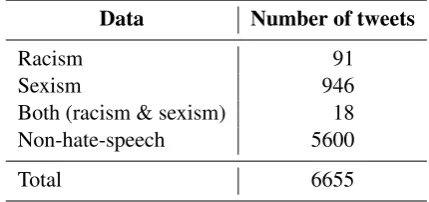
The class distributions of the dataset are shown in Table 1. The total size of the dataset (6,655 tweets) is slightly lower than the original set (Waseem reported it as containing 6,909 tweets), since some of the annotated tweets were unavail-able or had been deleted.
Data Number of tweets
Racism 91
Sexism 946
Both (racism & sexism) 18
Non-hate-speech 5600
Total 6655
Table 1: Twitter hate-speech dataset statistics
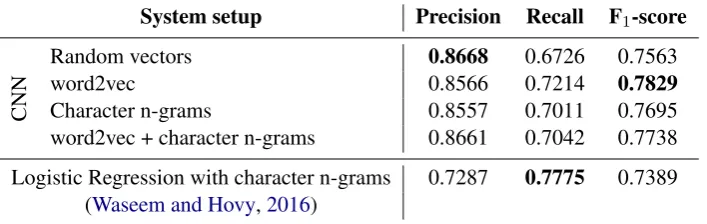
[image:3.595.308.523.609.710.2]System setup Precision Recall F1-score
CNN
Random vectors 0.8668 0.6726 0.7563
word2vec 0.8566 0.7214 0.7829
Character n-grams 0.8557 0.7011 0.7695 word2vec + character n-grams 0.8661 0.7042 0.7738 Logistic Regression with character n-grams 0.7287 0.7775 0.7389
[image:4.595.124.478.64.176.2](Waseem and Hovy,2016)
Table 2: System performance (10-fold cross-validated)
4.1 Results
The average 10-fold cross-validated results for all four Convolutional Neural Network (CNN) models are shown in Table 2, and compared to the Logistic Regression (LogReg) model used by Waseem and Hovy(2016).
In the first CNN model, random word vec-tors were considered as feature embeddings when training the network. This baseline model achieved precision, recall and F-score values of 86.68%, 67.26% and 75.63%, respectively, mark-ing a drastic improvement in precision compared to the LogReg model, but at the expense of lower recall. In the second approach, word2vec word vectors were taken as feature embeddings to learn the CNN model, resulting in clearly (7.3%) im-proved recall, for an F-score of 78.29%, even though the precision actually was slightly reduced compared to using the random vectors.
The third and fourth models both added charac-ter n-grams to the input of the CNN model. In line with the experiments reported on the same dataset by Waseem and Hovy (2016), length 4 character n-grams were used. In the third model, only the character n-gram were considered as fea-ture embeddings when training the CNN model, while in the fourth model, the feature embeddings were generated by concatenating word2vec word embeddings and character n-grams. Tested by 10-fold cross-validation, the latter system showed better precision (86.61%) than recall (70.42%), for an F-score of 77.38%.
However, although the character n-grams thus helped a little in improving precision, the word2vec model without character n-grams still achieved the best results of all the compared mod-els, with the precision, recall and F-score values of 85.66%, 72.14% and 78.29%, respectively. Note that all CNN models convincingly outperformed
Logistic Regression in terms of both precision and F1-score, while the LogReg model achieved better recall than all the neural network models.
4.2 Error Analysis
An error analysis was carried out for each of the 10 folds. The confusion matrices are shown in Ta-ble3. It can be observed that the model overall did not identify many tweets as hate-speech tweets. This may be due to insufficient training instances. Furthermore, the system wrongly identified some non-hate-speech tweets as hate-speech.
In particular, the system was not able to identify properly the category ‘both’, since the examples of this category are very few (1 or 2 per fold) with respect to the whole set of training instances. The system performed better in the ‘sexism’ category than in the other hate-speech categories (‘both’ and ‘racism’) because the number of tweets of this category are larger.
5 Conclusion and Future Work
Here we have experimented with a system for Twitter hate-speech text classification based on a deep-learning, Convolutional Neural Network model. The classifier assigns each tweet to one of four predefined categories: racism, sexism, both (racism and sexism) and neither.
True CNN b sFold-1r n b sFold-2r n b sFold-3r n b sFold-4r n b sFold-5r n
both 0 0 0 1 0 2 0 0 0 0 0 1 1 1 0 0 0 1 0 0
sexism 1 70 0 25 0 71 0 20 0 78 0 19 0 82 0 18 0 69 0 23
racism 0 0 5 6 0 0 0 6 0 0 2 8 0 0 5 7 0 0 1 8
neither 0 13 1 543 0 15 4 547 0 11 2 544 0 11 3 537 0 13 0 550
Fold-6 Fold-7 Fold-8 Fold-9 Fold-10
both 1 1 0 0 0 1 0 0 0 1 0 0 0 2 0 1 1 3 0 0
sexism 0 66 0 17 0 72 0 18 0 80 0 33 0 70 0 26 0 70 0 18
racism 0 0 3 1 0 0 1 3 0 0 6 9 0 0 1 9 0 0 6 4
[image:5.595.73.532.63.195.2]neither 0 9 4 563 0 10 0 560 0 7 2 527 0 16 0 540 0 6 0 562
Table 3: Confusion matrices for each fold, with rows showing the true labels and columns system outputs. Legend: ‘b’ = both, ‘s’ = sexism, ‘r’ = racism and ‘n’ = neither.
Trained and tested by 10-fold cross-validation, the system based on word2vec word vectors per-formed best overall, with an F1-score of 78.3%. Adding character n-grams slightly increased the precision, but resulted in lower recall and F-score. The tested models and neural network archi-tectures could be extended in several ways: The word2vec embeddings used here were built on skip-grams that predict the context words using the current word. An alternative would be to use continuous-bags-of-words that basically do the opposite and predict the current word from a window of surrounding context words. Also, fol-lowing Waseem and Hovy (2016) only length 4 character n-grams were used. Clearly it would be interesting to explore whether these are uniformly ineffective when changing the n-gram size.
The experiments reported here were carried out on a convolutional network architecture, but other types of deep neural networks could obviously be tried. In particular, the bi-directional Long Short-Term Memory (LSTM) recurrent neural network architecture has shown itself to be useful to lan-guage processing problems where utilising the se-quential nature of the input is more essential, such as named entity recognition and sentiment analy-sis, although most of the best performing systems in SemEval 2016 (the International Workshop on Semantic Evaluation; Task 4: Sentiment Analysis in Twitter) actually utilised convolutional neural networks or combinations of CNNs and other ap-proaches (Nakov et al.,2016).
A long those lines,Sikdar and Gambäck(2017) report experiments with a set-up for named entity recognition combining an LSTM with a more tra-ditional machine learning classifier based on Con-ditional Random Fields (CRF). Such an approach
could be tested also for the abusive language clas-sification task, either using the LSTM/CRF com-bination or including CNN.
Acknowledgments
The work reported here was carried out within the CZ09 Czech-Norwegian Research Programme un-der Project Contract 7F14047, HaBiT (“Harvest-ing big text data for under-resourced languages”;
http://www.habit-project.eu) funded by the Research Council of Norway (NFR) and the Czech Republic’s Ministry of Education, Youth and Sports (MŠMT) through the EEA/Norway Fi-nancial Mechanism.
Thanks to the four anonymous reviewers for comments that helped improve the paper.
References
Erin E. Buckels, Paul D. Trapnell, and Delroy L. Paul-hus. 2014. Trolls just want to have fun. Personality
and Individual Differences67:97–102.
CDU/CSU & SPD. 2017. Gesetzentwurf der Frak-tionen der CDU/CSU und SPD: Entwurf eines Gesetzes zur Verbesserung der Rechtsdurchsetzung in sozialen Netzwerken (Netzwerkdurchsetzungs-gesetz — NetzDG). Drs. 18/12356, Deutscher Bundestag, Berlin, Germany.
Ying Chen, Yilu Zhou, Sencun Zhu, and Heng Xu. 2012. Detecting offensive language in social me-dia to protect adolescent online safety. In Proceed-ings of the 2012 ASE/IEEE International Confer-ence on Social Computing and 2012 ASE/IEEE In-ternational Conference on Privacy, Security, Risk
and Trust. IEEE Computer Society, Amsterdam, The
Netherlands, pages 71–80.
scratch. Journal of Machine Learning Research
12:2493–2537.
Thomas Davidson, Dana Warmsley, Michael Macy, and Ingmar Weber. 2017. Automated hate speech detection and the problem of offensive language.
In Proceedings of the International AAAI
Confer-ence on Web and Social Media (ICWSM).
Ameri-can Association for Artificial Intelligence, Toronto, Canada. To appear.
Home Affairs Committee. 2017. Hate crime: abuse, hate and extremism online. Fourteenth Report of Session 2016–17 HC 609, House of Commons, Lon-don, UK.
Tomas Mikolov, Kai Chen, Greg Corrado, and Jeffrey Dean. 2013a. Efficient estimation of word represen-tations in vector space.CoRRabs/1301.3781. Tomas Mikolov, Ilya Sutskever, Kai Chen, Greg
Cor-rado, and Jeffrey Dean. 2013b. Distributed repre-sentations of words and phrases and their composi-tionality. In Advances in Neural Information Pro-cessing Systems 26 (NIPS 2013). Curran Associates, Red Hook, NY, USA, pages 3111–3119.
Preslav Nakov, Alan Ritter, Sara Rosenthal, Fabrizio Sebastiani, and Veselin Stoyanov. 2016. SemEval-2016 Task 4: Sentiment analysis in Twitter. In Pro-ceedings of the 10th International Workshop on Se-mantic Evaluation. ACL, San Diego, California. Nikolaj Nielsen. 2017. EU states back bill against
on-line hate speech. EUobserver, May 24. https://euobserver.com/justice/138009.
Chikashi Nobata, Joel Tetreault, Achint Thomas, Yashar Mehdad, and Yi Chang. 2016. Abusive lan-guage detection in online user content. In Proceed-ings of the 25th International Conference on World
Wide Web. International World Wide Web
Confer-ences Steering Committee, Montreal, Canada, pages 145–153.
Etienne Papegnies, Vincent Labatut, Richard Dufour, and Georges Linarès. 2017. Impact of content features for automatic online abuse detection. In Alexander Gelbukh, editor,Computational Linguis-tics and Intelligent Text Processing: Proceedings of the 18th International Conference. Springer, Bu-dapest, Hungary.
Björn Ross, Michael Rist, Guillermo Carbonell, Ben-jamin Cabrera, Nils Kurowsky, and Michael Wo-jatzki. 2016. Measuring the reliability of hate speech annotations: The case of the European refugee crisis. In 3rd Workshop on Natural Lan-guage Processing for Computer-Mediated
Commu-nication. Bochum, Germany, pages 6–9.
Utpal Kumar Sikdar and Björn Gambäck. 2017. Named entity recognition for Amharic using stack-based deep learning. In Alexander Gelbukh, editor,
Computational Linguistics and Intelligent Text Pro-cessing: Proceedings of the 18th International Con-ference. Springer, Budapest, Hungary.
Sara Owsley Sood, Elizabeth F. Churchill, and Judd Antin. 2012. Automatic identification of personal insults on social news sites. Journal of the Ameri-can Society for Information Science and Technology
63(2):270–285.
Ellen Spertus. 1997. Smokey: Automatic recognition of hostile messages. InProceedings of the 14th Na-tional Conference on Artificial Intelligence and 9th Conference on Innovative Applications of Artificial Intelligence. American Association for Artificial In-telligence, Providence, Rhode Island, pages 1058– 1065.
Emma Thomasson. 2017. German cabinet agrees to fine social media over hate speech. Reuters, Apr 5. http://uk.reuters.com/article/idUKKBN1771FK. Zeerak Waseem. 2016. Are you a racist or am i seeing
things? Annotator influence on hate speech detec-tion on Twitter. In Proceedings of 2016 EMNLP Workshop on Natural Language Processing and
Computational Social Science. ACL, Austin, Texas,
pages 138–142.
Zeerak Waseem and Dirk Hovy. 2016. Hateful sym-bols or hateful people? Predictive features for hate speech detection on Twitter. In Proceedings of the 15th Annual Conference of the North American Chapter of the Association for Computational
Lin-guistics: Human Language Technologies. ACL, San
Diego, California, pages 88–93.
Ellery Wulczyn, Nithum Thain, and Lucas Dixon. 2016. Ex Machina: Personal attacks seen at scale.
CoRRabs/1610.08914.
Guang Xiang, Bin Fan, Ling Wang, Jason I. Hong, and Carolyn P. Rose. 2012. Detecting offensive tweets via topical feature discovery over a large scale Twit-ter corpus. InProceedings of the 21st ACM Inter-national Conference on Information and Knowledge
Management. ACM, Maui, Hawaii, pages 1980–
1984.
Dawei Yin, Zhenzhen Xue, Liangjie Hong, Brian D. Davison, April Kontostathis, and Lynne Edwards. 2009. Detection of harassment on Web 2.0. In
Proceedings of the Content Analysis in the WEB 2.0