
Abstract— In this study the application of a newly developed efficient method namely, optimal homotopy analysis method (OHAM) has been illustrated for solving nonlinear singular boundary value problems (SBVPs) which frequently arise in chemical and biochemical engineering. For demonstration, the reaction-diffusion process occurring in a spherical permeable biocatalyst has been successfully solved with the Michaelis-Menten form of kinetics. The obtained OHAM results match well with the numerical solutions and are found to be equally good or superior to those obtained by available approximate method. OHAM is a flexible method and can be applied to solve different types of singular or nonsingular BVPs. Moreover, it can easily be implemented in various symbolic soft computing tools, e.g. MATHEMATICA, MAPLE.
Index Terms— reaction-diffusion process, effectiveness factor, bio-catalyst, homotopy analysis method
I. INTRODUCTION
ONLINEAR singular boundary value problems (SBVPs) are frequently encountered in various engineering disciplines [1-5]. Due to nonlinearity and the presence of singularity, these equations present difficulty in obtaining their solutions and different analytical and numerical techniques are employed or devised to solve these problems [1-14]. Recently, an approximate method namely, homotopy analysis method (HAM) has been developed to solve different types of nonlinear problems. Many problems of engineering and allied disciplines have been successfully solved by it [7, 9]. In this work, we present the application of an efficient variant of HAM i.e., OHAM [10] to solve one such problem. For demonstration, the reaction-diffusion process inside a spherical biocatalyst has been solved with the Michaelis-Menten kinetics [13, 14, 16-18]. The resulting problem is a nonlinear SBVP [6-8, 11, 12, 16-18]. It should be noted that other forms of kinetics can also be treated in a similar way. The titled problem is related to the design of a biocatalytic reactor and is of interest to chemical/biochemical engineers.
Manuscript received August 20, 2011.
Mohammad Danish is Assistant Professor in the Department of Chemical Engineering, Aligarh Muslim University, Aligarh-202002, Uttarpradesh, India and at present is on study leave at the Department of Chemical Engineering, Indian Institute of Technology Roorkee, Roorkee -247667, Uttarakhand, India ( e-mail: [email protected]).
Shashi Kumar, Associate Professor, Department of Chemical Engineering, Indian Institute of Technology Roorkee, Roorkee -247667, Uttarakhand, India (e-mail: [email protected]).
Surendra Kumar, Professor, Department of Chemical Engineering, Indian Institute of Technology Roorkee, Roorkee -247667, Uttarakhand, India, Tel: +91-1332-285714, Fax: +91-1332-273560 (e-mail: [email protected])
II. HOMOTOPY ANALYSIS METHOD
HAM is basically an efficient approximate analytical tool for solving a variety of nonlinear equations [9]. The basic objective of HAM is to break the original difficult nonlinear equation into a family of infinite and easily solvable linear equations. The solutions of thus derived linear equations are then united to yield the HAM series solution. The major advantages of this method are that it does not require the presence of small/large parameter unlike the perturbation method or delta decomposition method and can be applied to any type of nonlinearity [9]. Further, working of HAM reduces to those of other methods for a certain choice of auxiliary quantities defined later [9, 15], and it can easily be implemented in various symbolic soft computing tools e.g. MATHEMATICA, MAPLE etc. A brief description of the HAM is presented below and the other details of this method can be found in the original work of Liao [9].
A. Selection of Auxiliary Quantities and Formation of the Zero Order Deformation Equation
The first foremost thing in HAM is to select the auxiliary quantities (parameters/functions/operators) related to the given nonlinear equation, and to construct the concerned zero order deformation equation [9]. Here we show the application of HAM by considering the following operator form a nonlinear BVP.
[ ( )] 0
N y x with B y x( ),dy x( ) 0 dx
(1) Where
N
represents the nonlinear operator form of the differential equation andB
is the associated boundary operator. The following zero order deformation equation corresponding to Eq. (1) is constructed [9]:0
(1) [ ( , )L x y x( )] hH x N( ) [ ( , )] x (2) Where [0, 1] is a hypothetical embedding parameter and h0 is an auxiliary parameter which is also called convergence control parameter. H x( )0is an auxiliary function and is added so as to ensure that in the later operations, the rule of coefficient of ergodicity is not violated [9]. L is an auxiliary linear operator with the conditions that the order of this operator is same as that of the highest order operator in Eq. (1)and L[0]0. y x0( ) is
the initial guess and ( , )x is the unknown function. There are several advantages of incorporating these auxiliary quantities in HAM: (i) while treating different types of nonlinear equations the applicability and effectiveness of HAM are enhanced and (ii) for a particular
OHAM Solution of a Singular BVP of Reaction
cum Diffusion in a Biocatalyst
Mohammad Danish, Shashi Kumar and Surendra Kumar
N
IAENG International Journal of Applied Mathematics, 41:3, IJAM_41_3_08
choice of these auxiliary quantities, the working of HAM resembles with those of other approximate methods namely, Adomian decomposition method and -decomposition method [9, 15].
B. Higher Order Deformation Equation
It is clear from the Eq. (2) that as varies from 0 to 1, the unknown function ( , )x varies from initial guess
0( )
y x to the solution y x( ) of original equation, i.e.
0 0
lim ( , )x y x( )
and lim ( , )1 x y x( ). Using
Taylor’s theorem the unknown function ( , )x is expanded around 0 and the following series is found.
1 0
1 ( , )
( , ) ( , 0) ! m m m m x x x m
0 1( ) m( ) m
m
y x y x
(3a)Where,
0
1 ( , )
( ) ! m m m x y x m
(3b) The mth order deformation equation is constructed by substituting Eq. (3a) in Eq. (2) and by differentiating m times the resultant with respect to , and evaluating it at =0. mth order deformation equation thus obtained provides the estimate of the mth term of the HAM solution (y xm( )). Following mth order deformation equation is obtained.
1 1
[ m( ) m m ( )] ( ) m[ m , ] L y x y x hH x R y x
(4a) Where, the vector ym1
denotes the set of functions
1 { ( ), ( ),...,0 1 1( )}
m m
y y x y x y x , 1 1 1 1 0 [ ( , )] 1 [ , ] ( 1)! m m
m m m
N y x
R y x
m (4b)
with 0, 1
1, 2 m m m (4c) A slight rearrangement of the Eq. (4a) yields the following recursive scheme.
1
1 1
( ) ( ) [ ( ) [ , ]]
m m m m m
y x y x hL H x R y x
(5)
Where, L1 is the inverse of the linear operator L; for example, if L d
dx
then one has 1 0
[.] x
L dx
and so on. C. HAM SolutionFinally, with the help of Eqs. (3a) and (5), the approximate HAM solution is obtained for a pre-specified number of terms (nT), i.e.
1
0
1
( ,1) ( ) ( ) ( ) ( )
T
n
HAM m
m
x y x y x y x y x
(6)It has been shown by Liao [9] that if the auxiliary linear operator, auxiliary parameter, auxiliary function and initial guess are chosen properly then the above HAM series will converge to one of the solutions of Eq. (1). Generally,
( )
H x , L and y x0( ) are chosen a priori to apply this
scheme. However, in classical HAM, the value of h is basically selected from the valid region of the so-called h -curves [9]. In most of the problems, the valid region in the
h-curve is flat and many values of h can be chosen. To avoid this uncertainty, we have adopted the OHAM which is described in the following section.
III. OPTIMAL HOMOTOPY ANALYSIS METHOD The key steps in the presented OHAM [10] are same as those of HAM, but in the OHAM, h is chosen by minimizing the sum of square of residual error of the HAM solution. The residual error can be found by substituting the HAM solution in the original Eq. (1), as shown below: Residual error at x=
1 0 ( , ) ( , ) T n HAM m m
N y x h N y x h
The sum of square of residual error is given by the following equation. 2 1 1 0 0 ( , ) T n m m
N y x h dx
(7)For minimization of , 0 h
, and the equation below can be deployed for finding the optimal value of
h
.2
1 1
0 0
( , ) 0
T
n
m m
N y x h dx
h h
(8a) Since, the analytical integration in the above equation may be quite tedious, hence, the following simple but competent approximation can be employed.2 1
1 0
( , ) 0
T
n
m i
i m
N y x h
h h
(8b)Where, x is the equispaced interval in the region of interest. As soon as the value of h is available, the OHAM solution can easily be constructed by using Eq. (6).
IV. SOLUTION OF REACTION CUM DIFFUSION PROCESS IN A SPHERICAL BIOCATALYST
We consider an inert permeable spherical solid particle. Bacterial immobilization has been made inside the permeable particle by usual methods, and this permeable particle with bacteria immobilized inside it is termed as biocatalyst. This biocatalyst is immersed in a pool of liquid containing the substrate. It is further assumed that the resistance due to film surrounding the biocatalyst is negligibly small under the operating conditions in the bioreactor. Thus, the substrate (A) diffuses inside biocatalyst and the biochemical reaction occurs therein simultaneously. The application of mass balance for the substrate (A) over a thin spherical shell inside the biocatalyst yields the following model equation along with the coupled BCs (boundary conditions).
2
2
2 m A
A A
e
m A
r C
d C dC
D
r dr K C
dr (9a) BC I: CACAS at rR (catalyst surface) (9b)
BC II: dCA 0
dr at r0 (center of the catalyst) (9c) While deriving this model equation it is assumed that the biochemical reaction follows Michaelis-Menten kinetics. The details of derivation of Eqs. (9) may be found in an
IAENG International Journal of Applied Mathematics, 41:3, IJAM_41_3_08
excellent text book by Fogler [12]. Introducing the following dimensionless variables [13, 16],
A
AS
C y
C
,x r R , 2 2 ( ) (1 ) AS m
e AS e m
r R R r
D C D K
, AS m C K
where denotes the Thiele modulus and
2 signifies the ratio of the intrinsic chemical reaction rate in the absence of mass transfer limitation to the rate of diffusion through the catalyst, i.e.2 reaction rate at the catalyst surface
diffusion rate through the catalyst pores
the Eqs. (9a) - (9c) are reduced into the following dimensionless forms:
2
2 2
2 (1 )
0
(1 )
d y dy y
x dx y
dx
(10a) BC I: y1 at x1 (catalyst surface) (10b) BC II: dy 0
dx at x0 (center of the catalyst) (10c) Many investigators have studied the above reaction diffusion problem in various contexts and a lot of literature is available. Various numerical schemes e.g. finite difference methods and orthogonal collocation methods have been applied to solve this problem and a good account of work can be found in various books [3-5, 11]. Recently, Adomian decomposition method and HAM have been applied to solve the same problem but in a slab geometry [6, 7]. Asymptotic matching approach has been applied in [13] however, again for a slab catalyst. For spherical catalyst, the restarted Adomian decomposition method has been used in [8].
Following quantities are defined for finding the OHAM solution of Eqs. (10).
2
2 2
2 (1 )
[ ]
(1 )
d y dy y
N y
x dx y
dx , 1 2 2 0 1 [.] x
L x dx dx
x
,( ) 1
H x , y x0( )C2
And the following mth order deformation equation is constructed:
2
1 2 1
0
1
( ) ( ) [ , ]
x
m m m m m
y x y x h x R y x dx dx
x
(11)With the help of the above defined quantities and by iteratively employing Eq. (11), following four terms (nT=4) OHAM solution is found.
2 2
2 2
2
2
(3 3 )(1 )
6 6
OHAM
C h h h
y C x
C
2 2 4 3 3 6
4 6
2 2 2
3 5
2 2
(3 2 )(1 ) ( 3 10 )(1 )
120(1 ) 15120(1 )
C h h C h C
x x C C (12) 2
C and h can respectively be found from BC I and Eq. (8b); BC II is satisfied automatically.
For example, one finds C2 0.48995 and h 0.87076
for =2, =1 for nT= 4 and the following OHAM
solution is found by substituting these values in Eq. (12).
2 4 6
0.489948 0.437501 0.075384 0.002834
OHAM
y x x x
(13) The following expression is obtained for the same values of parameters (=2, =1) by using the relation of Li et al. [14].
2 3
0.457427 0.418479 0.124094
Li
y x x (14)
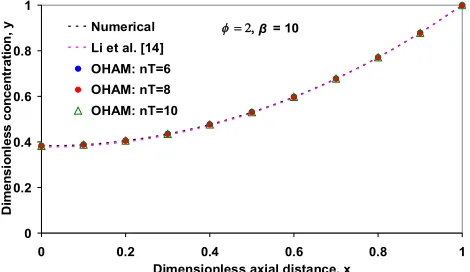
Figs. 1 & 2 show the dimensionless concentration profiles computed by using OHAM for several values of and (=2, =1; =2, =10). Besides, the numerically obtained profiles and those obtained by the approximate relation of Li et al. [14] have also been shown in these figures. From these figures, following observations may be made:
A close agreement exists between the OHAM and numerically obtained solutions. Moreover, the OHAM solutions are either equally good or are better than those obtained by Li et al [14].
One can increase the accuracy of OHAM solutions by increasing the number of terms.
The residual error profiles of OHAM solution and those obtained by the relation of Li et al. [14] have been shown in Figs. 3 & 4. Here too, it can be seen that the residual error profiles decrease with the increase in number of terms.
Alongside concentration profile, there exists another essential quantity, namely effectiveness factor (), which is pertinent to the design of biochemical reactors.
Effectiveness factor is defined by the following relation: actual reaction rate within catalyst pores
reaction rate at the surface conditions
Mathematically the above definition can be expressed for a spherical catalyst in dimensionless form as follows [13]:
0 0.2 0.4 0.6 0.8 1
0 0.2 0.4 0.6 0.8 1
Dimensionless axial distance, x
D im e n s io n le s s c o n c e n tr a ti o n , y Numerical Li et al. [14] OHAM: nT=6 OHAM: nT=8 OHAM: nT=10
[image:3.595.303.546.420.597.2]f = 2, β = 10
Fig. 2. Comparison of dimensionless concentration profiles obtained by different methods (=2, =10)
0 0.2 0.4 0.6 0.8 1
0 0.2 0.4 0.6 0.8 1
Dimensionless radial distance, x
D im e n s io n le s s c o n c e n tr a ti o n , y Numerical Li et al. [14] OHAM: nT=4 OHAM: nT=8 OHAM: nT=10
f= 2, β = 1
Fig. 1. Comparison of dimensionless concentration profiles obtained by different methods (=2, =1)
IAENG International Journal of Applied Mathematics, 41:3, IJAM_41_3_08
[image:3.595.309.544.628.764.2]2 1
3
x
dy dx
(15) Using Eq. (15) and four terms OHAM solution [Eq. (12)], one finds the following expression for
.
2 42 2
5 2
1 (1 ) 840(3 3 )(1 )
840(1 )
OHAM C C h h h C
2 2 4 2
2 2
(1 ) ( 3 10 ) 84 (3 2 )(1 )( ) )
h C h h C
2 2
84 (3 2 )(1h h )( C)
(16)
For different values of and , Table I shows the values of obtained by using numerical method, OHAM and the relations provided by Li et al. [14]. It is clear that the OHAM predictions are close to those of numerical method. Besides, the error in the prediction of decreases as one increases the terms in OHAM. One should be careful while comparing the results with those of Li et al. [14], since, dimensionless quantities defined in Li et al. [14] are different. It should also be noted that the approximate relation given by Li et al. [14] is specific to this particular equation as well as to the Michaelis-Menten form of kinetics whereas, OHAM presented in this paper is quite general and can be applied to other forms of equations [9].
V. CONCLUSIONS
The effectiveness of OHAM has been established by solving a singular boundary value problem of chemical/bio-chemical engineering, namely reaction cum diffusion process inside a permeable biocatalyst in which occurring biochemical reaction follows Michaelis-Menten kinetics. The results obtained by OHAM match well with the numerical solutions and thus prove its effectiveness.
OHAM is pretty useful as it is applicable to various types of nonlinearities and can easily be programmed in symbolic languages as available in standard mathematical soft computing tools e.g. MATHEMATICA.
ACKNOWLEDGMENT
M. Danish is thankful to his parent institution A.M.U., Aligarh-202002, U.P., India for kindly granting study leave to pursue his doctoral work at I.I.T. Roorkee, Roorkee-247667, Uttarakhand, India.
NOMENCLATURE 2
C [-] constant
A
C [mol.m-3] concentration of species A inside the catalyst pores
AS
C [mol.m-3] concentration of species A at the catalyst surface
e
D [m2.s-1] diffusion coefficient of species A inside the catalyst pores
m
K [mol.m-3] parameter in Michaelis-Menten kinetics
T
n [-] total number of terms in HAM/OHAM solution
r [m] coordinate in the radial direction
m
r [mol.m-3.s-1] parameter in Michaelis-Menten kinetics
R [m] radius of the catalyst pellet
[-] sum of square of residual error
x [-] dimensionless radial distance
( )
y x [-] dimensionless concentration
Greek letters
[-] hypothetical embedding parameter in HAM/OHAM, [0, 1]
[-] Thiele Modulus
REFERENCES
[1] A.S.V.R. Kanth, K. Aruna, “Solution of singular two-point boundary value problems using differential transformation method”, Phys. Lett. A.
vol. 372, pp. 4671–4673, 2008.
[2] M. Kumar, N. Singh, “Modified Adomian decomposition method and computer implementation for solving singular boundary value problems arising in various physical problems”, Comput. Chem. Eng. vol. 34, pp. 1750-1760, 2010.
[3] J. Villadsen, M. L. Michelsen, Solution of differential equation models by polynomial approximation, New Jersey: Prentice-Hall Inc., 1978. [4] B. A. Finlayson, Nonlinear Analysis in Chemical Engineering, New
York: Mc Graw-Hill, 1980.
[5] M. Kubicek, V. Hlavacek, Numerical Solution of Nonlinear Boundary Value Problems with Applications, New Jersey: Prentice-Hall Inc., 1983.
[6] L. Shi-Bin, S. Yan-Ping, K. Scott, “Analytic solution of diffusion-reaction in spherical porous catalyst”, Chem. Eng. Technol. vol. 26, 87-95, 2003.
[image:4.595.49.288.52.196.2][7] S. Abbasbandy, “Approximate solution for the nonlinear model of diffusion and reaction in porous catalysts by means of the homotopy analysis method”, Chem. Eng. J. vol. 136, pp. 144-150, 2008. TABLE I
EFFECTIVENESS FACTOR OBTAINED BY DIFFERENT METHODS
β
Numerical solution
Li et al. [14]
OHAM (present work)
T
n = 6 nT= 8 nT= 10
2 1 0.8716 0.9069 0.8715 0.8716 0.8716 2 10 0.9647 0.9673 0.9626 0.9645 0.9647
-0.2 -0.15 -0.1 -0.05 0 0.05 0.1 0.15 0.2
0 0.2 0.4 0.6 0.8 1
Dimensionless radial distance, x
R
e
s
id
u
a
l
e
rr
o
r
Li et al. [14] OHAM: nT=4 OHAM: nT=8 OHAM: nT=10
f= 2, β = 1
Fig. 3. Comparison of residual error profiles obtained by OHAM for various values of nTwith those obtained by relation of Li et al. [14]
-0.05 -0.04 -0.03 -0.02 -0.01 0 0.01 0.02 0.03 0.04 0.05
0 0.2 0.4 0.6 0.8 1
Dimensionless radial distance, x
R
e
s
id
u
a
l
e
rr
o
r
Li et al. [14] OHAM: nT=6 OHAM: nT=8 OHAM: nT=10
f = 2, β = 10
Fig. 4. Comparison of residual error profiles obtained by OHAM for various values of nTwith those obtained by relation of Li et al. [14]
IAENG International Journal of Applied Mathematics, 41:3, IJAM_41_3_08
[8] M. Danish, Sh. Kumar, S. Kumar, “Analytical solution of the reaction-diffusion process in a permeable spherical catalyst”, Chem. Eng. Tech.
vol. 33, pp. 664–675, 2010.
[9] S. J. Liao, Beyond Perturbation: An Introduction to the Homotopy Analysis Method, Boca Raton: Chapman & Hall/CRC Press, 2003. [10]S. Liao, “An optimal homotopy analysis approach for strongly nonlinear
differential equations” Commun. Nonlinear Sci. Numer. Simul. vol. 15, pp. 2003-2016, 2010.
[11]R. Aris, Mathematical Theory of Diffusion and Reaction in Permeable Catalyst, Vol. I and II, Oxford: Clarendon Press, 1975.
[12]H. S. Fogler, Elements of Chemical Reaction Engineering, 2nd ed., New Jersey: Prentice-Hall Inc., 1997.
[13]J. C. Gottifredi, E.E. Gonzo, “On the effectiveness factor calculation for a reaction-diffusion process in an immobilized biocatalyst pellet”
Biochem. Eng. J., vol. 24, pp. 235-242, 2005.
[14]X. Li, X. D. Chen, N. Chen, “A third order approximate solution of the reaction-diffusion process in an immobilized biocatalyst particle”
Biochem. Eng. J., vol. 17, pp. 65-69, 2004.
[15]F. M. Allan, “Derivation of the Adomian decomposition method using the homotopy analysis method”, Appl. Math. Comp. vol. 190, pp. 6-14, 2007.
[16]M. Danish, Sh. Kumar, S. Kumar, “Solution of a singular BVP of reaction-diffusion in a biocatalyst by OHAM”, Lecture notes in Engineering and Computer Science: Proceedings of the World Congress on Engineering 2011, WCE 2011, 6-8 July, 2011, London, U.K., pp24-28.
[17]J. L. Gomez, A. Bodalo, E. Gomez, J. Bastida, M. F. Maximo, “Two-parameter model for evaluating effectiveness factor for immobilized enzymes with reversible Michaelis–Menten kinetics”, Chem. Eng. Sci.
vol. 58, pp. 4287 – 4290, 2003.
[18]J. L. Gomez Carrasco, A. Bodalo Santoyo, E. Gomez, J. Bastida Rodrıguez, M.F. Maximo Martın, M. Gomez, “A short recursive procedure for evaluating effectiveness factors for immobilized enzymes with reversible Michaelis–Menten kinetics”, Biochem. Eng. J. vol. 39, pp. 58–65, 2008.
![TABLE I York: Mc Graw-Hill, 1980. [5] M. Kubicek, V. Hlavacek, Numerical Solution of Nonlinear Boundary EFFECTIVENESS FACTOR OBTAINED BY DIFFERENT](https://thumb-us.123doks.com/thumbv2/123dok_us/386809.536194/4.595.49.288.52.196/hlavacek-numerical-solution-nonlinear-boundary-effectiveness-obtained-different.webp)
