CERTIFICATE BY THE MANUSCRIPT EDITOR
This is to cerƟfy that the dissertaƟon enƟtled “A study to assess the effec veness of the structured teaching programme on knowledge and a tude regarding family planning methods among the selected rural male popula on living in Paruvachi Village, Bhavani Taluk, Erode District” is a bonafide research work done by Mr.Alex K. George, II Year M.Sc., (Nursing) student of Dharmarathnakara Dr.Mahalingam InsƟtute of Paramedical Sciences & Research, Sakthi Nagar, Bhavani Taluk, Erode District. Mrs.T.S.Sumithra Devi., M.A., M.Phil edited this manuscript on behalf of the parƟal fulfillment of the prerequisite for the degree of Master of Science in Nursing (Specialty: Branch – IV, Community Health Nursing).
Date: Signature of the Editor
LIST OF EXPERTS
:1. Mrs. Dr.N. Sumathi, M.Sc (N) ; Ph.D
Head Of the Department
Sri Vinayaga Mission Collge of Nursing,Salem
2. Mrs.Kalaivani,M.Sc(N);
Principal ,
Dr.Mahalingam College of Nursing,
Sakthi Nagar(po),
Bhavani
3. Mrs. M.Arockia Marry,M.Sc(N)
Reader,
Sre Sakthimayeil Institute of Nursing & Research,
KomaraPalayam,
Erode.
4. Mrs.K.Lakshmi Devi,M.Sc(N)
Reader,
Sri Vijay Vidhyalaya College of Nursing ,
Dharmapuri.
5. Prof.M.Dhanapal,M.Sc,Ph.D,
Professor,
Dr.Mahalingam College of Nursing,
Sakthi Nagar(po),
Bhavani.
6. Mrs.Sumithra,M.A,M.Phil.,
Lecturer in English,
CHAPTER I
INTRODUCTION
CURRENT DEMOGRAPHIC SCENARIO
India, currently the second most populated country in 17% world’s population is less, than three percent of earth’s land area. India began the 20th
centurey with the population about 238 million and doubled in 60 year to 439 million (1961) doubled
aagain, this time in only 30 years to reach 846 million by: 1991 it crossed 1.210 billion in 2011. While the global population has increased three times during the last
centurey in the same period. India’s population is excepted to exceed that of china before 2030 to become the most popular countey in the world.
www.google.com. The high growth rate in India is a threat to its developmental plans and the
unlimited urbanization has cause various problem like unemployment over crowding and environmental pollution. If the gains of economic development are not to be effect by a rapid increase in the population there is no escape from family planning.
Family planning is defined by WHO as a way of thinking and living that is adopted voluntarily upon the basis of knowledge, attitude and responsible decision by
individuals and couples in order to promote the health and welfare of the family groups and thus contribute effectively to the social development of country. It is seen that the socio economic and demographic influences are factors which are important
for the acceptance and actual practice of family planning. An adequate knowledge about the various contraceptives available is also a pre-requisite. An understand of
India in the middle of demographic transition. Both fertility and mortality have started declining throughout the country, though the pace and magnitude of the decline varies considerably across the states. Like many countries of the world, the
onset of mortality decline preceded the onset of fertility decline by few decades. The country has witnesses significant improvement’s in demographic and health indicators
since independence. But an accurate assessments in demographic and health indicators since independence. But an accurate assessment of India’s demographic achievements is estimates of fertility and mortality levels at the time of independence
are believed to be gross under estimates. None the less, even the suggest significant achievements in this fluid. The crude birth rate, which was officially put at 42 per
1,000 in 1951-61, has declined to 22.8 in 2008, as per the estimates available from the sample registration system (SRS). The life expectancy at birth, which was about 32 years at the time of independence, has doubled, infant mortality rate has come down
from about 150 in 1951 to 21 by 2013. www.google.com
Considering the size and diversity of India’s population, the decline in both
fertility and mortality is a significant achievement. Nearly one-third of India’s population has lowered its fertility to replacement level. Fertility in India has come down under a wide range of socio-economic and cultural conditions. Despite this
achievement many are concerned with the pace of fertility decline, particularly in the large, north Indian states. To over come this, the northern region of India will need
much more focused programmes and more investment not only in the provision of family welfare services but also for the overall socio-economic development.
Council, an expert group headed by Dr.M.S.Swaminathan, and more specifically to address the concerns expressed at the International Conference on population and Development held at Cairo in 1994.
Following a major review under taken with the support of the world bank and other agencies in 1994-95, method, specific contraceptives targets were abolished and
the emphasis shifted a decentralized planning at district level based on community needs assessment and implementation of programmes aimed at fulfilling in met needs. The first phase of the reproductive the child health programme was launched in 1997
as a flagship programme that covered the entire gamut of safe motherhood, child health and RTI/STI diagnosis and care. The National Population Policy (NPP)
articulated the new broad-based approach towards population stabilization and set long-term policy goals. A National Population Commission was also set up under the chairmanship of the Prime Minister of India to review monitor and give directions for
the implementation of the NPP and to promote inter-sectoral coordination.
NEED FOR THE STUDY World Population Trends
At the beginning of the Christian era, nearly 2,000 year age world population
was estimated to be around 250 million.
Table 1
WORLD POPULATION
Year Population (million)
Average annual growth rate (percent)
1750 791
-1800 798 0.4
1850 1262 0.5
1900 1650 0.5
1950 2526 1.1
1960 3037 1.79
1970 3969 1.92
1975 4066 1.89
1980 4432 1.72
1987 5000 1.63
1991 5385 1.7
1998 5884 1.6
2000 6054 1.7
2002 6225 1.1
2003 6313 1.1
2007 6655 1.4
2008 6734 1.2
2010 6908 1.23
Table 2
POPULTION SIZE AND GROWTH, INDIA, 2001-2011
Census year Population (in Million)
Growth over decade Multiple of 1901 Number (in Percent
1901 238,396 - - 1.0
1911 252,093 13,697 5.7 1.1
1921 251,321 -772 -0.3 1.1
1931 278,977 27,656 11.0 1.2
1941 318,661 39,683 14.2 1.3
1951 361,088 42,428 13.3 1.5
1961 439,235 78,147 21.6 1.8
1971 548,160 108,925 24.8 2.3
1981 683,329 135,169 24.7 2.9
1991 846,421 163,092 23.9 3.6
2001 1,028,737 182,316 21.5 4.3
2011 1210.1 198.214 17.6 4.8
Table 3
RANKING OF MOST POPULOUS STATES IN INDIA BY POPULATION SIZE 2011
Rank State
Population 01.03.2011 (in
Million)
Percent to total population of India 31.03.2011
1 Utter Pradesh 199.581 16.49
2 Maharashtra 111.372 9.29
3 Bihar 103.804 8.58
4 West Bengal 91.347 7.55
5 Andhra Pradesh 84.665 7.00
6 Tamil Nadu 72.597 6.00
7 Madhya Pradesh 72.138 5.96
8 . 68.621 5.67
9 Karnataka 61.130 5.05
Table 4
TOTAL FERTILITY RATES IN SELECTED DEVELOPED AND DEVELOPING COUNTRIES 1994 AND 2013
COUNTRY 1994 2010 2013
India 3.7 2.6 2.4
Bangladesh 3.9 2.2 2.1
Nepal 4.8 2.7 2.5
Sri Lanka 2.3 2.3 2.2
Myanmar 3.6 2.0 2.1
China 1.9 1.6 1.7
Pakistan 5.5 3.4 3.2
UK 1.8 1.9 1.7
USA 2.0 2.1 2.0
Japan 1.5 1.4 1.5
Switzerland 1.5 1.5 1.2
K. Park 22th
Edition Table 5
TOTAL FERTILITY RATE AROUND 2000 AND THE EXPECTED NUMBER OF YEARS IT WOULD TAKE TO REACH REPLACEMENT
LEVEL FERTILITY, MAJOR INDIAN STATES
State
Total fertility rate (TFR) 2000
Expected (TFR) Total Fertility Rate 2013
Andhra Pradesh 2.5 1.66
Assam 3.2 2.24
Bihar 4.3 3.43
Gujarat 3.0 2.25
Haryana 3.0 2.15
Himachal Pradesh 2.4 1.64
Karnataka 2.4 1.79
Madhya Pradesh 3.9 2.95
Maharashtra 2.7 1.72
Orissa 2.9 2.27
Punjab 2.6 1.64
.Himachal pradesh 4.1 1.64
Tamil Nadu
2.0 1.64Uttar Pradesh 4.6 3.21
West Bengal 2.4 1.71
All India 3.3 2.32
www.google.com Table 6
USE OF CONTRACEPTIVE METHODS IN INDIA 1998-99 TO 2011-2013
Methods
Percentage of married women ages 15-49 using contraception
1998-99 2002-08 2011-13
Any method 48.2 53.0 54.2
Any modern method 42.8 45.7 47.3
Pill 2.1 3.5 12.1
IUD 1.6 1.9 23.7
Condom 3.1 4.8 38.1
Female Sterilization 34.2 34.3 53.9
Male Sterilization 1.9 0.9 0.7
Any traditional method 5.0 7.3 19.1
Periodic Abstinence 3.0 4.1 11.0
Withdrawal 2.0 2.7 3.8
Others 0.4 0.5 2.1
Not using a method 51.8 47.0 26.9
www.google.com Table 7
INDIA IN COMPARISON WITH OTHER COUNTRIES
Indicator India China
US A
IMR/1000 live births 47 15.2 5.6 9.24 41 Under 5 mortality / 1000 live
births
56 15 8 12 12
Fully immunized (%) 67 84 93 99 94
Births by skilled attendants 59 98 99 99 100
Health expenditure as% of
GDP
7.3 5.2 17.7 3.2 3.9
Government share of Total
expenditure (%)
53 40 51.2 56.1 72.3
Government health spending
to total government spending (%)
5.2 14.9 26.2 8 23.1
Per capital spending in
international dollars
59 278 860
8
97 202
Source: World health Report 20013, World health organization, General.
There are different ways of improving the responsiveness of health and family welfare system. Just increasing the budgetary provision will not yield the desired results unless it is accompanied by strategic reforms and programmes to involve
communities in population stabilization. Health outcomes can be improved if local communities have a greater say in the provision of basic health care. To improve
efficiency, based on the experience so far the following recommendations have been made.
1. Despite five decated of effort to promote the use of family planning methods,
a large percentage of couples report comment need for contraception. ANMs and ASHAs could be asked to identify the couples with unmet need in their
although the NRHM launched by the government of India acknowledged this issue.
2. India’s family welfare programme placed heavy emphasize on sterilization as
the major method of family planning. Many other Asian countries started their family planning programmes with spacing methods and then gradually
introduced sterilization services requires well-trained medical personnel and well equipped facilities. A permanent method may not be preferred when levels of infant and child mortality are high, or because of religious beliefs.
Therefore, sterilization should be the last resort than the first one in the contraceptive choices given to the public. So there is a need to expand the
range of choices of contraceptives as well as to improve the quality of services provided to couples, both in rural and urban areas.
3. There is an urgent need to restructure the existing PHCs and SCs does it make
sense to have the same number of ANMs per population in every state, given that birth –rates differ considerably from state to state, whether the
government has the capacity and funds to adequately maintain and to operate the current level of infrastructure. How best we can attract qualified doctors to government health care institutions in rural areas. Answers to such persisting
questions should be immediately found within the frame work of NRHM. Some successful experiments made to address these concerns should be
carefully looked into for implementation at a wider scale.
4. There is a need for specially focusing on poorly performing districts based on the available data from the DGHS and facility surveys. To bridge the gap in
essential drugs, vaccines and contraceptives of required quality and quantity to all the CHCs, PHCs and SCs.
5. The Panchayat Raj Institutions should play a bigger role in the supervision and
monitoring of PHCs. In most states the PRI involvement is not very effective mainly because the health management committees are not functioning or not
representing the poor. Even when the health committees are active they have no authority over medical and paramedical personnel. In many cases there is the need to develop better co-ordination mechanism between local self
government’s and health care institutions.
6. Consented efforts are necessary to improve the coverage and quality of
registration of births, deaths, marriages and pregnancies. A motivated ANM, Anganwadi worker or ASHA can play an important role in this regard.
7. Strict enforcement of the child marriage restraint Act, 1976 implying
prevention of marriages of girls and boys below the legally permissible ages of 10 and 21 respectively would facilitate not only reduction of high risk teenage
pregnancies but also help in human resource development amongst these younger girls and boys during their formative years towards improvement in the quality of life in the long run. The group recommends a national campaign
against child marriage, sex selection against the girl child and for promoting institutional delivery by the central and state governments.
8. Focused attention on antenatal and institutional delivery care would help towards reduction in neo-natal component of infant mortality as well as maternal mortality, which in turn has externalities towards better acceptance
9. To improve the operational efficiency of the programmes. The health management information system (HMIS) needs to be strengthened. The timely and accurate information gives the health managers the ability to
monitor inputs and outputs of the system and help them to assess the costs and returns from various procedures. In many cases, measuring performance and
distributing that information will automatically provide certain incentives for the service providers to problem.
10. The success of the family welfare programme depends to a great extent on the
personnel working in various institution regular in service training to enhance their knowledge and skills and to familiars them with the new programmes
should becomes a part of regular activity of the health department. They should also be in a position to develop local level healthy plans taking into account the health condition of the people and their requirements.
11. It is important to periodically assess the utilization of health services and customer satisfaction. Regular surveys both for clients as well as for health
care providers, to be undertaken. The findings from these periodic surveys should provide feed back to the health department as well as to the local bodies.
The respondents of family planning surveys included women only focused on determinants of their contraceptive use but knowledge and attitude of male partners
are seldom reported. But strengthening communication between partners about reproductive health will be rewarding. Thus recently the importance of male participation in promotion of reproductive health matters have received increasing
thus understanding knowledge, attitudes and practices of the male partners about a range of reproductive issues.
But in many developing countries males often dominate in taking important
decisions in the family including with reproduction family size and contraceptive use. Participation of male not only helps in accepting appropriate contraception, but also in
its effective use. So there is a need to understand the level of knowledge and attitudes of males towards family planning and the extent to which they perceive their responsibilities in family formation and reproductive health.
www.google.com STATEMENT OF THE PROBLEM
“A STUDY TO ASSESS THE EFFECTIVENESS OF THE STRUCTURED TEACHING PROGRAMME ON KNOWLEDGE AND ATTITUDE REGARDING FAMILY PLANNING METHODS AMONG THE SELECTED RURAL MALE
POPULATION LIVING IN PARUVACHI VILLAGE, BHAVANI TALUK, ERODE DISTRICT”.
OBJECTIVES OF THE STUDY
1. To assess the pre-test and post test knowledge and attitude of experimental and control group regarding family planning method.
2. To compare the pre-test and post test knowledge and attitude of
3. To find out the correlation between knowledge and attitude of experimental and control group.
4. To find out the association between demographic variable with
knowledge and attitude. HYPOTHESIS
H1: There will be significant difference between pretest and post-test knowledge and attitude of experimental group.
H2: There will be significant relation between knowledge and attitude in control and experimental group.
H3:There will be a significant association between knowledge, attitude and selected demographic variables.
ASSUMPTIONS
Structured teaching programme improves knowledge of rural men about
family planning methods.
Structured teaching programme improves the attitudes of rural men about
family planning methods.
It promote positive health behaviours of rural men that is practice of
family planning methods.
Population explosion can be decreased significantly if the men practice
family planning methods.
OPERATIONAL DEFINITIONS Assess
Measurement of knowledge of rural men as observed from the score based on
It refers to determine the extent to which the teaching programme has achieved the desired effect and is measured in terms of significant gain the post test knowledge of rural men.
Structured Teaching Program
It is systematically developed instruction and teaching aids designed for a
group of rural men to provide information regarding population explosion and family planning methods.
Knowledge
Defined as the correct responses of rural men to the items in the structured interview schedule regarding family planning methods or information and skills
acquired through experience or education. Attitude
Feeling a belief about something or some one or way of behaving.
Family Planning
A way of thinking and living that is adopted voluntarily upon the basis of
knowledge attitudes and responsible decision by individuals and couples in order to promote the health and welfare of the family group and thus contribute effectively to the social development of a country.
Rural Male Population
It refers to the married men residing in Paruvachi area with their families.
LIMITATIONS
The result of the study could not be generalized. The study is conducted only
in Paruvachi areas.
The data was collected only from rural men those who were present in the
The study was limited to eligible couples who are residing in study areas at the
CHAPTER II
REVIEW OF LITERATURE
Review of literature is a key step in research process. Review of literature
refers to an extensive, exhaustive and systematic examination of publications relevant to the research project. Nursing research may be considered a continuing process in which knowledge gained from earlier studies is an integral part of research in general.
Before and research can be started whether it is a single study or an extended project, a literature review of previous studies and experiences related to the proposed
investigations should be done. One of the most satisfying aspect of the literature review is the contribution it makes to the new knowledge, in sight and general scholarship of the researches. A researcher analyzes existing knowledge before
delving into a new area of study while conducting a study, when interpreting the results of the study, and when making judgements about applications of a new
knowledge in nursing practice.
A review of literature is a compilation of resources that provides the ground work for further study. It helps with the conceptualization of research problems and
the determination of specific problems and the determination of specific methodology to be used for further exploration of the problems
Thus, review of literature is an essential step in the development of a research project. It helps the researcher to design the proposed study in a scientific manner. So as to achieve the desired result. It helps to determine the gaps, consistencies and
inconsistencies in the available literature about a particular subject under the study. This chapter attempts to present a review of studies done, methodology
internet search, text book, published journal, editorials, conference proceeding published and unpublished thesis. In this chapter, the researcher prevents the review of literature under the following headings:
1. Literature related to family planning methods. 2. Studies related to family planning methods.
I. LITERATURE RELATED TO FAMILY PLANNING METHODS 1. Definition of Family Planning:
“Family Planning is a way of thinking and living that it is adopted voluntarily,
upon the basis of knowledge, attitude and responsible decisions by individuals and couples in order to promote the health and welfare of the family group and thus
contribute effectively to the social development of a country (WHO 1971). OBJECTIVES OF THE FAMILY PLANNING
1. To avoid unwanted births.
2. To bring about wanted births.
3. To regulate about intervals between pregnancies.
4. To control the time at which birth occurs in relation to the age of the parents. 5. To determine the number of children in the family.
CONTRACEPTIVE METHODS Mainly two types:
1. Spacing methods or temporary
2. Terminal methods or permanent.
1. CLASSIFICATION OF THE SPACING OR TEMPORARY METHODS. 1. Barrier methods
c) Combined methods 2. Intra uterine devices. 3. Hormonal methods
4. Post conceptional methods 5. Miscellaneous
2. CLASSIFICATION OF THE TERMINAL OR PERMANENT METHODS 1. Male sterilization.
2. Female sterilization
1. TEMPORARY METHODS 1) Barrier Methods
a. Physical Methods: i. Condom (Nirodh) ii. Female Condom
iii. Diaphragm (Douch cap) iv. Vaginal sponge
b. Chemical methods:
i. Foams: Foams tablets, foam aerosols
ii. Cream jellies and pates – squeezed from a tube
iii. Suppositories- Inserted manually
iv. Soluble films – C – film , inserted manually.
2) Intra- uterine devices a. copper – T
3) Hormonal contraceptives a. Oral pills
b. Injectables
c. Subdermal implants a. Oral pills
i. Mala – N ii. Mala – D b. Injectables
ii. DMPA (Depot-medroxyprosesterone acetate) iii. NET – EN (Nor ethisterone emanate)
c. Subdermal implants
¾ “Norplant” is a highly effective, reversible, oestrogemfree long acting
contraceptive it contains only progesterone.
4) Post conceptional methods
¾ Abortion (MTP) Medical termination of pregnancy
5) Miscellaneous ii. Abstinence
iii. Coitus interruptus or withdrawal
iv. Safe period (rhythm method) v. Breast feeding.
2. TERMINAL METHODS OF PERMANENT METHODS i) Female Sterilization
II. STUDIES RELATED TO FAMILY PLANNING METHODS
Sep 2013, Stanty yoder of ICF. Macro with the help of USAID. The topic was the use of family planning methods in mali.
The findings of this study point to four key conclusions about users and non-users of family planning among married women in three regions first women and men
undustand the dangers posted by short birth intervals for the health of the mother and her chldren. Second they understand the benefits of contraceptive use, and few are opposed to family planning on priniciple, third women’s experience in becoming
socialized, finding a husband, and having children associated with the practice of family planning and women’s ability to use contraception. Fourth; both women and
men, often fail to apply their knowledge of the sphiazy of births to their own situation. Kazerooni R., 2013, Takizwa NigeriaThe objective was to identify predictors of adherence to hormonal contraceptives in female vetran population. They concluded
that hormonal contraceptive adherence in the vetran population in below optimal, providing 3 – month supplies of high – value therapies such as hormonal
contraceptives is on straterg that may improve adherence. Initiatives to target lower socio economic status or new start populations to increase contraceptive adherence should also be considered.
J. Biomed (2013) study investigated on knowledge and accaptance of “vasectomy as a method of contraception amogst literate married men in Nigeria.
They concluded that vasectomy to an extent is unknown and even to those with knowledge; it is unaceptable owing to lack of information’s failure of health workers to make male contraceptives information available and accesible. They
information’s on vasectomy and also discuss family planning with patients irrespective of their main purpose for visiting the clinic.
Igor Volsky, 2013 Feb, UK International, Despite the claims of anti-abortion activits, the largest study ever conducted on the issue finding that abortion does not increase a women chance of developing mental health problems. Among women with
un wanted pregnancies, those who had abortions were no more likely to suffer from problems including anxiety or depression than women who gave birth the research review by UK’S National collabrating centre for mental health foundation.
Adam sonfield, 2013 studied about clinical clients in USA. They concluded that majority of the clients say that use of birth control to prevent pregnancy has
helped them meet emotional, career, finacial and family goals and women with incomes below the federal poverty level have more than five times the unitendied pregnancy rate of women at 200% of poverty and greator.
Marchi NM, (2012), conducted study on contraceptive methods with male participation of Brazilian couples. They concluded that specific actions are necessary
for men to achieve integral participation in relation to reproductive sexual health. These include education and discussions on gender roles, leading to great awareness in men of the realities of sexual and reproductive health.
Bunce A, etal., (2011), conducted studies on factors affectiing vasectomy acceptablity in Janzania. They concluded that spousal discussions are important in
the decision to get a vasectomy but these discussions should be initiated by the male partner. programs need to educate men about contraceptive options, including vasectomies. Detailed, culturally relevant knowledge of the barriers and facilitators
Ziyane IS, Ehlers Vy(2011), Study investigated Swazi men’s contraceptive knowledge, attitudes and practices, advit Swazi men indicated that men were the sole decision makers about sexual and reproductive issues. This finding hold some
promise for enabling more Swazi women to use contraceptives at least until they have completed their schooling contraceptive services were not readily accessible women
in Swaziland.
Costantino. A. etal, (2010), Study conducted on current status and future perspective sin male contraception first clinic of objectives and Gyaecologty S. orsola
Hospital, University of Oolonga, Italy, antonietta, Cost antino evides contraception is a crucial human right for its role on health, development and quality of life since the
introduction of hormonal female contraception the burden of family planning has fallen mostly on women. The few methods of family planning available for men namely condom, vasectomy, periodic abstinence and withdrawal are hundred year old
in concept are based on preindustrial practices and have low effectively or are difficult to reverse.
Kaza. Rc, (2010), study investigated on No scalpel vasectomy among mavlana azad medical college, New Delhi, Male sterilization is less popular because of fear of loss of virility and loss of physical strength. No scalpel vasectomy is a
surgical attempt to reduce complication and thereby allays the feat in the minds of the couples. Despite the introduction of the advanced technique the acceptance of male
sterilization has not gone up. Though with aggressive IEC campaign has failed to produce the desired result, but a camp based approach was successfully adopted in some states of India. Technique of no scalpel vascetomy has been summarized in the
Training is mandatory for experienced surgeons. Government of India funds and supports both training and service activity.
Sadeghipoor Roudsari HR. etal, (2010), comparative study conducted on Reproductive health knowledge, attitudes and practices of Iranian and Afghan men in Tehran province. A questionnaire was used for the assessment means cores for
knowledge, attitudes and practices for Iranians were 4.38/30, 13.89/20 and 12.99/31 respectively for Afghans the scores were 3.79/30, 11.66/20 and 11.88/31. Although the scores in both groups were low, Afghans showed significantly lower scores for
attitudes and practices. Access to reproductive health services was the same for both groups further scrutiny of men’s role in reproductive health, particularly social and
cultural factors, is strongly recommended.
Nuguyen. HN, etal, (2009), study conducted on knowledge of contraceptives and sexually transmitted diseases and contraceptive practices amongst young people
in Ho Chi Minh City, Vietnam. They examine knowledge of contraceptives and sexually transmitted diseases (STDs) and contraceptives practices amongst young
vietnamese people. They conducted a qualitative study on sexuality and abortion with young people in Ho Chi Minh city, Vietnam. Twelve female and 4 male young people were individually interviewed using an in depth interview technique. They
found the condoms and pills were contraceptives known by almost all young people but their knowledge of condom and pills was still inadequate. Sexual education
provided by educational institutions and within families was very basic.
Tavakoli. R. Rashidi – Jahan. H, (2009), Cross sectional study was carried out on knowledge of and attitudes to family planning in male teachers working in the
having a favourable attitude towards the implementation of family planning programmes and about 90% believed that decision making regarding use of contraceptives should be a joint process. To improve the planning and administration
of family planning programmes. The main variables identified in this study should be further investigated in different population groups. Addressing men in family
planning programmes may improve their success and lead to increased contraceptive use.
Manhoso. FR, Hoga. LA, (2008), study conducted on men’s experiences of vasectomy in the brazillian public health service. An integrated public policy is required to promote male involvement in reproductive health family planning
programmes must be meaningful socio culturally and the inclusion of men in these programmes is recommended. The use of anonymized video taped narratives or the recruitment of the men themselves during counselling about this method would be
helpful for the resolution of reservations related to vasectomy. All the interviewed men expressed satisfaction with vasectomy and this feeling was mainly based on the
certainly of the preservation of sexual performance.
Espirito Santo. DC, (2007), study conducted on male views of contractive methods in a rural community in Bahia state. Brazil family planning programs have
traditionally concentrated on women. This study aimed to determine men’s knowledge of contraceptive methods in a rural community in Bahia state Brazil.
Mean age of interviews was 40.0 (+1-17.6) yeas avoiding unwanted pregnancy was reported as a responsibility of the couple by 39.7% of the male interviewers (n=71) and as the men’s responsibility by 26.8% (n=48). The most gidely known methods
interviews (56.4%) reported that they ‘always’ use some method. The men chose the method in 45.6% of he couple.
Durate. GA, etal, (2006), study conducted on male participation in contraceptive methods use. This study aimed to evaluate male participation in the use of contraceptive methods and to identify relevant variables. A secondary data
analysis was conducted and the sample size was estimated at 175 men using contraceptives methods that require male participation. The study used the qui-square test to evaluate different between groups, as well as multiple logistic repression
analysis. Some 38% of interviewers used some birth control method that required male participation.
Ndiaye. CA, etal, (2006), study conducted on knowledge and use of contraceptive methods in rural sereer. Senegal. This study presents results from a respective survey carried out in a rural setting in senagees (on 804 20 to 69 year old
men and 1,039 15 to 54 year old women) and aims at improving the understanding of contraceptive knowledge and practice. Contraceptive knowledge was measured
through spontaneous and recognized contraceptive methods. Contraceptive practice was measured through the gap between spontaneously cited methods and recognized methods is important while about 80-% of men and 70% of women had even heard
about any contraceptive method only 46% of men and 23% of women could spontaneously mention a specific contraceptive methods.
Jenson. YT, (2005), study conducted on male contraception. Department of obstetrics and genealogy and division of reproductive sciences oxygen regional private Research centre, oxegon health and Science University from a public health
increasing male options for fertility control could improve family planning for new male contraceptive methods to have an impact. They must be acceptable to both men and women a well as effective. A male hormonal method will likely came to market
within the next 5 years other strategies such as contraceptive vaccines and inhabitors of spermatogeniesis and sperm nobility provide a potential for nonformal male
contraceptives.
Ghazal – Aswad. S, (2004), study conducted on the knowledge and practice of contraception among men in the United Arab Emirates. They found that the level
of awareness of contraception among men attending primary care in VAE is moderate. Two-thirds of the study subjects objected to the use of contraception by
CONCEPTUAL FRAME WORK
The conceptual frame work is based on the general system theory of learning. A system is made up of separate components. The parts rely on one another, are
interrelated share a common purpose and together form a whole. In systems model there is input, through put, output and feedback. The aims of the study was increased
knowledge and attitude of rural men regarding family planning methods and improve the acceptance, Ludwig von Betterlanffy’s consists of three components.
Input
Input is a assessing the knowledge and attitude on family planning methods of the rural men by using interview schedule on various aspects such as definition of
family planning, meaning, objectives, effects of population explosion, small family norms and its importance, hazards of the large and unplanned family and contraceptive methods (both temporary and permanent methods of family planning)
family planning. Throughput
Throughput is the teaching programme regarding definition, meaning, objectives and effects of population explosion. Small family norms and its importance, hazards of the large and unplanned family and contraceptive methods
(both temporary and permanent methods of family planning). Output
Output is increased knowledge and attitude on family planning methods and acceptance of family planning methods.
Feed Back
Input Pre teaching stage Throughput Output Post teaching stage
Rural Men Inadequate
Knowledge and a tude of on family planning methods
Increased knowledge and a tude on family planning methods. Increased awareness and acceptance of family planning methods. Improved to seek posi ve a tude towards family planning methods.
Feed Back
Knowledge on small
family norms Knowledge on
haazards of the large
& inplanned family
Knowledge on
Temporary &
Permanent method
of family planning
Defini on
Objec ves
Knowledge on
popula on explosion
FIGURE: 1, CONCEPTUAL FRAME WORK BASED ON GENERAL SYSTEM THEORY (MODIFIED)
LUDWING WON BERTALANTTY’S GENERAL SYSTEM THEORY
STP Regarding
CHAPTER III METHODOLOGY
Research Methodology is the systematic way to solve a research problem.
Pearson (1992) stated that there is no shortcut to truth. There is no way to gain knowledge of universe except through the gate way of scientific method.
Methodology is one, which enables the researcher to project a blue print of the research undertaken.
This chapter explains the methodology followed to assess the effectiveness of
structured teaching programme on knowledge and attitude regarding family planning methods among the selected rural men residing in Paruvachiarea.
The research methodology presents the research approach and the research design. The design of the study describes about the setting of the study, population, the sample and sampling technique. The data collection technique, content validity
and reliability of tools, pilot study and the method of data analysis based on the statement.
RESEARCH APPROACH
Experimental approach was used for this study. RESEARCH DESIGN
“The research design refers to the researcher’s overall plan for obtaining answers to the research questions and for testing the research hypothesis. The
research design spells out the strategies that the researcher adopts to develop information that is accurate, objective and interpretable”.
For this study the research design chosen is true experimental design, which
M - Manipulation
C - Control
R - Randomization
The design chosen is pretest and post-test with control group. The design was used for assessing the level of knowledge and attitude of men regarding the family
planning methods. It will be achieved through the comparison between two groups. The groups are experimental group and control group.
SCHEMATIC REPRESENTATION OF THE RESEARCH DESIGN
A true experimental design, which include manipulation, control and randomization
Key
O1 – Pre assessment
X – Structured Teaching Programme
O2 – Post assessment It is represented in figure.
VARIABLES
Variables are the qualities, properties of characteristic of person. Things or situation that change or vary. The variables mainly included in this study are
independent and dependent variables. Dependent variables explain the effect of independent variables.
A) Independent Variable
Independent variables are the variable that stand alive and is not dependent on any other. In this study, the independent variable refers to structured teaching
B) Dependent Variables
The dependent variable is the variable that the researcher is interested in understanding, explaining or predicting. In this study the dependent variable refers to
knowledge and attitude of men in population at Paruvachi village,Bhavani Taluk, Erode District.
SAMPLING AND SAMPLING TECHNIQUES: POPULATION
Men residing with in the Paruvachi area were the populations for the study
who fulfill the criteria are selected as sample. Ethical clearance was obtained to conduct the study.
SAMPLE
Married men whose wives are in the reproductive age or eligible for adopting methods of family planning.
SAMPLE SIZE
The sample comprises 60 rural men who met the inclusion criteria and
residing in Paruvachi area. SAMPLING TECHNIQUE
CRITERIA FOR SAMPLE SELECTION a) Inclusion Criteria
Men who are willing to participate in the study.
Married men whose wives are in the reproductive age or eligible for
adopting methods of family planning.
Men who had not undergone permanent method of family planning. Men who were present during the data collection
b) Exclusion Criteria
Men with Psychiatric disorders
Men who underwent vasectomy surgery
Men who do not understand Tamil and English.
SITE
Bhavani Taluk, Erode District.
SETTING
Setting is the physical location and condition in which data collections take
place in a study.
FIGURE: 2, SCHEMATIC REPRESENTATION OF THE STUDY DESIGN Target Population
Married men
Study Subjects
Married men whose wives are in the reproductive age or eligible for adopting
methods of family planning.
Sampling technique
Simple random sampling (Randomization)
Instrument
Knowledge and attitude questionarrie on family planning methods
Experimental Pre – Test Control
group Group
(n = 30) (n=30)
Planned intervention No planned
Administration of STP in intervention
knowledge and attitude
of family planning methods.
Post test
Expected outcome and analysis of the collection of data, data was analyzed
DEVELOPMENT OF DATA COLLECTION INSTRUMENT
The instruments selected in the research should be as far as possible the vehicle that would best obtain data for drawing conclusions, which are pertinent for
the study.
The major task of the researcher is to develop instruments that accurately and
precisely measure the variables of interest questioning allows gathering of large amount of information from a large sample, relatively quickly and responsively. It avoids interviewer bias offers anonymity and is cost effective.
To assess the knowledge and attitude of rural men a questionnaire was prepared based on objectives of the study by the investigator, after reviewing
literature on family planning methods and considering the opinion of the nursing subject experts.
DATA COLLECTION INSTRUMENT
Structured Questionnaire (Pre test and Post Test) Structured teaching programme.
DESCRIPTION OF DATA COLLECTION INSTRUMENT
The instrument used for data collection was structured questionnaire which consists of 4 sections.
Section I - Demographic variables
Section II - Structured questionnaires on knowledge
SECTION I – DEMOGRAPHIC VARIABLES
It consists of selected demographic, variables like age of eligible couple, number of children in family, educational status, occupational status, socio-economic
status, religion.
SECTION II – STRUCTURED KNOWLEDGE QUESTIONNAIRE
Structured questionnaire to assess the level of knowledge of the subjects on family planning methods.
It consisted of 20 items divided into 3 areas. They are
Knowledge regarding the meaning of family planning – 7 items.
Knowledge regarding temporary methods of family planning – 9 items.
Knowledge regarding permanent methods of family planning – 4 items.
All the items were multiple choice questions, which had 3 alternative responses. A score value of 1 (one) was allotted to each correct response and for
wrong response 0 (zero) was awarded. Thus there were 20 maximum obtainable scores.
KNOWLEDGE
76 – 100% - Adequate
51 – 75% - Moderately Adequate
50% and below - Inadequate
SECTION III
Attitude scale was used to assess that attitude of the subject on family planning methods.
It contains 20 questions related to men attitudes on family planning methods
which should be responded as agree, uncertain and disagree.
Uncertain - 2 Marks
Disagree - 1 Marks
SECTION IV
Structured teaching Programme on family planning methods
The structured teaching programme was titled as “Structured teaching
programme on family planning methods”.
The structured teaching programme was organized into various headings. a) Introduction related to family planning methods and population explosion.
b) Objectives of family planning. c) Causes of population explosion.
d) Temporary methods of family planning e) Permanent methods of family planning. CONTENT VALIDITY
The content validity of the instrument was assessed by obtaining opinion from five experts in the field of nursing and medicine. The experts suggested
simplification in language and reorganization and addition of certain items. Appropriate modifications were made accordingly and the tool was finalized.
RELIABILITY
The reliability is the degree of consistency or accuracy with which an instrument measures on attribute it is supposed to measure.
PILOT STUDY
A pilot study is a small preliminary investigation of the same general character as the major study. It is designed to acquaint the researcher with the problems to be
corrected in preparation for the larger research project and try out the problems for collecting the data”. Pilot study was conducted to ensure validity and reliability of the
tool and feasibility for giving intervention.
The pilot study was conducted in Appakodal, Bhavani Taluk, Erode District, Tamilnadu. After getting formal permission from through principal 6 sample were
taken during the pilot study. They were selected by using simple random sampling method. 3 Sample in experimental group and 3 in control group who fulfilled the
inclusion criteria other than the main study sample area. A Structured pretest and post test questions was used to collect data from the men during pilot study.
DATA COLLECTION PROCEDURE
The study was conducted in Paruvachi village, Bhavani Taluk, Erode District. The period of data collection was from 10.09.2013 to 22.10.2013. A written
permission was obtained from the president of Paruvachi area was made aware of the nature of the study and was assured that the study would not affect their daily routine. Men’s who fulfilled the criteria were selected using simple random sampling
technique method. The researcher introduced himself to the men and developed a good rapport with the men. The researcher assured the participants for the
confidentially of their responses.
The purpose of the study was explained to every sample. So as to get their full cooperation. Adequate privacy was provided and consent was taken.
on family planning methods using chart, hand made flash cards, which was prepared by the researcher consulting the specialists. The structured teaching programme consisted of the information regarding definition, objectives, temporary and
permanent methods of family planning. The teaching and the discussion lasted for period of 45 minutes. Certain points were repeated for better understanding and
doubts were cleared and given a self instructional module to each men. After seven days the post test was administered to the same sample for 15 to 20 minutes regarding the knowledge and attitude on family planning methods using the same questionnaire.
It took one month for the researcher to complete the process of this data collection involving 60 minutes.
PLAN FOR STATISTICAL ANALYSIS
The data were analyzed based on the objectives of the study using descriptive and inferential statistics.
1. Frequencies and percentages for the analysis of the demographic data. 2. Mean score, percentage and standard deviation for the knowledge score.
CHAPTERIV
ANALYSIS AND INTERPRETATION
The data analysis is described as “categorizing, ordering, manipulating and summarizing the data to obtain answer to research questions.
The purpose of analysis is to reduce the data to an intelligible and interpretable form so that the relation of research problems can be studied.” The term analysis
refers to a number of closely related operations, which are performed with the purpose of summarizing the collected data, organizing the data in such a manner that they answer the research questions.
The data was analyzed based on the objectives of the study. The objectives of the study were to:
¾ To assess the pre-test and post test knowledge and attitude of experimental
group regarding family planning method.
¾ To assess the pre-test and post test knowledge and attitude of control group
regarding family planning method.
¾ To compare the pre-test and post test knowledge and attitude of experimental
and control group.
¾ To find out the correlation between knowledge and attitude of experimental
and control group.
¾ To find out the association between demographic variable with knowledge
and attitude.
ORGANIZATION OF FINDINGS
The data have organized, tabulated, analyzed and interpreted by means of
SECTION I
Description of frequency and percentage distribution of selected demographic variables.
SECTION II
Assessment of pre-test and post-test knowledge of experimental and control group
regarding family planning method. SECTION III
Assessment of pre-test and post test attitude of experimental and control group
regarding family planning method. SECTION IV
Comparison of pre-test and post test knowledge of experimental and control group regarding family planning method.
SECTION V
Comparison of the pre-test and post test and attitude of experimental and control group regarding family planning method.
SECTION VI
Correlation between knowledge and attitude of experimental and control group regarding family planning method.
SECTION VII
Association between level of knowledge on family planning method with
selected demographic variables in control and experimental group. SECTION VIII
Association between level of attitude on family planning method with selected
SECTION I
DESCRIPTION OF FREQUENCY AND PERCENTAGE DISTRIBUTION OF SELECTED DEMOGRAPHIC VARIABLES
Table 8.a
DEMOGRAPHIC PROFILE AGE OF THE ELIGIBLE COUPLE
Demographic variables Group
Experiment Control
n % n %
Age of eligible couple
< 25 yrs 8 26.7% 7 23.3%
26 -33 yrs 8 26.7% 7 23.3%
34 -41 yrs 8 26.7% 8 26.7%
42 -49 yrs 6 20.0% 8 26.7%
The above table shows in relation to the age of male in experimental group
8(26.7%) of the respondents were in the age group of less than 25 years, 8(26.7%) of the respondents were in the age group of 26-33 years, 8(26.7%) of the respondents were in the age group 34-41 years, 6(20%) of the respondents were in the age group
of 42-49 years. In control group 7(23.3%) of the respondents were in the age group of less than 25 years, 7(23.3%) of the respondents were in the age group of 26-33 years,
8(26.7%) of the respondents were in the age group of 34-41 years, 8(26.7%) of the respondents were in the age group of 42-49 years.
< 25 yrs 26 ‐33 yrs 34 ‐41 yrs 42 ‐49 yrs ‐5.00% 0.00% 5.00% 10.00% 15.00% 20.00% 25.00% 30.00%
26.70% 26.70% 26.70%
20.00% 23.30% 23.30%
26.70% 26.70%
Distribu
Ɵ
on of Age
Experimental Group
Control Group
Table 8.b
DEMOGRAPHIC PROFILE NUMBER OF CHILDREN IN FAMILY
Demographic variables Group
Experiment Control
n % n %
Number of childrenin
family
No children 6 20.0% 5 16.7%
One child 10 33.3% 9 30.0%
Two children 7 23.3% 8 26.7%
> Two children 7 23.3% 8 26.7%
Above table shows in relation to the number of children in experimental
group 6(20%) of the respondents were not having children, 10(33.3%) of the
respondents were having one child, 7(23.3%) of the respondents were having
two children, 7(23.3%) of the respondents were having more than two
children.In control group 5(16.7%) of the respondents were not having
children, 9(30.0%) of the respondents were having one child, 8(26.7%) of the
respondents were having two children, 8(26.7%) of the respondents were
Figure3.b Table 8.c
DEMOGRAPHIC PROFILE OF EDUCATIONAL STATUS
Demographic variables Group
Experiment Control
n % n %
Educational Status
Illiterate 3 10.0% 4 13.3%
Primary school 17 56.7% 14 46.7%
Secondary school 5 16.7% 8 26.7%
Graduate 5 16.7% 4 13.3%
The above table shows in relation the educational status in the
experimental group 3(10.0%) of the respondents were illiterate, 17(56.7%) of
the respondents had primary school education, 5(16.7%) of the respondents had
secondary school education, 5(16.7%) of the respondents were graduate. In
control group 4(13.3%) of the respondents were illiterate, 14(46.7%) of the
respondents had primary school education, 8(26.7%) of the respondents had
secondary school education, whereas 4(13.3%) of the respondents were
Figure 3.c
Table 8.d
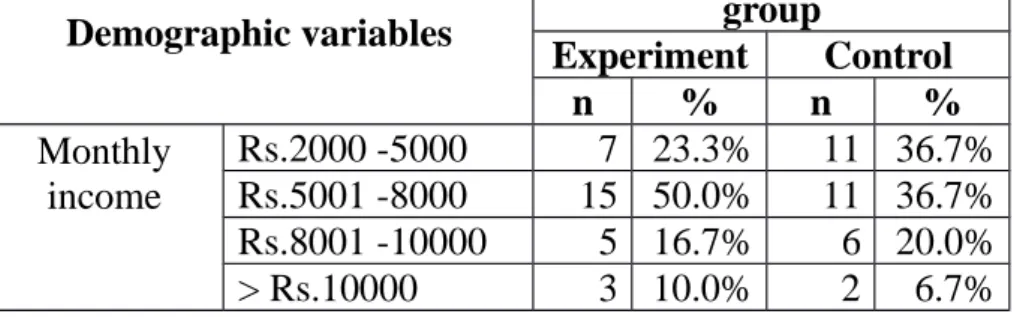
DEMOGRAPHIC PROFILE OF MONTHLY INCOME
Demographic variables group
Experiment Control
n % n %
Monthly income
Rs.2000 -5000 7 23.3% 11 36.7%
Rs.5001 -8000 15 50.0% 11 36.7%
Rs.8001 -10000 5 16.7% 6 20.0%
> Rs.10000 3 10.0% 2 6.7%
The above table shows in relation to the monthly income in the
experimental group 7(23.3%) of the respondents were earning Rs.2000-5000
per month, 15(50.0%) of the respondents were earning Rs.5001-8000 per
month, 5(16.7%) of the respondents were earning Rs.8001-10000 per month,
3(10.0%) of the respondents were earning is more than Rs.10000/- per
month.In the control group 11(36.7%) of the respondents were earning
Rs.2000-5000 per month, 11(36.7%) of the respondents were earning
Rs.5001-8000 per month, 6(20.0%) of the respondents were earning Rs.8001-10000 per
month, 2(6.7%) of the respondents were earning is more than Rs.10000/- per
23%
50% 17%
10%
Monthly Income (Experimental)
Rs.2000 ‐5000 Rs.5001 ‐8000 Rs.8001 ‐10000 > Rs.10000
37%
37% 20%
7%
Monthly Income (Control)
Rs.2000 ‐5000 Rs.5001 ‐8000 Rs.8001 ‐10000 > Rs.10000
Figure 3.d
Table 8.e
DEMOGRAPHIC PROFILE OF OCCUPATION
The
Demographic variables group
Experiment Control
n % n %
Occupation Professional 5 16.7% 2 6.7%
Coolie 5 16.7% 6 20.0%
Farmer 16 53.3% 18 60.0%
Table 8.f
DEMOGRAPHIC PROFILE OF RELIGION
Demographic variables group
Experiment Control
n % n %
Religion Muslim 4 13.3% 2 6.7%
Christian 6 20.0% 6 20.0%
Hindu 20 66.7% 22 73.3%
The above table shows in relation to the religion in the experimental group 4(13.3%) of the respondents were Muslim, 6(20.0%) of the respondents were
Christian, 20(66.7%) of the respondents were Hindu.
In control group 2(6.7%) of the respondents were Muslim, 6(20.0%) of the respondents were Christian, whereas 22(73.3%) of the respondents were Hindu.
SECTION II
ASSESSMENT OF PRE-TEST AND POST TEST KNOWLEDGE OF
EXPERIMENTAL AND CONTROL GROUP REGARDING FAMILY
PLANNING METHOD
Table 9.a
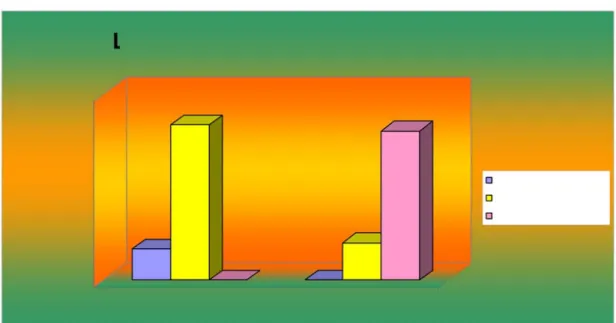
LEVEL OF KNOWLEDGE IN EXPERIMENTAL GROUP
Level of knowledge Pre-test Post-test
Inadequate 26(86.7%) 0(0.0%)
Moderately Adequate 4(13.3%) 9(30.0%)
Adequate 0(0.0%) 21(70.0%)
Above table shows the pre-test and post-test overall level of knowledge
for experiment group males. In pre-test 86.7% of males are having inadequate
knowledge regarding family planning methods. In post-test none of the staff
nurses are having inadequate knowledge regarding family planning methods.
Table 9.b
LEVEL OF KNOWLEDGE IN CONTROL GROUP
Level of knowledge Pre-test Post-test
Inadequate 26(86.7%) 25(83.3%)
Moderately Adequate 4(13.3%) 5(16.7%)
Adequate 0(0.0%) 0(0.0%)
Above table shows the pretest and posttest overall level of knowledge
for control group males. In pretest 86.7% of males are having inadequate
knowledge regarding family planning methods. In post-test none of them are
having inadequate knowledge regarding family planning methods.
Score 0 – 20
< 50% inadequate knowledge = 0 – 10 score
51 -75% moderately adequate knowledge = 11 -15 score
Figure 4.b
SECTION III
ASSESSMENT OF PRE-TEST AND POST TEST ATTITUDE OF
EXPERIMENTAL & CONTROL GROUP REGARDING FAMILY
PLANNING METHOD
Table 10.a
LEVEL OF ATTITUDE IN EXPERIMENTAL GROUP
Level of attitude Pre-test Post-test
Inadequate 5 (16.7%) 0 (0.0%)
Moderately Adequate 25 (83.3%) 6 (20.0%)
Adequate 0 (0.0%) 24 (80.0%)
Above table shows the pre-test and post-test overall level of attitude
for experimental group. In Pre-test 16.7% are having inadequate attitude
regarding family planning methods. In Post-test none of them are having
inadequate attitude.
Score 10 - 60
< 50% inadequate attitude = < =30 score 51 -75% moderately adequate attitude = 31- 45 score 76 -100% adequate attitude = 46 -60 score
Table 10.b
LEVEL OF ATTITUDE IN CONTROL GROUP
Level of Practice Pre-test Post-test
Inadequate 8(26.7%) 7(23.3%)
Moderately Adequate 22(73.3%) 23(76.7%)
Adequate 0(0.0%) 0(0.0%)
Above table shows the level of attitude in the control group in pretest, 8
(26.70%) of the participants had inadequate attitude, 22(73.3%) of the
participants had moderately adequate attitude and none of them had adequate
attitude, in post-test 7(23.3%) of the respondents had inadequate attitude,
23(76.7%) of the participants had moderately adequate attitude and none of
them had adequate attitude.
SECTION IV
Table 11.a
COMPARISON THE PRE-TEST AND POST TEST KNOWLEDGE OF
EXPERIMENTAL AND CONTROL GROUP REGARDING FAMILY
PLANNING METHOD
Knowledge Pretest knowledge Posttest knowledge Student’spaired t-test
Mean SD Mean SD
Experiment
group 7.73 2.16 16.40 1.65
t=17.78
P=0.001significant
Control group 7.33 2.23 8.03 3.01 t=1.24 P=0.22 not
significant
Above table shows comparison of pretest and post-test overall
knowledge score. In the experimental group pretest knowledge 7.33 and in the
In thepost-test was the knowledge score of the experimental group was
16.40 and control group was 8.03. t value was 1.24 which was not significant.
Figure 6
Table 11.b
COMPARISON OF EXPERIMENT AND CONTROL GROUP
Knowledge Experiment group Control group Student’s Independent t-test
Mean SD Mean SD
Pre-test 7.73 2.16 7.33 2.23 t=0.70 P=0.48 not significant
Post-test 16.40 1.65 8.03 3.01 t=13.34 P=0.001 significant
Above table shows the pretest knowledge in experimental group was
7.73 and in control group was 7.33 and t value 0.70 which is not significant and
the post-test knowledge of the experimental group was 16.40 and control group
SECTION
V
COMPARISON THE PRE-TEST AND POST TEST AND ATTITUDE OF
EXPERIMENTAL AND CONTROL GROUP REGARDING FAMILY
PLANNING METHOD
Table 12.a
COMPARISON OF PRETEST & POSTTEST OVERALL ATTITUDE SCORE
Attitude
Pretest knowledge
Posttest
knowledge Student’s
paired t-test
Mean SD Mean SD
Experiment
group 34.30 2.168 49.67 2.758
t=26.85 P=0.001 significant
Control group 33.37 2.399 34.50 2.980 t=1.74 P=0.09 not
significant Above table represent that the overall pretest attitude and post-test
attitude in experimental group was 34.30 and 49.67 respectively t was 26.85
(P=0.001) which was significant it showed effectiveness of structured teaching
programme.In control group the overall pretest and post-test attitude was 33.37
and 34.50 respectively (t=1.74, P=0.09) which revealed they are not significant.
Table 12.b
COMPARISON OF EXPERIMENT AND CONTROL GROUP OVERALL ATTITUDE SCORE
Attitud e
Experiment group
Control group
Student’s Independent t-test
Mean SD Mean SD
Pre-test 34.30 2.16 33.37 2.39 t=1.58 P=0.12 not significant
Post-test 49.67 2.75 34.50 2.98 t=20.45 P=0.001 significant
Above table showed that the pretest attitude of experimental group and control group was 34.30 and 33.37, t=1.58 which showed no significance.
In post-test the attitude of experimental group and control group was 49.67
and 34.50 respectively. t value 20.45 and p=0.001 and was significant. Table 13
EFFECTIVENESS OF STRUCTURED TEACHING PROGRAMME
Pre-test Post-test % of Difference
Net Benefit
Knowledge Experiment 38.65% 82.05% 43.40% 39.55%
Control 36.65% 40.50% 3.85%
Attitude Experiment 57.60% 82.78% 25.18% 23.30%
Control 55.62% 57.50% 1.88%
The above table shows knowledge of experimental group pretest was 38.65% and post-test was 82.05% the difference was 43.40%, attitude of experimental group
in pretest was 57.60% and post-test was 82.78% . The difference was 25.18% and in the control group knowledge in pretest was 36.65% and post-test was 40.50% and there were difference 3.85% and attitude in pretest was 55.62% and post-test was
57.50%. Difference was 1.88%. Net benefit (23.30%) It showed the effectiveness of
SECTION VI
CORRELATION BETWEEN KNOWLEDGE AND ATTITUDE OFEXPERIMENTAL AND CONTROL GROUP REGARDING FAMILY
PLANNING METHOD Table 14.a
CORRELATION BETWEEN KNOWLEDGE AND ATTITUDE EXPERIMENTAL Test Correlatio n between mean
score PearsonKarl correlation coefficient Interpretation Mean±SD Pre-test Knowledge 7.73±2.16
r = 0.05 P=0.79
No Correlation.
It means there is no correlation between knowledge and attitude Attitude 34.30±2.1
7
Post-test
Knowledge 16.40±1.6
5 r = 0.57
P=0.001
Moderate Positive Significant correlation. It means when knowledge increases their attitude also increases
Attitude 49.67±2.7 6
The above table shows the pretest level of knowledge and attitude was 7.73±2.16, 34.30±2.17 respectively r=0.05, p=0.79 in which there is no correlation between knowledge and attitude.
Posttest knowledge score 20 18 16 14 12 10 P o st te s t p ra c ti ce s c o re 56 54 52 50 48 46 44 42 Table 14.b
CORRELATION BETWEEN KNOWLEDGE AND ATTITUDE IN CONTROL GROUP Test Correlation between Mean score Karl Pearson correlation coefficient Interpretation Mean±SD Pre-test Knowledge 7.33±2.23
r = 0.08 P=0.51
Poor Correlation. It means there is nocorrelation or poor correlation between knowledge and attitude Attitude 33.37±2.4
0
Post-test
Knowledge 8.03±3.01
r = 0.10 P=0.55
Poor Positive correlation. It means there is no correlation or poor correlation between knowledge and attitude Attitude 34.50±2.9
8
The above table shows the pretest level of knowledge and attitude in pretest among control group. The r value was 0.08 which revealed that there was poor
correlation between knowledge and attitude.
In post test the knowledge level and attitude was 8.03 and 34.50 respectively. The r=0.10, (P=0.55) which showed no correlation between knowledge and attitude.
SECTION VII
ASSOCIATION BETWEEN LEVEL OF KNOWLEDGE ON FAMILY
PLANNING METHOD WITH SELECTED DEMOGRAPHIC
VARIABLES IN CONTROL AND EXPERIMENTAL GROUP
Table 15.a
ASSOCIATION BETWEEN LEVELS OF PRETEST KNOWLEDGEAND THEIR DEMOGRAPHIC VARIABLESIN EXPERIMENTAL GROUP
Demographic variables
Pre-test level of knowledge
Significance
Inadequate Moderately
adequate
n % n %
Age of eligible
couple
< 25 yrs 7 87.5% 1 12.5% χ2=0.07
P=0.96
not significant
26 -41yrs 14 87.5% 2 12.5%
42 -49 yrs 5 83.3% 1 16.7%
Number of children in
family
No children 5 83.3% 1 16.7% χ2=0.10
P=0.96
not significant
<Two children 15 88.2% 2 11.8%
> Two children 6 85.7% 1 14.3%
Educational Status
Illiterate 3 100.0% χ2=0.66
P=0.72
not significant Primary/secon
dary
19 86.4% 3 13.6%
Graduate 4 80.0% 1 20.0%
Monthly income
Rs.2000 -5000 6 85.7% 1 14.3% χ2=0.52
P=0.77
not significant
Rs.5001 -10000 17 85.0% 3 15.0%
> Rs.10000 3 100.0%
Occupation Professional 5 100.0% χ2=1.97
P=0.37
not significant
Coolie/farmer 17 81.0% 4 19.0%
Others 4 100.0%
Religion Muslim 4 100.0% χ2=2.88
P=0.24
not significant
Christian 4 66.7% 2 33.3%
Hindu 18 90.0% 2 10.0%
The above table shows the association between demographic variables
and their pretest level of knowledge regarding family planning methods among
rural male population in experimental group. None of the variables are